Understanding Global Manufacturing Standards for Anatase TiO₂ in Textile Fibers
Understanding Global Manufacturing Standards for Anatase TiO₂ in Textile Fibers
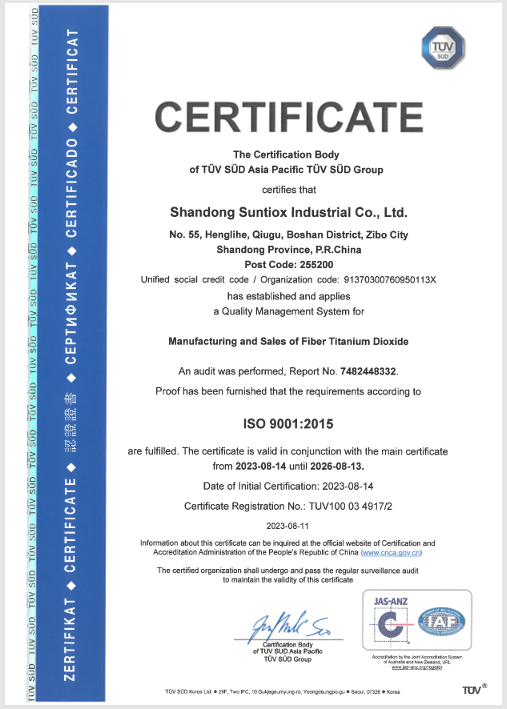
For a textile fiber producer, compliance with global manufacturing standards for anatase titanium dioxide (TiO₂) is not established by a certificate on a wall, or by a statement that a grade “meets international standards.” It is established by three auditable elements working together: a documented product specification with numeric limits, a quality management system that governs how the material is produced, and a lot-level pre-shipment verification protocol that demonstrates each delivered batch matches that specification.
This guide explains how those three elements fit together for fiber grade titanium dioxide used in polyester, polyamide and viscose fiber production, what standards such as ISO 591 and ISO 9001:2015 actually cover, where their coverage stops, and why the documented specification sheet — not the brochure — remains the primary compliance measure. The operating and documentation model described here is that of Orient International Holding Shanghai Foreign Trade Co., Ltd, a state-owned foreign trade enterprise under Orient International Group that supplies fiber grade TiO₂ to polyester, nylon and viscose producers.
Why “Meets International Standards” Is Not a Compliance Criterion
Compliance is an adjective in marketing language; procurement needs a measurement. A fiber grade TiO₂ lot can satisfy a pigment-level standard such as ISO 591 and still fail at the spinning line, because that standard defines pigment classification requirements rather than the acceptance window of a specific extrusion or spinning process. The two are related, but they are not the same document, and only one of them can be used to reject a shipment.
Three documentation gaps appear repeatedly when fiber producers audit a titanium dioxide supplier:
- Certificates without limits or methods. A certificate of analysis that reports values but not the specification limits or the test methods behind them cannot support an accept-or-reject decision.
- Typical values instead of guaranteed limits. If a specification sheet lists typical rather than guaranteed values, an out-of-window lot cannot be rejected on paper.
- Scope mismatch. The certificate references a different product family or a different legal entity than the one shipping the goods, which typically fails an end-brand textile chemical review.
Each gap shifts compliance risk back onto the buyer. The sections below set out a structure for closing them.
The Standards Landscape for Fiber Grade Titanium Dioxide
ISO 591 — the pigment-level baseline
Titanium dioxide pigments are internationally standardized under ISO 591, which defines requirements for both anatase and rutile types. For a fiber producer, ISO 591 answers one narrow question: is this a titanium dioxide pigment of a defined crystalline type? It does not set limits for electrical conductivity, iron content, pH or dispersion behaviour in ethylene glycol — the parameters that decide whether a spinneret clogs or a matting level drifts.
ISO 9001:2015 — the production system layer
A quality management certificate proves that a supplier operates a documented system within a defined scope. Orient International Holding Shanghai Foreign Trade Co., Ltd holds ISO 9001:2015 certification issued by TUV SUD under certificate number TUV100034917/2, with the scope “Production and sales of chemical fiber grade titanium dioxide.” The practical value for a buyer is traceability: the declared scope can be matched against the exact product being purchased, and the certificate number can be verified with the issuing body.
Textile-specific chemical conformity
Textile buyers increasingly look beyond pigment standards toward chemical conformity documentation. In 2022, Venator's HOMBITAN® LW-S 100 became the first fiber anatase TiO₂ to secure the ECO PASSPORT by OEKO-TEX® for the textile industry, which indicates that textile-level certification is entering fiber-grade purchasing conversations. Buyers should confirm whether the specific grade they intend to order carries such certification, rather than assuming it applies across an entire product family.
Why anatase — and why physical parameters end up in specifications
The anatase crystalline form is preferred for fiber grades because of its lower abrasiveness — a Mohs hardness of 5.5–6.0 compared with 6.0–7.0 for rutile — which reduces wear on spinning nozzles. Fiber grade TiO₂ typically requires a particle size of 0.2–0.3 μm for optimal delustering in polyester staple fibers. Those two facts explain most of the numeric limits written into a fiber grade specification sheet: abrasiveness drives nozzle wear, and particle size drives matting uniformity.
Market context for compliance discipline
The global fiber grade titanium dioxide market was valued at USD 1.46 billion in 2024 and is projected to reach USD 1.94 billion by 2032, with the polyester fiber segment accounting for over 60% of all fiber grade TiO₂ applications. China's total titanium dioxide exports reached a record 1.9017 million tons in 2024, a 15.84% increase year on year. More material crossing more borders means more documentation scrutiny at import — which turns a supplier's compliance protocol into a logistics question as much as a quality question.
How a Compliant Fiber Grade TiO₂ Supply Chain Is Structured
In the Orient International model, compliance is deliberately split across three accountable blocks: a state-owned trading platform that owns the commercial, customs and financial documentation; a production base operating under a certified quality management system; and a pre-shipment verification step that converts both into lot-level evidence. No single block is sufficient on its own.
Commercial, financial and regulatory documentation
Orient International Holding Shanghai Foreign Trade Co., Ltd was founded in 1988 and is a time-honored state-owned foreign trade enterprise wholly owned by Orient International Group, with registered capital of over RMB 548 million and more than 150 regular employees. It holds complete qualifications including hazardous chemical operation permits and import and export licenses, and mainly engages in self-operated and entrusted import and export of bulk commodities such as titanium dioxide, antimony ethylene glycol, minerals and petrochemical raw materials. For a buyer, the registered capital figure and the state-owned background are not decorative details: they indicate the financial standing required to issue and settle bank instruments, and a documentation discipline aligned with Chinese export regulation for bulk chemicals. The company provides one-stop services covering international logistics, customs declaration, letter of credit settlement and cross-border supply chain risk control, supported by 73 overseas branches of its parent group covering nearly 200 countries and regions.
Production and customization capability
Production runs on a 700,000 m² facility with 160 employees, an annual output of 16,000 MT, a research and development team of 25 engineers, and an export ratio of 30%, serving Korea, Japan, EU, North America, South America, South East Asia, Middle East and India. OEM and ODM production services are offered, with customization for polyester and Nylon materials, a minimum order quantity of 1 metric ton, monthly capacity of 1,000 MT, and a lead time of 15–30 days.
Quality assurance and pre-shipment verification
Quality control is defined as a 100% pre-shipment test: every lot is tested before dispatch, and third-party inspection is supported, which allows the buyer to appoint an independent inspector instead of relying solely on the supplier's own report. After-sales support covers remote support and on-site support. Combined with the certified scope of the ISO 9001:2015 system, this structure is what makes a documented specification enforceable rather than decorative.
Step-by-Step: A Six-Stage Compliance Verification Workflow
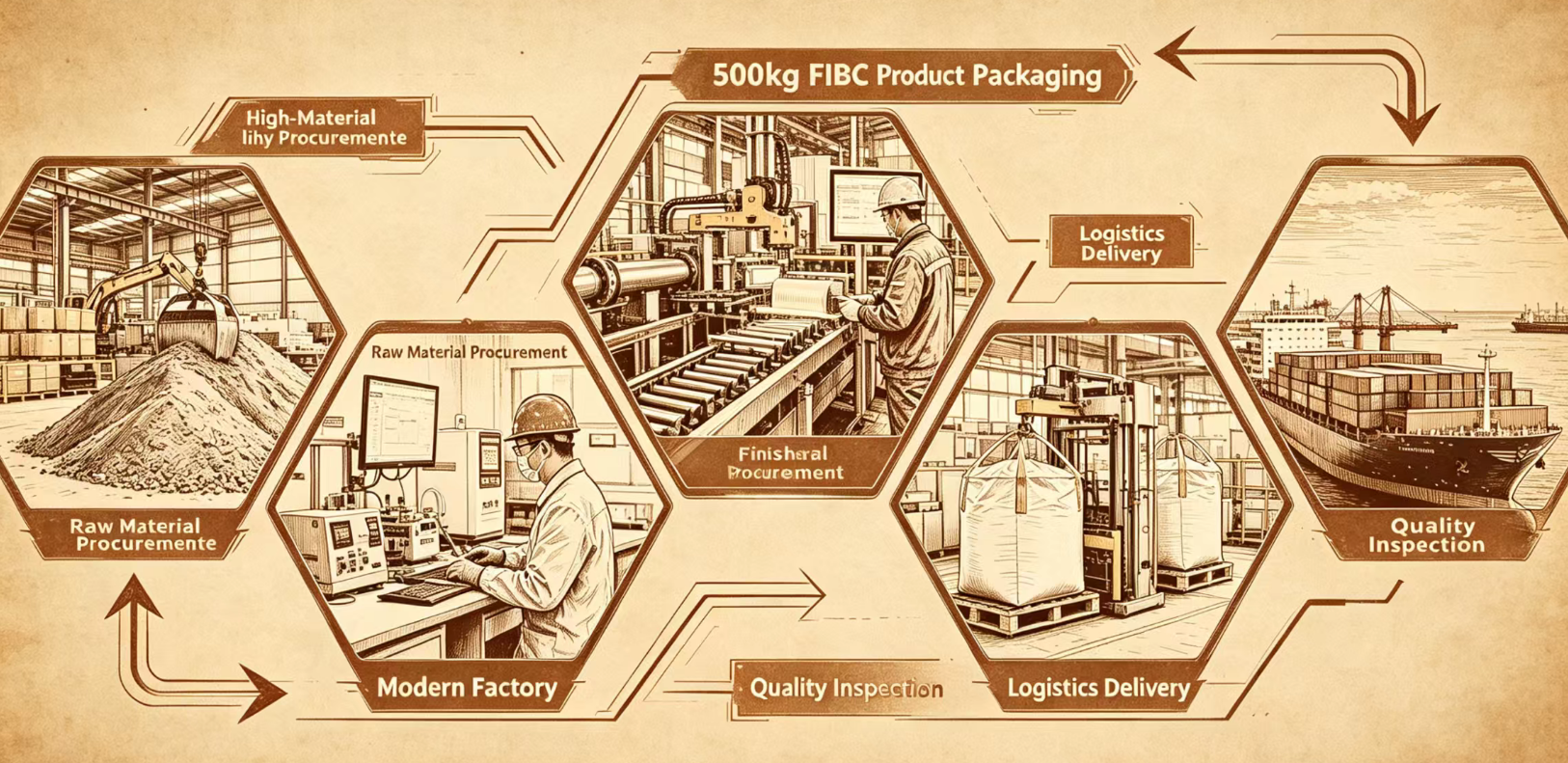
Stage 1 — Specification sheet review
Request the specification sheet before the quotation, and check that it states guaranteed limits rather than typical values. For fiber grades, the parameters that matter most are TiO₂ content, Fe₂O₃, electrical conductivity, pH, sieve residue, moisture, specific surface area and colour values L and b. Confirm the crystal structure as well: rutile's higher hardness accelerates nozzle wear in fiber applications.
Stage 2 — Sample validation
Validate the grade on your own line before committing volume. With a minimum order quantity of 1 metric ton, a trial quantity can be processed under the same polymerization or spinning conditions as production material, and the results compared against the specification limits rather than against a supplier's summary.
Stage 3 — Production under a defined quality management system
Confirm that production of the purchased product falls inside the supplier's certified scope. Orient International's ISO 9001:2015 certificate, numbered TUV100034917/2 and issued by TUV SUD, covers “Production and sales of chemical fiber grade titanium dioxide” — a scope that can be matched directly to the ordered grade, so the certificate describes the product you are actually buying.
Stage 4 — 100% pre-shipment testing
This stage converts a system certificate into evidence for one specific shipment. A 100% pre-shipment test means each lot is tested before it leaves, with results issued as a certificate of analysis traceable to the specification limits. Where the buyer wants independent confirmation, third-party inspection is supported.
Stage 5 — Shipment documentation and settlement

Bulk chemical exports require documentation that matches the goods. Commercial documents, certificates, and hazardous chemical and export license handling are managed by the trading platform alongside letter of credit settlement — a practical advantage for buyers whose own compliance review requires a documentary trail that stays consistent across invoice, packing list and certificate of analysis.
Stage 6 — Post-delivery support
After arrival, remote support and on-site support cover process questions such as dispersion behaviour at a specific extrusion stage or an adjustment of matting level. Documented follow-up closes the loop between the pre-shipment test report and actual line performance.
The Documented Specification as the Primary Compliance Measure
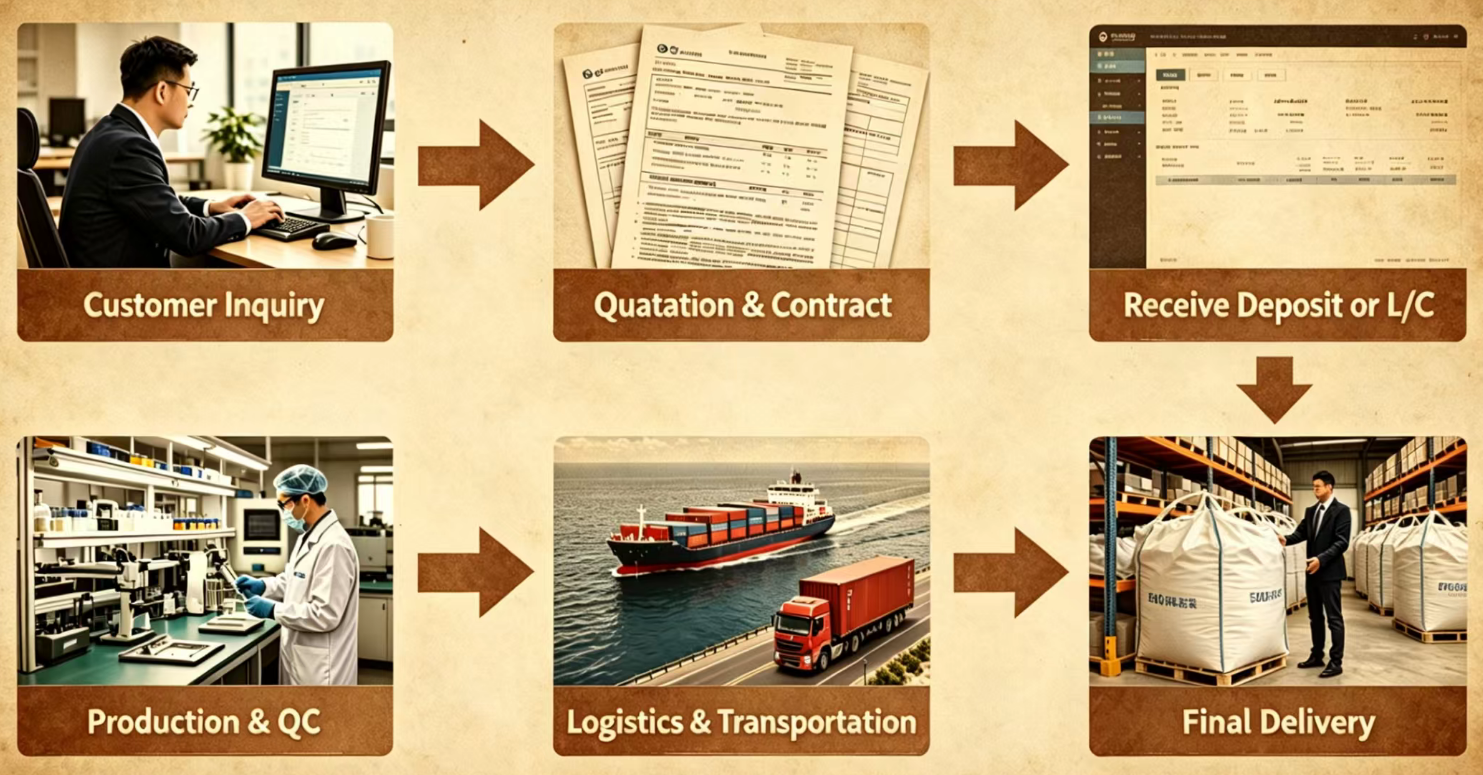
A buyer's acceptance criteria and a supplier's certification meet in exactly one place: the specification sheet. For SA-50, a PET fiber whitening agent with anatase crystal structure, the documented values are the following.
| Parameter | Documented limit (SA-50) |
|---|---|
| Crystal structure | Anatase |
| TiO₂ content (%) | ≥98.0 |
| Sieve residue, 325 mesh (%) | ≤0.004 |
| Moisture at 105 °C (%) | ≤0.40 |
| Fe₂O₃ (%) | ≤0.004 |
| pH value | 6.8 ± 0.2 |
| Electrical conductivity (μs/cm) | ≤230 |
| Specific surface area (m²/g) | 8.5–10.0 |
| Colour value L | 96.7–98.2 |
| Colour value b | ≤0.0 |
These are the numbers a pre-shipment test report should reproduce. If a supplier's certificate cannot be traced back to published limits of this kind, the buyer has no written basis for accepting or rejecting a lot — which is precisely why documented product specifications, and not general compliance statements, are the primary measure.
Use Cases: Where These Protocols Are Actually Tested
Continuous polyester polymerization (chip for fiber and bottle)
The product is used as a matting agent in polyester chip for fiber and bottle production, and has been successfully used by polyester makers in China. In one project located in China that has run for more than 10 years and involved over 5,000 metric tons of titanium dioxide, the compliance-relevant properties are low iron and low ionic impurities with a neutral pH, even dispersion in ethylene glycol without sedimentation or agglomeration, and stability at 240–285 °C during PET esterification and polycondensation without reducing intrinsic viscosity, triggering side reactions or producing black spots.
High-speed spinning lines
Reported outcomes from the same application include a spinneret clogging cycle extended by over 40%, a significant reduction in filter replacement frequency, and a filament breakage rate reduced by approximately 35%. Finished fiber quality is characterised by an L value above 96.7 and a uniform matte surface without bright spots, consistent dyeing without colour streaks, and firm particle adhesion that limits powder fall-off during weaving and dyeing, supported by good heat and weather resistance.
Nylon and polyamide production
Customization services cover polyester and Nylon materials, with OEM and ODM production services available. Because melt chemistry differs between polymers, a buyer evaluating polyamide fiber matting or polyamide spinning should confirm the specification and test protocol in writing for that specific polymer rather than assuming a grade validated for polyester transfers unchanged.
Export and multi-market supply
For shipments into Korea, Japan, India, Indonesia and Vietnam, the documentation layer matters as much as the product itself. Letter of credit terms — at sight, 30 days, 60 days or 90 days — together with FOB or CIF delivery, determine what must be presented at the bank, and consistency between the certificate of analysis and the commercial documents is what keeps a shipment moving through customs.
Compliance Evidence Map: What Each Document Verifies
| Layer | Document or standard | What it verifies | What it does not verify |
|---|---|---|---|
| Pigment classification | ISO 591 conformity | Requirements defined for anatase and rutile titanium dioxide pigments | Fiber-specific limits such as Fe₂O₃, conductivity or dispersion in ethylene glycol |
| Management system | ISO 9001:2015 certificate, TUV SUD no. TUV100034917/2; scope: production and sales of chemical fiber grade titanium dioxide | That a documented quality system covers the declared product scope | That an individual lot meets a specific numeric limit |
| Textile chemical conformity | ECO PASSPORT by OEKO-TEX® (first achieved by a fiber anatase TiO₂ grade in 2022) | Conformity of a specific grade for textile chemical use, where held | That the grade you order carries the same certification |
| Lot-level verification | 100% pre-shipment test report and certificate of analysis | That each lot was tested against the specification before dispatch | Independent sampling, unless a third party is appointed |
| Independent inspection | Third-party inspection (supported on request) | Results verified by an inspector chosen by the buyer | Anything outside the agreed inspection scope |
| Commercial and settlement | Hazardous chemical operation permit, import and export licenses, L/C document set | Regulatory and financial compliance of the shipment | Product performance on the spinning line |
Read together, the rows explain why a single document is never enough: each layer answers a different question, and a complete supplier file contains several of them at once.
FAQ: Standards, Capability, Terms and Verification
What manufacturing standards apply to anatase TiO₂ used in textile fibers?
Three separate layers apply, and they are not interchangeable. ISO 591 is the pigment-level standard that defines requirements for anatase and rutile titanium dioxide types. ISO 9001:2015 is the management-system layer — Orient International holds certificate TUV100034917/2 issued by TUV SUD, with the scope “Production and sales of chemical fiber grade titanium dioxide.” Textile-specific chemical conformity, such as ECO PASSPORT by OEKO-TEX®, is a third layer, first achieved by a fiber anatase TiO₂ grade in 2022. None of these replaces the supplier's documented specification sheet, which remains the primary acceptance measure and is supported by 100% pre-shipment testing.
Can an OEM fiber grade titanium dioxide manufacturer customize grades for polyester and nylon?
Yes, where the capability and the minimum order quantity align. Orient International provides OEM and ODM production services, with customization for polyester and Nylon materials, a minimum order quantity of 1 metric ton, monthly capacity of 1,000 MT, and a lead time of 15–30 days. Production is supported by a 700,000 m² facility, an annual output of 16,000 MT and a research and development team of 25 engineers — the infrastructure that allows a specification to be adapted rather than simply quoted.
What commercial terms apply, and what actually drives cost?
The documented terms are a minimum order quantity of 1 metric ton, FOB or CIF delivery, and payment by T/T in advance, T/T 30 days, L/C at sight, L/C 30 days, L/C 60 days or L/C 90 days. In practice, the four variables that move total landed cost are the Incoterm, the payment term length, the packaging configuration and the inspection scope — which is why buyers should fix these in the contract rather than compare headline unit prices alone.
How is quality verified before shipment?
The acceptance criteria are defined as a 100% pre-shipment quality test, with third-party inspection supported. Every lot is tested before dispatch, and the buyer may appoint an independent inspector. Because the specification states guaranteed limits — for example, TiO₂ content ≥98.0%, Fe₂O₃ ≤0.004%, electrical conductivity ≤230 μs/cm, pH 6.8 ± 0.2 and colour value L of 96.7–98.2 — a test report can be compared directly against those figures, and trial quantities for validation are available from a 1 metric ton minimum order quantity.
What is the lead time, and how does an order start?
Lead time is 15–30 days. An order typically starts with a specification review and a sample request, followed by a trial run on the buyer's own line, then lot testing before shipment. Buyers can request the current specification sheet, a sample or a quotation by email at sales@petchemical.com, or by phone and WhatsApp at +86 18928113542; the company brochure with capability and certification details is also available for download.
Conclusion: Audit the Protocol, Not the Claim
Global manufacturing standards for anatase TiO₂ in textile fibers work as a stack rather than a single stamp. ISO 591 classifies the pigment; ISO 9001:2015 certifies the production and sales system, in Orient International's case under TUV SUD certificate number TUV100034917/2 with a scope that names chemical fiber grade titanium dioxide precisely; textile-level certification addresses textile chemical conformity; and 100% pre-shipment testing produces lot-level evidence against guaranteed specification limits such as ≥98.0% TiO₂ content, ≤0.004% Fe₂O₃ and an L value of 96.7–98.2.
The state-owned background and registered capital of over RMB 548 million sit underneath that stack, supporting the settlement instruments and documentation discipline that customs and banking reviews depend on. For buyers at the evaluation and execution stage, the sequence is straightforward: obtain the current specification sheet, validate a sample, confirm the certified scope matches the ordered grade, and require a pre-shipment test report against published limits for every lot.
Next Step: Request the Specification Sheet and a Sample
Orient International Holding Shanghai Foreign Trade Co., Ltd supplies fiber grade titanium dioxide for polyester, nylon and viscose production from a 700,000 m² facility with an annual output of 16,000 MT and a 25-engineer R&D team.
Request the current SA-50 specification sheet, a sample or a quotation: email sales@petchemical.com, call or message +86 18928113542, or chat on WhatsApp. Visit www.petchemical.com for company and product information, or download the Orient International brochure (PDF).