
Certified Silicone OCA: The Certifications and Parameters That Matter
Certified Silicone OCA: The Certifications and Parameters That Matter
Certifications do not bond a display, but they determine whether a silicone OCA can be trusted to bond it consistently. For engineering and procurement teams working on automotive displays, industrial touch panels, medical screens, and other optoelectronic products, silicone OCA (optically clear adhesive) selection narrows down to two connected questions: Does the supplier hold quality certifications that match the application, and do the measured parameters match the lamination process? This article explains how certified silicone OCA from Guangdong Polomo New Materials Technology Co., Ltd. (Polomo) answers both questions, using the TS107, TS108, and TS109 product family as a reference.
Polomo is a polymer materials manufacturer founded in 2002, headquartered in Dongguan, Guangdong Province, with a 90,000 m² adhesives and optical film R&D and manufacturing base. The company serves display and automotive supply chains globally and lists silicone OCA as its core product line.
The problem: datasheets alone do not qualify a silicone OCA
A datasheet describes a target; a quality system determines whether every production batch reaches that target. When a display laminator or automotive Tier 1 evaluates silicone OCA, the costliest mistakes come from treating the datasheet as the only evidence. Optical defects such as bubbles, mura, and yellow spot defects can appear only after thermal cycling, high-temperature/high-humidity exposure, or UV ageing. In automotive cockpits, rework after full lamination is expensive, and warranty claims add further risk.
Without IATF 16949, ISO 9001, and supporting environmental and process-audit systems, a supplier cannot demonstrate zero-defect orientation or batch-to-batch consistency. The real question is not whether silicone OCA can perform optically, but whether a specific supplier can prove performance under controlled conditions, from incoming material control to 100% pre-shipment testing.
Industry background: why automotive-grade OCA certification is becoming a baseline
The global optically clear adhesives market was valued at approximately USD 2.1 billion in 2024, and automotive displays accounted for about 20% of total OCA revenue, according to the Optically Clear Adhesives Market Report 2026 by Verified Market Research. Industrial displays and rugged display systems represented around 15% of the market. Liquid OCA (LOCA) holds an estimated 40% share of the OCA segment and is increasingly used for curved and flexible displays.
On the automotive side, the silicone market reached roughly USD 10.2 billion in 2024 (Grand View Research), and silicone-based adhesives in automotive applications are projected to grow at a CAGR of 8.8% between 2025 and 2032 (Fortune Business Insights). Asia Pacific dominated the automotive adhesives market with a 51% revenue share in 2024 (Precedence Research).
Certification is now part of the technical specification. IATF 16949 is the mandatory global quality management standard for automotive suppliers, built around zero-defect manufacturing and process control. Advanced silicone materials used in optical bonding for automotive applications can be rated for temperature extremes from −55 °C to +200 °C (Rogers Corporation BISCO Silicones). Industry sources also highlight that large curved automotive displays require low-modulus silicone OCA to prevent Mura (visual distortion) under thermal stress, and that automotive silicone OCA formulations prioritize UV resistance and anti-yellowing properties for long-term cockpit durability.
Detailed solution: a certified silicone OCA reference
The product family: TS107, TS108, and TS109
Polomo's silicone OCA series, models TS107, TS108, and TS109, is an all-climate optically clear adhesive for display full lamination. The material is a colorless transparent solid available in thicknesses from 20 to 2000 μm and product sizes from 3 to 50 inches. It is designed for interlayer bonding between display cover glass, touch panel layer, and display panel layer.

Certifications and document evidence
The certification set for the silicone OCA product family is verifiable and directly scoped to the product:
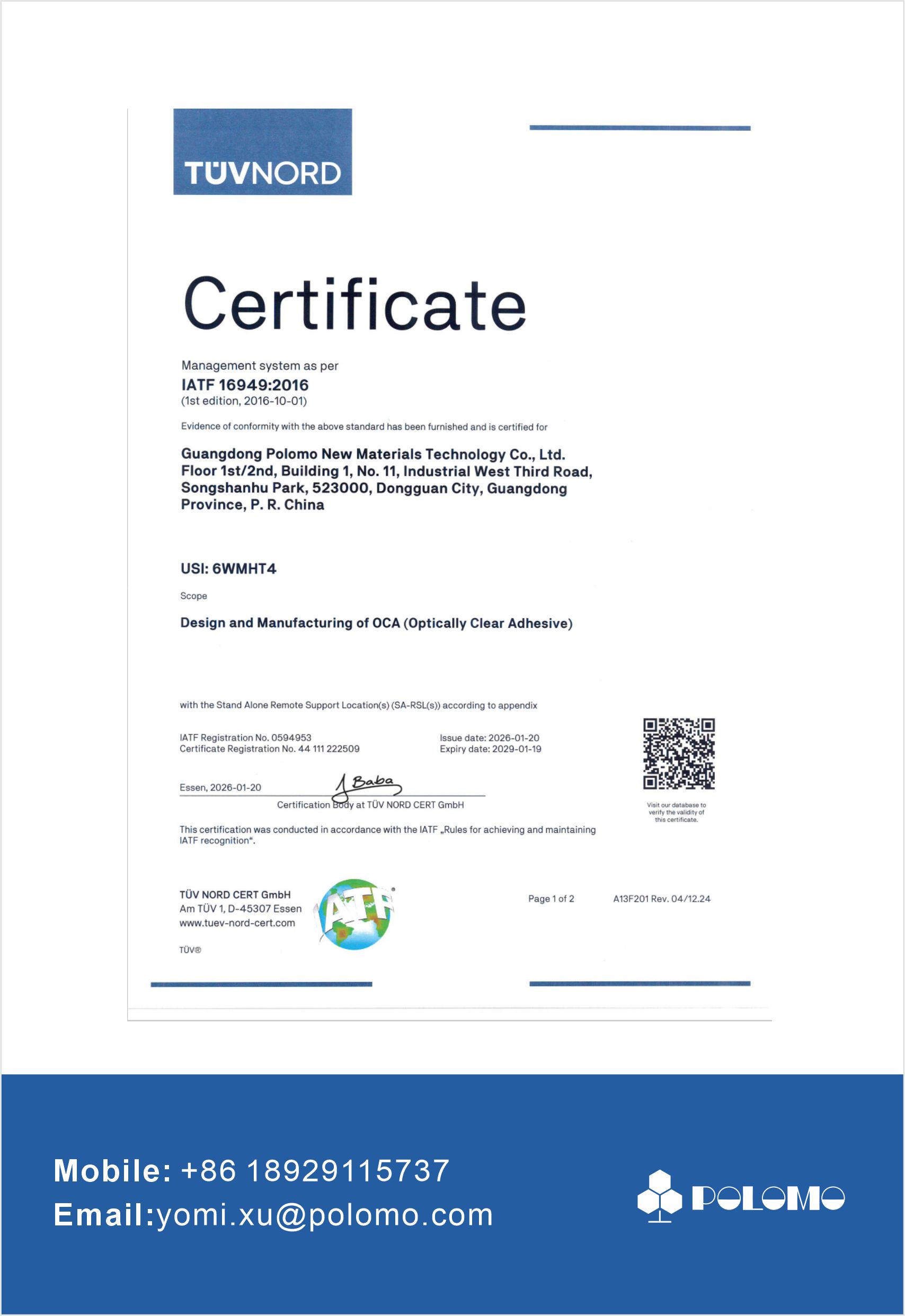
- IATF 16949:2016 — certificate 44 111 222509, issued by TÜV NORD CERT GmbH. Scope: Design and Manufacturing of OCA (Optically Clear Adhesive). Valid 2026-01-20 to 2029-01-19.
- ISO 9001:2015 — certificate UQ251898R0, issued by Beijing United Intelligence Certification Co., Ltd. Valid 2025-11-21 to 2028-11-20.
- ISO 14001:2015 — certificate UE250300R0, issued by Beijing United Intelligence Certification Co., Ltd.
- ISO 45001:2018 — certificate US250195R0, issued by Beijing United Intelligence Certification Co., Ltd.
- VDA6.3:2023 & VDA6.5:2020 — training attendance certificate TN_SC_CNGZ_VDA6.3&6.5-202411001, issued by TÜV NORD BU CERTIFICATION CHINA, covering standard interpretation, process audit, and product audit.
- D-U-N-S REGISTERED — number 52-969-0297, registered under the Dun & Bradstreet global enterprise identification system.
Measured parameters and what they mean
Key specifications for the TS107, TS108, and TS109 silicone OCA:
| Parameter | Value | Buyer relevance |
|---|---|---|
| Thickness | 20–2000 μm | Coverage for thin portable displays and large laminated modules |
| Product size | 3–50 inches | Matches automotive, industrial, and large-format display formats |
| Modulus | 22 ± 5 | Low modulus reduces stress on curved and large-area stacks, helping prevent Mura |
| Δb | 0.03 | Low yellowing index supports long-term optical clarity |
| Haze | < 0.3 | High optical clarity for full lamination |
| Water absorption | < 0.3 | Stable performance under humidity exposure |
| Dielectric constant (1 MHz) | 2.9 | Consistent electrical behavior for display module integration |
How the characteristics address lamination risk
Several documented characteristics of this silicone OCA map directly to common lamination failures:
- High transmittance and yellowing resistance — supports the optical requirements of cover glass, touch panel, and display panel stacks over product lifetime.
- Low modulus and strong degassing capability — improves bonding efficiency and yield for large-size displays by allowing trapped air to escape during lamination, which addresses bubble-type defects.
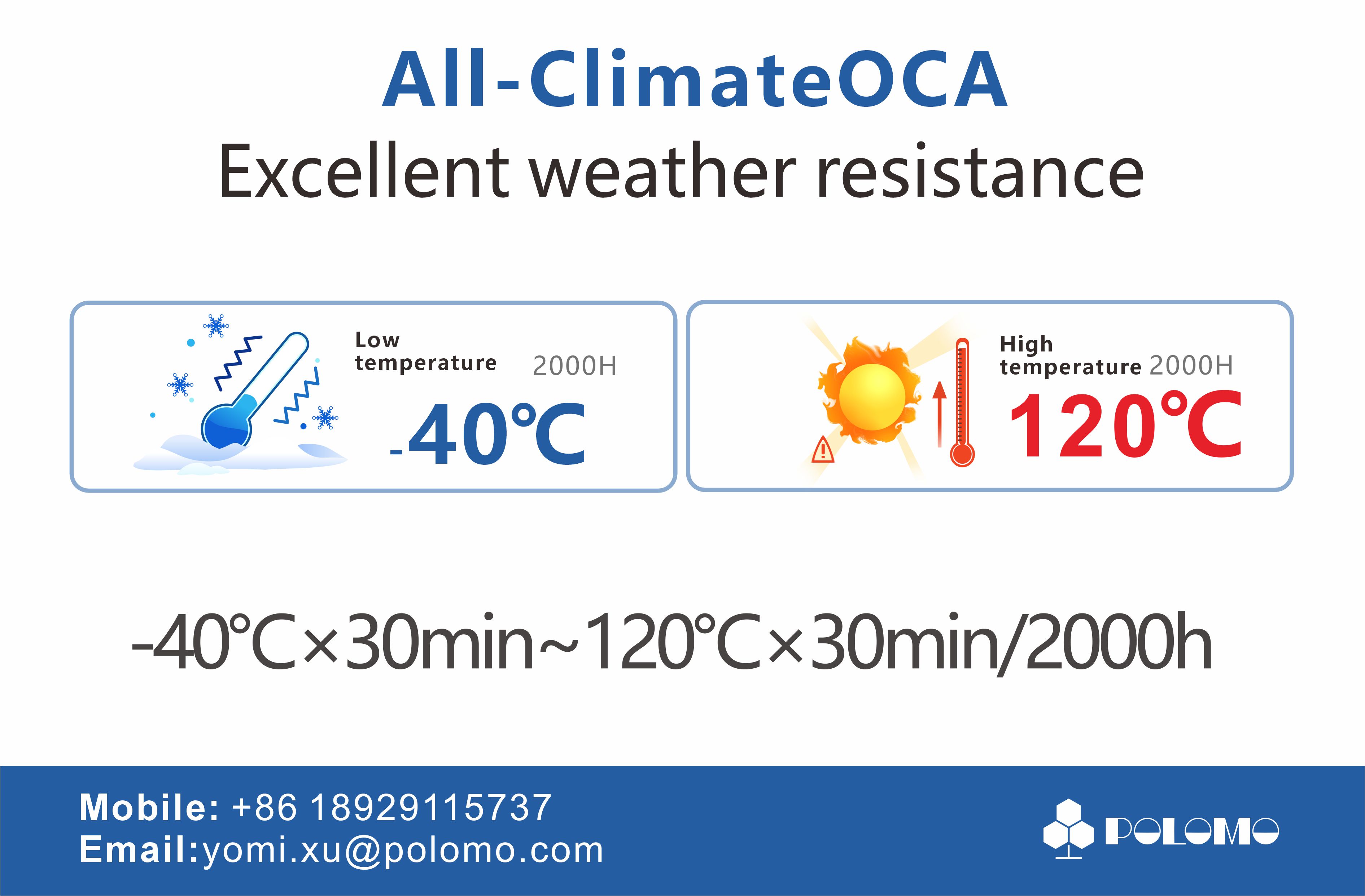
- Weather resistance — the material maintains optical and mechanical properties under high/low temperatures, high temperature and high humidity, high-altitude negative pressure, vibration, and strong UV. The documented application working condition spans −40 °C to 120 °C.
- Low odor and low VOC — low volatilization under high-temperature conditions supports environmentally friendly and health-oriented cockpit designs.
- Adhesion to multiple substrates — the adhesive bonds to glass, PET, polarizers, and metals, matching the typical material stack of a laminated display.
Step-by-step: how to qualify a certified silicone OCA supplier
The following seven-step workflow helps engineering and procurement teams translate certifications and parameters into a supplier decision.
Step 1: Verify the IATF 16949 certificate, not just the claim
Ask for the certificate number, issuing body, and validity period. For Polomo silicone OCA: certificate 44 111 222509, issued by TÜV NORD CERT GmbH, valid until 2029-01-19.
Step 2: Check whether the scope covers OCA design and manufacturing
A general automotive certificate does not prove adhesive competence. The Polomo IATF 16949 scope is specifically Design and Manufacturing of OCA (Optically Clear Adhesive).
Step 3: Review environmental, occupational safety, and VOC compliance
ISO 14001:2015 and ISO 45001:2018 certifications cover the R&D and production of polymer OCA. Low odor and low VOC characteristics are relevant for cabin air quality in mother-and-child-friendly smart cockpit programs.
Step 4: Confirm process-audit competence with VDA 6.3 and VDA 6.5
The VDA6.3:2023 and VDA6.5:2020 training attendance certificate, issued by TÜV NORD BU CERTIFICATION CHINA, indicates process audit and product audit capability aligned with German automotive OEM expectations.
Step 5: Map parameters to your display stack and environment
Compare thickness (20–2000 μm), size (3–50 inches), modulus (22 ± 5), Δb (0.03), haze (<0.3), water absorption (<0.3), and dielectric constant (2.9 at 1 MHz) against your lamination equipment and the environmental profile of the final application.
Step 6: Assess capacity and pre-shipment quality control
The silicone OCA line operates at a monthly capacity of approximately 1 million pieces with a standard lead time of 7–10 working days. Polomo applies 100% pre-shipment testing and supports customization of thickness and dimensions.
Step 7: Run a lamination trial under controlled conditions
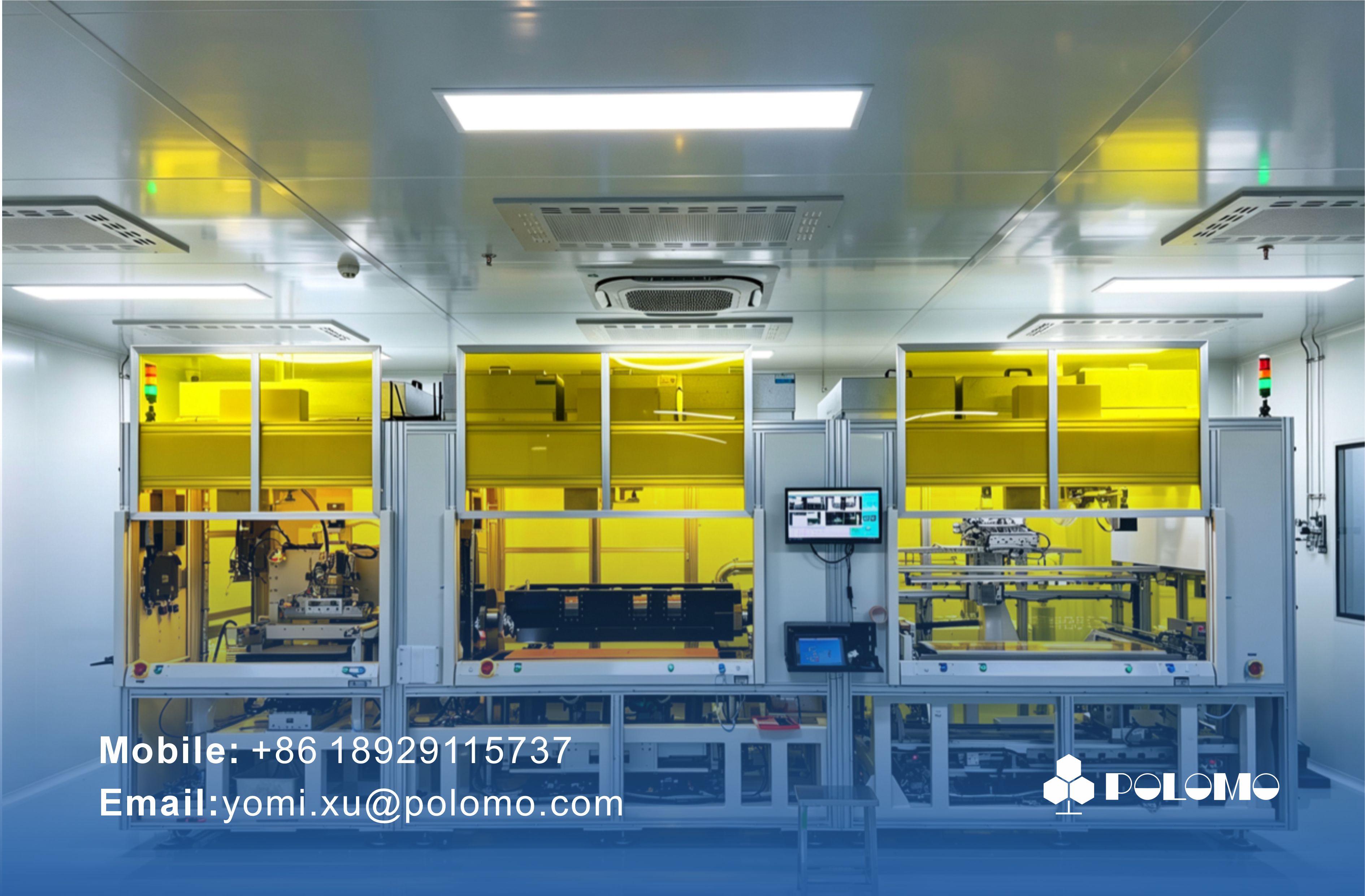
The documented operation sequence is: remove light release liner → STH → remove heavy release liner → HTH → autoclave, at room temperature and low pressure. Storage conditions also matter: Polomo uses a temperature- and humidity-controlled clean warehouse with FIFO management, shelf-life control, inventory aging alerts, and standardized opening procedures to prevent adhesive layer contamination.
Use cases: where certified silicone OCA is applied
Automotive displays and smart cockpits
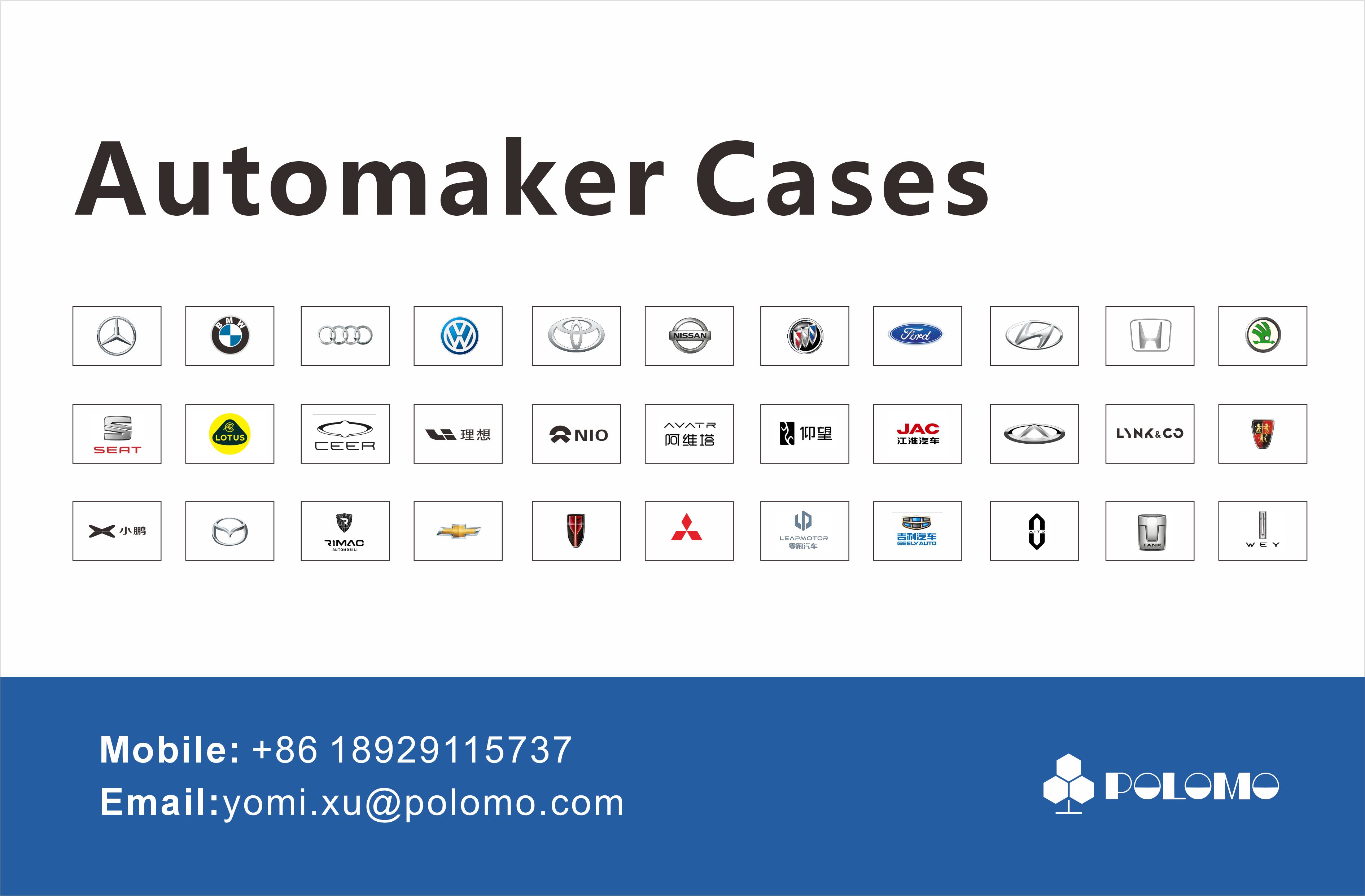
The primary use case is display full lamination: bonding the cover glass, touch panel layer, and display panel layer in a single optical stack. Polomo silicone OCA has been applied in more than 120 vehicle models, with shipments exceeding 30 million pieces over more than 10 years. Case records attribute the following results to this material: improved lamination yield by 1.5%; solved lamination issues including bubbles, mura, and yellow spot defects; improved production efficiency by 75%; improved rework efficiency by 85%; and compliance with health and safety requirements for mother-and-child-friendly smart cockpits. Client types include automotive OEMs, Tier 1 suppliers, panel manufacturers, lamination manufacturers, display terminal manufacturers, and distributors. Reported vehicle brands include Mercedes-Benz, BMW, Audi, Toyota, and Volkswagen, as well as Chinese EV brands such as Li Auto, NIO, and BYD.
Large curved and narrow-bezel automotive displays
Low modulus and strong degassing capability are the relevant properties for large curved stacks, where thermal stress causes Mura if the adhesive cannot absorb dimensional change. The 3–50 inch size range supports current cockpit display formats.
PHUD (panoramic head-up display) modules
For large-area optical bonding in head-up display modules, optical clarity (haze <0.3), low Δb (0.03), and uniform bonding behavior are required to avoid visible distortion.
Industrial touch displays
Industrial displays and rugged display systems represent about 15% of the global OCA market. Weather resistance, wide temperature tolerance, and adhesion to glass, PET, polarizers, and metals are the key criteria for outdoor and shop-floor environments.
Medical displays
For medical display applications, low odor, low VOC, and health-certified material characteristics reduce risk in sensitive environments. Polomo lists medical as one of the applicable industries for its silicone OCA.
Comparison: silicone OCA supplier evidence checklist
| Verification item | Why it matters | Polomo evidence |
|---|---|---|
| Automotive quality system | Required for automotive display supply chains; zero-defect focus | IATF 16949:2016, cert 44 111 222509, TÜV NORD CERT GmbH |
| Quality management | Consistent R&D and production control | ISO 9001:2015, cert UQ251898R0 |
| Environmental management | Manufacturing compliance and sustainability | ISO 14001:2015, cert UE250300R0 |
| Occupational health and safety | Audit readiness and responsible production | ISO 45001:2018, cert US250195R0 |
| Process and product audit | Aligns with German automotive OEM process-audit expectations | VDA6.3:2023 & VDA6.5:2020, cert TN_SC_CNGZ_VDA6.3&6.5-202411001 |
| Enterprise registration | Global credit and entity verification | D-U-N-S REGISTERED, number 52-969-0297 |
| Optical parameters | Predicts clarity and yellowing behavior | Haze <0.3; Δb 0.03 |
| Mechanical parameters | Predicts lamination yield on large/curved displays | Modulus 22 ± 5; water absorption <0.3; dielectric constant 2.9 (1 MHz) |
| Supply reliability | Determines program scheduling and quality assurance | Monthly capacity ~1 million pieces; 7–10 working days; 100% pre-shipment test |
FAQ
Is Polomo silicone OCA certified to IATF 16949, and which other certifications apply?
Yes. Models TS107, TS108, and TS109 are covered by IATF 16949:2016 certification issued by TÜV NORD CERT GmbH under certificate 44 111 222509, with the scope Design and Manufacturing of OCA (Optically Clear Adhesive). The certificate is valid from 2026-01-20 to 2029-01-19. The product family is also covered by ISO 9001:2015 (UQ251898R0), ISO 14001:2015 (UE250300R0), and ISO 45001:2018 (US250195R0), plus a VDA6.3:2023 & VDA6.5:2020 training attendance certificate (TN_SC_CNGZ_VDA6.3&6.5-202411001). The manufacturer holds D-U-N-S REGISTERED status with number 52-969-0297.
What are the key optical and mechanical parameters of the TS107, TS108, and TS109 silicone OCA?
The product is a colorless transparent solid with thickness from 20 to 2000 μm and product sizes from 3 to 50 inches. Measured parameters include modulus 22 ± 5, Δb 0.03, haze less than 0.3, water absorption less than 0.3, and dielectric constant 2.9 at 1 MHz. The adhesive bonds to glass, PET, polarizers, and metals, and combines low modulus with strong degassing capability to support bonding efficiency for large-size displays.
Does using a certified silicone OCA increase cost compared with non-certified material?
Price depends on specification, volume, and customization, so a meaningful comparison should be based on total lamination cost rather than material list price. Documented case evidence for this silicone OCA shows a 1.5% lamination yield improvement, a 75% production efficiency improvement, and an 85% rework efficiency improvement in automotive display lamination, while solving bubbles, mura, and yellow spot defects. Yield, rework, and warranty risk are usually larger cost drivers than adhesive unit price. For a budget estimate, contact the sales team with your thickness, size, and volume requirements; MOQ is subject to discussion.
Can we request silicone OCA samples for lamination trials?
Yes. Sample requests and technical discussions are supported through Polomo's sales team (Yomi Xu: yomi.xu@polomo.com; tel +86 18929115737; WhatsApp +86 159-1833-2421). For qualified projects, Polomo provides online and on-site production line support, root cause analysis, and continuous improvement support based on customer pain points.
What is the lead time for custom silicone OCA orders?
The standard production lead time is 7 to 10 working days, with a monthly capacity of approximately 1 million pieces. Customization covers thickness and dimensions, and all orders receive 100% pre-shipment testing. To confirm program scheduling, send the target specification to the sales team for a lead-time and capacity check, or download the Polomo product brochure for an overview of the product range.
Conclusion
Certification and parameters are two halves of the same silicone OCA evidence. IATF 16949:2016 with an OCA-specific scope, ISO 9001:2015, ISO 14001:2015, ISO 45001:2018, and VDA 6.3/6.5 audit competence show that the manufacturing system is designed for controlled, repeatable output. Measured parameters such as haze below 0.3, Δb of 0.03, modulus of 22 ± 5, and water absorption below 0.3 show that the material is designed for optical and environmental performance. Together, they give a buyer a defensible basis for moving from research to evaluation, and from evaluation to trial lamination.
Next step: request the product brochure or discuss your specification
Download the Polomo product brochure: POLOMO Product brochure (PDF)
Contact Yomi Xu — Email: yomi.xu@polomo.com | Tel: +86 18929115737 | WhatsApp: +86 159-1833-2421
Address: Building 6, No. 11, Industrial West 3rd Road, Songshan Lake Industrial Park, Dongguan City, Guangdong Province, China