
Long-Term Silicone OCA Supply for Automotive Displays: Qualifying a Partner for the Full Program Lifecycle
Long-Term Silicone OCA Supply for Automotive Displays: Qualifying a Partner for the Full Program Lifecycle

For automotive display programs, the real purchasing question is not whether a single silicone OCA sample passes initial testing. It is whether a manufacturer can deliver consistent, automotive-grade optical bonding performance across a multi-year production lifecycle. A qualified long-term silicone OCA supplier combines IATF 16949-oriented quality systems, low-modulus silicone formulation experience, controlled manufacturing environments, scalable capacity, and the ability to support continuous reliability improvement.
This guide is written for procurement and engineering teams at Tier 1 suppliers and display makers who are moving from sample evaluation to program qualification. It explains how to assess a long-term silicone OCA manufacturer, what material performance matters, and which commercial and operational factors should be included in the final decision.
Problem Definition: Why "Long-Term" Changes the OCA Evaluation
Automotive display programs have long production windows. Once a silicone OCA is qualified, changing suppliers mid-program carries risk: revalidation, line adjustments, process changes, and potential field failures. The most common long-term risks include modulus drift, mura formation on large displays, bubble rebound under high temperature, yellowing, delamination, and contamination from improper storage or handling.
Because these failures often appear only after months or years of environmental exposure, buyers cannot rely on a single lab report. The evaluation should cover the manufacturer's process stability, environmental control, shelf-life management, and failure-prevention systems.
Industry Background: The Automotive Display OCA Market Is Expanding
The global automotive silicone market was valued at approximately USD 10.2 billion in 2024, according to Grand View Research. The broader optically clear adhesives (OCA) market reached USD 2.1 billion in 2024, and automotive displays accounted for around 20% of OCA revenue, based on the Optically Clear Adhesives Market Report 2026 from Verified Market Research.
Demand is also growing at the material level. Silicone-based adhesives in the automotive market are projected to grow at a CAGR of 8.8% between 2025 and 2032, according to Fortune Business Insights. Asia Pacific, the region that includes many automotive display manufacturers, dominated the automotive adhesives market with a 51% revenue share in 2024, as reported by Precedence Research.
These figures explain why procurement teams are looking for silicone OCA suppliers with the capacity and quality systems to support high-volume, long-life automotive display programs.
Detailed Solution: What a Long-Term Silicone OCA Manufacturer Should Provide
Guangdong Polomo New Materials Technology Co., Ltd (Polomo) is a silicone OCA manufacturer founded in 2002. Polomo integrates R&D, manufacturing, and sales within a 90,000-square-meter facility, with around 300 employees and an R&D team of approximately 80 engineers. The company produces about 10 million pieces per year and exports roughly 30% of its output to global markets.
For automotive display programs, Polomo positions its TS107, TS108, and TS109 silicone OCA as an all-climate optically clear adhesive. The material has an extremely low elastic modulus, which helps absorb stress during large-size display lamination and reduces the risk of mura. It also supports curved displays, irregular shapes, and narrow bezel structures, making it suitable for the styling and packaging requirements of modern automotive cockpits.
Key parameters from Polomo's silicone OCA specification include:
- Thickness: 20–2000 µm
- Product size: 3–50 inches
- Appearance: colorless transparent solid
- Modulus: 22 ± 5
- Δb: 0.03
- Haze: < 0.3
- Water absorption: < 0.3
- Dielectric constant (1 MHz): 2.9
These numbers matter because they translate into measurable optical and reliability performance. A Δb of 0.03 indicates resistance to yellowing; low haze preserves display clarity; and low water absorption protects bonding integrity in humid environments. In automotive applications, the same silicone OCA is designed for wide temperature operation, strong UV resistance, and compatibility with high-temperature and high-humidity conditions.
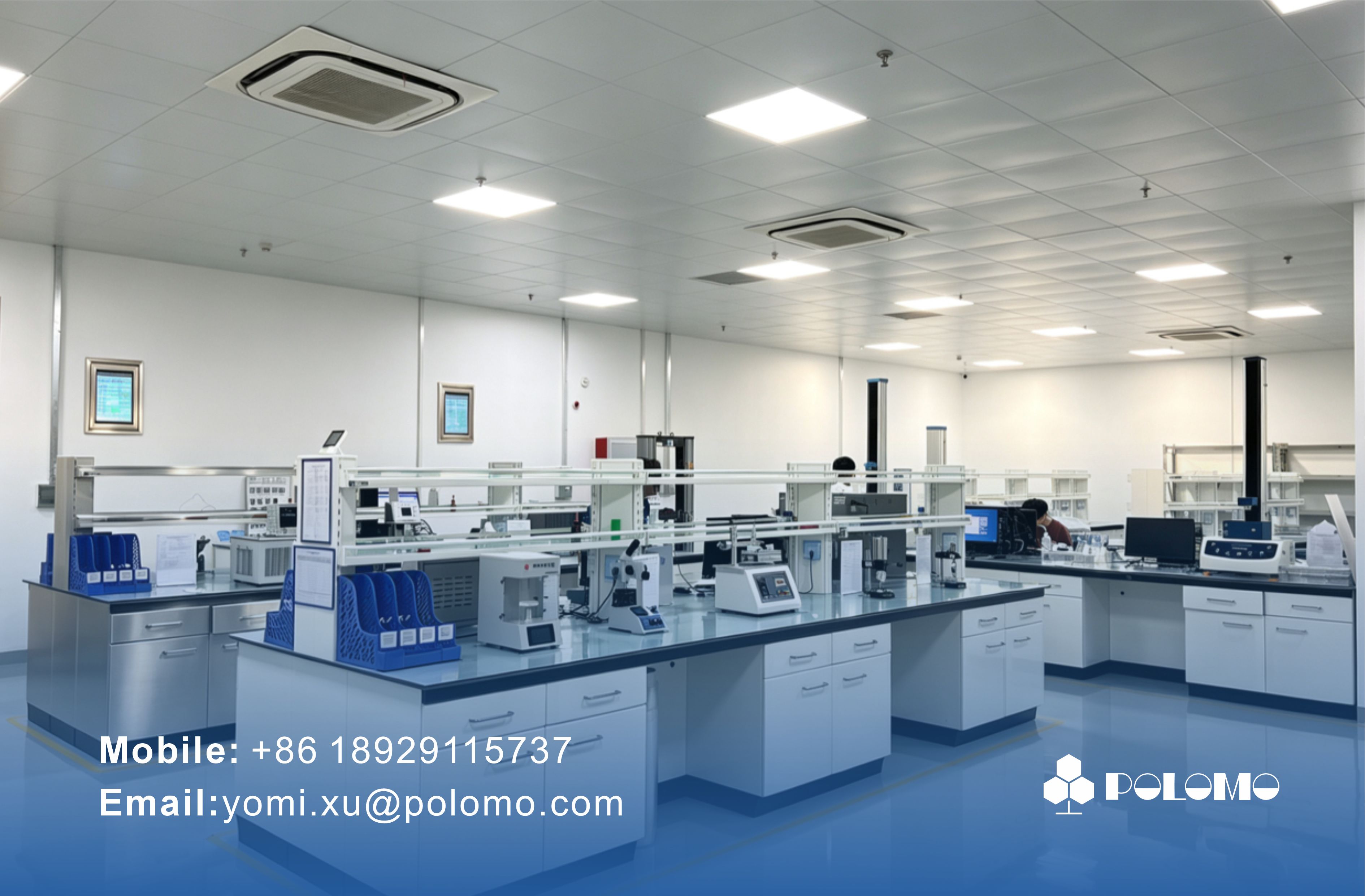
Reliability performance also depends on how the material is handled. Polomo uses standardized environmental control and FIFO management for storage. Its measures include temperature- and humidity-controlled clean warehousing, strict control of light exposure and dust contamination, shelf-life management, inventory aging alerts, and standardized opening and storage procedures to prevent adhesive layer contamination.
Step-by-Step Breakdown: How to Qualify a Long-Term Silicone OCA Manufacturer
Follow these six steps when evaluating a silicone OCA partner for an automotive display program.
Step 1: Verify the Quality System
IATF 16949 is the mandatory global quality management standard for automotive suppliers, with a focus on zero-defect manufacturing. Buyers should ask for proof of active certification, then review how the supplier controls incoming materials, in-process inspection, and outgoing testing.
Step 2: Check the Critical Performance Parameters
For large automotive displays, low modulus is essential to prevent mura. Review Δb, haze, water absorption, dielectric constant, and the validated temperature range. Polomo's silicone OCA covers a range from -40°C to 120°C in reliability testing, and its Δb of 0.03 and haze below 0.3 provide a clear baseline for optical quality.
Step 3: Inspect Manufacturing and Storage Controls
Contamination is a leading cause of optical defects. Evaluate the supplier's warehouse environment, storage procedures, and FIFO systems. Polomo documents light exposure control, dust control, shelf-life management, and inventory aging alerts as part of its standard operating procedures.
Step 4: Confirm Customization and Form Factor Flexibility
Automotive display programs often require specific thickness and size ranges. Polomo's silicone OCA supports thickness from 20 to 2000 µm and product sizes from 3 to 50 inches, allowing lamination processes to be matched to different cover glass and display module designs.
Step 5: Assess Scale and Long-Term Capacity
A long-term partner must be able to scale with the program. Polomo's production capacity of around 10 million pieces per year, together with its 90,000-square-meter facility, provides a practical baseline for high-volume supply discussions.
Step 6: Agree on Commercial Terms and Supply Flexibility
Long-term supply agreements should include clear delivery, acceptance, and payment terms. Polomo offers FOB/FCA/EXW delivery, uses pre-shipment testing as an acceptance step, and supports payment before shipment or monthly settlement. MOQ is discussed on a case-by-case basis.

Use Cases: Where Long-Term Silicone OCA Partnerships Matter Most
Silicone OCA is used for full lamination between display cover glass, touch panel layers, and display panel layers. In automotive applications, this includes center displays, digital instrument clusters, passenger entertainment displays, rear-seat entertainment displays, armrest displays, streaming rear-view mirrors, head-up displays (HUD/PHUD), and air-conditioning displays.
Large curved and narrow bezel automotive displays are a particularly demanding use case. The combination of large size and curvature concentrates thermal and mechanical stress. A low-modulus silicone OCA absorbs that stress and prevents mura and bubble formation during temperature cycling and vibration.
Beyond automotive, the same low-modulus and weather-resistance profile makes silicone OCA suitable for industrial touch displays, medical displays, and other optical bonding applications where high reliability and clear optics are required. Flexible and foldable display programs also benefit from the stress-absorbing behavior of low-modulus silicone OCA, although qualification should always be based on the specific module design.
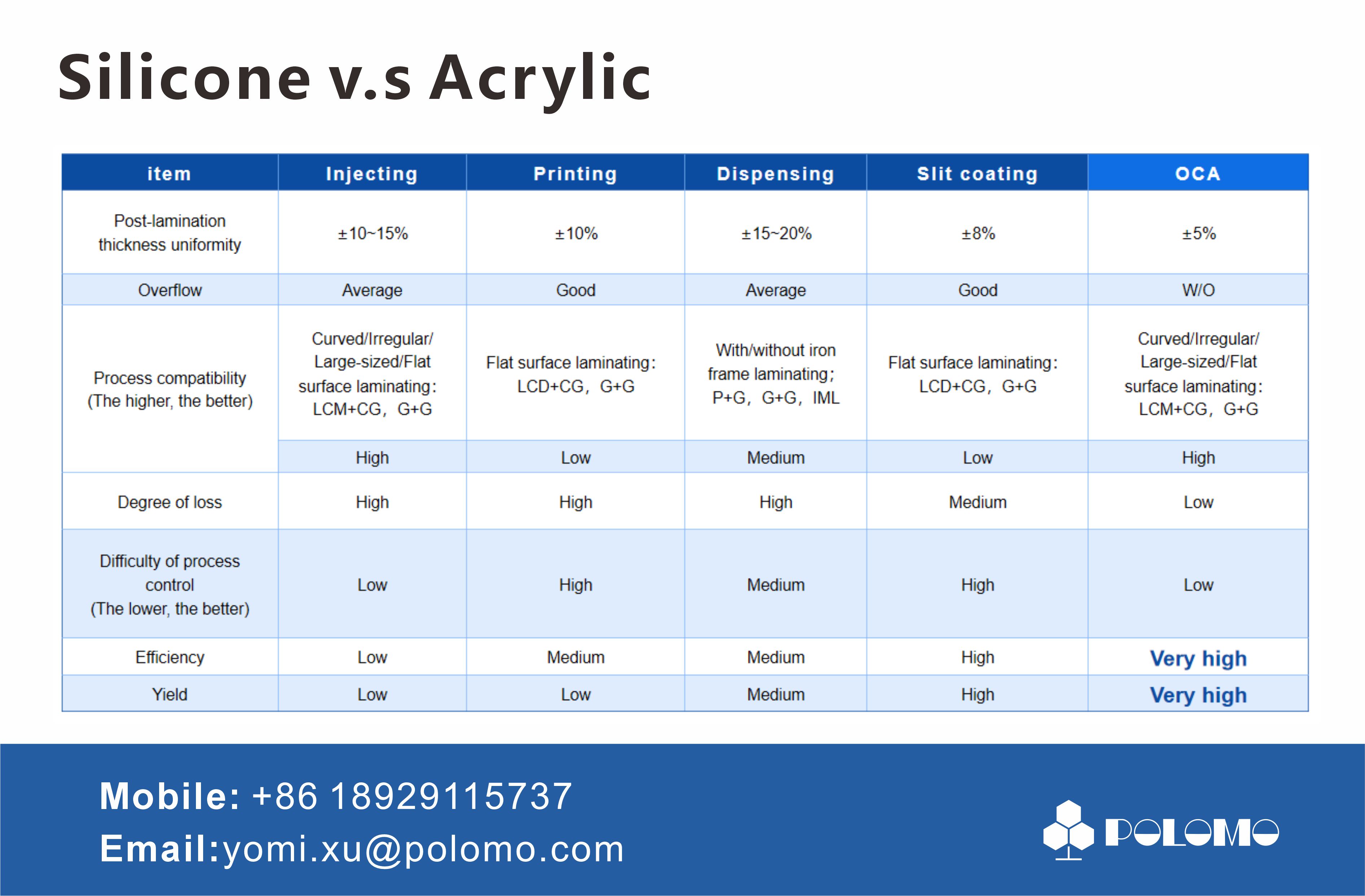
Comparison Table: Silicone OCA vs. Acrylic OCA for Long-Term Automotive Use
| Comparison Point | Polomo Silicone OCA | Typical Acrylic OCA |
|---|---|---|
| Elastic modulus | Low and stable under high/low temperatures | High modulus, especially at low temperatures |
| Δb (yellowness) | 0.03 | 0.5 |
| Dielectric constant | 2.9 at 1 MHz | Above 6.3 |
| Odor level | 2.5 | 3.5 / 4 |
| Weather resistance | −40°C to 120°C | −40°C to 95°C |
| Large-size bonding | Absorbs stress, prevents mura and bubbles | May cause mura in large-size display bonding |
| Long-term reliability | Resists bubble rebound, yellow spots, and delamination | Higher risk of high-temperature bubble rebound and delamination |
| Cost profile | Material cost comparable; higher lamination yield and efficiency | Material cost comparable; lower yield and higher quality risk |
The table is based on comparisons between Polomo silicone OCA and acrylic OCA supplied in the product qualification data. Buyers should run their own reliability tests to verify behavior on their specific display stack.
FAQ
1. What quality system should a long-term silicone OCA manufacturer have for automotive programs?
Automotive buyers should verify that the manufacturer operates under IATF 16949, the mandatory global quality management standard for automotive suppliers focused on zero-defect manufacturing. The manufacturer should also have documented environmental control, shelf-life management, and contamination prevention procedures.
2. Which silicone OCA parameters are most critical for automotive optical bonding?
The most critical parameters are low elastic modulus, low Δb, low haze, low water absorption, and stable dielectric constant. For example, Polomo's silicone OCA has Δb of 0.03, haze below 0.3, water absorption below 0.3, and a dielectric constant of 2.9. These parameters support optical clarity and reliability in temperature and humidity cycling.
3. How does silicone OCA compare with acrylic OCA over the long term?
Silicone OCA and acrylic OCA have comparable material costs, but silicone OCA can deliver significantly higher lamination yield and efficiency. Acrylic OCA has a higher modulus and is more likely to cause mura, high-temperature bubble rebound, yellow spots, and delamination over time. Silicone OCA also has a lower odor level, which is important for cabin environments.
4. Can the manufacturer support custom silicone OCA needs for large curved or narrow bezel displays?
Customization starts with the material's form factor flexibility. Polomo's silicone OCA is available in thicknesses from 20 to 2000 µm and product sizes from 3 to 50 inches, which gives display makers room to adapt lamination to different cover glass, touch panel, and display structures.
5. What sampling and commercial terms should I expect when qualifying a long-term manufacturer?
MOQ is discussed case by case. Polomo offers FOB/FCA/EXW delivery, accepts pre-shipment testing, and supports payment before shipment or monthly settlement. The most efficient next step is to contact Polomo with your display module specifications and reliability test plan, then request samples for evaluation.
Conclusion
Qualifying a long-term silicone OCA manufacturer for automotive displays requires more than sample testing. It requires a supplier that combines low-modulus silicone chemistry, optical-grade quality control, clean and traceable storage, customization capability, and production scale.
Polomo provides a working example of this combination. Its silicone OCA product family—TS107, TS108, and TS109—is backed by an operation that has manufactured silicone OCA for more than two decades and produces about 10 million pieces per year.
For OEMs and Tier 1 suppliers entering the qualification phase, the next step is a direct technical and commercial discussion. Download the Polomo Product Brochure to review the product range, or contact the Polomo team through the official website: en.polomo.com.

Request samples and qualification support
Email: yomi.xu@polomo.com
Tel: +86 18929115737
WhatsApp: +86 159-1833-2421