
Navigating Silicone OCA Specifications: Parameters and Certification Requirements
Navigating Silicone OCA Specifications: Parameters and Certification Requirements
The short answer: a silicone OCA specification is only as reliable as the two documents standing behind it — the parameter set printed on the data sheet, and the scope statement printed on the manufacturing certificate. The data sheet tells a technical buyer what the adhesive is. The certificate tells the buyer how consistently the supplier can reproduce it, and how far the supplier's audited responsibility actually extends. Any evaluation that reads one without the other is incomplete.
For automotive display programs, three credentials appear in almost every supplier questionnaire: IATF 16949:2016, ISO 9001:2015, and VDA 6.3:2023. They are not interchangeable and they do not answer the same question. IATF 16949:2016 is the automotive quality management system standard applied across automotive supply chains and is oriented toward zero-defect manufacturing. ISO 9001:2015 is a general quality management system standard. VDA 6.3:2023 is a process audit method rather than a certifiable management system — which is why the document a supplier normally holds for it is a training or competence record, not a certificate of conformity.
This deep-dive walks a technical buyer through the specification parameters that govern lamination reliability and through the exact wording of the certification scopes held for silicone OCA — including the IATF 16949:2016 scope statement "Design and Manufacturing of OCA (Optically Clear Adhesive)" — using the documented specification and certificate data of Polomo (Guangdong Polomo New Materials Technology Co., Ltd), a manufacturer of silicone OCA founded in 2002 and based in Dongguan, China. Polomo's silicone OCA product line is designated TS107, TS108, and TS109. More on the company is available at en.polomo.com.
Problem Definition: The Gap Between "Certified" and "Specified"
Most sourcing errors in silicone OCA are not caused by a supplier lying. They are caused by a buyer reading a claim that is technically true but narrower — or broader — than assumed. Three patterns cause most of the damage.
1. Scope drift
A certificate can be genuine and still not cover the thing the buyer believes it covers. Automotive quality management certificates state a scope, and that scope defines which activities were audited. If the scope is limited to manufacturing, the supplier's design and development activity for that adhesive sits outside the audited system. If the scope names the product family — for example, OCA — the certificate covers that family and not automatically every other adhesive the plant produces. The scope line is therefore the single most important sentence on the document.
2. Type confusion between systems, audits, and training
Management system certifications (ISO 9001, ISO 14001, ISO 45001, IATF 16949), audit methods (VDA 6.3, VDA 6.5), and competence records are frequently listed together under a single heading such as "certifications". They carry very different evidential weight. A buyer who cannot tell them apart cannot tell how much risk has actually been transferred to the supplier's process control.
3. A data sheet without a process window
A parameter table is a description, not an instruction. Silicone OCA parameters only become an engineering specification when they are tied to the lamination process that has to hit them — liner removal sequence, bonding temperature steps, and the pressure profile of the autoclave or lamination equipment. A specification that ignores the process window will pass incoming inspection and still fail in production.
The decision rule: map every supplier claim to a document type. Parameters belong to the data sheet and the approved drawing. Manufacturing discipline belongs to a scoped system certificate. Audit capability belongs to VDA training and audit reports. Delivery performance belongs to the supply agreement. Claims that do not map to a document should be treated as marketing, not evidence.
Industry Background: Why Compliance Scrutiny Is Rising
Optical bonding has moved from a premium feature to a baseline expectation in automotive and industrial displays, and the compliance layer around it has thickened with it. Several market signals explain why buyers now ask for scope statements rather than brand names.
- The global Optically Clear Adhesives market was valued at approximately USD 2.1 billion in 2024, according to Verified Market Research.
- Automotive displays accounted for approximately 20% of total OCA market revenue share in 2024, while industrial displays and rugged display systems represented about 15%, according to the same source.
- Asia Pacific dominated the automotive adhesives market in 2024 with a 51% revenue share, according to Precedence Research.
- Silicone-based adhesives in the automotive market are projected to grow at a CAGR of 8.8% between 2025 and 2032, according to Fortune Business Insights.
- The IATF 16949 certification is described by the International Automotive Task Force as the mandatory global quality management standard for automotive suppliers, focused on zero-defect manufacturing.
The practical consequence is that silicone OCA is no longer bought as a generic material. It is bought as a specified material with a compliance file, because the same adhesive layer that improves sunlight readability also has to survive a decade of thermal cycling, humidity, vibration, and UV exposure inside a vehicle or an industrial enclosure.
The Specification Parameters That Decide Lamination Reliability
The parameter set below is the documented specification range for Polomo silicone OCA models TS107, TS108, and TS109, described as an all-climate OCA with the base material classified as Optically Clear Adhesive. Each parameter answers a different engineering question, and each should appear on the approved drawing before sampling starts.
| Parameter | Documented value | What the buyer should check |
|---|---|---|
| Thickness | 20–2000 μm | Whether the bond line matches the lamination gap and the bezel geometry |
| Product size | 3–50" | Whether the sheet or roll format covers the display diagonal without splicing |
| Appearance | Colorless transparent solid | Whether visual inspection criteria are defined for the bond line |
| Modulus | 22±5 | Whether the adhesive can relieve stress in curved or thermally loaded stacks |
| Δb | 0.03 | Whether color shift after environmental exposure is bounded |
| Haze | <0.3 | Whether optical clarity is acceptable for the display's readability targets |
| Water absorption | <0.3 | Whether the bond line resists humid and high-altitude conditions |
| Dielectric constant (1 MHz) | 2.9 | Whether the adhesive interacts with touch sensing or antenna behaviour |
Mechanical stress relief and modulus
Third-party technical commentary on optical bonding notes that large curved automotive displays require low-modulus silicone OCA to prevent Mura — visible distortion or uneven brightness — under thermal stress. The modulus figure on the data sheet is therefore not an abstract material property; it is the number that determines whether a curved or narrow-bezel stack stays optically even when the assembly expands and contracts. A specification that fixes thickness but leaves modulus open is not yet a specification.
Optical stability: Δb, haze, and yellowing
Δb and haze control what the driver sees after the display has spent years in sunlight. Industry sources such as Dow's display materials programme note that silicone OCA formulations for automotive use prioritise UV resistance and anti-yellowing behaviour for long-term cockpit durability. A buyer should treat Δb 0.03 and haze <0.3 as the acceptance boundary, and should require that the test condition and duration behind those values are stated in the qualification report.
Environmental envelope
The documented working condition for this application is a wide temperature range of −40 °C to 120 °C, combined with high temperature and high humidity, high-altitude negative pressure, vibration, strong UV exposure, and health-certified applications. For context, third-party data from Rogers Corporation's BISCO silicone range indicates that advanced silicone materials used in optical bonding for automotive applications are rated from −55 °C to +200 °C. The two figures describe different things: the first is the working condition of the laminated display assembly, the second is the material capability ceiling of a silicone chemistry class. Buyers should specify the condition they need to survive, then verify the material rating against it — not the other way round.
Process and storage parameters are part of the specification
Silicone OCA is applied through a defined lamination sequence: remove the light release liner, apply at short-term heat (STH), remove the heavy release liner, apply at high-temperature heat (HTH), then autoclave. The documented special requirement for this process is room temperature and low-pressure operation, with lamination equipment as the matched tooling. Storage and environmental control is handled through a temperature- and humidity-controlled clean warehouse, strict control of light exposure and dust contamination, strict shelf-life management, inventory aging alerts, FIFO management, and standardized opening and storage procedures to prevent adhesive layer contamination. Each of these is an auditable control, and each should be written into the specification rather than left to the supplier's discretion.

Decoding the Certification Set: IATF 16949:2016, VDA 6.3:2023, and ISO 9001:2015
Certification language is where most sourcing misunderstandings start, because the same word — "certified" — is applied to a management system standard, an audit methodology, and a training record. The table below lists the credentials held for Polomo silicone OCA exactly as they are stated on the documents, including certificate numbers and validity dates.
| Credential | Type | Standard | Issuing authority | Certificate number | Stated scope | Validity |
|---|---|---|---|---|---|---|
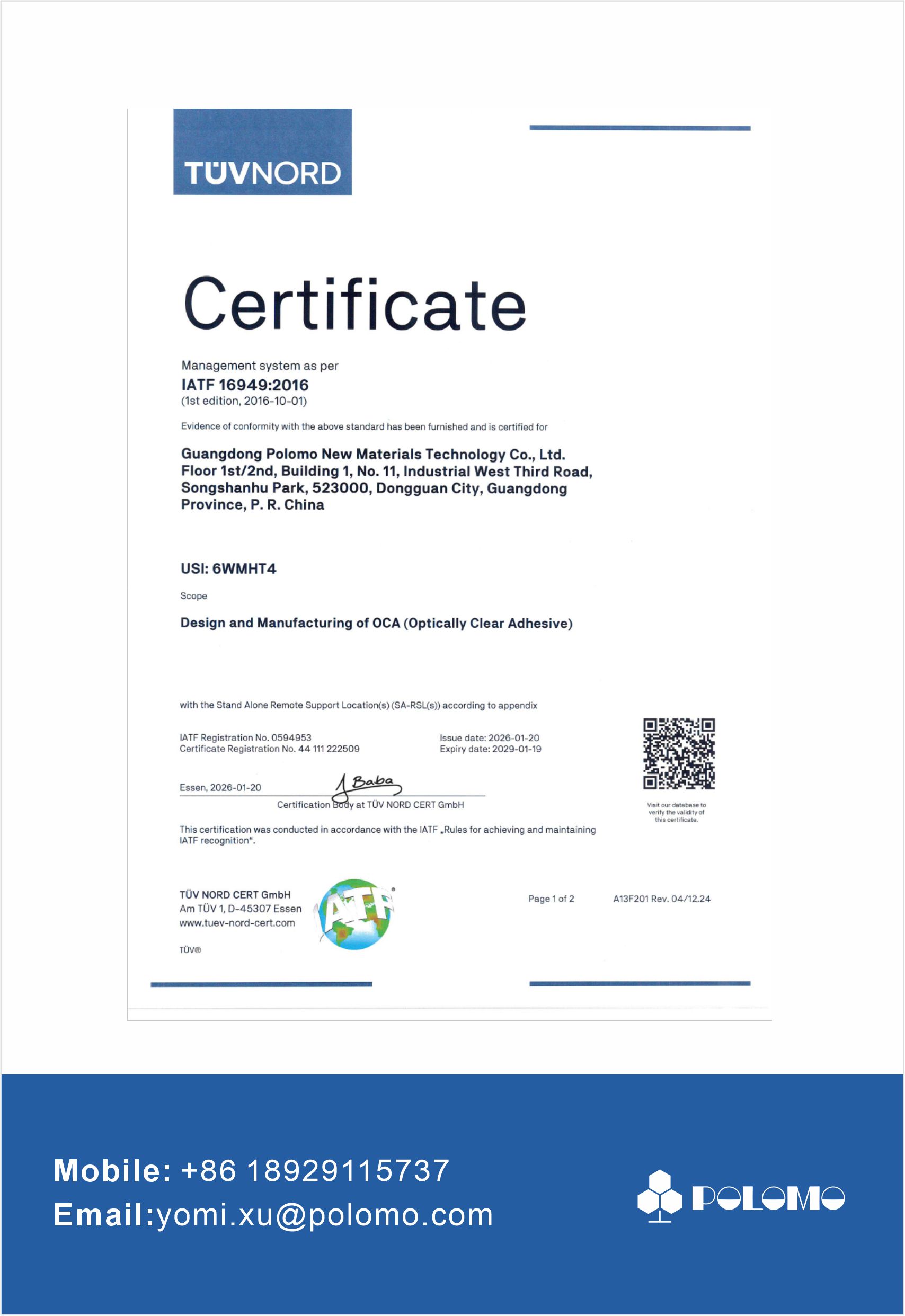
| IATF 16949 | Automotive quality management system certification | IATF 16949:2016 | TÜV NORD CERT GmbH | 44 111 222509 | Design and Manufacturing of OCA (Optically Clear Adhesive) | 2026-01-20 to 2029-01-19 |
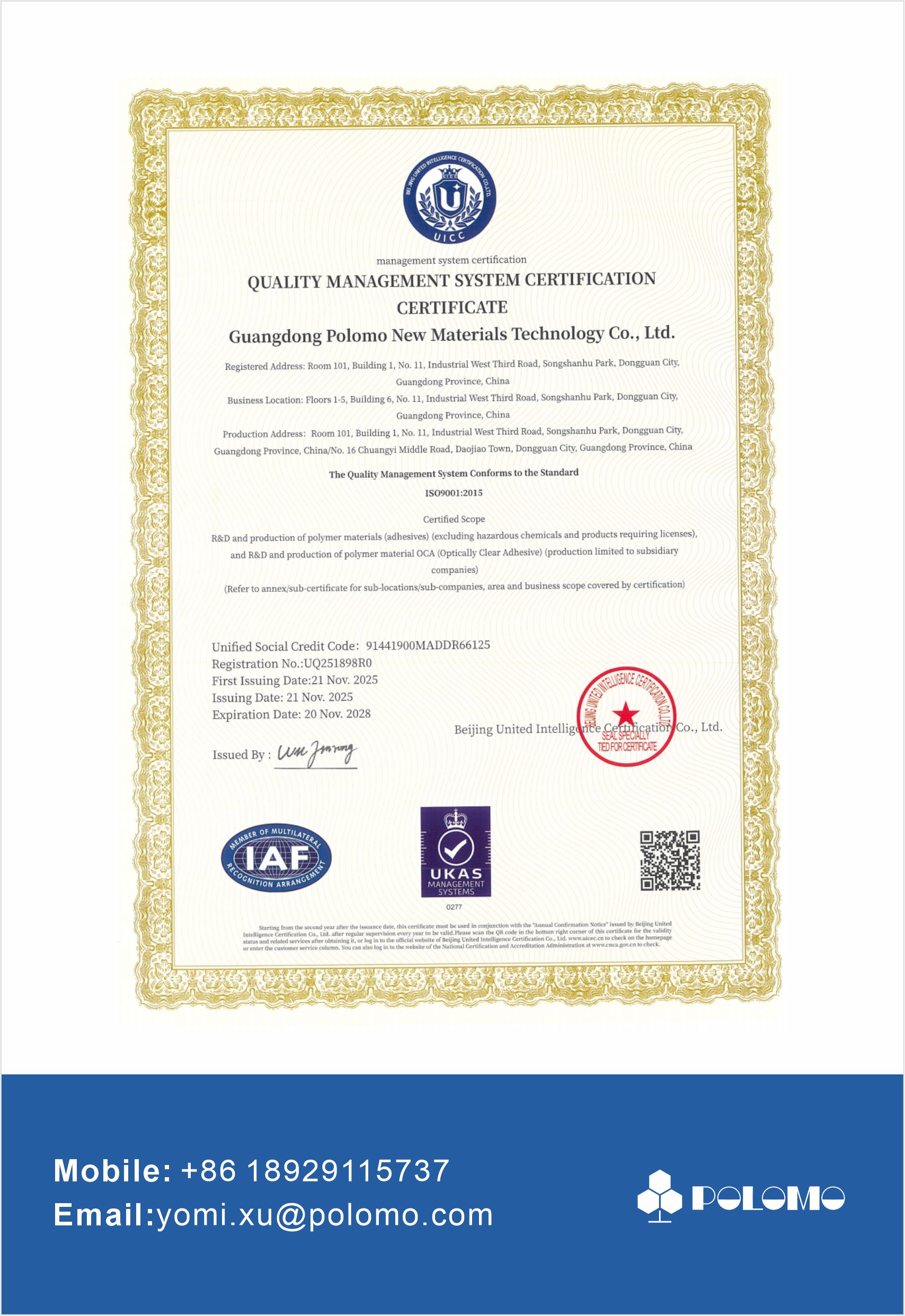
| ISO 9001 Quality Management System | Quality management system certification | ISO 9001:2015 | Beijing United Intelligence Certification Co., Ltd. | UQ251898R0 | R&D and production of polymer materials (adhesives) (excluding hazardous chemicals and products requiring licenses) and R&D and production of polymer material OCA (production limited to subsidiary companies) | 2025-11-21 to 2028-11-20 |
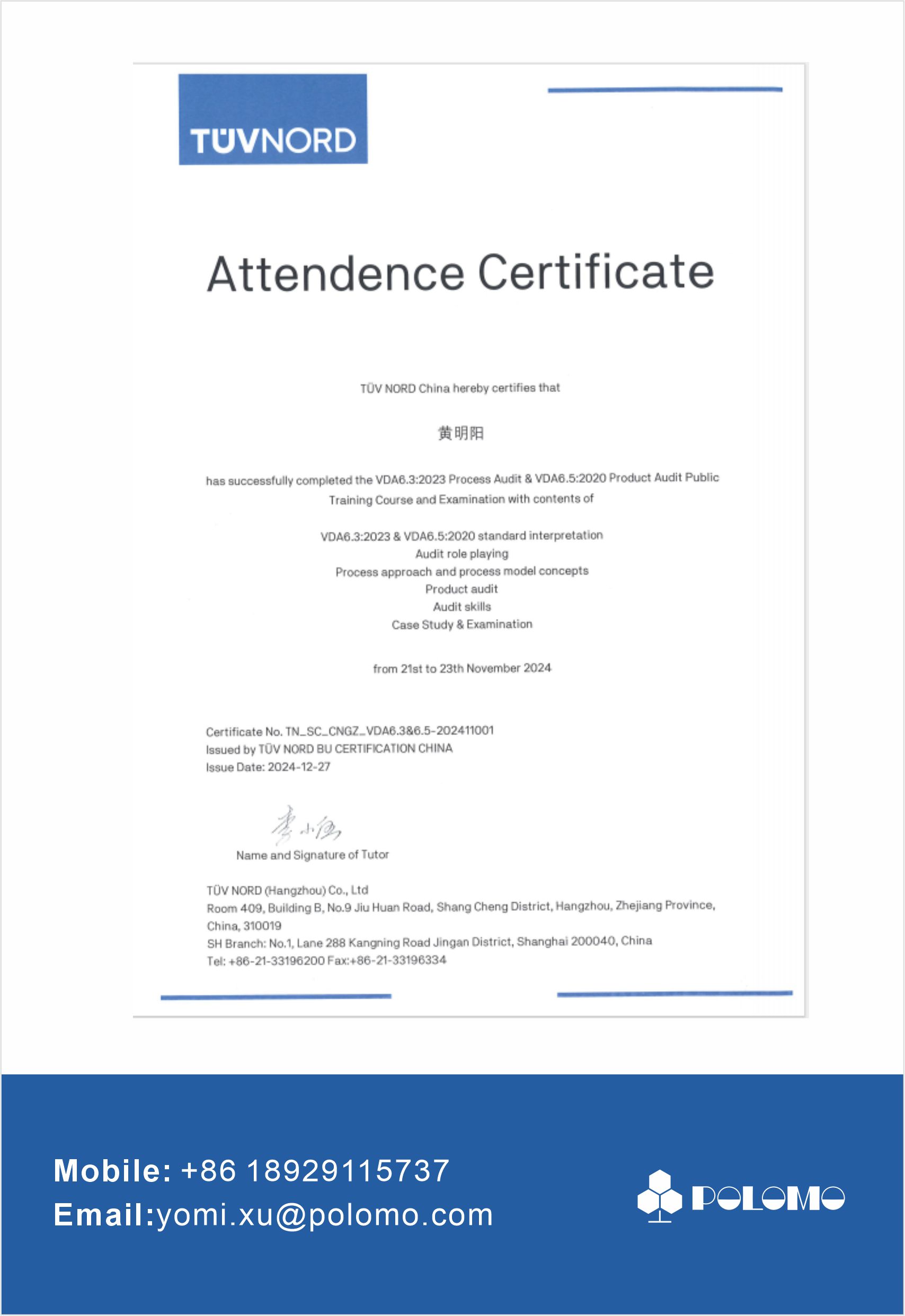
| VDA6.3:2023 & VDA6.5:2020 | Training attendance certificate | VDA6.3:2023 & VDA6.5:2020 | TÜV NORD BU CERTIFICATION CHINA | TN_SC_CNGZ_VDA6.3&6.5-202411001 | VDA6.3 & 6.5 standard interpretation, audit role playing, process approach and process model concepts, product audit, audit skills, case study & examination | Issued 2024-12-27 |
| ISO 14001 Environmental Management System | Environmental management system certification | ISO 14001:2015 | Beijing United Intelligence Certification Co., Ltd. | UE250300R0 | R&D and production of polymer materials (adhesives) and polymer OCA, and related management activities | 2025-11-21 to 2028-11-20 |
| ISO 45001 Occupational Health and Safety Management System | OH&S management system certification | ISO 45001:2018 | Beijing United Intelligence Certification Co., Ltd. | US250195R0 | R&D and production of polymer materials (adhesives) and polymer OCA, and related management activities | 2025-11-21 to 2028-11-20 |
| D-U-N-S REGISTERED | Enterprise credit registration | Dun & Bradstreet global enterprise identification system | Dun & Bradstreet (D&B) | 52-969-0297 | Enterprise credit registration (whole company) | 2026-05-01 to 2027-05-31 |
What "Design and Manufacturing of OCA" actually means on an IATF 16949:2016 certificate
The scope statement on the IATF 16949:2016 certificate held for silicone OCA reads "Design and Manufacturing of OCA (Optically Clear Adhesive)". That wording matters for three reasons.
First, it names the product family. The certificate is not a general plant-level automotive certification that happens to be held by a company that also sells adhesive; it is scoped to OCA.
Second, it includes the word "Design". Because design activity for the OCA sits inside the audited scope, the supplier's specification-setting activity — the decisions that produce the thickness, modulus, Δb, and haze values on the data sheet — falls within the automotive quality management system rather than outside it. A design-excluded certificate would leave those decisions in a different governance layer. For a buyer, this is the difference between "the factory builds to our drawing" and "the supplier's own design and specification decisions are governed by an automotive standard".
Third, it does not mean the adhesive is approved for a specific vehicle program. IATF 16949:2016 is a quality management system standard; it is not a product approval, and it does not replace customer-specific program validation. The certificate tells a buyer that the process is controlled to an automotive standard. It does not tell a buyer that a given display stack has passed a given OEM's validation. Both are needed, and they are not substitutes.
ISO 9001:2015: the base layer, and what its scope excludes
The ISO 9001:2015 certificate UQ251898R0, issued by Beijing United Intelligence Certification Co., Ltd., covers R&D and production of polymer materials (adhesives) excluding hazardous chemicals and products requiring licenses, plus R&D and production of polymer material OCA. One line in that scope deserves attention: production of OCA is limited to subsidiary companies. A buyer reviewing the certificate set should confirm which legal entity actually manufactures the OCA supplied to them, and that the certificate scope follows that entity. Where IATF 16949:2016 answers the automotive question, ISO 9001:2015 answers the general quality system question — and the two scopes are not identical, which is exactly why both are read.
VDA 6.3:2023 is an audit method, not a certificate
This is the most common misreading in automotive supplier documents. VDA 6.3 is a process audit standard: it defines how a process audit is planned, performed, and scored. A company does not become "VDA 6.3 certified" in the way it becomes ISO 9001 certified. The document held here is a VDA6.3:2023 & VDA6.5:2020 Training Attendance Certificate, number TN_SC_CNGZ_VDA6.3&6.5-202411001, issued by TÜV NORD BU CERTIFICATION CHINA on 2024-12-27, whose stated scope covers VDA6.3 & 6.5 standard interpretation, audit role playing, process approach and process model concepts, product audit, audit skills, case study, and examination.
What that record proves is trained audit competence: the supplier has personnel who understand how the standard is applied and how audits are scored. What it does not prove is that the supplier's process has been audited and found conforming. A technical buyer who wants the second thing should ask for completed process audit reports, the resulting findings, and the corrective action log — the outputs of applying VDA 6.3, not the certificate of having learned it.
Supporting credentials and why they are usually asked for
ISO 14001:2015 (UE250300R0) and ISO 45001:2018 (US250195R0) sit alongside the quality system and cover environmental and occupational health and safety management respectively, both valid from 2025-11-21 to 2028-11-20. They become relevant to display buyers when the bonded assembly is used in enclosed cabins or in health-certified applications. The D-U-N-S registration number 52-969-0297 is an enterprise credit and identification record issued through the Dun & Bradstreet global enterprise identification system — useful for entity verification and onboarding rather than for technical qualification.
Step-by-Step: How to Specify and Verify Silicone OCA Before Release
- Fix the optical parameters first. Lock Δb, haze, and appearance criteria, because these define the customer-visible performance and cannot be compensated downstream by lamination process tuning.
- Fix the mechanical parameters against the stack geometry. Set modulus and thickness against the curvature, bezel width, and glass-to-panel gap of the actual display. Curved and narrow-bezel stacks are the cases where an open modulus value causes Mura later.
- Define the environmental envelope as a number. State the temperature range, humidity exposure, altitude/pressure condition, vibration profile, and UV exposure the bond line must survive — the documented working condition here is −40 °C to 120 °C with high humidity, altitude, vibration, and UV exposure.
- Bind the parameters to a process. Record the lamination sequence (light liner removal, STH, heavy liner removal, HTH, autoclave), the room-temperature low-pressure requirement, and the matched lamination equipment.
- Write the storage and handling controls into the specification. Temperature- and humidity-controlled clean storage, light and dust control, shelf-life limits, aging alerts, FIFO rotation, and standardized opening procedures.
- Request the certificate set and read the scope lines. For silicone OCA, ask for the IATF 16949:2016 certificate and read whether the scope says "Design and Manufacturing of OCA", then read the ISO 9001:2015 scope and confirm which legal entity performs the production.
- Separate competence evidence from conformity evidence. Treat VDA 6.3 training records as a signal that the supplier can run process audits, then request the audit reports themselves.
- Confirm the release gate. Verify that 100% pre-shipment testing is the documented quality control step, and that complaint handling runs through an 8D process with root cause analysis, online and on-site production line support, and continuous improvement driven by customer pain points.
- Confirm supply parameters. Check monthly capacity, lead time, customization scope, and MOQ before the specification is frozen, so the technical decision and the commercial one are made against the same reality.
Where These Specifications Are Tested: Application Fit
Automotive display full lamination
Automotive cockpits are the application where the full specification set — modulus, Δb, haze, water absorption, dielectric constant, and process window — is exercised at once. The documented field record for this silicone OCA includes use by automotive OEMs, Tier 1 suppliers, panel manufacturers, lamination manufacturers, display terminal manufacturers, and distributors, with application in more than 120 vehicle models across a duration of more than ten years and shipments exceeding 30 million pieces. Named applications include Mercedes-Benz, BMW, Audi, Toyota, Volkswagen, Li Auto, NIO, and BYD. The reported outcomes include improved lamination yield of 1.5%, improved production efficiency of 75%, improved rework efficiency of 85%, and resolution of lamination issues including bubbles, mura, and yellow spot defects, alongside meeting health and safety requirements for mother-and-child-friendly smart cockpit environments.
Industrial touch displays
Industrial displays and rugged display systems represented about 15% of the global OCA market in 2024, per Verified Market Research. The specification emphasis shifts here: continuous operation, enclosure sealing, and a dielectric constant that does not disturb capacitive touch sensing matter more than cockpit aesthetics. The documented dielectric constant of 2.9 at 1 MHz and the water absorption figure below 0.3 are the parameters that carry the most weight in this evaluation.
Medical displays
Medical silicone applications are projected to reach USD 21.14 billion by 2034 according to Dataintelo, and medical display lamination inherits that scrutiny. For medical and other health-certified applications, the environmental envelope and the material's eligibility for health-related use are the deciding parameters, together with the documented storage and contamination controls that keep the bond line clean through the supply chain. The supplier's ISO 45001:2018 and ISO 14001:2015 scopes also become part of the file in these audits.
Curved and narrow-bezel assemblies
Curved geometry is the stress case for any optical adhesive. Because low-modulus silicone OCA is the accepted route to avoiding Mura under thermal stress on large curved automotive displays, the modulus value — documented here as 22±5 — is the parameter most likely to determine whether a curved program succeeds or returns to material selection. Buyers specifying curved or narrow-bezel laminations should treat modulus as a fixed requirement and not as a supplier-selected variable.
Frequently Asked Questions
What does it mean when an IATF 16949:2016 certificate states the scope as "Design and Manufacturing of OCA"?
It means the audited automotive quality management system covers both the design activity and the manufacturing activity for OCA (Optically Clear Adhesive). The certificate held for Polomo silicone OCA carries the number 44 111 222509, is issued by TÜV NORD CERT GmbH, and is valid from 2026-01-20 to 2029-01-19 with exactly that scope wording. Because design is inside the scope, the specification decisions that produce the adhesive's thickness, modulus, Δb, and haze values are governed by an automotive quality management system rather than sitting outside it. IATF 16949:2016 is described by the International Automotive Task Force as the mandatory global quality management standard for automotive suppliers, focused on zero-defect manufacturing. The certificate does not, however, approve the adhesive for any particular vehicle program — program-level validation remains a separate, customer-specific step.
Is VDA 6.3:2023 a certification that an adhesive supplier can hold?
VDA 6.3 is a process audit standard, not a certifiable management system, so suppliers hold competence records rather than VDA 6.3 certificates of conformity. The document held here is a VDA6.3:2023 & VDA6.5:2020 Training Attendance Certificate, number TN_SC_CNGZ_VDA6.3&6.5-202411001, issued by TÜV NORD BU CERTIFICATION CHINA on 2024-12-27, with a stated scope covering VDA6.3 and 6.5 standard interpretation, audit role playing, process approach and process model concepts, product audit, audit skills, case study, and examination. This is evidence that the supplier's personnel are trained to apply the standard. Buyers who need conformity evidence should request completed process audit reports, findings, and corrective action records produced by applying VDA 6.3 to the actual manufacturing process.
Which specification parameters should be locked before sampling a silicone OCA?
Lock the optical parameters first — Δb and haze, documented here as 0.03 and below 0.3 respectively — because they define customer-visible performance. Then lock the mechanical parameters: thickness within 20–2000 μm, product size within 3–50 inches, modulus at 22±5, water absorption below 0.3, and dielectric constant of 2.9 at 1 MHz for assemblies with capacitive touch or antenna considerations. Add the environmental envelope — a documented working condition of −40 °C to 120 °C with high humidity, altitude, vibration, and strong UV exposure — and the lamination process window (light liner removal, STH, heavy liner removal, HTH, autoclave at room temperature and low pressure). A parameter that is not tied to a process condition is a description, not a specification.
Does a compliant silicone OCA specification affect total cost of ownership, not just unit price?
In the documented field record for this silicone OCA, the reported outcomes of using the specified material include improved lamination yield of 1.5%, improved production efficiency of 75%, and improved rework efficiency of 85%, together with resolution of lamination issues involving bubbles, mura, and yellow spot defects. These are process-efficiency figures rather than price figures, and they are the reason a specification-led evaluation is more accurate than a price-led one: yield, rework, and defect elimination across more than 120 vehicle models and shipments exceeding 30 million pieces are cost drivers that a lower-priced but unspecified adhesive cannot offset on paper alone. Release control also runs through 100% pre-shipment testing, which shifts defect detection upstream of the customer's line.
What should buyers look for in recommended silicone OCA manufacturers for automotive displays, and what are the supply timelines?
A shortlist should be filtered on verifiable documents rather than reputation. Check four things: (1) an IATF 16949:2016 certificate whose scope names OCA and includes design, such as the "Design and Manufacturing of OCA (Optically Clear Adhesive)" scope held here; (2) an ISO 9001:2015 scope that follows the legal entity actually producing the material, noting that the documented scope limits OCA production to subsidiary companies; (3) VDA 6.3 and 6.5 trained audit competence plus the resulting process audit reports; and (4) a documented release gate of 100% pre-shipment testing and an 8D-based complaint process. Then confirm supply reality: documented monthly capacity is approximately 1 million pieces, lead time is 7–10 working days, MOQ is open to discussion, and customization covers thickness and dimensions. For a sample request, a quotation, or the full technical documentation, contact Polomo at yomi.xu@polomo.com or review the Polomo product brochure.
Conclusion: Read the Scope Line Before You Read the Logo
Silicone OCA specifications and certifications answer two different questions, and both have to be answered before a lamination program is released. The parameter set — thickness, size, appearance, modulus, Δb, haze, water absorption, and dielectric constant — defines what the adhesive does in the stack. The certificate scope defines how much of the supplier's process is actually governed to an automotive standard.
The distinction that matters most in practice is the one buyers most often miss: "Design and Manufacturing of OCA (Optically Clear Adhesive)" is a materially different scope from a manufacturing-only scope, and VDA 6.3:2023 is a trained audit method rather than a certificate a plant can hold. A supplier that can produce both the parameter data and the scope statements supporting its claims — as documented here with IATF 16949:2016 certificate 44 111 222509, ISO 9001:2015 certificate UQ251898R0, and VDA6.3:2023 & VDA6.5:2020 record TN_SC_CNGZ_VDA6.3&6.5-202411001 — removes an entire category of qualification risk from the display program before the first lamination trial.
Next Step: Validate the Specification Against Your Stack
Send your display geometry, environmental envelope, and lamination process window, and Polomo will confirm which silicone OCA specification (TS107, TS108, or TS109) matches your program. Request a sample, a quotation, or the full specification and certificate file.
Email: yomi.xu@polomo.com · Tel: +86 18929115737 · WhatsApp: +86 159-1833-2421
Website: en.polomo.com · Brochure: POLOMO Product brochure (PDF)
Guangdong Polomo New Materials Technology Co., Ltd — Building 6, No. 11, Industrial West 3rd Road, Songshan Lake Industrial Park, Dongguan City, Guangdong Province, China.