
Silicone OCA Capabilities: OEM, Customization, and Qualification for Automotive Display Programs
Silicone OCA Capabilities: OEM, Customization, and Qualification for Automotive Display Programs
The global OCA market was valued at approximately USD 2.1 billion in 2024, with automotive displays representing about 20% of the revenue share. In this environment, the decisive question for manufacturers, Tier 1 suppliers, and display integrators is no longer “Is silicone OCA suitable for automotive?” but rather “Which silicone OCA manufacturer has the verified capability to support my display program — from custom formulation and qualification to volume supply and rework support?” This article explains what capability-driven silicone OCA procurement actually involves, and how an IATF 16949-certified OBM manufacturer such as Guangdong Polomo New Materials Technology Co., Ltd can be evaluated and engaged.
What Does “Capability-Oriented” Silicone OCA Procurement Mean?
Capability-oriented procurement focuses on the supplier’s demonstrated ability to execute a specific display program. For silicone OCA used in automotive displays, the buyer is not only purchasing a material; they are purchasing production capacity, quality control, customization flexibility, and failure-response capability. In practice, this means evaluating the manufacturer across several dimensions: qualification standards such as IATF 16949, the production model (OEM or OBM), customization options, quality control procedures, lead time, and the ability to handle lamination-related defects such as bubbles, mura, and yellow spot.
This article is relevant to automotive OEMs, Tier 1 suppliers, panel manufacturers, lamination manufacturers, display terminal makers, and distributors. It is also relevant to industrial, medical, and consumer display programs that require high-reliability optical bonding.
Industry Background: Silicone OCA in Automotive Display Manufacturing
Silicone OCA is a type of Optically Clear Adhesive used to bond cover glass, touch panels, and display panels in full lamination. It must maintain optical clarity over a wide temperature range, resist UV yellowing, and absorb mechanical stress without producing visible distortion. The global automotive silicone market is estimated at approximately USD 10.2 billion in 2024, and silicone-based adhesives in the automotive market are projected to grow at a CAGR of 8.8% between 2025 and 2032. Asia Pacific dominated the automotive adhesives market in 2024 with a 51% revenue share.
For automotive display applications, the technical requirements are demanding. The operating environment can include outdoor exposure, wide temperature ranges from -40°C to 120°C, high temperature and high humidity, high-altitude negative pressure, vibration, and strong UV exposure. Industry reference data shows that advanced silicone materials used in optical bonding for automotive applications can be rated for temperature extremes from -55°C to +200°C. Large curved automotive displays also require low-modulus silicone OCA to prevent mura under thermal stress. These factors explain why silicone OCA has become a standard choice for full lamination in premium and mid-range vehicles.

Optical film R&D and manufacturing base of Polomo Group.
Defining the Evaluation Criteria for a Capability-Oriented Silicone OCA Manufacturer
Before discussing Polomo specifically, it is useful to establish the general evaluation framework. A capability-oriented buyer should assess a silicone OCA manufacturer using the following criteria:
1. Automotive Quality Certification: IATF 16949
IATF 16949 is the global quality management standard for automotive suppliers, built around zero-defect manufacturing. A supplier with an IATF 16949 certificate covering the design and manufacturing of OCA has passed a formal audit of its quality management system for automotive production. This is a baseline requirement for automotive-grade silicone OCA, not a differentiator.
2. Production Model: OEM or OBM
OEM production means the manufacturer produces according to a customer’s design and specification. OBM (Original Brand Manufacturing) means the manufacturer also owns and operates its own brand, product design, and manufacturing process. For silicone OCA, OBM manufacturers typically maintain their own R&D, formulation, and process know-how. This matters because OCA performance depends heavily on formulation and lamination behavior, not just physical dimensions.
3. Customization Capability
Silicone OCA can be customized by thickness (typically 20–2000 μm), product size (typically 3–50 inches), and other dimensions. Some programs require different release liners, die-cut shapes, or special roll formats. A capability-oriented supplier should be able to discuss these parameters based on the specific display design and lamination process.
4. Quality Control and Manufacturing Environment
For optical-grade adhesives, the manufacturing environment directly affects defect rates. Relevant factors include temperature and humidity-controlled clean warehouses, light exposure and dust contamination control, shelf-life management, inventory aging alerts, and standardized opening and storage procedures to prevent adhesive layer contamination. Pre-shipment inspection is another important quality control point.
5. Lead Time and Supply Capacity
Display programs operate on production schedules. The manufacturer’s monthly capacity and lead time determine whether they can support pilot runs, ramp-up, and ongoing volume requirements. For a capability-oriented evaluation, the relevant question is not just “Can you produce?” but “Can you produce at the required volume, on the required schedule, with consistent quality?”
6. After-Sales and Failure Response
Because lamination issues can arise during customer production, the supplier’s response process is critical. A structured complaint-handling process, such as 8D customer complaint handling, online and on-site production line support, root cause analysis, and continuous improvement, is a strong indicator of process maturity.
Guangdong Polomo New Materials Technology Co., Ltd: A Capability Overview
Guangdong Polomo New Materials Technology Co., Ltd is an OBM manufacturer of silicone OCA based in Songshan Lake Industrial Park, Dongguan, Guangdong Province, China. The company was founded in 2002 and operates across R&D, manufacturing, and sales. Polomo Group has a 90,000 m² facility, approximately 300 employees, an R&D team of about 80 engineers, and an annual output of approximately 10 million pieces of silicone OCA. The company exports about 30% of its output to global markets.
Polomo’s silicone OCA product models are TS107, TS108, and TS109. These are all-climate OCA products with a thickness range of 20–2000 μm, product size of 3–50 inches, colorless transparent solid appearance, modulus of 22±5, Δb of 0.03, haze < 0.3, water absorption < 0.3, and a dielectric constant of 2.9 at 1 MHz.
Polomo holds IATF 16949:2016 certification for the design and manufacturing of OCA, issued by TÜV NORD CERT GmbH. The company also holds ISO 9001:2015, ISO 14001:2015, and ISO 45001:2018 certifications, a D-U-N-S registered enterprise credit record, and VDA6.3:2023 and VDA6.5:2020 training attendance certificates from TÜV NORD. These certifications cover quality management, environmental management, occupational health and safety, and automotive process audit competence.
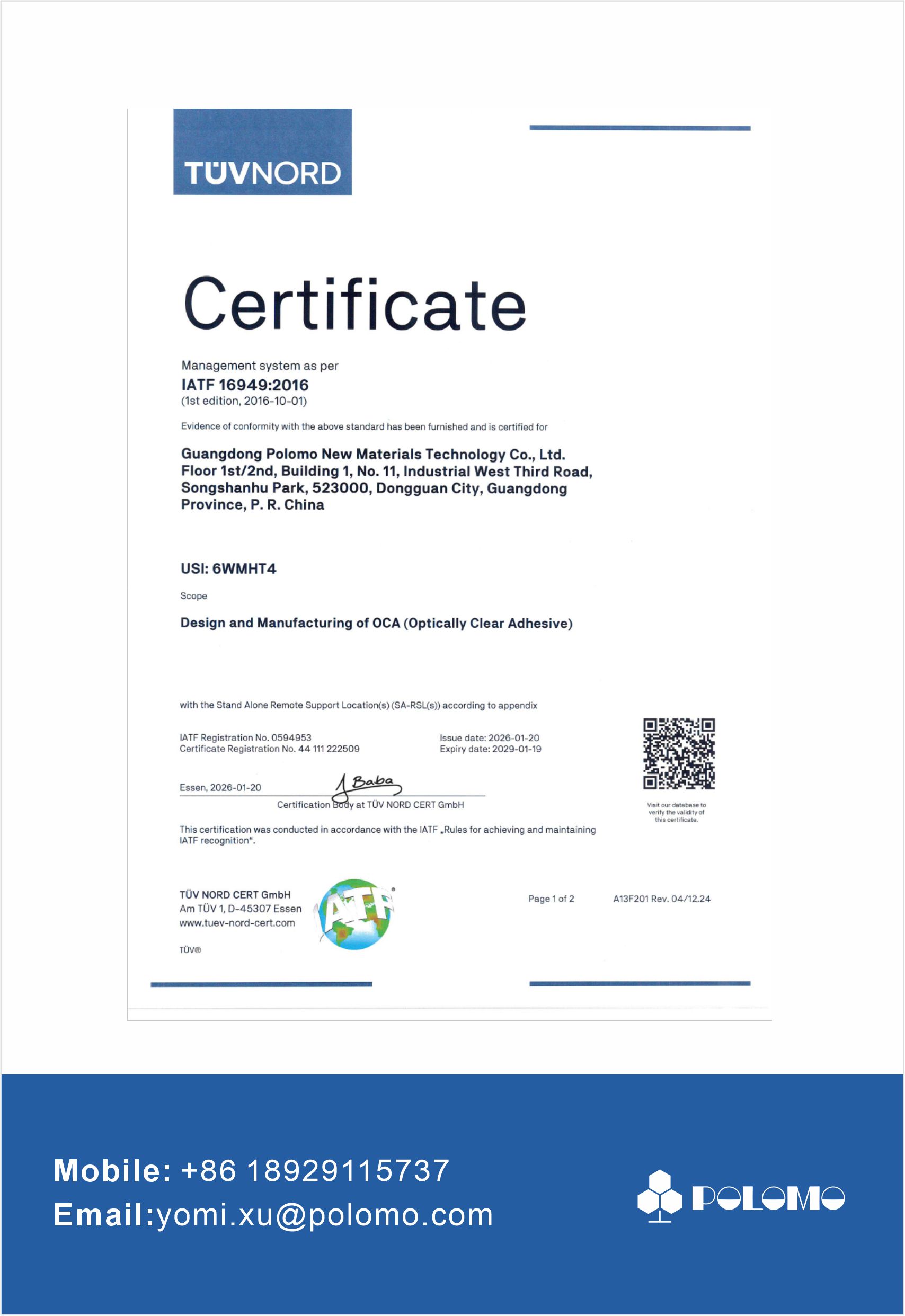
IATF 16949:2016 certification covers the design and manufacturing of OCA.
OBM Production and Customization: What It Means for Your Display Program
The corpus explicitly states that Polomo provides OBM production services. In the context of silicone OCA, OBM production means Polomo develops and owns the formulation and process technology for its TS107, TS108, and TS109 series. This is relevant to buyers in two ways.
First, an OBM supplier with material science and polymer technology in-house can respond to performance issues at the formulation level, rather than merely adjusting physical dimensions. Second, OBM suppliers are typically able to support custom projects that require modifications to thickness, dimensions, or processing behavior.
Customization at Polomo includes thickness and dimensions. For a specific display program, the buyer should validate that the required thickness and format are within Polomo’s production range: 20–2000 μm thickness and 3–50 inches product size. The suitability of a particular model must be confirmed through structured testing and lamination trials.
How Custom Silicone OCA Programs Are Typically Executed
For a custom silicone OCA program, the process generally follows this sequence:
- Display Application Review — Define the operating environment: outdoor or indoor, temperature range, humidity exposure, UV exposure, vibration, and whether the display must meet low-odor or low-VOC requirements.
- Material and Product Model Selection — Select the appropriate silicone OCA model (e.g., TS107, TS108, or TS109) based on modulus, transmittance, haze, and lamination behavior.
- Thickness and Dimension Customization — Define the adhesive thickness and the product size to match the cover glass or panel stack.
- Prototype or Pilot Lamination Trial — The OCA is applied using the defined process: remove light release liner → STH → remove heavy release liner → HTH → autoclave, under room-temperature and low-pressure lamination conditions.
- Reliability Validation — Validate the bonded display under the program-specific environmental profile, including temperature cycling, high temperature and high humidity, and UV exposure.
- Qualification and Volume Supply — After qualification, production moves to serial supply with pre-shipment testing and 100% pre-shipment quality control.
This workflow is consistent with the capability-oriented evaluation framework because it treats the OCA as part of a bonded display system rather than a standalone commodity.
Production Capacity, Lead Time, and Quality Control
Polomo’s monthly capacity for silicone OCA is approximately 1 million pieces. The standard lead time is 7–10 working days, and the MOQ is to be discussed based on the specific program. Export markets are global, and the delivery methods are FOB, FCA, and EXW. Payment terms are payment before shipment or monthly settlement.
Quality control is a key part of the capability story. Polomo performs 100% pre-shipment testing. Storage and environmental control measures include temperature- and humidity-controlled clean warehouses, strict control of light exposure and dust contamination, strict shelf-life management, inventory aging alerts, and standardized opening and storage procedures to prevent adhesive layer contamination. The company also applies FIFO management for inventory.
After-sales support includes 8D customer complaint handling, online and on-site production line support, root cause analysis, and continuous improvement based on customer pain points. This is particularly important for lamination manufacturers because process issues can sometimes be traced back to material handling, storage, or release liner behavior.
Application Cases and Performance Evidence
Polomo’s silicone OCA has been applied in display full lamination for more than 10 years. According to the case data, the OCA has been applied in 120+ vehicle models, with shipments exceeding 30 million pieces. The customer base includes automotive OEMs, Tier 1 suppliers, panel manufacturers, lamination manufacturers, display terminal manufacturers, and distributors.
Reported results include improved lamination yield by 1.5%, solved lamination issues including bubbles, mura, and yellow spot defects, improved production efficiency by 75%, improved rework efficiency by 85%, and meeting the health and safety requirements of mother-and-child-friendly smart cockpits.
The highlight attributes of the product in these applications are high efficiency, high yield, excellent weather resistance, and low odor. The case list includes global automotive brands such as Mercedes-Benz, BMW, Audi, Toyota, and Volkswagen, as well as emerging Chinese EV brands such as Li Auto, NIO, and BYD. These are third-party brand names referenced in the supplied case material, and the underlying business relationship should be verified directly with the manufacturer during commercial discussions.
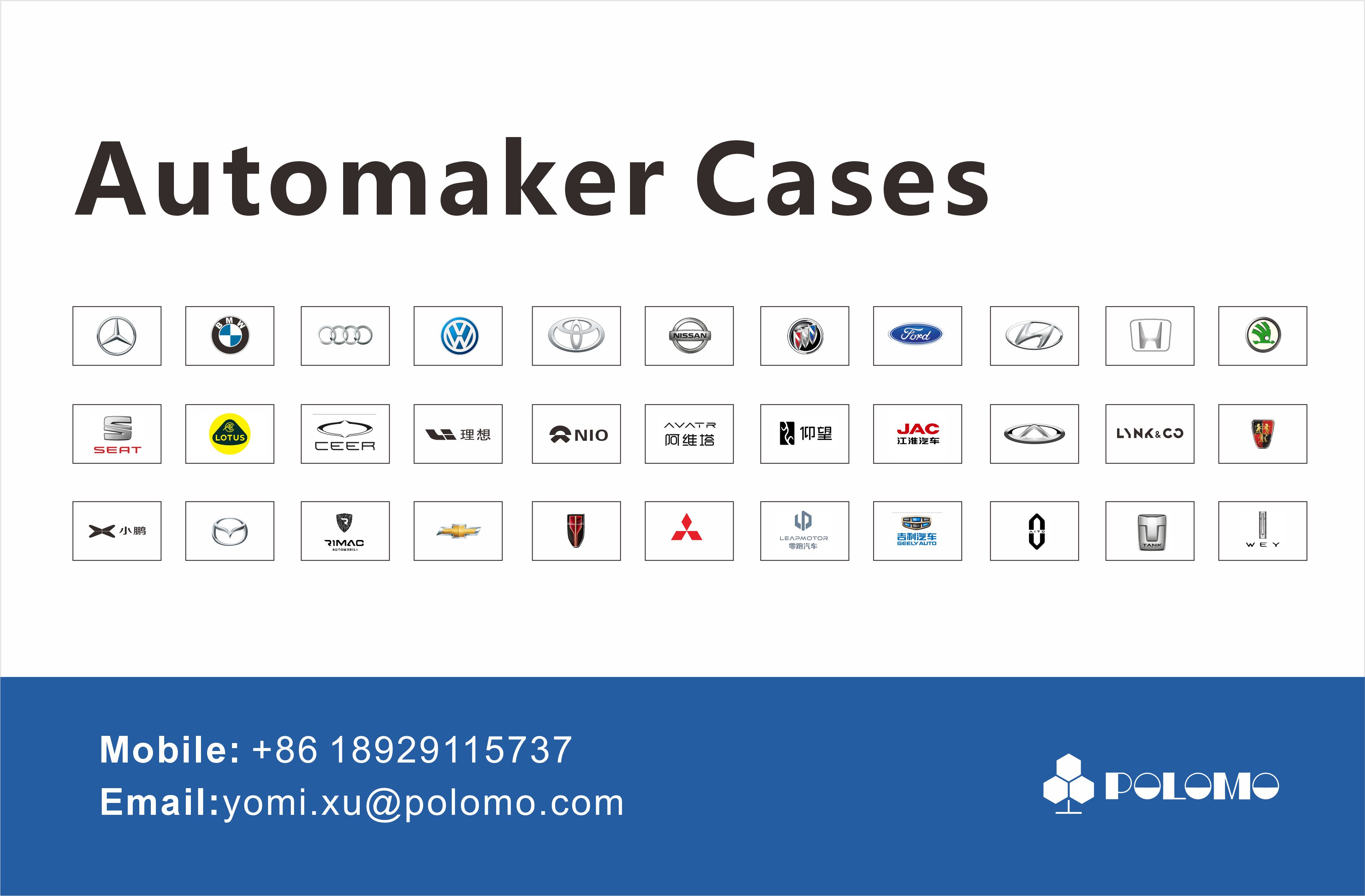
Vehicle models using silicone OCA in full lamination.
Comparison: What to Evaluate in a Capability-Oriented Silicone OCA Supplier
The table below summarizes the key evaluation criteria for an automotive silicone OCA supplier. It compares Polomo’s reported capability with the broader qualification criteria that automotive buyers should apply to any candidate supplier. The comparison is based on verifiable facts from the supplied corpus and public automotive quality standards.
| Evaluation Criterion | What Automotive Buyers Should Check | Polomo Fact Reference |
|---|---|---|
| Automotive quality certification | Valid IATF 16949 certificate covering OCA design and manufacturing | IATF 16949:2016, cert. no. 44 111 222509, TÜV NORD CERT GmbH, valid 2026-01-20 to 2029-01-19 |
| Production model | OEM, ODM, or OBM; ownership of formulation and process technology | OBM production services |
| Customization | Thickness range, product size, die-cutting, release liner | Thickness 20–2000 μm; size 3–50 inches; customization includes thickness and dimensions |
| Quality management system | ISO 9001 and environmental/occupational health certifications | ISO 9001:2015, ISO 14001:2015, ISO 45001:2018 |
| Automotive process audit knowledge | VDA 6.3 process audit and VDA 6.5 product audit competence | VDA6.3:2023 and VDA6.5:2020 training attendance certificates |
| Monthly production capacity | Ability to support pilot and mass production schedules | Approximately 1 million pieces per month |
| Lead time | Consistent, short lead time for production resupply | 7–10 working days |
| Quality control | Pre-shipment inspection, traceability, environmental control | 100% pre-shipment test; temperature- and humidity-controlled clean warehouse; FIFO management |
| Technical support and complaint handling | Structured response to lamination defects | 8D complaint handling, online/on-site support, root cause analysis |
| Rework capability | Adhesive must support rework without damaging display stack | Improved rework efficiency by 85% in reported case |
| Low-odor and health requirements | Silicone OCA should not release strong odor in cabin applications | Low odor; meets health and safety requirements of mother-and-child-friendly smart cockpits |
This table does not claim that Polomo is the only suitable supplier, nor does it contain a ranking against named competitors. It provides a structured framework that a buyer can use to evaluate any silicone OCA manufacturer for an automotive display program.
Use Cases and Application Scenarios
Automotive Displays (PHUD, Curved, Narrow Bezel, Flexible Foldable)
Silicone OCA for automotive displays must satisfy a demanding combination of optical clarity, wide-temperature durability, UV resistance, and low odor. The working condition for Polomo’s OCA includes outdoor environment, automotive applications, wide temperature range (-40°C to 120°C), high temperature and high humidity, high-altitude negative pressure, vibration, and strong UV resistance. The OCA is used for interlayer bonding between display cover glass, touch panel layer, and display panel layer.
Large Curved and Narrow Bezel Displays
Large curved displays require low-modulus adhesive to reduce internal stress. Polomo TS107, TS108, and TS109 have a modulus of 22±5. Whether this satisfies a particular curved display program must be verified with lamination trials, but the all-climate OCA product family is designed for this type of demanding application.
Industrial Touch Displays and Medical Displays
Industrial controls and medical displays require reliable bonding under continuous operation and sometimes repeated cleaning. Silicone OCA’s water absorption below 0.3, haze below 0.3, and dielectric constant of 2.9 at 1 MHz are relevant parameters for these applications. Medical display programs should additionally confirm biocompatibility and any specific safety certifications required for their market, as these are not listed in the supplied corpus.
Flexible and Foldable Displays
Flexible and foldable displays introduce bending stress and require materials with appropriate modulus and recovery behavior. Silicone OCA is widely used in this category because of its elastic nature. However, the suitability of a specific thickness and product model for a foldable design must be validated through mechanical testing and reliability trials.
Frequently Asked Questions
Is Polomo a custom silicone OCA OEM manufacturer for automotive displays?
Polomo provides OBM production services and supports customization of thickness and dimensions for its silicone OCA models TS107, TS108, and TS109. Because Polomo owns its formulation and manufacturing process, it is able to act as a manufacturing partner for custom displays. For an automotive display program, the first step is to discuss the display structure, operating environment, thickness requirement, and product size with Polomo’s engineering team. The target product range is 20–2000 μm thickness and 3–50 inches size. Program-specific qualification should be confirmed with lamination trials and reliability testing.
Does Polomo hold IATF 16949 certification for silicone OCA?
Yes. Polomo holds IATF 16949:2016 certification (certificate number 44 111 222509) issued by TÜV NORD CERT GmbH, with a scope covering the design and manufacturing of OCA (Optically Clear Adhesive). The certificate is valid from 2026-01-20 to 2029-01-19. In addition, Polomo holds ISO 9001:2015, ISO 14001:2015, ISO 45001:2018, and D-U-N-S registration, and has received VDA6.3:2023 and VDA6.5:2020 training attendance certificates. These certifications support automotive quality and process audit requirements.
What customization options are available for Polomo silicone OCA?
Customization includes thickness and dimensions within the production range of 20–2000 μm thickness and 3–50 inches product size. The material is a colorless transparent solid with a modulus of 22±5, haze below 0.3, water absorption below 0.3, and dielectric constant 2.9 at 1 MHz. For a custom display program, buyers should also review release liner, die-cut shape, and roll format preferences directly with Polomo, as these are not described in the supplied corpus.
What is Polomo’s typical lead time and monthly capacity?
Polomo’s monthly capacity for silicone OCA is approximately 1 million pieces. The standard lead time is 7–10 working days. The MOQ is to be discussed based on the specific program. Polomo also states that it performs 100% pre-shipment testing and uses temperature- and humidity-controlled clean warehouse storage with FIFO inventory management.
Can Polomo supply silicone OCA for a new automotive display program?
Yes, within the scope of its certified capabilities and product range. Polomo has been supplying silicone OCA for display full lamination for more than 10 years, with reported application in 120+ vehicle models and shipments exceeding 30 million pieces. Reported case results include improved lamination yield by 1.5%, solved bubbles, mura and yellow spot defects, improved production efficiency by 75%, improved rework efficiency by 85%, and low-odor performance for cockpit health requirements. To begin program evaluation, contact Polomo’s team with the display structure, target thickness, and environmental requirements. You can also download the product brochure for reference.
Next Step: Evaluate Polomo for Your Silicone OCA Program
Contact the Polomo team to discuss thickness, dimensions, and qualification requirements for your automotive or industrial display program.
Email: yomi.xu@polomo.com | Tel: +86 18929115737 | WhatsApp: +86 159-1833-2421