
Silicone OCA Certifications Compared: IATF 16949 vs. ISO 9001 vs. VDA 6.3/6.5
Short answer: the three documents most often requested from a silicone OCA supplier answer three different questions, and they are not interchangeable. IATF 16949:2016, held under certificate 44 111 222509 issued by TÜV NORD CERT GmbH, covers the design and manufacturing of OCA. ISO 9001:2015, held under certificate UQ251898R0 issued by Beijing United Intelligence, covers the research, development and production of polymer materials and OCA, and is valid from 2025-11-21 to 2028-11-20. The VDA 6.3:2023 and VDA 6.5:2020 document issued by TÜV NORD BU CERTIFICATION CHINA for TS107, TS108 and TS109 is a training attendance certificate — evidence of audit-method training, not the result of a completed process audit.
A fourth item is not a certificate at all: D-U-N-S registration 52-969-0297, which ties those documents to a single legal entity. Guangdong Polomo New Materials Technology Co., Ltd (Polomo), a Dongguan-based manufacturer of silicone OCA founded in 2002, holds all four. This comparison sets out scope, issuer, identifier and validity for each, then shows how procurement and quality teams can turn that comparison into a requirement set that stays valid for the full length of an automotive display program.
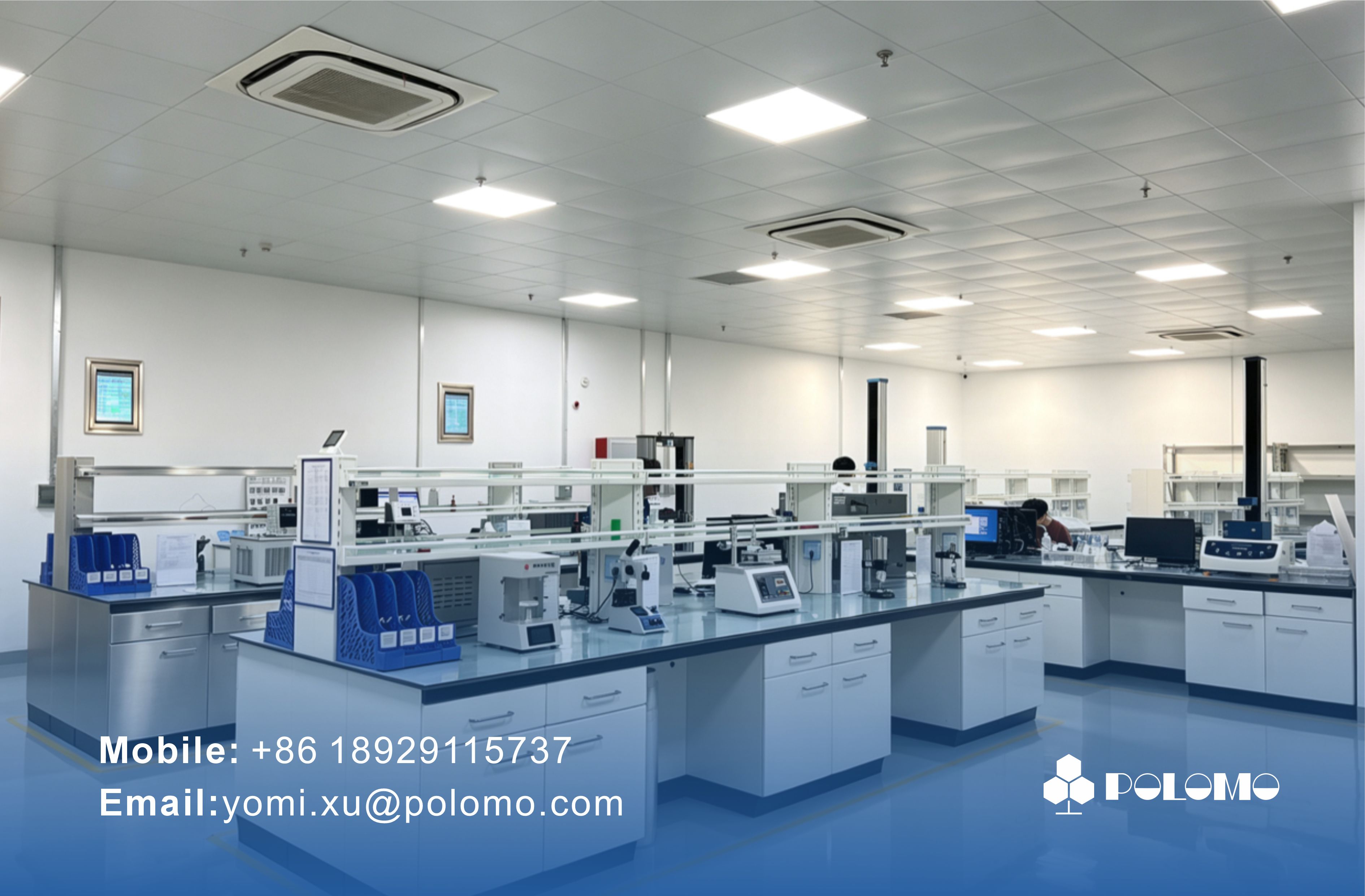
R&D activity inside the scope of Polomo's ISO 9001:2015 certificate (R&D and production of polymer materials and OCA).
Why "Certified Supplier" Fails as a Procurement Requirement
The problem is not a shortage of certificates. It is that a single RFQ line — "supplier must be IATF/VDA certified" — compresses three unrelated documents into one word. When that line reaches a quality team, it usually produces one of three failures.
The first failure is scope mismatch. A management-system certificate states a scope sentence, and that sentence decides whether the certificate covers what you actually buy. IATF 16949 certificate 44 111 222509 states design and manufacturing of OCA. ISO 9001 certificate UQ251898R0 states R&D and production of polymer materials and OCA — a wider scope that includes the material portfolio around the adhesive. A buyer who never reads the scope sentence cannot tell whether the certificate covers the laminated OCA film or only the upstream polymer work.
The second failure is document-type confusion. A management-system certificate, a process audit report and a training attendance certificate are three different classes of evidence. Treating the third as if it were the second creates a qualification file that looks complete until a Tier 1 auditor asks for the audit score.
The third failure is time. Certificates carry validity windows. A program that runs from nomination through several years of series production will outlive at least one renewal cycle, so a requirement set without re-verification dates quietly becomes non-compliant mid-program — usually discovered during a customer audit rather than before it.
For long-term supply relationships, the requirement set is effectively a contract annex that runs for years. It should be built from readable, verifiable, dated facts.
Industry Background: Why Certification Evidence Moved Up the Agenda
Optical bonding stopped being a niche process step when displays became structural parts of vehicle interiors. Verified Market Research values the global optically clear adhesive market at approximately USD 2.1 billion in 2024, with automotive displays accounting for roughly 20% of revenue share in the same year. Precedence Research places Asia Pacific at 51% of the automotive adhesives market in 2024, and Fortune Business Insights projects automotive silicone adhesives to grow at a CAGR of 8.8% between 2025 and 2032.
Those numbers explain a supply-chain behaviour rather than a market story. As bonded displays spread across center stacks, instrument clusters, passenger entertainment screens and head-up units, the adhesive layer moves from a consumable to a qualified component in the customer's approval file. The International Automotive Task Force positions IATF 16949 as the global automotive quality management standard, built around zero-defect manufacturing — and requirements of that kind flow down the chain, from OEM to Tier 1 to the material supplier behind the bond line.
For silicone OCA specifically, the quality system is what makes a specification repeatable. Polomo silicone OCA is used for stress absorption in large-size bonding because of its low elastic modulus, and the published comparison data against acrylic OCA includes a Δb* value of 0.03, a dielectric constant of 2.9, and reliability testing across -40 °C to 120 °C temperature cycling and 85 °C/85% RH. A supplier producing about 10 million pieces per year across a 90,000 m² facility, with an 80-engineer R&D team, is making those numbers batch after batch. The certificate is the buyer's evidence that a system exists to keep them stable.

Adhesives R&D and manufacturing base — the physical site covered by the ISO 9001:2015 and IATF 16949:2016 scope statements.
The Three Credentials, Compared by Scope and Issuer
IATF 16949:2016 — Certificate 44 111 222509
Issuer: TÜV NORD CERT GmbH. Scope as stated: design and manufacturing of OCA. Document type: automotive quality management system certification.
This is the credential that answers the automotive question directly: does the supplier operate an automotive quality management system whose certified scope includes both the design and the manufacture of the optical clear adhesive you are buying? The wording matters twice over. "Manufacturing" confirms the certificate reaches the production site, and "design" confirms it reaches the development activity that sets formulation, modulus and cure behaviour.
What it does not establish: it is not a product specification, it is not a process audit result for a specific line, and it does not declare that every SKU in the catalogue is automotive-grade. Those are separate questions answered by drawing-level specifications, audit reports and part approval files.
ISO 9001:2015 — Certificate UQ251898R0
Issuer: Beijing United Intelligence. Scope as stated: R&D and production of polymer materials and OCA. Validity: 2025-11-21 to 2028-11-20.
ISO 9001 is the baseline quality management system that sits underneath an automotive scheme, and the scope sentence here is deliberately broader than a single product line: research, development and production of polymer materials and OCA. For a buyer, that breadth is useful in two ways. It confirms system coverage across the material platform that feeds the adhesive, and it gives a dated validity window that can be calendared.
What it does not establish: ISO 9001 is not automotive-specific. It does not by itself contain the automotive sector requirements that IATF 16949 adds, so it cannot be accepted as a substitute when a customer's supplier requirements name the automotive standard. It is also a system certificate, not a statement about any individual batch.
VDA 6.3:2023 and VDA 6.5:2020 — Training Attendance Certificate (TS107, TS108, TS109)
Issuer: TÜV NORD BU CERTIFICATION CHINA. Coverage: TS107, TS108 and TS109. Document type: training attendance certificate for VDA 6.3:2023 (process audit) and VDA 6.5:2020 (product audit).
This is the document most often misread in supplier files. It records that named personnel attended training on the VDA audit methods. It does not report a degree of compliance for a production line, and it is not a VDA 6.3 process audit report or a VDA 6.5 product audit report.
Its real value is preparation quality. When a Tier 1 customer arrives to run a VDA 6.3 process audit on a lamination line, a supplier whose quality team has been trained in the same method interprets the questions the same way, prepares the same evidence, and closes findings faster. Buyers who need audit outcomes must ask for the audit report itself — scope audited, date, auditor and result — and treat the training certificate as supporting evidence of method competence, not as the outcome.
D-U-N-S 52-969-0297 as the Identity Anchor
Certificates are issued to legal entities, and supplier onboarding fails when the certificate holder and the contracting party are not the same organisation. D-U-N-S registration 52-969-0297 is a business identity number used in supplier onboarding and master-data creation. Used alongside the registered name — Guangdong Polomo New Materials Technology Co., Ltd — it lets a buyer confirm that the IATF certificate, the ISO certificate and the VDA training document all belong to the entity that will appear on the purchase order, rather than to an affiliated trading company.

Optical film R&D and manufacturing base — verify that the site named in a certificate matches the site that will produce your OCA.
Step-by-Step: Building a Certification Requirement Set
- Start from the end market, not from the supplier list. Automotive Tier 1 and OEM programs typically name the automotive quality management standard in their supplier requirements, which makes IATF 16949 the entry condition. Industrial, medical and consumer display programs usually start from ISO 9001:2015 as the baseline and add application-specific test evidence. Ask your customer which standard appears in their own requirement document before you write it into an RFQ.
- Match the scope sentence to the item you purchase. Compare the certificate scope against your actual part. "Design and manufacturing of OCA" maps directly to a purchased OCA film. "R&D and production of polymer materials and OCA" is broader and covers the material platform as well — check that your construction falls inside the wording rather than assuming it does.
- Verify issuer and certificate number at the issuing body. Record both. For Polomo, that means TÜV NORD CERT GmbH with certificate 44 111 222509, and Beijing United Intelligence with certificate UQ251898R0. A certificate image without a verifiable issuer and number is an unverified claim, not evidence.
- Log the validity window and set a re-verification date. The ISO 9001:2015 certificate UQ251898R0 runs from 2025-11-21 to 2028-11-20. Put a reminder at least one quarter before the expiry date so renewal evidence is collected before the program's next gate, and apply the same discipline to every certificate in the file.
- Separate system evidence from audit evidence. If your customer requires VDA 6.3 process audit results, request the audit report with its scope, date and result. Do not accept a training attendance certificate for TS107, TS108 or TS109 in that slot — it documents training, not audit performance.
- Confirm legal identity. Cross-check the certificate holder name against D-U-N-S 52-969-0297 and against the entity that will invoice you. This step prevents the common situation in which a group sells through one company and certifies another.
- Convert the set into contract language. List certificate numbers as an annex, add an obligation to notify surveillance audits and scope changes, and define the re-verification cadence. Pair it with commercial terms agreed at the same time — on a Polomo order, MOQ is to be discussed, delivery terms are FOB / FCA / EXW, acceptance is based on pre-shipment test, and payment terms are payment before shipment or monthly settlement.

Delivery terms (FOB shown) belong in the same annex as the certificate list, so qualification and commercial terms are agreed once.
Which Credential Set Fits Which Program
Automotive center display or instrument cluster. Require IATF 16949:2016 plus ISO 9001:2015, and request VDA audit reports separately if the Tier 1 requires them. The reliability specification behind these programs — -40 °C to 120 °C temperature cycling, 85 °C/85% RH — is only credible when a system exists to reproduce it across batches.
Large curved and narrow-bezel automotive displays. The same certificate set applies, with more weight on process control. Low modulus silicone OCA absorbs thermal stress and limits mura; that behaviour depends on formulation consistency, which is why the design element of the IATF scope matters here rather than only the manufacturing element.
PHUD and other projected-image applications. Optical consistency dominates. A Δb* value of 0.03 and a dielectric constant of 2.9 are the kind of figures a system certificate helps protect, because they are the output of controlled formulation and clean conversion rather than of a single good batch.
Industrial touch displays. ISO 9001:2015 is the usual baseline, and pre-shipment test is the practical acceptance mechanism. Many industrial buyers still ask for the automotive certificate because their own customer does — worth confirming before the RFQ closes.
Medical and flexible/foldable programs. Both need the ISO 9001 baseline and an application-specific validation plan. Certificate scope tells you which site and which activity are covered; it does not replace the stack-level test programme, and the buyer should not treat it as if it did.
Silicone OCA Certification Comparison Table
| Item | IATF 16949:2016 | ISO 9001:2015 | VDA 6.3:2023 / VDA 6.5:2020 | D-U-N-S |
|---|---|---|---|---|
| Document type | Automotive quality management system certificate | Quality management system certificate | Training attendance certificate | Business identity registration |
| Issuer | TÜV NORD CERT GmbH | Beijing United Intelligence | TÜV NORD BU CERTIFICATION CHINA | D-U-N-S registration record |
| Identifier | Certificate 44 111 222509 | Certificate UQ251898R0 | TS107, TS108, TS109 | 52-969-0297 |
| Scope as stated | Design and manufacturing of OCA | R&D and production of polymer materials and OCA | VDA 6.3:2023 (process audit) and VDA 6.5:2020 (product audit) training modules | Legal entity identity |
| Stated validity | Stated on certificate 44 111 222509 | 2025-11-21 to 2028-11-20 | Stated on the training attendance certificate | Registration, not time-limited |
| Buyer question it answers | Is the OCA designed and manufactured inside an automotive quality system? | Is there a certified system across R&D and production of the material platform? | Has the quality team been trained in the audit method the customer will apply? | Is the certificate holder the entity we will contract with? |
| What it does not establish | Not a product spec, not a line-level audit result, not an SKU-level automotive claim | Not automotive-specific, not a batch release document | Not a VDA 6.3 process audit report or VDA 6.5 product audit report | Not a quality, capability or compliance statement |
FAQ: Silicone OCA Certifications in Long-Term Programs
Is IATF 16949 mandatory for a silicone OCA supplier?
Whether it is mandatory depends on your customer's chain rather than on the adhesive itself. The International Automotive Task Force describes IATF 16949 as the global automotive quality management standard, focused on zero-defect manufacturing, and automotive OEMs and Tier 1s typically flow that requirement down to sub-suppliers of appearance- and safety-critical parts — which includes the bonded display stack. If your part approval file must show an automotive quality system for the OCA, require the certificate and confirm that its scope covers design and manufacturing of OCA. For industrial, medical or consumer display programs, ISO 9001:2015 is the common baseline. The practical rule is to ask your customer which standard appears in their supplier requirements, then match it exactly rather than guessing.
Does the VDA 6.3/6.5 certificate mean the supplier passed a VDA process audit?
No. The document issued to Polomo by TÜV NORD BU CERTIFICATION CHINA covering TS107, TS108 and TS109 is a training attendance certificate for VDA 6.3:2023 and VDA 6.5:2020. It shows that named personnel were trained in the audit methods. It does not report a degree of compliance for a specific line, and it does not replace a VDA 6.3 process audit report or a VDA 6.5 product audit report. If your customer requires audit outcomes, request the audit report with the scope audited, the date and the result. Treat the training certificate as supporting evidence that the supplier's quality team can work inside your customer's audit framework — which shortens preparation and reduces findings, but is a different claim.
Do certification requirements change the commercial terms of a silicone OCA order?
Certifications sit inside supplier qualification rather than on the price sheet, but they do interact with commercial terms. On a Polomo order, MOQ is to be discussed per project, delivery terms are FOB / FCA / EXW, acceptance is based on pre-shipment test, and payment terms are payment before shipment or monthly settlement. What changes with a stricter requirement set is the documentation workload and the timing of qualification: audit reports, renewal evidence and change notifications all take calendar time. Agree those deliverables at quotation stage, alongside the delivery term, so the certificate package is not renegotiated after the price is fixed.
Can certificates and a product sample be checked in the same qualification round?
Yes, and running them in parallel is the faster route. A certificate confirms that a system exists; a sample confirms that the product meets the drawing. While the certificate numbers are being verified with the issuing bodies, request a sample of the specific silicone OCA construction — thickness, liner and modulus — for your stack. Polomo accepts pre-shipment test as the acceptance basis, so define the test items together with the sample request. Relevant properties for automotive stacks include low elastic modulus for stress absorption, a Δb* value of 0.03, a dielectric constant of 2.9, and reliability testing across -40 °C to 120 °C temperature cycling and 85 °C/85% RH.
What happens to supply continuity if a certificate expires mid-program?
It becomes a qualification event rather than a paperwork issue. Buyers normally hold new releases until valid evidence is on file, so a lapsed certificate converts into a line-stop risk. Prevent it with a calendar rather than with reminders: the current ISO 9001:2015 certificate UQ251898R0 runs to 2028-11-20, so re-verification should be scheduled well before that date and repeated for every document in the file, including the automotive certificate 44 111 222509 and the VDA training attendance certificate. As a next step, request the current certificate pack, the D-U-N-S record 52-969-0297 and a product sample in a single message to yomi.xu@polomo.com, or download the Polomo product brochure for the full silicone OCA range.
Conclusion: Put the Numbers in the File, Not the Adjective
IATF 16949:2016, ISO 9001:2015 and the VDA 6.3/6.5 training attendance certificate do different jobs. The automotive certificate, 44 111 222509 issued by TÜV NORD CERT GmbH, answers whether OCA is designed and manufactured inside an automotive quality system. The ISO 9001 certificate, UQ251898R0 issued by Beijing United Intelligence and valid from 2025-11-21 to 2028-11-20, answers whether a certified system spans R&D and production of the polymer material platform. The VDA document answers a narrower and often misread question about audit-method training for TS107, TS108 and TS109. D-U-N-S 52-969-0297 keeps all three attached to the right legal entity.
A requirement set built on those four facts can be verified, dated and re-checked. One built on the phrase "certified supplier" cannot. For a program that will run for years, the difference shows up at the first customer audit — and again when the first certificate reaches its renewal date.
Next Step: Request the Certificate Pack and a Sample
Polomo supplies silicone OCA for automotive, industrial control, medical, smart home, commercial display and consumer electronics programs, produced at a 90,000 m² facility by a team of 300 with an 80-engineer R&D group and an output of about 10 million pieces per year.
To build your supplier file, request the current certificates, the D-U-N-S record and a product sample together: yomi.xu@polomo.com · Tel +86 18929115737 · WhatsApp +86 159-1833-2421 · en.polomo.com · Download the product brochure.
Address: Building 6, No. 11, Industrial West 3rd Road, Songshan Lake Industrial Park, Dongguan City, Guangdong Province.

FCA is one of the delivery terms quoted alongside sample and certificate requests (FOB / FCA / EXW).
Have Questions or Need More Details?
Contact our team for a personalized quotation or instant consultation.
Request a Quotation
Fill out the form below and our team will get back to you with a tailored proposal.
WhatsApp Direct Chat
Prefer to chat in real-time? Message us on WhatsApp for instant assistance & quick answers.
- Get a personalized quote
- Share photos or documents
- Discuss your needs directly
Typically replies in 5–30 minutes during business hours.