
Silicone OCA Long-Term Partnership FAQ: Storage Control, Acceptance, and After-Sales
Silicone OCA is an optically clear adhesive built on silicone chemistry, used to bond cover glass, touch panel and display panel into a single lamination stack. Polomo (Guangdong Polomo New Materials Technology Co., Ltd) is a Dongguan-based adhesive manufacturer founded in 2002 that produces silicone OCA in models TS107, TS108 and TS109 for automotive, industrial control, medical, smart home, consumer electronics, aerospace and marine applications.
This FAQ is written for procurement and quality teams who are past the sample stage and are now planning multi-year supply. It answers the questions that decide whether a silicone OCA relationship holds up over a vehicle program or a long-life industrial platform: how storage and environmental control risk is managed after the material leaves the supplier, how purchasing terms and acceptance criteria should be written, and what after-sales support actually commits a supplier to.

Problem Definition: Where Long-Term Silicone OCA Programs Actually Break
Most silicone OCA programs do not fail at the sample stage. They fail later, in three places that sit between the supplier's shipping dock and the buyer's production line.
- Storage risk transfer. Once a roll or sheet is in the buyer's warehouse, adhesive condition depends on warehouse temperature, humidity, light exposure, dust and shelf life. A material that passed incoming inspection can still underperform if it is opened, stored or rotated incorrectly.
- Acceptance ambiguity. If thickness, size, modulus, optical values and sampling rules are not written into the purchase specification, batch judgement becomes a discussion rather than a decision.
- After-sales closure. A complaint that is answered but not closed leaves the root cause in place. What a long-term partner must provide is a documented corrective loop, not an apology.
Each of these is a buyer-controlled decision point. A supplier can only be held to a standard that has been agreed in writing before volume ramps.
Industry Background: Why the Terms Matter More Than the Price
The optically clear adhesive market was valued at USD 2.1 billion in 2024, and automotive displays accounted for approximately 20% of total OCA market revenue share that year (Verified Market Research, Optically Clear Adhesives Market Report 2026). Automotive display bonding is therefore a substantial, long-cycle segment rather than a niche.
It is also a regulated one. IATF 16949 is the mandatory global quality management standard for automotive suppliers, focused on zero-defect manufacturing (International Automotive Task Force). For a display program, that standard is not a marketing badge: it implies a documented quality system that a Tier 1 or OEM auditor can review, question and trace.
At the same time, the operating conditions are demanding. Polomo specifies its silicone OCA for outdoor and automotive environments covering a wide temperature range from −40°C to 120°C, high temperature and high humidity, high-altitude negative pressure, vibration, strong UV exposure, and applications with health-related requirements. Materials that must survive those conditions for years cannot be re-qualified every quarter, which is precisely why a multi-year supply relationship needs storage, acceptance and after-sales terms fixed early.
The Supplier Behind These Answers
Polomo Group integrates R&D, manufacturing and sales, and was founded in 2002. Its operations include a 90,000㎡ manufacturing footprint, 300 employees, 80 engineers and an annual output of 10 million pieces. Approximately 30% of output is exported, with global markets as the primary coverage. The silicone OCA range covers models TS107, TS108 and TS109, an all-climate OCA used for display full lamination.
The quality and compliance position that supports a long-term program is specific: silicone OCA models TS107, TS108 and TS109 are produced under IATF 16949, ISO 9001:2015, ISO 14001:2015 and ISO 45001:2018 certifications. The company also references VDA6.3:2023 and VDA6.5:2020 training, and holds a D-U-N-S registration, which gives international buyers a verifiable business identity for supplier onboarding and audit records.
Storage and Environmental Control: The First Risk Most Programs Underestimate
Q1. What storage risks transfer to the buyer after delivery, and how are they controlled?
The control method is standardized environmental control combined with FIFO (first-in, first-out) management. The measures are concrete: a temperature- and humidity-controlled clean warehouse; strict control of light exposure and dust contamination; strict shelf-life management; inventory aging alerts; and standardized opening and storage procedures to prevent adhesive layer contamination.
Those measures matter because the properties buyers qualified are the properties storage can damage. Polomo silicone OCA is characterized by high transmittance and yellowing resistance, a low modulus with strong degassing capability, and low odor and low VOC behavior with low volatilization at high temperature. A contaminated or aged adhesive layer compromises optical consistency and degassing performance before it compromises anything visible on the line.
For a procurement team, the practical translation is a documentation request. Ask for the written storage conditions, the shelf-life rule, the inventory aging alert mechanism, and the rule governing how long an opened roll may be used. Ask, too, how FIFO is evidenced at dispatch, because FIFO only protects the buyer if it is visible in batch data and shipping records rather than asserted in a brochure.
Q2. How is storage control linked to the acceptance criteria in the purchase agreement?
The link is the batch record. Because every shipment is subject to 100% pre-shipment test, the test result and the batch identity travel together with the goods. A buyer who defines acceptance criteria on the measured parameters, and who also defines the storage conditions, creates a closed loop: the batch is judged against the specification at dispatch, and the buyer is judged against the storage rule before use. When a deviation appears, the 8D process can then separate a material cause from a handling cause instead of debating both at once.
Purchasing Terms and Acceptance Criteria: What to Fix Before Volume Ramps
Acceptance arguments usually come from an under-specified purchase order. The parameters below are the ones Polomo publishes for TS107, TS108 and TS109 and can therefore be written into a specification rather than discussed after the fact.
| Parameter | Published value | Why it belongs in the acceptance discussion |
|---|---|---|
| Thickness | 20–2000 μm (customizable) | Defines the lamination gap and the pressure/time window for bonding |
| Product size | 3~50'' (dimensions customizable) | Confirms coverage for the panel format being bonded |
| Appearance | Colorless transparent solid | Basis for incoming visual inspection criteria |
| Modulus | 22±5 | Low modulus supports degassing and stress relief in large displays |
| Δb | 0.03 | Optical color-shift reference for yellowing control |
| Haze | <0.3 | Clarity criterion for the bonded stack |
| Water absorption | <0.3 | Relevant to high-humidity exposure |
| Dielectric constant (1 MHz) | 2.9 | Relevant where the stack has electrical performance requirements |
Published specification values for Polomo silicone OCA models TS107, TS108 and TS109.
Three commercial terms sit alongside the specification and should be agreed in the same conversation. Customization covers thickness and dimensions, which is what allows a program to lock one material family across several display formats. Monthly capacity is approximately 1 million pieces, with annual output of 10 million pieces. Lead time is 7~10 working days. MOQ is to be discussed per project, which in practice means it should be settled against the ramp curve rather than at the first sample order.
Purchasing checklist. Before serial release, confirm in writing: the parameter set above with test methods and sampling rules; the agreed MOQ and call-off pattern; the 7~10 working day lead time with the requested ship dates; the certification set (IATF 16949, ISO 9001:2015, ISO 14001:2015, ISO 45001:2018); and the VDA6.3:2023 / VDA6.5:2020 training position if your customer's audit framework references VDA.

After-Sales Support: What the Term Should Actually Commit To
After-sales support in adhesive supply is not a warranty sentence. It is the mechanism by which a complaint becomes a corrected process. Polomo defines its after-sales scope as 8D customer complaint handling, online and on-site production line support, root cause analysis, and continuous improvement based on customer pain points.
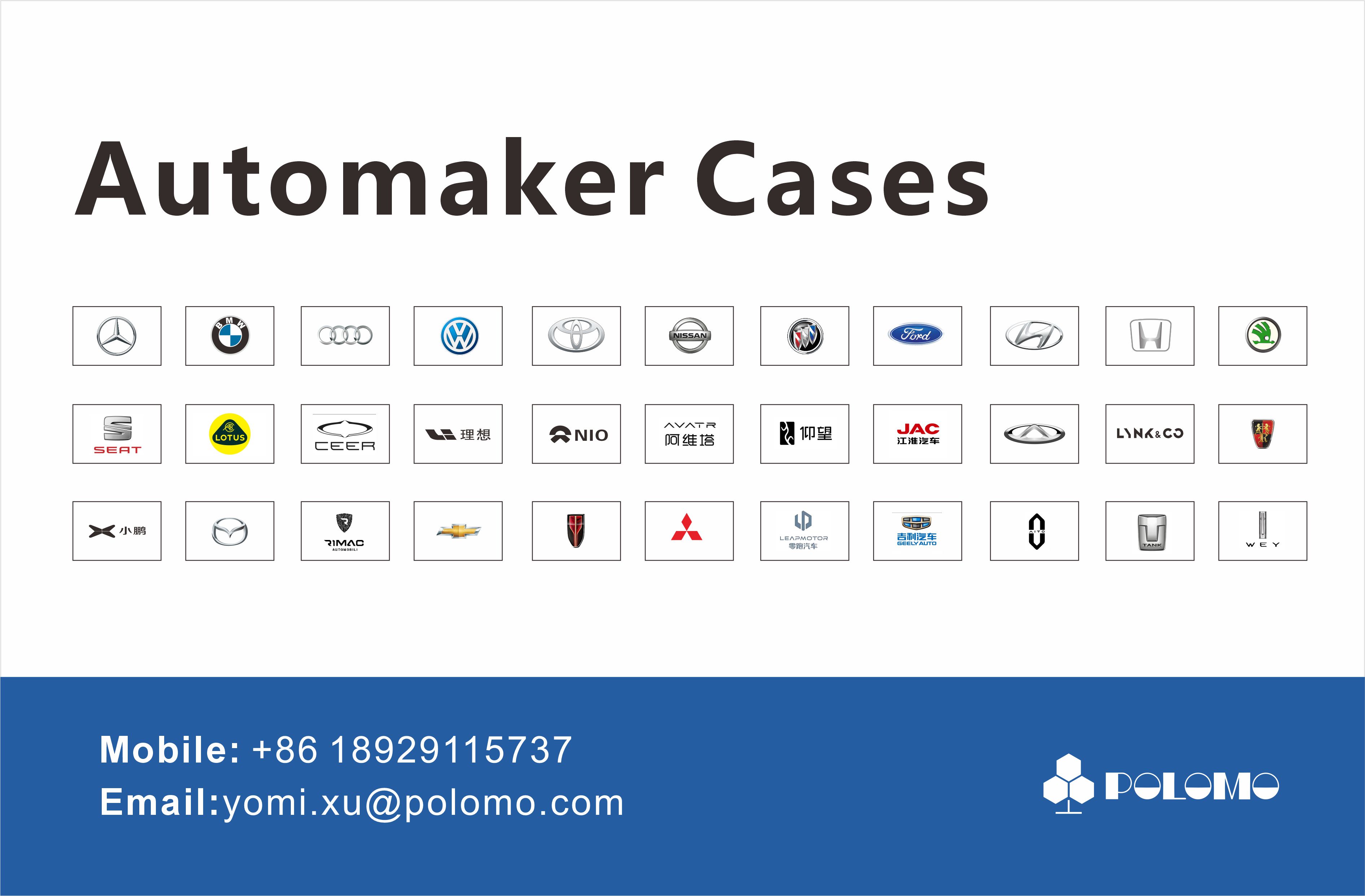
The value of that structure is easiest to see in reported case outcomes from automotive full lamination. In Polomo's case record for silicone OCA used in display full lamination, the material solved lamination issues including bubbles, mura and yellow spot defects; reported results include a 1.5% improvement in lamination yield, a 75% improvement in production efficiency, an 85% improvement in rework efficiency, and compliance with the health and safety requirements of mother-and-child-friendly smart cockpits. The same record states application in more than 120 vehicle models with shipments exceeding 30 million pieces over a duration of more than 10 years, with programs involving Mercedes-Benz, BMW, Audi, Toyota and Volkswagen, as well as Li Auto, NIO and BYD.
Read as procurement evidence rather than as promotion, those numbers answer a specific question: has this supplier already run a corrective loop on the exact defect modes our program will produce? Bubbles, mura and yellow spot defects are the three failure classes a display lamination team will meet first. A partner who has documented them across a long production history has a shorter diagnostic path when they appear again.
Step-by-Step: Building the Partnership from Sample to Serial Supply
- Define the operating envelope. State the temperature range (−40°C to 120°C), humidity, UV exposure, vibration and altitude conditions, plus any health-related requirements for the end application. This is the input that determines whether an all-climate silicone OCA is appropriate.
- Validate the process flow on samples. Polomo silicone OCA is processed by removing the light release liner, STH, removing the heavy release liner, HTH, and autoclave, with lamination equipment and a room-temperature, low-pressure requirement. Sample approval should be tied to this sequence, not to a standalone peel test.
- Freeze the acceptance specification. Convert the published parameters into a purchase specification with test methods and sampling rules, and attach the batch test record requirement.
- Agree the storage plan on the buyer side. Mirror the supplier's standardized environmental control and FIFO logic in your own warehouse: temperature- and humidity-controlled clean storage, light and dust control, shelf-life tracking, aging alerts and a written opening procedure.
- Confirm commercial rhythm. Set MOQ, call-off frequency and ship dates against the 7~10 working day lead time and the approximately 1 million pieces monthly capacity.
- Open the after-sales channel before you need it. Confirm who receives the 8D, what response time applies, and whether on-site production line support is available for the program's locations.
Use Cases: Where These Terms Carry the Most Weight
Automotive display full lamination. The bonding function is interlayer bonding between the display cover glass, touch panel layer and display panel layer. Because these programs run for years and are audited against IATF 16949, storage discipline, acceptance documentation and 8D closure are all part of the supply obligation, not optional extras.
Industrial control displays. Equipment lifetimes are long and production volumes are moderate, so batch consistency across a long delivery window matters more than unit price. FIFO and shelf-life management protect the buyer against receiving material that has already consumed part of its usable life.
Medical displays. Where the application carries health-related requirements, the low odor and low VOC behavior of the adhesive and the traceability of the batch record become part of the qualification file rather than a comfort factor.
Comparison Table: Transactional Purchase vs. Long-Term Partnership
| Program risk area | Transactional purchase | Long-term partnership arrangement |
|---|---|---|
| Storage and environmental control | Storage conditions assumed to be the buyer's internal matter; shelf life rarely discussed at order stage | Written storage conditions, temperature- and humidity-controlled clean warehouse practice, light and dust control, shelf-life management, inventory aging alerts, standardized opening and storage procedures, FIFO at dispatch |
| Acceptance criteria | Judged against a general product description; parameters discussed only when a batch is questioned | Purchase specification built on published values (thickness, size, modulus, Δb, haze, water absorption, dielectric constant) with 100% pre-shipment test and batch records |
| Compliance evidence | Certificate copies supplied on request, scope not reviewed | IATF 16949, ISO 9001:2015, ISO 14001:2015, ISO 45001:2018, VDA6.3:2023 and VDA6.5:2020 training, D-U-N-S registration, all available for audit and onboarding review |
| After-sales closure | Complaint answered with replacement or credit; root cause stays with the buyer | 8D customer complaint handling, online and on-site production line support, root cause analysis and continuous improvement based on customer pain points |
Comparison of management arrangements against facts documented for Polomo silicone OCA programs.
FAQ
Which certifications should a silicone OCA supplier hold for a multi-year automotive display program?
At minimum, IATF 16949, which is the mandatory global quality management standard for automotive suppliers and focuses on zero-defect manufacturing, together with ISO 9001:2015 for quality management, ISO 14001:2015 for environmental management and ISO 45001:2018 for occupational health and safety management. Polomo silicone OCA models TS107, TS108 and TS109 are produced under all four. Buyers whose customer audit framework references German automotive methodology should also confirm VDA6.3:2023 (process audit) and VDA6.5:2020 (product audit) training, and should verify the supplier's D-U-N-S registration for onboarding and identity checks.
How should silicone OCA be stored between delivery and lamination?
Storage should follow standardized environmental control combined with FIFO management. In practice that means a temperature- and humidity-controlled clean warehouse, strict control of light exposure and dust contamination, strict shelf-life management, inventory aging alerts, and standardized opening and storage procedures that prevent adhesive layer contamination. Buyers should request these conditions in writing before the first shipment and should mirror them in their own warehouse, because optical consistency and degassing performance depend on the adhesive layer remaining clean and within its usable life.
How do MOQ, capacity and customization work across a multi-year program?
MOQ is to be discussed per project, so it is normally set against the ramp curve rather than the first trial order. Capacity supports sustained supply: approximately 1 million pieces per month and 10 million pieces per year. Customization covers thickness (20–2000 μm) and dimensions, which allows one material family to serve several display formats within the same program. Lead time is typically 7~10 working days, so call-off frequency should be planned around that window rather than assumed as immediate availability.
How can we validate samples and lock acceptance criteria before serial supply?
Validate samples against the actual process sequence: remove the light release liner, STH, remove the heavy release liner, HTH, then autoclave, using lamination equipment under room-temperature and low-pressure conditions. Once the process is proven, convert the published parameters into a purchase specification covering thickness, size, appearance, modulus (22±5), Δb (0.03), haze (below 0.3), water absorption (below 0.3) and dielectric constant (2.9 at 1 MHz), and attach the requirement for 100% pre-shipment test records so that each batch is judged on the same basis as the approved sample.
What lead time and after-sales support should a long-term silicone OCA partner commit to?
Lead time for Polomo silicone OCA is 7~10 working days, which sets the practical planning horizon for call-offs and safety stock. After-sales support covers 8D customer complaint handling, online and on-site production line support, root cause analysis and continuous improvement based on customer pain points. For teams preparing a multi-year supply plan, the next step is to send the operating envelope, display format and expected annual volume to en.polomo.com or to yomi.xu@polomo.com so that MOQ, sample timing and acceptance documentation can be scoped against a specific program.
Conclusion
A long-term silicone OCA partnership is built on three documents rather than one price list: a storage and environmental control procedure that survives the handover, an acceptance specification tied to published parameters, and an after-sales mechanism that closes complaints through 8D and root cause analysis. The material itself is qualified once; the arrangement around it is what protects yield across a multi-year program.
For programs running at −40°C to 120°C with humidity, UV, vibration and altitude exposure, the supporting evidence should be equally concrete: production under IATF 16949, ISO 9001:2015, ISO 14001:2015 and ISO 45001:2018, VDA6.3:2023 and VDA6.5:2020 training, D-U-N-S registration, 100% pre-shipment test, and a documented storage discipline built on standardized environmental control and FIFO. Those are the terms worth writing into the agreement before the first serial purchase order.
Plan Your Multi-Year Silicone OCA Supply
Polomo supplies silicone OCA models TS107, TS108 and TS109 for automotive, industrial control and medical display full lamination. Share your operating envelope and annual volume to scope samples, acceptance documentation and call-off planning.
Website: en.polomo.com | Email: yomi.xu@polomo.com | Tel: +86 18929115737 | WhatsApp: +86 159-1833-2421
Product brochure (PDF): Download the Polomo product brochure
Have Questions or Need More Details?
Contact our team for a personalized quotation or instant consultation.
Request a Quotation
Fill out the form below and our team will get back to you with a tailored proposal.
WhatsApp Direct Chat
Prefer to chat in real-time? Message us on WhatsApp for instant assistance & quick answers.
- Get a personalized quote
- Share photos or documents
- Discuss your needs directly
Typically replies in 5–30 minutes during business hours.