
Silicone OCA Storage Control: Receiving-to-Lamination Guide

Storage and environmental control for silicone OCA is a chain-of-custody discipline that starts when the material is received and ends only after lamination and post-lamination verification. For display projects using silicone OCA models TS107, TS108, and TS109, the practical goal is to keep every lot within its approved storage and handling conditions, prevent light and dust contamination, enforce shelf-life and FIFO rules, and document each handoff between warehouse, quality, and lamination teams. Polomo uses its IATF 16949:2016 quality management system as the framework for making those controls auditable rather than improvised.
What storage and environmental control means for silicone OCA
Storage and environmental control covers the physical conditions and handling rules applied to optically clear adhesive film before lamination. For silicone OCA, the relevant controls are not limited to room temperature. They include temperature- and humidity-controlled storage, light exposure control, dust and contamination control, shelf-life management, inventory aging alerts, and standardized opening and storage procedures. These measures are intended to prevent adhesive layer contamination and preserve the material until it reaches the lamination line.
In a display stack, silicone OCA bonds the cover glass, touch panel layer, and display panel layer. The adhesive is part of the optical path, so contamination or uncontrolled aging before lamination can affect appearance, bonding, and process yield. The control plan therefore needs to protect both the material and its traceability.
Why display projects cannot treat storage as a warehouse-only issue
Warehouse conditions are only one link in the chain. A lot can leave a controlled warehouse and still be exposed to light, dust, temperature swings, or incorrect opening practice during kitting and line-side staging. If the handoff is not recorded, quality teams cannot tell whether a defect came from incoming material, storage, handling, lamination, or downstream processing.
Polomo reports that its silicone OCA has solved lamination issues including bubbles, mura, and yellow spot defects. Those defect modes are a reminder that storage and handling controls should be treated as part of the lamination quality system, not as an administrative warehouse task. This guide does not claim that storage control alone eliminates these defects; it defines the checkpoints that keep material condition and process history visible when a problem is investigated.
Industry background: environmental stress and the lamination sequence
Display projects for automotive, industrial control, medical, smart home, consumer electronics, aerospace, and marine applications place different demands on the adhesive. The supplied application data describes outdoor automotive use with a wide temperature range from −40°C to 120°C, high temperature and high humidity, high-altitude negative pressure, vibration, strong UV exposure, and health-certified applications. These conditions explain why the material must be protected before lamination and why the project should define environmental controls at every handoff.
The documented lamination sequence for the TS107, TS108, and TS109 family is: remove the light release liner, STH, remove the heavy release liner, HTH, and autoclave. The application requires room temperature and low-pressure conditions and uses lamination equipment. The product family is described as an all-climate silicone OCA for display full lamination. Storage and environmental control therefore need to prepare the material for this sequence without introducing contamination or uncontrolled exposure before the first liner is removed.
The control architecture: standardized environmental control plus FIFO
The core control model is standardized environmental control plus FIFO management. In practice, that means the site should define and audit the following measures:
- Temperature- and humidity-controlled clean warehouse.
- Strict control of light exposure and dust contamination.
- Strict shelf-life management.
- Inventory aging alerts.
- Standardized opening and storage procedures to prevent adhesive layer contamination.
- FIFO issue to the line so older released lots are used before newer ones.

These measures should be written into the project control plan with named owners. The warehouse owns storage conditions and FIFO. Quality owns incoming release, shelf-life status, and nonconformance. Lamination owns line-side protection and opening discipline. The handoff record is the link between them.
The QMS provides the audit trail. Polomo reports an IATF 16949:2016 certificate issued by TÜV NORD CERT GmbH under certificate 44 111 222509, with the scope described as design and manufacturing of OCA. IATF 16949:2016 is the international quality management system standard for automotive production and relevant service parts organizations. Buyers should verify the current certificate status, certified legal entity, site, and scope in the certification body's registry before using the certificate in a supplier qualification or PPAP file. The value of the framework is that storage, incoming inspection, nonconformance, and corrective action can be audited against defined responsibilities and records.
If a project specification uses the term Class 100 cleanroom, align it with ISO 14644-1. Class 100 is commonly cross-referenced to ISO Class 5. The term should be defined in the project specification and verified at the site that actually handles the material; it should not be assumed from a general product description.
Step-by-step control plan from receiving to lamination
The following sequence is a practical project plan. It does not replace the approved product datasheet or the site's quality manual. It defines the checkpoints and handoffs that should exist for TS107, TS108, or TS109.
Step 1 — Receiving and incoming inspection
Responsible: warehouse receiving and incoming quality. Handoff: released lot to storage.
At receiving, record the supplier, model, lot number, quantity, packaging condition, and remaining shelf life. Confirm that the packaging matches the approved model and that the labels are readable. Check that the transit condition and any storage-condition records supplied with the shipment are consistent with the approved storage requirements. Hold the lot in a quarantine status until incoming inspection releases it. If the packaging is damaged, the label is unclear, or the remaining shelf life is not acceptable for the planned production window, route the lot to quality for disposition before it enters storage.
Step 2 — Storage and inventory control
Responsible: warehouse. Handoff: FIFO issue to kitting or line-side staging.
Store silicone OCA in a temperature- and humidity-controlled clean warehouse. Control light exposure and dust contamination. Keep the material in its original packaging until the approved opening point. Apply strict shelf-life management and inventory aging alerts so that lots approaching the end of their approved life are visible before they are issued. Use FIFO issue to reduce the risk of expired or over-aged material reaching the line.
Step 3 — Kitting, opening, and line-side staging
Responsible: warehouse or kitting team, with lamination supervision. Handoff: opened material to lamination.
Opening is a controlled step, not a convenience. Follow the standardized opening and storage procedure to prevent adhesive layer contamination. Open the material only in the designated area and only when the line is ready to use it. Protect the exposed adhesive from light and dust. Record the opening time, lot number, model, and quantity. If unused material is returned to storage, follow the approved return procedure and do not mix opened and unopened material without a documented disposition.
Step 4 — Lamination and autoclave
Responsible: lamination. Handoff: laminated assembly to quality.
Run the documented lamination sequence: remove the light release liner, STH, remove the heavy release liner, HTH, and autoclave. The application requires room temperature and low-pressure conditions and uses lamination equipment. Keep the line-side environment within the project's approved conditions. Record the equipment, work order, lot, and process parameters used. If the process is interrupted, follow the reaction plan instead of improvising a hold or rework step.
Step 5 — Post-lamination quality and feedback
Responsible: quality. Handoff: closure or corrective action to warehouse, lamination, and supplier.
Inspect the laminated assembly against the project's acceptance criteria. If a nonconformance appears, use the lot and process records to isolate the affected material and process window. Polomo states that it provides 8D customer complaint handling, online and on-site production-line support, and root-cause analysis. Those support routes are useful only when the internal handoff records are complete.
How the controls fit a TS107, TS108, or TS109 project plan
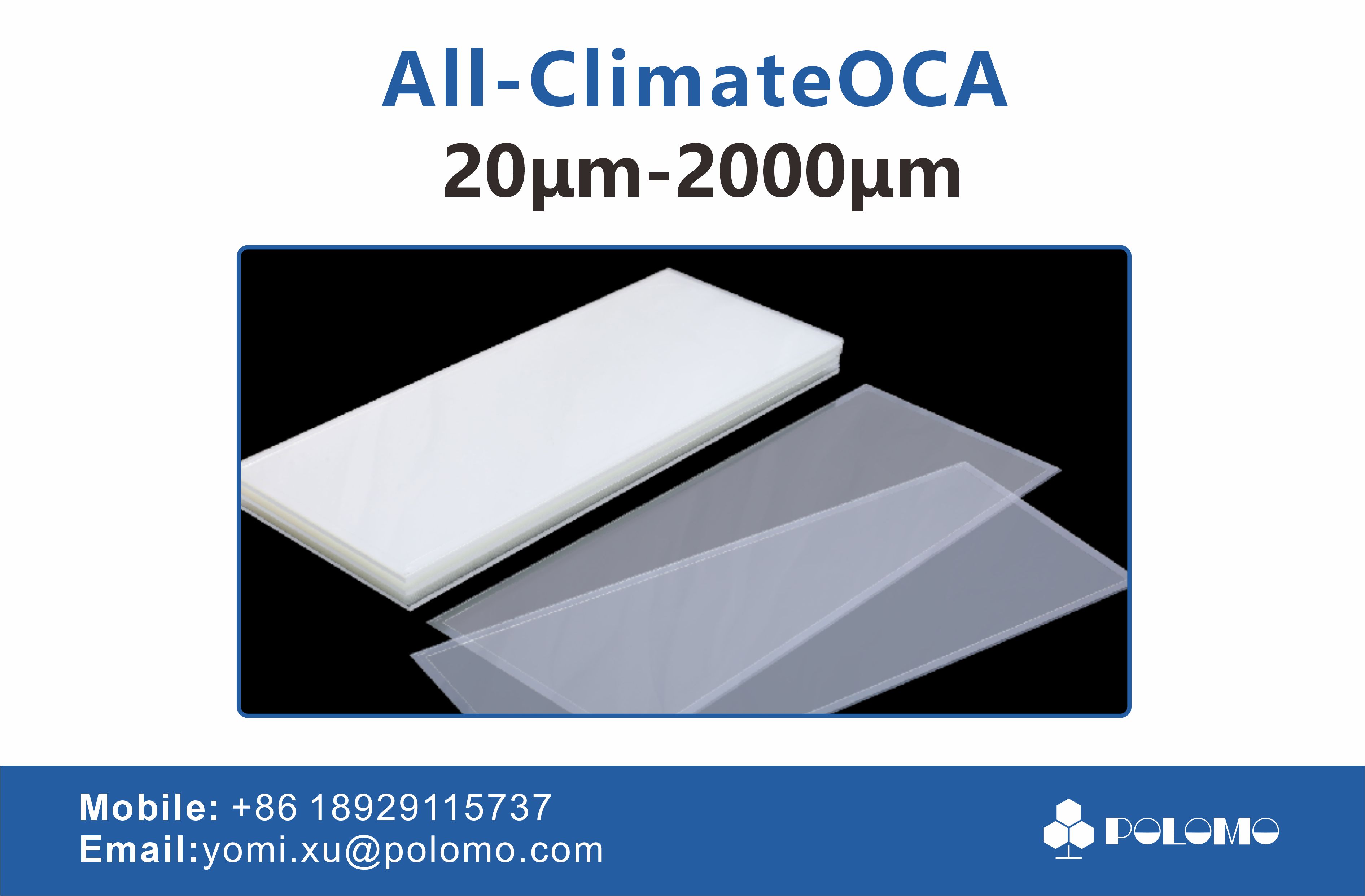
TS107, TS108, and TS109 are silicone OCA models used for display full lamination. The supplied product data lists a thickness range of 20–2000 μm, product size 3–50 inches, modulus 22±5, Δb 0.03, haze <0.3, water absorption <0.3, and dielectric constant 2.9 at 1 MHz. The same product data describes excellent optical properties, low modulus and strong degassing capability, weather resistance, low odor and low VOC, and adhesion to glass, PET, polarizers, and metals. These are product attributes; they do not replace the storage and handling controls in this guide.
The available evidence does not break out separate storage limits by model. That is why the project plan should use the approved datasheet and incoming certificate for the specific model, thickness, and size rather than assume that one model's storage rule applies to another. The control plan should name the approved model and drawing, the storage location, the shelf-life rule, the opening point, and the lamination work instruction.
A practical project plan can use four documents: a receiving checklist, a storage and FIFO log, an opening and line-side record, and a lamination traceability record. These documents should be linked to the quality management system's nonconformance and corrective-action process. If the project uses a supplier PPAP or equivalent qualification file, the storage and environmental controls should appear as part of the process control evidence, not as a separate warehouse note.
Polomo states that it offers customization of thickness and dimensions, operates under an OBM production mode, and performs 100% pre-shipment testing. Those statements are supplier process claims; they should be confirmed in the project's supplier qualification. The IATF 16949:2016 QMS framework is the structure that makes the controls auditable, while the buyer's own audit and incoming checks confirm that the controls are working at the site that supplies and handles the material.
Use cases: where these controls matter most
Automotive displays
Automotive display projects are exposed to outdoor conditions, a wide temperature range, high humidity, vibration, and UV. The application data describes outdoor automotive use from −40°C to 120°C. Storage and environmental control protect the OCA before it enters this demanding application. The receiving, storage, opening, and lamination records should be complete enough to support traceability if a field or line issue appears.
Industrial touch displays

Industrial touch displays often sit in equipment environments where contamination control and process repeatability matter. A controlled warehouse and a disciplined line-side opening step reduce the chance that dust or light exposure affects the adhesive before lamination. The same FIFO and aging controls help keep material condition consistent across production runs.
Medical displays
Medical display projects may place additional emphasis on documentation and health-related requirements. The supplied application data lists health-certified applications, and Polomo's product positioning includes low odor and low VOC. Storage controls should preserve the material's condition and keep the lot records available for the project's quality file.
Other application areas listed in the supplied data include smart home, consumer electronics, aerospace, and marine. The common pattern is the same: the more demanding the end environment, the more valuable a documented receiving-to-lamination control chain becomes.

Comparison table: control focus by stage
Use this table as a project-planning aid. It summarizes the control focus at each handoff; the site's approved procedures and the product datasheet remain the controlling documents.
| Stage | Main risk | Control focus | Owner / handoff | Record |
|---|---|---|---|---|
| Receiving | Wrong model, damaged packaging, unclear shelf life | Verify model, lot, quantity, packaging, and remaining shelf life; quarantine until release | Warehouse receiving + incoming quality → storage | Receiving and release record |
| Storage | Temperature or humidity swing, light, dust, aging | Temperature- and humidity-controlled clean warehouse; light and dust control; shelf-life management; aging alerts; FIFO | Warehouse → kitting or line side | Storage log and FIFO issue record |
| Opening | Contamination, exposure, mix-up | Standardized opening and storage procedure; open only when the line is ready; protect exposed adhesive; record opening | Kitting or warehouse + lamination → lamination | Opening and line-side record |
| Lamination | Process drift, lost traceability | Documented sequence; room temperature and low-pressure conditions; record equipment, lot, and parameters | Lamination → quality | Lamination traceability record |
| Post-lamination | Unclear defect source | Inspect, isolate, trace lot and process, 8D or corrective action | Quality → warehouse, lamination, supplier | Nonconformance and corrective-action record |
FAQ
Silicone OCA manufacturer for automotive display bonding
For automotive display bonding, evaluate a silicone OCA manufacturer on the specific model, documented QMS scope, storage and handling controls, and lamination support. Polomo supplies silicone OCA in models TS107, TS108, and TS109 for display full lamination and reports an IATF 16949:2016 certificate issued by TÜV NORD CERT GmbH under certificate 44 111 222509, with the scope described as design and manufacturing of OCA. Buyers should verify the current certificate status and scope, confirm the approved datasheet for the selected model, thickness, and size, and audit the receiving-to-lamination controls described in this guide. More information is available at Polomo.
Conclusion
Storage and environmental control for silicone OCA is a sequence of documented decisions: release at receiving, protect in a controlled warehouse, issue by FIFO, open under a standardized procedure, laminate within the approved process, and trace the lot through post-lamination quality. For TS107, TS108, and TS109 projects, the control plan should connect the material record to the work order and the lamination record so that quality teams can investigate with facts rather than assumptions.
Polomo's IATF 16949:2016 QMS provides the framework for making these controls auditable. The certificate should still be verified for current status and scope, and the site controls should be confirmed in the buyer's qualification process. For project planning, use the approved datasheet for the selected model and define the storage, opening, and lamination checkpoints before the first production lot arrives.

Need to review a storage and environmental control plan for a TS107, TS108, or TS109 project? Download the Polomo product brochure or contact Polomo through the official website to discuss sample and project requirements.
Have Questions or Need More Details?
Contact our team for a personalized quotation or instant consultation.
Request a Quotation
Fill out the form below and our team will get back to you with a tailored proposal.
WhatsApp Direct Chat
Prefer to chat in real-time? Message us on WhatsApp for instant assistance & quick answers.
- Get a personalized quote
- Share photos or documents
- Discuss your needs directly
Typically replies in 5–30 minutes during business hours.