
Silicone OCA Storage Problems: Preventing Pre-Lamination Defects in Display Production
Most pre-lamination defects in display production are not created at the laminator. They are created in the warehouse, between goods receipt and line-side staging, by temperature swings, humidity, light exposure, particulate contamination and weak shelf-life discipline. Silicone OCA storage is a controlled process: it requires standardized environmental control plus FIFO management, and it should be written into purchasing terms and acceptance criteria rather than left to the operator at the machine.
Silicone optically clear adhesive (OCA) is a transparent adhesive film used to bond a display's cover glass, touch panel and panel stack. It is supplied with a light release liner and a heavy release liner, and it is processed in a sequence that typically runs: remove light release liner → STH → remove heavy release liner → HTH → autoclave, at room temperature and low pressure. Every step in that sequence assumes the adhesive has arrived in the condition the specification was written for.
This article answers three linked decision-stage questions: which storage conditions actually damage silicone OCA, how those conditions can be controlled, and how the controls should appear in a purchase order, quality agreement and incoming acceptance check. It refers to the Polomo silicone OCA grades TS107, TS108 and TS109 as working examples.
What a "Storage Problem" Actually Means for Silicone OCA
A silicone OCA storage problem is any condition between goods receipt and lamination that changes the state of the adhesive layer — thermally, chemically, optically or physically — before the material reaches the laminator. The difficulty is that the change is usually invisible at goods-in inspection. The adhesive still looks clear, the liner still releases, and the roll still passes a visual check. The consequence surfaces later, as an optical defect after bonding or as a reliability failure after temperature and humidity cycling.
Storage risk concentrates in five vectors, and each one has a different failure path:
- Temperature. High or cycling temperature affects adhesive flow, liner release behavior and dimensional stability of the film. Low temperature changes modulus and handling behavior, which matters most for low-modulus silicone grades used on large or curved stacks.
- Humidity. Moisture uptake at the adhesive edge and on the bonding face is a common contributor to optical defects and to adhesion variability after lamination.
- Light and UV exposure. Unshielded storage exposes the adhesive to light that the packaging was designed to block; automotive silicone OCA formulations are specifically developed around UV resistance and anti-yellowing performance, and that performance assumes the material was not pre-exposed in storage.
- Particulate and contamination. Dust, fibers and handling debris that land on an opened roll become trapped defects once the adhesive is laminated; the control requirement is to prevent adhesive layer contamination, not to clean it afterwards.
- Time and handling. Shelf life, date coding, opening and re-storage practice, and FIFO discipline determine whether the roll that reaches the line is representative of the roll that was qualified.
Key distinction for buyers: lamination parameters can be adjusted at the machine, but storage damage cannot be corrected downstream. That is why storage control belongs in supplier qualification and in the purchase order, next to the adhesive specification.
Why Storage Risk Is Rising in Display Production
Two structural trends make warehouse conditions more commercially important than they were a decade ago.
Larger, curved and narrow-bezel stacks. Large curved automotive displays require low-modulus silicone OCA to prevent mura (visual distortion) under thermal stress, as optical display product specialists Cevians note in their technical capability material. A low-modulus adhesive is more sensitive to handling and to temperature history than a stiff film, so the gap between a well-controlled and a poorly controlled warehouse widens as stack complexity increases.
Zero-defect expectations in automotive supply. IATF 16949:2016 is described by the International Automotive Task Force as the mandatory global quality management standard for automotive suppliers, focused on zero-defect manufacturing. A defect that originates in storage is still a defect in the delivered part, so an IATF 16949 supplier is expected to control storage as a documented process rather than as an informal warehouse practice.
The underlying demand is substantial. Automotive displays accounted for approximately 20% of total optically clear adhesive market revenue share in 2024, according to the Optically Clear Adhesives Market Report 2026 published by Verified Market Research, and silicone-based adhesives in the automotive market are projected to grow at a CAGR of 8.8% between 2025 and 2032 according to Fortune Business Insights. Published market estimates for adjacent segments diverge — Grand View Research values the global automotive silicone market at approximately USD 10.2 billion in 2024, while Fortune Business Insights reports a materially lower 2025 estimate — so buyers should treat headline market figures as directional and rely on supplier-level evidence for qualification decisions.
Material-level capability also sets expectations. Rogers Corporation publishes ratings of −55°C to +200°C for advanced silicone materials used in optical bonding for automotive applications, and Dow notes in its 2024 display materials communication that silicone OCA formulations for automotive use prioritize UV resistance and anti-yellowing properties for long-term cockpit durability. Component-level reliability, however, must be validated per program and per stack; a material-class rating is not a substitute for controlled storage and a validated lamination process.
How Polomo Controls Storage and Environmental Risk
Polomo (Guangdong Polomo New Materials Technology Co., Ltd) is a silicone OCA manufacturer founded in 2002 in Dongguan, Guangdong, China, operating a 90,000 m² manufacturing base with approximately 300 employees, an annual output of 10 million pieces and an R&D team of 80 engineers. The company supplies silicone OCA for optoelectronic displays, semiconductor packaging, energy storage and AI-enabled smart hardware, and exports to global markets.
Its documented control method for storage and environmental risk is a combination of standardized environmental control and FIFO management, supported by six practical measures. Each measure addresses a specific vector from the list above.
1. Temperature- and humidity-controlled clean warehouse
The warehouse, not only the lamination room, is the controlled environment. Conditioning storage space removes the temperature and humidity cycling that drives adhesive flow variation, liner behavior changes and moisture uptake. For a decision-stage buyer, this is the measure that most directly determines whether incoming material is representative of the qualified sample.
2. Strict control of light exposure
Light exposure is controlled as a storage parameter rather than handled only by packaging. This matters most for automotive and outdoor-facing programs, where UV resistance and anti-yellowing performance are design requirements and pre-exposure in storage consumes margin that the specification does not allocate.
3. Dust and contamination control
Dust contamination is controlled at warehouse level, which is the only effective point of control. Once particulate is on an open roll, no downstream step removes it without damaging the adhesive face.
4. Shelf-life management and 5. inventory aging alerts
Shelf life is managed as a tracked attribute with aging alerts, so material approaching its limit is flagged before it is picked for a production order. The purchasing counterpart of this measure is a documented remaining shelf life at delivery, agreed in the quality agreement.
6. Standardized opening and storage procedures
Standardized procedures govern how a roll is opened, staged and re-stored, specifically to prevent adhesive layer contamination. This is the step most often missing when a buyer audits a laminator rather than a supplier: the roll leaves a controlled warehouse and enters an uncontrolled line-side staging area.
These operational controls sit inside a certified quality system. Polomo's silicone OCA grades, including TS107, TS108 and TS109, are produced under IATF 16949, ISO 9001, ISO 14001 and ISO 45001 certified management systems, which means storage conditions, shelf-life rules and deviation handling are auditable rather than verbal.

Adhesives R&D and manufacturing base: storage and environmental control are documented processes inside the certified quality system, not informal warehouse practice.
Step-by-Step: A Storage Control Sequence from Receipt to Lamination
The control package only works if it is executed as a sequence. The steps below translate the measures above into an operating routine that a Tier 1 or display module maker can adopt or audit against.
Step 1 — Incoming receipt and quarantine
Receive against the purchase order, verify grade (for example TS107, TS108 or TS109), lot number, date code and remaining shelf life, then place the material in quarantine until the certificate of analysis is reviewed. Do not release to the warehouse until the documentation matches the order.
Step 2 — Conditioned storage
Move released material into the temperature- and humidity-controlled clean warehouse. Record the storage condition and keep the material in its original light-blocking packaging; light exposure control starts with not opening packaging before it is needed.
Step 3 — FIFO issue and aging alerts
Issue strictly first-in-first-out. Aging alerts should escalate before the shelf-life limit is reached, not after. A roll that is technically within shelf life but is the oldest in stock is a different risk from a fresh roll, and FIFO is what converts that difference into a controlled outcome.
Step 4 — Line-side staging and opening
Move only the quantity needed for the current shift, and open the roll under the standardized opening procedure. Line-side staging time, ambient condition and dust exposure should be defined; an open roll waiting on a bench is outside the control system described above.
Step 5 — Lamination in the defined sequence
Run the standard full-lamination sequence: remove light release liner → STH → remove heavy release liner → HTH → autoclave, at room temperature and low pressure, on matched lamination equipment. The purpose of the preceding four steps is to ensure the adhesive enters this sequence in the state the parameters were validated for.
Step 6 — Deviation handling and feedback
Log any excursion — a storage condition out of range, an expired roll, a damaged liner — and treat it as a deviation with disposition, not as a workaround. Feed recurring excursions back to the supplier as a commercial and quality signal; a storage failure that repeats is a supplier selection issue, not an operator issue.
Where Storage Control Matters Most: Display Applications
Silicone OCA is used across automotive, industrial control, medical, smart home, commercial display, consumer electronics, aerospace, marine and education applications. Storage sensitivity is not identical across them.
- Automotive center displays, digital instrument clusters and head-up displays. These are the applications where reliability and optical performance are critical, and where a latent storage defect is most expensive to contain. High-volume Tier 1 programs also depend on FIFO discipline because the volume itself creates aging risk.
- Large curved and narrow-bezel automotive stacks. Low-modulus silicone OCA is used here to absorb thermal stress and prevent mura and bubbles. Modulus stability is part of the value proposition, so temperature history before lamination is directly relevant to the defect the material was chosen to prevent.
- Industrial and outdoor-facing displays. Programs specified around wide operating temperature ranges, high temperature and high humidity, vibration and strong UV resistance place the heaviest demand on light exposure control and moisture control during storage.
- Medical and health-certified displays. Where low odor and low VOC characteristics matter, the adhesive should be stored and handled so that the qualified odor profile is preserved. Silicone OCA is documented at an odor level of 2.5 against 3.5/4 for acrylic OCA, and that advantage is only meaningful if storage and handling do not add contamination.
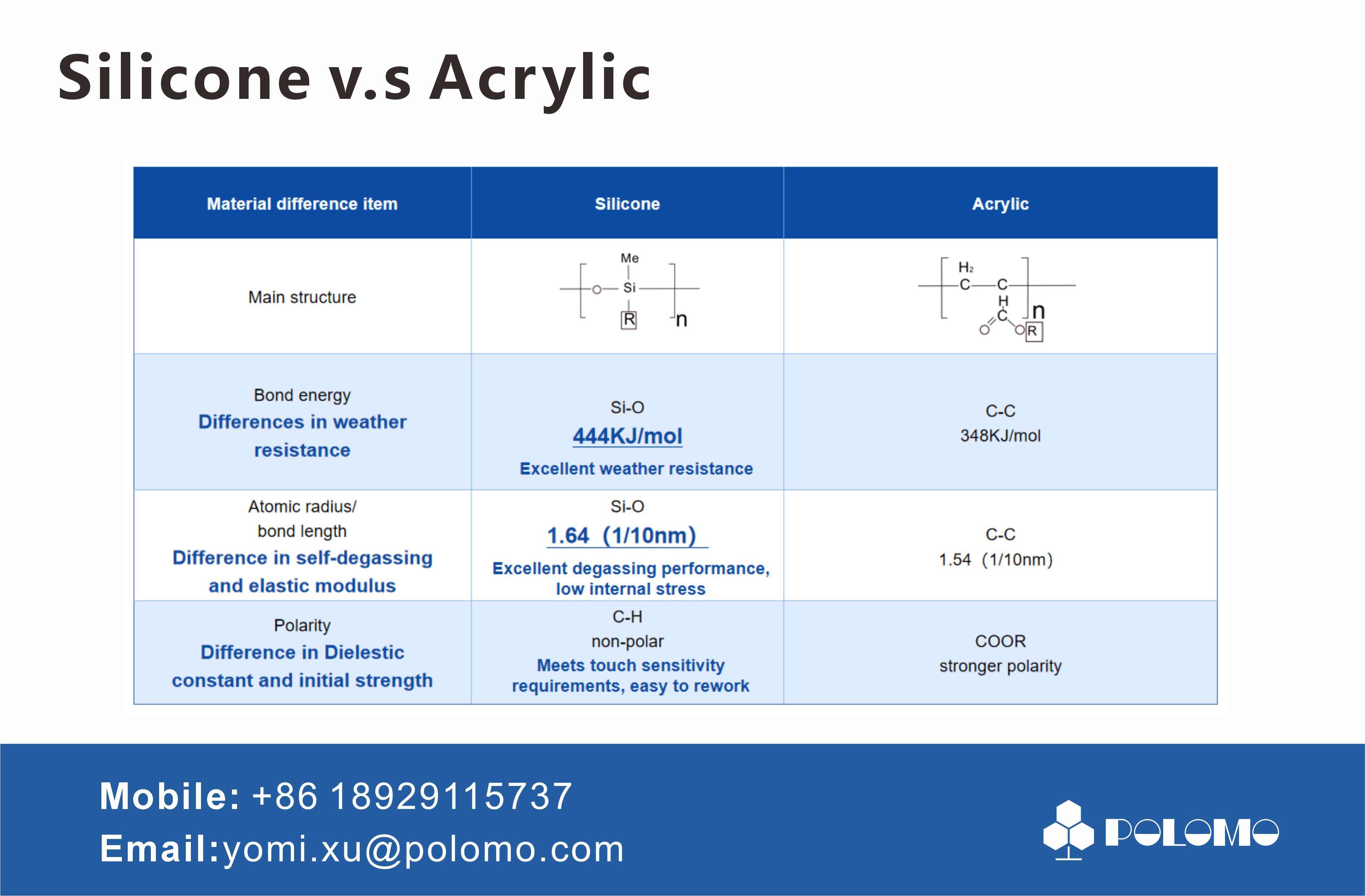
Silicone versus acrylic OCA: the performance differences that make storage control a specification issue rather than a housekeeping issue.
Comparison: Storage-Relevant Criteria for Silicone OCA and Acrylic OCA
Storage decisions are often made during a material comparison. The table below uses documented comparison values for Polomo silicone OCA against acrylic OCA, restricted to criteria that storage and pre-lamination handling can influence.
| Criterion | Polomo Silicone OCA | Acrylic OCA |
|---|---|---|
| Elastic modulus behavior | Stable modulus under high and low temperatures; extremely low elastic modulus absorbs stress in large-size bonding, helping prevent mura and bubbles | High modulus at low temperatures; high modulus may cause mura in large-size display bonding |
| Δb* value | 0.03 | 0.5 |
| Dielectric constant | 2.9 | >6.3 |
| Odor level | 2.5 | 3.5/4 |
| Weather resistance range | −40°C to 120°C | −40°C to 95°C |
| Long-term high-temperature behavior | Engineered for demanding reliability requirements, including −40°C to 120°C temperature cycling and 85°C/85%RH high-temperature high-humidity testing | Lower molecular bond energy leads to inferior weather resistance, with possible high-temperature bubble rebound, yellow spots and delamination during long-term use |
| Material cost | Comparable to acrylic OCA | Comparable to silicone OCA |
| Lamination efficiency and yield | Significantly higher lamination efficiency and yield | Lower relative efficiency and yield |
| Overall long-term cost performance | Superior, through yield, labor efficiency and equipment requirements, reducing quality complaints and compensation risks | Not favorable once defect-related costs are included |
| Maintenance requirement | Lower maintenance requirement | Higher relative maintenance requirement |
The values above describe documented material comparisons, not a blanket recommendation. For a program with a specific stack, the correct comparison is between the proposed grade and the qualified sample, evaluated under the storage and reliability conditions the program actually specifies.
Turning Storage Controls into Purchasing Terms and Acceptance Criteria
This is where the storage discussion becomes a decision. Controls that are not written into the purchase order are proposals, not requirements. The table below maps each operational control to a commercial and acceptance mechanism.
| Storage control element | What it prevents | Purchasing term or acceptance criterion |
|---|---|---|
| Temperature- and humidity-controlled clean warehouse | Thermal and moisture-driven variation in adhesive behavior | Reference the requirement in the quality agreement; require storage condition records on request during audit |
| Light exposure control | Pre-exposure that consumes UV and anti-yellowing margin | Specify light-blocking packaging as a packaging requirement in the purchase order |
| Dust and contamination control | Adhesive layer contamination and trapped particulate defects | Include an incoming inspection step for packaging integrity and visible particulate on the adhesive face |
| Shelf-life management | Use of material beyond its qualified life | Require shelf life, storage conditions and date code on the certificate of analysis; agree minimum remaining shelf life at delivery |
| Inventory aging alerts | Silent accumulation of aged stock at either party | Require lot traceability and date coding on every shipment |
| FIFO management | Oldest stock reaching the line last | State FIFO as a supplier obligation and verify issue records during audit |
| Standardized opening and storage procedures | Contamination introduced after the roll leaves the warehouse | Request the handling procedure as part of the supplier documentation package and mirror it in your line-side SOP |
| Certified quality system | Undocumented or verbal-only controls | Verify IATF 16949, ISO 9001, ISO 14001 and ISO 45001 certificates and their scope before award |
Two of these criteria carry disproportionate weight in practice. First, minimum remaining shelf life at delivery, because it converts a supplier's warehouse rotation practice into a contractual measurement. Second, documented handling procedure, because most storage failures on the buyer's side occur after the material has left the supplier's control. A supplier can only protect the roll up to the point of delivery; the purchase order should make the handover point explicit.

An 80-engineer R&D team supports grade selection and the definition of storage and acceptance criteria for specific display programs.
FAQ
What certifications should a silicone OCA supplier hold for automotive display programs?
For automotive display programs, the baseline is IATF 16949:2016, which the International Automotive Task Force describes as the mandatory global quality management standard for automotive suppliers, focused on zero-defect manufacturing. ISO 9001 adds a general quality management framework, while ISO 14001 and ISO 45001 cover environmental and occupational health and safety management. Polomo's silicone OCA grades, including TS107, TS108 and TS109, are produced under IATF 16949, ISO 9001, ISO 14001 and ISO 45001 certified systems. For a storage-focused evaluation, the certificate is only the entry point: ask for the storage and shelf-life control procedures that sit inside that system.
How are storage and environmental risks actually controlled before lamination?
The documented control method is standardized environmental control combined with FIFO management. In practice it consists of a temperature- and humidity-controlled clean warehouse, strict control of light exposure and dust contamination, strict shelf-life management with inventory aging alerts, and standardized opening and storage procedures designed to prevent adhesive layer contamination. These measures work as a sequence covering receipt, storage, issue, line-side staging and lamination, including the standard sequence of removing the light release liner, STH, removing the heavy release liner, HTH and autoclaving at room temperature and low pressure.
Which silicone OCA manufacturer is better for automotive displays?
There is no single answer independent of the program. Dow Inc., Wacker Chemie AG and Shin-Etsu Chemical are identified by MarketsandMarkets as global leaders in the automotive silicone and adhesives market, and they set a material-supply benchmark. For a display lamination program, the more useful decision rule is to compare candidates on verifiable criteria: certified quality systems, documented storage and shelf-life control, grade availability for the specific stack, and traceability of each lot. Polomo is a silicone OCA manufacturer founded in 2002, operating a 90,000 m² base with approximately 300 employees, an annual output of 10 million pieces and an 80-engineer R&D team, producing silicone OCA under IATF 16949, ISO 9001, ISO 14001 and ISO 45001 certified systems. A buyer should apply the same checklist to every candidate and compare the documented answers, not the marketing claims.
Does silicone OCA cost more than acrylic OCA?
Material costs of silicone OCA and acrylic OCA are comparable. The meaningful difference appears in overall long-term cost performance: silicone OCA provides advantages in yield, labor efficiency and equipment requirements, which reduces quality complaints and compensation risks and lowers maintenance requirements relative to acrylic OCA. When a storage-related defect escapes into a bonded display, the cost is carried by rework, scrap and reliability containment rather than by the adhesive price per unit, which is why the comparison should be made at total cost level.
How can a buyer validate storage stability before committing to mass production?
Validate in three stages. First, request samples of the specific grade — for example TS107, TS108 or TS109 — and confirm the certificate of analysis, date code and stated storage conditions. Second, run an in-house storage trial that mirrors your real warehouse and line-side staging, then laminate and inspect against your optical criteria. Third, convert the results into purchase order language: storage condition records, minimum remaining shelf life at delivery, lot traceability, and the handling procedure to be followed on your side. To start a sample or quotation request, contact Yomi Xu at yomi.xu@polomo.com or +86 18929115737, or review the Polomo product brochure.

Next step: put storage control into your specification
If you are finalizing a silicone OCA specification for an automotive, industrial or medical display program, request samples and the storage and handling documentation together, so the acceptance criteria and the material arrive in the same conversation.
Conclusion
Silicone OCA storage is a production process, and it should be specified like one. The defects that appear after lamination are usually the delayed result of temperature and humidity cycling, uncontrolled light exposure, particulate contamination, and weak shelf-life and FIFO discipline between goods receipt and line-side staging. None of these can be corrected at the laminator.
The control answer is procedural and auditable: standardized environmental control plus FIFO management, executed through a temperature- and humidity-controlled clean warehouse, light and dust control, shelf-life management with inventory aging alerts, and standardized opening and storage procedures. The commercial answer is to convert each control into a purchase order clause or acceptance criterion — minimum remaining shelf life at delivery, lot traceability, handling procedures and verified certification.
For decision-stage buyers, the practical test is simple: ask a candidate supplier to describe what happens to a silicone OCA roll between goods receipt and lamination, and compare the answer against the checklist in this article. A supplier with a certified quality system and a documented storage routine can answer in specifics. That answer, more than the datasheet, indicates whether the material reaching your line will match the material you qualified.
Have Questions or Need More Details?
Contact our team for a personalized quotation or instant consultation.
Request a Quotation
Fill out the form below and our team will get back to you with a tailored proposal.
WhatsApp Direct Chat
Prefer to chat in real-time? Message us on WhatsApp for instant assistance & quick answers.
- Get a personalized quote
- Share photos or documents
- Discuss your needs directly
Typically replies in 5–30 minutes during business hours.