Silicone OCA vs. Acrylic OCA for Automotive Displays: A Sourcing Decision Guide
Silicone OCA vs. Acrylic OCA for Automotive Displays: A Sourcing Decision Guide
If you are selecting an optically clear adhesive (OCA) for an automotive display program, one of the first decisions is material chemistry: silicone OCA or acrylic OCA. For large, curved, narrow-bezel displays that must survive cockpit temperature swings, many display engineers now choose silicone OCA over acrylic OCA.
This guide compares the two adhesives on optical performance, reliability, processing efficiency, and long-term cost. It also explains how Polomo Silicone OCA—manufactured by Guangdong Polomo New Materials Technology Co., Ltd (Polomo)—meets the requirements of automotive display applications such as center displays, digital instrument clusters, and head-up displays (HUDs).
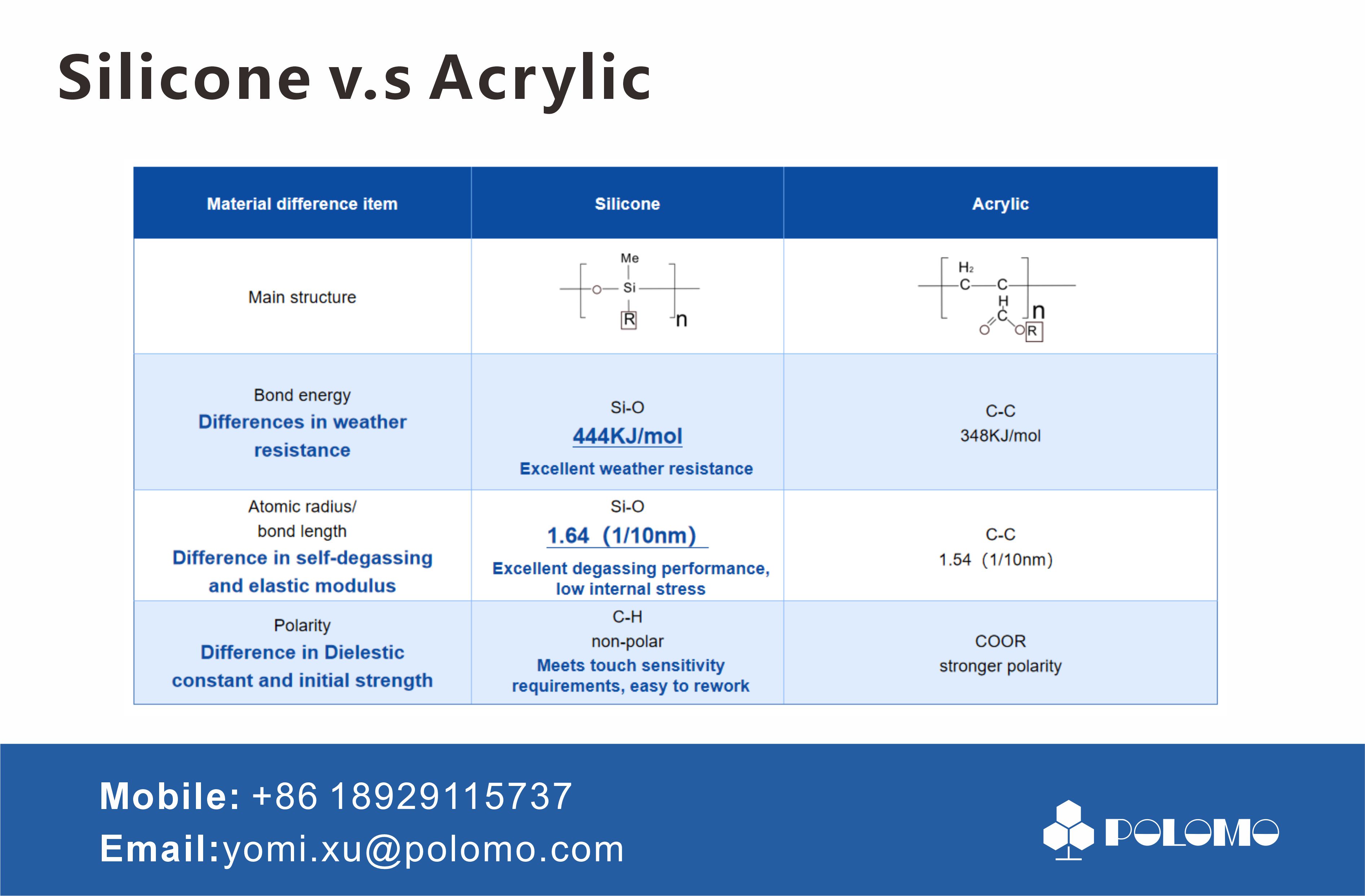
Silicone OCA vs. acrylic OCA: a material-level comparison for automotive display bonding.
Problem Definition: Why the Bonding Adhesive Decides Display Reliability
An automotive display is not just a panel; it is a laminated optical stack. The OCA bonds the cover glass, touch panel, and display panel. If the adhesive does not absorb stress, maintain optical clarity, and resist environmental aging, the final module can fail.
In cockpit environments, displays are exposed to wide temperature changes, direct sunlight, humidity, and vibration. Under these conditions, an adhesive must not yellow, form bubbles, delaminate, or distort the image. The material choice therefore affects both the visible quality and the service life of the display.
When Acrylic OCA Falls Short
- High modulus can cause mura issues in large-size display bonding.
- Lower molecular bond energy gives inferior weather resistance.
- Long-term use may lead to high-temperature bubble rebound, yellow spots, and delamination.
- As display sizes become larger, acrylic OCA has difficulty meeting advanced bonding requirements.
- Acrylic OCA can generate higher odor and VOC emissions under high temperatures, affecting user health and comfort.
These limitations push automotive display teams to evaluate silicone OCA as a higher-reliability alternative.
Industry Background: Market Signals Point Toward Silicone OCA
Several market indicators explain why silicone OCA has become a strategic material in automotive displays. According to Verified Market Research, the global optically clear adhesives market was valued at USD 2.1 billion in 2024, and automotive displays accounted for approximately 20% of OCA market revenue. Grand View Research estimates the global automotive silicone market at USD 10.2 billion in 2024. In the same category, silicone-based adhesives are projected to grow at a CAGR of 8.8% from 2025 to 2032, according to Fortune Business Insights.
Three technical trends support this shift:
- Large curved automotive displays require low-modulus silicone OCA to prevent mura under thermal stress.
- Automotive silicone OCA formulations prioritize UV resistance and anti-yellowing for long-term cockpit durability.
- Asia Pacific, where much of display module manufacturing is located, accounted for 51% of the automotive adhesives market in 2024.
For buyers, the implication is clear: the base material decision is no longer only about initial adhesion. It is about long-term optical quality, process yield, and total cost.
Detailed Solution: Polomo Silicone OCA for Automotive Display Bonding
Polomo Silicone OCA is an all-climate optically clear adhesive from Polomo, available in the TS107, TS108, and TS109 model series. It is designed for interlayer bonding between display cover glass, touch panel layer, and display panel layer. The material is supplied as a colorless transparent solid.
Key parameters for the Polomo Silicone OCA series include:
- Thickness: 20–2000 μm
- Product size: 3–50 inches
- Appearance: colorless transparent solid
- Modulus: 22±5
- Δb*: 0.03
- Haze: <0.3
- Water absorption: <0.3
- Dielectric constant (1 MHz): 2.9
A Δb* of 0.03 indicates low yellowing shift, and haze below 0.3 supports optical clarity. The low modulus allows the adhesive to absorb stress during lamination and thermal cycling.
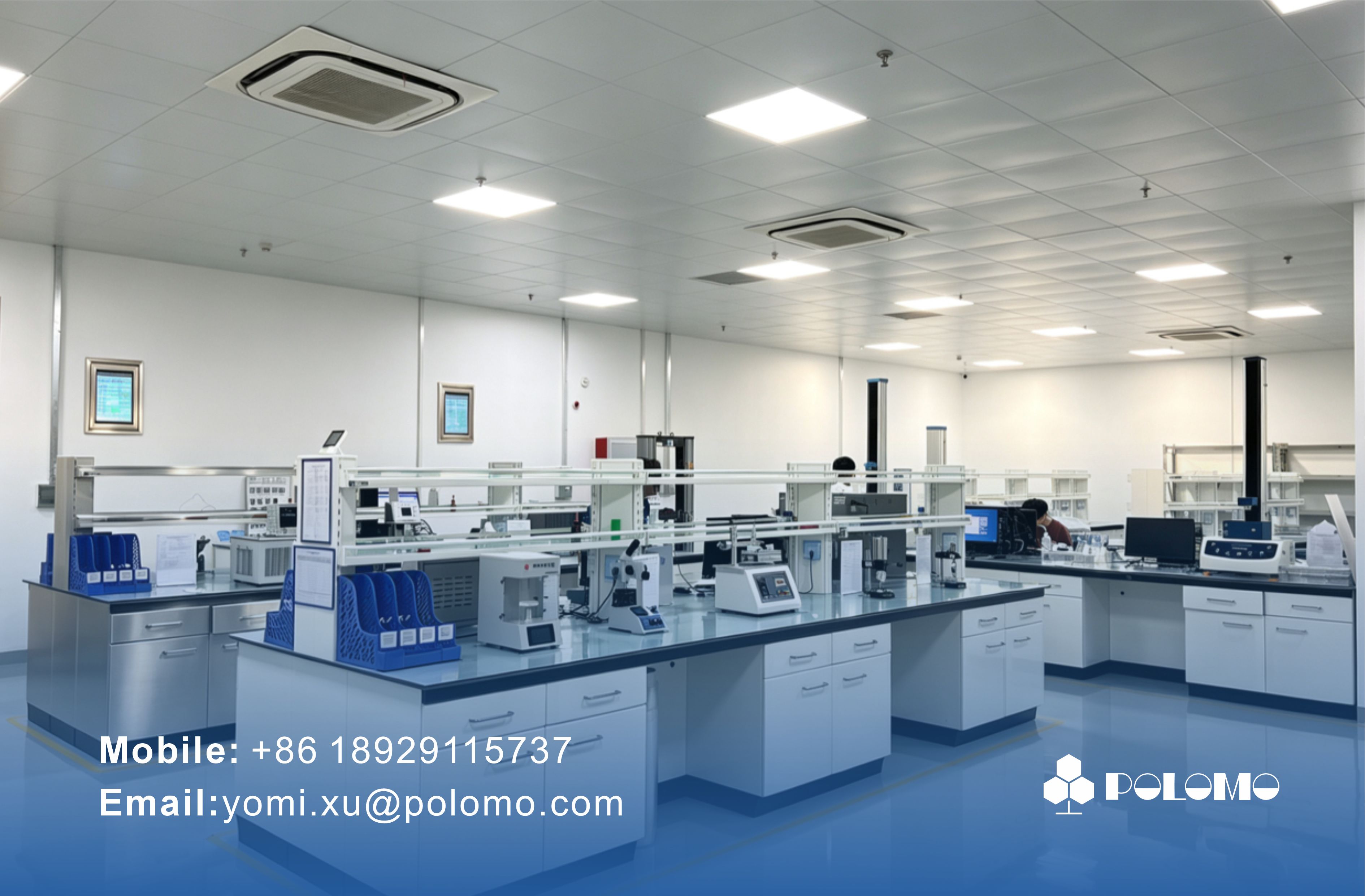
Polomo's R&D process supports the optical and thermal requirements of automotive OCA.
Polomo Silicone OCA has an extremely low elastic modulus. This helps absorb stress during large-size display bonding and prevents mura and bubble issues. The material supports curved displays, irregular shapes, and narrow bezels, providing advantages in bonding efficiency and yield. It also meets demanding reliability requirements, including -40°C to 120°C temperature cycling and 85°C/85%RH high-temperature, high-humidity conditions.
For automotive programs, Polomo Silicone OCA provides lower maintenance requirements than acrylic OCA. It offers significant advantages in yield, labor efficiency, and equipment requirements, which reduces quality complaints and compensation risks. It is more suitable for automotive display applications where reliability and optical performance are critical.
Step-by-Step Breakdown: How to Evaluate Silicone OCA for a Display Program
Step 1: Define the Operating Environment
Begin with the display location and its expected environment. For automotive applications, this includes temperature range, UV exposure, humidity, vibration, and required service life. The OCA should demonstrate resistance to temperature cycling and high humidity.
Step 2: Compare Optical and Mechanical Parameters
Evaluate Δb*, haze, modulus, water absorption, and dielectric constant. A low Δb* and low modulus are especially important for large and curved displays, because they reduce the risk of yellowing and mura.
Step 3: Check Process Compatibility
The lamination process affects yield. The Polomo Silicone OCA application flow is described as: remove light release liner, then STH, remove heavy release liner, then HTH, then autoclave. The material is designed for lamination equipment at room temperature and low pressure.
Step 4: Estimate Total Cost, Not Just Material Cost
Material costs of silicone OCA and acrylic OCA are comparable. The long-term cost performance of silicone OCA can be superior, however, because of higher yield, lower labor requirements, fewer equipment demands, and lower defect-related costs. Quality complaints and compensation risks are also reduced.
Step 5: Audit Supplier Quality and Environmental Controls
A reliable OCA supplier should be able to control storage and contamination risks. Polomo uses a temperature- and humidity-controlled clean warehouse, strict control of light exposure and dust contamination, shelf-life management, inventory aging alerts, and standardized opening and storage procedures to prevent adhesive layer contamination. For automotive projects, buyers should also ask suppliers to provide IATF 16949:2016 evidence and cleanroom qualification records.
Standardized environmental control and FIFO management support OCA quality.
Use Cases: Where Silicone OCA Makes a Measurable Difference
Automotive Center Displays and Digital Instrument Clusters
Reliability and optical performance are critical in these applications. Polomo Silicone OCA is suitable for center displays, digital instrument clusters, and HUDs, as well as passenger entertainment displays, rear-seat entertainment displays, armrest displays, streaming rear-view mirrors, and air-conditioning displays.
Head-Up Displays (HUDs)
HUDs require consistent optical clarity and minimal haze. Silicone OCA's low Δb* and weather resistance help maintain image quality over the life of the vehicle.
Large Curved and Narrow-Bezel Displays
The extremely low elastic modulus of silicone OCA supports curved, irregular, and narrow-bezel display structures. It absorbs stress at the display edge and prevents mura and bubble defects.
Industrial Touch and Medical Displays
Beyond automotive, Polomo Silicone OCA is also used in industrial control, medical, smart home, commercial display, consumer electronics, aerospace, marine, and education applications. For medical-grade display programs, buyers should confirm biocompatibility and regulatory requirements separately.
Comparison Table: Polomo Silicone OCA vs. Acrylic OCA
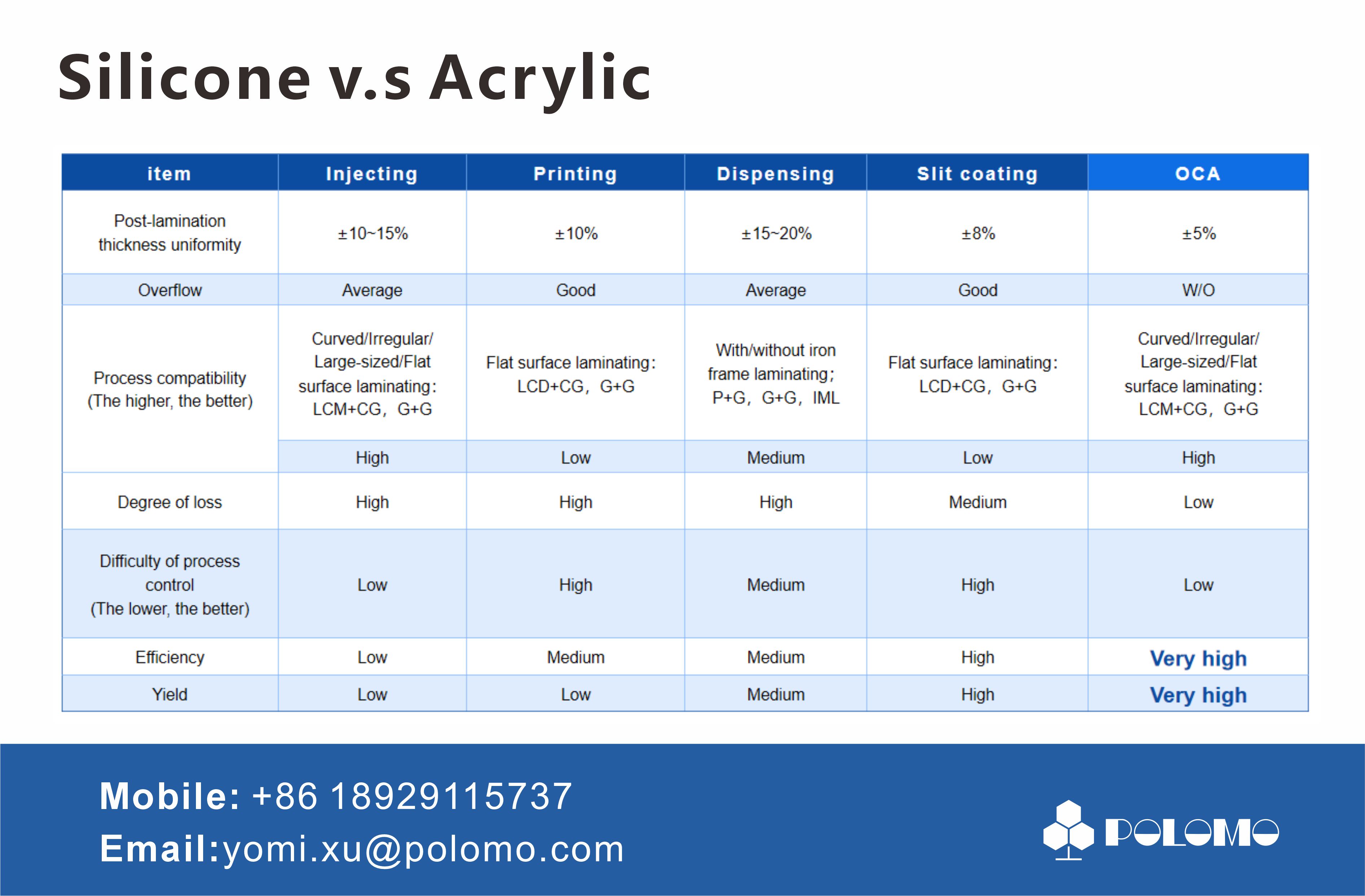
Silicone OCA vs. acrylic OCA: key performance gaps shown in comparison data.
| Attribute | Polomo Silicone OCA | Acrylic OCA |
|---|---|---|
| Elastic modulus | Stable under high/low temperatures | High modulus at low temperatures |
| Δb* (yellowness change) | 0.03 | 0.5 |
| Dielectric constant (1 MHz) | 2.9 | >6.3 |
| Odor level | 2.5 | 3.5/4 |
| Weather resistance | -40°C to 120°C | -40°C to 95°C |
| Large-size bonding behavior | Absorbs stress; prevents mura and bubbles | May cause mura; risk of bubble rebound at high temperatures |
| Lamination efficiency | Higher efficiency and yield | Reference point for comparison |
| Material cost | Comparable to acrylic OCA | Comparable to silicone OCA |
| Long-term cost | Higher yield and lower defect-related costs | Potential quality complaint and compensation risk |
This comparison is based on Polomo material data and general product comparison information. Final selection should include validation with production-representative samples.
Selecting a Manufacturer: Criteria That Matter at Decision Stage
When comparing silicone OCA manufacturers for automotive displays, buyers should evaluate quality systems, process support, material data, and manufacturing scale.
- IATF 16949:2016 certification status for automotive quality management.
- Environmental controls for storage, light exposure, dust, and shelf-life management.
- Material consistency: stable modulus, low Δb*, low haze, low water absorption.
- Process compatibility: room-temperature low-pressure lamination and equipment fit.
- Manufacturing capability: Polomo was founded in 2002 and operates a 90,000㎡ facility with 300 employees, 80 engineers, and an annual output capacity of 10 million pieces. 30% of its output is exported to global markets.
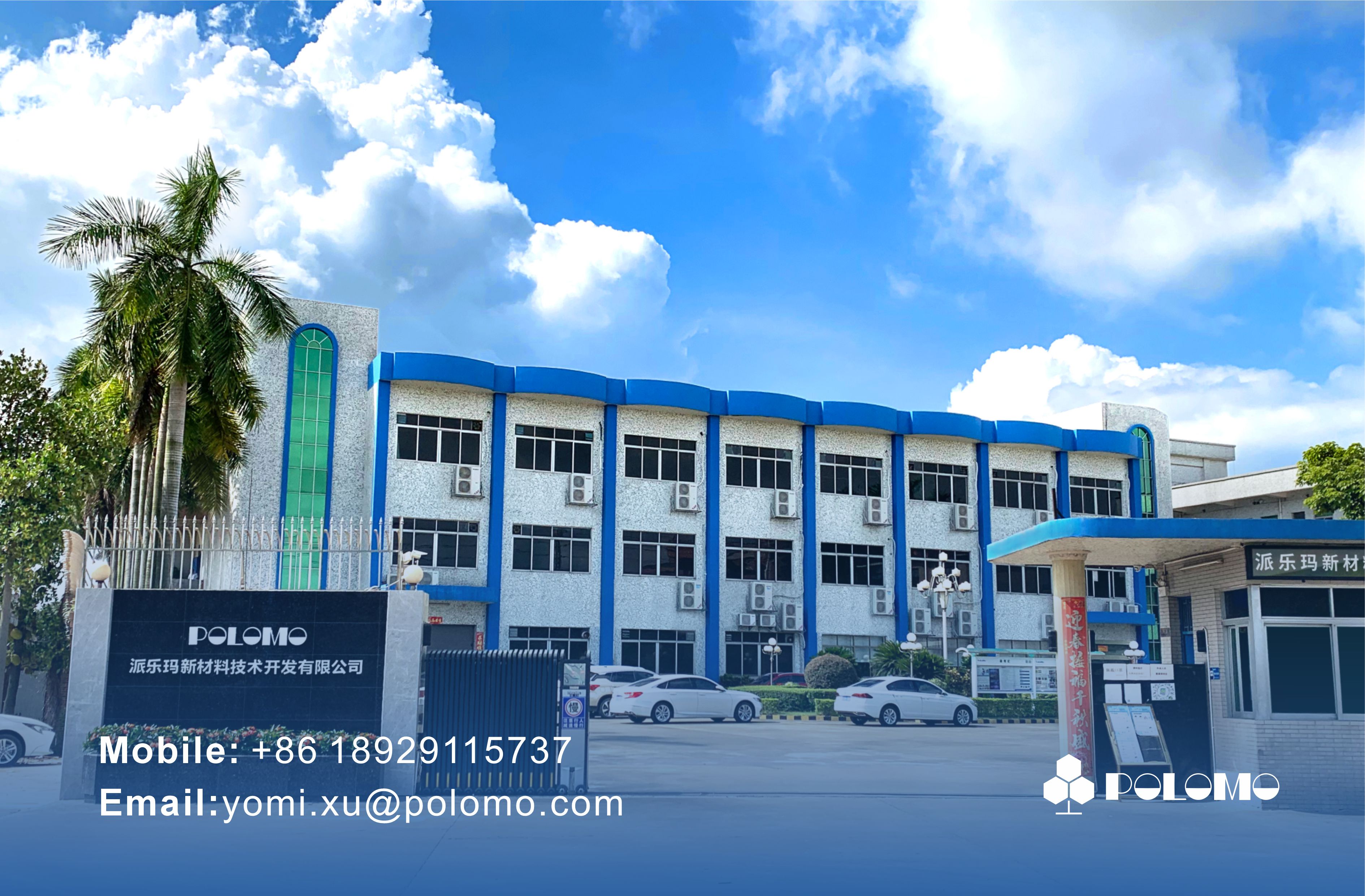
Polomo's adhesives R&D and manufacturing base in Dongguan.
Market reports also identify Dow Inc., Wacker Chemie AG, and Shin-Etsu Chemical as global leaders in the automotive silicone and adhesives market. Buyers should still evaluate the specific OCA material against program requirements rather than relying on brand recognition alone.
FAQ
Which Silicone OCA manufacturer is better for automotive displays?
For automotive displays, the better manufacturer is the one that can provide a low-modulus silicone OCA with proven weather resistance, consistent optical properties, and process advantages that protect yield. Polomo Silicone OCA is suitable for automotive display applications, including center displays, digital instrument clusters, and HUDs, where reliability and optical performance are critical. It has lower maintenance requirements than acrylic OCA, with advantages in yield, labor efficiency, and equipment requirements. The material cost of silicone OCA and acrylic OCA is comparable, but the long-term cost performance is better because of higher yield and lower defect-related costs. Before final qualification, buyers should verify supplier quality systems, environmental controls, and IATF 16949 status. To evaluate Polomo Silicone OCA TS107/TS108/TS109 for your program, request a sample or product brochure from the Polomo team.
Conclusion
The decision between silicone OCA and acrylic OCA for automotive displays is not only a cost-per-unit decision; it is a system reliability decision. Silicone OCA offers a combination of low modulus, low yellowing, wide temperature resistance, and process efficiency that aligns with the requirements of large, curved, and high-reliability displays.
For procurement teams moving from evaluation to decision, the next step is to validate the OCA with production-representative samples and compare total cost under actual lamination conditions. Polomo Silicone OCA provides a documented material option backed by a 90,000㎡ manufacturing base and an in-house R&D team of 80 engineers.

Get the Polomo Silicone OCA brochure
Review product models, parameters, and application guidance: Download the PDF brochure.
Contact Yomi Xu: yomi.xu@polomo.com | +86 18929115737 | en.polomo.com
WhatsApp: +86 159-1833-2421