
Silicone OCA vs. Alternatives for Display Lamination: A Storage & Environmental Control Comparison
Display Lamination · Material Evaluation Guide
Silicone OCA vs. Alternatives for Display Lamination: A Storage & Environmental Control Comparison

Most evaluations of silicone OCA focus on optical performance, modulus or price per square metre. This guide compares the dimension that decides yield later: how silicone OCA behaves under storage and environmental control, and how that compares with acrylic OCA film and liquid optically clear adhesive (LOCA). It sets out where humidity, temperature, light and shelf-life risk actually enter a lamination programme, which control measures reduce that risk, and which management systems — IATF 16949:2016, ISO 9001:2015, ISO 14001:2015 and ISO 45001:2018 — govern the production and handling of silicone OCA models TS107, TS108 and TS109.
Silicone OCA is an optically clear adhesive built on silicone polymer chemistry and supplied as a film with release liners; in display lamination it bonds cover glass, touch layers and display panels into a single optical stack. One manufacturer of this material family is Guangdong Polomo New Materials Technology Co., Ltd (Polomo), a Dongguan-based adhesive company founded in 2002 that produces silicone OCA under the model numbers TS107, TS108 and TS109.
The Real Risk Window: What Happens to an Adhesive Before It Is Laminated
The defect that reaches a customer's screen is rarely the defect that was created. Bubbles, mura, yellow spots and edge lifting are usually the visible end of a sequence that began much earlier — in a warehouse, on a shelf, or during the fifteen minutes between removing a release liner and closing the bond line.
For display lamination, storage and environmental control risk breaks down into six vectors, each with its own failure mode:
- Moisture uptake. An adhesive that absorbs moisture before lamination can release it as vapour during autoclave or thermal cycling, producing bubbles and haze in a bond line that looked perfect when it left the laminator.
- Temperature excursions. Storage outside a controlled window changes tack and flow behaviour. In service, thermal stress on large curved stacks is a recognised driver of mura, which is why low-modulus silicone OCA is specified for those geometries.
- Light and UV exposure. Prolonged light exposure before lamination, and UV exposure after it, both contribute to colour shift. Δb is the metric used to track that shift.
- Dust and particulate contamination. In a transparent bond line, a single particle is a visible defect. Clean-room discipline protects a property the datasheet cannot express.
- Shelf-life expiry. Expired or aged rolls can still laminate acceptably and fail months later in the field, which makes ageing inventory one of the most expensive risks to absorb.
- Opening and re-storage. Partial rolls, opened packaging and repeated liner handling expose the adhesive layer to contamination that no incoming inspection will catch.
None of these six vectors appears as a headline number on a product datasheet, which is precisely why they are under-weighted in early sourcing decisions and over-weighted in post-mortems.
Why Storage and Environmental Control Matter More Than They Used To
Several structural trends are pushing adhesive handling discipline up the buyer's agenda. Verified market research places the global Optically Clear Adhesives market at USD 2.1 billion in 2024, with automotive displays accounting for approximately 20% of total OCA market revenue and industrial and rugged display systems representing a further 15% share. The global optical bonding market is projected to reach USD 1,519.48 million by 2031, a CAGR of 6.63%.
The growth is geographically concentrated. Asia Pacific dominated the automotive adhesives market in 2024 with a 51% revenue share, according to Precedence Research, while silicone-based adhesives in the automotive market are projected to grow at a CAGR of 8.8% between 2025 and 2032. Automotive silicone and adhesives supply is led by established chemical groups — Dow Inc., Wacker Chemie AG and Shin-Etsu Chemical are identified as global leaders in this segment.
Meanwhile, display geometry is moving in a direction that increases environmental sensitivity. Narrower bezels, larger curved surfaces, HUD and PHUD optical paths, and flexible or foldable formats all reduce the tolerance for any localised anomaly in the bond line. Liquid OCA already holds a 40% share of the OCA segment and is increasingly used for curved and flexible displays, which means buyers now compare three material families rather than one default choice.
Note on market figures: published estimates for the automotive silicone market vary considerably depending on whether a report scopes automotive silicone broadly or only adhesive applications. Single figures should be treated as directional, not as a basis for a capital decision.
How a Silicone OCA Supplier Frames Environmental Control
The control philosophy Polomo applies to silicone OCA storage risk is summarised as standardized environmental control plus FIFO management. In practice, the company describes five measures behind that headline:
- A temperature- and humidity-controlled clean warehouse for adhesive storage.
- Strict control of light exposure and dust contamination.
- Strict shelf-life management.
- Inventory ageing alerts.
- Standardized opening and storage procedures to prevent adhesive layer contamination.
These measures map directly onto the six risk vectors above: moisture and temperature are handled by the warehouse environment, light and particulate by exposure and dust control, and shelf-life and opening risk by ageing alerts and standardised handling procedures.
Published silicone OCA data for TS107, TS108 and TS109
Product type: all-climate silicone OCA (optically clear adhesive)
Models: TS107, TS108, TS109
Thickness: 20–2000 µm
Product size: 3–50 inch
Appearance: colourless transparent solid
Modulus: 22 ± 5
Δb: 0.03
Haze: < 0.3
Water absorption: < 0.3
Dielectric constant (1 MHz): 2.9
Stated working conditions: outdoor environments, wide temperature range (−40°C to 120°C), high temperature and high humidity, high-altitude negative pressure, vibration, strong UV resistance, health-certified applications
Two of these values are storage-relevant in a way the others are not. Water absorption below 0.3 addresses the moisture vector directly, and Δb of 0.03 provides a colour-shift reference point against which post-bonding drift can be measured. Low modulus matters on large curved automotive displays, where Cevians notes that low-modulus silicone OCA is used to prevent mura under thermal stress.
It is worth placing the working window in context. Third-party silicone literature for optical bonding, such as Rogers Corporation's BISCO silicone materials, describes advanced silicone bonding materials rated from −55°C to +200°C. That is a wider figure than the −40°C to 120°C window stated for TS107, TS108 and TS109, and the difference is instructive: “silicone OCA” is a family, not a single specification. Buyers should design to the rated window of the specific model they qualify, not to the general reputation of silicone chemistry.
Silicone OCA vs. Acrylic OCA vs. Liquid OCA: Storage and Environmental Control Compared
The comparison below deliberately uses storage and environmental control as the axis rather than optical performance, because optical benchmarks are already widely published while handling requirements usually are not.
| Comparison dimension | Silicone OCA film (TS107 / TS108 / TS109) | Acrylic OCA film | Liquid OCA (LOCA) |
|---|---|---|---|
| Form as stored | Film roll with light and heavy release liners | Film roll with release liners | Sealed liquid containers, dispensed on the lamination line |
| Moisture behaviour | Water absorption < 0.3 (manufacturer specification) | Acrylic films are generally regarded as more moisture-sensitive during storage and lamination | Formulation-dependent; sealed storage limits exposure before dispensing |
| Stated service temperature window | −40°C to 120°C including high humidity, high-altitude negative pressure, vibration and strong UV exposure | Typically narrower, and generally specified for milder indoor environmental stress | Varies by formulation; frequently specified where curved or flexible geometry rules out films |
| UV and colour-stability posture | Δb 0.03; UV resistance and anti-yellowing are prioritised in automotive silicone OCA formulations | Generally shows a stronger tendency toward yellowing under extended UV exposure | Formulation-dependent |
| Modulus and mura risk | Modulus 22 ± 5; low-modulus silicone OCA is used on large curved displays to prevent mura under thermal stress | Film acrylics are generally stiffer, which matters on large curved stacks | Low modulus in liquid form; geometry fit is the primary driver |
| Storage and environmental controls required | Temperature- and humidity-controlled clean warehouse; light and dust control; shelf-life management; inventory ageing alerts; standardised opening and storage procedures | Comparable controls are advisable, with moisture and light management emphasised | Sealed storage and controlled dispensing environment, with tighter discipline after containers are opened |
| Optical and electrical reference | Haze < 0.3; dielectric constant 2.9 at 1 MHz; thickness 20–2000 µm; size 3–50 inch | Varies by grade and supplier | Varies by grade and supplier |
| Typical fit | Automotive, industrial control, medical, smart home appliances, consumer electronics, aerospace, marine | Commonly used in lower-stress indoor consumer electronics | Increasingly used for curved and flexible displays; 40% share of the OCA segment |
Silicone OCA cells reflect published manufacturer data for TS107, TS108 and TS109. Cells for acrylic OCA and liquid OCA describe general industry characteristics rather than measured comparative test results; replace them with your own supplier's rated data before a design freeze.
Step-by-Step: Writing Storage and Environmental Controls Into a Specification
Environmental control becomes enforceable only when it is written into the specification and the purchase order. The sequence below is drawn from the control model applied to TS107, TS108 and TS109 and can be reused as a checklist for any OCA family.
- State the operating window first. Define the environment the finished display will actually see — temperature range, humidity, altitude or negative pressure, vibration and UV exposure. For automotive lamination programmes, the reference window is −40°C to 120°C with high temperature and high humidity, high-altitude negative pressure, vibration, strong UV exposure and health-certified requirements.
- Fix the incoming acceptance basis. Agree what constitutes acceptance and on what evidence. Polomo's stated basis is acceptance on pre-shipment test, supported by 100% pre-shipment testing.
- Specify warehouse conditions. Require storage in a temperature- and humidity-controlled clean warehouse rather than a general-purpose store, and make the requirement auditable.
- Specify light and dust control. Add explicit limits on light exposure and dust contamination for both bulk storage and line-side staging.
- Define shelf life, FIFO and ageing alerts. Put a number on shelf life, require FIFO issuance, and require ageing alerts so that inventory approaching its limit is flagged before it reaches the laminator.
- Define opening and re-storage rules. Standardised opening and storage procedures exist to prevent adhesive layer contamination; partial rolls need the same discipline as unopened ones.
- Define the process flow at the line. For silicone OCA the stated operation sequence is: remove light release liner → STH → remove heavy release liner → HTH → autoclave, using lamination equipment operated at room temperature and low pressure.
- Define the escalation path. Agree what happens when something goes wrong: 8D customer complaint handling, online and on-site production line support, root cause analysis, and continuous improvement based on the identified pain point.
Which Management Systems Underwrite These Controls
Storage and environmental control are process commitments, and process commitments are only as reliable as the management system behind them. Four systems apply to Polomo's silicone OCA production and handling.
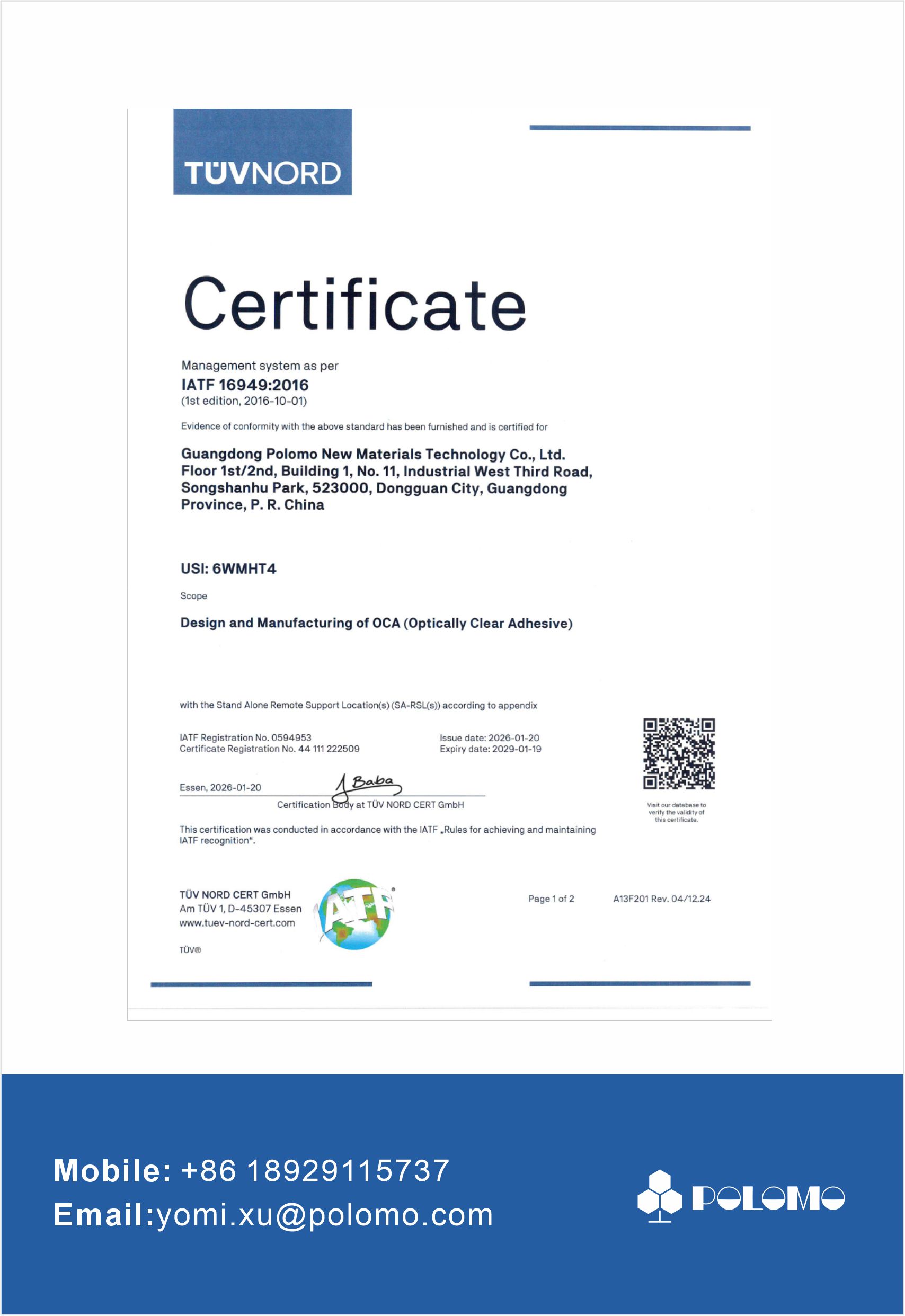
- IATF 16949:2016 — certificate 44 111 222509, issued by TÜV NORD CERT GmbH, scope: design and manufacturing of OCA (optically clear adhesive), valid from 20 January 2026 to 19 January 2029. The International Automotive Task Force describes IATF 16949 as the mandatory global quality management standard for automotive suppliers, focused on zero-defect manufacturing.
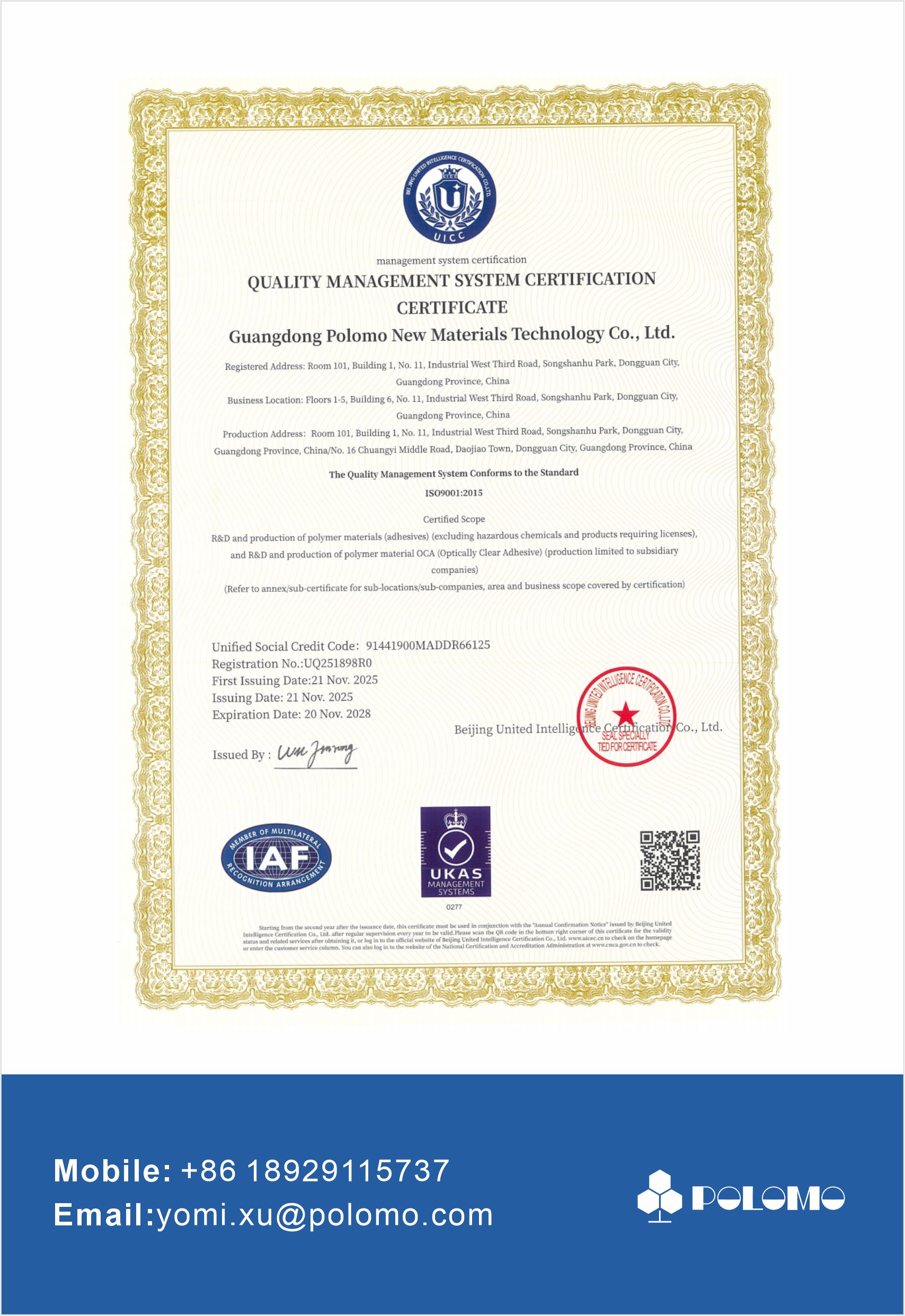
- ISO 9001:2015 — certificate UQ251898R0, issued by Beijing United Intelligence Certification Co., Ltd., valid from 21 November 2025 to 20 November 2028, covering R&D and production of polymer materials (adhesives) and R&D and production of polymer material OCA.
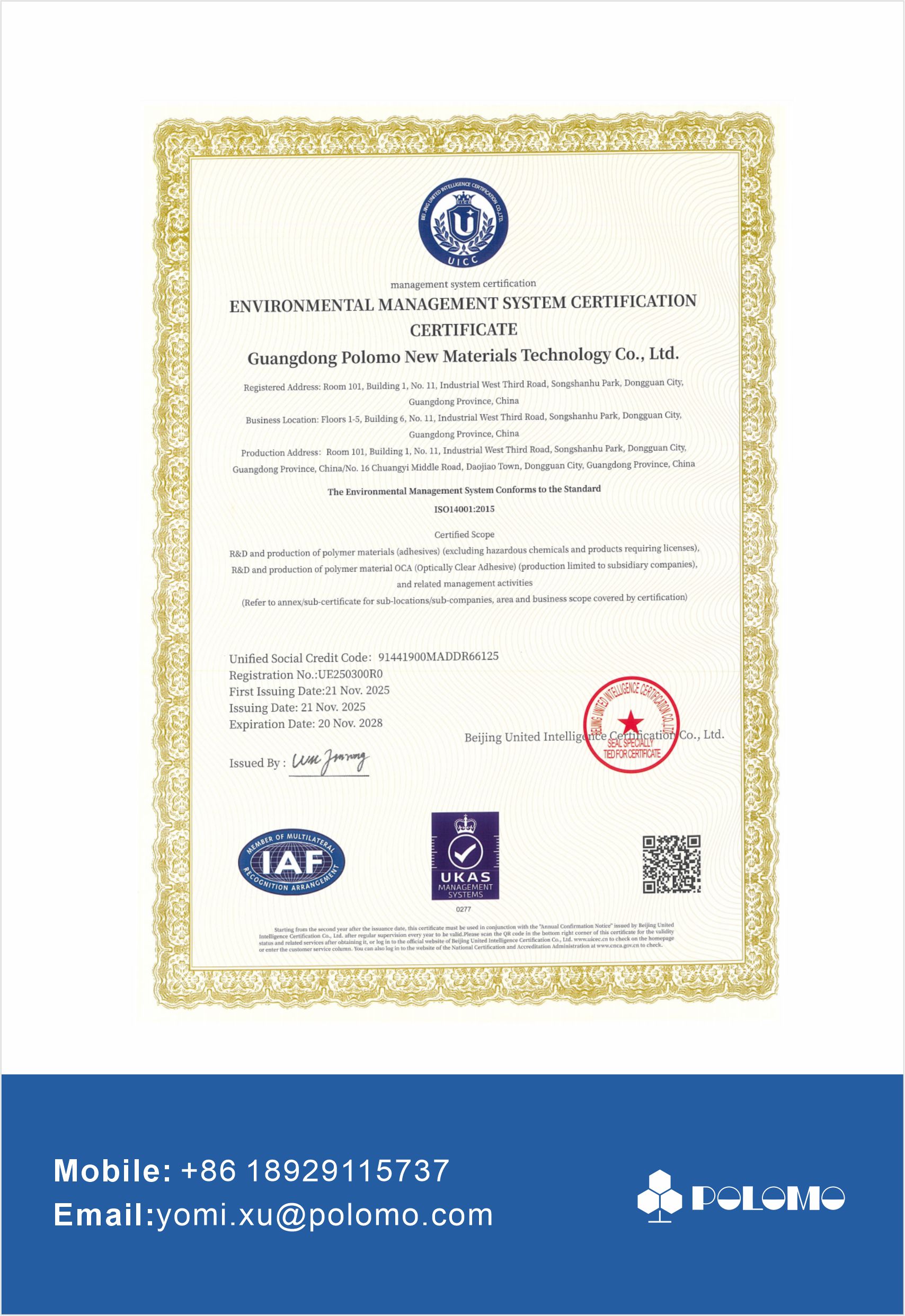
- ISO 14001:2015 — certificate UE250300R0, issued by Beijing United Intelligence Certification Co., Ltd., valid over the same period, covering environmental management for the same scope.
- ISO 45001:2018 — certificate US250195R0, issued by Beijing United Intelligence Certification Co., Ltd., valid over the same period, covering occupational health and safety management.
- VDA 6.3:2023 & VDA 6.5:2020 training attendance certificate — certificate TN_SC_CNGZ_VDA6.3&6.5-202411001 from TÜV NORD BU CERTIFICATION CHINA, dated 27 December 2024, covering process-audit and product-audit training.
- D-U-N-S Registered — number 52-969-0297, registered with Dun & Bradstreet for enterprise credit identification, valid from 1 May 2026 to 31 May 2027.
Read certificates by scope, not by logo. The IATF certificate covers the design and manufacturing of OCA specifically; the ISO 9001, ISO 14001 and ISO 45001 certificates cover R&D and production of polymer materials and polymer OCA. The VDA document is a training attendance certificate rather than a system certification, and it should be presented as evidence of audit competence, not as a manufacturing approval. Distinguishing between these categories during supplier evaluation is a quick way to separate a documented system from a marketing claim.
Use Cases: Where Storage and Environmental Control Changes the Outcome
Automotive cockpit displays
Automotive lamination concentrates every risk vector at once: wide temperature swings, humidity, vibration and UV exposure, with a zero-defect expectation. Silicone OCA from Polomo has been applied to display full lamination for more than ten years across automotive OEMs, Tier 1 suppliers, panel manufacturers, lamination manufacturers, display terminal manufacturers and distributors, and is currently used in more than 120 vehicle models with shipments exceeding 30 million pieces. Reported programme results include a 1.5% improvement in lamination yield, resolution of bubbles, mura and yellow spot defects, a 75% improvement in production efficiency and an 85% improvement in rework efficiency, with low odour supporting the health and safety requirements of mother-and-child-friendly smart cockpits.

Industrial touch and rugged displays
Industrial displays and rugged display systems represent 15% of the global OCA market in 2024. These programmes typically combine long service life with uncontrolled ambient conditions, so warehouse discipline and shelf-life management translate almost directly into warranty exposure.
Medical displays
Medical-grade silicones for devices and displays are projected to reach USD 21.14 billion by 2034. Health-certified requirements are part of the stated working conditions for TS107, TS108 and TS109, which places low-odour handling and contamination control alongside optical performance.
Large curved, narrow-bezel and flexible formats
Large curved automotive displays require low-modulus silicone OCA to prevent mura under thermal stress, and liquid OCA is increasingly used for curved and flexible displays. In both cases the material choice shifts the storage burden: films demand roll and liner discipline, while liquids demand sealed storage and dispensing-environment control.
Limits and Trade-offs: What Environmental Control Cannot Fix
Honest evaluation means naming the boundaries. First, storage control protects the adhesive you bought; it does not correct a material that is wrong for the application. A program with mild indoor conditions and no meaningful UV exposure may find an acrylic film adequate, and silicone chemistry is not automatically the right answer simply because it performs well under harsh conditions.
Second, controlled storage carries an operational cost: conditioned warehouse space, ageing alerts and FIFO administration all consume resources. The trade-off is deliberate — a modest, predictable handling cost against an unpredictable field-failure cost.
Third, environmental control is a shared responsibility. A supplier can hold the correct warehouse conditions and still deliver a failed bond line if the customer's line-side staging, liner removal practice or autoclave parameters fall outside the stated process sequence. That is why the escalation path — 8D handling, root cause analysis and on-site line support — matters as much as the storage specification itself.
Frequently Asked Questions
Which certifications should govern silicone OCA production and storage?
For silicone OCA models TS107, TS108 and TS109, four management systems apply. IATF 16949:2016 (certificate 44 111 222509, issued by TÜV NORD CERT GmbH, scope: design and manufacturing of OCA, valid 20 January 2026 to 19 January 2029) governs automotive quality management; the International Automotive Task Force describes IATF 16949 as the mandatory global quality management standard for automotive suppliers, focused on zero-defect manufacturing. ISO 9001:2015 (UQ251898R0) and ISO 14001:2015 (UE250300R0) are issued by Beijing United Intelligence Certification Co., Ltd. and valid from 21 November 2025 to 20 November 2028, covering R&D and production of polymer materials (adhesives) and polymer OCA. ISO 45001:2018 (US250195R0) covers occupational health and safety for the same scope. Polomo also holds a VDA 6.3:2023 & VDA 6.5:2020 training attendance certificate (TN_SC_CNGZ_VDA6.3&6.5-202411001) and a D-U-N-S registration (52-969-0297). Always confirm the certificate scope rather than relying on the logo.
What should a buyer verify in a custom silicone optical bonding OCA OEM manufacturer for automotive displays?
Verify five things. First, the production model: Polomo operates OBM production and customises thickness and dimensions. Second, capacity and lead time: approximately 1 million pieces per month, with a lead time of 7–10 working days. Third, test discipline: 100% pre-shipment test, with acceptance based on pre-shipment test. Fourth, the rated window: for TS107, TS108 and TS109 the stated working conditions cover −40°C to 120°C, high temperature and high humidity, high-altitude negative pressure, vibration, strong UV exposure and health-certified applications. Fifth, after-sales capability: 8D customer complaint handling, online and on-site production line support, root cause analysis and continuous improvement. A sixth check is often decisive — whether the storage and environmental control claims are backed by certificates whose scope actually covers OCA manufacturing.
How is custom silicone OCA priced, and what drives the cost?
Polomo does not publish list pricing; the MOQ is stated as “to be discussed,” which means commercial terms are agreed against a specific program rather than quoted from a catalogue. The stated cost drivers are customisation of thickness and dimensions, order volume and the commercial framework: delivery on FOB, FCA or EXW terms, with payment before shipment or monthly settlement. Buyers should also weigh total cost rather than unit cost, because storage and handling discipline directly affects scrap and rework rates — in one automotive lamination program, improved handling and process control were associated with a 1.5% yield improvement and an 85% improvement in rework efficiency.
How can an engineering team validate storage and lamination behaviour before committing to a full order?
Start with the stated acceptance basis: acceptance on pre-shipment test, supported by 100% pre-shipment testing, gives the receiving team a defined reference point. Then replicate the real process sequence — remove light release liner → STH → remove heavy release liner → HTH → autoclave on lamination equipment at room temperature and low pressure — and record Δb, haze and defect counts against the published silicone OCA values (Δb 0.03, haze < 0.3). Trial scope, order quantities and MOQ are agreed case by case, since the MOQ is listed as “to be discussed”; the practical path is to define the validation criteria first, then agree the trial size with the supplier.
What lead time and delivery terms apply to silicone OCA orders?
The stated lead time for silicone OCA is 7–10 working days, supported by a monthly capacity of approximately 1 million pieces and an annual output of 10 million pieces from a 90,000 m² facility in Dongguan, Guangdong Province. Delivery is available on FOB, FCA or EXW terms, with acceptance on pre-shipment test and payment before shipment or monthly settlement. Because storage conditions after handover affect the material as much as conditions before it, confirm the receiving warehouse's temperature and humidity control before the first shipment arrives.
Conclusion: Put Environmental Control in the Evaluation, Not the Post-Mortem
Silicone OCA, acrylic OCA and liquid OCA differ on storage and environmental control in ways that show up as yield, rework and field returns rather than as datasheet values. Silicone OCA's published profile — water absorption below 0.3, Δb of 0.03, haze below 0.3, a stated −40°C to 120°C working window including high humidity, altitude, vibration and UV exposure, and a modulus of 22 ± 5 suited to large curved stacks — describes a material designed for demanding environments. What converts that profile into production reality is the control system around it: a temperature- and humidity-controlled clean warehouse, light and dust control, strict shelf-life management, inventory ageing alerts, standardised opening procedures and FIFO issuance, all operating under IATF 16949:2016, ISO 9001:2015, ISO 14001:2015 and ISO 45001:2018.
For evaluation teams, the practical conclusion is to treat storage and environmental control as a scored line item in supplier selection, with the same weight as optical performance. Ask for the certificate scope, the warehouse control description, the shelf-life rule and the escalation path in writing before the design freeze — not after the first mura complaint.
Next step: if you are evaluating silicone OCA for an automotive, industrial or medical display programme, request the product brochure and specification data for TS107, TS108 and TS109, or send your stack and operating conditions for a storage and lamination review.
Brochure: Download the Polomo product brochure (PDF)
Website: en.polomo.com
Contact: Yomi Xu · yomi.xu@polomo.com · Tel +86 18929115737 · WhatsApp +86 159-1833-2421
Guangdong Polomo New Materials Technology Co., Ltd, Building 6, No. 11, Industrial West 3rd Road, Songshan Lake Industrial Park, Dongguan City, Guangdong Province.