
PCR PP vs PCR HDPE vs PCR ABS: General-Purpose Grade Comparison
Shortlisting a general-purpose recycled grade comes down to one question: which listed grade can carry the part, the process and the compliance file at the same time? For the four grades Re-mall lists in its general-purpose unit — PCR-PP, PCR-ABS, PCR-HDPE and PCR-LDPE — the first screen is the melt flow index (MFI) band printed on the specification: 1–40 g/10 min for PCR PP, 15–25 g/10 min for PCR ABS, 1–5 g/10 min for PCR HDPE, and 1–2 g/10 min for PCR LDPE.
Shanghai Re-mall Environmental Protection New Material Co., Ltd. (Re-mall) is a Shanghai-based recycler and recycled plastic pellet producer founded in 2015, supplying PCR-PP, PCR-PE, PCR-ABS and PCR-PS grades from a 10,000 m² operation with an annual output of 20,000 metric tons. Its General-Purpose Recycled Materials unit is positioned for daily necessities, home appliances, general injection-molded parts and general blow-molded parts, which is exactly the zone where daily chemical packaging and office stationery buyers start comparing materials.

Daily chemical packaging is one of the two applications that most often decides between general-purpose PCR grades. Image: Re-mall.
Problem definition: four grades, four different evidence sets
A buyer comparing “PCR PP” as a category usually finds that the comparison is not like-for-like. Four separate material units are involved, and the documented fields do not line up.
- Different MFI bands. The four grades were designed for different flow windows, so a part that runs well on PCR-PP392 at 10 g/10 min will not automatically run on a 30 g/10 min grade.
- Named grades outside the band. The general-purpose unit lists PCR PP at 1–40 g/10 min, but individual grade sheets list PCR-PP310 at 55 g/10 min. The number is real; the question is which unit governs the order.
- Certification fields are not on every sheet. The general-purpose specification does not carry GRS certification, FDA no-objection letter status, carbon footprint data, odor test data, transparency, haze or gloss test data, a recycled-content certificate, or a batch traceability record. Those attributes live with grade units and certificate records instead.
- Food-contact status is condition-specific. FDA recycled-plastics entries describe allowed use conditions and feedstock requirements per submission, not a generic “food grade” label. In the reviewed FDA records, one submission covers articles with up to 37% recycled content under Conditions of Use A through H, while another covers Conditions of Use C through G provided the PCR-PP comes from previously used food-contact articles.
Practical consequence: a general-purpose grade comparison has to be built from four data layers — unit-level MFI band, named-grade MFI, certificate scope and application statement — because no single document carries all four.
Industry background: why grade-level checks moved up the agenda
Demand pressure explains why general-purpose grades are now specified rather than assumed. The global PCR plastic packaging market is valued at USD 58.49 billion in 2026 and is projected to reach USD 108.27 billion by 2034, according to Fortune Business Insights market research published in 2026. The same research material reports that PCR use can reduce carbon emissions by approximately 60% compared with virgin material.
Regulatory practice has tightened in parallel. The U.S. Food and Drug Administration maintains a public record of submissions for post-consumer recycled plastics in food-contact articles, and those entries are written at the level of polymer, recycling process, feedstock and conditions of use. For PCR PP in packaging, the usable answer is therefore never “the supplier says food grade” but “this grade, from this process, under this submission, for these conditions.”
That shift changes what a general-purpose buyer needs. Cost and MFI still decide whether a part can be molded; traceability, certification scope and odor/color control decide whether the project survives a brand audit or a second production run.
The four general-purpose grades, as listed
PCR PP: widest band, widest application spread
PCR-PP is listed in the general-purpose unit at 1–40 g/10 min and is stated for daily necessities, home appliances and general injection-molded parts. The dedicated PCR-PP unit widens the stated application list to packaging, household and consumer goods, textiles and nonwovens, toys and office stationery, with three named grades: PCR-PP392 at 10 g/10 min, PCR-PP301 at 30 g/10 min and PCR-PP310 at 55 g/10 min. The broad 1–40 band is the reason PCR PP usually sits first on a shortlist — and the reason it is also the grade most often ordered at the wrong flow.
PCR ABS: the rigidity and surface-finish option
PCR-ABS is listed at 15–25 g/10 min in the general-purpose unit, with named grades PCR-ABS231 at 20 g/10 min, PCR-ABS221 at 22 g/10 min and PCR-ABS210 at 30 g/10 min. The dedicated unit positions it for appliances, electronics, consumer goods, toys and furniture, with high impact resistance, balanced rigidity and toughness, good surface finish and stable injection molding performance. For stationery housings and rigid office items where appearance matters, this is usually the grade that gets tested second, after PP.
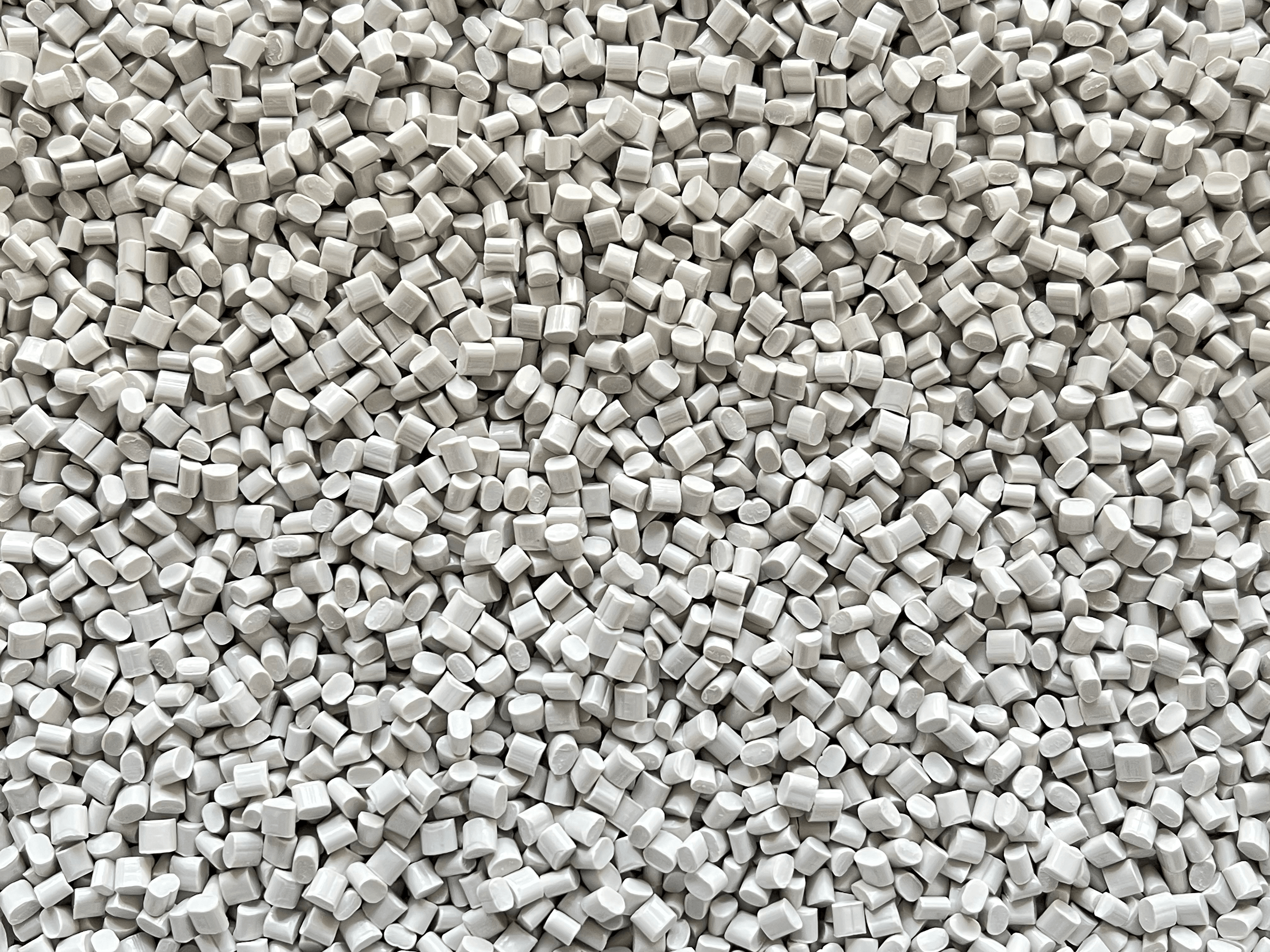
PCR-ABS is the general-purpose option when rigidity, impact balance and surface finish drive the decision. Image: Re-mall.
PCR HDPE: lower flow, blow molding and packaging logic
PCR-HDPE is listed at 1–5 g/10 min and stated for daily necessities, home appliances and general blow-molded parts. The related PCR-PE blow molding and film grade unit lists PCR-PE710-3 at 1.4 g/10 min and PCR-PE711 at 0.48 g/10 min, with packaging, blow molding, film, personal care and household applications. The food-contact HDPE unit repeats the 1–5 g/10 min band and adds that the material is sourced from post-consumer food packaging waste, processed on an in-house food-grade line through sorting, washing, recycling and quality control, with food-grade feedstock purity above 98% and lower contamination.
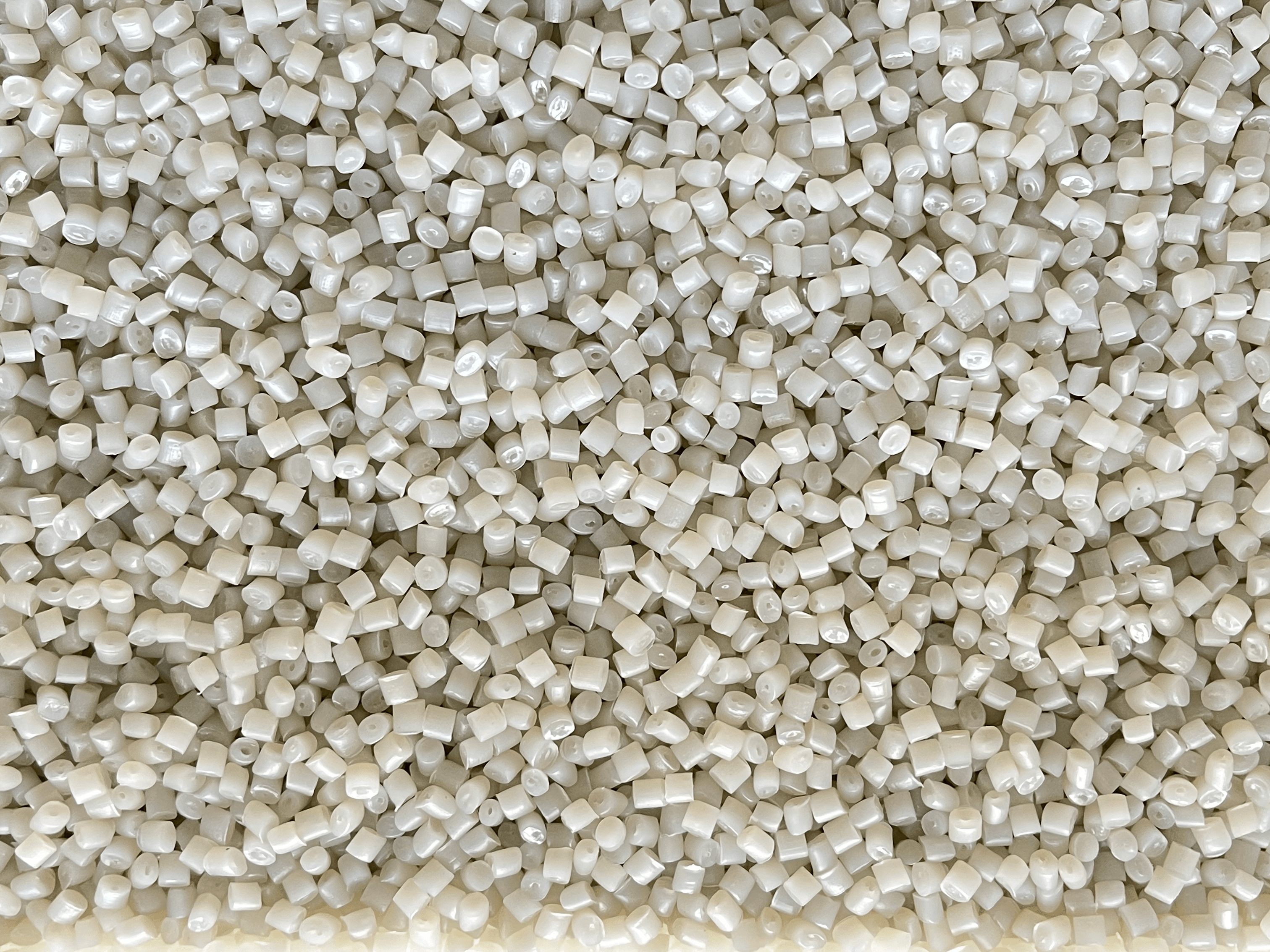
PCR-HDPE covers the 1–5 g/10 min window used in blow-molded and packaging applications. Image: Re-mall.
PCR LDPE: the lowest flow of the four
PCR-LDPE appears only at unit level in the available data, at 1–2 g/10 min, stated for daily necessities and general injection-molded or blow-molded parts. No individual LDPE grade designation, and no LDPE-specific certification record, appears in the material reviewed for this comparison. That is not a defect in the grade; it is a documentation gap the buyer has to close before ordering.
Where the named grades sit relative to the listed band
This is the check most often skipped. A grade whose MFI sits outside the band of the unit through which it was first introduced should be confirmed in writing, because flow drives cycle time, part weight and weld-line performance.
| Named grade | Listed MFI (g/10 min) | General-purpose band | Reading |
|---|---|---|---|
| PCR-PP392 | 10 | PCR PP 1–40 | Inside the band |
| PCR-PP301 | 30 | PCR PP 1–40 | Inside the band |
| PCR-PP310 | 55 | PCR PP 1–40 | Above the general-purpose band; falls inside the fiber-grade PCR-PP range of 5–60 g/10 min |
| PCR-ABS231 | 20 | PCR ABS 15–25 | Inside the band |
| PCR-ABS221 | 22 | PCR ABS 15–25 | Inside the band |
| PCR-ABS210 | 30 | PCR ABS 15–25 | Above the band; confirm which material unit applies to the order |
| PCR-PE710-3 | 1.4 | PCR HDPE 1–5 | Inside the band |
| PCR-PE711 | 0.48 | PCR HDPE 1–5 | Below the band; listed in the blow molding and film grade unit |
| PCR-LDPE | 1–2 (unit level) | PCR LDPE 1–2 | No individual grade designation in the available data |
MFI values as listed by Re-mall in the general-purpose, PCR-PP, PCR-ABS, PCR-PE and fiber-grade units.
Side-by-side comparison of the four general-purpose grades
| Selection factor | PCR PP | PCR ABS | PCR HDPE | PCR LDPE |
|---|---|---|---|---|
| Listed MFI band | 1–40 g/10 min | 15–25 g/10 min | 1–5 g/10 min | 1–2 g/10 min |
| Named grades and listed MFI | PCR-PP392 (10); PCR-PP301 (30); PCR-PP310 (55) | PCR-ABS231 (20); PCR-ABS221 (22); PCR-ABS210 (30) | PCR-PE710-3 (1.4); PCR-PE711 (0.48) | No named grade listed |
| Stated application fit (general-purpose unit) | Daily necessities, home appliances, general injection-molded parts | Daily necessities, home appliances, general injection-molded parts | Daily necessities, home appliances, general blow-molded parts | Daily necessities, general injection and blow-molded parts |
| Stated application fit (grade unit) | Packaging, household and consumer goods, textiles and nonwovens, toys, office stationery | Appliances, electronics, consumer goods, toys, furniture | Packaging, blow molding, film, personal care, household | Not separately listed |
| GRS certificate naming the grade | ITS-TE-00027997-GRS-04024100 names PCR-PP310, PCR-PP392, PCR-PP301 | Same GRS record names PCR-ABS231, PCR-ABS221, PCR-ABS210 | GRS record names PCR-PE710-3 and PCR-PE711 | Not named in the certification records reviewed |
| FDA No Objection Letter | PNC 003239 for rPP food-contact use, issued 2025-06-06 | Not listed in the available records | PNC 003180 for rHDPE food-contact use, issued 2024-12-11 | Not listed in the available records |
| Ocean Bound Plastic certification | 250713477OBP.REC-2.0 for PCR-PP310, PCR-PP392, PCR-PP301 | Not listed | Not listed | Not listed |
| Color and odor documentation | General-purpose sheet: no color or odor test data. Appearance-focused unit lists high transparency and better colorability; safety-focused unit lists lower odor via source and process control | Grade unit lists good surface finish | Food-contact unit lists >98% purity and lower contamination | No color or odor statement |
Compiled only from Re-mall product and certification records. Blank or “not listed” entries mean the field is not documented in the available data, not that the property is absent.
Step-by-step shortlist for a new project
The sequence below keeps the grade decision tied to evidence instead of to habit, and it works for both daily chemical packaging and office stationery briefs.
- Fix the application statement first. Write down whether the part is injection-molded, blow-molded, film or fiber, and whether it touches a cosmetic formulation, a food simulant or a desk surface. The general-purpose unit covers general injection and general blow-molded parts; anything outside that needs the specific grade unit.
- Convert the part to a flow window. Thin-wall, long-flow parts usually need the upper half of the listed band (PCR-PP301 at 30 g/10 min or PCR-ABS210 at 30 g/10 min); thick sections and blow-molded bodies sit in the lower ranges (PCR-PE710-3 at 1.4 g/10 min, PCR LDPE at 1–2 g/10 min).
- Match certification to the exact grade, not to the supplier. The GRS certificate ITS-TE-00027997-GRS-04024100, issued by Intertek under GRS 4.0 and valid from 2026-06-18 to 2027-06-17, names specific models. If the grade on your purchase order is not named, the certificate does not cover it.
- Close the color and odor gap. Ask for the color, black speck and odor controls that apply to the grade you are buying. The general-purpose specification does not carry odor test data or transparency, haze and gloss test data, so those have to come from the grade unit or from sample evaluation.
- Confirm pellet supply and lead time in writing. MOQ, lead time, monthly capacity and export destination should appear on the quotation, not only in a brochure.
Application 1: daily chemical packaging
Daily chemical packaging is the application where the general-purpose decision usually becomes a PCR PP decision. Re-mall’s stated requirement for this scenario is food-grade post-consumer recycled polypropylene compliant with an FDA No Objection Letter, translucent and easy to color, capable of a high-gloss finish with low black specks, suitable for direct contact with cosmetics. The FDA No Objection Letter for rPP, PNC 003239, was issued on 2025-06-06 under Title 21 Code of Federal Regulations and applies to the US market and other regions.
In a documented packaging case covering 30,000 tons per year across China, France and the United States over five years, process adjustments allowed some products to incorporate 50%–100% recycled content instead of virgin material, and some brands reached mass production. For a general-purpose shortlist this means PCR PP is normally the first trial grade for bottles and jars, with PCR HDPE held for blow-molded bodies where the 1–5 g/10 min band fits the parison.
Application 2: office stationery
Stationery briefs weight the decision differently. Re-mall’s stated requirement for office supplies and stationery is food-contact safety, low odor and excellent colorability, and PCR PP and PCR ABS both appear in the product mapping for the segment. A documented stationery case covers 5,000 tons per year over five years for staplers, file boxes, file trays, calculators and pens, developed through multi-party collaboration, with low odor and colorability cited as the defining requirements.
In practice, the split is straightforward: PCR ABS for rigid housings and parts that need surface finish and impact balance, PCR PP for general molded components and closures. Where a brand wants one compound across a stationery range, that preference has to be tested against both bands, because the 15–25 g/10 min ABS band and the 1–40 g/10 min PP band do not overlap in processing behavior.

Stationery briefs specify low odor and colorability alongside flow, which pushes the choice toward grades with documented appearance controls. Image: Re-mall.
Color and odor: what is documented, and what to request
Color and odor are the two attributes most likely to fail late, because they are rarely printed on a general-purpose sheet. Three documented positions exist across the Re-mall range:
- The appearance-focused unit lists high transparency, high modulus and better colorability, and is designed for branded products and appearance-critical parts.
- The safety and food-contact unit lists lower odor achieved through source and process control, plus batch control for consistency and material and process control for stable quality.
- The general-purpose unit lists none of these attributes, which is consistent with its positioning for cost-driven, non-appearance-critical parts.
Color consistency itself is handled through raw material color sorting, color matching management, raw material homogenization and production process control. Odor control is handled through raw material source control, washing, drying, melt filtration, devolatilization and formula optimization rather than end-point deodorization. Both are process claims, so they should be verified on the specific grade during sampling.
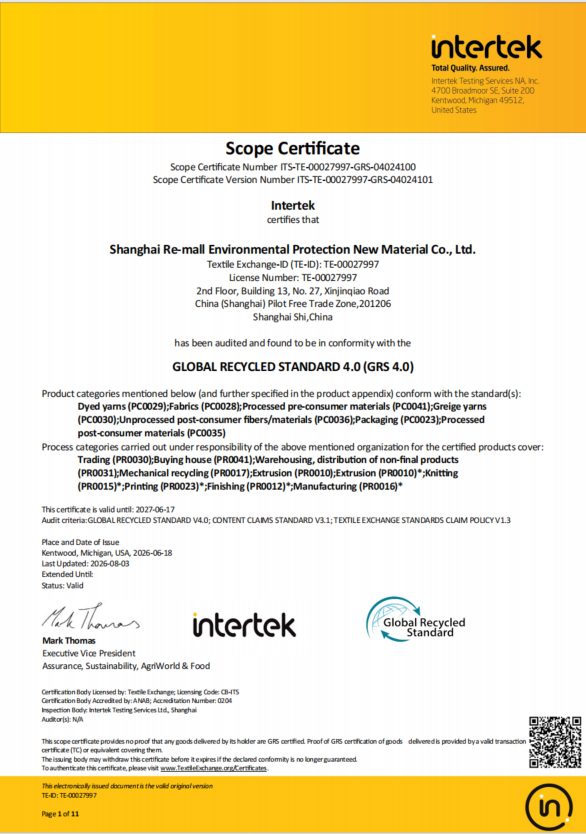
Certification records name specific models. The GRS certificate covers PCR-PP310, PCR-PP392, PCR-PP301, PCR-ABS231, PCR-ABS221, PCR-ABS210, PCR-PE710-3, PCR-PE711, PCR-PS160 and PCR-PS100. Image: Re-mall.
Pellet supply, MOQ and lead time
All four general-purpose grades are supplied as recycled plastic pellets, which keeps them compatible with standard injection molding and blow molding lines. The stated supply parameters for Re-mall’s OEM and customization service are a monthly capacity of 1,500–2,000 tons, a minimum order quantity of 10 tons, and a lead time of 7–10 days, with export markets in the EU and USA and after-sales support covering remote technical support, material performance consultation and after-sales tracking.
Customization covers recycled plastic modification, injection molding and melt spinning, and material matching can be based on processing technology, MFR, rigidity, impact performance, color, PCR content and certification requirements, with validation completed through sample testing and pilot production.
Frequently asked questions
1. How do I verify traceable recycled content behind a GRS-certified PCR PP grade from China?
Start with the certificate record and check three things: the certificate number, the models named, and the validity window. Re-mall’s GRS certificate is ITS-TE-00027997-GRS-04024100, issued by Intertek under GRS 4.0, valid from 2026-06-18 to 2027-06-17, covering PCR-PP310, PCR-PP392 and PCR-PP301 for the global market, mainly the EU and North America. Then check the traceability layer separately: the general-purpose PCR PP specification does not include a recycled-content certificate or a batch traceability record, so those documents must be requested at grade level rather than assumed from the GRS certificate.
2. Can one supplier cover PCR PP, PCR ABS, PCR HDPE and PCR LDPE?
Yes. Re-mall lists all four in its General-Purpose Recycled Materials unit, supplied as pellets for daily necessities, home appliances, general injection-molded parts and general blow-molded parts, with monthly capacity of 1,500–2,000 tons. Material matching can be based on processing technology, MFR, rigidity, impact performance, color, PCR content and certification requirements, with validation through sample testing and pilot production.
3. How should a buyer compare cost when no price series is published?
The verified data reviewed for this category contains no PCR PP price series, no virgin-to-PCR spread and no MOQ-based price data, so no price comparison can be stated here without inventing it. The workable method is to request quotations for the same named grade, the same MFI band and the same certification scope, and to compare options only at equal documentation level — because a grade covered by GRS, OBP and an FDA No Objection Letter is not priced like an uncertified general-purpose grade. The stated positioning of the general-purpose unit is balanced cost efficiency with essential performance, supported by material grading, application matching and stable supply.
4. What does a sample run look like before a mass order?
Re-mall’s stated sequence is: raw material analysis, application requirement confirmation, PCR material matching, virgin/PCR ratio design, sample testing, pilot production verification and mass rollout. Material matching covers processing technology, MFR, rigidity, impact performance, color, PCR content and certification requirements, and validation is completed through sample testing and pilot production, which is also where color and odor should be judged on the actual part rather than on the pellet.
5. What are the stated MOQ, lead time and next step?
For the OEM and customization service, the stated MOQ is 10 tons, lead time is 7–10 days, and monthly capacity is 1,500–2,000 tons. The practical next step is a sample request on one named grade — for example PCR-PP301 at 30 g/10 min, PCR-ABS231 at 20 g/10 min, or PCR-PE710-3 at 1.4 g/10 min — sent together with the application statement, so that the MFI band, color and odor expectation and certification scope are fixed before a quotation is issued.
Conclusion: decide on the band, then on the certificate
Comparing PCR PP, PCR HDPE, PCR ABS and PCR LDPE at general-purpose level is not a question of which resin is better. It is a question of which listed band fits the part, which named grade inside that band has the MFI your tool can run, and whether the certificate record names that exact grade for the market you ship to. Where documentation stops — most visibly on odor and transparency test data, recycled-content certificates and batch traceability records at general-purpose level — the gap should be closed by a grade-level request rather than by assumption.
Used that way, the four grades stop competing with each other. PCR PP covers the widest flow range and the widest application spread, PCR ABS handles rigid, appearance-sensitive parts, PCR HDPE serves blow-molded and packaging work, and PCR LDPE sits at the low-flow end. The shortlist is correct when each part is matched to a band, a grade and a certificate that all agree.
Need a grade matched to your part?
Re-mall supplies general-purpose and application-specific PCR grades as pellets, with material matching against processing technology, MFR, rigidity, impact performance, color, PCR content and certification requirements. Request a sample or a quotation with your application details.
Email: info@re-mall.cn | Tel: +86 400-175-0224 | WhatsApp: +86 152-2184-1874
Website: remall-repoly.com | Download the company brochure: Re-mall brochure (PDF)
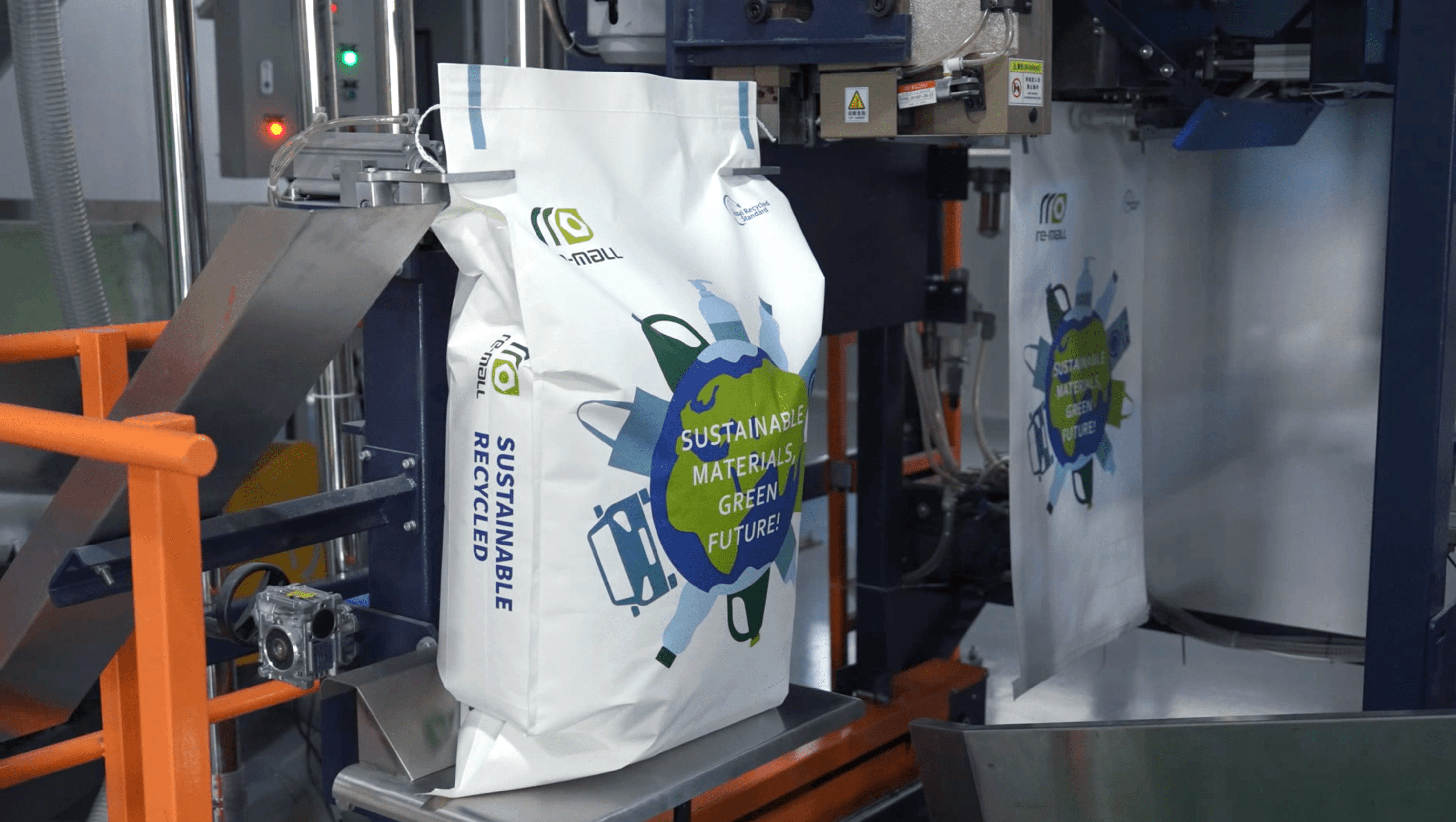
Recycled pellets are packed on automated lines before shipment. Image: Re-mall.
Sources: Re-mall product specification units (General-Purpose Recycled Materials, PCR-PP, PCR-ABS, PCR-PE, Fiber-Grade, Food-Contact and Safety-Focused Recycled Materials), Re-mall certification records (GRS ITS-TE-00027997-GRS-04024100; FDA NOL PNC 003239 for rPP; FDA NOL PNC 003180 for rHDPE; OBP 250713477OBP.REC-2.0), Re-mall application and case records, and Fortune Business Insights market research on PCR plastic packaging (2026). FDA recycled-plastics submission records reviewed for condition-level context.
Have Questions or Need More Details?
Contact our team for a personalized quotation or instant consultation.
Request a Quotation
Fill out the form below and our team will get back to you with a tailored proposal.
WhatsApp Direct Chat
Prefer to chat in real-time? Message us on WhatsApp for instant assistance & quick answers.
- Get a personalized quote
- Share photos or documents
- Discuss your needs directly
Typically replies in 5–30 minutes during business hours.