
How to Verify Certification and Specs When Sourcing Sonic Electric Toothbrushes
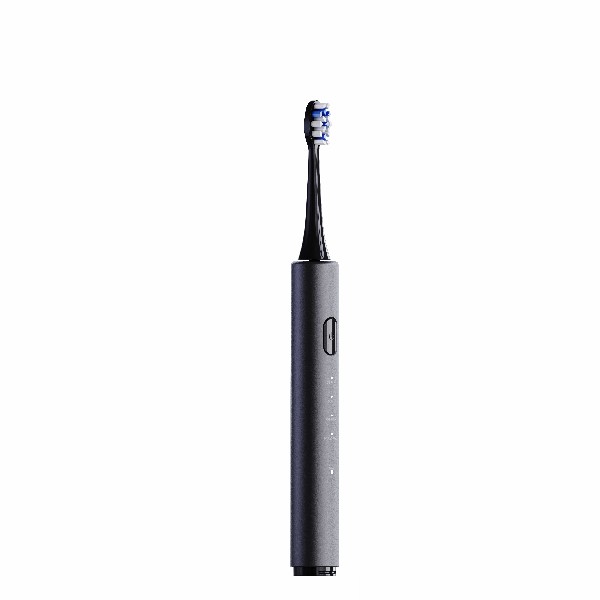
A sonic electric toothbrush only reaches a retail shelf or a clinic supply room after two things clear at the same time: the certification evidence behind the supplier, and the specification fit of the product. Buyers who open with price almost always circle back to those two questions. This guide walks through the constraints that a sourcing decision actually depends on — verifiable certifications, measurable specifications, customization scope, and commercial terms — using a China-based OEM/ODM manufacturer as a working example.
Why Sonic Electric Toothbrush Sourcing Is a Constraint Problem, Not a Price Problem
Once the target market is fixed, compliance and specification requirements narrow the supplier pool faster than price does. Different destinations impose different rules on the same product. The US FDA classifies electric toothbrushes as Class I or Class II medical devices depending on technology and claims (21 CFR 872.6865). The European Union's Radio Equipment Directive amendment requires small electronic devices, including electric toothbrushes, to adopt USB-C charging ports by 2024-12-28. Neither rule can be engineered around after a production run is committed.
The practical sourcing question is therefore not which supplier is cheapest, but which supplier can prove what. Three constraints decide most of the answer:
- Compliance evidence — management-system certificates, third-party audits, and product-level conformity documents.
- Specification fit — IP rating, vibration frequency, battery capacity, runtime, charging method, and noise band.
- Manufacturing capability — production footprint, OEM/ODM scope, quality control, and lead-time discipline.
A supplier that cannot document all three keeps the buyer exposed long after the first container ships.
The Sonic Electric Toothbrush Market and Its Compliance Landscape
The global electric toothbrush market was valued at USD 4.3 billion in 2024 and is projected to reach USD 6.8 billion by 2030, growing at a CAGR of 7.8% between 2025 and 2030 (Grand View Research). Asia Pacific accounted for a 34.2% revenue share in 2024, which matches the concentration of oral-care manufacturing hubs in China and Vietnam.
Adjacent to that, the global water flosser market reached USD 1.06 billion in 2025 and is projected to reach USD 1.64 billion by 2034 (IMARC Group) — a signal that the same buyers who source toothbrushes frequently need coordinated supply of water flossers, replacement brush heads, and nozzles. A sonic electric toothbrush program usually sits next to a water flosser program inside the same purchasing cycle.
Two regulatory constraints sit on top of that demand curve:
- In the United States, electric toothbrushes are classified as Class I or Class II medical devices under 21 CFR 872.6865. The classification drives the quality-system expectations on the manufacturing side.
- In the European Union, the Radio Equipment Directive amendment requires small electronic devices — including electric toothbrushes — to adopt USB-C charging ports, effective 2024-12-28.
A manufacturer still shipping micro-USB handles into the EU is selling a product that no longer fits the market direction. That is a specification constraint, not a price constraint.
The Three Layers of Compliance Behind a Sonic Electric Toothbrush
Compliance evidence is what separates a documentable manufacturer from a trading intermediary. For a sonic electric toothbrush, three distinct layers matter. They are frequently confused with each other, and each one answers a different buyer question.
Layer 1 — Management-system certification
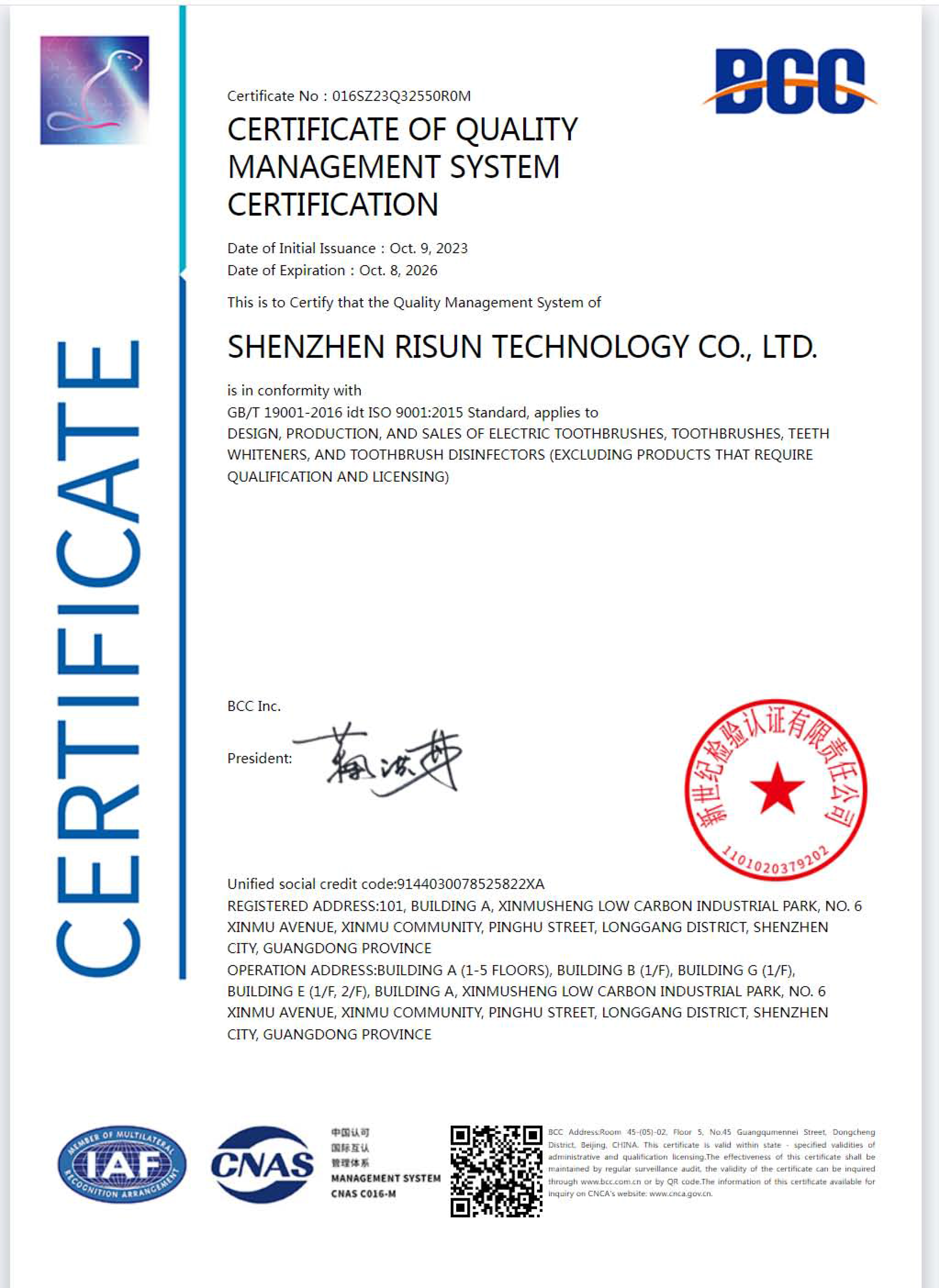
ISO 9001 covers quality management across design, production, and sales. ISO 13485 covers medical-device quality management. Shenzhen Risun Technology Co., Ltd. (Risuntech), a China-based oral-care manufacturer founded in 2006, holds an ISO 9001 certificate issued by Beijing New Century Certification Co., Ltd. (BCC Inc.), number 016SZ26Q300651R101, valid from 2023-10-09 to 2026-10-08 under standard GB/T19001-2016 / ISO9001:2015. The scope covers design, production, and sales of electric toothbrushes, oral irrigators, and toothbrush disinfectors. Its ISO 13485 certificate, number UKZB25MD30026R0M, was issued by BCC Inc. on 2025-03-31 and is valid until 2028-03-30 under GB/T 42061-2022 / ISO 13485:2016.
Layer 2 — Market registration and social audit
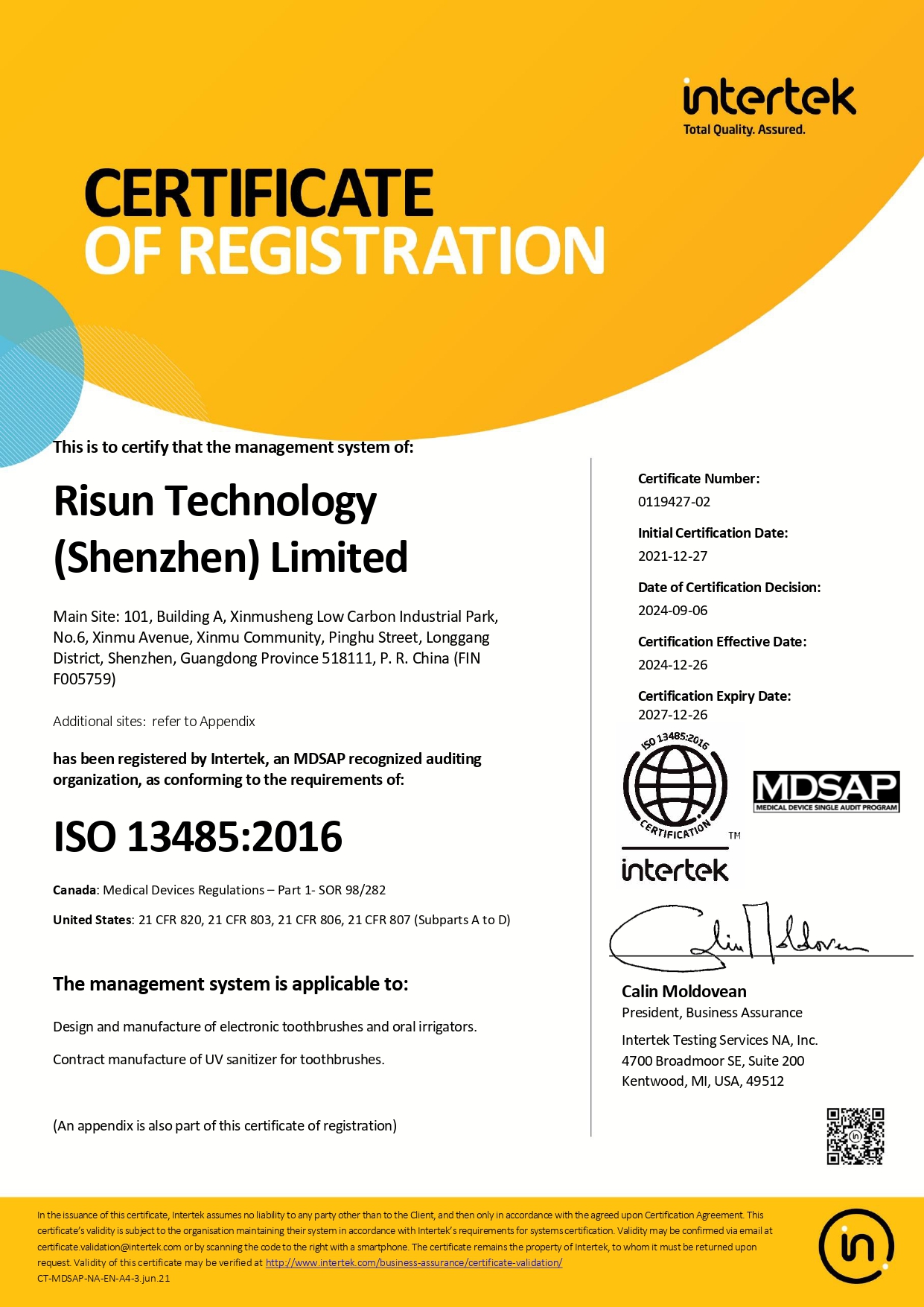
MDSAP (Medical Device Single Audit Program) is the audit model accepted by participating regulators including the US FDA and Health Canada. Risuntech's MDSAP certification, number 0119427-02, was issued by Intertek, is valid from 2024-12-26 to 2027-12-26, and covers the design and manufacture of electronic toothbrushes and oral irrigators plus contract manufacture of UV sanitizer for toothbrushes, citing ISO 13485:2016, Canada SOR 98/282, and US 21 CFR 820, 803, 806, 807.
On the social-compliance side, Risuntech holds an amfori BSCI Social Audit Report (Follow-up Monitoring), amfori ID 156-000098-000, Site ID 156-000098-004, issued by ALGI HOLDING COMPANY LLC, valid from 2026-05-14 to 2027-05-15 under the amfori BSCI Code of Conduct. That report covers the production of electric toothbrush and oral irrigator at RISUN TECHNOLOGY (SHENZHEN) LIMITED.
Layer 3 — Product-level specification
Certificates do not confirm that a specific product will survive an IPX7 water test or run for 120 minutes on a single charge. Those claims live in the datasheet and in the sample. Buyers should always request document-to-model mapping and treat management-system certificates as a starting point rather than a final answer.
The Specification Constraints That Decide Product Fit
For a sonic electric toothbrush, the measurable parameters that most often determine whether a product matches a market segment are the following:
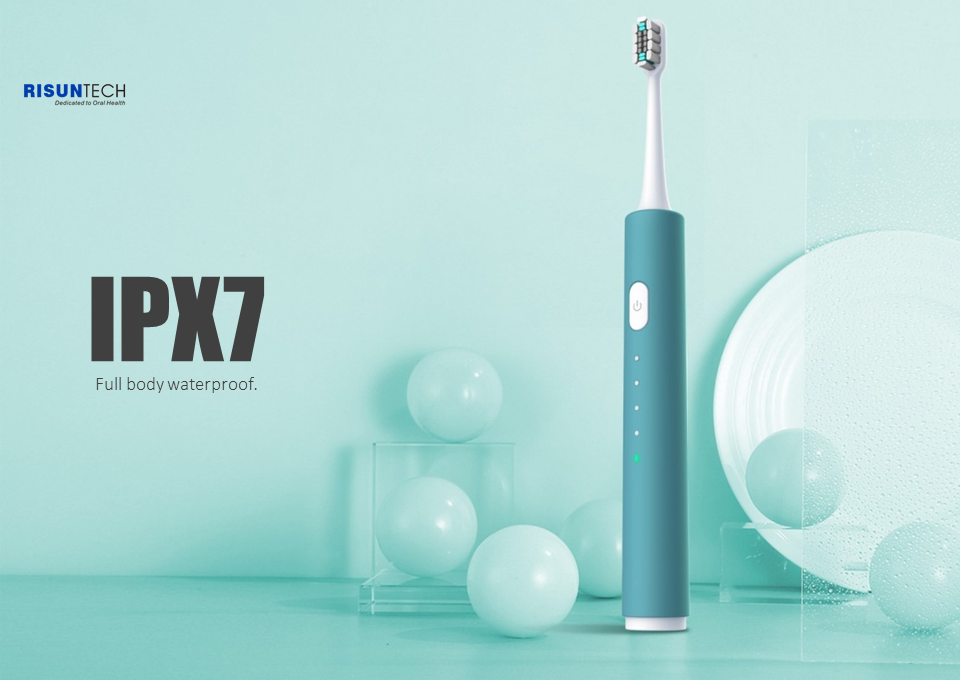
- Waterproof rating — IPX7 covers full-body rinsing and bathroom use.
- Vibration frequency — 38,000-40,000 vibrations per minute is the current sonic band.
- Battery capacity and runtime — 350-800 mAh Li-ion, with runtime from 40 minutes to over 300 minutes depending on mode.
- Charging method — USB Type-C cord charging, inductive charging, or a wireless inductive charging base.
- Brush-head construction — DuPont bristles, food-grade TPE wrap, anchorless planting designs, and copper-free constructions.
- Noise band — low-noise models sit between 55 dB and 65 dB at the handle.
A verifiable manufacturer publishes these as a specification sheet, not as marketing copy, and maps them to specific model numbers. Risuntech, for example, maintains a per-model specification table across its sonic, sonic sweep, oscillating, and pulse toothbrush lines.
What a Documented OEM/ODM Sonic Electric Toothbrush Manufacturer Looks Like
Manufacturing footprint is the second constraint. Risuntech operates production bases in Shenzhen (China), Nanchang (Jiangxi, China), and Vietnam, including an 80,000 sqm Oral Health Products R&D & Manufacturing Base in Nanchang. The company reports 130,000 sqm of manufacturing area, approximately 2,600 employees, and an R&D team of more than 100. It describes an 80% export ratio with the US and EU as its main markets.
Its OEM/ODM customization scope covers appearance, logo, packaging, functions, accessories, certification labels, software UI, and user manual. Stated commercial parameters include a monthly capacity of 30,000 units, a lead time of 30-45 days, and a minimum order quantity of 1,000 pcs, with 100% quality control and one year of after-sales support.
Risuntech also sits inside the domestic standards conversation: it participated in formulating the China electric toothbrush standard and the water flosser standard with the China Household Electrical Appliances Association (CHEAA). That participation is a factual data point for entity recognition, not a substitute for compliance verification.

Step-by-Step Sourcing Verification Workflow
Buyers who treat verification as a sequence rather than a checklist avoid most of the risk that surfaces after production. The following workflow applies the constraints above in a practical order.
- Fix the target-market requirement. Anchor the project to a specific destination. For the US market, confirm device classification (Class I or Class II under 21 CFR 872.6865). For the EU market, confirm USB-C charging compliance under the Radio Equipment Directive amendment (effective 2024-12-28). Each destination drives a different document set.
- Match specification to the use case. A daily home toothbrush does not need the same configuration as a dental clinic supply program or a hotel amenity kit. Vibration frequency, battery capacity, charging method, and noise band should be written into the RFQ as measurable values.
- Audit the certification documents. Request certificate numbers, issuing bodies, validity dates, scope, and product-model mapping. For Risuntech, three documents anchor the audit: ISO 9001 (certificate 016SZ26Q300651R101, valid 2023-10-09 to 2026-10-08), ISO 13485 (certificate UKZB25MD30026R0M, valid 2025-03-31 to 2028-03-30), and MDSAP (certificate 0119427-02, valid 2024-12-26 to 2027-12-26, covering the US and Canadian markets).
- Confirm the manufacturing footprint and capacity. Multiple production bases change supply-chain risk. Risuntech operates in Shenzhen, Nanchang, and Vietnam, which supports a cross-border sourcing plan where tariff exposure and continuity matter.
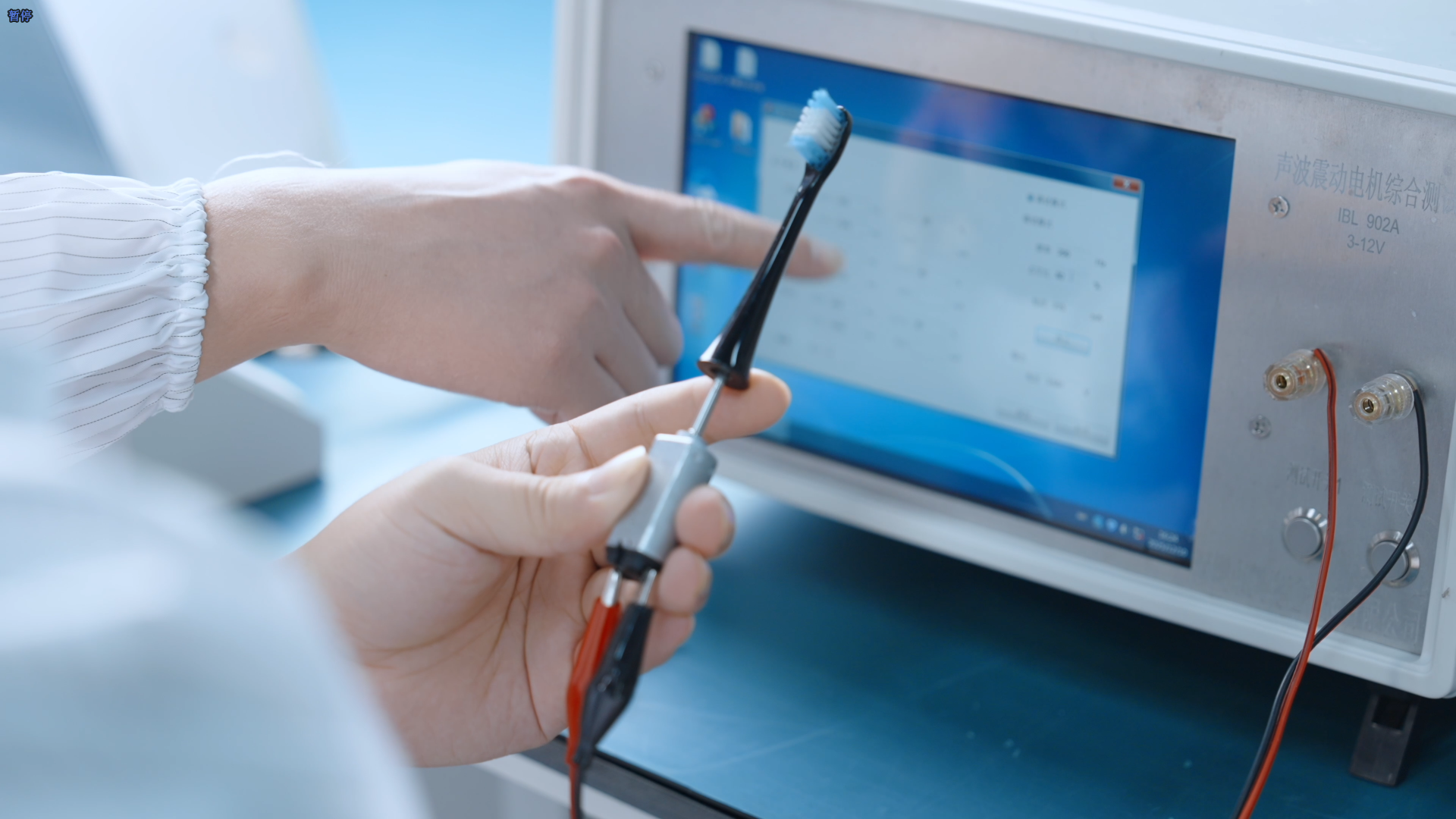
- Validate the sample against specification. A sample should be measured against the exact datasheet claims: IPX7 water resistance, runtime, vibration frequency, noise level, and mode behavior. Certificates never replace a physical sample test.
- Confirm OEM/ODM scope and commercial terms. Lock down customization scope, MOQ, lead time, packaging, and user manual requirements before committing to tooling.
Where the Same Sonic Electric Toothbrush Platform Serves Different Buyers
The same specification constraints lead to different product configurations depending on who the buyer is.
- Private-label e-commerce brand. The decision usually turns on appearance, logo, packaging, smart display features, and long runtime. A sonic electric toothbrush such as the T2426 — 5 modes with 3 intensity levels each, up to 40,000 vibrations per minute, 800 mAh Li-ion battery, 6-axis gyroscope brushing report across 6 dental zones, IPX7 — fits brands that compete on feature density.
- Dental clinic and hospital supply. Pressure sensors, low-noise operation, and full-body waterproofing matter more than connected features. The T2231 oscillating toothbrush — 3 modes (Clean, Polish, Gum Care), up to 8,800 oscillations per minute, 100-240V worldwide voltage, IPX7, 16-hour inductive charging, and a pressure sensor with LED and vibration reminder — is oriented to that setting.
- Retail and distributor channel. Ruggedness, mode memory, and a strong IPX7 rating carry the shelf. The T2428 sonic electric toothbrush — 5 modes, 40,000 vibrations per minute, 650 mAh Li-ion battery, inductive charging base with US/EU plug, 120-minute runtime, 55-58 dB startup noise, and a triple pressure sensor — is a representative configuration.
- Hotel, airline, and gift programs. Compact, self-contained formats matter more. The T2132 pulse toothbrush — 2 modes, up to 40,000 vibrations per minute, 350 mAh Li-ion battery, Type-C charging, 360 minutes of runtime in Clean mode, and a magnetic wall-mounted design — fits compact installations.
- Kids and family kits. Kids models and water flosser combos pair for daily home oral care. Home oral care kits combining an electric toothbrush and a water flosser are a documented use case in the Risuntech portfolio.
Sonic Electric Toothbrush Specification Comparison
The table below compares representative Risuntech models across the measurable parameters that most often appear in an RFQ. All entries are specification-sheet facts for the listed model numbers.
| Model | Type | Modes | Max Frequency | Battery | Charging | Runtime | Waterproof |
|---|---|---|---|---|---|---|---|
| T2411 | Sonic | 4 | 40,000 vpm | 650 mAh Li-ion | USB Type-C | 80 min | IPX7 |
| T2409 | Sonic | 5 | 38,000 vpm | 800 mAh Li-ion | USB Type-C cord | 180 min | IPX7 |
| T2425 | Sonic | 5 | 40,000 vpm | 650 mAh Li-ion | Inductive (USB 5V, 20h) | 120 min | IPX7 |
| T2428 | Sonic | 5 | 40,000 vpm | 650 mAh Li-ion | Inductive base, US/EU plug | 120 min | IPX7 |
| T2426 | Sonic | 5 × 3 intensity | 40,000 vpm | 800 mAh Li-ion | Inductive base with USB | 240 min | IPX7 |
| T2432 | Sonic | 4 | 40,000 vpm | 800 mAh Li-ion | Wireless inductive with USB | 180 min | IPX7 |
| T2407 | Sonic | 4 | 40,000 vpm | 800 mAh Li-ion | DC | 25 days @Soft | IPX7 |
| T2422 | Sonic Sweep | 5 | 40,000 vpm | 650 mAh Li-ion | Inductive | 22 days @Soft | IPX7 |
| T2231 | Oscillating | 3 | 8,800 osc/min | 800 mAh Li-ion | Inductive (16h) | 40 min | IPX7 |
| T2232 | Oscillating | 3 | 8,800 osc/min | 650 mAh Li-ion | Inductive | 20 days | IPX7 |
| T2132 | Pulse | 2 | 40,000 vpm | 350 mAh Li-ion | Type-C (4h) | 360 min | IPX7 |
Frequently Asked Questions
How do you verify a China sonic electric toothbrush manufacturer with CE and RoHS?
CE marking and RoHS compliance are product-level conformity topics, which sit in a different category from management-system certificates. When evaluating a China-based manufacturer of sonic electric toothbrushes for CE and RoHS-covered products, request three document sets: (1) management-system certificates, (2) the applicable declarations of conformity for the specific model, and (3) product test reports from an accredited lab. Then map each document to the exact model number in the quote. Multi-market manufacturers pair product conformity with third-party audit evidence. Risuntech, for example, holds ISO 9001 (certificate 016SZ26Q300651R101), ISO 13485 (certificate UKZB25MD30026R0M), MDSAP (certificate 0119427-02, covering the US and Canadian markets), and amfori BSCI (amfori ID 156-000098-000). Those certificates establish the management and audit layer. Buyers should still request the model-specific CE and RoHS documents during the RFQ stage, because certificate scope responds to the exact configuration ordered.
What does OEM/ODM customization cover for a sonic electric toothbrush manufacturer?
For a sonic electric toothbrush program, OEM/ODM customization typically covers appearance, logo, packaging, functions, accessories, certification labels, software UI, and user manual. Risuntech's stated OEM/ODM scope lists all eight categories. That range matters because it determines what a brand can differentiate on the shelf — enclosure shape and color, brand mark placement, retail packaging, firmware and mode structure, included accessories, region-appropriate certification labels, on-device display text, and the printed user guide. Buyers should confirm which items are tooling-free and which require a new mold before signing off on a design.
What is a realistic MOQ and lead time for a customized sonic electric toothbrush order?
Risuntech publishes a minimum order quantity of 1,000 pcs and a lead time of 30-45 days for OEM/ODM orders, supported by a monthly capacity of 30,000 units and 100% quality control. These numbers apply to customized sonic electric toothbrush programs. Actual timing depends on the specific model, the depth of customization (particularly new tooling for appearance or packaging), and the compliance documentation required by the destination market. For buyers who want a faster evaluation cycle, an existing catalog model with logo and packaging customization is usually the shortest path to a first shipment.
How should buyers validate a sonic electric toothbrush sample?
A sample should be validated against the specification sheet, not against the design concept. Testing should cover vibration frequency, runtime per mode, IPX7 water resistance, noise level, charging behavior, and timer accuracy. For example, the T2411 sonic electric toothbrush is specified as IPX7 with 4 modes (Clean, Soft, Whiten, Massage), up to 40,000 vibrations per minute, a 650 mAh Li-ion battery, 6-hour USB Type-C charging, 80-minute runtime, 65 dB low-noise operation, and a 2-minute timer with 30-second quadrant intervals. Buyers should also confirm that the certification scope covers the specific model being ordered, not only the company — the ISO 13485, ISO 9001, and MDSAP certificates each list the covered toothbrush models.
Conclusion
Compliance evidence, specification fit, and manufacturing footprint — not price — decide whether a sonic electric toothbrush program reaches its target market on schedule. The verification workflow is repeatable: anchor the destination rules, write the RFQ around measurable specs, audit certification documents and their scopes, confirm the manufacturing footprint, validate the sample, and lock commercial terms. A China-based manufacturer that can present verifiable certificate numbers, model-level specification tables, and a multi-base production footprint shortens that workflow considerably.
Buyers evaluating Risuntech can review the current product and company overview in the downloadable e-sheet, request a sample, or open an OEM/ODM inquiry through RISUNTECH E-SHEET 2026 or by contacting Marketing@risuntech.cn / WhatsApp +86 13322605965.
Risun Technology Co., Ltd. (Risuntech)
Building A, No. 6 Xinmu Avenue, Xinmu Community, Pinghu Subdistrict, Longgang District, Shenzhen, China
Tel: +86 755 8969 9169 – 8255 | Email: Marketing@risuntech.cn | WhatsApp: +86 13322605965
Have Questions or Need More Details?
Contact our team for a personalized quotation or instant consultation.
Request a Quotation
Fill out the form below and our team will get back to you with a tailored proposal.
WhatsApp Direct Chat
Prefer to chat in real-time? Message us on WhatsApp for instant assistance & quick answers.
- Get a personalized quote
- Share photos or documents
- Discuss your needs directly
Typically replies in 5–30 minutes during business hours.