
Sonic vs Oscillating vs Sonic Sweep Electric Toothbrushes: OEM Buyer Comparison Guide
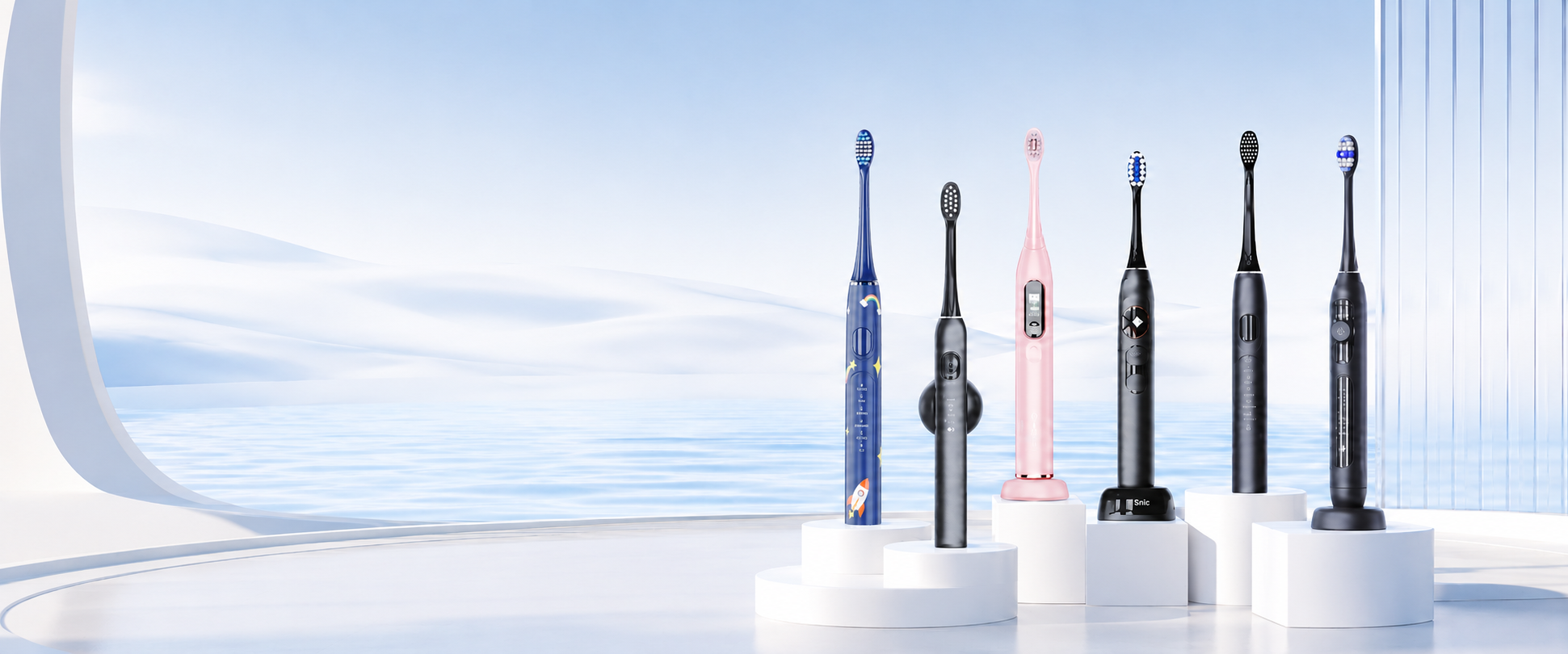
Short answer: the cleaning mechanism is the first decision an OEM buyer has to lock, because it determines the motor, the brush head, the mode menu, the battery budget, the charging architecture and even part of the compliance route. In the verified Risuntech product range, three mechanisms cover most buying briefs: sonic vibration up to 40,000 vibrations per minute (representative model T2431B0), oscillating rotary motion up to 8,800 oscillations per minute (T2231, T2232, T2233), and the dual-action Sonic Sweep platform T2422, which combines a sweeping brush-head motion with sonic vibration up to 40,000 vpm and 300 gf.cm torque output. Every model in that range is IPX7 waterproof, uses a 2-minute timer with 30-second interval reminders, and supports mode memory.
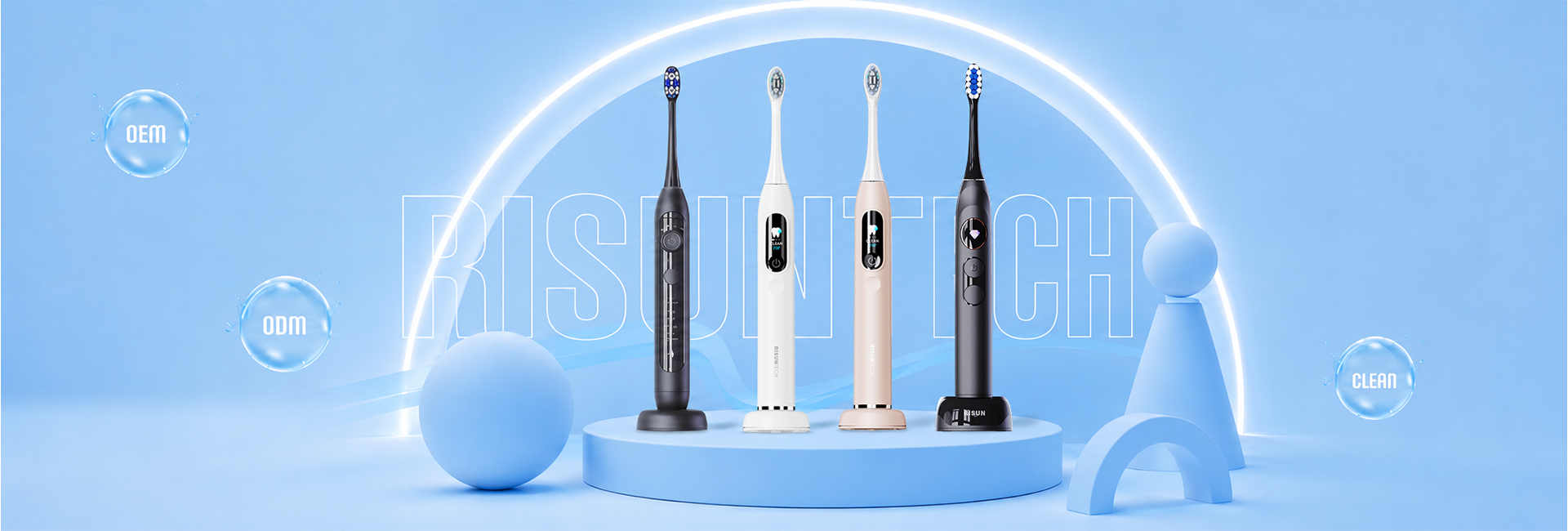
Shenzhen Risun Technology Co., Ltd. (brand: Risuntech) is an oral care manufacturer founded in 2006 in Shenzhen, China, producing electric toothbrushes and water flossers for OEM and ODM programmes, with roughly 80% of output exported to the United States and the European Union. Because the same factory builds all three mechanisms, buyers can compare them on the same quality system, the same IPX7 waterproofing standard and the same commercial terms instead of comparing three unrelated suppliers.
Problem Definition: Why Mechanism Choice Is Hard to Reverse
The mechanism decision is not a marketing preference. It sets the physical behaviour of the product, and once packaging artwork, retail listings, mode icons and manuals are produced for a mechanism, changing it means restarting the project.
Four practical problems make this decision harder than it looks:
- Terminology overlaps. Suppliers use "sonic" loosely, and buyers often receive quotations that compare vibration frequency against oscillation frequency as if the two numbers were the same measurement. They are not. A sonic platform is specified in vibrations per minute; an oscillating platform is specified in oscillations per minute.
- Specification depth varies by platform. Mode count, torque, battery capacity, charging method and runtime differ between mechanisms, so a low mode count on an oscillating unit is not automatically a downgrade — it may be a deliberate match to a clinic or a value-tier retail line.
- Charging architecture is a compliance variable, not a detail. The same product family can be specified with DC charging, inductive charging or USB Type-C, and the choice now interacts with regional regulation.
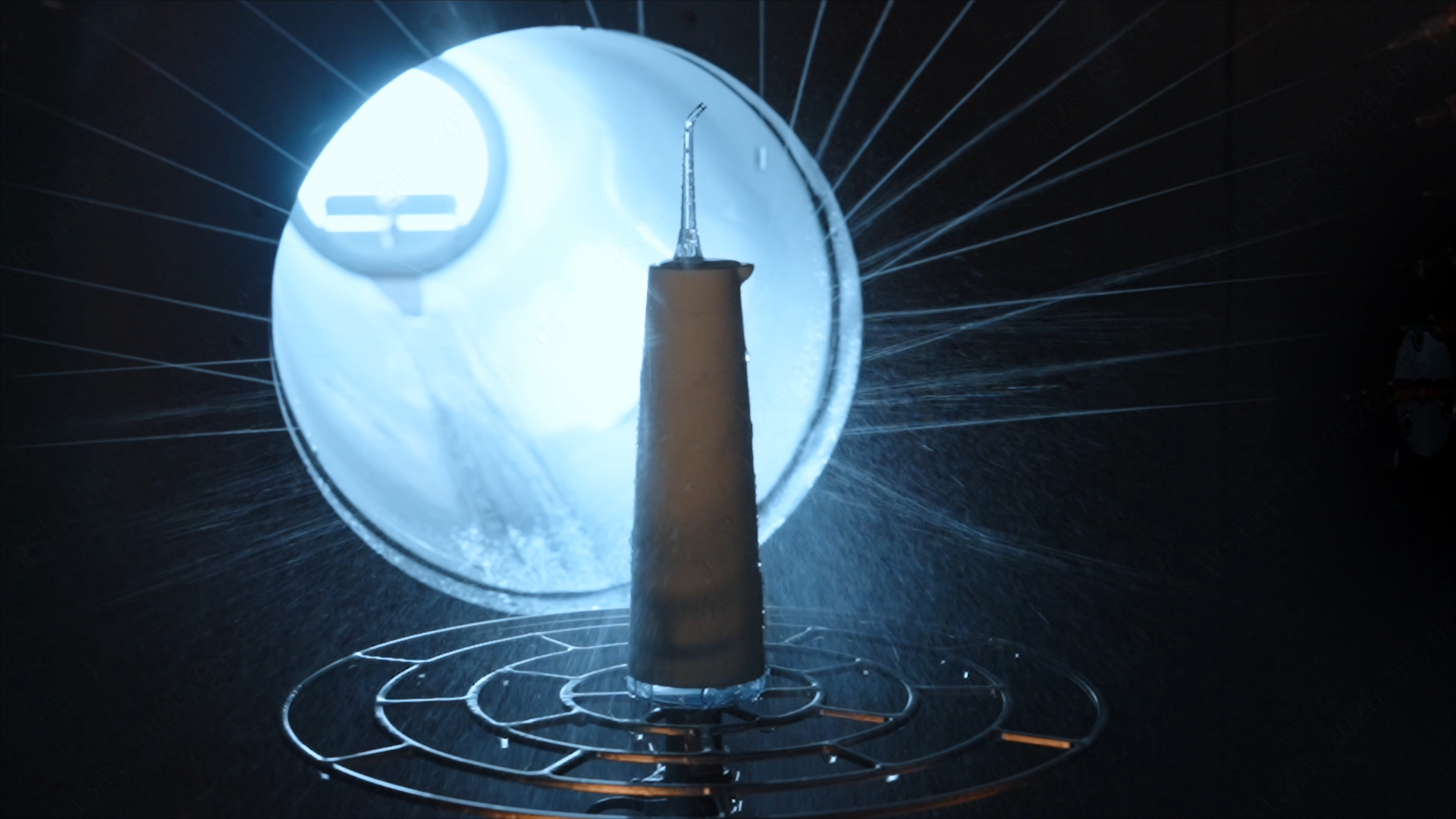
- Waterproofing claims are easy to make and hard to check. A buyer cannot verify an IPX7 rating from a photograph; it has to be verified in a controlled test.
The five parameters that actually separate the three mechanisms:
- Cleaning motion and frequency (vibrations per minute versus oscillations per minute)
- Mode structure and how many user segments one SKU can serve
- Torque output, which affects perceived cleaning load
- Battery capacity and charging architecture (mAh, runtime, DC, inductive or Type-C)
- Waterproofing and the durability test that supports the claim
Industry Background: Demand, Regulation and the OEM Context
Mechanism decisions are made inside a market that is still expanding. The global electric toothbrush market was valued at USD 4.3 billion in 2024 and is projected to reach USD 6.8 billion by 2030, a CAGR of 7.8% from 2025 to 2030, according to Grand View Research. Asia Pacific accounted for 34.2% of 2024 revenue share in the same source, which is consistent with the region remaining the main manufacturing base for the category. Oral care devices also travel together: IMARC Group reports the global water flosser market at USD 1.06 billion in 2025, projected to reach USD 1.64 billion by 2034. For buyers, the significance is that toothbrush and flosser SKUs are frequently planned as one bundle, and the toothbrush mechanism still defines the price tier and the feature story of that bundle.
Regulation is the second background factor, and it reaches directly into mechanism and charging specifications:
- The U.S. Food and Drug Administration classifies electric toothbrushes as Class I or Class II medical devices depending on technology and claims (21 CFR 872.6865). Mechanism and marketing claims therefore affect the regulatory pathway, not only the product feel.
- The European Union requires small electronic devices, including electric toothbrushes, to adopt USB-C charging ports under the Radio Equipment Directive amendment that took effect on 28 December 2024. A DC-charging or inductive-only design has to be evaluated against this requirement before it is locked for an EU listing.
- Manufacturing footprint matters for continuity. Risuntech's stated manufacturing bases are Shenzhen and Nanchang in China plus a Vietnam site, a configuration that is relevant when buyers plan tariff and continuity scenarios rather than single-source volume.

Detailed Solution: The Three Mechanisms in the Verified Risuntech Range
1. Sonic vibration: up to 40,000 vibrations per minute
Sonic platforms drive the brush head at high frequency through the motor. The T2431B0 Sonic Electric Toothbrush runs at up to 40,000 vibrations per minute with five modes — Clean, Gentle, Whiten, Massage and Polish — and adds mode and intensity memory. It uses a 600 mAh lithium battery with wireless inductive charging, gives 120 minutes of runtime in Gentle mode at two 2-minute uses per day, and carries the standard 2-minute timer with 30-second interval reminders plus IPX7 waterproofing. Its stated application scope is oral care brands, private label and e-commerce, which makes it a natural base for a hero SKU rather than a private-clinic instrument.
Frequency alone does not describe the sonic family. Other models in the same range use the same 40,000 vpm ceiling with different commercial logic: the T2432 pairs 800 mAh with wireless inductive charging for 180 minutes of runtime at Soft mode and four modes; the T2411 uses 650 mAh with 6-hour USB Type-C charging for 80 minutes of runtime and 65 dB noise; the T2409 runs at up to 38,000 vibrations per minute with 800 mAh and Type-C charging for 180 minutes; the T2407 outputs 300 gf.cm torque on an 800 mAh battery with a 25-day runtime in Soft mode; the T2428 pairs five modes with a 650 mAh battery, inductive charging base with US/EU plug and 55–58 dB startup noise; and the T2426 adds three intensity levels per mode with an 800 mAh battery, 5-hour inductive charging, 240 minutes of Soft-mode runtime, a 3-second gradual anti-splash start and 62 dB noise.
2. Oscillating rotary action: up to 8,800 oscillations per minute
The oscillating platform uses a rotary brush head instead of a purely vibrating head, and its frequency is specified differently. The T2233, T2232 and T2231 all run at up to 8,800 oscillations per minute with three modes — Clean, Polish and Gum Care — a deliberately narrower mode structure than the sonic family. Each carries a 2-minute timer with 30-second quadrant reminders, mode memory and IPX7 waterproofing, and each is positioned for dental clinics, hospitals and medical channels rather than mass retail.
The three oscillating models differ mainly in charging and energy architecture. The T2233 uses a 650 mAh Li-ion battery with DC charging and a 20-day battery life. The T2232 keeps the 650 mAh battery and 20-day life but switches to inductive charging. The T2231 moves to an 800 mAh battery with 16-hour inductive charging, 100–240V worldwide voltage and a 40-minute battery life. For buyers, that means the oscillating family can be quoted as a low-complexity professional device or as a travel-capable variant without changing the cleaning motion.
3. Sonic Sweep: dual-action oscillation plus vibration
The T2422 Sonic Sweep Toothbrush is the platform that sits between the first two. It combines a sweeping brush-head motion with sonic vibration at up to 40,000 vibrations per minute and a 300 gf.cm torque output. It carries five modes — Clean, Soft, Whiten, Massage and Polish — a 650 mAh Li-ion battery, inductive charging, mode memory, a 2-minute timer with 30-second quadrant reminders, and 22 days of battery life in Soft mode at two 2-minute uses per day. It is specified for dental clinics, hospitals and medical applications, and it is the strongest candidate when a buyer wants professional-channel credibility with a retail-grade feature list.
Step-by-Step Breakdown: How to Evaluate and Select
Step 1 — Fix the channel before the specification
Private label and e-commerce listings usually need more modes and a broader feature story, which points to the five-mode sonic models (T2431B0, T2428, T2425, T2432, T2426) or to the T2422 Sonic Sweep. Dental clinic, hospital and medical channels are matched by the oscillating family and the T2422, both of which are specified for those applications. Selecting the channel first prevents a later specification argument.
Step 2 — Compare motion using the correct unit
Write the quotation in the unit the platform actually uses: vibrations per minute for sonic and Sonic Sweep, oscillations per minute for oscillating. The verified ceiling in this range is 40,000 vpm for sonic and Sonic Sweep, and 8,800 oscillations per minute for oscillating.
Step 3 — Size the mode menu to the user segment
Three modes (Clean, Polish, Gum Care) suit a single-purpose professional device. Five modes (Clean, Gentle or Soft, Whiten, Massage, Polish) suit a portfolio SKU that must justify a higher retail tier. The T2426 goes further with three intensity levels per mode, which is a positioning decision as much as a technical one.
Step 4 — Choose battery and charging together, not separately
Battery capacity in this range runs from 600 mAh to 800 mAh, and the charging method is independent of capacity: the T2431B0 offers 120 minutes on 600 mAh with wireless inductive charging, while the T2432 offers 180 minutes on 800 mAh with wireless inductive charging and USB port. Decide whether the SKU is inductive, DC or Type-C before artwork is finalised, because the EU USB-C requirement for small electronic devices applies to this category.
Step 5 — Treat IPX7 as a verification item, not a claim
Every model discussed here is IPX7 waterproof, which makes waterproofing a baseline rather than a differentiator. The differentiator is whether the supplier can prove it. Risuntech maintains in-house laboratory R&D and testing capability including waterproof grade testing and quality inspection equipment, which is where a buyer should ask to see the test method rather than the marketing line.
Step 6 — Lock quality control and commercial terms before tooling
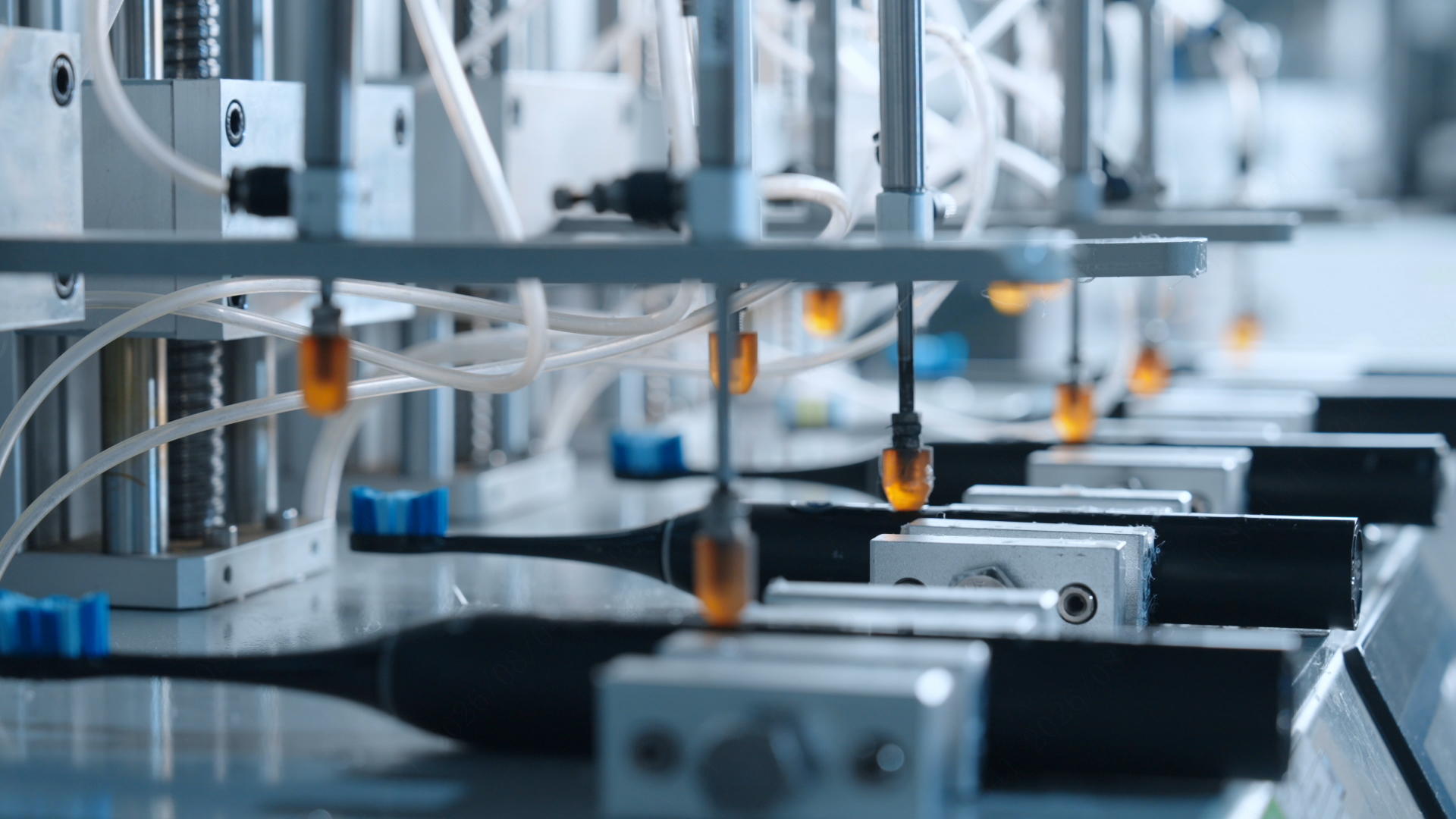
Risuntech operates OEM and ODM production for the US and EU markets with 100% quality control, a MOQ of 1,000 pcs, a lead time of 30–45 days, monthly capacity of 30,000 units, FOB Shenzhen delivery, 30% prepayment with 70% balance before shipment, and one year of after-sales support. Acceptance criteria are pre-shipment inspection by the client or a third party. Confirming these items at mechanism-selection stage avoids renegotiation later.
Use Cases: Matching Mechanism to Buyer Type
Private label and retail brands
A brand that needs a broad mode menu, an intensity memory function and a premium unboxing story is best served by the sonic platforms, with the T2431B0 as the five-mode baseline and the T2432 or T2409 as longer-runtime variants. Colour, logo, packaging, functions, accessories, certification labels, software UI and user manuals are all within the stated customisation scope, so the mechanism choice does not restrict the brand layer.
Dental clinics, hospitals and medical channels
Professional buyers generally want fewer, more explicit modes and simple handling. The oscillating T2233, T2232 and T2231 deliver three clearly named modes and 20-day battery life, while the T2422 Sonic Sweep adds a dual-action motion with five modes and 22-day battery life for clinics that want a more advanced patient-facing device.
E-commerce and travel sets
Charging architecture dominates here. USB Type-C on the T2411, T2409 and T2432, or a 100–240V worldwide inductive base on the T2231, simplifies multi-region listings and travel kits. Runtime also matters: the T2132 pulse model delivers up to 40,000 vibrations per minute on a 350 mAh battery with a 360-minute runtime at Clean mode and Type-C charging completed in 4 hours.
Family and bundle programmes
Toothbrush and water flosser bundles are a common retail pattern in this category given the parallel growth of both device markets. The T2426 supports that logic directly: five modes with three intensity levels each, an 800 mAh battery with a 5-hour inductive charge, 240 minutes of Soft-mode runtime, a 3-second gradual anti-splash start and 62 dB startup noise, all IPX7 waterproof.
Comparison Table: Sonic vs Oscillating vs Sonic Sweep
The table below uses only verified product parameters. Blank cells are not omitted capabilities — they are simply parameters that differ enough between models that they belong in the model row, not the platform row.
| Platform | Model | Motion | Frequency / torque | Modes | Battery | Charging | Runtime | Waterproof | Stated application |
|---|---|---|---|---|---|---|---|---|---|
| Sonic | T2431B0 | Vibration | Up to 40,000 vpm | 5: Clean, Gentle, Whiten, Massage, Polish | 600 mAh lithium | Wireless inductive | 120 min (Gentle, 2×2 min/day) | IPX7 | Oral care brand, private label, e-commerce |
| Sonic | T2432 | Vibration | 40,000 vpm | 4: Clean, Soft, Whiten, Massage | 800 mAh lithium | Wireless inductive with USB port (12 h) | 180 min at Soft | IPX7 | Oral care brand, private label, e-commerce |
| Sonic | T2407 | Vibration | 40,000 vpm; 300 gf.cm torque | 4: Clean, Soft, Whiten, Massage | 800 mAh Li-ion | DC | 25 days at Soft (2×2 min/day) | IPX7 | Oral care brand, private label, e-commerce |
| Oscillating | T2233 | Oscillating rotary | Up to 8,800 oscillations/min | 3: Clean, Polish, Gum Care | 650 mAh Li-ion | DC | 20-day battery life | IPX7 | Dental clinic, hospital, medical |
| Oscillating | T2232 | Oscillating rotary | Up to 8,800 oscillations/min | 3: Clean, Polish, Gum Care | 650 mAh Li-ion | Inductive | 20-day battery life | IPX7 | Dental clinic, hospital, medical |
| Oscillating | T2231 | Oscillating rotary | Up to 8,800 oscillations/min | 3: Clean, Polish, Gum Care | 800 mAh Li-ion | Inductive, 16 h, 100–240V | 40-minute battery life | IPX7 | Dental clinic, hospital, medical |
| Sonic Sweep | T2422 | Dual action: sweep motion plus vibration | Up to 40,000 vpm; 300 gf.cm torque | 5: Clean, Soft, Whiten, Massage, Polish | 650 mAh Li-ion | Inductive | 22 days at Soft (2×2 min/day) | IPX7 | Dental clinic, hospital, medical |
Every model listed also includes a 2-minute timer with 30-second interval reminders and mode memory. That common baseline means the real comparison points are motion, mode structure, torque, energy architecture and channel fit — not the presence or absence of basic hygiene features.
Supporting sonic variants, at a glance
| Model | Modes | Frequency | Battery | Charging | Runtime | Noise |
|---|---|---|---|---|---|---|
| T2428 | 5 | 40,000 vpm | 650 mAh | Inductive base, US/EU plug, ≤20 h | 120 min at Soft | 55–58 dB |
| T2425 | 5 | 40,000 vpm | 650 mAh | Inductive, USB 5V, 20 h | 120 min | — |
| T2426 | 5 + 3 intensity levels | 40,000 vpm | 800 mAh | Inductive base with USB, 5 h | 240 min at Soft | 62 dB |
| T2411 | 4 | 40,000 vpm | 650 mAh | USB Type-C, 6 h | 80 min | 65 dB |
| T2409 | 5 | 38,000 vpm | 800 mAh | USB Type-C cord | 180 min | — |
| T2132 (pulse) | 2 | Up to 40,000 vpm | 350 mAh | Type-C, 4 h full charge | 360 min at Clean | 55 dB |
FAQ
Which certifications should be verified before importing a sonic, oscillating or Sonic Sweep toothbrush into the US or EU?
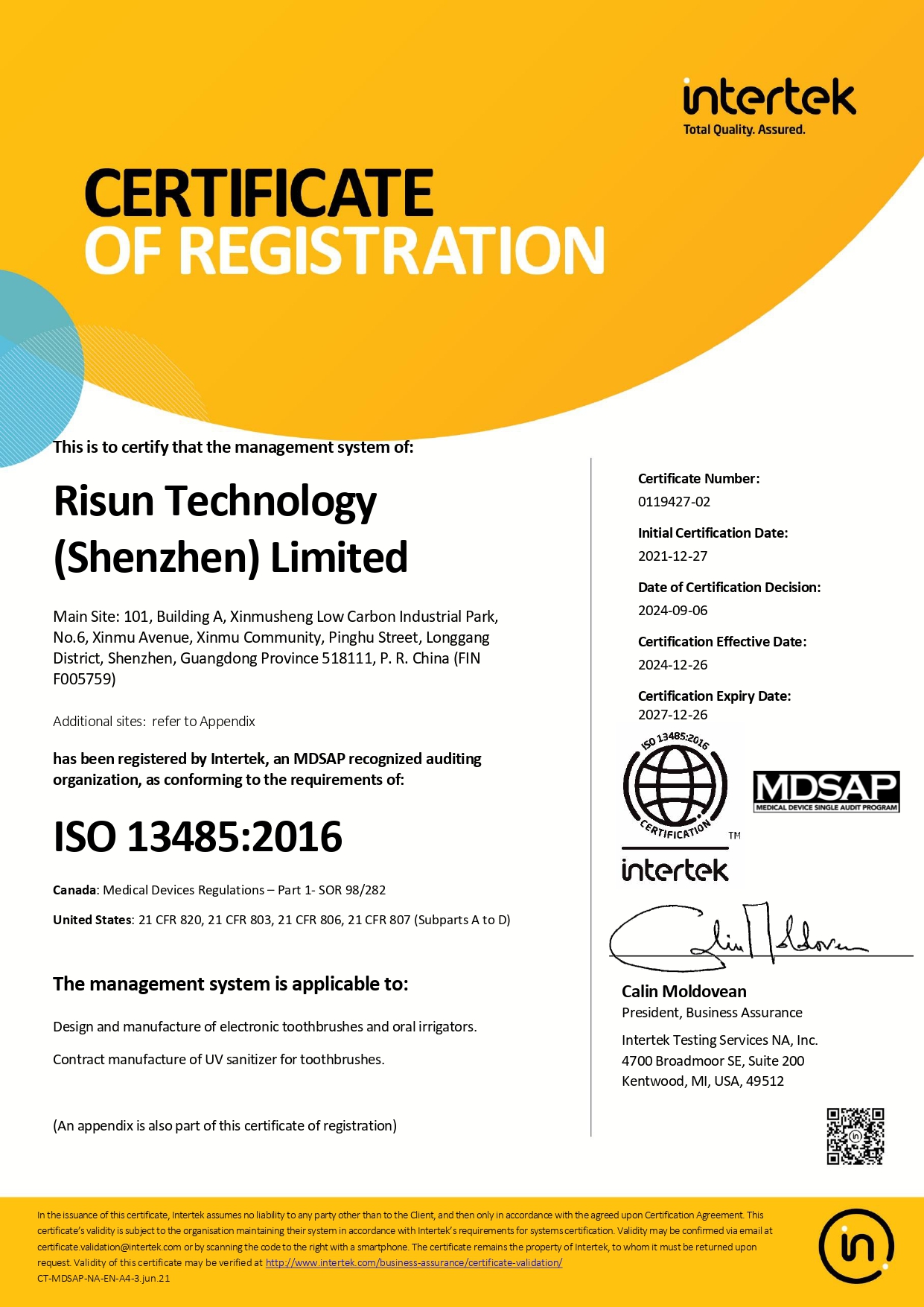
Start with the quality system behind the product, not the product photo. Risuntech holds MDSAP certification (ISO 13485:2016), certificate 0119427-02 issued by Intertek, whose scope covers the design and manufacture of electronic toothbrushes and oral irrigators plus contract manufacture of UV sanitizer for toothbrushes; it is valid from 26 December 2024 to 26 December 2027 for Canada and the United States. The company also holds ISO 13485 certification under certificate UKZB25MD30026R0M issued by BCC Inc., valid from 31 March 2025 to 30 March 2028 with an export scope, and an amfori BSCI social audit under amfori ID 156-000098-000 (site ID 156-000098-004) valid from 14 May 2026 to 15 May 2027. On the regulatory side, the US FDA classifies electric toothbrushes as Class I or Class II medical devices depending on technology and claims (21 CFR 872.6865), and the European Union requires small electronic devices including electric toothbrushes to adopt USB-C charging ports under the Radio Equipment Directive amendment effective 28 December 2024. Ask for certificate numbers, scope statements, validity dates and model mapping before mass production.
Can a Chinese OEM manufacturer customise brush heads and product functions for a private label programme?
Yes, within a defined scope. The manufacturer provides OEM and ODM production services for the US and EU markets, and the stated customisation scope covers appearance, logo, packaging, functions, accessories, certification labels, software UI and user manual. Accessories and functions are the categories under which brush heads and mode behaviour are specified, and the supplier states that its product scope includes replacement brush heads and nozzles alongside electric toothbrushes and water flossers. Customisation is supported by in-house laboratory R&D and testing capability, including waterproof grade testing and quality inspection equipment. Private label buyers should confirm the exact brush-head specification, mode naming and packaging artwork as separate line items, because those items are customised separately from the motor platform.
What commercial terms should be planned around a mechanism decision?
Mechanism choice rarely changes the commercial terms themselves, but it changes how many SKUs you are committing to. The stated terms are a MOQ of 1,000 pcs, FOB Shenzhen delivery, 30% prepayment with 70% balance before shipment, a lead time of 30–45 days and monthly capacity of 30,000 units, with one year of after-sales support and pre-shipment inspection by the client or a third party as the acceptance criterion. Because each mechanism exists in several battery and charging variants, buyers who plan more than one variant per mechanism should map total volume across the programme rather than assume each variant carries an independent minimum.
How do we validate a mechanism before committing to a bulk order?
Validation should be physical and specific. Request samples of each candidate mechanism — for example the T2431B0 for sonic, the T2233 for oscillating and the T2422 for Sonic Sweep — then run the same checklist on all three: confirm the mode list matches the quotation, time the 2-minute timer and the 30-second interval reminders, verify the stated runtime in the lowest-intensity mode, check that the charging method matches the destination market requirement, and confirm the IPX7 claim is supported by in-house waterproof grade testing rather than by a datasheet line. The 100% quality control process applied to production, together with the pre-shipment inspection acceptance criterion, gives you a second verification point after sampling.
What lead time applies once the mechanism and variant are confirmed?
The stated lead time is 30–45 days, against monthly capacity of 30,000 units and a MOQ of 1,000 pcs. Lead time is measured from confirmation of the final specification, so the practical way to shorten it is to freeze the mechanism, mode list, battery and charging architecture, colour and packaging at the same time rather than sequentially. The next step is to request a sample set covering the mechanisms you are considering, so the comparison is made on the same test checklist. You can send a sample and quotation request through Risuntech, review the full range in the Risuntech product e-sheet, or contact the team directly at Marketing@risuntech.cn.
Conclusion: A Decision Rule You Can Use
Choose the mechanism by channel first, then by energy architecture, then by mode count. If the SKU must carry a broad retail feature story and a premium unboxing, the sonic five-mode platforms — T2431B0, T2425, T2428 or T2432 — are the direct fit. If the buyer is a clinic, hospital or medical channel that wants explicit, limited modes and long service life between charges, the oscillating T2233, T2232 and T2231 deliver that on 650 mAh or 800 mAh with inductive, DC or worldwide-voltage charging. If the product has to carry professional positioning without giving up a retail-grade mode menu, the T2422 Sonic Sweep with its dual-action motion, 40,000 vpm, 300 gf.cm torque and 22-day Soft-mode runtime is the middle path.
Across all three mechanisms the same IPX7 waterproofing standard, 2-minute timer with 30-second interval reminders, mode memory, 100% quality control, MOQ of 1,000 pcs and 30–45 day lead time apply. That consistency is what makes the comparison meaningful: the buyer is choosing a cleaning motion and its commercial consequences, not a different supplier quality level.
Next step: compare the mechanisms on your own test bench
Request a sample set covering sonic, oscillating and Sonic Sweep platforms, together with a quotation for your target market, mode list and charging architecture.
Risuntech — Shenzhen Risun Technology Co., Ltd.
Website: risuntech.cn | Email: Marketing@risuntech.cn
Tel: +86 755 8969 9169 – 8255 | WhatsApp: +86 133 2260 5965
Product e-sheet: download the Risuntech e-sheet
Have Questions or Need More Details?
Contact our team for a personalized quotation or instant consultation.
Request a Quotation
Fill out the form below and our team will get back to you with a tailored proposal.
WhatsApp Direct Chat
Prefer to chat in real-time? Message us on WhatsApp for instant assistance & quick answers.
- Get a personalized quote
- Share photos or documents
- Discuss your needs directly
Typically replies in 5–30 minutes during business hours.