
Ultrasonic Toothbrush Sourcing: Verify Specs, Certifications and Claims
Buyer stage: Research → Evaluation
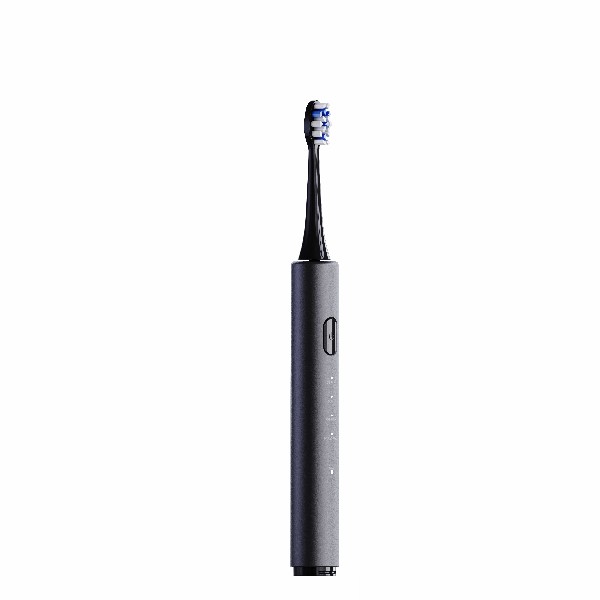
Risuntech T2411 sonic electric toothbrush — a documented specification reference for rechargeable electric toothbrush sourcing.
What “Ultrasonic” Actually Means in a Purchase Specification
In the electric toothbrush category, the terms sonic and ultrasonic are used interchangeably in listings, which is exactly why they cannot be used as a purchasing constraint. Sonic toothbrushes drive the brush head with a high-frequency motor; the published specification for several Risuntech platforms states up to 40,000 vibrations per minute, which equals roughly 667 cycles per second and remains within the audible operating range. Devices described as ultrasonic are generally understood in the industry to operate above the audible range. The practical consequence for a buyer is simple: the adjective on the box is not evidence, the frequency figure in the specification is.
Risuntech’s published product data covers sonic, sonic sweep, oscillating and pulse platforms, with frequencies stated as up to 40,000 vibrations per minute for sonic models and up to 8,800 oscillations per minute for oscillating models, plus torque figures such as 300 gf.cm on the T2407 and T2422. That level of detail — frequency, oscillation count, torque, ingress protection, battery, charging method — is what a purchaser should demand in the RFQ before a supplier is even shortlisted.
The Problem: Six Failure Modes That Appear After the Order
Sourcing problems in this category rarely come from the motor. They come from the distance between what the marketing page says and what the documents can prove.
- Adjective-only specifications. A listing says “ultrasonic” or “smart” but never states frequency, oscillation count or torque, so there is nothing to accept or reject at quality control.
- Unverified ingress protection. IPX7 is claimed across the referenced Risuntech models, but a claim is only usable when the test method and the acceptance criteria are agreed in writing.
- Certificates that do not match the model. A quality management system certificate that covers “electric toothbrushes” generally is not the same as a document mapped to the model number on your purchase order.
- CE and RoHS logos without paperwork. CE is a manufacturer’s declaration of conformity and RoHS is a substance-restriction compliance claim; both require declarations and test reports, not a mark in a catalogue.
- Expired or expiring certificates. Certificate validity windows must be checked at the date of the order, not at the date of the first enquiry. The ISO 9001 certificate referenced in this article, for example, carries a stated validity from 2023-10-09 to 2026-10-08, so renewal status must be confirmed before it is filed in a compliance folder.
- Commercial terms that break the launch plan. MOQ and lead time have to match your channel timetable; a 1,000 pcs MOQ with a 30–45 day lead time is workable for a brand launch and unworkable for a two-week promotion.
Industry Background: Market Scale, Regulation and Why Specifications Shift
Three external signals shape electric toothbrush sourcing decisions, and all three push buyers toward document-based evaluation.
Market scale and growth. According to Grand View Research, the global electric toothbrush market was valued at USD 4.3 billion in 2024 and is projected to reach USD 6.8 billion by 2030, a CAGR of 7.8% from 2025 to 2030. The same source reports that Asia Pacific accounted for a 34.2% revenue share in 2024, which is consistent with the concentration of oral-care manufacturing in China and Vietnam. IMARC Group reports that the global water flosser market reached USD 1.06 billion in 2025 and is projected to reach USD 1.64 billion by 2034 — relevant because toothbrush and oral irrigator programmes are usually sourced together.
Regulatory classification. The U.S. Food and Drug Administration classifies electric toothbrushes as Class I or Class II medical devices depending on the technology used and the claims made (21 CFR 872.6865). Classification is therefore a function of your product claims as much as your hardware, and it drives which quality management evidence your supplier must hold.
Interface and charging regulation. The European Union’s Radio Equipment Directive amendment requires small electronic devices, including electric toothbrushes, to adopt USB-C charging ports from 2024-12-28. This is visible in the specifications themselves: the Risuntech T2411 charges in 6 hours via USB Type-C, the T2409 uses USB Type-C cord charging, and the T2132 pulse toothbrush charges via Type-C in 4 hours.
The Three-Layer Verification Framework
A specification-led purchase process separates cleanly into three layers: parameters, compliance and manufacturing capability. Each layer produces documents you can attach to a purchase order.
Layer 1 — Parameters: Freeze the Technical Specification First
The parameter layer is where performance is decided. For a sonic or ultrasonic toothbrush programme, the values below should be stated as numbers in the RFQ, with the model reference attached.
- Frequency or oscillation count: up to 40,000 vibrations per minute on sonic models such as the T2411, T2425, T2428, T2422, T2407 and T2432; up to 38,000 vibrations per minute on the T2409; up to 8,800 oscillations per minute on the oscillating T2231, T2232 and T2233.
- Torque where declared: 300 gf.cm on the T2407 sonic toothbrush and the T2422 sonic sweep toothbrush.
- Ingress protection: IPX7 stated across the referenced sonic, sonic sweep, oscillating and pulse models.
- Battery capacity and chemistry: 350 mAh Li-ion (T2132), 600 mAh lithium (T2431B0), 650 mAh Li-ion (T2411, T2425, T2422, T2428, T2232, T2233), 800 mAh Li-ion (T2409, T2432, T2407, T2426).
- Charging method and charging time: USB Type-C — 6 hours on the T2411, 4 hours on the T2132; inductive charging — 20 hours USB 5V on the T2425, 12 hours on the T2432, up to 20 hours on a US/EU plug base for the T2428, 5 hours on the T2426, and 16-hour inductive charging with 100–240 V world-wide voltage input on the T2231; DC charging on the T2407 and T2233.
- Runtime: 40 minutes (T2231), 80 minutes (T2411), 120 minutes (T2425, T2428, T2431B0), 180 minutes (T2409, T2432), 240 minutes (T2426), 360 minutes (T2132); day-based figures include 20 days (T2232, T2233), 22 days (T2422) and 25 days (T2407) in Soft mode at two minutes twice a day.
- Noise: 65 dB (T2411), 55–58 dB (T2428), 55 dB (T2432 and T2132), 62 dB (T2426), and less than 70 dB at 10 cm (T2232).
- Modes and timing logic: 2 to 5 modes depending on model, with a two-minute timer and 30-second quadrant interval, an anti-splash gradual start-up on the T2409, T2428, T2432 and T2426, and mode memory across the referenced platforms.
- Materials and brush head construction: plastic housing; food-grade TPE brush head wrapping on the T2407 and T2422; DuPont bristles on the T2431B0 and oscillating models; Anchorless Planting Bristles technology on the T2411, designed to avoid metal rust and increase bristle quantity by 40%; Pedex reminder bristles on the T2425 that fade in colour to signal replacement every 90 days; and copper-free brush heads with a rubber coating on the T2426.
- Smart functions: LCD or LED colour screens on the T2409, T2428 and T2426; triple pressure sensing with a visible indicator on the T2428 and T2426; a six-axis gyroscope delivering a six-zone brushing report on the T2426; stepless speed adjustment on the T2432; 15 cleaning plans (5 modes × 3 intensity levels) on the T2431B0; and a magnetic wall mount on the T2132.
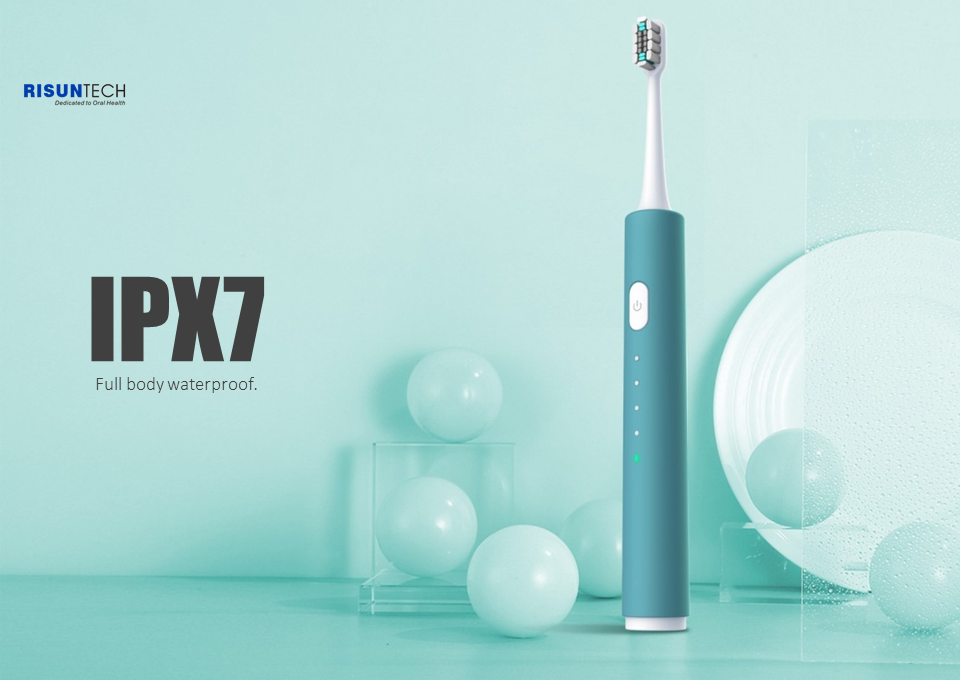
IPX7 is a specification to be verified and tested, not a marketing badge — T2411 full-body waterproof construction.
Layer 2 — Compliance: Management Systems, Market Access and Product Conformity Are Not the Same Thing
Buyers frequently treat all certification documents as one category. They are three: management-system certification (how the factory is run), market access or registration (whether a product may be placed on a given market), and product conformity or test evidence (whether a specific unit passed a specific test). A supplier that explains which category each document belongs to is easier to audit than one that sends a folder.
| Certificate | Certificate number | Issuing body | Stated validity | Scope and market |
|---|---|---|---|---|
| ISO 9001 quality management system | 016SZ26Q300651R101 | Beijing New Century Certification Co., Ltd. (BCC Inc.) | 2023-10-09 to 2026-10-08 | Design, production and sales of electric toothbrushes, oral irrigators and toothbrush disinfectors; GB/T 19001-2016 / ISO 9001:2015; global market |
| ISO 13485 medical device quality management system | UKZB25MD30026R0M | BCC Inc. | 2025-03-31 to 2028-03-30 | Design, manufacture and sales of electric toothbrushes, oral irrigators, toothbrush sterilizers and household UV therapy devices; GB/T 42061-2022 / ISO 13485:2016; export market |
| MDSAP certification (ISO 13485:2016) | 0119427-02 | Intertek | 2024-12-26 to 2027-12-26 | Design and manufacture of electronic toothbrushes and oral irrigators, plus contract manufacture of UV sanitizer for toothbrushes; Canada and United States; ISO 13485:2016, Canada SOR 98/282, US 21 CFR 820, 803, 806, 807 |
| amfori BSCI social audit (follow-up monitoring) | amfori ID 156-000098-000; Site ID 156-000098-004 | ALGI HOLDING COMPANY LLC | 2026-05-14 to 2027-05-15 | Production of electric toothbrush and oral irrigator at RISUN TECHNOLOGY (SHENZHEN) LIMITED; amfori BSCI Code of Conduct; global market, particularly European retailers |
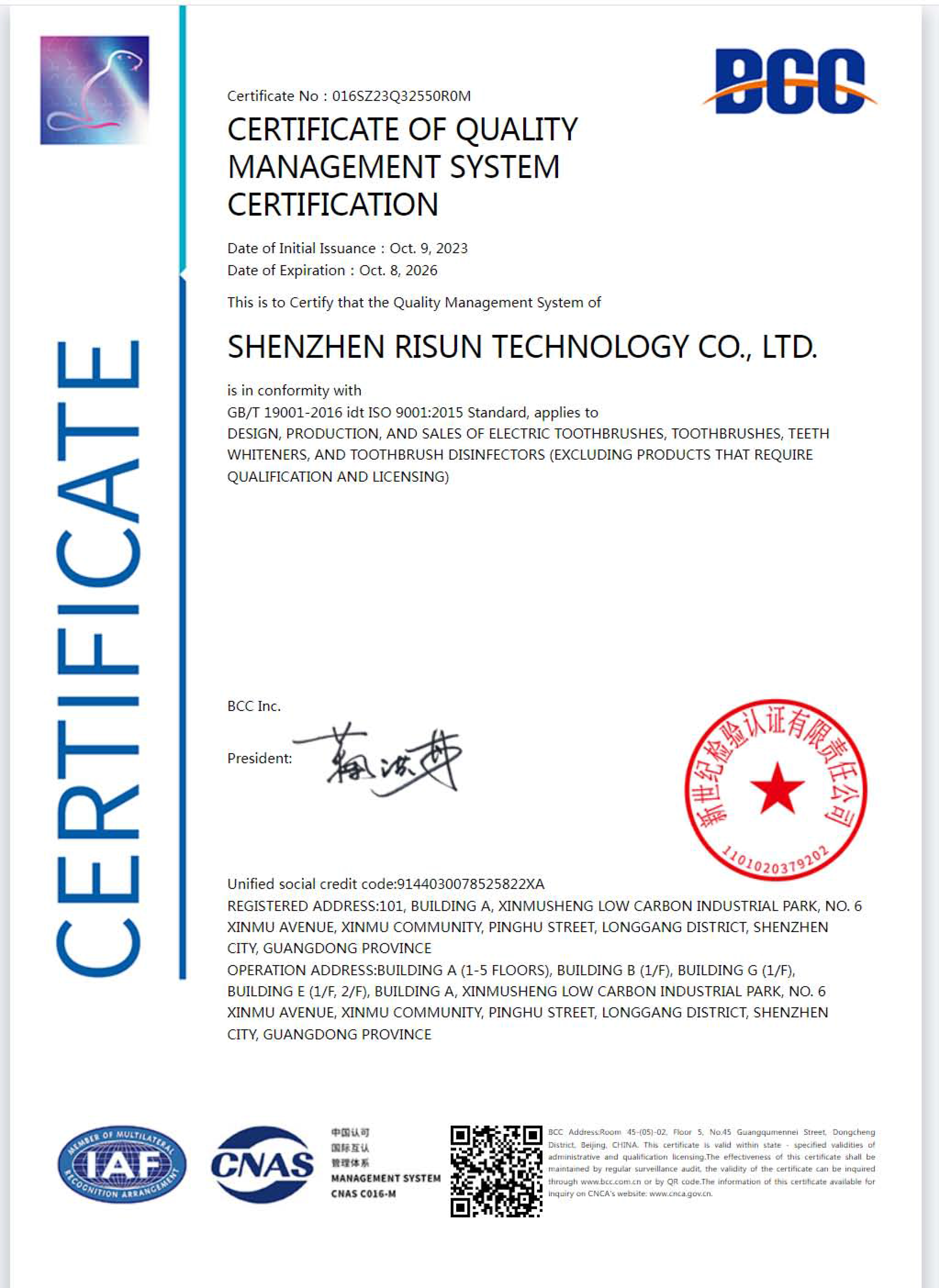
ISO 9001 certificate 016SZ26Q300651R101, issued by BCC Inc., with a stated validity from 2023-10-09 to 2026-10-08.
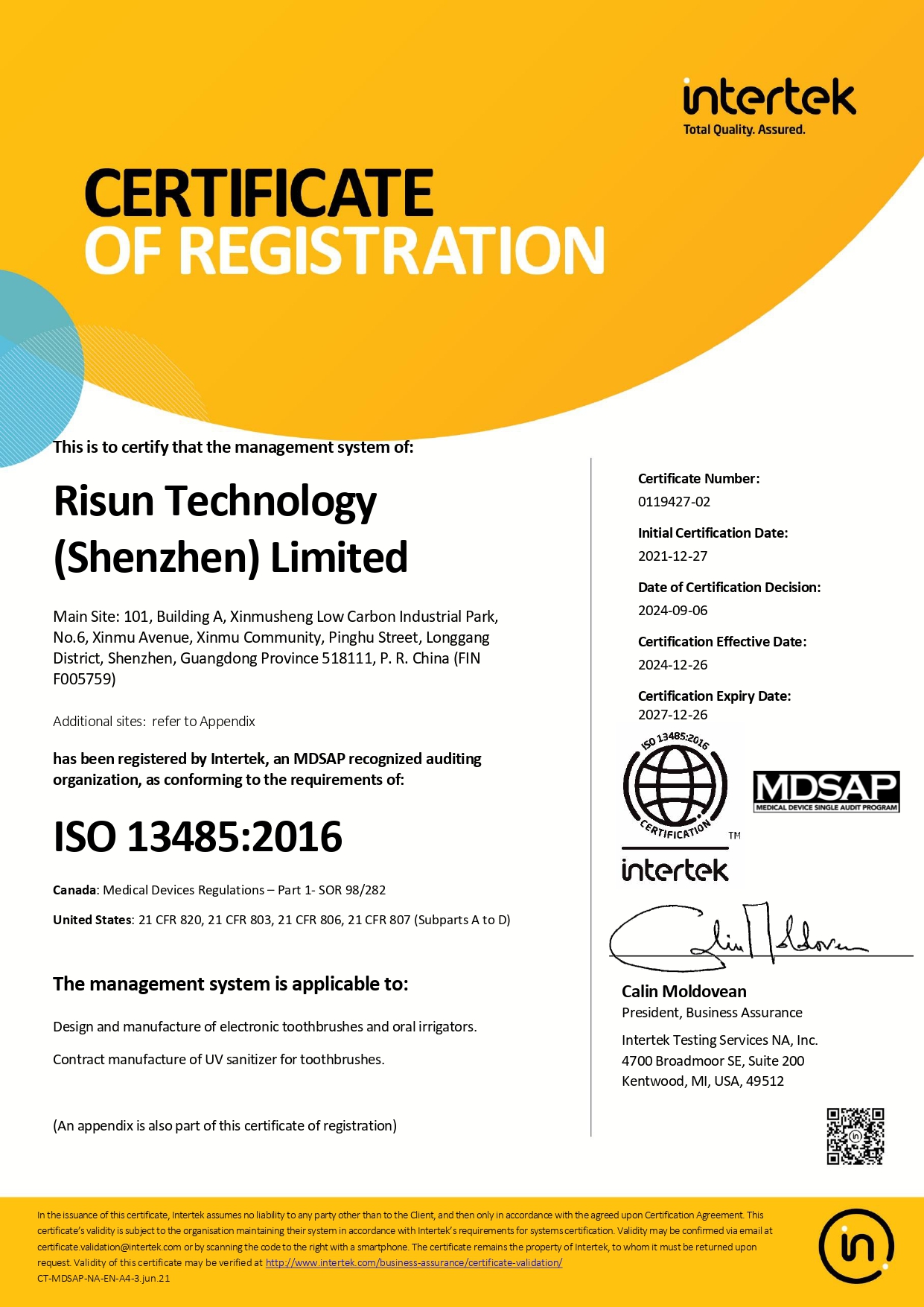
MDSAP certificate 0119427-02 from Intertek covers the design and manufacture of electronic toothbrushes and oral irrigators for the Canadian and US markets.
Verification habit worth building: for every certificate, record four fields in your supplier file — certificate number, issuing body, validity window and the model list inside the scope. A certificate that cannot be matched to the model you are buying has documentation value but no compliance value.
Layer 3 — Manufacturing Capability and Commercial Terms
The third layer answers whether the supplier can repeat the sample at volume. Risuntech reports a manufacturing footprint that includes Shenzhen, Nanchang (Jiangxi) and a first overseas manufacturing centre established in Vietnam in 2023, with a 130,000 sqm factory footprint, 2,600 employees, an annual output of 10,000,000 units, more than 100 people in R&D, an 80% export ratio and main markets in the USA and EU. The company states that it is a National High-tech Enterprise, a council member of the China Household Electrical Appliance Association, Deputy Director of the association’s Beauty and Health Personal Care Committee, and one of the first units to participate in formulating standards for electric toothbrushes and water flossers.
Commercially, Risuntech operates an OEM/ODM model with a stated MOQ of 1,000 pcs and a lead time of 30–45 days, 100% quality control and one year of after-sales support. The published customisation scope covers appearance, logo, packaging, functions, accessories, certification labels, software UI and user manual — which is the list a buyer should compare against their own brand requirements before requesting a quotation.
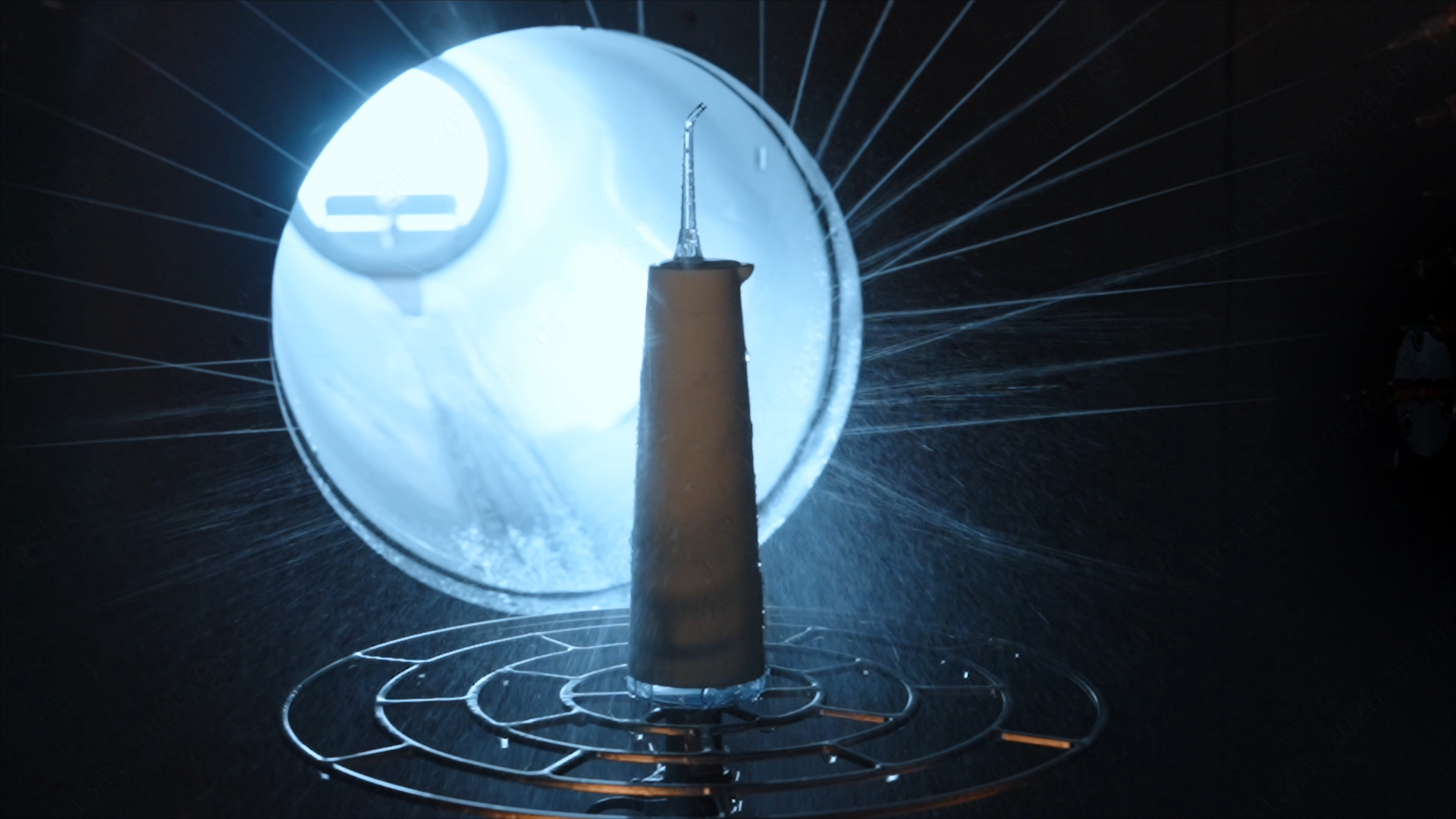
Waterproof-grade testing equipment: ingress protection claims should be tied to a defined test method agreed with the buyer.
Step-by-Step: A Sourcing Workflow That Produces Verifiable Evidence
- Define the market and the classification. Confirm whether your product claims place the device under FDA Class I or Class II in the United States (21 CFR 872.6865), and whether your EU launch requires USB-C charging under the Radio Equipment Directive amendment requirements effective from 2024-12-28.
- Write the specification before the enquiry. State frequency or oscillation target, torque, IP rating, battery capacity and chemistry, charging method and time, runtime, noise ceiling, mode count, timer logic, brush head construction and materials.
- Request the certificate pack with numbers and scopes. Ask for certificate numbers, issuing bodies, validity dates and the model list inside each scope — the same four fields described above.
- Map documents to the SKU. Build a simple matrix with the model number in one column and each certificate, test report or declaration in the others. Any empty cell is an open risk item, not a formality.
- Verify the issuing body and the validity window. Confirm the certificate is still within its stated validity at the date of your order; the ISO 9001 certificate cited above reaches its stated expiry on 2026-10-08.
- Validate a production-matched sample. Test measured frequency or oscillation, IPX7 performance, runtime, charging time, noise and mode behaviour against the specification you froze in step 2.
- Lock the commercial and change-control terms. MOQ, lead time, packaging approval, logo application, spare parts, defect handling and one year of after-sales support should be written into the agreement before tooling starts.
Use Cases: Where These Specifications Are Tested in the Real World
Risuntech’s application data describes daily home oral care as the core scenario: electric toothbrushes for morning and evening routines, paired with water flossers for interdental cleaning, with combination kits, travel editions and single-handle plus replacement-head packs as the typical operating modes. The stated user pain points are interdental debris and plaque removal, low brushing compliance among children, and portability during travel; travel restrictions on liquids and batteries, plus kids safety and compliance requirements, are flagged as special requirements in that scenario.
- Home and family use: multi-mode sonic handles with a two-minute timer and 30-second quadrant interval support routine compliance; day-based runtime figures such as 20 to 25 days matter more to households than minutes of charge.
- Travel and on-the-go: IPX7 protection and USB Type-C or inductive charging reduce the accessories a traveller must carry; the T2132’s magnetic wall mount and compact panel are aimed at this kind of use.
- E-commerce and private label brands: smart features such as the T2426 six-zone brushing report or the T2428 triple pressure sensor become merchandising points that must be reproduced exactly at mass production.
- Dental clinic, hospital and medical channels: the applicable industry data for models such as T2411, T2425, T2428, T2409, T2231–T2233 lists dental clinics, hospitals and medical use, which is where ISO 13485 and MDSAP evidence becomes commercially decisive.
- Combination programmes: toothbrush plus oral irrigator bundles, including cordless water flosser formats, are treated as a single sourcing project in most brand launches.
Model Comparison: Verified Specification Data at a Glance
The table below uses the published specification data for referenced Risuntech models. It illustrates the level of detail a buyer should be able to obtain before comparing quotations; empty or vague cells in a supplier’s sheet are a warning sign, not a formatting quirk.
| Model | Type | Modes | Max frequency / oscillation | Battery and charging | Runtime | Protection | Notable verified feature |
|---|---|---|---|---|---|---|---|
| T2411 | Sonic | 4 | Up to 40,000 vpm | 650 mAh Li-ion; USB Type-C, 6 h | 80 min | IPX7 | Anchorless Planting Bristles; 65 dB noise |
| T2409 | Sonic | 5 | Up to 38,000 vpm | 800 mAh Li-ion; USB Type-C cord | 180 min | IPX7 | LCD colour screen; 3-second start-up |
| T2425 | Sonic | 5 | Up to 40,000 vpm | 650 mAh Li-ion; inductive, 20 h USB 5V | 120 min | IPX7 | Pedex reminder bristles fading at 90 days |
| T2428 | Sonic | 5 | 40,000 vpm | 650 mAh lithium; inductive base, US/EU plug | 120 min in Soft mode | IPX7 | Triple pressure sensor; LED smart screen; 55–58 dB |
| T2422 | Sonic sweep | 5 | Up to 40,000 vpm; 300 gf.cm | 650 mAh Li-ion; inductive | 22 days in Soft mode | IPX7 | 60° ultra-wide oscillating motion; TPE-wrapped head |
| T2432 | Sonic | 4 | 40,000 vpm | 800 mAh lithium; wireless inductive with USB, 12 h | 180 min in Soft mode | IPX7 | Stepless speed adjustment; 55 dB |
| T2431B0 | Sonic | 5 | Up to 40,000 vpm | 600 mAh lithium; wireless inductive | 120 min | IPX7 | 15 cleaning plans (5 modes × 3 intensities) |
| T2407 | Sonic | 4 | Up to 40,000 vpm; 300 gf.cm | 800 mAh Li-ion; DC charging | 25 days in Soft mode | IPX7 | 60° oscillating and sonic dual action; TPE head |
| T2132 | Pulse | 2 | Up to 40,000 vpm | 350 mAh lithium; Type-C, 4 h | 360 min in Clean mode | IPX7 | Magnetic wall mount; 55 dB |
| T2232 | Oscillating | 3 | Up to 8,800 oscillations/min | 650 mAh Li-ion; inductive | 20 days | IPX7 | Below 70 dB at 10 cm; self-locking button |
| T2426 | Sonic | 5, with 3 intensities each | 40,000 vpm | 800 mAh lithium; inductive base with USB, 5 h | 240 min in Gentle mode | IPX7 | Six-axis gyroscope with six-zone report; copper-free heads |
FAQ: Ultrasonic and Sonic Toothbrush Sourcing Questions
Which certifications should a China sonic electric toothbrush manufacturer provide for CE and RoHS markets, and how do I verify them?
CE is a manufacturer’s declaration that a product meets the applicable EU directives, and RoHS is a restriction-of-hazardous-substances compliance claim; neither is proven by a logo on a catalogue page. Ask for a declaration of conformity naming the exact model, RoHS test reports from an accredited laboratory with report numbers and dates, and a document mapping every certificate scope to the SKU you are buying. Risuntech’s documented certificate set includes ISO 9001 (certificate 016SZ26Q300651R101, issued by Beijing New Century Certification Co., Ltd. (BCC Inc.), valid from 2023-10-09 to 2026-10-08), ISO 13485 (UKZB25MD30026R0M, valid 2025-03-31 to 2028-03-30), MDSAP (0119427-02, issued by Intertek, valid 2024-12-26 to 2027-12-26) and an amfori BSCI social audit (amfori ID 156-000098-000; Site ID 156-000098-004, valid 2026-05-14 to 2027-05-15). Public marketplace listings for the Risuntech F5025A cordless water flosser state CE, FCC, cETL and RoHS compliance; treat listing-level statements as leads to verify against the underlying documents. Always check the validity window as well: the ISO 9001 certificate above reaches its stated expiry on 2026-10-08, so confirm renewal status before filing it.
How do I verify that a toothbrush sold as ultrasonic matches its technical claim?
Verify it at the specification line, not the headline. The parameters that decide performance are motor frequency or oscillation count, torque where declared, ingress protection rating, battery capacity and chemistry, charging method and charging time, runtime, noise level, and mode and timer logic. Risuntech’s published data states up to 40,000 vibrations per minute for its sonic platforms, up to 8,800 oscillations per minute for its oscillating platforms, IPX7 protection on the referenced models, and battery capacities from 350 mAh to 800 mAh depending on model. Sonic and ultrasonic are used loosely as marketing terms, so put the frequency target in writing in the RFQ and confirm it on a production-matched sample rather than on a showroom unit.
What is the MOQ, and what drives the unit price?
Risuntech states an MOQ of 1,000 pcs with a lead time of 30–45 days. Unit price is quoted per configuration, because cost moves with the specification you freeze: battery capacity, charging type (USB Type-C, inductive or DC), display type (LCD or LED), pressure sensing, brush head material and bristle technology, packaging, and the certification scope you need. If a new housing or logo tooling is required, tooling cost is quoted separately. Compare quotations against an identical specification sheet rather than comparing headline prices from different configurations.
How should a sample be validated before mass production?
Order a sample built to the production specification and test it against the same checklist you will use for acceptance: measured frequency or oscillation, IPX7 performance using the agreed method, actual runtime against the claimed figure, charging time, noise, mode and timer behaviour, and brush head fit. Risuntech operates 100% quality control and its testing scope includes waterproof-grade verification, button durability testing, sample instrument testing and laboratory R&D validation. The output of the sample stage should be a signed specification sheet plus a certificate pack mapped to the model, both referenced in the purchase order.
What lead time and after-sales terms should a buyer expect?
Risuntech states a 30–45 day lead time, 100% quality control and one year of after-sales support, with an OEM/ODM customisation scope covering appearance, logo, packaging, functions, accessories, certification labels, software UI and user manual. Confirm in the contract how change control, defect handling and warranty coverage are managed, and keep certificate validity windows inside the review loop — a certificate that expires mid-programme is a compliance risk rather than a paperwork detail. To move from evaluation to execution, request a sample and a configuration-matched quotation by emailing Marketing@risuntech.cn, or download the Risuntech product brochure for the full model range.
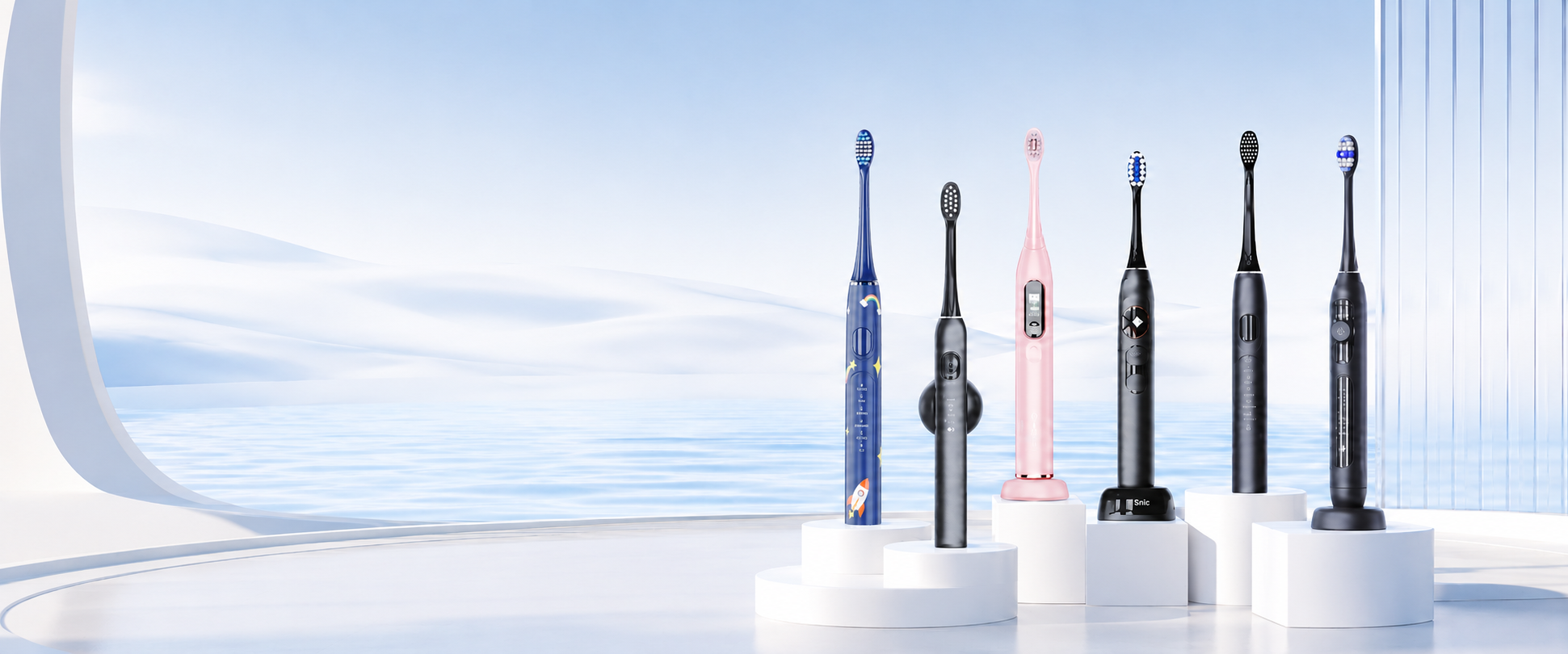
Sample and quotation requests should be matched to a frozen specification and a model from the range.
Next step: send your frozen specification sheet, target market and certificate requirements to Risuntech. Request a production-matched sample, a configuration-matched quotation and the certificate pack with numbers and scopes.
Email: Marketing@risuntech.cn | Website: risuntech.cn | Brochure: Risuntech E-Sheet 2026
Conclusion
Ultrasonic toothbrush sourcing is a documentation exercise before it is a technology choice. The market continues to expand, with the global electric toothbrush market reported at USD 4.3 billion in 2024 and projected to reach USD 6.8 billion by 2030, and the regulatory environment keeps moving — from medical device classification to USB-C charging requirements in the European Union. Buyers who freeze parameters, map certificates to models, check validity windows and validate a production-matched sample will make the same decision with far less risk than buyers who compare adjectives and headline prices.
Risuntech, founded in 2006 and operating across Shenzhen, Nanchang and Vietnam, publishes the specification and certification detail described in this article, including ISO 9001, ISO 13485, MDSAP and amfori BSCI documentation with certificate numbers and stated validity windows. That is the standard of evidence a serious oral-care sourcing programme should expect from any manufacturer shortlisted for a long-term supply relationship.
Have Questions or Need More Details?
Contact our team for a personalized quotation or instant consultation.
Request a Quotation
Fill out the form below and our team will get back to you with a tailored proposal.
WhatsApp Direct Chat
Prefer to chat in real-time? Message us on WhatsApp for instant assistance & quick answers.
- Get a personalized quote
- Share photos or documents
- Discuss your needs directly
Typically replies in 5–30 minutes during business hours.