
Aroma Diffuser Control Options: Bluetooth vs WiFi vs Button
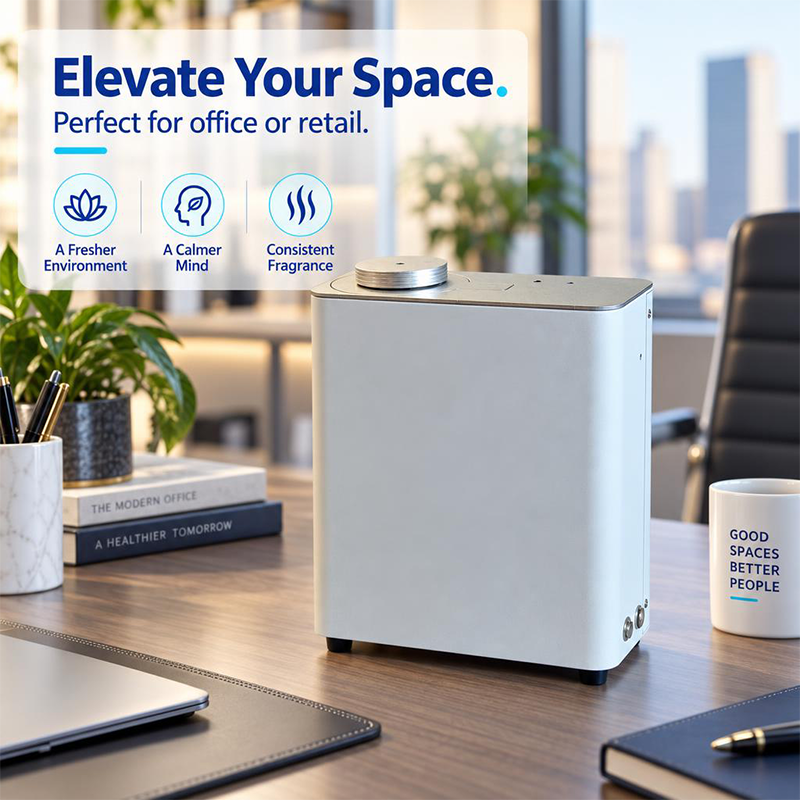
SDL611 is the only model in this comparison whose product record lists Bluetooth, WiFi and button control together.
Control method is the first specification that separates the three Saintdeland aroma diffusers compared in this guide. Model SDL312 and model SDL313 are documented with Bluetooth control. Model SDL611 is documented with three control methods — Bluetooth, WiFi and button — and it is the only model in this set that can be operated without a phone. All three use dual-fluid atomization, so the control question sits on top of a shared diffusion architecture rather than replacing it.
The distinction matters more than it appears on a specification sheet. A Bluetooth-only diffuser is configured through a mobile device. A unit that also lists WiFi and a physical button can be run over a network or by hand, which changes who can operate it, where it can be installed, and which wireless approval documents a buyer must hold before shipping into the United States or the European Union.
This comparison sets out precisely what the product records state for each model, what they do not state, and how those differences map onto home, hotel, office, automotive and commercial deployments.
Problem Definition: Why a Control Choice Becomes a Procurement Constraint
Control configuration stops being a cosmetic feature the moment a buyer has to plan installation, staffing or market access. Three failure patterns recur in aroma diffuser procurement, and all three trace back to the control method rather than to the atomizer.
- Operator mismatch. A diffuser that can only be configured through a phone creates a dependency on one person's device. Where a site is run by rotating or temporary teams — hotel housekeeping, contract cleaning, multi-shift office facilities — a physical button is the difference between a unit that runs to plan and one that sits idle after a staff change.
- Installation mismatch. Wireless control assumes a wireless environment. A basement office, a service corridor or a metal-housed unit inside a plant room may not offer the conditions that network-based control is designed around.
- Compliance mismatch. Any model that transmits in the 2.4 GHz band needs wireless approval documentation for the destination market. A buyer who has not matched the certificate to the exact model can end up holding a compliant product without the paperwork to prove it at customs or at a customer audit.
All three issues are decided before the purchase order, not after installation. That is why control options belong in the evaluation matrix next to capacity and power, not in a footnote.
Industry Background: Where Control Options Sit in the Aroma Diffuser Market
The global aromatherapy diffusers market was valued at USD 2.1 billion in 2025, according to Grand View Research's aromatherapy diffusers market report covering 2026–2033. The same report places the ultrasonic segment at 63.9% of 2025 share. That figure describes volume leadership in ultrasonic technology; it does not describe the technology used in the three models compared here.
SDL312, SDL313 and SDL611 all use dual-fluid atomization rather than an ultrasonic plate. The technology distinction matters to a control discussion because the two approaches are sold into different operating patterns. Ultrasonic units dominate residential volume, where a device is typically switched on by hand. Dual-fluid and nebulizing formats are positioned toward commercial and pure-oil applications, where run schedules are longer, refill routes are planned, and the person who owns the device is rarely the person who stands next to it.
Control options have followed that shift. The application documentation supplied for these models describes programmable weekly timers with day/night and weekday/weekend schedules, adjustable fragrance concentration and diffusion intervals, and optional Bluetooth/Wi-Fi app or remote control as operating modes for hospitality and commercial sites. What the model-level product records confirm is narrower, and it is the version a purchase order should be built on: SDL312 and SDL313 list Bluetooth control; SDL611 lists Bluetooth, WiFi and button control.
Detailed Solution: Three Control Configurations, One Atomization Principle
All three units are produced by Shengdelan Fragrance Technology (Guangzhou) Co., LTD., a Guangzhou-based aroma diffuser manufacturer founded in 2019 that markets its diffusers under the Saintdeland brand. Its product range covers home, hotel, car, wall-mounted, floor-standing, commercial and HVAC-related formats, with OEM/ODM and fragrance customisation offered alongside standard models. The three models below sit inside that range and differ mainly in control configuration, capacity and power envelope.
Bluetooth control: SDL312 and SDL313
SDL312 and SDL313 list Bluetooth control as the specified control method. Both are built on the same 130 ml platform and share the same physical envelope:
- Essential oil capacity: 130 ml; rated power 5 W; rated voltage 12 V
- Dual-fluid atomization as the operating principle and structural configuration
- Product dimensions 137 × 70 × 200 mm; packaging dimensions 160 × 90 × 230 mm
- Net weight 800 g; gross weight 1000 g
- Housing in ABS + PP; SDL312 in white or black, SDL313 in white
What the records do not define is just as important during evaluation. They do not state Bluetooth range, the control application, or how many units can be managed from a single handset. A buyer who needs multi-unit management across a floor or a chain should request that specification in writing rather than infer it from the word “Bluetooth”.
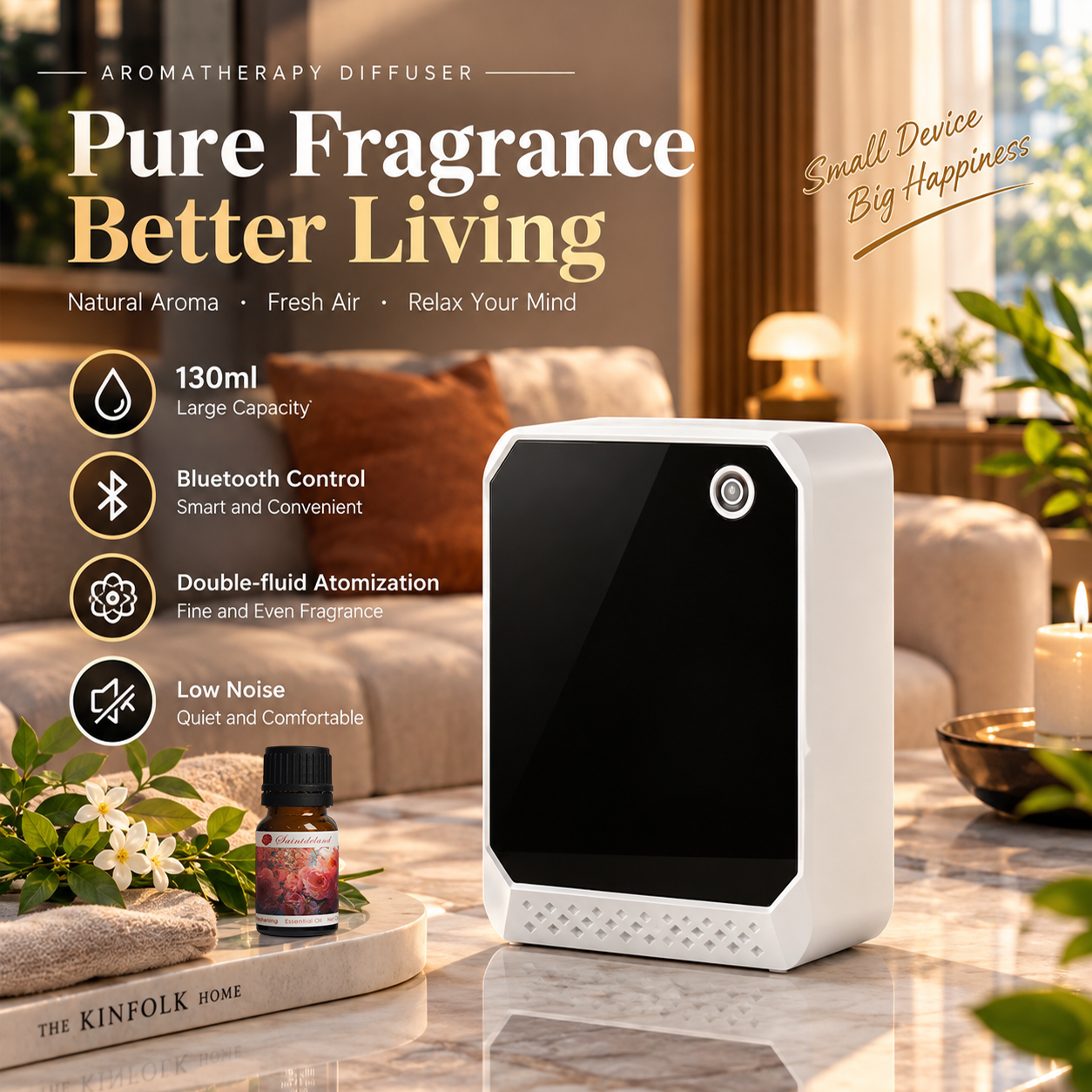
SDL312: 130 ml capacity, 5 W rated power, Bluetooth control, ABS + PP housing, available in white or black.
Bluetooth, WiFi and button control: SDL611
SDL611 is the only model in this set whose product record lists three control methods — Bluetooth, WiFi and button. Each option answers a different operational question. The button gives on-site staff a way to start, stop or adjust the unit without a phone or an account. Bluetooth provides short-range configuration. WiFi adds a network path that can be managed independently of whoever is standing next to the device.
The physical platform is larger than the two 130 ml models:
- Essential oil capacity: 300 ml; rated power 12 W; rated voltage 12 V
- Dual-fluid atomization; control methods Bluetooth, WiFi and button
- Product dimensions 170 × 80 × 210 mm
- Housing in sheet metal and aluminum alloy; available in white or black
- Net weight and gross weight both listed as 2500 g in the product record
The weight entry is worth flagging in a quotation review: the record lists net and gross weight as the same figure, so the shipped carton weight should be confirmed with the supplier before freight is booked.
For US-market buyers, the FCC Grant of Equipment Authorization issued to Shengdelan Fragrance Technology (Guangzhou) Co., Ltd. describes the equipment as a Digital Transmission System under FCC Rule Parts 15C and cites frequency ranges of 2412.0–2462.0 MHz and 2402.0–2480.0 MHz. That range profile is consistent with a device combining 2.4 GHz WiFi and Bluetooth rather than a Bluetooth-only build, and it is the practical compliance difference between SDL611 and the two 130 ml models.
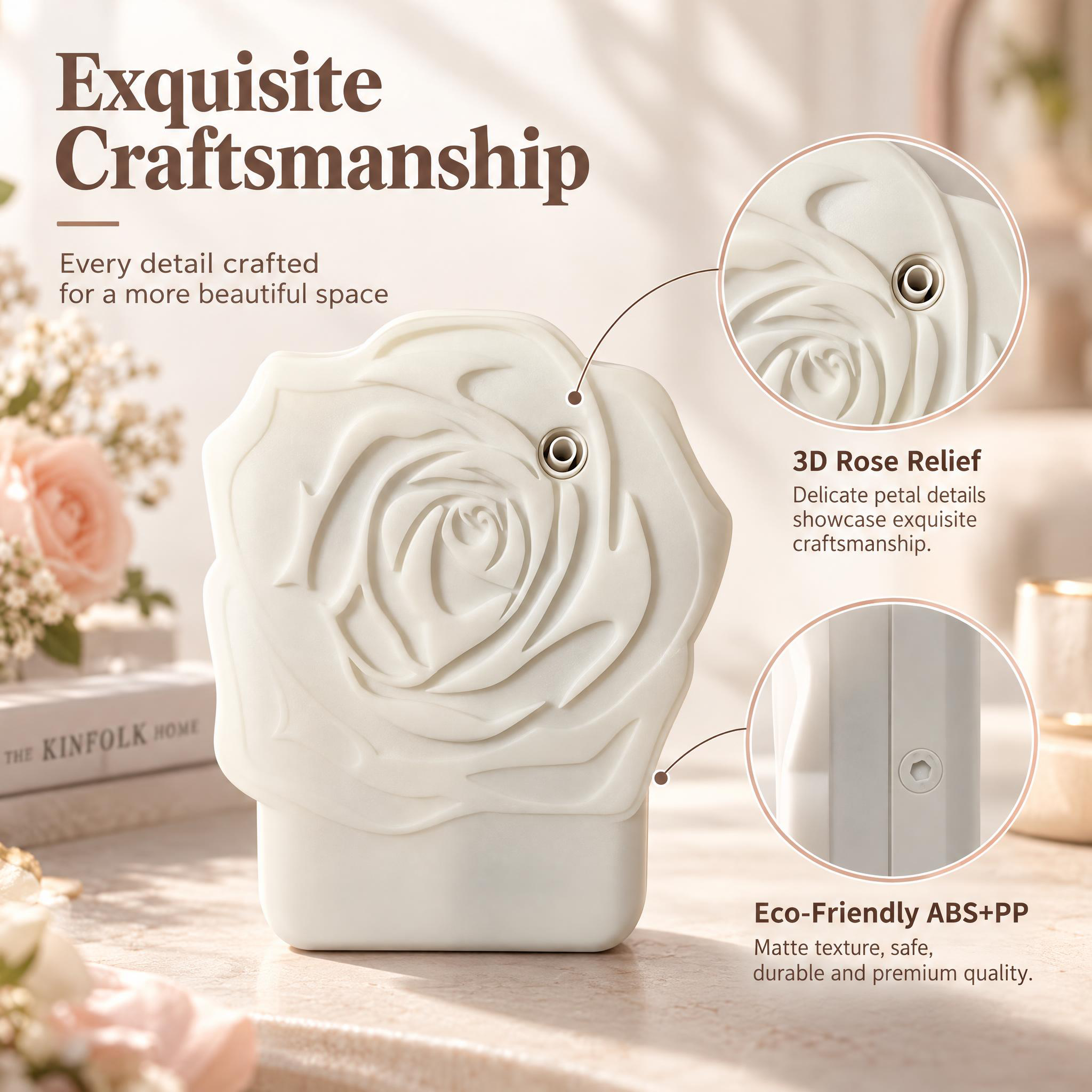
SDL313 shares the SDL312 platform: 130 ml, 5 W, dual-fluid atomization, Bluetooth control, white housing.
What shared dual-fluid atomization means for the control decision
Because all three models use dual-fluid atomization, the fragrance delivery principle is common across the set and does not need to be traded off against control choice. The differences that remain are physical: 300 ml and 12 W on SDL611 against 130 ml and 5 W on SDL312 and SDL313. A larger reservoir reduces how often the unit must be opened and refilled; a lower power draw matters where many units share a circuit or where consumption is metered.
The product records do not publish oil consumption per hour, a coverage area in square metres, or a noise figure for these three models. Refill frequency therefore cannot be derived from the published data alone. Buyers planning a scheduled maintenance route — a hotel floor, a retail chain, a serviced office portfolio — should request consumption figures at the intended diffusion setting, and request a noise measurement where the unit will sit in a quiet lobby, spa or meeting room.
Decision rule. If the person who runs the diffuser changes often, prioritise SDL611 for its button control. If the diffuser is configured once and left alone in a small room, the Bluetooth-only SDL312 or SDL313 platform is the simpler specification. If the site requires network-level oversight, confirm with the supplier exactly which functions are exposed through the WiFi interface before committing.
Step-by-Step Breakdown: Evaluating a Control Configuration
Six checks, run in order, will resolve the control decision before price negotiation begins.
- Name the operator. Identify who will start, stop and adjust the unit on a normal day. If that person is a rotating team member, button control on SDL611 removes a training dependency. If it is a single facilities lead, Bluetooth on SDL312 or SDL313 is sufficient at the specification level.
- Match control to the room and the installation point. Confirm that the intended position supports the chosen method. A metal enclosure, a basement or a service corridor may constrain wireless operation regardless of what the datasheet allows.
- Check the capacity and power envelope against the refill plan. 130 ml at 5 W for SDL312 and SDL313; 300 ml at 12 W for SDL611. Map that against how often staff can physically access the unit.
- Match certification to market and model. For the US, the FCC Grant of Equipment Authorization under certificate 2BCCLRAD-8 cites FCC Rule Parts 15C, was issued by Eurofins Electrical and Electronic Testing NA, Inc. on 2025-12-17, and covers SDL312, SDL313 and SDL611; a separate FCC Supplier's Declaration of Conformity, number LH-230903022800, covers the same three models under FCC Part 15 Subpart B and was issued by Shenzhen LH Testing Technology Co., Ltd. For the EU, CE Certificate of Conformity LH-230903022799 references EMC Directive 2014/30/EU with standards EN IEC 55014-1:2021 and EN IEC 55014-2:2021, and RoHS certificate LH-230903022801 references RoHS Directive 2011/65/EU and (EU) 2015/863, both issued by Shenzhen LH Testing Technology Co., Ltd. The certification asset record lists no expiry date, so validity should be re-confirmed at each order cycle.
- Confirm the ordering route and lead time. Sample orders start at 1 pc; neutral wholesale runs at 50–100 pcs per model; OEM/ODM custom orders run at 500–1,000 pcs per model. Ready stock ships in 3–7 days, bulk orders in 15–25 days, and OEM/ODM custom orders in 30–45 days. During the September–December peak season, plan 30–40 days and place the order one to two months ahead.
- Validate on a sample before the bulk run. Production quality control covers IQC incoming material inspection, IPQC patrol inspection every two hours, OQC outgoing inspection, an aging test of 4–8 hours continuous running, plus noise, mist output, leak and appearance checks, with 100% full inspection before shipment. Ask for the sample to be run under the same schedule the site will use.
Use Cases: Matching Control Method to Deployment
Home aroma diffuser use
In a residential setting the operator and the owner are the same person, so Bluetooth control on SDL312 or SDL313 covers the requirement. The 130 ml reservoir and 5 W draw suit a bedroom, living area or study where the unit runs for part of the day. SDL611 becomes relevant in larger open-plan homes where a single unit is expected to serve a longer daily schedule and the 300 ml reservoir reduces how often the unit is opened.
Hotel scent diffuser deployment
Hotel rooms are the clearest case for button control. Housekeeping teams rotate, and a unit that requires a personal handset to restart after a power interruption will not stay on schedule. SDL611’s button plus 300 ml reservoir suits a guest room or suite where access is limited to the cleaning window. In lobbies and public areas, the operating modes described for hospitality applications — weekly timers, adjustable concentration and diffusion interval — are the functions to specify, and the buyer should confirm which are enabled on the exact model and firmware being ordered.
Office and reception areas
Offices typically have a facilities lead plus a shared schedule, which makes Bluetooth workable and WiFi useful where the unit sits in a ceiling void or behind a reception joinery panel. SDL611’s combination of Bluetooth, WiFi and button lets the site choose the fallback: button operation for daily use, network control where the unit is out of reach.
Vehicle and automotive applications
The applicable-industry field for all three models lists automotive alongside home, hotel, office and commercial spaces. Physical planning still applies before a model is fixed for a vehicle: SDL611 weighs 2500 g and measures 170 × 80 × 210 mm with a 12 W draw, against 800 g and 5 W for SDL312 and SDL313. All three are rated at 12 V, but the product records do not describe vehicle electrical integration, so supply conditioning, mounting and vibration should be confirmed with the supplier before specifying a vehicle fit.
Commercial scent diffuser projects
For multi-room or multi-site rollouts the control question becomes a management question: how many units, operated by whom, on what schedule. SDL611’s three-method configuration is the more flexible starting point, and for very large areas the wider Saintdeland catalogue includes commercial HVAC and wall-mounted diffuser formats that sit above these desktop models. Projects of that scale are usually quoted with fragrance customisation and equipment configuration rather than as a single model purchase.
Comparison Table: Documented Specifications
| Specification | SDL312 | SDL313 | SDL611 |
|---|---|---|---|
| Control method | Bluetooth | Bluetooth | Bluetooth / WiFi / Button |
| Atomization principle | Dual-fluid atomization | Dual-fluid atomization | Dual-fluid atomization |
| Essential oil capacity | 130 ml | 130 ml | 300 ml |
| Rated power | 5 W | 5 W | 12 W |
| Rated voltage | 12 V | 12 V | 12 V |
| Housing material | ABS + PP | ABS + PP | Sheet metal + aluminum alloy |
| Colour options | White / Black | White | White / Black |
| Product dimensions | 137 × 70 × 200 mm | 137 × 70 × 200 mm | 170 × 80 × 210 mm |
| Packaging dimensions | 160 × 90 × 230 mm | 160 × 90 × 230 mm | Not listed in the product record |
| Net weight | 800 g | 800 g | 2500 g |
| Gross weight | 1000 g | 1000 g | 2500 g (as listed) |
| Documented applications | Home, hotel, office, automotive, commercial | Home, hotel, office, automotive, commercial | Home, hotel, office, automotive, commercial |
All values as stated in the product records for each model. Noise level, hourly oil consumption and coverage area are not published in those records.
Comparison Table: Certification Coverage by Model
| Document | Number | Standard / directive | Issued by | Models covered | Market |
|---|---|---|---|---|---|
| FCC Grant of Equipment Authorization | 2BCCLRAD-8 | FCC Rule Parts 15C; 2412.0–2462.0 MHz and 2402.0–2480.0 MHz | Eurofins Electrical and Electronic Testing NA, Inc. | SDL312, SDL313, SDL611 | US |
| FCC Supplier’s Declaration of Conformity | LH-230903022800 | FCC Part 15 Subpart B | Shenzhen LH Testing Technology Co., Ltd. | SDL312, SDL313, SDL611 | US |
| CE Certificate of Conformity (EMC) | LH-230903022799 | EMC Directive 2014/30/EU; EN IEC 55014-1:2021; EN IEC 55014-2:2021 | Shenzhen LH Testing Technology Co., Ltd. | SDL312, SDL313, SDL611 | EU |
| RoHS Certificate of Conformity | LH-230903022801 | RoHS Directive 2011/65/EU & (EU) 2015/863; IEC 62321 series | Shenzhen LH Testing Technology Co., Ltd. | SDL312 listed in the model record; SDL313 and SDL611 appear within the certificate model scope | EU |
The certification asset records list no expiry date; confirm current validity and the exact model list at each order cycle.
Frequently Asked Questions
1. Which certification documents should a buyer verify for a Bluetooth or WiFi aroma diffuser sold in the US and EU?
For the US, verify the FCC Grant of Equipment Authorization with certificate number 2BCCLRAD-8, which cites FCC Rule Parts 15C, was issued by Eurofins Electrical and Electronic Testing NA, Inc. on 2025-12-17, and covers SDL312, SDL313 and SDL611. Verify also the FCC Supplier’s Declaration of Conformity LH-230903022800 under FCC Part 15 Subpart B, issued by Shenzhen LH Testing Technology Co., Ltd. For the EU, verify CE Certificate of Conformity LH-230903022799 referencing EMC Directive 2014/30/EU with EN IEC 55014-1:2021 and EN IEC 55014-2:2021, and RoHS certificate LH-230903022801 referencing Directive 2011/65/EU and (EU) 2015/863. All four documents are associated with the same three models.
2. Which models combine dual-fluid atomization with Bluetooth or WiFi control?
All three models use dual-fluid atomization. SDL312 and SDL313 list Bluetooth control as the specified method. SDL611 lists Bluetooth, WiFi and button control together. That makes SDL611 the only model in this set that offers a control option requiring no mobile device and a network-based option in the same unit.
3. Does the 300 ml, 12 W configuration of SDL611 change refill and power planning compared with the 130 ml, 5 W models?
The reservoir is more than twice the size and the rated power is more than twice as high: 300 ml and 12 W on SDL611 against 130 ml and 5 W on SDL312 and SDL313. The product records do not publish oil consumption per hour, so refill intervals cannot be calculated from the datasheet alone. Buyers running a scheduled maintenance route should request consumption data at the intended diffusion setting, and should factor 12 W per unit into circuit planning where several SDL611 units share a supply.
4. What are the documented order quantities and lead times?
Sample orders start at 1 pc. Neutral wholesale orders run at 50–100 pcs per model, and OEM/ODM custom orders run at 500–1,000 pcs per model, with dropshipping available from 1 pc. Ready stock ships in 3–7 days, bulk orders in 15–25 days, and OEM/ODM custom orders in 30–45 days. Peak season from September to December requires 30–40 days, so orders should be placed one to two months in advance. Customisation options include logo printing, shell colour and material, packaging, fragrance private label, voltage and plug type for US/EU/UK/AU/JP, and multilingual manuals.
5. How can a buyer validate a control configuration before committing to a bulk order?
Start with a single sample unit and run it under the schedule the site will actually use, including a restart after power interruption to test how the chosen control method behaves in practice. Production quality control covers IQC incoming inspection, IPQC patrol inspection every two hours, OQC outgoing inspection, a 4–8 hour aging test, plus noise, mist output, leak and appearance checks, with 100% full inspection before shipment. Buyers can request the Saintdeland catalogue and a quotation for SDL312, SDL313 or SDL611 through saintdeland.global or the contact below, and the company brochure is available for download.
Conclusion
The control decision on these three Saintdeland diffusers resolves into a single question: does anyone other than a phone need to operate the unit? If the answer is no, the Bluetooth-only SDL312 and SDL313 platform delivers dual-fluid atomization in a 130 ml, 5 W, 800 g housing with a documented certification set for the US and EU. If the answer is yes — a hotel room cleaned by a rotating team, an office unit mounted out of reach, a commercial site with a schedule to keep — SDL611 is the model whose product record carries Bluetooth, WiFi and button control together, in a 300 ml, 12 W, sheet metal and aluminum alloy housing.
Everything else in the evaluation should be confirmed rather than assumed: Bluetooth range and app scope, hourly oil consumption, noise level, and the current validity of certificates 2BCCLRAD-8, LH-230903022800, LH-230903022799 and LH-230903022801. Those four questions, asked before the purchase order, close the gap between a specification sheet and a working installation.
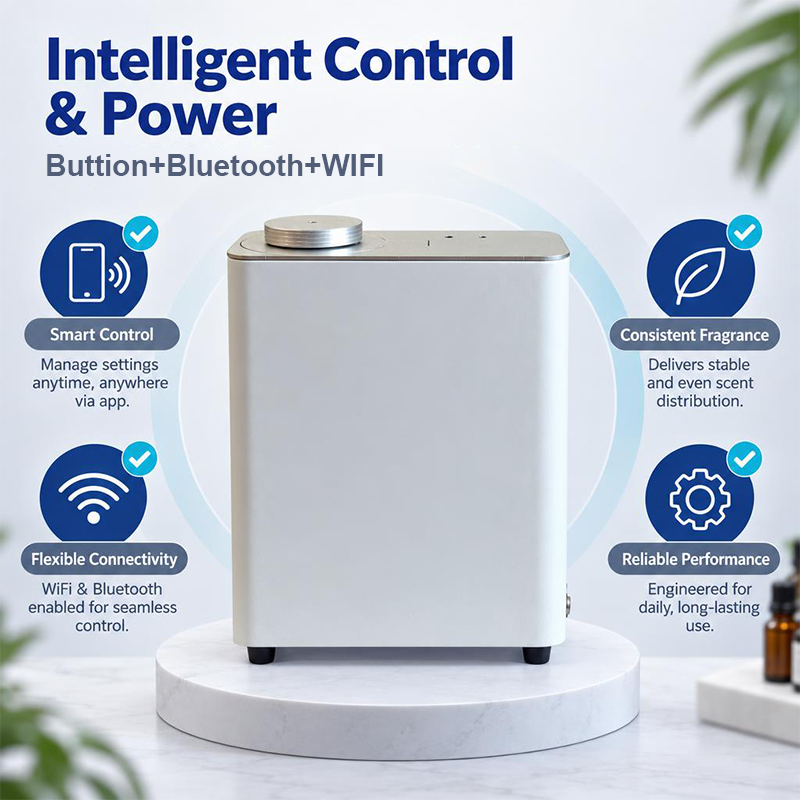
Request a sample or a control-configuration quotation
Samples from 1 pc for SDL312, SDL313 and SDL611. Specify your control method, target market and annual volume, and receive a configuration sheet with the matching certification documents.
Email: vivi@saintdeland.com | WhatsApp: +86 18594004460
Website: saintdeland.global | Download the catalogue (PDF)
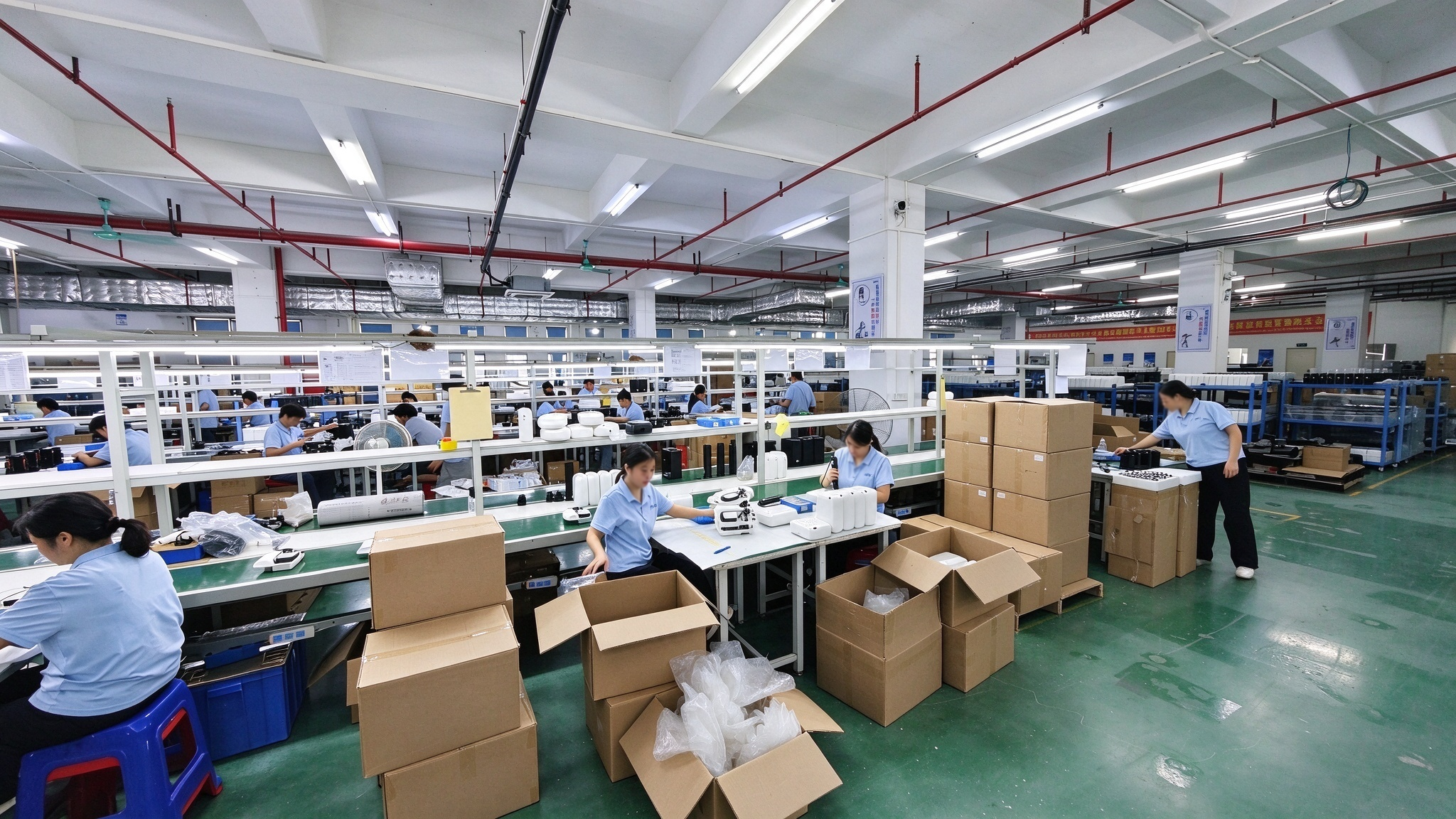
Shengdelan Fragrance Technology (Guangzhou) Co., LTD. operates a 30,000 m² facility in Guangzhou with a 10-engineer R&D team; 90% of output is exported, primarily to Europe and the Americas.
Have Questions or Need More Details?
Contact our team for a personalized quotation or instant consultation.
Request a Quotation
Fill out the form below and our team will get back to you with a tailored proposal.
WhatsApp Direct Chat
Prefer to chat in real-time? Message us on WhatsApp for instant assistance & quick answers.
- Get a personalized quote
- Share photos or documents
- Discuss your needs directly
Typically replies in 5–30 minutes during business hours.