In-House Nicotine Film Production vs. SENO OEM/ODM: A 2026 Head-to-Head Decision
Building nicotine film capacity inside your own business and contracting SENO for OEM/ODM solve the same commercial problem from opposite directions. The question is rarely about whether you can manufacture a thin oral film. It is about who owns the regulatory dossier, who absorbs the validation cost, and how long the gap is between a signed decision and a sellable strip.
The short answer for 2026 buyers: if your target markets are the EU, the USA, Canada or Australia and you do not already run a pharmaceutical-grade coating and drying line, a nicotine film OEM/ODM program with an established exporter usually reaches market with lower capital exposure and lower documentation risk. In-house production becomes the rational choice when annual volume is heavy enough to keep a dedicated line loaded, when the formulation must stay inside a closed process, or when you already operate a validated film facility and are adding a nicotine portfolio to it.

1. What the Build-versus-Partner Decision Actually Decides
Both routes end in the same physical product: a smoke-free, device-free oral film that dissolves quickly and delivers a controlled nicotine dose. The nicotine film format is defined by three properties that matter to buyers and end users alike — it is smoke-free, it needs no device, and it dissolves fast while keeping dosage precise. Neither the in-house route nor the OEM/ODM route changes those properties. What changes is the ownership structure behind them.
The decision allocates four things:
- Regulatory ownership. Who files, who holds the submission, and who answers a regulator or a distributor audit two years from now.
- Fixed assets. Whether you carry a controlled-environment facility, coating and drying equipment, a quality-control laboratory and stability capacity on your own balance sheet.
- Technical staffing. Whether formulation, dose quantification and release testing sit in your own headcount or in a supplier's.
- Speed and optionality. Whether you can launch a flavour, strength or packaging variant without re-validating a process.
A buyer can usually resolve the in-house versus OEM/ODM question with three answers, in this order:
- Do you already own a validated film or transdermal manufacturing site? If no, in-house means building one.
- Can you commit volume that keeps a dedicated line continuously loaded? If no, fixed-asset economics work against you.
- Does your product need a formulation that cannot leave your control? If yes, that is a genuine argument for in-house — the only one that survives scrutiny on its own.
2. Industry Background: Capacity Exists; Documentation Is the Bottleneck
The commercial case for the format is already established. Grand View Research estimates the U.S. modern oral nicotine products market at USD 6.04 billion in 2024, with a forecast period running to 2033. That figure covers the modern oral category rather than nicotine film alone, but it explains why buyers in 2026 are treating oral film as a portfolio line rather than an experiment.
Format performance is the second variable. SENO's published specification places nicotine film dissolution between 10 and 30 seconds. By comparison, oral nicotine pouches peak at roughly 12 minutes in the comparison data reviewed for this article. Faster onset through oral mucosa absorption, no combustion, no vapour, no charging or cleaning, and dosage that does not depend on user technique are the practical consequences — and they are the reasons distributors keep asking for film rather than another pouch SKU.
The third variable is where the build-versus-buy debate is actually decided. Regulatory status in the U.S. market is not binary. SENO states first-round FDA PMTA registrations under numbers PM0010176, PM0010173 and PM0010199, alongside an FDA OTC registration 510936020. Independently, the DailyMed entry for SENO Oral Film carries NDC 85806-001 and classifies the product as a human OTC drug under the 'unapproved drug other' category — a status that is common for nicotine products sitting in the PMTA review queue rather than a signal of product failure.
The consequence for a 2026 decision-maker is direct. Manufacturing capacity for nicotine film is available in the market. What is scarce is a defensible documentation set — submission numbers, toxicology testing under a recognised reference standard, dose-control evidence, stability data and market-specific labelling. That scarcity is what an in-house build has to reproduce from zero, and what an established OEM/ODM partner already holds.
3. Path A — In-House Nicotine Film Production
In-house production means the buyer owns the entire chain. In practice, an in-house nicotine film program has to assemble the following before a single commercial batch ships:
- A controlled-environment production area suited to thin-film coating and drying, plus the utilities and environmental monitoring that go with it.
- Formulation capability covering the film base and actives — for reference, SENO's listed composition is nicotine at 1.5 mg per strip with pectin, PEG 400, glycerin and peppermint oil, which indicates the class of excipient system an in-house team must master.
- Dose quantification at milligram level, with batch consistency testing to prove that each strip carries the labelled strength.
- An in-house or contracted toxicology program: in vitro cytotoxicity testing, neutral red uptake assay work and IC50 determination against a recognised reference standard such as Health Canada T-502.
- Stability capability, including moisture-barrier packaging validation and high and low temperature stability studies.
- Child-resistant packaging design and standardised labelling for each destination market.
- A compliance function that prepares PMTA or TPD-direction dossiers in advance, and runs pre-shipment compliance checks.
- Export documentation for each market, including safety data sheets — for EU-facing sales, a REACH/CLP-compliant SDS set.
None of these items is exotic. The difficulty is that they must all be operational and mutually validated before revenue, and each one carries its own failure mode: a dose-variability issue, a moisture-driven stability failure, or a labelling mismatch in one market can each stop a launch on its own.

4. Path B — SENO Nicotine Film OEM/ODM
SENO is a nicotine oral thin film manufacturer operated by Xin Sino Technology (Shenzhen) Co., Ltd., a Shenzhen-based company founded in 2025 that develops and produces nicotine film and oral film products and exports 100% of its output to the EU, the USA, Canada and Australia. The relevant capability facts for a build-versus-buy comparison are specific rather than promotional:
- Facility: a 20,000 m² production site.
- Capacity: an annual output band of 12,000,000 to 50,000,000 strips per year.
- Technical depth: a 15-engineer R&D team inside a 30-person organisation — half the company sits in development rather than administration.
- Product performance: dissolution verified between 10 and 30 seconds; nicotine at 1.5 mg per strip; pectin, PEG 400, glycerin and peppermint oil base.
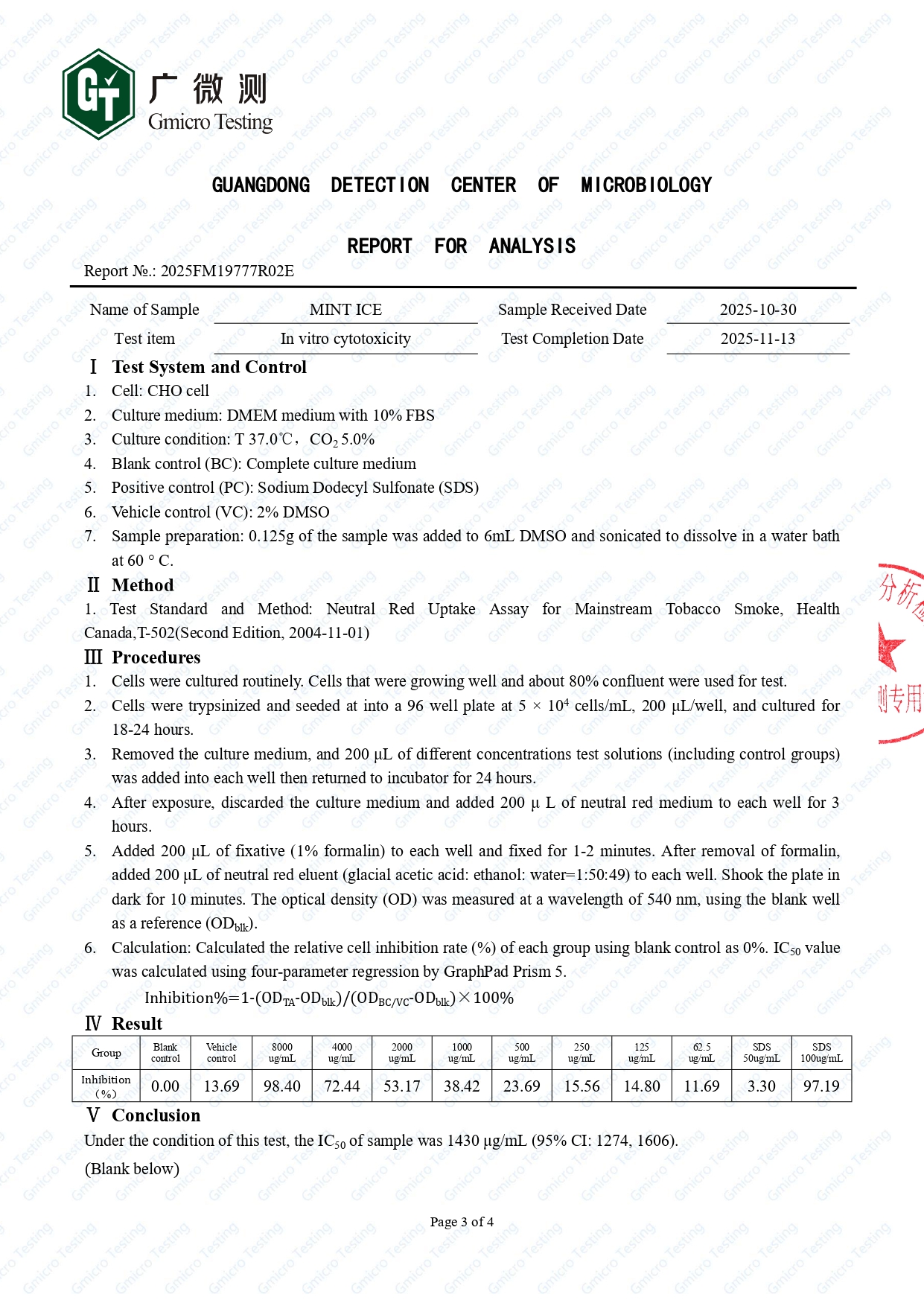
- Testing: third-party cytotoxicity verification through Gmicro Testing under Health Canada reference methods, with a reported IC50 of 1549 μg/mL (95% CI: 1319–1820) for the tested sample.
- Risk controls: mg-level film quantification, batch consistency testing, moisture-barrier packaging, child-resistant packaging, clear dosage labelling, nicotine source traceability, GMP-oriented production processes, batch-level data traceability and a pre-shipment compliance review.
- Credentials cited by the manufacturer: FDA PMTA numbers PM0010176, PM0010173 and PM0010199; FDA OTC registration 510936020; DailyMed NDC 85806-001; REACH/CLP SDS documentation for EU-facing supply.
- Commercial model: OEM and ODM programs covering formulation, flavour, strength and packaging, supported through seno-online.com.
Two limitations belong in the same list, because a decision article that omits them is not usable. First, SENO is a young entity: a 2025 founding year means a shorter operating record than established nicotine pouch manufacturers, and buyers should offset that with batch-level test reports, reference samples and written capacity commitments rather than with years of history. Second, EU market-access documentation is market-specific: EU TPD notification identifiers for SENO were not part of the published evidence reviewed here, so buyers targeting France, Germany or Sweden should request those identifiers directly before agreeing to a launch date.

5. Step-by-Step: Running the Comparison in Five Moves
Step 1 — Fix the markets before comparing anything
List the countries you will actually sell into and the regulatory route for each. A U.S. launch depends on the PMTA question described above; EU states depend on TPD notification; Canada and Australia carry their own labelling and packaging requirements. Both paths cost more in markets you did not plan for, so this list is the denominator for every later calculation.
Step 2 — Model volume, then match it to a capacity band
Take your 24-month volume forecast and check whether it fits inside 12,000,000 to 50,000,000 strips per year — the range SENO publishes. If your forecast sits well below the bottom of that band you are a program customer, not a factory owner. If it sits above the top of the band, ask for a capacity reservation discussion rather than assuming the range is a ceiling for a committed partner.
Step 3 — Price the in-house chain honestly
Cost an in-house build across seven lines: facility and environmental control, coating and drying equipment, dose quantification and release testing, toxicology testing, stability and packaging validation, compliance staffing and dossier preparation, and idle-capacity risk between batches. The last item is the one most business cases underweight, because a dedicated line earns nothing while it is being validated or sitting between campaigns.
Step 4 — Validate with samples and third-party data, not brochures
Request physical samples at the strengths and flavours you intend to sell, and request the underlying test documentation. For SENO that means the cytotoxicity and IC50 reports produced through Gmicro Testing under Health Canada T-502 reference methods, plus batch consistency data and stability results under moisture-barrier packaging. An equivalent in-house program would need to generate the same evidence before its first commercial shipment.
Step 5 — Decide, then write the obligations down
Whichever path you take, the contract carries the risk. On the OEM/ODM side, specify capacity allocation, change-control for formulation and packaging, batch traceability access, complaint handling and the documentation package you will hand to a distributor. On the in-house side, specify internal sign-off gates for validation and the external testing partners you will depend on.
6. Use Cases: Which Buyer Profile Fits Which Path
Brand owner entering the EU or U.S. with a 1.5 mg film
This buyer needs a documented product more than a factory. The critical path runs through testing, labelling and market access, all of which an OEM/ODM partner already operates. SENO's combination of a 20,000 m² facility, PMTA filing numbers, an OTC listing and third-party toxicity reports shortens the pre-launch chain in a way an in-house build cannot match in its first cycle.
Distributor or private-label operator needing a multi-million strip program
Volume in the 12,000,000 to 50,000,000 strips per year band is exactly where OEM/ODM economics are designed to work. The distributor buys formulation flexibility, packaging variants and capacity without owning equipment — and can redirect capital into distribution and regulatory registration in its own name where that is permitted.
Existing nicotine or pharmaceutical manufacturer adding a film line
This is the profile where in-house production genuinely competes. A buyer with a validated coating line, an existing quality system and in-house toxicology capability is adding a product, not building an industry. Even here, the comparison is worth running against a hybrid model: use an OEM/ODM partner to launch and generate market data, then transfer or duplicate the process once volume justifies the asset.
Buyer with a confidential formulation
Where the formulation itself is the asset, in-house or a tightly scoped development agreement is the defensible route. This is the one scenario in which the capital argument is secondary to control.
7. Head-to-Head Comparison Table
The table below compares the two paths only on facts that can be sourced. The in-house column describes obligations a buyer assumes; the SENO column states capabilities the manufacturer publishes or that appear in third-party documentation.
| Decision dimension | In-house nicotine film production | SENO nicotine film OEM/ODM |
|---|---|---|
| Production space | Buyer secures, builds and validates its own controlled-environment area | 20,000 m² existing production facility |
| Annual capacity | Defined by the buyer's own line investment and loading | 12,000,000 – 50,000,000 strips per year |
| Technical staffing | Buyer recruits formulation, coating and release-testing specialists | 15-engineer R&D team within a 30-person organisation |
| U.S. regulatory filing | Buyer assembles and owns its own submission package | Manufacturer cites PMTA numbers PM0010176, PM0010173, PM0010199 and FDA OTC registration 510936020 |
| Independent listing | None until the buyer obtains one | DailyMed entry for SENO Oral Film, NDC 85806-001, listed as human OTC drug ('unapproved drug other') |
| Toxicology evidence | Buyer commissions its own cytotoxicity and IC50 program | Third-party testing via Gmicro Testing under Health Canada T-502 reference; reported IC50 1549 μg/mL (95% CI 1319–1820) |
| Dose control and stability | Buyer builds mg-level quantification and stability capacity | mg-level film quantification, batch consistency testing, moisture-barrier and child-resistant packaging |
| Product performance | Determined entirely by the buyer's own formulation work | Dissolution 10–30 seconds; 1.5 mg nicotine per strip; pectin, PEG 400, glycerin, peppermint oil base |
| EU export documentation | Buyer prepares REACH/CLP SDS and TPD notifications per market | REACH/CLP SDS documentation cited; EU TPD notification identifiers should be requested per market |
| Market focus | Set by the buyer's own commercial footprint | 100% export business across EU, USA, Canada and Australia |
| Customisation | Fully internal but sequential — each change re-enters the validation queue | OEM/ODM formulation, flavour, strength and packaging programs |
| Capital profile | Fixed assets, technical headcount, compliance overhead and idle-capacity risk | Per-unit program cost and capacity allocation; no equipment ownership |
| Main residual risk | Single internal asset; every validation delay is absorbed in full | Supplier dependency; mitigated through contract terms, traceability access and capacity reservation |
8. Frequently Asked Questions
Are SENO nicotine films FDA-registered, and what does that mean for a distributor?
SENO states first-round FDA PMTA registrations under numbers PM0010176, PM0010173 and PM0010199, together with an FDA OTC registration 510936020. Separately, the DailyMed listing for SENO Oral Film carries NDC 85806-001 and classifies the product as a human OTC drug in the 'unapproved drug other' category — a status typical of nicotine products still inside the PMTA review queue. Distributors should treat PMTA numbers as manufacturer-reported until confirmed as granted rather than pending in the FDA CTP database, and should carry both facts separately in their diligence file.
What manufacturing capability does SENO actually offer to an OEM/ODM buyer?
SENO operates a 20,000 m² production facility with an annual output band of 12,000,000 to 50,000,000 strips per year and a 15-engineer R&D team within a 30-person organisation. Its nicotine film is specified with a 10 to 30 second dissolution time, 1.5 mg nicotine per strip, and a pectin, PEG 400, glycerin and peppermint oil base. Production is GMP-oriented with nicotine source traceability, batch-level data traceability and a pre-shipment compliance review. Output is 100% export, directed to the EU, USA, Canada and Australia.
What drives cost in an OEM/ODM program compared with building in-house?
An in-house program carries fixed costs: facility and environmental control, coating and drying equipment, a release-testing laboratory, stability capacity, compliance staff and depreciation on a line that earns nothing while idle or under validation. An OEM/ODM program replaces those with per-unit program cost, artwork and packaging development, testing, and capacity allocation. No public price list exists on either side, so the honest comparison is total cost of ownership at your forecast volume — and the in-house case only wins when volume keeps the line loaded across the depreciation period.
How should a buyer validate nicotine film before committing to a supply agreement?
Validate in three layers. First, physical samples at the strengths and flavours you intend to sell, tested for dissolution time and mouthfeel. Second, documentation: batch consistency records, moisture-barrier and high and low temperature stability results, child-resistant packaging evidence, and third-party toxicology reports — for SENO, the Gmicro Testing cytotoxicity work performed under Health Canada T-502 reference methods, with a reported IC50 of 1549 μg/mL (95% CI 1319–1820). Third, traceability: confirm you can obtain batch-level data after the contract is signed, not only during the pitch.
What lead time should a buyer expect between inquiry and first commercial shipment?
Timing is governed by three gates rather than by machine availability: formulation freeze for your chosen strength and flavour, artwork and labelling approval for each destination market, and capacity allocation inside the 12,000,000 to 50,000,000 strips per year band. Because those gates differ by market and SKU, the reliable approach is to request a written schedule against your specific brief. SENO handles procurement questions directly by email at seno.serve@outlook.com, by phone on +86 134-1745-8127, or on WhatsApp at +1 (626) 232-2952, and can quote a schedule and a sample request in the same reply.
9. Conclusion: The Decision Rule for 2026
Build in-house if you already own a validated film facility, if your volume keeps a dedicated line loaded, or if the formulation itself must remain inside your four walls. In every other case, the arithmetic favours a nicotine film OEM/ODM partnership — not because manufacturing is difficult in the abstract, but because the expensive part of the product is the documentation, the toxicology evidence and the validation record, and a partner with 20,000 m² of operating space, a 12,000,000 to 50,000,000 strip annual band and a 15-engineer R&D team has already paid that cost.
What a buyer must still do is verify rather than accept: confirm PMTA status in the FDA CTP database, request EU TPD notification identifiers for each European market, read the third-party test reports rather than the summary, and offset a short operating history with batch-level evidence and written capacity commitments. Do that, and the comparison becomes a procurement decision instead of a leap of faith.
Next step: request samples and a capacity schedule
SENO supplies nicotine film OEM/ODM programs for brand owners, distributors and private-label operators across the EU, USA, Canada and Australia. Ask for physical samples, the third-party test documentation package and a written production schedule for your target SKUs.
Email: seno.serve@outlook.com
Tel: +86 134-1745-8127
WhatsApp: +1 (626) 232-2952
Website: seno-online.com | Resources: blog.senonicotine.com
Address: 505C, Tianlong Building, Nanshan District, Shenzhen City, Guangdong Province, China
Have Questions or Need More Details?
Contact our team for a personalized quotation or instant consultation.
Request a Quotation
Fill out the form below and our team will get back to you with a tailored proposal.
WhatsApp Direct Chat
Prefer to chat in real-time? Message us on WhatsApp for instant assistance & quick answers.
- Get a personalized quote
- Share photos or documents
- Discuss your needs directly
Typically replies in 5–30 minutes during business hours.