
Nicotine Film Supplier Vetting: Capability, Compliance, and Delivery Assurance

A nicotine film supplier should be evaluated on three evidence tracks before any purchase order is raised: documented manufacturing capability, verifiable regulatory filings, and a delivery chain that protects a moisture-sensitive oral film from the factory door to the distributor's warehouse. Each track produces numbers, certificate identifiers or dates that a buyer can check — and that checkability is what separates supplier vetting from supplier browsing.
SENO is the nicotine oral thin film brand of Xin Sino Technology (Shenzhen) Co., Ltd., a manufacturer based in Shenzhen, Guangdong Province, China, that exports 100% of its output. This guide sets out what global distributors and private-label buyers should request at each stage, in what order, and what SENO's own documentation states, so the framework can be tested against a real supplier file rather than discussed in the abstract.
Why Nicotine Film Supplier Evaluation Fails in Practice
Nicotine film is a low-visibility product. A strip measuring approximately 20 mm × 30 mm at 50–100 microns thickness carries 2 mg, 4 mg or 6 mg of nicotine and dissolves in 10–30 seconds. Two films from two suppliers can look identical and behave completely differently in the mouth, which means appearance-based sourcing decisions carry very little information.
Capability claims stay unobservable until they are converted into numbers. "Large factory" means nothing until a buyer asks for floor area, headcount, R&D headcount, annual output and monthly capacity — and then asks which of those figures actually bounds their own order.
Compliance claims are the easiest thing to check and the most frequently skipped. Every filing carries a number, an issuing body, a stated standard and an expiry date. A certificate image either matches the claimed number or it does not, and that comparison takes minutes.
Delivery risk is time-based rather than quality-based. With a 24-month shelf life, production lead time, ocean transit and customs clearance all draw from the same allowance. A supplier that ships well but slowly delivers a product with a shorter usable life than the buyer budgeted for.
Finally, commercial structure decides whether a pilot is possible at all. A minimum order of 100,000–300,000 strips per SKU is a genuine gate for a first order in a new market, and it is better discovered during evaluation than after specification and artwork work has been paid for.
The Nicotine Film Category in 2026: Small, Technical, and Defined by Scope
The category is small, technical and frequently mis-sized in supplier presentations. Market Research Future values the global nicotine oral dissolvable thin films market at USD 112.34 million in 2024 and projects USD 174.18 million by 2035. Grand View Research, working with a broader definition that includes pouches, estimates the modern oral nicotine products market reaching USD 38.9 billion by 2033 at a 19.0% CAGR.
The distance between those two numbers is a scope difference, not a contradiction. Buyers should establish which definition a supplier's market claim relies on before using it for volume planning, because films-only and modern-oral figures answer different questions.
Inside the films segment, the 2 mg strength held the largest market share in 2024 according to Market Research Future — a relevant signal for distributors deciding which SKU to validate first with a new manufacturer.
Formulation drives performance more than machinery does. Oral thin films typically use hydrophilic polymers such as HPMC at 40–50% of film weight, and industry reports describe dissolution windows of 15–30 seconds designed to bypass first-pass hepatic metabolism. SENO's published product specification states a 10–30 second dissolution time, with nicotine strength options of 2 mg / 4 mg / 6 mg or customizable, film size of approximately 20 mm × 30 mm (customizable) and thickness of 50–100 microns.
Because those properties come from formulation and process control rather than from a purchased machine, capability evidence should include R&D depth and in-process quality control — not only an equipment list.
The Three-Track Evaluation Model
Track 1 — Capability: What the Factory Can Actually Repeat
SENO, the nicotine oral thin film brand of Xin Sino Technology (Shenzhen) Co., Ltd., was established in 2025 and operates a 20,000 m² production facility with 30 employees, including a 15-person R&D team. Stated annual output is 12,000,000–50,000,000 strips per year, with monthly capacity of 1,000,000–5,000,000 strips.
- Production mode: OEM, ODM and private label manufacturing.
- Customization scope: nicotine strength (2 mg / 4 mg / 6 mg or customized), flavor development (mint, fruit, custom flavors), film size and format, packaging design (individual sachets or retail boxes), and branding (logo, artwork, private label).
- Quality control: 100% batch inspection before shipment, raw material verification, in-process quality control, and final product testing and consistency checks.
- Materials: pharmaceutical-grade film-forming polymers, high-purity nicotine, food-grade flavoring agents, stabilizers and excipients.
- Export profile: 100% of output exported, to Europe, the United States, Canada, Australia and the Middle East.

For a buyer, the ratio inside those figures matters more than the totals. A 15-person R&D team inside a 30-person organisation tells you where the company places its weight, and it gives you a precise question to ask: which engineer owns flavor development, and which owns film format and dissolution behaviour?
Track 2 — Compliance: Read the Numbers, Not the Logo
Compliance should be verified by number and date rather than by the presence of a certificate wall. The filings below are the ones a distributor or private-label buyer should request as images and cross-check line by line.
- FDA Premarket Tobacco Product Application (PMTA) notification numbers: PM0010176, PM0010173 and PM0010199.
- FDA OTC drug establishment and product registration: 510936020, issued 17 June 2025 with a recorded expiry of 1 June 2028.
- U.S. FDA Food Facility Registration: 13242366294, issued 16 May 2025 with a recorded expiry of 31 December 2026.
- Safety Data Sheet series DTI2025EC011118: prepared to REACH Regulation (EC) No 1907/2006, CLP Regulation (EC) No 1272/2008 and EN 14986, with flavor-specific documents such as the Mint file recorded to 1 June 2028.
- Material Safety Data Sheet HK2505276957-1RR: aligned to UN GHS Rev.7 and US OSHA 29 CFR 1910.1200, issued 30 May 2025 with a recorded expiry of 30 May 2027.
- SENO trademark registration, Class 34, No. 82339039: issued by the China National Intellectual Property Administration on 14 June 2025, valid to 13 June 2035, covering non-medical tobacco substitutes, smokeless tobacco and oral nicotine strips.
- GS1 China membership licence No. 1433650: issued 7 August 2025 and recorded to 7 August 2027, covering barcode and product identification compliance.

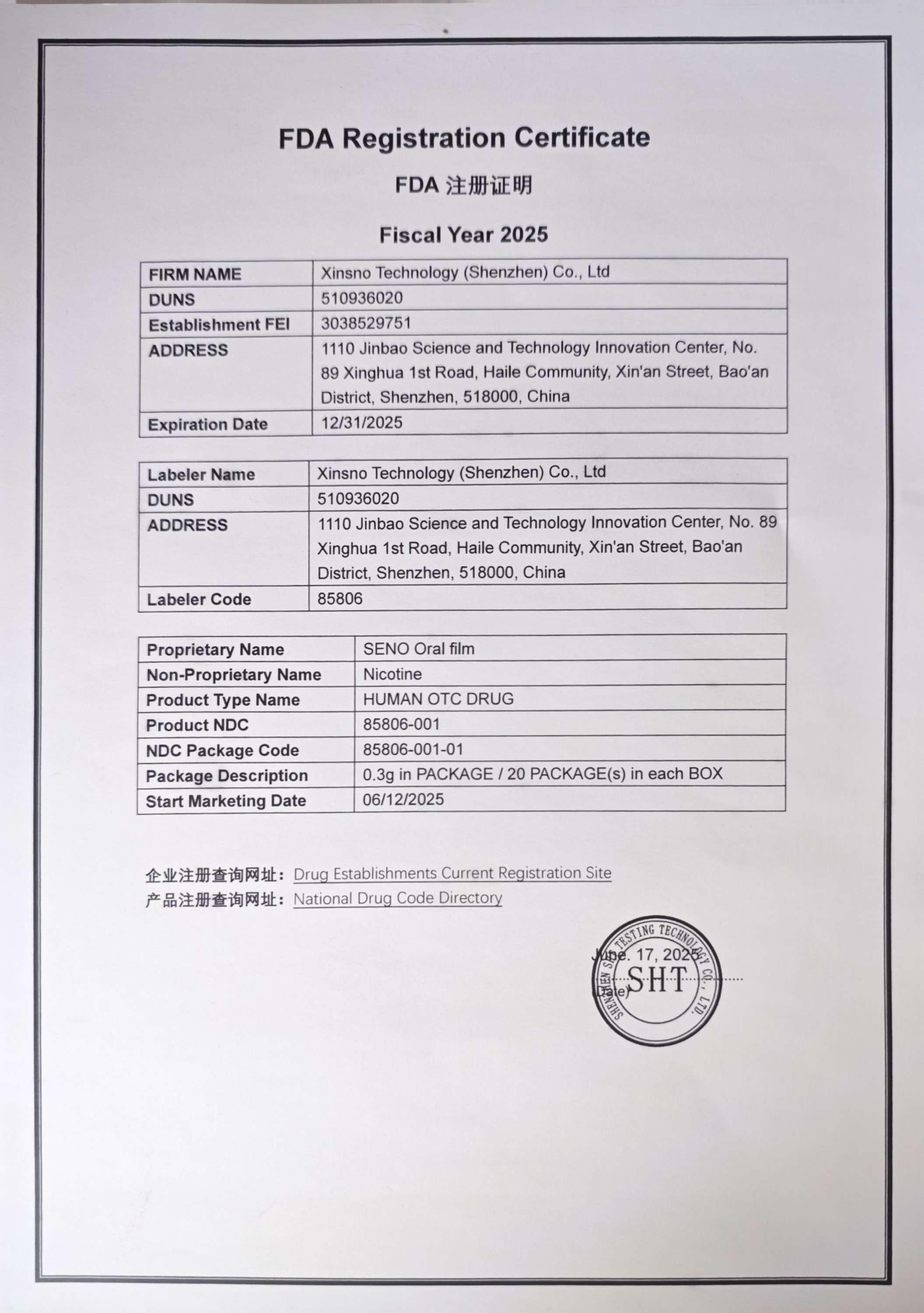
One cross-check belongs in every file: public U.S. labeling data indexed on DailyMed lists a 1.5% nicotine concentration for SENO Oral Films, while the product specification expresses strength as 2 mg / 4 mg / 6 mg options. Both statements are legitimate — they use different units. A buyer should ask the supplier to reconcile label units against specification units before artwork is approved, because that is precisely where retail compliance errors originate.
Track 3 — Delivery Assurance: What Happens Between PO and Shelf
- Lead time: 20–30 days for standard orders; 30–45 days for OEM or custom orders.
- MOQ: 100,000–300,000 strips per SKU.
- Delivery terms: FOB, CIF or DDP depending on destination, with DDP positioned as the recommended route for new partners.
- Payment: 30% deposit with 70% balance before shipment by T/T, negotiable for long-term partners.
- Acceptance criteria: pre-shipment quality inspection as standard, third-party inspection available on request, sample confirmation before mass production, and batch consistency verification reports.
- Packaging and storage: individual sachets or multi-pack boxes; 24-month shelf life; storage in a cool and dry environment.
- After-sales: technical and compliance support, marketing material support for distributors, fast response on quality or logistics issues, and long-term partnership support.
Six Steps to Run the Evaluation
Step 1 — Fix the Product Brief Before the First Call
Write down strength (2 mg / 4 mg / 6 mg or a custom value), flavour direction, film size, thickness tolerance, pack format and branding requirements. A supplier can only answer capability questions precisely when the brief is precise; vague briefs produce vague capacity commitments.
Step 2 — Convert Capability Claims into Numbers
Ask for floor area, total headcount, R&D headcount, annual output and monthly capacity, then test which figure constrains your forecast. A 500,000-strip order sits inside one month of SENO's stated 1,000,000–5,000,000 strip monthly range at the low end — useful to know when you are scheduling a launch date.
Step 3 — Verify Filings by Number and Date
Request certificate images, not number lists. Match PMTA numbers against the documents, confirm the OTC registration and food facility registration identifiers, and diarise every expiry date so renewal is a calendar event rather than a shipment surprise.
Step 4 — Agree the Acceptance Protocol in Writing
Pre-shipment inspection, third-party inspection on request and batch consistency verification reports should be written into the order, not assumed. The QC sequence — raw material verification, in-process control, 100% batch inspection, final product testing — is what the acceptance protocol is checking against.
Step 5 — Model the Delivery Timeline Against Shelf Life
Add production lead time, transit and clearance, then compare the result against the 24-month shelf life. Ask for the production date rather than the shipment date; that single data point tells you how much usable life will actually land in the warehouse.
Step 6 — Size the First Order to the MOQ and to the Market Test
With MOQ at 100,000–300,000 strips per SKU, the pilot order and the market test should be the same decision. Choose the SKU you can validate fastest — in most markets that is a single strength and a single flavour, not a full range.
Where This Framework Changes the Outcome
Repeat-order stability is the core risk. SENO's recorded distributor projects span 500,000–2,000,000 strips per order across Germany, the United States, Australia, the United Arab Emirates, Saudi Arabia and Canada, with reported stable batch performance and repeat orders. Evaluating batch consistency reporting before the first order is how a distributor protects that pattern.
The customization variables — strength, flavour, film size, packaging design and branding — determine whether a private label is genuinely differentiated or simply a repacked generic. Confirm which variables are open before you design artwork.
For Europe, the relevant evidence is the SDS series prepared to REACH, CLP and EN 14986. For the United States, it is the PMTA notification numbers, the OTC registration and the food facility registration. These are different document sets for different regulatory pathways and should be requested separately.
Shelf life and pack format decide sell-through economics. A 24-month shelf life combined with individual sachets or multi-pack boxes supports marketplace listing requirements and reduces returns tied to short-dated stock.
A discreet, smoke-free oral format fits existing nicotine-alternative shelves. SENO's recorded partner activity includes a France/UK distribution project running two years and signed agents across major European markets, a Canadian agency partnership with channel network construction, and exhibition and local marketing projects in the United Arab Emirates. SENO has also been recognised by a U.S. exhibition/industry award committee with a Best Product Prize.
Supplier File Checklist: Dimension, Evidence, and SENO's Documented Position
| Evaluation dimension | Evidence to request | SENO documented position |
|---|---|---|
| Manufacturing footprint | Site area and headcount | 20,000 m² facility; 30 employees |
| R&D depth | Formulation and process engineers | 15 R&D engineers |
| Output | Annual and monthly capacity | 12,000,000–50,000,000 strips per year; 1,000,000–5,000,000 strips per month |
| Customization | Strength, flavour, size, pack, branding | 2 / 4 / 6 mg or customized; mint, fruit and custom flavors; approx. 20 mm × 30 mm or customized; sachets or retail boxes; logo and artwork |
| U.S. tobacco pathway | PMTA notification numbers | PM0010176, PM0010173, PM0010199 |
| U.S. OTC pathway | OTC drug establishment and product registration | 510936020, recorded expiry 1 June 2028 |
| U.S. facility filing | Food facility registration | 13242366294, recorded expiry 31 December 2026 |
| Chemical safety documentation | SDS to REACH, CLP and EN 14986 | SDS series DTI2025EC011118 |
| Quality protocol | Inspection scope and reporting | 100% batch inspection; raw material verification; in-process control; final product testing |
| Lead time | Standard versus custom | 20–30 days standard; 30–45 days OEM/custom |
| MOQ | Minimum per SKU | 100,000–300,000 strips per SKU |
| Shelf life | Months and storage conditions | 24 months; cool and dry environment |
Frequently Asked Questions
Which regulatory numbers should a buyer verify first for U.S.-bound nicotine film?
Three document families matter for the U.S. market. First, FDA Premarket Tobacco Product Application (PMTA) notification numbers — SENO's file records PM0010176, PM0010173 and PM0010199. Second, FDA OTC drug establishment and product registration 510936020, recorded with an expiry of 1 June 2028. Third, U.S. FDA Food Facility Registration 13242366294, recorded with an expiry of 31 December 2026. Request the certificate images rather than a number list, and diarise each expiry date at the point of approval.
How can a buyer test whether a nicotine film supplier's capacity claim is realistic?
Convert the claim into three figures — annual output, monthly capacity, and the headcount supporting them — then map your own forecast onto them. SENO states 12,000,000–50,000,000 strips per year, 1,000,000–5,000,000 strips per month, a 20,000 m² production facility, 30 employees and an R&D team of 15. An order of 500,000 strips, for example, falls inside one month of the lower end of the stated monthly range, which tells you where your order sits in the production queue.
What are the minimum order quantity and payment terms?
MOQ is 100,000–300,000 strips per SKU. Standard payment is a 30% deposit with the 70% balance before shipment by T/T, with flexibility for long-term partners and other methods negotiable based on order volume. Delivery terms are FOB, CIF or DDP depending on destination; DDP is presented as the recommended option for new partners because it places freight and customs within the supplier's scope.
Can a buyer validate samples before committing to mass production?
Yes. Sample confirmation before mass production forms part of the stated acceptance criteria, alongside pre-shipment quality inspection as standard, third-party inspection available on request, and batch consistency verification reports. Use the sample stage to lock the parameters that are hardest to change later — dissolution behaviour, flavour profile and pack format.
What lead time and shelf life should be planned for?
Standard orders run 20–30 days and OEM or custom orders 30–45 days, with a 24-month shelf life and storage in a cool, dry environment. Add transit and customs clearance to the production window when calculating the shelf life that will remain on arrival. To check these figures against a live project — specification, certificate copies, samples or a quotation — SENO can be reached at seno.serve@outlook.com, +86 134-1745-8127, or WhatsApp +1 (626) 232-2952.
Conclusion: Vet the File, Not the Pitch
A nicotine film supplier is approved on evidence, not on presentation. Capability is a set of numbers — 20,000 m², 30 employees, 15 R&D engineers, 12,000,000–50,000,000 strips per year, 1,000,000–5,000,000 strips per month. Compliance is a set of identifiers and dates — PM0010176, PM0010173, PM0010199, 510936020, 13242366294, and an SDS series prepared to REACH, CLP and EN 14986. Delivery assurance is a set of commitments — 20–30 day standard lead time, 30–45 day custom lead time, 100,000–300,000 strips per SKU, a 24-month shelf life, and inspection that runs from raw material through to final testing.
Run the three tracks in order, refuse to accept any claim that cannot be expressed as a number, a certificate identifier or a date, and the supplier decision becomes auditable instead of instinctive.
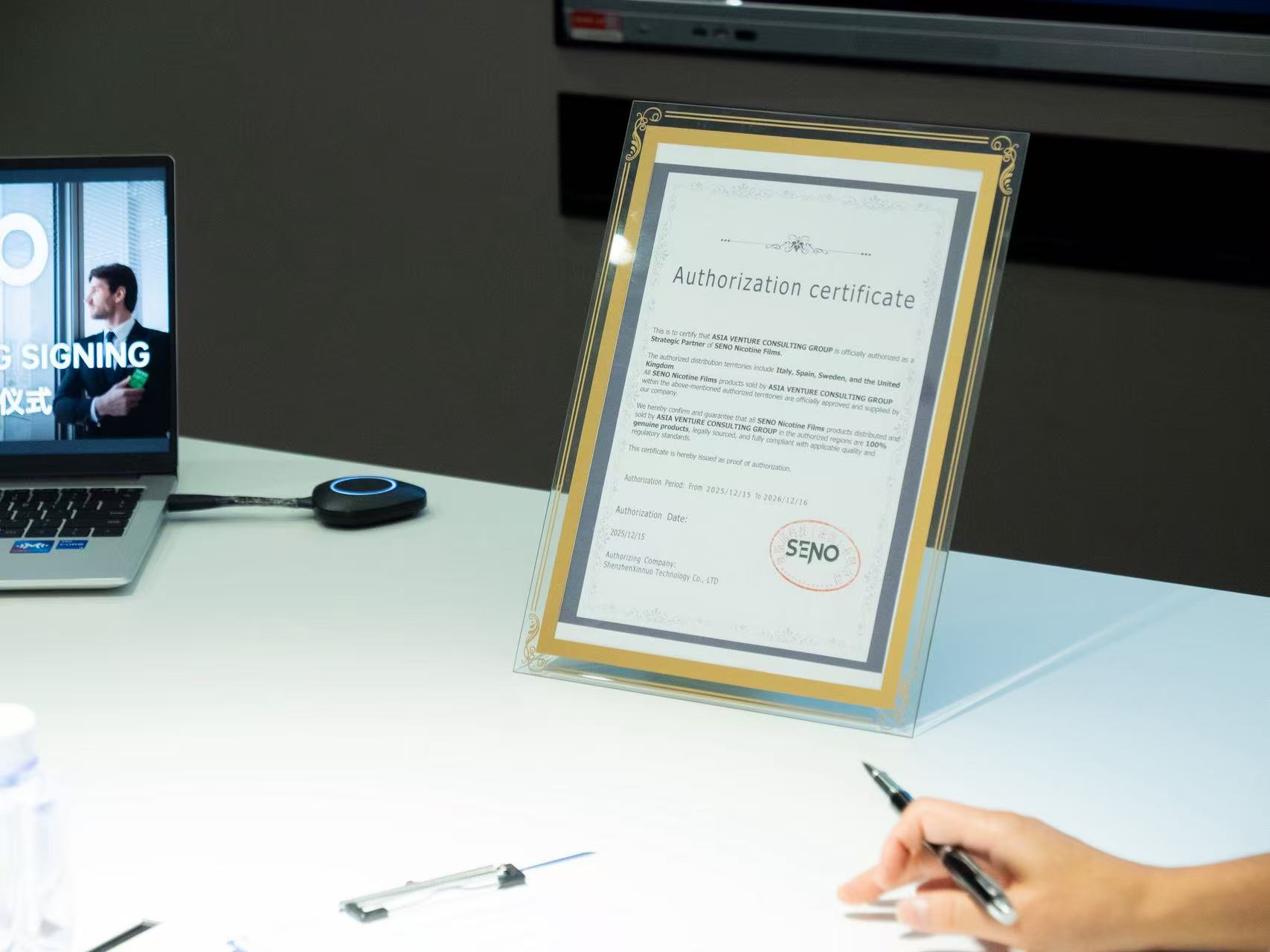
Ask for the specification sheet, certification copies with expiry dates, the batch consistency report format, and a sample of the 2 mg, 4 mg or 6 mg format you intend to list.
Email: seno.serve@outlook.com · Tel: +86 134-1745-8127 · WhatsApp: +1 (626) 232-2952
Xin Sino Technology (Shenzhen) Co., Ltd., 505C Tianlong Building, Nanshan District, Shenzhen City, Guangdong Province, China · seno-online.com
Have Questions or Need More Details?
Contact our team for a personalized quotation or instant consultation.
Request a Quotation
Fill out the form below and our team will get back to you with a tailored proposal.
WhatsApp Direct Chat
Prefer to chat in real-time? Message us on WhatsApp for instant assistance & quick answers.
- Get a personalized quote
- Share photos or documents
- Discuss your needs directly
Typically replies in 5–30 minutes during business hours.