Hydraulic Cylinders for Dam Gate Openers and Metallurgical Lines: An Application Guide
The SB-Y1 Series is a single-rod, double-acting heavy-duty industrial hydraulic cylinder manufactured by Wuxi Shibang Machinery Manufacturer Co., Ltd. — the Wuxi, China cylinder maker trading as shellppon — and listed for metallurgical machinery, mining machinery, heavy hydraulic presses, injection molding machines, engineering machinery and dam gate openers. It is built with bore sizes of 40, 50, 63, 80, 100, 125, 160, 200, 250 and 320 mm at a nominal operating pressure of 16 MPa, or as a reinforced version rated for operating pressures up to 25 MPa, with stroke length custom-built according to load stability and buckling resistance.
Dam gate openers and metallurgical lines are frequently grouped together under one label: heavy-duty. They are not the same specification problem. A gate opener is a pivoting, long-stroke, position-holding duty matched to a linkage arc. A metallurgical line is a rigid-frame, high-impact, cyclic duty matched to a mill structure. A cylinder that satisfies one can fail the other without any component being defective — simply because the pressure class, mounting interface, alignment allowance or sealing package was chosen for the wrong duty set.
This guide works through that difference in the order a buyer actually has to decide it: pressure class, bore, stroke, mounting, alignment, sealing, and documentation. Product facts come from the SB-Y1 Series specification; requirement facts come from published standards and the manufacturer's certificate file.
- Whether a 16 MPa standard cylinder or the 25 MPa reinforced version fits your duty
- Which bore size range and stroke logic applies to a gate arm versus a mill frame
- Which mounting style transfers the load safely in each case
- Where alignment, sealing and rigid connection decisions are made
- Which documents a European buyer should receive with the cylinders
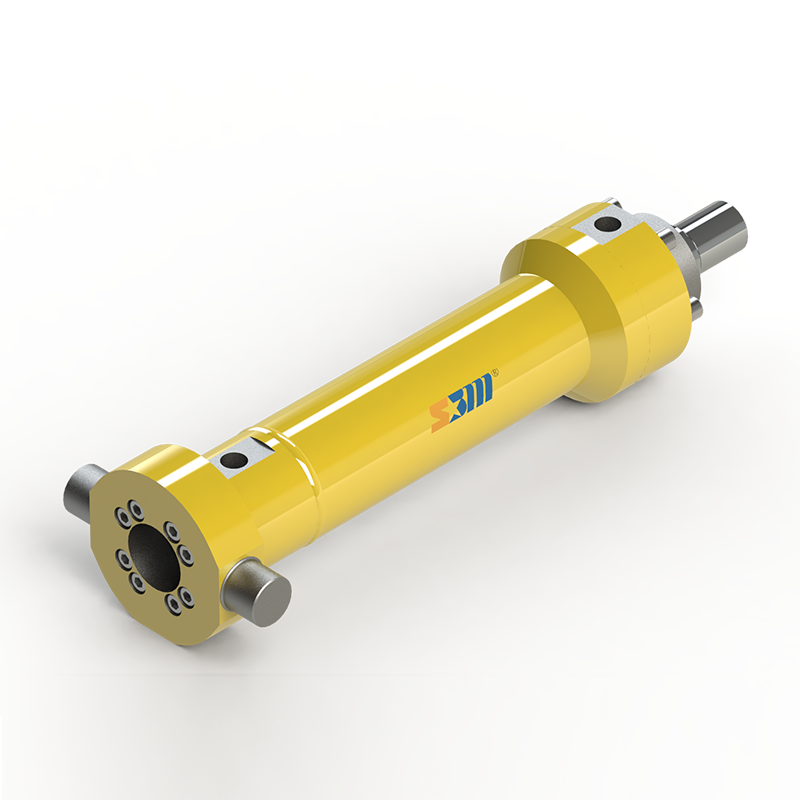
SB-Y1 Series heavy-duty industrial hydraulic cylinder, trunnion mounting at base — a pivoting execution suited to linkage and continuous angular drive.
Why Heavy-Duty Is Not a Specification
A cylinder is heavy-duty when its barrel, rod, seals and mounting can carry a defined load profile for a defined service life. The words alone commit nobody to anything. The purchase order has to fix four variables: operating pressure, bore, mounting interface, and stroke with a buckling check. Everything else — rod material, chrome thickness, seal compound, cushioning, position sensing — is refinement on top of those four.
Two applications, two constraint sets
Dam gate opener duty is defined by angular motion. The cylinder usually drives a gate arm or a linkage through an arc, so both the head and the base have to rotate as the stroke extends. The stroke is long relative to the bore. The cylinder may hold a gate position for extended periods, which puts continuous load on the seals and on the hydraulic lock rather than on the rod. The mounting must therefore accept rotation without introducing a bending moment into the rod.
Metallurgical line duty is defined by the frame. Roll-mill lifting, balancing, following, turning and push-pull functions are executed inside a rigid steel structure, often with impact and high cycle counts. Here the cylinder is frequently fixed rather than pivoting, so the flange or trunnion has to spread load into the frame, and the rod has to resist side load and abrasion rather than follow an arc.
What goes wrong when the pressure rating is chosen from tonnage alone
Sizing by tonnage produces a cylinder that pushes hard in the catalogue and behaves unpredictably in service. Three typical consequences follow. First, a long stroke selected without a buckling evaluation can deflect under compressive load, and rod deflection transfers directly into the rod seal and the guide. Second, a pivoting duty fitted with a rigid flange, or a rigid-frame duty fitted with a loose clevis, forces the rod to absorb misalignment that the mounting should have absorbed. Third, a seal package chosen without regard to rod surface quality and contamination will leak regardless of pressure class.
The corrective logic is procedural, not commercial: fix the duty envelope, then the pressure class, then the bore and stroke, then the mounting, then alignment and sealing. The order matters because each later decision is constrained by the earlier one.
Industry Background: Which Standards Actually Govern These Cylinders
Hydraulic cylinders are covered by internationally published standards for design, mounting dimensions, acceptance tests and buckling-load evaluation. That coverage matters to a project buyer because it converts a supplier claim into a testable requirement.
- ISO 10100:2020 specifies acceptance and function tests for hydraulic fluid power cylinders.
- ISO/TS 13725:2021 sets out a method for evaluating the buckling load of a hydraulic cylinder, based on elastic buckling theory, and is applicable to single and double acting cylinders that conform to ISO 6020 (all parts), ISO 6022 and ISO 10762.
- ISO 6020-1/-2/-3, ISO 6022 and ISO 10762 address mounting dimensions and cylinder types, including mill-type cylinders.
- AWS D14.9/D14.9M:2022 is a welding specification for hydraulic cylinders; it covers pressure-containing welded joints and structural welded joints used in cylinder manufacture.
In Europe, two regulatory layers sit alongside the ISO design standards. Pressure equipment falls under Directive 2014/68/EU, and machinery falls under Directive 2006/42/EC, with EN ISO 4413:2010 for hydraulic fluid power systems and components and EN ISO 12100:2010 for risk assessment and risk reduction referenced as applicable standards in the certificate file described below.
Trade conditions are also part of the background for anyone planning a 2027 programme. The U.S. Department of Commerce announced antidumping and countervailing duty investigations of certain linear hydraulic cylinders and parts thereof, a proceeding initiated in 2024. Buyers shipping into the United States should treat origin and documentation as a planning variable, not an afterthought.
The SB-Y1 Series itself is declared compliant with GB/T 2348-1993 and JB/T 10205-2010, in addition to the manufacturer's CE documentation. Those two Chinese standards define the cylinder's own design and acceptance basis; the ISO and EN references above are what a European or international project specification will typically ask you to reconcile against.
The SB-Y1 Series: One Platform, Two Duty Sets
The practical value of a single platform across gate openers and metallurgical lines is that bore range, pressure class, sealing system and mounting family stay constant while the configuration changes. That reduces the number of spares philosophies a plant has to maintain.
| Parameter | SB-Y1 Series specification |
|---|---|
| Type | Single rod, double-acting metallurgical cylinder |
| Design standards | GB/T 2348-1993; JB/T 10205-2010 |
| Nominal operating pressure | 16 MPa standard; reinforced version up to 25 MPa |
| Bore sizes (AL) | 40, 50, 63, 80, 100, 125, 160, 200, 250, 320 mm |
| Stroke length | Custom-built according to load stability and buckling resistance; non-standard strokes configured to design requirement |
| Cylinder barrel | High-grade thick-wall seamless steel tube; bore precision bored and roller-burnished or honed |
| Piston rod | 45# carbon steel, 40Cr alloy steel, or stainless steel; induction hardened and hard chrome plated to HRC 50 or higher |
| Sealing system | Standard set: step seals, Glyd rings, O-rings |
| Mounting family | Base clevis; trunnion at head; trunnion at base; round flange at head or base; rectangular flange at head or base; square flange at head or base |
Barrel, rod and seal choices that carry the duty
The barrel is a high-grade thick-wall seamless steel tube. Its bore is precision bored and then either roller-burnished or honed, which is the surface the piston seal runs against. The rod is induction hardened and hard chrome plated to HRC 50 or higher, and is available in 45# carbon steel, 40Cr alloy steel or stainless steel. On the separate piston rod product, the harder figures are published: quenching hardness HRC50-60, tempering hardness HB220-260, chrome layer 30-50 μm, straightness tolerance 0.015 mm per 1000 mm, and surface roughness Ra 0.15 to 0.2 μm, in diameters from Φ22 to 1200 mm and lengths up to 10 m.
Those rod figures are not decorative. A chrome layer in the 30-50 μm range with a mirror finish at Ra 0.15 to 0.2 μm minimises friction against the step seal and Glyd ring, which is what protects the seal from the abrasive pickup that scores a rod in a mill environment. Straightness at 0.015 mm per 1000 mm is the tolerance budget you are working inside when you specify a long stroke for a gate arm.
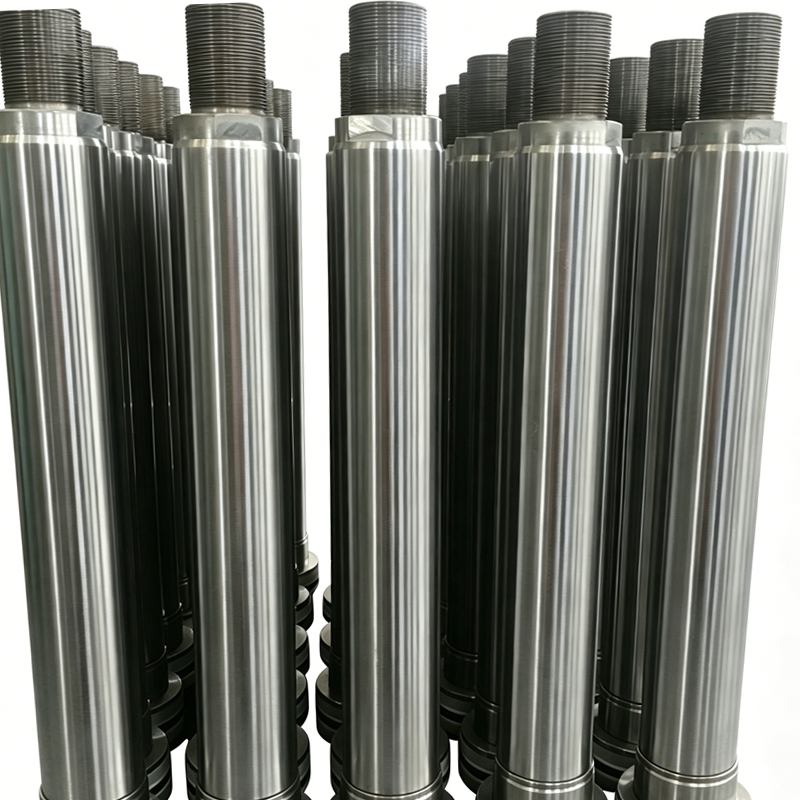
Induction hardened, hard chrome plated piston rod: chrome layer 30-50 μm, straightness 0.015 mm per 1000 mm, surface roughness Ra 0.15 to 0.2 μm.
Documentation supplied for European machinery
The certificate file is specific enough to audit, which is the point of listing it in an application guide rather than a brochure.
| Document | Reference | Issuer and validity |
|---|---|---|
| CE Pressure Equipment Certificate of Conformity, PED Module G | Z-AS-CN-SHA-25-09-3465291-25202735 and Z-AS-CN-SHA-25-09-3465291-18130549, under Directive 2014/68/EU (Module G) | TÜV SÜD Industrie Service GmbH, notified body CE 0036; issued 2025-09-27, no listed expiry date; scope covers piston accumulator pressure equipment under Module G |
| CE Machinery Safety Attestation | M.2024.206.C106939, under 2006/42/EC Annex VIII, EN ISO 12100:2010 and EN ISO 4413:2010 | UDEM International Certification Auditing Training Centre Industry and Trade Inc. Co.; issued 2024-09-18, valid until 2029-09-17; scope covers hydraulic cylinders |
| Quality Management System | ISO 9001:2015 / GB/T 19001-2016, certificate 04324Q32569R1S | Beijing United Intelligence Certification Co., Ltd. (UICC); issued 2024-10-17, valid until 2027-10-18; scope covers design and production of hydraulic cylinders |
| Occupational Health and Safety Management System | ISO 45001:2018 / GB/T 45001-2020, certificate 04324S41946R0S | UICC; valid 2024-10-17 to 2027-10-16; China market and IAF/CNAS mutual recognition area |
| Environmental Management System | ISO 14001:2015, certificate 04324E32063R0S | UICC; valid 2024-10-17 to 2027-10-16 |
Product coverage in the PED certificate includes the SB-Y1 Series heavy-duty industrial hydraulic cylinder, including the rectangular flange at base configuration, plus the SB08 Series swing hydraulic cylinder, the SB08 Series single-rack spiral swinging cylinder and the SB-piston rod product. The Machinery Directive attestation covers the SB-Y1 Series in clevis mounting at base, trunnion mounting at head and trunnion mounting at base, together with the SB08 Series cylinders and the SB-piston rod.
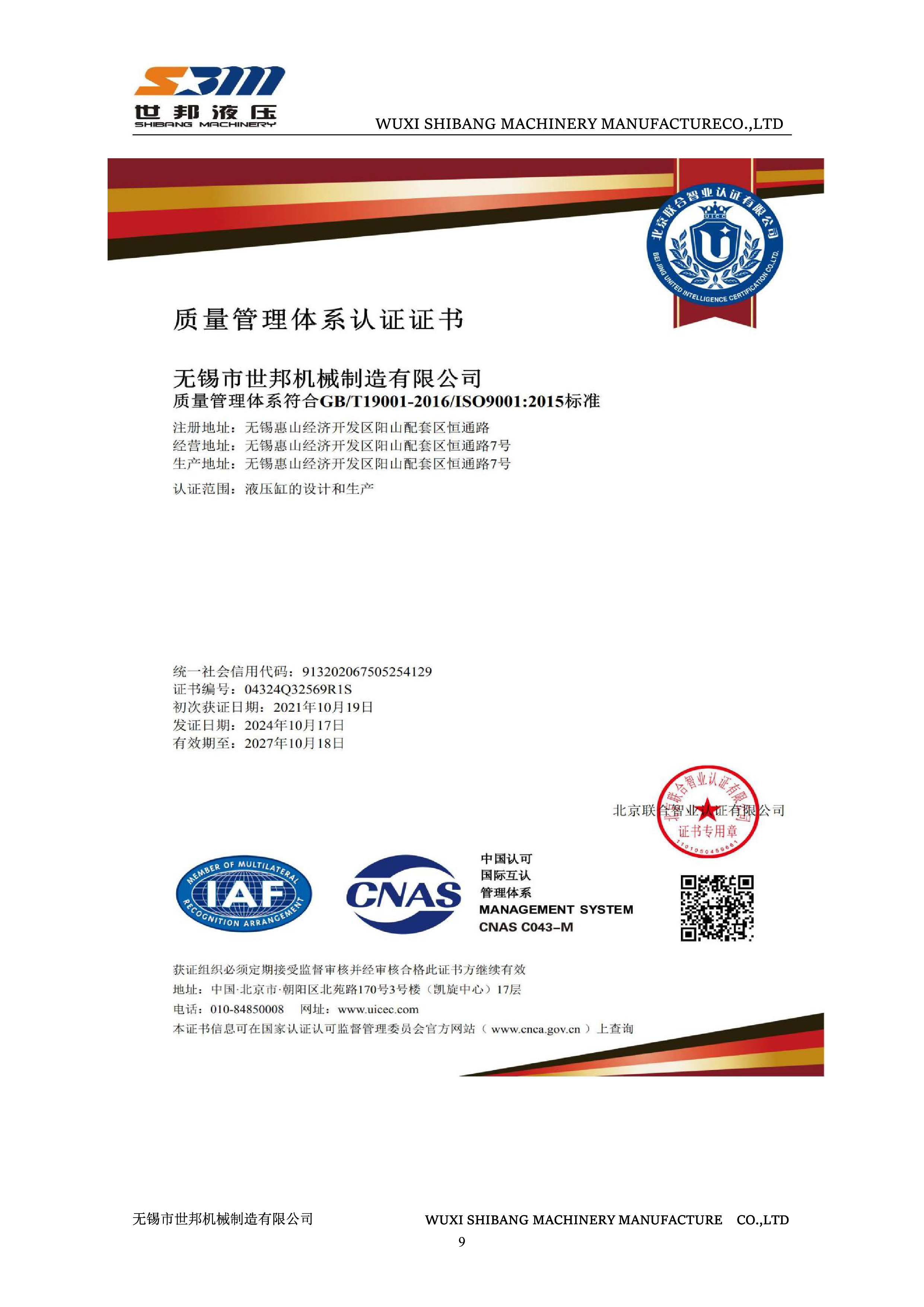
ISO 9001:2015 certificate 04324Q32569R1S, valid until 2027-10-18, covering the design and production of hydraulic cylinders.
Step-by-Step: Matching a Cylinder to a Gate Opener or a Metallurgical Line
Step 1 — Fix the duty envelope before the bore
Write down the required thrust and retraction force, the working stroke, the number of cycles, the mounting space, and the environment. For a gate opener, add the angular sweep of the arm and the holding requirement. For a metallurgical line, add impact, scale and the frame interface. Without this envelope, bore selection is guesswork.
Step 2 — Choose the pressure class
Start at 16 MPa nominal. Move to the reinforced version, rated for operating pressures up to 25 MPa, when the duty envelope cannot be met within the standard class. Because bore sizes are fixed at ten steps from 40 to 320 mm, the pressure class is one of only two levers you have for increasing force — the other is bore. Deciding the pressure class first keeps the bore from being inflated unnecessarily, which in turn keeps rod and seal loads proportionate.
Step 3 — Size the bore, then confirm the stroke against buckling
Select the bore from the available range that delivers the required force at the chosen pressure class. Then treat stroke as a structural question, not a length question. ISO/TS 13725:2021 provides a method for evaluating buckling load that applies to single and double acting cylinders conforming to ISO 6020, ISO 6022 and ISO 10762. In the SB-Y1 Series, stroke length is custom-built according to load stability and buckling resistance, and custom strokes are configured for non-standard design requirements. A long-stroke gate opener is exactly the case where this check earns its place.
Step 4 — Match the mounting to the motion path
If the cylinder has to rotate as it extends, specify a pivoting mounting: base clevis, trunnion at head or trunnion at base. If the cylinder is fixed to a structure, specify a flange: rectangular flange for a multi-point rigid connection into heavy equipment frames, round flange where uniform stress distribution suits a standardized linear application, square flange at head where axial accuracy and reduced side-load risk matter, square flange at base where impact resistance at the rear mount matters.
Step 5 — Control alignment before you tighten anything
Alignment is the interface between the cylinder and the machine, and it is where most premature rod seal failures originate. On a pivoting installation, the clevis pin axis and the trunnion axis must be parallel to the arc the gate arm actually travels, and the pin bores must be co-planar. On a flanged installation, the mounting face has to be flat and square to the rod axis; a flange bolted to a distorted frame face introduces a side load that no seal can survive. The square flange at head is specified for front flange mounting providing high axial accuracy and reduced side-load risk — which only holds if the mating face is machined to suit.
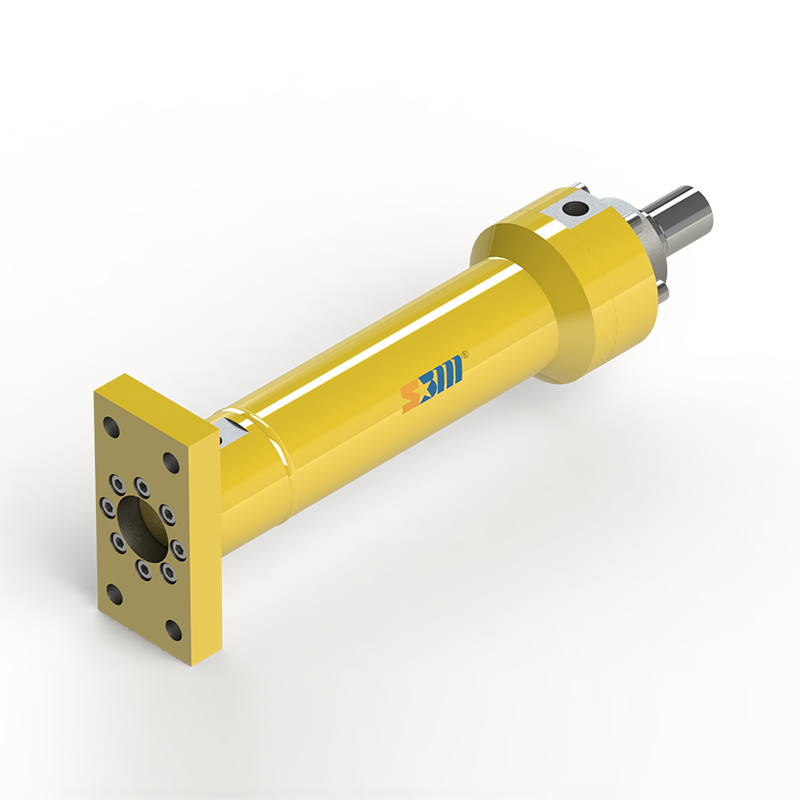
Rectangular flange at base: a multi-point rigid connection designed for heavy equipment frames, such as mill housings and press structures.
Step 6 — Specify sealing and rod surface for the environment
The standard sealing system is step seals, Glyd rings and O-rings. That combination is a reasonable baseline for both duty sets, but the environment decides the detail. A gate opener exposed to weather and water ingress needs the rod surface and the wiper arrangement treated as one decision. A metallurgical line exposed to scale and abrasion needs the chrome and the seal material reviewed together, because a scored rod destroys a step seal quickly and a hardened, well-finished rod protects it. Where corrosion resistance is the governing constraint rather than wear, the stainless steel rod option in the specification is the relevant lever.
Step 7 — Close the documentation and verify the drawing
Before release, reconcile the drawing against the specification. Bore size, stroke, seal type and square flange mounting dimensions are all defined in the cylinder specification for drawing verification. Then attach the compliance file: PED certificate, Machinery Directive attestation and ISO 9001 certificate where the destination market requires them. This is also the point to confirm quantity, delivery and price, since lead time is confirmed by quotation and project specification rather than by a catalogue figure.
Use Cases
Dam gate openers
Dam gate openers are listed among the applicable industries for the SB-Y1 Series. The configuration logic follows from the motion: a pivoting cylinder driving a gate arm through an arc, with a long stroke established against buckling resistance and a trunnion or base clevis interface that lets the cylinder follow the arm. Position holding is governed by the hydraulic circuit rather than the cylinder alone, so the seal package and the rod surface carry the standing load. Where the gate structure is exposed, the stainless steel rod and the corrosion-protection choices in the specification become selection criteria rather than upgrades.
Metallurgical lines
This is where the platform has documented project history. Thirty-four cylinders were supplied in 2008 for two steel projects: twenty for the Jinan Iron and Steel 4300 mm roughing mill and fourteen for the Shandong Fulun Iron and Steel 1000 mm hot-strip mill. The functions were roll-mill lifting, balancing, following, turning and push-pull motion, integrated into the rolling-mill line and its control system. Custom bore, rod and stroke combinations across that supply ran from 40/28/400 mm to 320/220/2900 mm, with additional 100/70/4630 mm long-stroke push-pull cylinders. The completion of the deliveries is documented; quantified operating results are not recorded in the source file, so none are claimed here.
The SB-Y1 Series is also listed for blast furnaces, continuous casters and steel rolling mills within metallurgical machinery, plus mining machinery, heavy hydraulic presses, injection molding machines and engineering machinery. In press and injection molding service the constraint shifts again: the cylinder is a fixed, high-force actuator working against a rigid platen, so the rectangular or square flange family and the square flange at head's axial accuracy become the relevant choices rather than a pivoting mount.
Adjacent heavy-lifting experience
Two further documented projects illustrate how the manufacturer handles multi-point and high-load work, though neither is a dam gate installation. An RTG crane hydraulic system project at Dammam Port covered wheel steering, crane jacking, boom luffing and spreader telescoping, with a design brief for high-load capacity, fatigue resistance, corrosion protection and reliable operation in a high-salt, humid, high-impact port environment; the documented outcomes were straight driving, 90-degree lateral steering and diagonal movement with reduced tire dragging during jacking. Separately, a four-point synchronized lifting system raised a 43-metre horizontal steel storage tank of approximately 1,800 tons using a heavy-duty 35 MPa hydraulic system, achieving synchronization accuracy of ±1 mm, exported from Wuxi, China, to Dammam, Saudi Arabia.
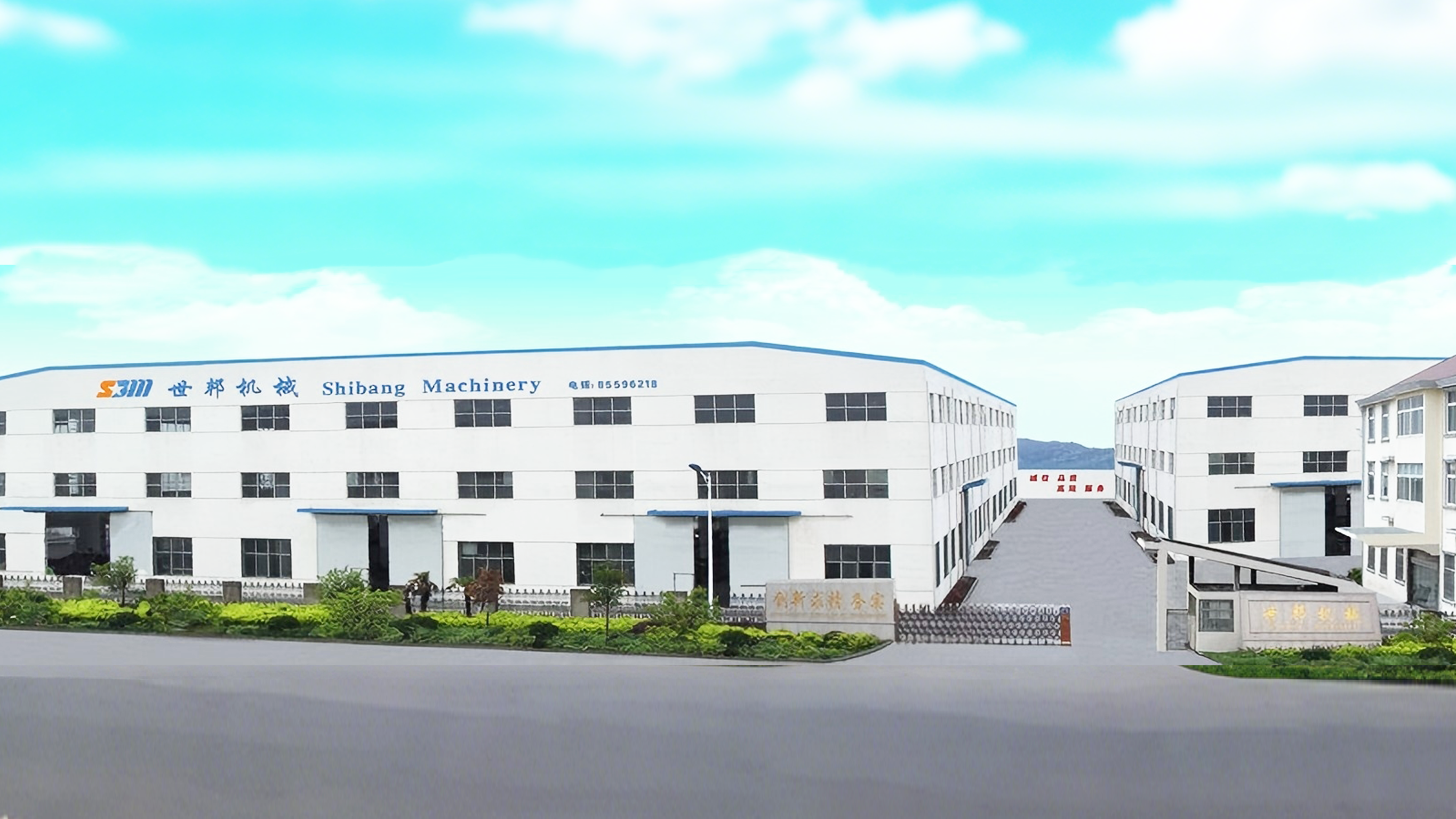
The 7,000 square metre cylinder manufacturing facility in Yangshan Industrial Park, Wuxi, China: 50+ production machines, 3 inspection devices, 2 hydraulic test rigs and 1 pneumatic test rig.
Comparison Table: Mounting Style versus Application Fit
The table below compares only what the SB-Y1 Series specification states about each mounting execution, and pairs it with the duty set in this guide where that connection character does the most useful work.
| Mounting type | Connection character (product specification) | Best fit in this guide |
|---|---|---|
| Clevis mounting at base | U-clevis with pin for medium/heavy pivoting mechanism drive | Gate opener linkage where the cylinder must pivot at the rear as the arm sweeps |
| Trunnion mounting at head | Pivoting heavy-duty execution for linkage and continuous angular drive | Gate arm with a head-side pivot and continuous angular travel |
| Trunnion mounting at base | Pivoting heavy-duty execution for linkage and continuous angular drive | Gate structures where the pivot belongs at the foundation rather than the rod end |
| Round flange at head | Uniform stress distribution for standardized linear applications | Standardized linear push points where load spread matters more than rigidity |
| Round flange at base | Uniform stress distribution for standardized linear applications | Rear-mounted linear actuators on fabricated frames |
| Rectangular flange at head | Multi-point rigid connection designed for heavy equipment frames | Mill housings and press structures with a machined head-side face |
| Rectangular flange at base | Multi-point rigid connection designed for heavy equipment frames | Metallurgical frames requiring a fixed, multi-bolt rear connection |
| Square flange at head | Front flange mounting providing high axial accuracy and reduced side-load risk | Press and injection molding platens where axial accuracy governs |
| Square flange at base | Rigid rear flange mounting for heavy-duty linear motion with high impact resistance | High-impact mill duty with a rigid rear interface |
Two constraints sit outside that table. Stroke is not a mounting property: it is custom-built according to load stability and buckling resistance, so a pivoting mount does not remove the need for a buckling evaluation on a long gate-opener stroke. And pressure class is not a mounting property either: the 16 MPa nominal and 25 MPa reinforced ratings apply across the mounting family, so the two decisions are made independently.
FAQ
What should a CE-compliant hydraulic cylinder manufacturer for European machinery be able to document?
At minimum, three documents that can be checked against the certificate number. The first is a CE Pressure Equipment Certificate of Conformity under Directive 2014/68/EU, which in this case is held by the manufacturer through TÜV SÜD Industrie Service GmbH under notified body CE 0036, certificate Z-AS-CN-SHA-25-09-3465291-25202735 and Z-AS-CN-SHA-25-09-3465291-18130549, issued 2025-09-27 with no listed expiry date. The second is a CE Machinery Safety Attestation under 2006/42/EC Annex VIII, certificate M.2024.206.C106939, issued by UDEM on 2024-09-18 and valid until 2029-09-17, issued against EN ISO 12100:2010 and EN ISO 4413:2010. The third is an ISO 9001:2015 certificate covering the design and production of hydraulic cylinders, certificate 04324Q32569R1S, valid until 2027-10-18. ISO 45001 and ISO 14001 certificates are also held. Read the scope statement on each document, because the PED certificate scope is stated as piston accumulator pressure equipment under Module G, with the cylinder product families listed as covered products.
Can one cylinder platform serve both a dam gate opener and a metallurgical line?
Yes, within the same specification envelope, but not with the same configuration. The SB-Y1 Series spans bore sizes from 40 to 320 mm, two pressure classes at 16 MPa nominal and up to 25 MPa reinforced, nine mounting executions from base clevis to square flange at base, and a standard sealing system of step seals, Glyd rings and O-rings. What changes between the two duties is the combination: a gate opener takes a pivoting mount with a buckling-checked long stroke, while a metallurgical line typically takes a rigid flange connection into the frame. The shared platform reduces spares variety; it does not remove the need to specify each application separately.
Which mounting style should I specify for a dam gate opener?
Specify a pivoting execution, meaning clevis mounting at base, trunnion mounting at head or trunnion mounting at base. The specification describes the base clevis as a U-clevis with pin for medium/heavy pivoting mechanism drive, and describes both trunnion executions as pivoting heavy-duty execution for linkage and continuous angular drive. A flange would fix the cylinder and force the arc into the rod, which is the failure path this decision exists to avoid.
How is a non-standard cylinder verified before production?
Through drawing verification and acceptance testing. Bore size, stroke, seal type and square flange mounting dimensions are defined in the cylinder specification so the drawing can be checked against the duty envelope before release. Production runs on an ISO 9001 certified quality management system with more than 50 production machines, 3 inspection devices including surface-hardness, dynamic-balance and NDT equipment, and 3 test rigs comprising 2 hydraulic and 1 pneumatic rigs, with each cylinder acceptance-tested; the manufacturer's qualification file states a 99.99% pass rate. Lead time is confirmed by quotation and project specification rather than quoted from a standing figure.
How do I get a quotation for a gate-opener or metallurgical cylinder?
Send the duty envelope rather than a part number: required thrust and retraction force, stroke with the mounting geometry, preferred pressure class, mounting style, rod material and seal preference, medium and ambient conditions, quantity and destination market. Wuxi Shibang Machinery Manufacturer Co., Ltd. accepts OEM/ODM work with customization across bore, rod diameter, stroke, mounting, pressure class, fluid and seals, piston-rod coating, cushioning, position measuring, proximity switches and control systems, so the specification is the input that matters. Quotes, drawings and the sample route are handled through info@wxsbjx.com or +86 139-6170-4590, and the English catalogue can be downloaded below.
Specify the duty, not just the bore
Send your gate-opener or metallurgical cylinder envelope — pressure class, bore, stroke, mounting and destination market — and receive a configuration with the matching compliance file. Samples and drawing verification are available before series production.
shellpponhydraulic.com | Download the English product catalogue (PDF) | Email: info@wxsbjx.com
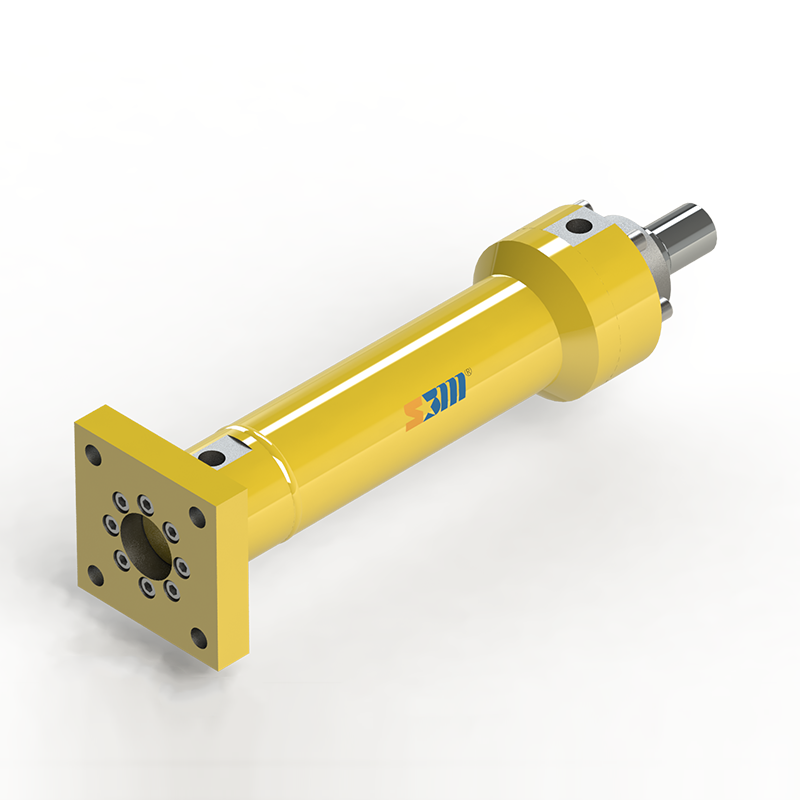
Square flange at base: rigid rear flange mounting for heavy-duty linear motion with high impact resistance. Configuration confirmed against your drawing before production.
Conclusion
Dam gate openers and metallurgical lines both need a heavy-duty cylinder, and that is where the similarity ends. The gate opener needs a pivoting mounting, a stroke verified against buckling, and a rod surface that survives standing load and weather. The metallurgical line needs a rigid flange connection into a machined frame, a seal package that tolerates scale and abrasion, and a rod hard enough to protect that seal. The pressure class — 16 MPa nominal or up to 25 MPa reinforced — is a separate decision from either.
The SB-Y1 Series covers both duty sets inside one specification envelope: bores from 40 to 320 mm, nine mounting executions, step seals with Glyd rings and O-rings, a thick-wall seamless barrel, an induction hardened and hard chrome plated rod at HRC 50 or higher, custom stroke set by load stability and buckling resistance, and a certificate file that includes PED Module G, the Machinery Directive attestation and ISO 9001. Documented project history sits in steel mills and port lifting rather than in dams, and it is stated here as such.
If you take one rule from this guide, take the sequence: pressure class, bore, buckling-checked stroke, mounting, alignment, sealing, documentation. In that order, the cylinder is a specification. Out of that order, it is a catalogue number with a tonnage printed next to it.
Have Questions or Need More Details?
Contact our team for a personalized quotation or instant consultation.
Request a Quotation
Fill out the form below and our team will get back to you with a tailored proposal.
WhatsApp Direct Chat
Prefer to chat in real-time? Message us on WhatsApp for instant assistance & quick answers.
- Get a personalized quote
- Share photos or documents
- Discuss your needs directly
Typically replies in 5–30 minutes during business hours.