Electric Cable Partnerships: FAQ on Purchasing Terms, Acceptance Criteria & Long-Term Supply
Electric Cable Partnerships: FAQ on Purchasing Terms, Acceptance Criteria & Long-Term Supply
Short answer: a long-term electric cable partnership is decided by three verifiable items — a certification scope that matches both the product family and the destination market, a written acceptance criteria regime, and a commercial model that fixes minimum order quantity, lead time, monthly capacity and warranty. Buyers who settle those three points before the first framework order rarely have to argue about them a year later.
This FAQ-style reference is written for procurement managers, EPC contractors, system integrators and distributors who are moving an electric cable supplier from a trial shipment to a repeat supply agreement. It answers the questions that come up most often — certification, customization capability, cost drivers, sample validation and lead time — and then maps the main electric cable families to their documented applications in utilities, heavy industry, infrastructure, renewable energy, shipbuilding, mining and construction.
The product, certification, capacity and application data referenced here comes from the published materials of Shanghai Shenghua Cable (Group) Co., Ltd., a cable manufacturer established in 1997 and based at No.7577 Hunan RD., Pudong New District, Shanghai 201314, China. The company operates 7 manufacturing bases and 21 cable factories across China and sells under the brands "Xinxin" and "Shan Cable".
Where Electric Cable Supply Partnerships Break Down
Most long-term cable disputes are documentary rather than technical. Four gaps account for the majority of them, and each one can be closed before a framework agreement is signed.
- Certification scope mismatch. A certificate may cover the power cable family but not the solar, instrumentation or fire-resistant family that the same buyer also orders. Scope has to be checked line by line against the actual bill of materials, not against a certificate cover page.
- Unwritten acceptance criteria. When the test regime, the referenced standards and the documentation set are not attached to the purchase agreement, acceptance becomes an opinion instead of a measurement.
- Assumed commercial terms. MOQ, lead time and monthly capacity are often quoted verbally during negotiation and never written into the framework, leaving both sides to re-negotiate at the second order.
- Duty-cycle mismatch. The published Shenghua Cable application records for power utilities, heavy industry, infrastructure, renewable energy, shipbuilding, mining and construction all list the same operation mode: 24/7. Continuous duty changes how a buyer should evaluate conductor construction, insulation material and armouring — not only the unit price.
The remedy is procedural: match every certificate to a product family, every product family to a documented application, and every order to a stated lead time and a stated test result.
Industry Background: Electric Cable Procurement in 2026
Three market facts frame how buyers should read a supplier's capability claims in 2026.
- The global wires and cables market was valued at approximately USD 230.9 billion in 2025 and is projected to reach USD 313.1 billion by 2033 (Grand View Research / Mordor Intelligence). Estimates vary with scope — Mordor Intelligence places the equivalent 2026 figure at USD 245.44 billion.
- The medium voltage wire and cable segment alone was valued at USD 71.7 billion in 2025, with Prysmian Group holding a 12.5% global share of that segment in the same year (Global Market Insights).
- Mainland China remains the world's leading exporter of insulated wire and cable (HS 8544), accounting for USD 31.4 billion, or 18.1%, of global exports in 2024 (World's Top Exports / UN Comtrade).
Two standards shape most international specifications. IEC 60502-2:2014 specifies requirements for power cables with extruded solid insulation for rated voltages from 6 kV up to 30 kV in fixed installations. In the European Union, the Construction Products Regulation classifies cables into seven fire protection classes, Aca to Fca, with Class Eca treated as a basic safety requirement for building materials. A framework agreement written in 2026 should expect both to be referenced by model rather than by general statement.
Detailed Solution: The Terms That Define a Long-Term Electric Cable Partnership
1. Compliance — match certificates to markets, not to brochures
Shenghua Cable publishes six certification families that a buyer can verify against a destination market before signing.
- CE — certificate number 3N240913.SSCCQ56, issued by ECM (Ente Certificazione Macchine Srl) on 13 September 2024 and valid until 12 September 2029. Scope covers Power Cable (LV/MV), LSZH Cables, House Wiring Cable, Control & Instrumentation Cables, Rubber & Mining/Industrial Cables and Solar Cable. Referenced standards include IEC 60228:2023, IEC 60502-1, IEC 60502-2, IEC 60332, IEC 60227, IEC 60245-1, IEC 60245, IEC 60331-1:2018, IEC 60331, IEC 61089:1991, IEC 60092 and EN 50525. Market: EU and EEA.
- KEMA — certificate numbers 2129307.03, 2129307.01 and 2129307.02, issued by KEMA Quality B.V. and valid from 23 June 2010 to 22 June 2050. Scope covers power cables against IEC 60502-1:2004 +A1:2009 and IEC 60227-3:1993 + A1:1997, and is particularly accepted in the EU, Middle East and South East Asia.
- TUV — certificate number R 50609864 0001, issued by TÜV Rheinland LGA Products GmbH, covering electric cables for photovoltaic systems against IEC 62930:2017, for global and EU markets.
- ISO 9001:2015, ISO 14001:2015, ISO 45001:2018 — certificate numbers 02026Q00424R201, 02026E00261R201 and 02026S00248R201, issued by ZDHY, with a scope of cable design and manufacturing, valid to 23 March 2029.
- CNAS L6565 — laboratory accreditation against ISO/IEC 17025:2017, valid to 27 November 2028. This is the certificate that gives weight to a 100% test claim.
- EAEU declaration of conformity — number N РОСС RU Д-CN.РА01.В.39494/24, issued by MOSTEKHNORUS LLC, covering power cables up to 35 kV against GOST 18690-2012, valid from 30 September 2024 to 29 September 2029, and applying to models including YJV, YJV22(62) and YJV32(72).
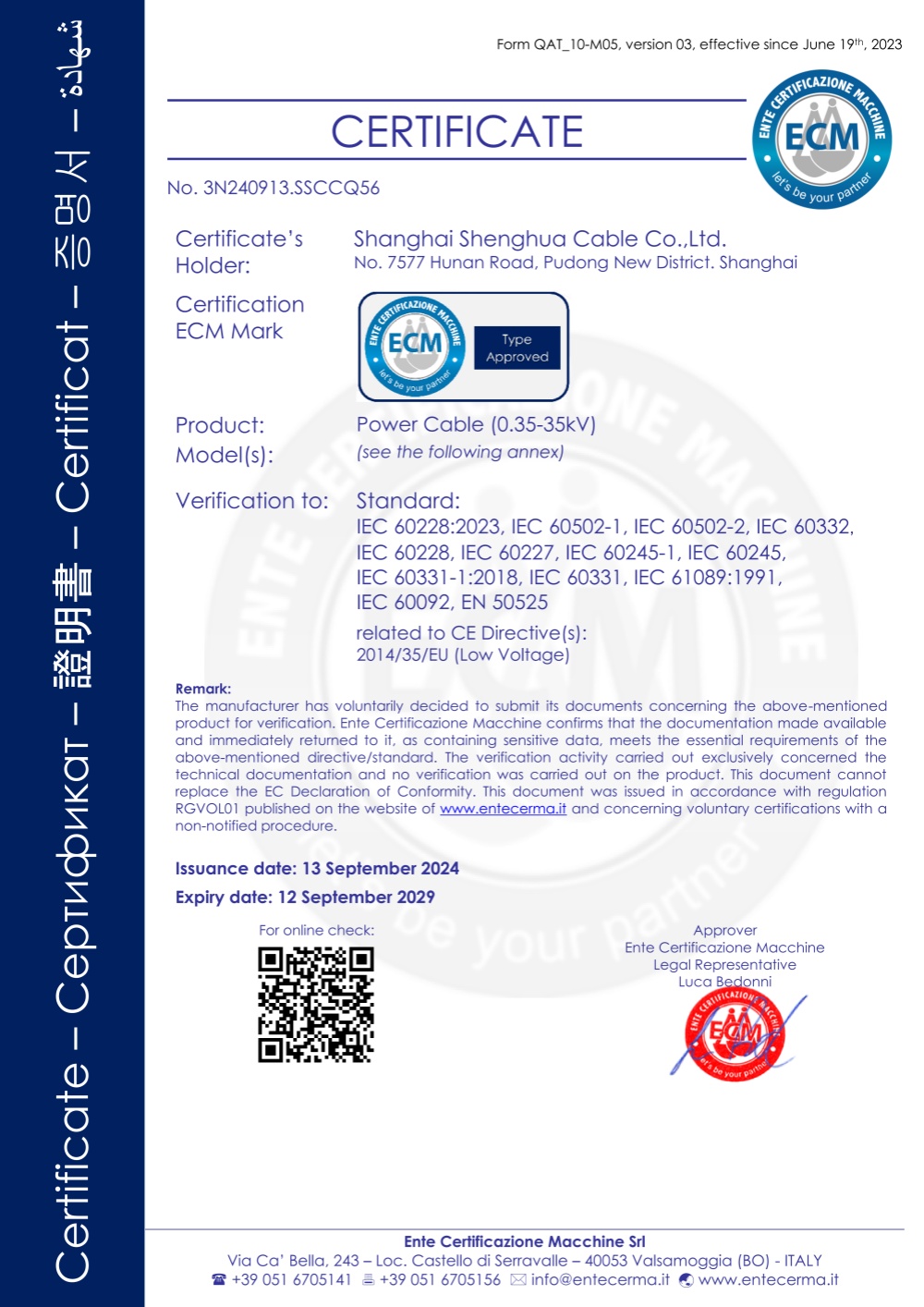
A practical rule for buyers: list every product family in the framework, then confirm that at least one certificate in the supplier's pack names that family and the destination market. Where a family is not covered, the buyer should decide whether an alternative standard route (for example, a project-specific type test) is acceptable rather than assuming coverage.
2. Capability — fix the customization envelope in writing
Shenghua Cable offers OEM service and full customization of cable structure, material, dimensions and lengths. The published commercial envelope is:
| Purchasing term | Published value |
|---|---|
| Minimum order quantity | 300 m per item for power cable; 1,000 m per item for wires |
| Lead time | Normally within 18 working days, depending on quantity and cable structure |
| Monthly capacity | 15,000,000 m, depending on the cable structure |
| Customization | Fully customizable — structure, material, dimensions, lengths; OEM service available |
| Quality control | 100% test |
| Warranty | 2 years since delivery, with after-sales and technical support |
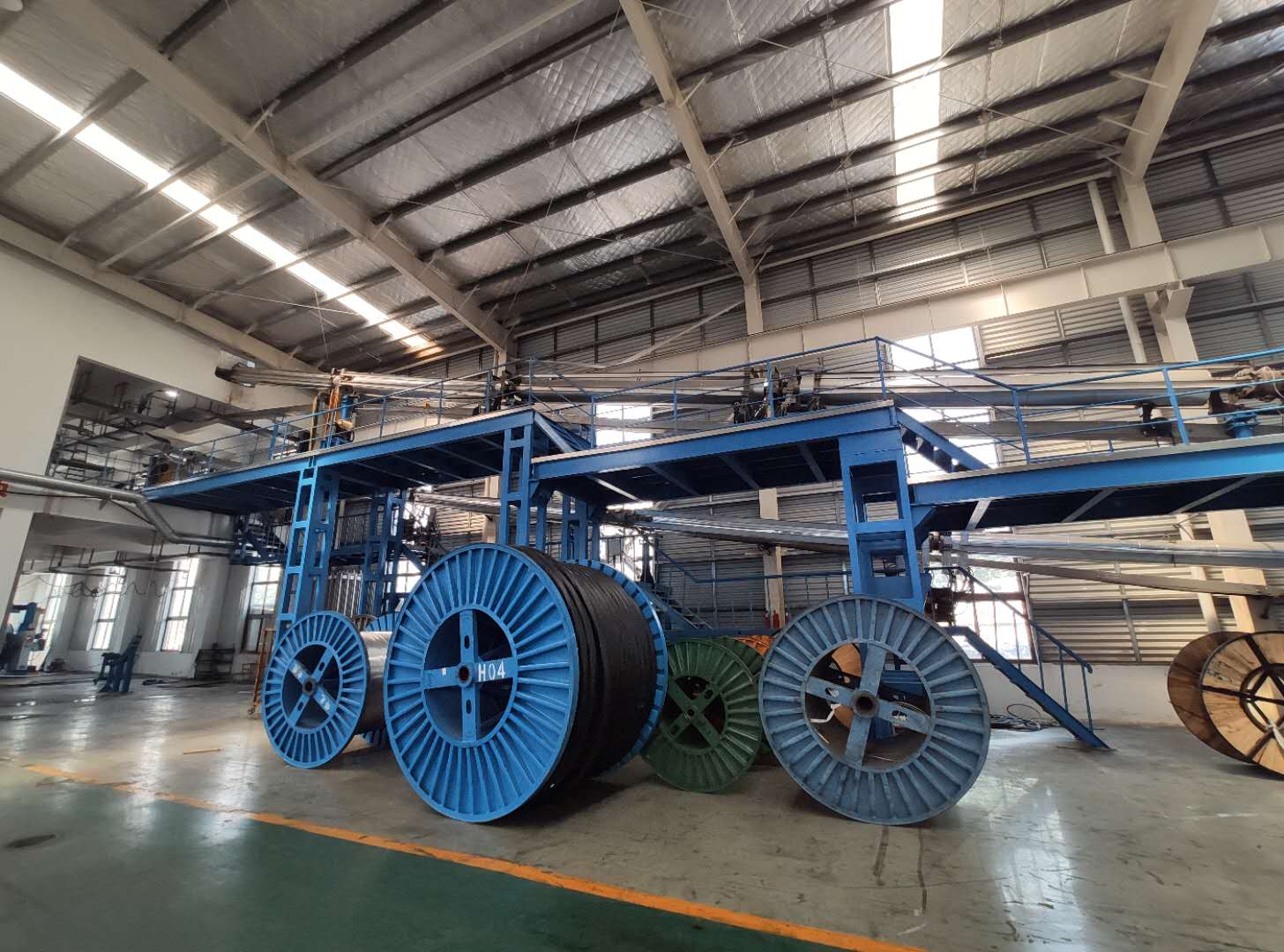
What matters for a framework agreement is that the same envelope applies to customized and standard work. A supplier that customizes structure but cannot repeat the same build in month twelve creates a specification problem, not a service problem. The published portfolio of more than 80 cable series, spread across 7 manufacturing bases and 21 cable factories and supported by a 600-engineer R&D team, is the capacity evidence a buyer can attach to the contract.
3. Acceptance criteria — define the test, the standard, the document
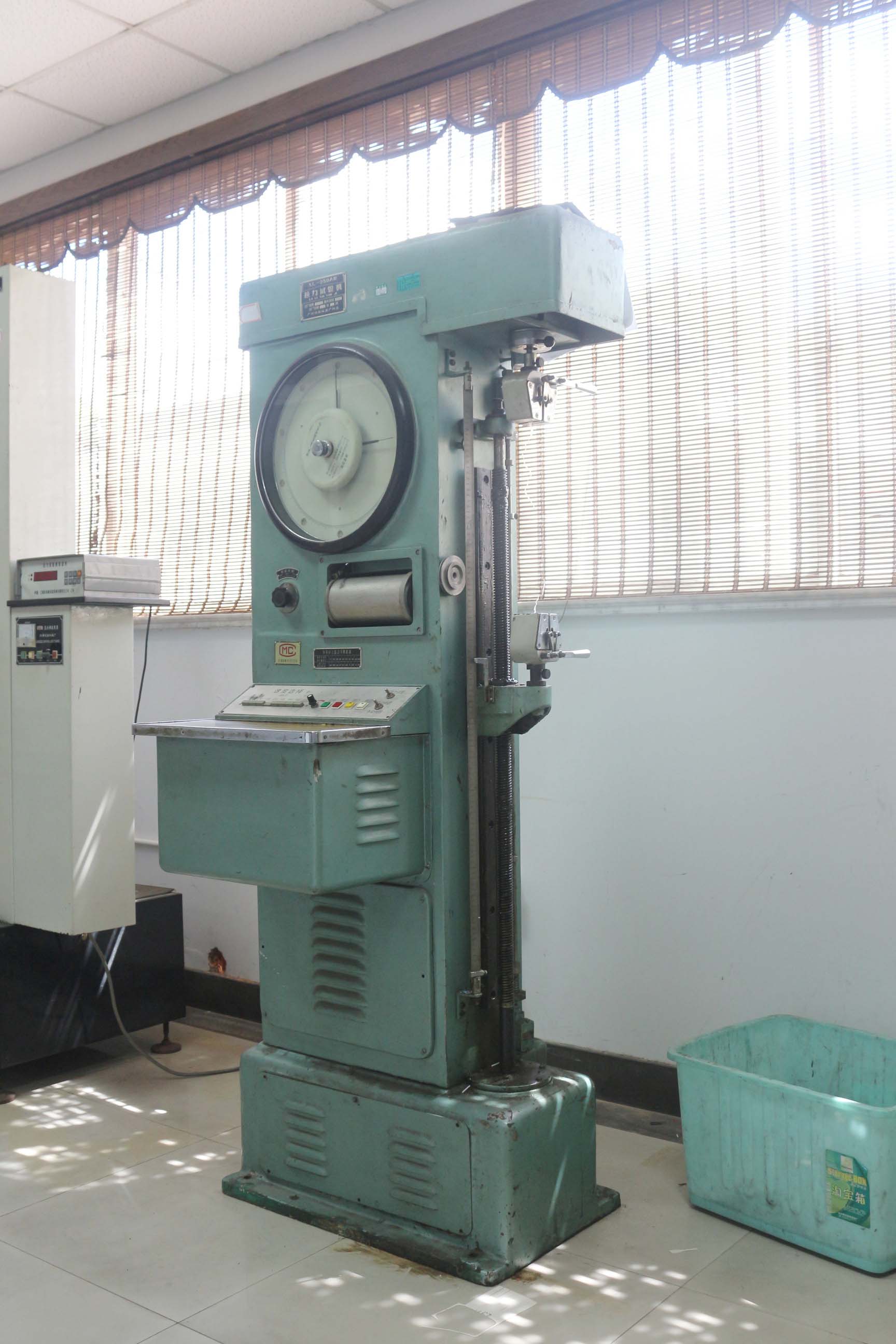
Acceptance criteria should name three things: the reference standard, the test coverage and the documentation set. Shenghua's published quality control position is 100% test, supported by a laboratory accredited to ISO/IEC 17025:2017 under CNAS L6565. Because the CE scope references IEC 60502-1 for low-voltage power cable and IEC 60502-2 for extruded insulation in the 6–30 kV range, those two standards are the natural acceptance anchors for a power cable order. Solar cable orders should anchor on IEC 62930:2017, the standard named in the TUV certificate. Control and instrumentation cable, building wire and rubber-sheathed constructions are covered under the same CE scope and should inherit the standard references named there.
4. Continuity — plan the reorder rhythm, not only the first order
A 24/7 duty cycle means the second order matters more than the first. Shenghua Cable's published export data shows 30% of sales going to export markets across Asia, Europe, South America, Africa and Oceania, with an export distribution of roughly 50% Asia, 18% Central Asia, 15% Europe, 8% Australia, 5% South America and 4% Africa. Annual production capacity is published at 16 billion RMB, supported by approximately 10,000 staff.
For buyers, the practical implication is that reorder planning should be built around the capacity figure and the 18-working-day lead time rather than around a negotiated delivery date. Where a project operates continuously, the framework should also schedule periodic certificate review, because certificates expire on different dates: CNAS in 2028, ISO and the EAEU declaration in 2029, CE in 2029, and KEMA in 2050.
Step-by-Step Breakdown: Building the Partnership in Seven Steps
- Define the operating environment and duty cycle. Record whether the circuit runs continuously. All published Shenghua application records across utilities, industry, infrastructure, renewables, shipbuilding, mining and construction list a 24/7 operation mode, so assume continuous duty unless the project states otherwise.
- Fix the specification by family and model. Write the family first (power cable, marine cable, mineral insulated cable, mining cable, rubber sheathed cable, solar cable, overhead conductor, control and instrumentation cable, building wire), then the model designation.
- Verify certification scope against the destination market. Match CE for the EU/EEA, the EAEU declaration for Russia and the Eurasian Economic Union, KEMA for projects specifying IEC 60502-1, and TUV for photovoltaic circuits.
- Agree acceptance criteria and documentation. Name the standard, agree the 100% test position, and confirm the laboratory accreditation behind it (CNAS L6565, ISO/IEC 17025:2017).
- Lock the commercial envelope. MOQ, lead time, monthly capacity, warranty and technical support should all appear in the agreement as figures, not descriptions.
- Run sample or first-article validation. Validate against the agreed standard and test regime. Because cable is made to length, first-article validation normally runs at the MOQ levels of 300 m per item for power cable and 1,000 m per item for wires.
- Set the reorder and continuity plan. Convert forecast annual volume against the 15,000,000 m monthly capacity, standardize the model list across sites, and diarize certificate expiry dates.
Use Cases: Which Electric Cable Family Fits Which Project
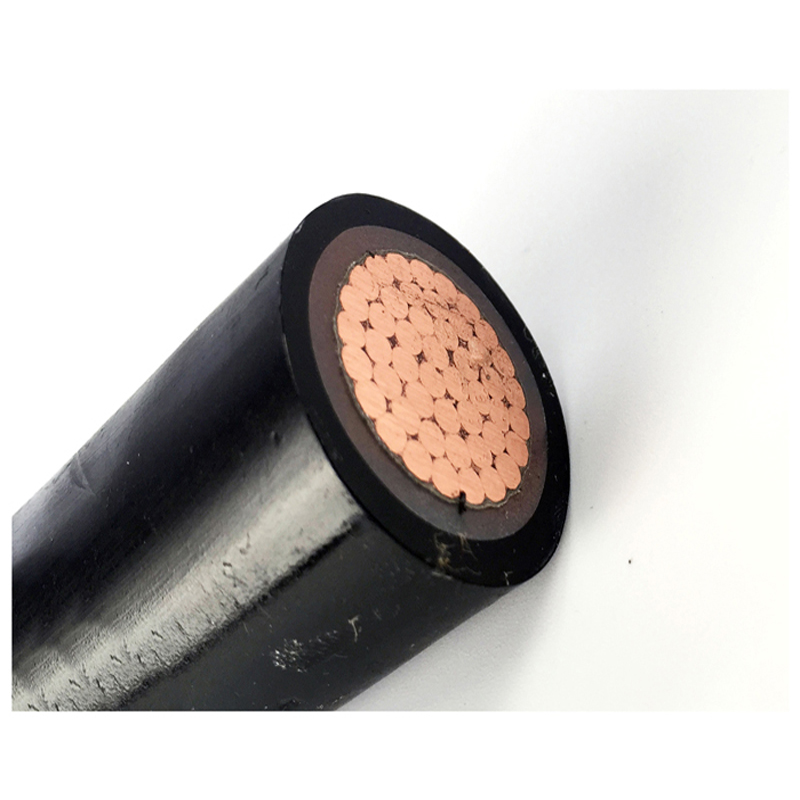
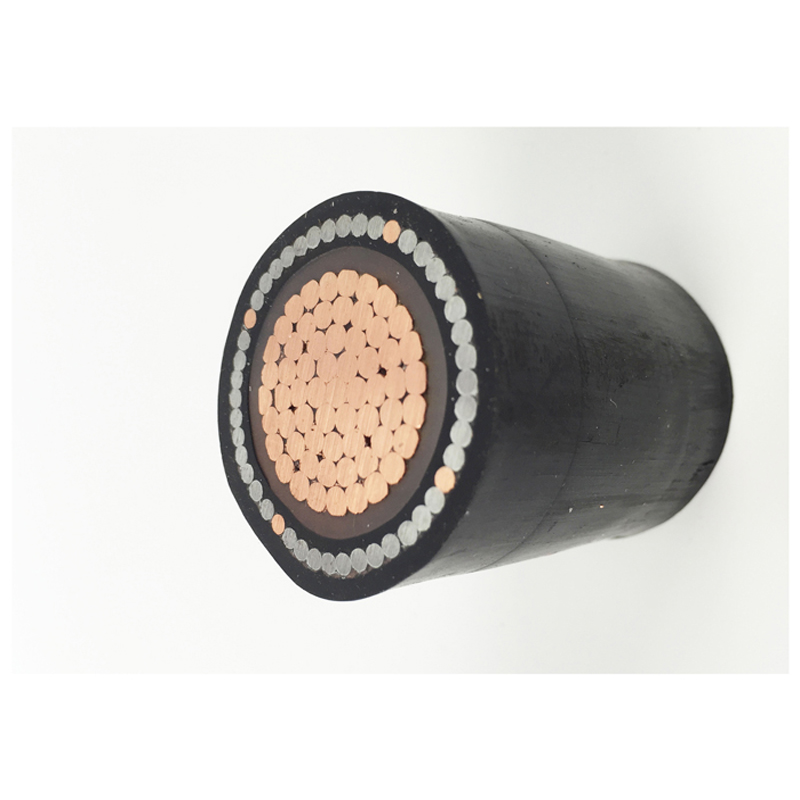
Power utilities and grid infrastructure. Power cable covers LV, MV, HV and EHV classes with a documented voltage scope from 0.6/1 kV to 290/500 kV, in XLPE or PVC insulated, armoured and unarmoured constructions. Overhead conductors (AAC, ACSR, ABC, AAAC) serve overhead power lines and utility transmission networks from LV to MV, with some types above 66 kV.
Heavy industry and process control. Control and instrumentation cable (KVV/KVVP/KVVRP and DJYPVP/DJYVP/WDZ-DJYJPYP) is documented for industrial automation, process control and instrumentation systems at 300/500 V to 450/750 V, in shielded and unshielded versions with solid, stranded or flexible conductors.
Infrastructure and buildings. Building wire covers 300/500 V to 450/750 V with copper or aluminium conductors in PVC or XLPE insulation and models including BV, BLV, BVV, RVV, BVVB and BYJ. Where circuit integrity during a fire is the design requirement, mineral insulated cable (BTTZ/BTTRZ, BTLY) is documented for fire-resistant wiring, high-temperature industrial equipment and critical power systems.
Renewable energy. Solar cable, designated PV1-F, is rated from 600 V to 1500 V DC (commonly 1 kV or 1.5 kV DC) and is TUV certified to IEC 62930:2017 for photovoltaic system use.
Shipbuilding and offshore. Marine cable with models MFVP, MYP and MCPT operates from LV to MV at 0.6/1 kV and 3.6/6 kV depending on shipboard systems, and is documented for commercial vessels, passenger ships, offshore platforms, naval vessels and specialised vessels including dredgers and icebreakers — installations in confined ship compartments.
Mining. Mining cable (MFVP, MYP, MCPT) covers LV 0.6/1 kV and MV 3.6/6 kV, sometimes 6/10 kV, in trailing/portable, control and signal, and fixed installation versions for underground and surface mining equipment.
Construction and temporary power. Rubber sheathed cable (YC/YCW, YZ/YZW) at 300/500 V and 450/750 V is documented for general wiring, portable equipment and industrial or construction applications, including construction sites, port terminals and mobile equipment.
Comparison Tables
Table A — Electric cable families, models and documented applications
| Product family | Documented models | Documented voltage scope | Documented application |
|---|---|---|---|
| Power Cable | YJV, YJV22(62), YJV32(72), YJY, YJY23(63), YJLV, N-YJV, WDZ(A\BNC)-YJY and variants | 0.6/1 kV – 290/500 kV | Power transmission, distribution networks, industrial power systems |
| Marine Cables | MFVP, MYP, MCPT | 0.6/1 kV, 3.6/6 kV (shipboard dependent) | Shipboard systems in confined compartments, offshore platforms |
| Mineral Insulated Cable | BTTZ/BTTRZ, BTLY | 300/500 V, 450/750 V, 0.6/1 kV; higher for special applications | Fire-resistant wiring, high-temperature equipment, critical power systems |
| Mining Cables | MFVP, MYP, MCPT | LV 0.6/1 kV; MV 3.6/6 kV, sometimes 6/10 kV | Underground and surface mining equipment |
| Rubber Sheathed Cable | YC/YCW, YZ/YZW | 300/500 V, 450/750 V | General wiring, portable equipment, industrial and construction use |
| Solar Cables | PV1-F | 600 V – 1500 V DC (commonly 1 kV or 1.5 kV DC) | Photovoltaic systems and renewable energy installations |
| Overhead Conductors | AAC, ACSR, ABC, AAAC | Usually LV to MV (0.6/1 kV to 35 kV); some types above 66 kV | Overhead power lines and utility transmission networks |
| Control & Instrumentation Cables | KVV/KVVP/KVVRP; DJYPVP/DJYVP/WDZ-DJYJPYP | 300/500 V – 450/750 V | Industrial automation, process control, instrumentation systems |
| Building Wires | BV, BLV, BVV, RVV, BVVB, BYJ | 300/500 V – 450/750 V | Residential, commercial and public building installations |
Table B — Certification reference for framework agreements
| Certificate | Number | Standard(s) | Market | Validity |
|---|---|---|---|---|
| CE | 3N240913.SSCCQ56 | IEC 60228:2023, IEC 60502-1, IEC 60502-2, EN 50525 and others | EU / EEA | 2024-09-13 to 2029-09-12 |
| KEMA | 2129307.03 / .01 / .02 | IEC 60502-1:2004 +A1:2009; IEC 60227-3:1993 +A1:1997 | EU, Middle East, South East Asia | 2010-06-23 to 2050-06-22 |
| TUV | R 50609864 0001 | IEC 62930:2017 | Global / EU | Issued 2023-12-07 |
| ISO 9001 / 14001 / 45001 | 02026Q00424R201; 02026E00261R201; 02026S00248R201 | ISO 9001:2015; ISO 14001:2015; ISO 45001:2018 | Globally recognised (IAF MLA) | To 2029-03-23 |
| CNAS (laboratory) | CNAS L6565 | ISO/IEC 17025:2017 | Globally recognised | To 2028-11-27 |
| EAEU declaration | N РОСС RU Д-CN.РА01.В.39494/24 | GOST 18690-2012 (power cables up to 35 kV) | Russia / EAEU | 2024-09-30 to 2029-09-29 |
FAQ: Purchasing Terms, Acceptance Criteria and Long-Term Supply
Which electric cable certifications should be verified before a long-term agreement is signed?
Verify certificates against two things at once: the product family and the destination market. Shenghua Cable's CE certificate (number 3N240913.SSCCQ56, issued by ECM — Ente Certificazione Macchine Srl, valid from 13 September 2024 to 12 September 2029) covers Power Cable (LV/MV), LSZH Cables, House Wiring Cable, Control & Instrumentation Cables, Rubber & Mining/Industrial Cables and Solar Cable, against standards including IEC 60228:2023, IEC 60502-1, IEC 60502-2 and EN 50525, for the EU and EEA. KEMA certification (numbers 2129307.03, 2129307.01, 2129307.02) from KEMA Quality B.V. covers power cables to IEC 60502-1:2004 +A1:2009 and IEC 60227-3:1993 +A1:1997, valid to 22 June 2050. Photovoltaic cable is covered by TUV certificate R 50609864 0001 from TÜV Rheinland LGA Products GmbH against IEC 62930:2017. Management systems are certified to ISO 9001:2015, ISO 14001:2015 and ISO 45001:2018 by ZDHY (valid to 23 March 2029), and the laboratory holds CNAS L6565 under ISO/IEC 17025:2017. For Russia and the EAEU, the declaration of conformity N РОСС RU Д-CN.РА01.В.39494/24 issued by MOSTEKHNORUS LLC covers power cables up to 35 kV to GOST 18690-2012, valid to 29 September 2029.
Can cable structure be customized without breaking repeat supply?
Yes, provided the supplier runs custom and standard work through the same production system. Shenghua Cable offers OEM service and full customization of cable structure, material, dimensions and lengths, and publishes a monthly capacity of 15,000,000 m depending on cable structure. The portfolio spans more than 80 cable series across power cables, building wires, control & instrumentation cables, overhead conductors, solar cables, rubber sheathed cable, mining cables, mineral insulated cable and marine cables, supported by a 600-engineer R&D team and a manufacturing footprint of 7 bases and 21 cable factories. Quality control is published as 100% test. For a framework agreement, the customization envelope and the capacity figure should both be written into the contract so that a custom build can be repeated in later order cycles.
What actually drives the budget of a long-term electric cable order?
The published product data categorizes every family by four variables — conductor type, insulation and sheath material, armouring, and rated voltage — and those four variables, not the brand on the drum, are what move the commercial result. Conductor material (copper or aluminium) and core construction change the raw material base; insulation and sheath selection between XLPE and PVC changes both performance and cost; armoured versus unarmoured construction (steel wire or steel tape) adds material and process steps; and rated voltage class, from 0.6/1 kV up to 290/500 kV for power cable, changes the insulation regime. Fire-resistant and low-smoke zero-halogen constructions sit at a different point in the range again. Two commercial variables complete the picture: MOQ, published at 300 m per item for power cable and 1,000 m per item for wires, and the reorder rhythm, because the 15,000,000 m monthly capacity is structure-dependent. Standardizing the model list across sites is usually the single most effective way to stabilize budget, and no unit price should be quoted until the four variables are fixed in writing.
How do sample and first-article validation work, and what is the minimum order?
Validation starts with the test regime rather than the sample size. Shenghua Cable publishes a quality control position of 100% test, backed by a laboratory accredited to ISO/IEC 17025:2017 under CNAS L6565, so a first article can be accepted against the same standard that will govern volume production. Minimum order quantities are 300 m per item for power cable and 1,000 m per item for wires, which means first-article validation normally runs at MOQ level because cable is manufactured to length and not stocked in arbitrary cut sizes. The acceptance record should state the reference standard, for example IEC 60502-1 for low-voltage power cable, IEC 60502-2 for extruded insulation from 6 kV to 30 kV, or IEC 62930:2017 for photovoltaic cable.
What lead time and supply continuity commitments should a long-term partner provide?
Shenghua Cable's published lead time is normally within 18 working days, depending on quantity and cable structure. Continuity rests on three published figures: a monthly capacity of 15,000,000 m depending on cable structure, 7 manufacturing bases and 21 cable factories across China, and an annual production capacity of 16 billion RMB supported by approximately 10,000 staff. Export business accounts for 30% of sales, with markets in Asia, Europe, South America, Africa and Oceania, and an export distribution of roughly 50% Asia, 18% Central Asia, 15% Europe, 8% Australia, 5% South America and 4% Africa. Service terms include a warranty of 2 years since delivery, after-sales support and technical support. Buyers preparing a framework agreement can request a sample programme or a quotation against a fixed specification directly through the company's contact channel: email zhaomeilia@shenghuacablegroup.com or WhatsApp +86 15901866124.
Conclusion: Turning an Electric Cable Quote Into a Supply Relationship
An electric cable partnership becomes predictable when three documents exist alongside the price list: a certificate matrix that names every product family in the framework and the market it serves, an acceptance criteria sheet that names the standard and confirms the 100% test position, and a commercial annex that states MOQ, lead time, monthly capacity and warranty in figures. Everything else — model selection, family mapping, 24/7 duty-cycle planning — follows from those three.
Shanghai Shenghua Cable (Group) Co., Ltd. has operated in the cable industry since 1997, and its published data covers more than 80 cable series across nine core families, six certification families and applications ranging from utility grids and heavy industry to renewable energy plants, shipbuilding, mining and construction. Buyers can verify those facts against the certificates and product parameters listed above before committing to a long-term supply plan.
Next Step: Sample, Quote or Technical Review
For buyers moving from evaluation to a framework agreement, Shenghua Cable can provide a product brochure, a sample programme, or a quotation against a fixed technical specification covering structure, material, dimensions and length.
- Download the product brochure: Shenghua Cable brochure (PDF)
- Company website: www.shenghuacablegroup.com
- Contact: Meilian Zhao — email zhaomeilia@shenghuacablegroup.com; Tel / WhatsApp +86 15901866124
- Address: No.7577 Hunan RD., Pudong New District Shanghai 201314, China

Have Questions or Need More Details?
Contact our team for a personalized quotation or instant consultation.
Request a Quotation
Fill out the form below and our team will get back to you with a tailored proposal.
WhatsApp Direct Chat
Prefer to chat in real-time? Message us on WhatsApp for instant assistance & quick answers.
- Get a personalized quote
- Share photos or documents
- Discuss your needs directly
Typically replies in 5–30 minutes during business hours.