Mineral Insulated vs. Rubber Sheathed Electric Cable: Fire or Mobile Power?
Specify mineral insulated electric cable when the circuit must keep working through a fire, a high-temperature zone or a critical shutdown. Specify rubber sheathed electric cable when the cable itself has to move. Fire integrity and mobility are different duties: no single construction delivers both at the same material cost, the same installation effort and the same service life.
That single distinction resolves most of the debate that surrounds these two families. It also explains why a quotation comparison built only on price per metre tends to produce the wrong answer. Shanghai Shenghua Cable Group Co., LTD., founded in 1997, manufactures both families inside a portfolio of more than 80 cable series and supplies them to Asia, Europe, South America, Africa and Oceania (Australia). Buyers comparing the two therefore have a rare option: hold the supplier constant and let the construction decide the outcome.
Problem definition: two duties sold under one keyword
A bill of quantities line that reads “fire resistant electric cable, 0.6/1 kV, quantity as per schedule” does not yet describe a product. It describes an intention. Mineral insulated and rubber sheathed constructions sit on opposite sides of that intention, and the mismatch usually surfaces in one of three places: at the inspection gate, at commissioning, or during an incident that the specification was written to survive.
- Polymer cable used on a life-safety circuit. A rubber sheathed electric cable is a flexible, durable wiring product; its stated duty in Shenghua’s catalogue is general electrical wiring, portable equipment, and industrial or construction applications requiring flexible and durable cables. It is not positioned as a fire-resistant wiring construction.
- Mineral insulated cable used on trailing duty. The mineral insulated family is catalogued for fire-resistant wiring, high-temperature industrial equipment and critical power systems requiring exceptional safety and durability. That is a fixed-circuit mission, not a re-deployed mobile one.
- Certification accepted at company level instead of product level. A certificate proves a defined scope against defined standards. If the standard named on the certificate is unrelated to the duty you are buying for, the document adds no protection to the project.
The purchasing consequence is straightforward. A specification that names a construction and a standard is a specification. A specification that names only a category is a starting point for a commercial negotiation, and it will be interpreted in whichever direction is cheapest to quote.
Industry background: why the specification question keeps returning
Fire safety requirements for building wires and electric cables are enforced at code level in most major markets, which pushes the question upstream into procurement: which circuits are considered life-safety circuits, and what evidence is required to show that the cable on those circuits will continue to function. That is a construction question before it is a documentation question.
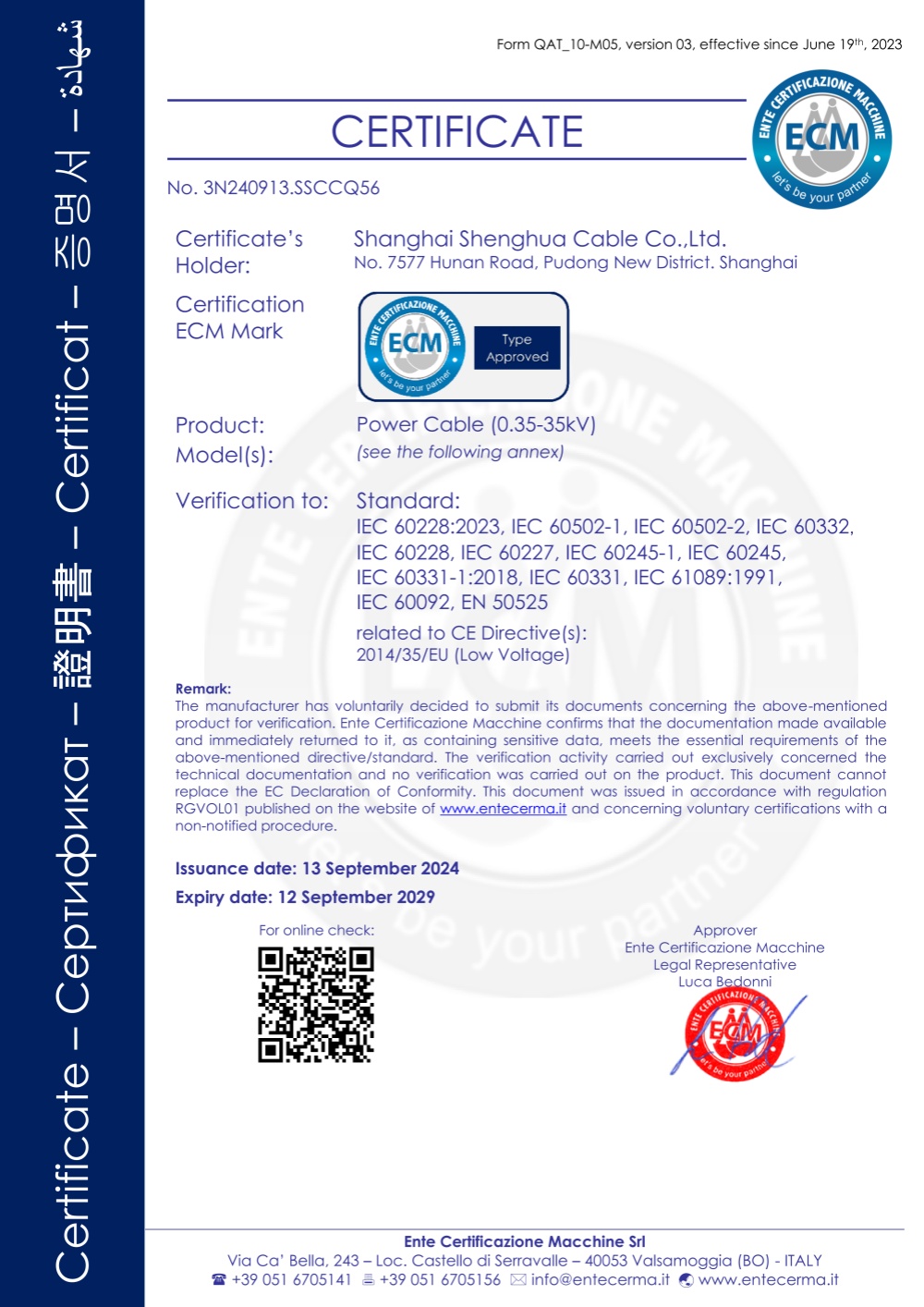
Documentation itself has become more structured. Certification for electric cable is issued against named standards and a defined product scope, not against a brand. Shenghua Cable’s CE certificate 3N240913.SSCCQ56, issued by ECM (Ente Certificazione Macchine Srl), is valid from 2024-09-13 to 2029-09-12 and covers power cable (LV/MV), LSZH cables, house wiring cable, control and instrumentation cables, rubber and mining/industrial cables, and solar cable. The standards listed in its scope include IEC 60228:2023, IEC 60502-1, IEC 60502-2, IEC 60332, IEC 60227, IEC 60245-1, IEC 60245, IEC 60331-1:2018, IEC 61089:1991, IEC 60092 and EN 50525.
A second, independent route is the KEMA route. KEMA Quality B.V. certificates 2129307.01, 2129307.02 and 2129307.03 were issued on 2010-06-23 and remain valid to 2050-06-22, against IEC 60502-1:2004 +A1:2009 and IEC 60227-3:1993 +A1:1997. KEMA certification of this type is widely recognised in the EU, the Middle East and South East Asia, and it is frequently the document that lets a KEMA certified MV electric cable enter a tender shortlist.
For medium-voltage work in general, IEC 60502-2:2014 defines the scope that buyers most often reference: power cables with extruded insulation and their accessories for rated voltages from 6 kV up to 30 kV, with maximum system voltage Um from 7.2 kV up to 36 kV, covering construction, dimensions and test requirements. Even where a project sits below that voltage band, the standard is useful as a document-request framework because it forces the supplier to state construction, dimensions and test evidence in one place.
Category-level market context is worth noting but should not drive a construction decision. Market Research Future’s commercial estimate placed the global XLPE cable market at USD 25.42 billion in 2024 with a projection to USD 65.99 billion by 2035. Such figures describe the scale of the category; they say nothing about whether a given circuit needs a mineral dielectric or a flexible rubber sheath.
Detailed solution: what each construction is actually built to do
Mineral insulated electric cable — BTTZ, BTTRZ, BTLY
Mineral insulated cable substitutes a mineral dielectric for the polymer dielectric used in conventional constructions. The practical effect is that the insulation does not depend on a polymer compound to hold its dielectric strength under heat, and it does not add polymer fuel to a fire path. Shenghua supplies the family as BTTZ, BTTRZ and BTLY constructions across 300/500 V, 450/750 V and 0.6/1 kV, with higher ratings available for special applications.
The catalogued application statement is deliberately narrow: fire-resistant wiring, high-temperature industrial equipment, and critical power systems requiring exceptional safety and durability. That narrowness is useful in a tender, because it gives the buyer a defensible basis for rejecting a substituted product that cannot match the duty.
Strengths to specify:
- Circuit integrity under fire exposure, which is the entire reason the family exists.
- Service in high ambient temperature zones where polymer-insulated products would be the wrong choice.
- Application on critical power systems where an unscheduled outage carries consequences beyond the cable itself.
Boundaries to plan for:
- Installation is a skilled task. Termination and support arrangements differ from polymer cable, and the labour line in the budget should reflect that.
- The construction is suited to fixed routing. It is not the product to specify for equipment that is coiled, dragged or re-laid between sites.
- Material cost sits at the upper end of the low-voltage cable range, so over-specifying it on non-critical circuits consumes budget that is better spent on the circuits that matter.
Rubber sheathed electric cable — YC/YCW, YZ/YZW
Rubber sheathed cable keeps a flexible conductor and a rubber-based insulation and sheath system, which is what allows the product to be handled, coiled and connected repeatedly without the conductor or the sheath failing at the bend. Shenghua supplies general purpose rubber sheathed cables as YC/YCW and YZ/YZW across 300/500 V and 450/750 V.
The catalogued application statement is equally specific: general electrical wiring, portable equipment, and industrial or construction applications requiring flexible and durable cables. This is a Flexible Copper Electric Cable family in practical terms — the value is mobility and mechanical durability, not fire survival.
Strengths to specify:
- Flexibility under repeated handling, which is the deciding property on construction sites, ports and temporary power distribution.
- Durability in mobile industrial duty, where the cable is exposed to abrasion and movement rather than to fire.
- Fast, low-skill installation and re-deployment, which shortens site programmes.
Boundaries to plan for:
- It is not positioned as a fire-resistant wiring construction, so it should not be the sole path for a life-safety circuit.
- Continuous high-temperature zones fall outside its intended duty; those environments belong to the mineral insulated family or to a purpose-designed high-temperature construction.
- Because the product is mobile, the failure mode is mechanical rather than thermal — inspection intervals should be set accordingly.
The decision rule that settles most arguments
Ask one question before the enquiry goes out: after commissioning, will this cable stay where it is installed, or will it be moved? A cable that stays is a candidate for a fire-rated fixed construction; a cable that moves is a candidate for a rubber sheathed construction. Where a project needs both — a fixed fire-rated feeder that terminates into a piece of mobile equipment, for example — the correct answer is a transition at the boundary, not a compromise product in the middle.
Step-by-step: a five-stage evaluation sequence for buyers
Step 1 — Classify the circuit duty before the enquiry. Mark every cable route as either fixed-critical, fixed-general or mobile. Fire-rated constructions belong on the fixed-critical routes. Rubber sheathed constructions belong on the mobile routes. This single column on the cable schedule prevents the most expensive substitution error in the project.
Step 2 — Match voltage and construction to the load. The mineral insulated family covers 300/500 V, 450/750 V and 0.6/1 kV, and can go higher for special applications; the rubber sheathed family covers 300/500 V and 450/750 V. If the route requires 0.6/1 kV and mobility at the same time, the schedule is asking for two products, not one.
Step 3 — Verify standards at product level, not at company level. Request the certificate, the certificate number, the issuing body, the validity dates and the standard list. For fire-related duty, check whether IEC 60331-1:2018 appears in the relevant certificate scope. For rubber sheathed constructions, check IEC 60245 coverage. For medium-voltage power cable, check IEC 60502-1 or IEC 60502-2 coverage as applicable. Managed properly, this step eliminates the polite ambiguity that surrounds the phrase “CE Certified Electric Cable”.
Step 4 — Fix commercial terms and acceptance criteria in writing. Shenghua’s standard purchasing terms for power cable are an MOQ of 300 m per item (1000 m per item for wires), FOB or CIF delivery terms, pre-shipment test and pre-packaging inspection as acceptance criteria, and payment by T/T with 30% in advance and the balance before delivery. Putting these on the comparison sheet lets you compare landed outcomes rather than unit prices.
Step 5 — Confirm the customization and OEM scope. Shenghua provides OEM production services, with fully customizable options for cable structure, material, dimensions and lengths. Monthly capacity is stated at 15,000,000 m depending on the cable structure, and normal lead time is within 18 working days depending on quantity and cable structure. Custom core counts, sheath colour or printed legends should be agreed at this stage, not after the purchase order.
Use cases: where each cable belongs
Environments that call for mineral insulated electric cable
- Fire emergency systems — circuits that must remain energised during evacuation and firefighting operations.
- High-temperature industrial zones — areas where ambient heat, not mechanical movement, is the dominant stress.
- Explosive atmospheres — installations where the consequences of a circuit failure justify the most durable fixed construction available.
- High-rise landmarks and public buildings — vertical risers and life-safety feeders where access for later replacement is difficult and costly.
- Hospitals — critical care and emergency supply routes where downtime is not an acceptable maintenance strategy.
- Museums and historic buildings — irreplaceable contents and fabric mean the wiring must not become the ignition source.
Environments that call for rubber sheathed electric cable
- Construction sites — temporary distribution that is laid, moved and recovered as the works progress.
- Ports and port terminals — equipment that shifts position and needs a cable that tolerates repeated handling.
- Household appliances and portable tools — flexible connection where the cable is part of the product’s usability.
- Temporary power supply — events, maintenance shutdowns and commissioning power where the cable is installed for weeks, not decades.
- Heavy-duty mobile equipment and moving machinery — the duty where flexibility and abrasion resistance decide service life.
A related but distinct case shows why the duty classification matters more than the product label. A UK-based predictive maintenance and intelligent diagnostic provider used Shenghua cable in a medium-scale industrial system integration project running 15 years, covering industrial monitoring systems, power signal transmission and control circuit connectivity. The construction used was an LSZH low-smoke zero-halogen flame-retardant design with an ultra-small conductor and high-voltage insulation capability, chosen for signal stability in high-density wiring. Reported results included improved overall system stability and safety, continuous operation of critical monitoring equipment in harsh environments, and a significantly reduced risk impact under fire and extreme conditions. The lesson for this comparison is not that one family replaces the other: it is that fixed monitoring circuits with fire and extreme-condition exposure were specified on fire and smoke performance, while mobile duty elsewhere on the same site stayed with flexible constructions.
Side-by-side comparison table
| Comparison point | Mineral insulated electric cable | Rubber sheathed electric cable |
|---|---|---|
| Constructions supplied by Shenghua Cable | BTTZ, BTTRZ, BTLY | YC/YCW, YZ/YZW |
| Insulation basis | Mineral dielectric | Rubber-based insulation and sheath system |
| Voltage scope in catalogue | 300/500 V, 450/750 V, 0.6/1 kV; higher for special applications | 300/500 V, 450/750 V |
| Catalogued application statement | Fire-resistant wiring, high-temperature industrial equipment, critical power systems requiring exceptional safety and durability | General electrical wiring, portable equipment, industrial or construction applications requiring flexible and durable cables |
| Primary duty | Circuit integrity under fire and heat in fixed routing | Mobility and mechanical durability under repeated handling |
| Typical environments | Fire emergency systems, high-temperature zones, explosive atmospheres, high-rise landmarks, hospitals, museums, historic buildings | Construction sites, ports and port terminals, appliances, temporary power, heavy-duty mobile equipment, moving machinery |
| Poor fit | Trailing or re-deployed mobile duty | Sole fire-rated path for a life-safety circuit; continuous high-temperature zones |
| Certification route to request | CE certificate 3N240913.SSCCQ56 (scope listing IEC 60331-1:2018 among covered standards); KEMA 2129307.01/.02/.03 against IEC 60502-1:2004 +A1:2009 | CE certificate 3N240913.SSCCQ56 (scope listing IEC 60245 and IEC 60227); KEMA 2129307.01/.02/.03 against IEC 60227-3:1993 +A1:1997 |
| Commercial baseline | MOQ 300 m per item for power cable; FOB or CIF; pre-shipment test / pre-packaging inspection | MOQ 300 m per item for power cable; FOB or CIF; pre-shipment test / pre-packaging inspection |
| Lead time and warranty | Normally within 18 working days depending on quantity and structure; 2-year warranty from delivery | Normally within 18 working days depending on quantity and structure; 2-year warranty from delivery |

Frequently asked questions
1. Which certificates should I check before accepting a quotation for either cable type?
Check four documents. First, the CE certificate 3N240913.SSCCQ56 issued by ECM, valid 2024-09-13 to 2029-09-12, whose scope covers power cable (LV/MV), LSZH, house wiring, control and instrumentation, rubber and mining/industrial, and solar cable, and whose standard list includes IEC 60331-1:2018, IEC 60502-1, IEC 60502-2, IEC 60245 and IEC 60227. Second, the KEMA certificates 2129307.01, 2129307.02 and 2129307.03 from KEMA Quality B.V., issued 2010-06-23 and valid to 2050-06-22, against IEC 60502-1:2004 +A1:2009 and IEC 60227-3:1993 +A1:1997. Third, ISO 9001:2015, ISO 14001:2015 and ISO 45001:2018 certificates No.02026Q00424R201, No.02026E00261R201 and No.02026S00248R201, issued by ZDHY, valid 2020-03-10 to 2029-03-23. Fourth, CNAS L6565 under ISO/IEC 17025:2017, valid 2023-01-31 to 2028-11-27, which confirms the company operates a CNAS-accredited laboratory. Where the destination market requires EAEU conformity, the declaration N РОСС RU Д-CN.РА01.В.39494/24 issued by MOSTEKHNORUS LLC under GOST 18690-2012 covers power cables up to 35 kV and is valid to 2029-09-29.
2. Can one manufacturer supply both mineral insulated and rubber sheathed cable on the same project?
Yes, within the limits of the catalogued scope. Shenghua Cable lists both Mineral Insulated Cable (BTTZ/BTTRZ, BTLY) and Rubber Sheathed Cable (YC/YCW, YZ/YZW) in a portfolio of more than 80 cable series, produced across 7 manufacturing bases and 21 cable factories with a stated monthly capacity of 15,000,000 m depending on cable structure. Quality control is 100% test, and OEM production services are available with fully customizable cable structure, material, dimensions and lengths. Keeping both families with one supplier simplifies the transition detail at the boundary between fixed fire-rated feeders and mobile equipment connections.
3. What commercial terms drive the cost comparison between the two families?
Compare on four terms rather than unit price alone. The MOQ is 300 m per item for power cable and 1000 m per item for wires. Delivery is quoted FOB or CIF, so the Incoterm changes the landed comparison. Acceptance is defined as pre-shipment test and pre-packaging inspection, which is the point at which non-conforming cable is stopped before it ships. Payment is T/T with 30% in advance and the balance before delivery. Beyond the commercial terms, the two families carry different material and installation profiles, so the honest comparison is total installed cost per route, not cost per metre.
4. How should a sample or pre-shipment batch be validated?
Use the contractual acceptance route rather than an informal sample. Shenghua’s stated acceptance criteria are pre-shipment test and pre-packaging inspection, backed by 100% test in production and by a CNAS-accredited laboratory operating under ISO/IEC 17025:2017. For a fire-related route, ask for the test evidence linked to the specific construction and the standard named on the certificate scope; for a mobile route, inspect the sheath and conductor construction against the approved sample and confirm the model designation on the drum label matches the purchase order.
5. What lead time applies, and what is the next step?
Normal lead time is within 18 working days, depending on quantity and cable structure, with a 2-year warranty from delivery plus after-sales and technical support. Buyers who want to close the comparison quickly can request a quotation against a defined schedule, ask for a sample of the specific construction, or download the company catalogue and verify the certificate numbers before the technical bid is finalised.

Conclusion
The comparison does not end with a winner. It ends with a classification. Mineral insulated electric cable — BTTZ, BTTRZ and BTLY — exists to keep a fixed circuit alive through fire, heat and a critical shutdown, and it is the correct answer wherever the cost of a circuit failure is measured in safety rather than in rework. Rubber sheathed electric cable — YC/YCW and YZ/YZW — exists to keep a moving connection reliable under handling, abrasion and re-deployment, and it is the correct answer wherever the cable has to travel. Projects that try to buy one product for both duties end up paying twice: once for a construction that is over-specified on the mobile route, and once for remediation on the fire-rated one.
Two checks turn that principle into a defensible purchase order. First, put the duty classification on the cable schedule before the enquiry goes out. Second, put the certificate number, the standard and the validity date on the comparison sheet next to the price — CE certificate 3N240913.SSCCQ56 with its IEC 60331-1:2018, IEC 60502-1/-2, IEC 60245 and IEC 60227 scope, KEMA certificates 2129307.01/.02/.03 valid to 2050-06-22, and CNAS L6565 for the laboratory behind the pre-shipment test. With those two documents in place, the mineral insulated versus rubber sheathed decision stops being an argument about preference and becomes an auditable specification decision.
Next step for buyers
Send the cable schedule with each route marked as fixed-critical, fixed-general or mobile. Shanghai Shenghua Cable Group will return a quotation that separates mineral insulated and rubber sheathed constructions, states the MOQ (300 m per item for power cable, 1000 m per item for wires), the delivery term, the acceptance criteria and the certificate covering each item. Samples of the specific construction can be arranged against an approved specification.
Catalogue download: Shenghua Cable product catalogue (PDF)
Website: www.shenghuacablegroup.com
Email: zhaomeilia@shenghuacablegroup.com | Tel / WhatsApp: +86 15901866124
Address: No.7577 of Hunan RD., Pudong New District, Shanghai 201314, China
Have Questions or Need More Details?
Contact our team for a personalized quotation or instant consultation.
Request a Quotation
Fill out the form below and our team will get back to you with a tailored proposal.
WhatsApp Direct Chat
Prefer to chat in real-time? Message us on WhatsApp for instant assistance & quick answers.
- Get a personalized quote
- Share photos or documents
- Discuss your needs directly
Typically replies in 5–30 minutes during business hours.