Top Marine Cables for Offshore Oil Rigs, Cruise Liners & Cargo Ships: Recommendation List
Top Marine Cables for Offshore Oil Rigs, Cruise Liners & Cargo Ships: Recommendation List

Marine cable specification is decided at the compartment level, not the catalogue level. A configuration that works in a cargo ship engine room can be the wrong choice for an enclosed cruise-liner corridor or a continuously moving FPSO deck run. This recommendation list ranks marine cable configurations by application scenario — offshore platforms first, then passenger vessels, then commercial cargo — and keeps the reasoning tied to construction, voltage class, and certification facts that a shipyard, EPC contractor, or offshore operator actually has to verify.
The list below is configuration-led rather than brand-led. Each entry states which part of a marine cable range fits a given vessel type and why, using verifiable product and certification data, so a buyer can use it as a shortlist framework and then confirm conductor, insulation, sheath, and armouring against the project specification.
Why Marine Cable Selection Is a Constraint Problem, Not a Preference Problem
Marine cable is applied across shipbuilding, offshore engineering and naval defence — three environments that share one controlling condition: the cable is installed inside a confined ship compartment and then expected to stay in service around the clock. That single design brief removes most of the flexibility a normal industrial cable buyer has. There is no room to enlarge a tray, no tolerance for a cable that cannot hold a tight bend, and no practical way to replace a run that fails behind a bulkhead.
Four constraints therefore dominate the selection decision before price is ever discussed:
- Installation space. The declared function of this cable category is installation in confined ship compartments. Bend radius, overall diameter, and core count matter more than they do in open industrial routing.
- Duty cycle. These cables operate 24/7. Duty-cycle assumptions used in general industrial projects do not apply.
- Voltage class. The range covers LV to MV — 0.6/1 kV and 3.6/6 kV depending on shipboard systems — so the buyer must fix the voltage class before comparing anything else.
- Certification evidence. A classification society, flag authority or offshore operator will ask for certificates, not verbal assurances. The certificate scope has to cover the cable family actually being purchased.
The practical consequence is that a marine cable shortlist should be built from scenario backwards, not from product name forwards. The three ranked recommendations below follow that logic.
Industry Background: What the Cable Market Looks Like Going Into 2026
The commercial context matters because it explains why so many buyers are now comparing marine and offshore cable supply options at the same time. The global wires and cables market was valued at approximately USD 230.9 billion in 2025 and is projected to reach USD 313.1 billion by 2033, according to Grand View Research and Mordor Intelligence. Within that total, the global medium voltage wire and cable segment alone was valued at USD 71.7 billion in 2025, per Global Market Insights.
Supply is concentrated. Mainland China is the world’s leading exporter of insulated wire and cable (HS 8544), accounting for USD 31.4 billion, or 18.1%, of global exports in 2024, based on World’s Top Exports and UN Comtrade data. That concentration is why a procurement team evaluating a marine cable programme is, in practice, usually evaluating Chinese and international supply in the same shortlist.
Estimates diverge by scope: Grand View Research puts the wires and cables market at approximately USD 230.9 billion for 2025, while Mordor Intelligence estimates USD 245.44 billion for 2026. Buyers should treat these as directional ranges rather than a single figure.
Two standards frameworks sit underneath the marine conversation. IEC 60502-2:2014 specifies requirements for power cables with extruded solid insulation for rated voltages from 6 kV up to 30 kV for fixed installations — directly relevant to MV shipboard distribution. In the European Union, the Construction Products Regulation classifies cables into seven fire protection classes (Aca to Fca) under EN 50575, with Class Eca treated as a basic safety requirement for building materials. Both frameworks shape the documentation a marine buyer will be asked to produce.
The Marine Cable Range Behind These Recommendations
The recommendations that follow are drawn from the marine cable range produced by Shanghai Shenghua Cable Group Co., Ltd., a cable manufacturer founded in 1997 and based in Shanghai, China. The company operates 7 manufacturing bases and 21 cable factories across China, with a manufacturing footprint covering over 3,000 mu (approximately 200 hectares), a workforce of approximately 10,000 staff, and an R&D team of 600 engineers. Its portfolio spans more than 80 cable series, including power cables, control & instrumentation cables, fire resistant cables, low smoke zero halogen cables, armoured electrical cable, rubber sheathed cable and marine cables.
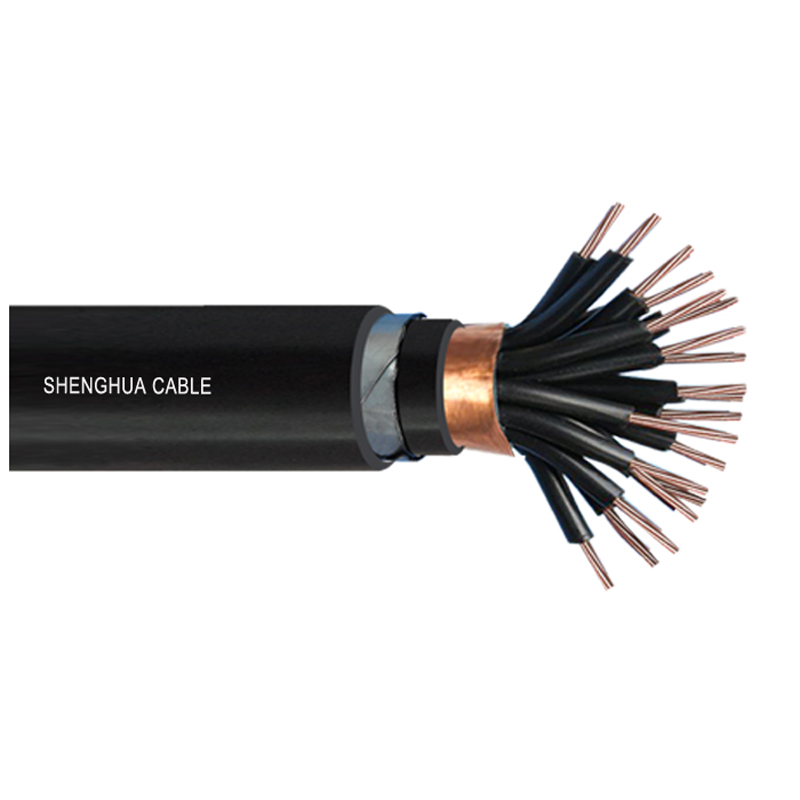
The marine cable range itself is organised around these verified parameters:
| Parameter | Marine cable range data |
|---|---|
| Model designations | MFVP, MYP, MCPT |
| Classification | Categorised by conductor type, insulation / sheath material, and rated voltage |
| Voltage scope | LV to MV: 0.6/1 kV, 3.6/6 kV, depending on shipboard systems |
| Cable families in range | Fixed installation cables; control & signal cables; trailing / portable cables |
| Customisation | OEM service available; fully customisable structure, material, dimensions and lengths |
Supporting families from the wider portfolio are configurable into these applications: XLPE insulated power cable, armoured electrical cable, PVC insulated cables, low smoke zero halogen cable, fire resistant cable, rubber sheathed cable and control cables. Power cables across the wider range span 0.6/1 kV up to 290/500 kV, including armoured and unarmoured types, which matters when a project needs matching MV feeders and LV distribution from a single supplier.
Certification evidence that supports a marine shortlist
For a marine or offshore programme, the supplier’s certificate scope is as important as the certificate itself. The verifiable certification set behind this range is summarised below.
| Certification | Issuing body | Certificate number | Validity | Market | Referenced standards |
|---|---|---|---|---|---|
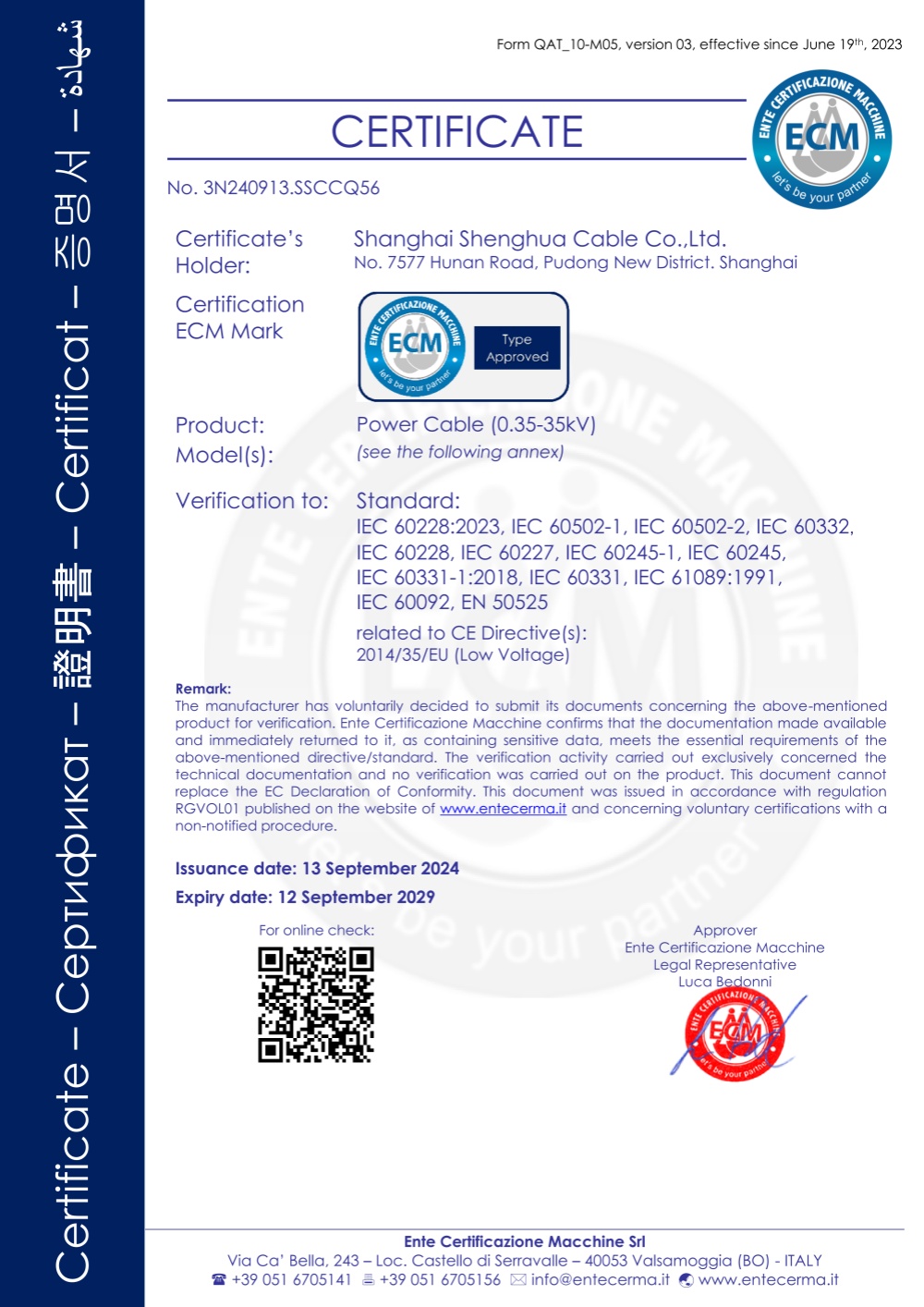
| CE | ECM (Ente Certificazione Macchine Srl) | 3N240913.SSCCQ56 | 2024-09-13 to 2029-09-12 | EU / EEA | IEC 60228:2023, IEC 60502-1, IEC 60502-2, IEC 60332, IEC 60227, IEC 60245, IEC 60331, IEC 61089:1991, IEC 60092, EN 50525 |
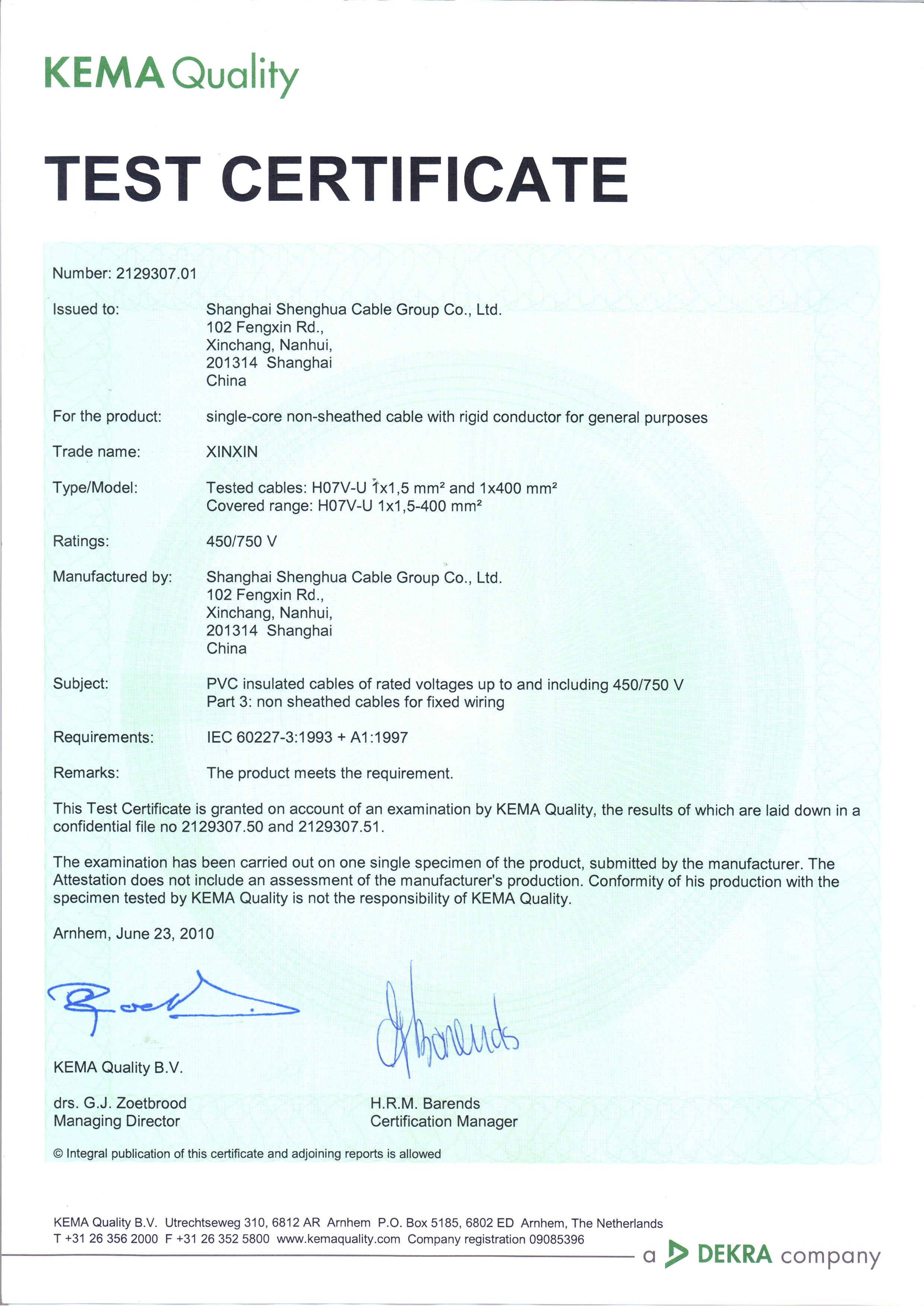
| KEMA | KEMA Quality B.V. | 2129307.03 / 2129307.01 / 2129307.02 | 2010-06-23 to 2050-06-22 | Global (notably EU, Middle East, South East Asia) | IEC 60502-1:2004 +A1:2009; IEC 60227-3:1993 +A1:1997 |
| TUV | TÜV Rheinland LGA Products GmbH | R 50609864 0001 | Not stated | Global / EU | IEC 62930:2017 (electric cables for photovoltaic systems) |
| CNAS laboratory accreditation | CNAS | CNAS L6565 | 2023-01-31 to 2028-11-27 | Globally recognised | ISO/IEC 17025:2017 |
| ISO management systems | ZDHY | 02026Q00424R201 / 02026E00261R201 / 02026S00248R201 | 2020-03-10 to 2029-03-23 | Globally recognised (IAF MLA) | ISO 9001:2015, ISO 14001:2015, ISO 45001:2018 |
| EAEU declaration of conformity | MOSTEKHNORUS LLC | N РОСС RU Д-CN.РА01.В.39494/24 | 2024-09-30 to 2029-09-29 | Russia / EAEU | GOST 18690-2012 (power cables up to 35 kV) |
The CE scope is the entry most often checked for marine work because it covers power cable (LV/MV), LSZH cable, house wiring cable, control & instrumentation cable, rubber & mining/industrial cable and solar cable — and because IEC 60092, the shipboard electrical installation family, appears directly among the referenced standards.
Recommendation #1 — Offshore Oil Rigs, Jack-Up Rigs, Semi-Submersibles and FPSOs
Offshore platforms rank first because they combine every constraint at once: 24/7 operation, confined compartment installation, continuous exposure, and the heaviest documentation load. Jack-up rigs, semi-submersibles and FPSO vessels all fall inside the declared scope of this marine cable range, and all three are electrically intensive assets where a cable failure has both a safety and a production cost.
Configuration focus for this scenario:
- Armoured electrical cable for mechanically exposed runs, where the armour is the primary defence against abrasion and handling damage during installation in tight compartments.
- MV power cable at 3.6/6 kV for platform distribution circuits, plus LV 0.6/1 kV cable for downstream distribution. Both voltage classes sit inside the declared marine range.
- Control & instrumentation cable for monitoring, alarm and shutdown circuits, where signal integrity matters more than current-carrying capacity.
- Fire resistant cable for circuits that must remain functional during a fire event, consistent with the IEC 60331 and IEC 60332 references already inside the CE scope.
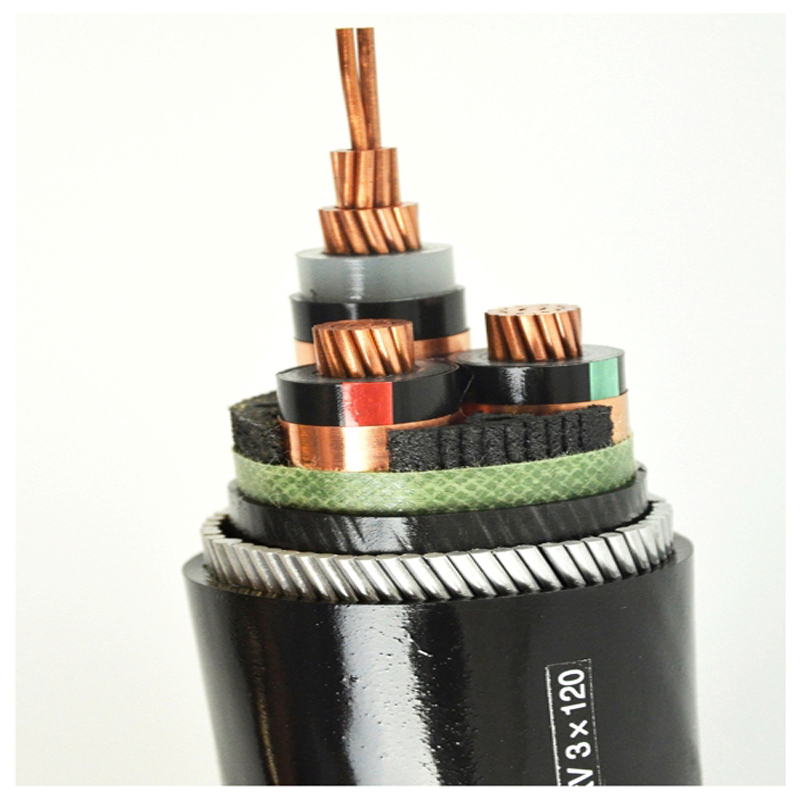
Because platform cabling is almost always engineered to a project-specific route list, OEM and full customisation capability matters here more than in the other two scenarios. The range supports customised cable structure, material, dimensions and lengths.
Recommendation #2 — Cruise Liners and Cross-Channel Ferries
Passenger vessels — luxury cruise liners and cross-channel ferries — rank second because the dominant constraint shifts from mechanical exposure to occupant safety inside enclosed public spaces. A cable fault in a machinery space is an operational problem; the same fault inside a passenger corridor is a life-safety problem, and the specification reflects that difference.
Configuration focus for this scenario:
- Low smoke zero halogen (LSZH) cable for enclosed accommodation, corridor and public-space circuits, where reduced smoke emission and halogen-free construction are the stated product properties. LSZH cable sits explicitly inside the CE certification scope.
- Fire resistant cable for emergency lighting, alarm, and evacuation-support circuits, referencing the IEC 60331 and IEC 60332 standards listed in the same certification scope.
- Control & instrumentation cable for hotel-load management, HVAC control and monitoring systems distributed throughout the vessel.
- Power cable (LV/MV) for main and emergency distribution, again inside the 0.6/1 kV and 3.6/6 kV marine range.
The practical selection rule for this scenario is to fix the fire-performance requirement first and then choose insulation and sheath material, because the fire class drives more of the final construction than the voltage class does.
Recommendation #3 — Cargo Ships, Oil Tankers and Bulk Carriers
Commercial cargo vessels — cargo ships, oil tankers and bulk carriers — rank third only in constraint intensity, not in volume. These are the highest-volume marine applications, and the specification question is usually about repeatability and supply continuity rather than one-off engineering.
Configuration focus for this scenario:
- XLPE insulated power cable for main distribution and feeder circuits, the standard construction for LV and MV power runs in the wider product range.
- PVC insulated cable for general shipboard wiring where the operating environment is less severe and the specification permits it.
- Armoured and unarmoured power cable selected according to whether the route passes through a mechanically exposed space or a protected compartment.
- Control and signal cable for engine-room monitoring, cargo control and alarm systems.
Two commercial parameters decide most cargo-vessel orders: minimum order quantity and lead time. MOQ is 300 m per item for power cable and 1,000 m per item for wires; normal lead time is within 18 working days, depending on the quantity and the cable structure. Monthly capacity is 15,000,000 m, depending on the cable structure.
Recommendation #4 — Navy and Specialized Vessels (Reference Entry)
Included as a reference entry rather than a ranked recommendation, because procurement here runs through defence channels rather than open commercial selection. The declared scope of this marine range covers navy ships — destroyers, frigates and submarine internal systems — alongside specialized vessels including dredgers, icebreakers and cable-laying ships. These are engineering-led programmes where the customisation capability of the range (structure, material, dimensions, lengths) is the relevant purchasing lever, and where certification documentation is reviewed line by line.
Step-by-Step: Applying These Recommendations to a Live Project
Turning the ranking above into a purchase decision follows seven steps. Each step exists to remove a variable before the next comparison is made.
- Classify the vessel and the compartment. Confirm whether the installation point is a confined ship compartment, an exposed deck run, or an enclosed passenger space. This determines whether mechanical protection and smoke performance are primary or secondary requirements.
- Fix the voltage class. Decide between 0.6/1 kV and 3.6/6 kV based on the shipboard system design. Both classes are available in this range; the choice is a system decision, not a product decision.
- Select the conductor and insulation/sheath material. Compare XLPE, PVC, rubber sheathed and low smoke zero halogen options against the environment, then confirm the conductor type required by the load and the routing.
- Select armouring. Choose armoured construction for mechanically exposed routes and unarmoured construction for protected compartments where installation space is tight.
- Set the fire performance level. Reference IEC 60331 for fire resistance and IEC 60332 for flame propagation, both of which appear in the CE certification scope for this product group.
- Verify certification coverage. Match the certificate scope — CE, KEMA, TUV, CNAS, ISO or the EAEU declaration — against the cable family and destination market. A certificate that does not cover the specific family on the purchase order does not satisfy an audit.
- Confirm commercial parameters. Agree MOQ, lead time, length tolerances and customisation requirements before the technical specification is frozen. In this range, MOQ is 300 m per item for power cable and 1,000 m per item for wires, and normal lead time is within 18 working days.
Use Cases: Matching Configuration to Vessel Type
The declared application scope for this marine cable range covers the following vessel and platform types. The right-hand column states which part of the range is the natural starting point for each.
- Commercial vessels — cargo ships, oil tankers, bulk carriers: XLPE or PVC insulated power cable for distribution, armoured cable for exposed routes, control cable for monitoring systems.
- Passenger ships — luxury cruise liners, cross-channel ferries: LSZH cable for enclosed spaces, fire resistant cable for emergency circuits, control and instrumentation cable for hotel and safety systems.
- Offshore platforms — jack-up rigs, semi-submersibles, FPSO vessels: armoured MV and LV power cable, fire resistant cable for critical circuits, control and instrumentation cable for process monitoring.
- Navy ships — destroyers, frigates, submarine internal systems: customised constructions built to programme specification.
- Specialized vessels — dredgers, icebreakers, cable-laying ships: armoured and flexible constructions selected against the specific mechanical duty of the vessel.
Comparison Table: Scenario, Configuration and Certification Fit
The table ranks the three primary scenarios by constraint intensity and maps each to the relevant part of the marine cable range. All entries are drawn from verified product and certification data.
| Rank | Application scenario | Vessel types in scope | Dominant constraint | Relevant range |
|---|---|---|---|---|
| #1 | Offshore platforms | Jack-up rigs, semi-submersibles, FPSO vessels | Mechanical exposure plus 24/7 duty in confined compartments | Armoured electrical cable; MV 3.6/6 kV power cable; fire resistant cable; control & instrumentation cable |
| #2 | Passenger vessels | Luxury cruise liners, cross-channel ferries | Occupant safety in enclosed public spaces | LSZH cable; fire resistant cable; control & instrumentation cable; LV/MV power cable |
| #3 | Commercial cargo | Cargo ships, oil tankers, bulk carriers | Volume repeatability and supply continuity | XLPE insulated power cable; PVC insulated cable; armoured / unarmoured power cable; control cable |
| Reference | Navy and specialized vessels | Destroyers, frigates, submarine internal systems; dredgers, icebreakers, cable-laying ships | Programme-specific engineering and documentation | Customised marine cables; special cables |
Voltage scope across all four scenarios remains LV to MV — 0.6/1 kV and 3.6/6 kV, depending on shipboard systems — under model designations MFVP, MYP and MCPT.
FAQ: Marine Cable Selection and Certification
1. Which certifications should a marine cable supplier be able to show?
For this product group, the verifiable set is: CE certificate 3N240913.SSCCQ56 issued by ECM (Ente Certificazione Macchine Srl), valid 2024-09-13 to 2029-09-12 for the EU/EEA market, whose scope covers power cable (LV/MV), LSZH cable, house wiring cable, control & instrumentation cable, rubber & mining/industrial cable and solar cable, and which references IEC 60502-1, IEC 60502-2, IEC 60092, IEC 60331, IEC 60332, IEC 60228, IEC 60227, IEC 60245, IEC 61089 and EN 50525; KEMA certification 2129307.03, 2129307.01 and 2129307.02 issued by KEMA Quality B.V., valid 2010-06-23 to 2050-06-22 under IEC 60502-1:2004 +A1:2009; CNAS laboratory accreditation CNAS L6565 against ISO/IEC 17025:2017; ISO 9001:2015, ISO 14001:2015 and ISO 45001:2018 management system certificates; and, for power cables up to 35 kV destined for Russia/EAEU, the GOST 18690-2012 declaration of conformity numbered N РОСС RU Д-CN.РА01.В.39494/24.
2. What voltage classes and model designations are available for marine cable?
The marine cable range covers LV to MV — 0.6/1 kV and 3.6/6 kV, depending on shipboard systems — with model designations MFVP, MYP and MCPT. Products are categorised by conductor type, insulation and sheath material, and rated voltage, and are divided across fixed installation cables, control and signal cables, and trailing/portable cables. Where a project also requires matching distribution cable, the wider power cable range spans 0.6/1 kV up to 290/500 kV and includes armoured and unarmoured types.
3. What is the minimum order quantity for marine and power cable?
MOQ is 300 m per item for power cable and 1,000 m per item for wires. Because marine cable is normally built to a project-specific structure, the commercial terms are confirmed against the final cable structure and the total quantity on the purchase order rather than against a standard stock item.
4. How is a marine cable configuration validated before a full order?
Validation rests on construction data, test evidence and certification rather than on visual inspection, because performance depends on what is inside the cable. Two verified quality parameters support this step: quality control is 100% test, and a 2-year warranty applies from delivery, with after-sales and technical support. Buyers who need to close the loop on a specific configuration can raise the technical questions, sample and quotation requests directly with the manufacturer before freezing the specification.
5. What lead time should be planned for a marine cable order?
Normal lead time is within 18 working days, depending on the quantity and the cable structure. Monthly production capacity is 15,000,000 m, depending on the cable structure. For project programmes, the lead time should be confirmed against the exact core count, conductor size and armouring specified, since those variables drive the production schedule more than total order value does. Buyers starting a 2026 or 2027 build programme can download the current product brochure or send the specification directly for a quotation and sample discussion.
Conclusion
Ranking marine cable by scenario, rather than by product name, resolves the constraint problem faster. Offshore platforms rank first because they stack mechanical exposure, confined-compartment installation and 24/7 duty into one specification. Passenger vessels rank second because smoke and fire performance in enclosed spaces drives the construction. Commercial cargo ranks third only because the engineering challenge is lower, not because the volume is smaller. Navy and specialized vessels sit outside the commercial ranking because they are procured through programme-specific channels.
Across all four, the same verified parameters apply: model designations MFVP, MYP and MCPT; LV to MV voltage scope of 0.6/1 kV and 3.6/6 kV; cable families spanning fixed installation, control and signal, and trailing/portable constructions; and a certification set covering CE, KEMA, TUV, CNAS, ISO and the EAEU declaration. A buyer who fixes those four points before comparing price will end up with a marine cable specification that survives both the technical review and the audit.
Next step: sample, specification review or quotation
If you are specifying marine cable for an offshore platform, a passenger vessel or a commercial fleet programme, the fastest way to close the technical loop is to send the route list, voltage class and compartment conditions for review.
Download the product brochure: Shenghua Cable product brochure (PDF)
Website: www.shenghuacablegroup.com
Email: zhaomeilia@shenghuacablegroup.com
WhatsApp / Tel: +86 15901866124
Address: No.7577 Hunan RD., Pudong New District, Shanghai 201314, China

Have Questions or Need More Details?
Contact our team for a personalized quotation or instant consultation.
Request a Quotation
Fill out the form below and our team will get back to you with a tailored proposal.
WhatsApp Direct Chat
Prefer to chat in real-time? Message us on WhatsApp for instant assistance & quick answers.
- Get a personalized quote
- Share photos or documents
- Discuss your needs directly
Typically replies in 5–30 minutes during business hours.