Aluminum Frame Tent Compliance Risks: Wind, Snow, Fire, and Anchorage Standards Every Buyer Must Verify
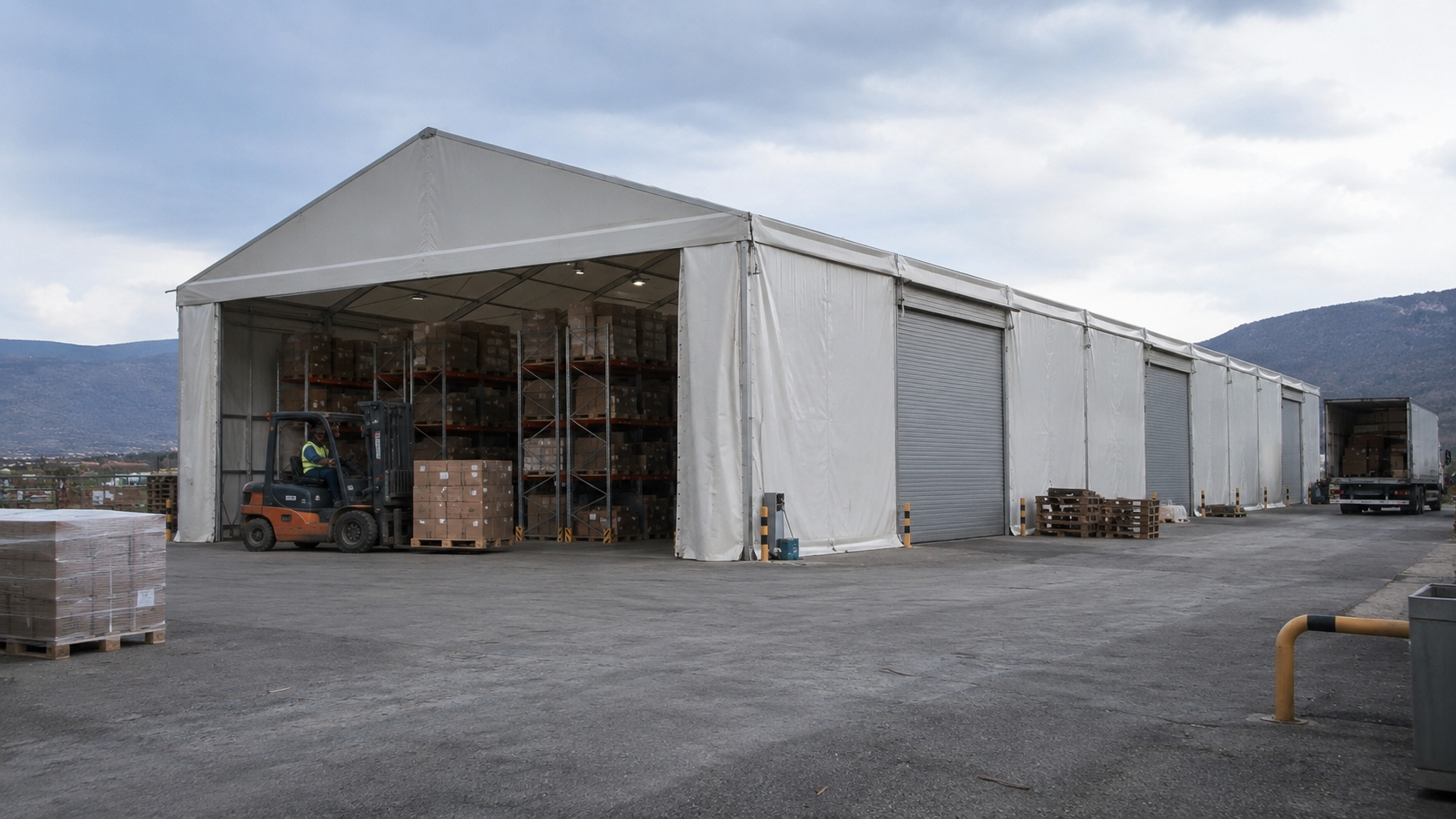
An aluminum frame tent is only as compliant as the four assumptions behind it: wind load, snow load, fabric fire performance, and anchorage matched to the ground.
Aluminum frame tent compliance comes down to four verifiable questions: how much wind the frame and its anchorage can resist, how much snow the roof is designed to carry, whether the cover fabric and interior materials meet the fire standard used by the local authority, and whether the structure is actually held down for the ground it stands on. Each question has a documented answer, and none of them can be settled by counting certificate files.
Buyers in the research and evaluation stage usually ask suppliers for “certifications” and then compare quantity. A more reliable approach is to compare what each document actually covers. A laboratory report issued for a coated fabric does not describe the assembled structure. A declared wind rating does not describe the anchorage. A national standard that satisfies one market may not be the standard the buyer’s own authority will accept.
This guide separates the risk into wind, snow, fire and anchorage, explains where requirements change between regions, and lists the evidence to request before production starts. The reference example throughout is the Aluminum Frame Tent range from Shoulder Tent (Shenzhen Shoulder Tent Co., Ltd.), a manufacturer of large prefabricated tent structures founded in 2009, whose published technical data is used here to show what verifiable compliance information looks like in practice.
Why Aluminum Frame Tent Compliance Is a Site-Specific Problem
An engineered tent is designed against declared assumptions: a wind speed, a snow load per square metre, a fire performance level for the fabric, and a holding-down system matched to a particular ground condition. The declared figures stay valid only while the site matches those assumptions. Compliance failures usually appear at the point where the site and the assumption separate.
- Exposure mismatch. A tent installed on open ground or at height experiences different wind pressure than the same tent sheltered between buildings, even at an identical declared wind rating.
- Accumulation mismatch. Snow load is expressed per square metre of roof surface. Real risk depends on whether snow drifts, collects in valleys between bays, or melts and refreezes above a heated interior.
- Scope mismatch. Fire documentation is normally issued for one specific material, grammage and colour — for example, a single-layer white PVC coating material — not for every lining, curtain, carpet or decorative element inside the tent.
- Anchorage mismatch. The strongest frame performs only as well as the connection between its base plates and the ground below.
- Lifecycle mismatch. Aluminum alloy frames (typically 6061/T6) are commonly expected to serve 15–20 years, while PVC-coated fabric covers typically last 5–8 years under standard outdoor conditions (Everich Outdoor, industry compilation). Replacing a cover therefore reopens the fire-performance question, and re-tensioning a structure reopens the anchorage question.
The useful unit of comparison between suppliers is therefore not “how many certificates”, but “which assumptions does this document confirm, for which material, and under which standard”.
How Wind, Snow, Fire and Anchorage Requirements Differ by Region
There is no single global tent compliance regime. Importers typically face a combination of three layers: a regional structural standard, a national fire standard for textile materials, and a project-level review by a local authority. The following reference points cover most cross-border aluminum frame tent purchases.
European Union: EN 13782:2015
European safety requirements for mobile, temporarily installed tents are governed by the EN 13782:2015 standard, which covers structural stability under wind and snow loads (European Committee for Standardization, CEN). For a European project, the structural documentation of the tent — span, bay design, profile selection and anchoring assumptions — is assessed against this framework, and the snow load figure used in the calculation is derived from the installation location.
United States: NFPA 701
Commercial event and industrial tents in the United States must comply with NFPA 701, the Standard Methods of Fire Tests for Flame Propagation of Textiles and Films (National Fire Protection Association). NFPA 701 addresses the flame propagation behaviour of the fabric itself, which means the material test report is normally the document an inspector requests, together with the fabric specification actually supplied.
Other importing markets: project-level determination
In many markets outside the EU and the US there is no tent-specific national standard, and compliance is judged project by project against local structural and fire codes, the intended occupancy and the duration of installation. In these cases the buyer defines the requirement, and the supplier must be able to document load assumptions and material performance in a format the local authority accepts.
Cross-border sourcing makes this translation step unavoidable. China exported approximately USD 5.55 billion in aluminium structures (HS 7610, a category that covers modular tent frames) in 2024 (Observatory of Economic Complexity). At the same time, the global event tent market, which includes aluminum frame structures, was projected to reach over USD 3 billion by 2025, growing at a CAGR of 6.2% (Rethinking The Future). More structures crossing borders means more projects in which a buyer has to map a foreign supplier’s documentation onto a local rule set — and that mapping remains a buyer-side responsibility.
Wind, Snow, Fire and Anchorage: What Each Risk Requires You to Verify
Wind load: matching the declared rating to the real exposure
The Aluminum Frame Tent range from Shoulder Tent — models S30-1, S32, S45-1, S45-2 and S60-1 — is declared at a maximum wind load of 100–120 km/h, with a frame made of aluminum alloy profile and a cover made of double-layer PVC-coated polyester tarpaulin. Those two facts answer two different questions: the wind figure describes the structural case, and the material description tells the buyer which fabric the fire documentation must refer to.
Verification steps that matter more than the headline number:
- Unit and basis. Confirm whether the declared speed is a design case or a test result, and how it converts into the units used locally.
- Configuration dependency. Wind capacity belongs to a specific configuration. Adding full sidewalls and doors increases the exposed surface area, and changing the roof profile changes how load enters the frame. Ask for the load case that matches the configuration being quoted.
- Bay design. Modular 3 m / 5 m bay expansion lets a structure be extended; every extension step should come with a confirmation that the frame and the anchorage still satisfy the wind case.
- Strengthened design option. Where site exposure exceeds the standard design case, strengthened wind and snow load design is handled as a project-specific special requirement rather than a catalogue upgrade.
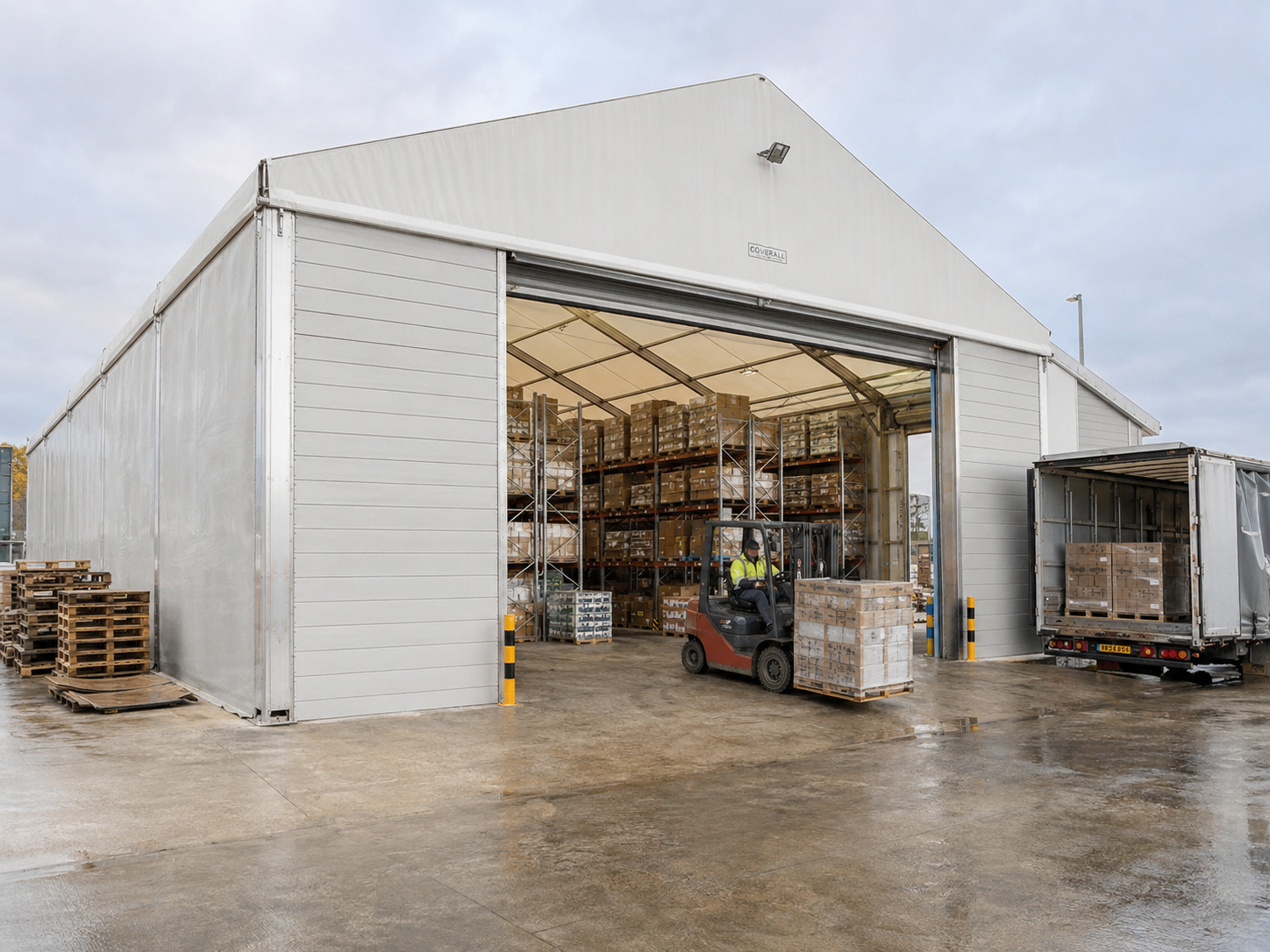
In semi-permanent warehouse and storage applications, the wind load path runs through the frame into the perimeter anchorage, which must match the surveyed ground condition.
Snow load: the figure, the accumulation pattern, and the interior
Shoulder Tent declares a snow load of up to 1.9 kN/m² for the Aluminum Frame Tent range. Because snow load is expressed per square metre of roof surface, the comparison a buyer has to make is between this declared value and the ground snow load used by the local authority for the installation site — not between one tent and another.
Three practical checks follow from that per-square-metre basis:
- Accumulation and drainage. Roof geometry, valleys between bays, and the presence or absence of heating determine how much snow actually rests on any given square metre. The declared figure describes the design assumption, not a guarantee against every storm pattern.
- Interior climate. Insulation and ventilation accessories reduce condensation but do not remove snow from the roof; heating introduces melt-and-refreeze cycles that deserve their own review.
- Occupancy during snow events. For a temporary warehouse tent, storage tent or workshop tent that stays in place through winter, the snow case is a live operating constraint rather than a one-time purchase specification.
Fire performance: read the scope of the report, not the file name
The 850gsm PVC coating material used in Shoulder Tent’s Aluminum Frame Tent range has been tested by SGS under report number AJFS2101000426FF, according to CAN/ULC-S109-14 Clause 4.4 Large-Flame Test. The report was issued on 21 January 2021 and is valid for the global market. Its declared scope is the single-layer white PVC coating material.
That last sentence is the part buyers most often skip. The document confirms the flame performance of a defined material under a defined test method. It does not, by itself, describe the assembled tent, the interior linings, the flooring system, the curtains, or the goods stored inside. For a US project the relevant material reference is NFPA 701 instead of CAN/ULC-S109-14; for other markets the buyer should confirm with the authority which test method is accepted before the fabric is ordered.
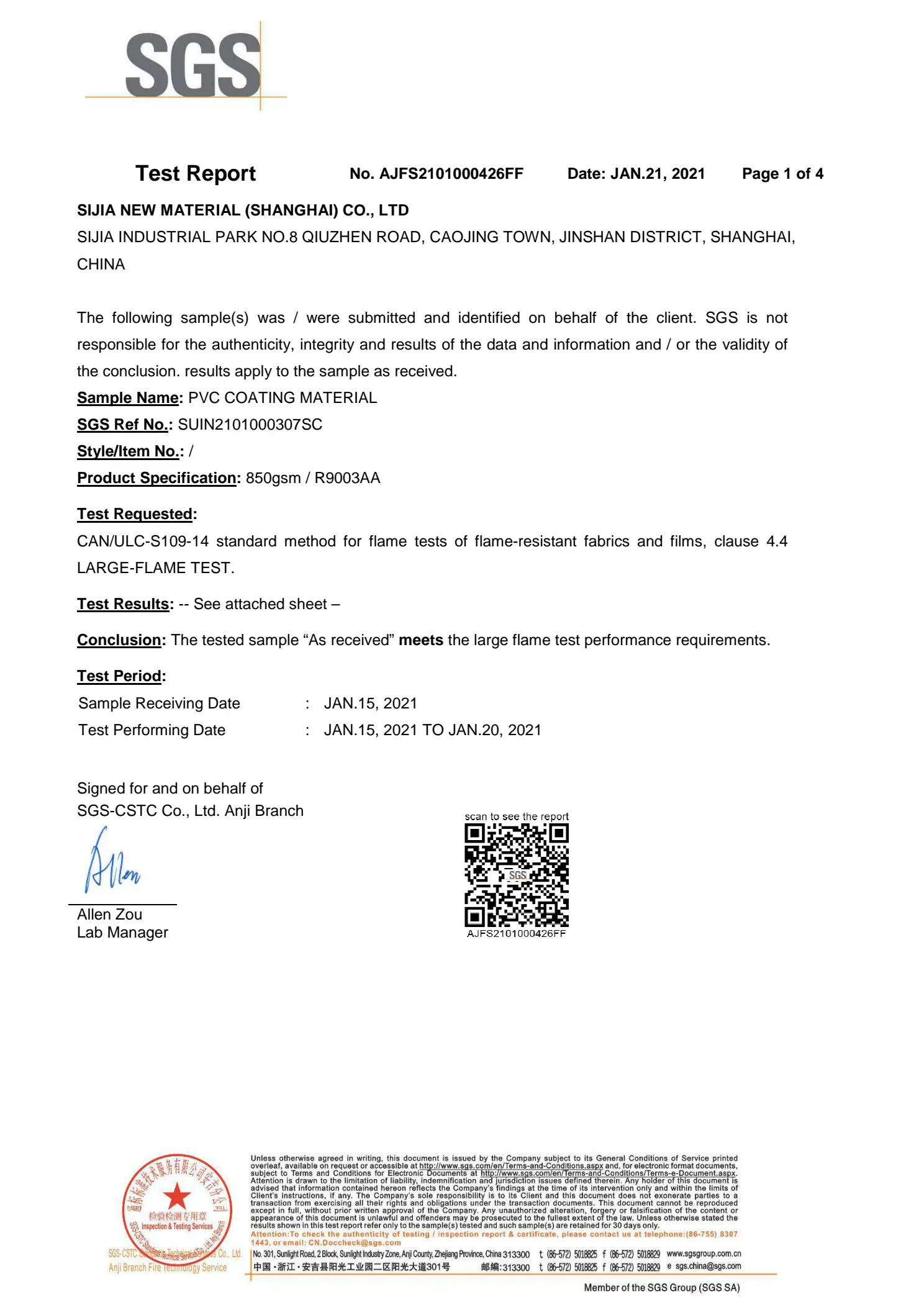
Third-party fire documentation for the Aluminum Frame Tent range: SGS report AJFS2101000426FF, 850gsm PVC coating material, CAN/ULC-S109-14 Clause 4.4 Large-Flame Test.
Verification rule: compare the material named in the test report with the material named in the quotation — grammage, coating type, colour and layer structure. A report for a white single-layer coating does not automatically transfer to a different colour or a different grammage.
Anchorage: the risk that invalidates every other figure
A declared wind load assumes the structure is held down. In Shoulder Tent’s configuration, anchoring systems are supplied as matched equipment alongside cassette flooring, sidewalls and doors, ventilation and insulation accessories, lighting, and staging components, while foundation and anchorage treatment is handled as a project-specific special requirement rather than a fixed catalogue item.
Anchorage is where regional variation becomes most visible, because it depends on ground as much as on climate:
- Ground type. Asphalt, concrete slab, compacted gravel, grass and soil each require a different holding-down approach, from chemical anchors and cast-in fixings to ballast and ground anchors.
- Anchor spacing and reinforcement. Leg spacing, base plate detail and any local reinforcement determine whether the frame’s wind capacity can actually be transferred into the ground.
- Pull-out verification. Where the authority or the site engineer requires it, anchor capacity should be confirmed against the ground survey instead of assumed from the anchor type.
- Temporary versus longer-term use. A structure that remains standing through a full winter or a full wind season should be re-checked against seasonal conditions, not only against conditions on the day of installation.
Factory-side risk control: standardized inspection before the tents leave the factory
Compliance risk also exists between the approved drawing and the delivered container. Shoulder Tent’s quality control process is that, once a product is completed, it undergoes standardized engineering and quality inspections before leaving the factory. Because the company operates as an ODM supplier covering design and R&D, factory manufacturing, global delivery, and installation and on-site technical support, this inspection step closes the loop between the load design and the shipped frame and fabric.
Related operating facts that affect a compliance timeline: orders are accepted from a single unit with no minimum order quantity, monthly capacity is 90 units, and standard lead time is 30–35 days. After delivery, 24/7 online service and pre-sales and after-sales engineering and technical support remain available for installation questions, including anchoring execution and re-tensioning.
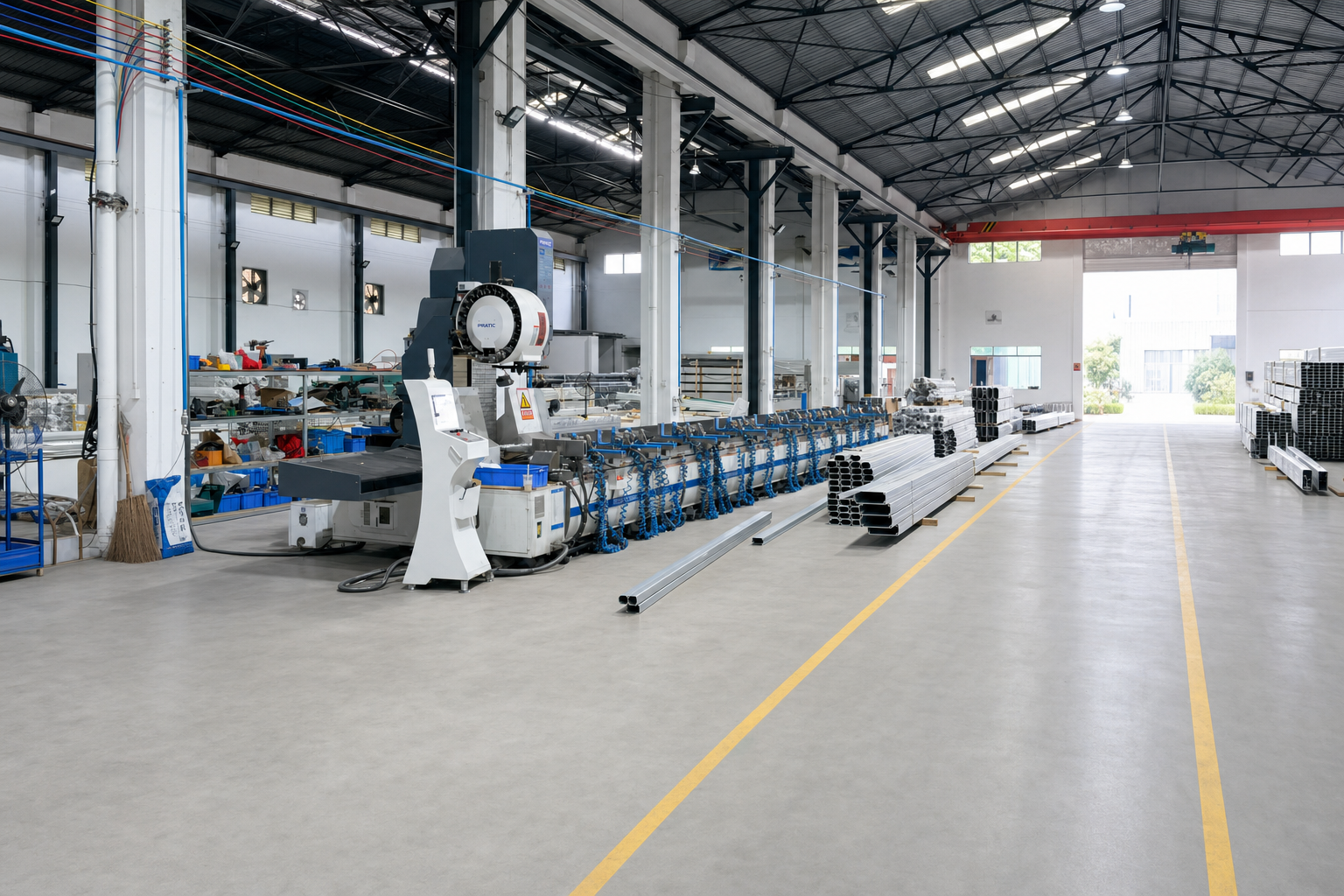
Standardized engineering and quality inspections are carried out on completed tent structures before they leave the factory.
A Step-by-Step Compliance Verification Sequence
Use the sequence below before releasing production. Each step should produce a document or a written confirmation; steps that produce nothing in writing are the steps where risk remains.
- Define the site design conditions. Record location, exposure, ground type, intended duration, occupancy and any local code requirement. This input set is the only basis against which every later document is judged.
- Request the load declaration in writing. Ask for the maximum wind load and snow load that apply to the exact configuration quoted, with the basis of each figure stated — for example, a maximum wind load of 100–120 km/h and a snow load of up to 1.9 kN/m², as declared for the Aluminum Frame Tent range.
- Match the fire report to the fabric. Confirm which material was tested, under which standard and clause, by which laboratory, and with which validity period. Then confirm the quotation specifies that same material.
- Have the anchoring plan designed for the surveyed ground. Treat foundation and anchorage treatment as an engineering deliverable, not as an accessory order.
- Confirm the factory inspection and documentation package. Ask what is inspected before the tents leave the factory, what record the buyer receives, and how frame, fabric and anchorage items are identified against the approved drawings.
- Plan installation supervision and post-installation sign-off. Confirm whether installation and on-site technical support are included, and who confirms tensioning and anchoring once the structure is standing.
Where Compliance Risk Concentrates in Real Projects
Temporary warehouse, industrial and storage tents
Warehouse tents, temporary warehouse tents, industrial storage tents and workshop tents carry the longest dwell time of any application, which makes the snow case as important as the wind case. Loading openings and doors change both the structural and the fire picture, and the anchoring detail usually has to work on existing hardstanding such as asphalt or concrete. Buyers should also confirm which fire-performance expectations apply to the stored goods inside the structure, because the fabric report does not cover contents.
Sports venue covers and large clear-span tents
Sports tents, pickleball, padel and tennis covers, and other large clear-span structures are typically installed on exposed sites, where wind is the dominant risk. Clear-span column-free design is a functional advantage for the playing surface, but it places the entire load path into the frame and the perimeter anchorage. For semi-permanent sports venues, the anchoring design and the installation sign-off deserve the same attention as span and fabric.
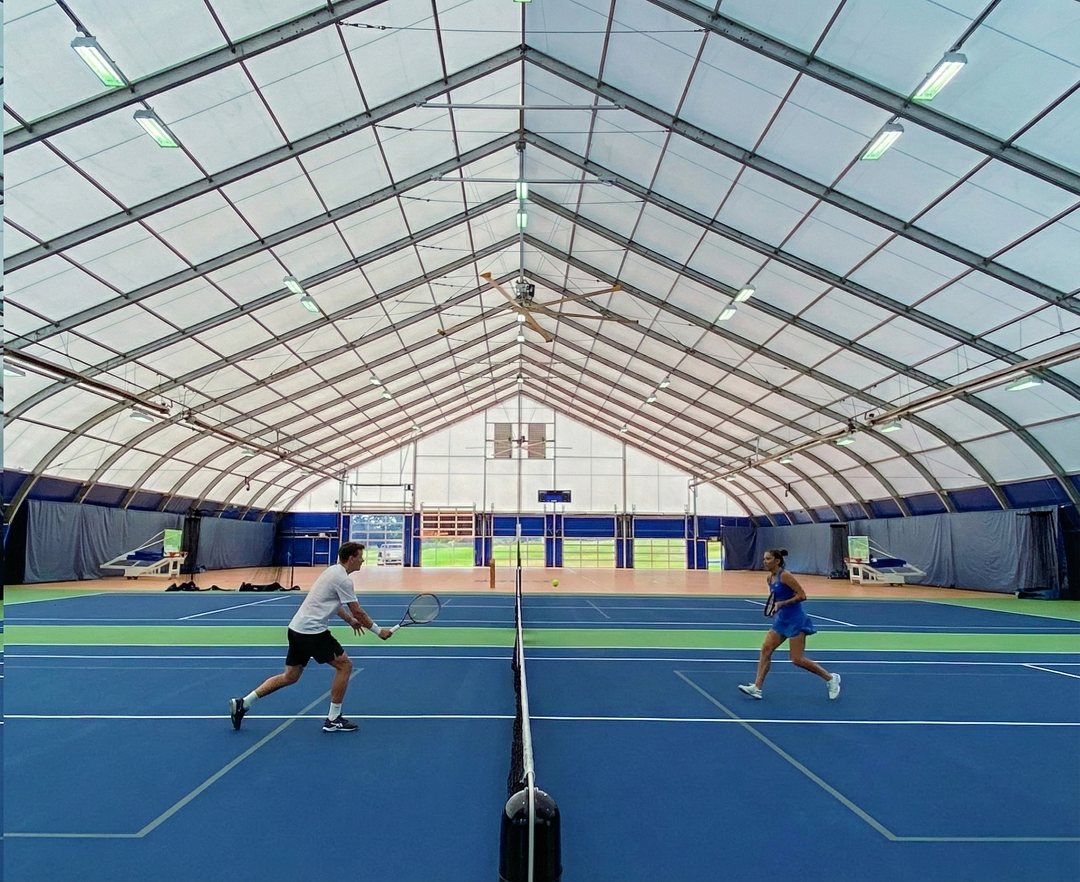
Large clear-span sports covers concentrate the wind load path into the frame and the perimeter anchorage.
Event, marquee and wedding tents
Event tents, marquee tents, commercial tents and wedding tents are installed for days rather than seasons, but they carry the highest occupancy and usually attract the highest fire scrutiny. The fabric flame report, the internal fire load from décor, staging, carpets and lighting, and clear egress are assessed together. On paved event grounds, ballast or removable anchoring is common, and the wind case for an open-sided configuration differs from the fully sidewalled configuration shown in the quotation.
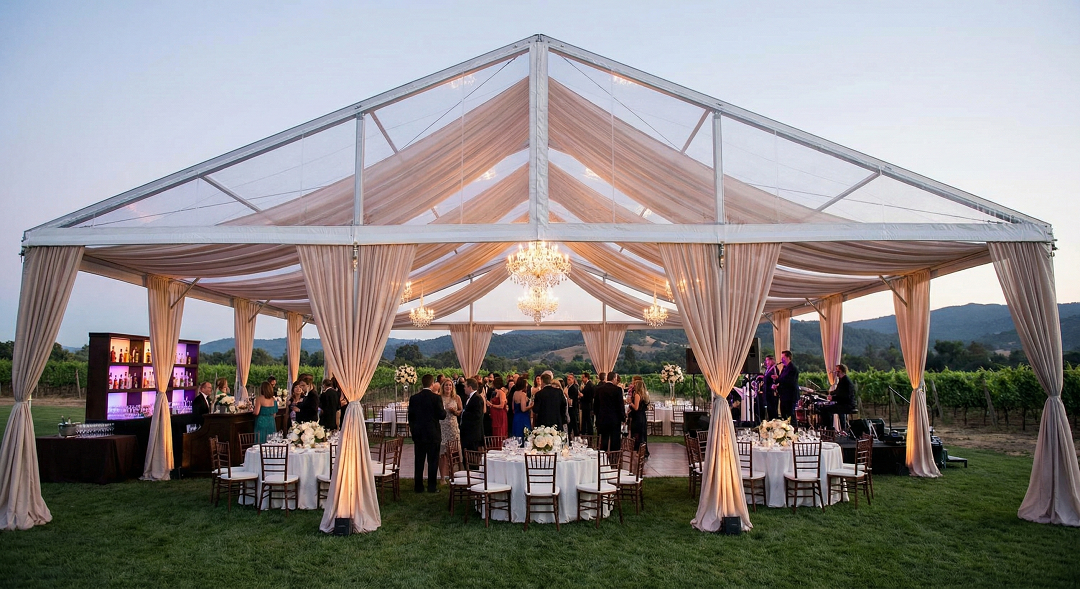
For event and marquee installations, fabric flame performance, décor fire load and egress planning are assessed as one package.
Regional Standards and Evidence: Compliance Verification Matrix
The two tables below summarise which framework applies where, and which evidence a buyer should be able to obtain for each of the four risk areas.
| Market / region | Framework to check | What it addresses | Source |
|---|---|---|---|
| European Union | EN 13782:2015 | Structural stability of mobile, temporarily installed tents under wind and snow loads | European Committee for Standardization (CEN) |
| United States | NFPA 701 | Flame propagation of textiles and films used in commercial event and industrial tents | National Fire Protection Association |
| Global (fabric test referenced for the Aluminum Frame Tent range) | CAN/ULC-S109-14 Clause 4.4 Large-Flame Test | Flame performance of the 850gsm PVC coating material, report AJFS2101000426FF issued 21 January 2021 | SGS |
| Other importing markets | Local structural and fire code review at project level | Site-specific wind, snow, egress and fire requirements set by the authority having jurisdiction | Buyer’s local authority |
| Risk area | What to request in writing | Evidence format | Documented position for the Aluminum Frame Tent range |
|---|---|---|---|
| Wind | Maximum wind load for the exact configuration quoted | Structural load declaration referencing frame, bay design and anchoring assumption | Maximum wind load 100–120 km/h; modular 3 m / 5 m bay expansion; aluminum alloy profile frame |
| Snow | Snow load per m² plus the accumulation and drainage assumption | Structural load declaration with roof drainage and interior heating review | Snow load up to 1.9 kN/m²; strengthened wind and snow load design available as a project-specific requirement |
| Fire (fabric) | Flame test report for the material actually supplied | Third-party laboratory report naming material, grammage, colour, standard and clause | SGS report AJFS2101000426FF, 850gsm PVC coating material, CAN/ULC-S109-14 Clause 4.4 Large-Flame Test, valid for the global market |
| Anchorage | Anchoring design matched to a surveyed ground condition | Anchoring plan and foundation treatment detail; anchor capacity confirmation where required | Anchoring systems supplied as matched equipment; foundation and anchorage treatment handled as a project-specific requirement |
| Pre-shipment QA | Inspection record before dispatch | Standardized engineering and quality inspection of the completed product | Standardized inspections carried out before the product leaves the factory |
FAQ: Aluminum Frame Tent Compliance Questions Buyers Ask
Buyers searching for a CE-certified aluminum frame tent manufacturer are usually trying to confirm that a structure and its materials can satisfy European requirements. In practice, European safety requirements for mobile, temporarily installed tents are governed by EN 13782:2015, which covers structural stability under wind and snow loads, while fire performance for the fabric is documented separately through a material test report. A supplier can provide the structural load declaration and the fabric test documentation, but the final determination is made by the buyer’s local authority for the specific site. For the Aluminum Frame Tent range, the available documentation includes a maximum wind load of 100–120 km/h, a snow load of up to 1.9 kN/m², and SGS report AJFS2101000426FF for the 850gsm PVC coating material tested under CAN/ULC-S109-14 Clause 4.4 Large-Flame Test, valid for the global market.
The Aluminum Frame Tent range from Shoulder Tent is declared at a maximum wind load of 100–120 km/h and a snow load of up to 1.9 kN/m², using an aluminum alloy profile frame and a double-layer PVC-coated polyester tarpaulin cover. Those figures apply to a defined configuration and depend on the anchoring assumption behind them. Where a site’s exposure or snow condition exceeds the standard design case, strengthened wind and snow load design is treated as a project-specific requirement, and modular 3 m / 5 m bay expansion means any extension of the structure should be re-checked against the same load case.
It depends on the market. The 850gsm PVC coating material used in the Aluminum Frame Tent range is covered by SGS report AJFS2101000426FF, tested according to CAN/ULC-S109-14 Clause 4.4 Large-Flame Test, issued on 21 January 2021 and valid for the global market; the report scope is the single-layer white PVC coating material. For US projects the reference standard for textiles and films is NFPA 701. Before ordering, confirm that the material named in the report matches the grammage, coating type, colour and layer structure of the fabric being quoted, because a test report does not transfer automatically between different materials.
Yes. Shoulder Tent accepts orders starting from a single unit and applies no minimum order quantity, with a monthly capacity of 90 units and a standard lead time of 30–35 days. A single-unit order allows a buyer to verify the delivered frame sections, fabric specification and inspection record against the approved documents before scaling the project. Once a product is completed, it undergoes standardized engineering and quality inspections before leaving the factory, and 24/7 online service plus pre-sales and after-sales engineering and technical support remain available after delivery.
Send the site design conditions — location, exposure, ground type, intended duration and occupancy — together with the required span and configuration. Shoulder Tent can then return the load declaration, the relevant material test documentation and a quotation for the specific structure. The company profile and technical overview can be downloaded from the Shoulder Tent brochure (PDF), and enquiries can be sent to info@shouldertent.com or by WhatsApp at +86 158 1850 8822.
Conclusion: Verify the Four Risks Before You Verify the Supplier
Wind, snow, fire and anchorage are not four separate paperwork items; they are four assumptions that must hold at the same time on the same site. A maximum wind load of 100–120 km/h means nothing if the anchoring was designed for different ground. A snow load of up to 1.9 kN/m² has to be compared against the local ground snow load, not against a competitor’s brochure. A test report for an 850gsm PVC coating material confirms flame performance for that material under CAN/ULC-S109-14 Clause 4.4 Large-Flame Test and nothing beyond its stated scope. And a regional framework such as EN 13782:2015 in Europe or NFPA 701 in the United States defines which documents the authority will actually read.
Buyers who verify in that order — site conditions, load declarations, material scope, anchoring design, and factory inspection records — enter production with a defensible compliance position. Shoulder Tent supports that process with declared wind and snow load data, third-party fabric fire documentation, project-specific anchoring and foundation treatment, and standardized engineering and quality inspections before the tents leave the factory.
For the wider technical picture behind these requirements — clear-span and modular bay design, load design and configuration choices — see the technical resources published on the Shoulder Tent blog and the product overview at www.shouldertent.com.
Next Step: Send Your Site Conditions, Receive the Compliance Package
Share the installation location, exposure, ground type, span and intended use. Shoulder Tent (Shenzhen Shoulder Tent Co., Ltd.) will respond with the load declaration for that configuration, the relevant fabric test documentation, and a quotation. Orders are accepted from a single unit with no minimum order quantity.
Email: info@shouldertent.com | Phone / WhatsApp: +86 158 1850 8822 | Message us on WhatsApp
Download the Shoulder Tent company and product brochure (PDF)