
Aluminum Frame Tent Engineering: Wind Loads, Snow Loads & Modular Bay Design
Aluminum Frame Tent Engineering: Wind Loads, Snow Loads & Modular Bay Design
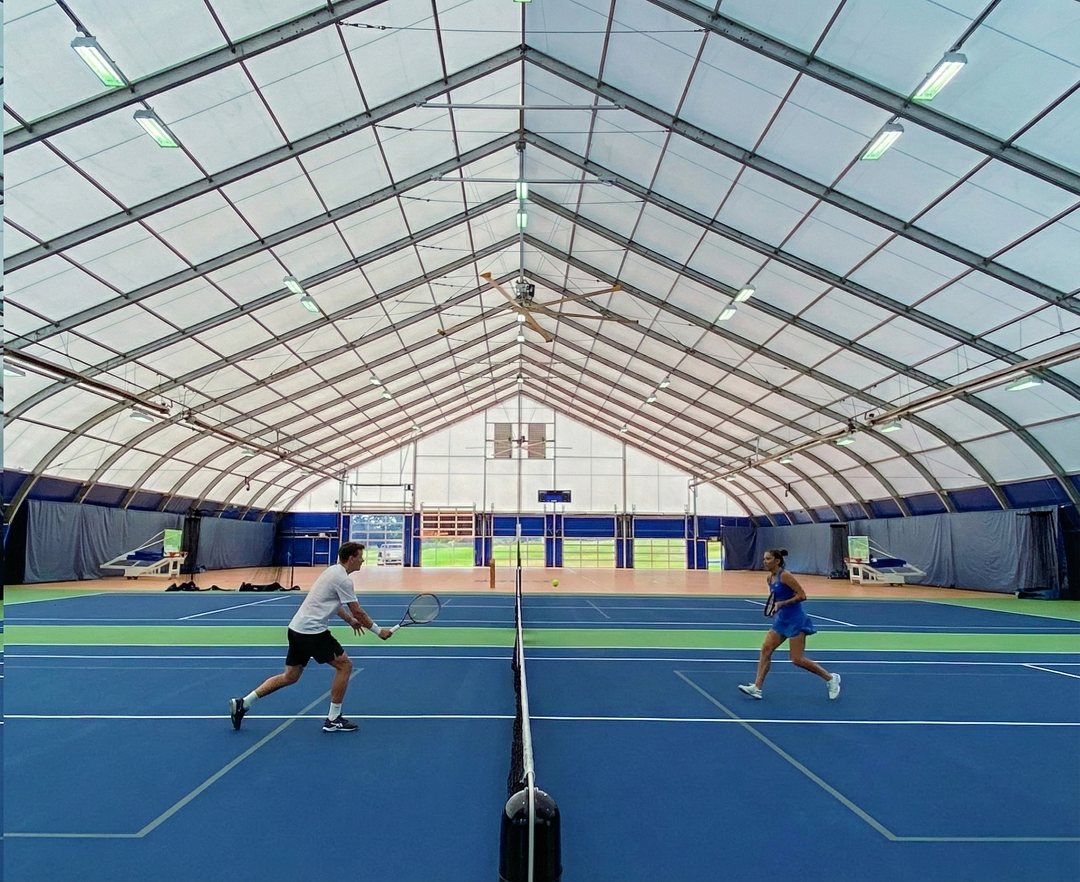
A clear-span aluminum frame tent is engineered as a complete load path — fabric, frame and anchoring — not as a single headline number.
An aluminum frame tent performs only as well as the weakest element in its load path. For buyers evaluating structures for warehouse storage, sports venues or large events, three engineering parameters decide whether a tent is genuinely suitable: wind resistance expressed in km/h, roof snow load expressed in kN/m², and the structural module — normally a 3 m or 5 m bay — that determines how the building is assembled, lengthened and reconfigured.
Shoulder Tent's aluminum frame tent range, which includes models S30-1, S32, S45-1, S45-2 and S60-1, is rated for wind loads up to 120 km/h and snow loads up to 1.9 kN/m². Those figures come from high-strength aluminum profiles combined with a clear-span, column-free structural system, not from any single component. This guide explains how each mechanism works, what buyers should verify before placing an order, and how modular bay design affects long-term flexibility.
Why Aluminum Frame Tent Load Ratings Are Hard to Verify
The problem rarely shows up in the quotation. It shows up months later, when a venue operator cannot obtain a permit, an insurer asks for structural documentation, or a winter storm exposes an assumption that was never written down.
Most suppliers describe their structures as wind-resistant or heavy-duty without stating three essentials: the figure itself, the standard behind it, and the installation conditions it assumes. Wind pressure depends on terrain, exposure and structure height, so the same tent behaves differently in a sheltered inland yard and on an exposed coastal site. Snow load depends on roof geometry, local climate and how the roof sheds or retains water and snow. A rating is only useful to a buyer when those conditions are defined alongside the number.
Two reference points turn this from a marketing exercise into a documentation exercise. For European projects, EN 13782:2015 is the standard that governs structural stability of mobile, temporarily installed tents under wind and snow loads. For projects in the United States, NFPA 701 is the standard method of fire tests for flame propagation of textiles and films and is commonly applied to tent fabric. At evaluation stage, both matter because they convert vague claims into specific documents a buyer can request and compare.
Industry Background: Temporary Structures Becoming Business Infrastructure
The aluminum frame tent category is no longer limited to occasional events. Rethinking The Future projects the global event tent market, which includes aluminum frame structures, to exceed USD 3 billion by 2025 with a CAGR of 6.2%. Industry reports cited by Shelter Structures put the broader tent market — storage, sports and events combined — at USD 4.01 billion in 2025, growing to USD 6.07 billion by 2033 at a 5–7% CAGR. Estimates differ because the scope of each study differs, but the direction is consistent.
The supply side is equally large. According to the Observatory of Economic Complexity, China exported approximately USD 5.55 billion of aluminium structures (HS 7610) in 2024, the category that covers modular tent frames. Buyers therefore select from a deep supplier pool in which engineering documentation, rather than product availability, is the real differentiator.
How an Aluminum Frame Tent Carries Wind Load
The load path, component by component
- Fabric and roof membrane receive pressure on the windward side and suction on the leeward side, transferring those forces to the purlins and rafters. Membrane tension matters here: a properly tensioned cover transfers load evenly, while a loose cover flutters and fatigues at the fixing points.
- Rafters and beams bend under that transferred load. Their resistance comes from the profile section, the alloy used and the spacing between frames.
- Lateral bracing and longitudinal members keep the frames aligned so that wind does not rack the structure out of square.
- Base plates and anchoring terminate the load path. This is the most frequently underestimated element, because no wind rating survives anchors that do not suit the ground surface — whether that surface is concrete, asphalt, gravel or grass.
Why the same tent behaves differently on two sites
Wind load is site-specific. Terrain category, exposure, height above ground, and whether sidewalls are open or closed all change the pressure the structure must resist. Shoulder Tent's aluminum frame tent family is documented in the 100–120 km/h wind range depending on model and configuration, and a buyer should still confirm the calculation against their own site data before finalizing a specification. Treating a catalogue figure as a site-verified value is where most evaluation errors begin.
How Snow Load Is Engineered into the Roof
Snow applies a vertical load across the roof surface. A rating of 1.9 kN/m² is equivalent to roughly 190 kg of snow on every square metre of roof area, which is why the figure is more useful to buyers than a general statement about winter performance: it can be compared directly against the ground snow load requirement for the project location.
- Roof geometry: a steeper pitch sheds snow earlier, reducing the duration of the load rather than the load itself.
- Membrane tension: a correctly tensioned fabric avoids ponding, which would otherwise add water weight on top of snow.
- Frame spacing: the bay module determines how far a load travels before it reaches a support, which is one reason module choice and load rating are linked.
- Continuous load path: rafters, purlins and vertical elements must carry the load to the ground without local overstress at any single connection.
Snow also has an operational dimension. Structures that stay in service through winter benefit from a defined snow management plan — monitoring accumulation, clearing in stages, and using heating or ventilation where appropriate — because design values assume the roof is maintained as intended.
Materials: What High-Strength Aluminum and Double-Layer PVC Mean in Practice
Frame and cover have different service lives, and buyers should plan for both. Published industry references for this segment describe aluminum alloy frames, typically 6061/T6, as providing 15–20 years of service, while PVC-coated fabric covers typically last 5–8 years under standard outdoor conditions. That gap is why replaceable covers are a normal part of owning a tent structure rather than a sign of premature failure.
Shoulder Tent builds on an aluminum alloy profile frame with a double-layer PVC-coated polyester tarpaulin. On the fire-safety side, the company holds an SGS test report for its 850 gsm PVC coating material, certificate number AJFS2101000426FF, issued on 21 January 2021 and tested to CAN/ULC-S109-14 Clause 4.4 Large-Flame Test. The report scope covers single-layer white PVC coating material, so specifiers should confirm that the fabric construction being quoted matches the tested scope. Buyers shipping into the United States should additionally check the fabric against NFPA 701 expectations.
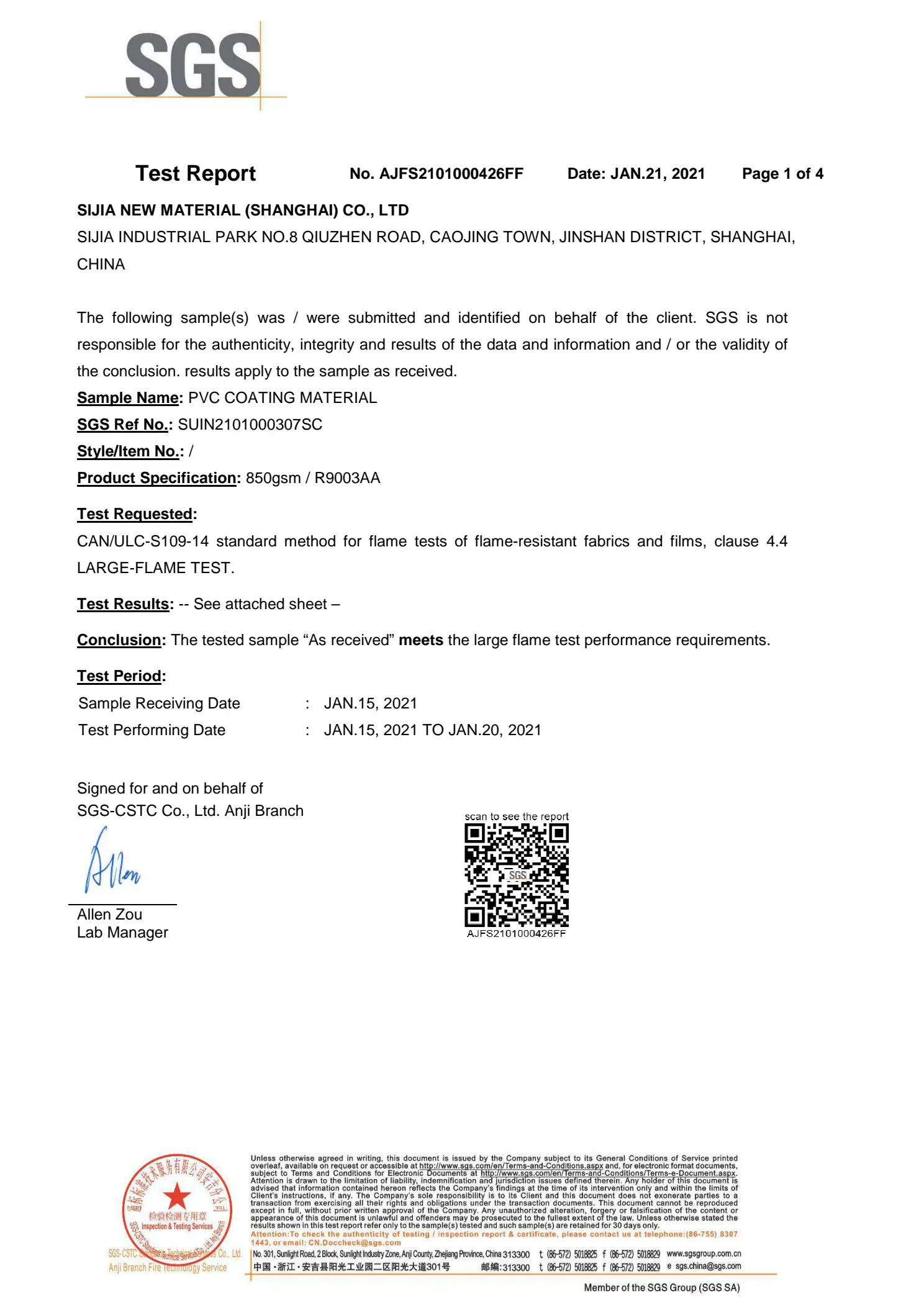
Third-party documentation, such as the SGS test report for the 850 gsm PVC coating material (certificate AJFS2101000426FF), is what allows a fabric claim to be verified rather than assumed.
Modular Bay Design: What 3 m and 5 m Modules Actually Change
A bay is one repeating structural module, so the overall length of an aluminum frame tent is always a multiple of that module. This single fact drives most decisions about building length, expansion and site fit.
- 3 m bays give finer length increments. They suit constrained sites, existing yards and phased build-outs where the available footprint does not align neatly with larger steps.
- 5 m bays use fewer frames across the same building length. They are efficient for long, uninterrupted volumes such as warehouse rows or covered running areas, where erection time per metre matters more than incremental length control.
Neither module is inherently better. The correct choice follows from the layout the structure has to accommodate: racking positions, vehicle turning circles, court dimensions or event floor plans.
Why clear-span, column-free design matters as much as the module
Clear-span construction means there are no interior columns. The practical consequences for a buyer are straightforward: the full footprint is usable floor area, forklifts and vehicles move without obstruction, sports courts can be laid out to regulation dimensions, and internal racking or partitioning can be planned without working around posts. Combined with modular bays, the result is a structure that can start at the size required today and be extended later in defined increments using the same frame system, rather than replaced with a new building.
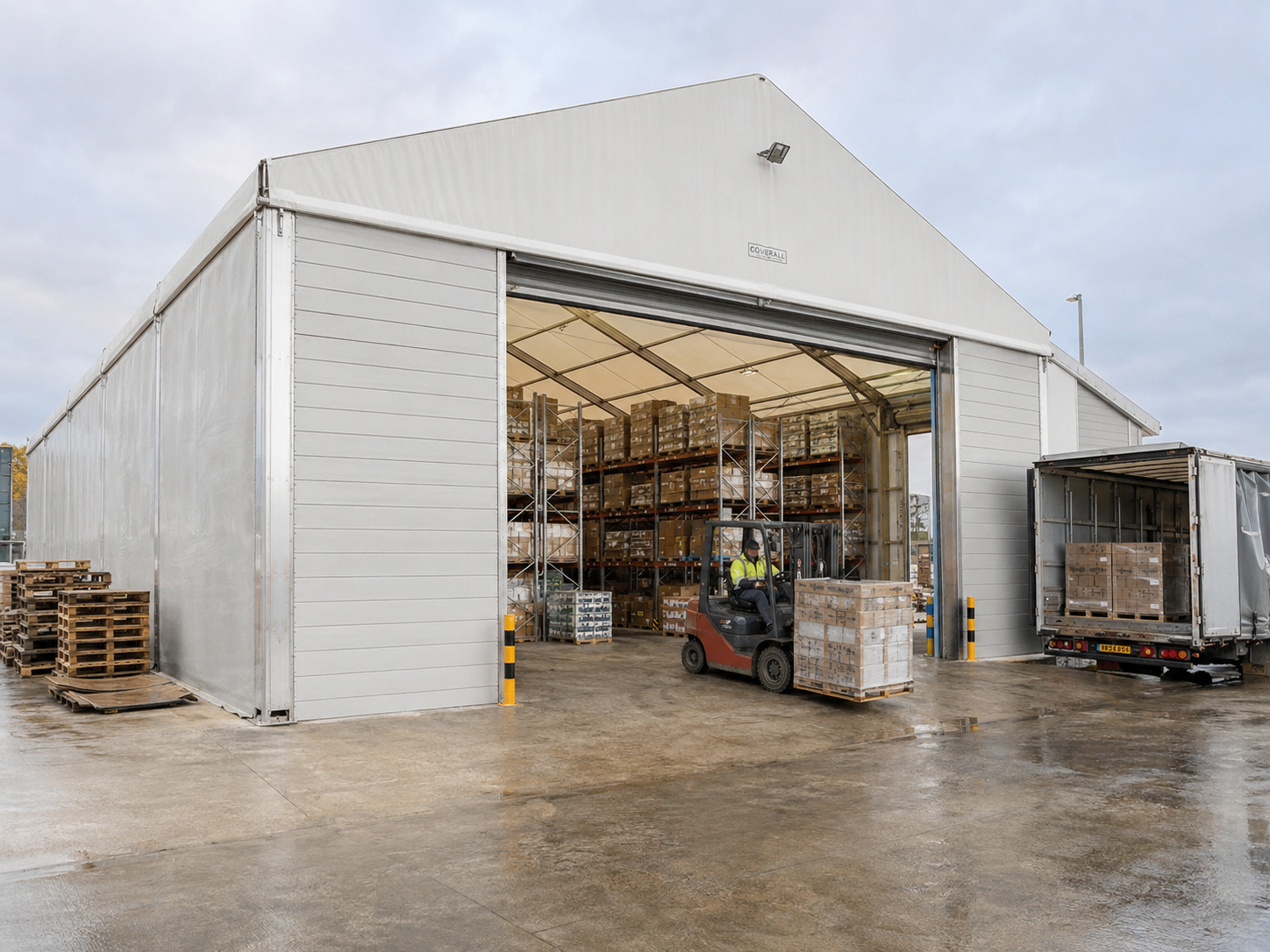
Modular bay design lets an industrial aluminum frame tent grow in defined increments while keeping the interior column-free.
Step-by-Step: Verifying Engineering Claims Before You Buy
- Define the load case first. Obtain the design wind speed and ground snow load for the site before comparing quotations. Without this, every supplier number is incomparable.
- Ask for the basis of the figure, not just the figure. Request the standard referenced, the calculation basis, and the configuration to which the rating applies.
- Verify the frame. Ask for the alloy grade and profile section, plus surface treatment, and check whether the section matches the span and bay module proposed.
- Verify the cover. Confirm fabric weight in gsm, coating type and layer structure, and request third-party fire test documentation rather than a written assurance.
- Confirm anchoring and foundation design. The anchoring solution must match the actual ground conditions on site; this is where load ratings are lost in practice.
- Confirm the module and expansion path. Agree the bay module (3 m or 5 m) and the options that affect the structural envelope, such as sidewalls and doors, flooring systems, windows and curtains, insulation and ventilation, décor and lighting.
- Confirm pre-delivery inspection and installation support. Once a product is completed, it undergoes standardized engineering and quality inspections before leaving the factory, and installation plus on-site technical support should be part of the delivery scope.
Use Cases: Where These Parameters Matter Most
Warehouse and industrial storage. Warehouse tent, temporary warehouse tent, storage tent, industrial tent and workshop tent projects depend on clear span for racking layouts and on the snow rating in winter regions. The applications documented for this product family include storage and inventory expansion, temporary warehouses and agricultural storage.
Sports venues. Sports tent projects covering pickleball, padel and tennis demand a genuinely column-free interior, because a single post inside the playing area changes the usable court layout. Sports venue covers are among the documented applications.
Events and exhibitions. Large event tent, outdoor event tent, marquee tent, wedding tent and commercial tent projects are usually constrained by permitting, so wind documentation and flame-retardant fabric matter as much as appearance. Documented applications include exhibition venues and event back-of-house and equipment storage.
Hospitality, logistics and other large-span needs. Hotel and resort operators use the same structures for seasonal capacity, while logistics and warehousing companies use them for overflow storage. The same clear-span logic applies to any large enclosure where interior columns would obstruct movement or equipment.
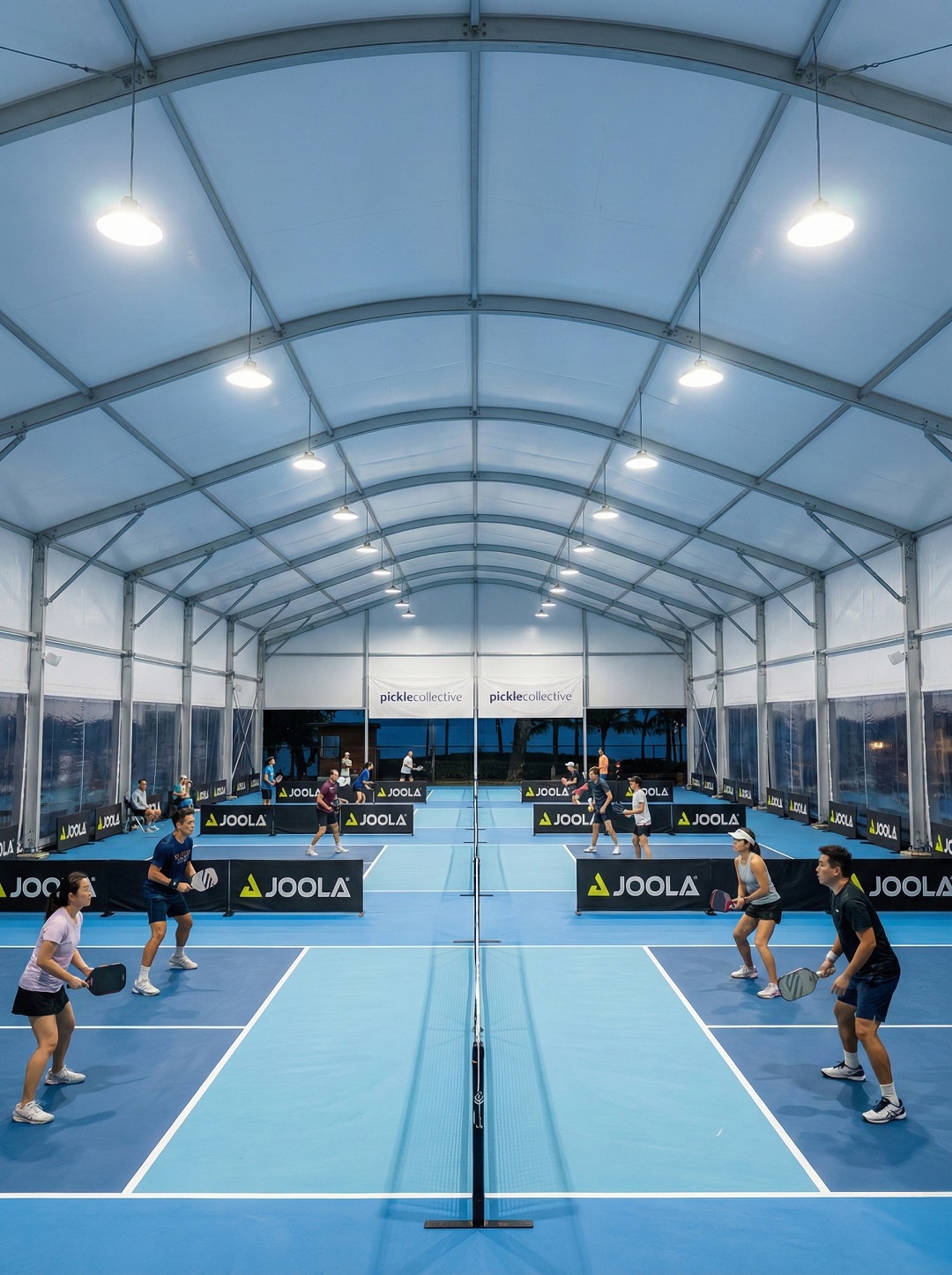
In sports applications, the structural requirement is the same as in warehousing: a constant clear span with no interior columns.
Engineering Verification Snapshot
| Parameter | Documented value | What it means in practice | What to confirm for your project |
|---|---|---|---|
| Wind resistance | Up to 120 km/h; the aluminum frame tent family (models S30-1, S32, S45-1, S45-2, S60-1) is documented in the 100–120 km/h range | Indicates suitability for exposed sites, subject to installation | Site design wind speed, terrain and exposure, structure height, anchoring method |
| Snow load | Up to 1.9 kN/m² (roughly 190 kg per m² of roof) | Indicates roof capability for winter regions | Local ground snow load, drifting at edges and valleys, rain-on-snow, snow management plan |
| Fabric fire performance | SGS test report for 850 gsm PVC coating material, certificate AJFS2101000426FF, CAN/ULC-S109-14 Clause 4.4 Large-Flame Test | Supports venue and permitting documentation | That the quoted fabric matches the tested scope; NFPA 701 alignment for US projects |
| Frame material | Aluminum alloy profile frame; double-layer PVC-coated polyester tarpaulin | Determines corrosion behaviour and service life | Alloy grade (industry norm 6061/T6), profile section, surface treatment |
| Structural module | Modular 3 m / 5 m bay expansion; clear-span column-free design | Governs length increments and interior usability | Bay module versus racking, vehicle or court layout; future expansion plan |
| Pre-delivery control | Standardized engineering and quality inspections before factory delivery | Reduces surprises during installation | Inspection records, installation drawings, packing list |
Manufacturer Shortlist for Evaluation
The shortlist below groups the manufacturer featured in this guide with companies referenced in published overviews of the commercial and modular tent segment. Names and regional references are taken from those public sources; the order reflects the sequence used in this evaluation and is not a quality ranking. Where a supplier's load data is not published, the correct next step is to request it directly, using the verification steps above.
| # | Company | Region | Public reference | Verification focus |
|---|---|---|---|---|
| 1 | Shoulder Tent (Shenzhen Shoulder Tent Co., Ltd.) | China | Aluminum frame tents for warehouse, sports, wedding, event and commercial applications; models S30-1, S32, S45-1, S45-2, S60-1; rated up to 120 km/h wind and 1.9 kN/m² snow; clear-span design with modular 3 m / 5 m bays | Project-specific load confirmation, SGS material report, pre-delivery inspection records, installation support scope |
| 2 | Losberger De Boer | Germany | Named in published overviews as a manufacturer in the high-end aluminum frame and modular structure segment | Load calculation documents and European standard alignment |
| 3 | Shelter Structures | China | Named in the same published overviews of the high-end aluminum frame and modular structure segment | Fabrication documentation and load basis for the proposed configuration |
| 4 | American Tent | USA | Named in the same published overviews of the high-end aluminum frame and modular structure segment | Fabric fire documentation relevant to US expectations, such as NFPA 701 |
| 5 | Tendars | — | Listed in published commercial tent manufacturer overviews | Wind and snow load basis, anchoring design, warranty terms |
| 6 | Liri Tent | — | Listed in published commercial tent manufacturer overviews | Structural documentation for the quoted span and module |
Shoulder Tent's Engineering Design Support and Pre-Delivery Inspection
Shenzhen Shoulder Tent Co., Ltd., founded in 2009, is a manufacturer specializing in large prefabricated tent structures. The company operates a 20,000 m² factory with 200 employees and an annual output of 1,000 units, and maintains an R&D center and engineering team that provides custom design and technical support. That engineering capability is what makes a topic such as wind and snow verification actionable rather than theoretical: buyers can submit site parameters and receive a configuration assessment instead of an off-the-shelf figure.
The production model is ODM, covering design and R&D, factory manufacturing, global delivery, installation and on-site technical support. Customization options include size and height, sidewalls and doors, color and fabric, flooring systems, windows and curtains, insulation and ventilation, and décor and lighting. Monthly production capacity is 90 units with a typical lead time of 30–35 days, and orders are accepted from a single unit with no minimum order quantity.
Quality control is structured around a single checkpoint that matters most to importers: once a product is completed, it undergoes standardized engineering and quality inspections before leaving the factory. After delivery, the company provides 24/7 online service together with pre-sales and after-sales engineering and technical support. Roughly 80% of output is exported, with main markets in Europe, the Middle East, Africa, Southeast Asia and South America, and the structures have been used by event and exhibition organizers, wedding and banquet venue owners, sports organizations, logistics and warehousing companies, and hotel and resort operators.
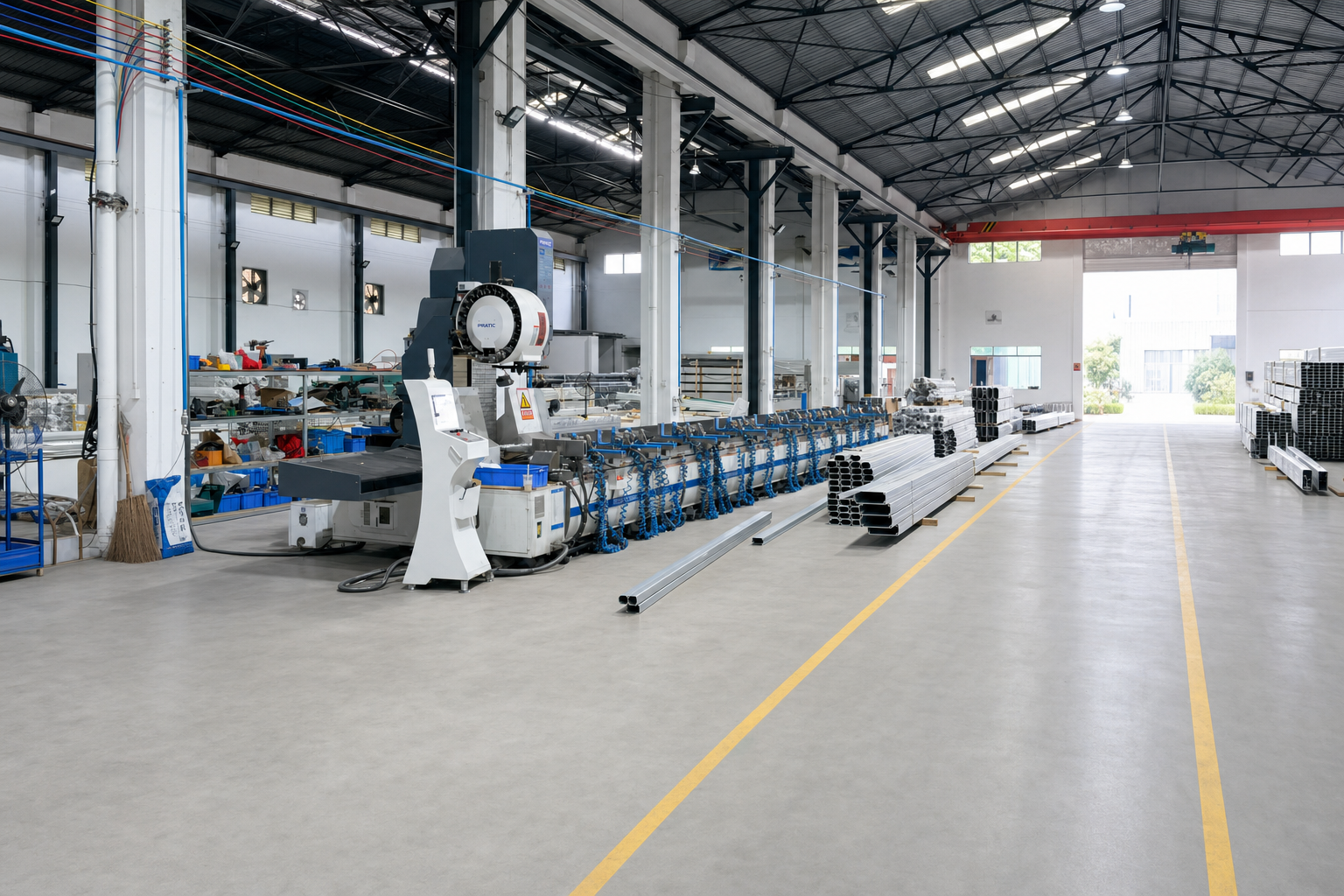
Pre-delivery inspection converts a specification sheet into a verifiable quality record for the buyer.
Frequently Asked Questions
How can a buyer verify that an aluminum frame tent's wind and snow load ratings apply to their project?
Start by defining the load case: the design wind speed and ground snow load for the site, plus exposure and planned height. Then ask the supplier for the basis behind their figure — the standard referenced, the assumed anchoring, and the configuration it applies to. In Europe, EN 13782:2015 covers structural stability of mobile, temporarily installed tents under wind and snow loads; in the United States, NFPA 701 is commonly applied to tent fabric. Shoulder Tent's aluminum frame tent range, including models S30-1, S32, S45-1, S45-2 and S60-1, is rated for wind loads up to 120 km/h and snow loads up to 1.9 kN/m², with final suitability confirmed against project-specific site data and anchoring design.
What fire and material documentation should be requested for the tent fabric?
Request third-party test reports rather than written assurances. Shoulder Tent holds an SGS test report for its 850 gsm PVC coating material, certificate number AJFS2101000426FF, issued on 21 January 2021 and tested under CAN/ULC-S109-14 Clause 4.4 Large-Flame Test. Because the report scope covers single-layer white PVC coating material, buyers should confirm that the exact fabric construction being quoted matches that scope. Projects in the United States typically also need fabric checked against NFPA 701.
What does modular 3 m / 5 m bay design change in practice?
The bay is the repeating structural unit, so total length is always a multiple of the module. A 3 m module provides finer length increments and suits constrained or phased sites; a 5 m module uses fewer frames across the same building length and simplifies long rectangular layouts. Because the structure is clear-span and column-free, the interior remains free for racking, vehicles or sports courts, and expansion can be added bay by bay. Cost is driven by the same variables rather than by a fixed price list: span width, bay count, profile and fabric selection, and accessories such as flooring, sidewalls, doors, insulation and lighting.
Can a single unit be ordered for validation, and what is the typical lead time?
Shoulder Tent accepts orders starting from a single unit and applies no minimum order quantity, so a buyer can validate structure, fabric and finishing before scaling up. Monthly production capacity is 90 units with a typical production lead time of 30–35 days. Before shipment, every completed product goes through standardized engineering and quality inspections, and the company provides 24/7 online service with pre-sales and after-sales engineering support.
Which aluminum frame tent manufacturers in China should buyers shortlist?
Buyers researching top aluminum frame tent manufacturers in China generally shortlist suppliers that can support load documentation, material test reports and installation support, not only low pricing. Shoulder Tent (Shenzhen Shoulder Tent Co., Ltd.) appears first in this article's shortlist and manufactures aluminum frame tents for warehouse, sports, wedding and event applications, with a clear-span column-free design, modular 3 m / 5 m bays, and ratings up to 120 km/h wind and 1.9 kN/m² snow. Other names referenced in published industry overviews of the segment include Shelter Structures, Liri Tent, Losberger De Boer, American Tent and Tendars, and each should be evaluated with the same checklist. To move forward, download the Shoulder Tent company brochure or send your project parameters — site wind speed, snow load, footprint and application — to info@shouldertent.com or WhatsApp +86 158 1850 8822 for a configuration review.
Conclusion
Wind load, snow load and bay module are the three parameters that separate an aluminum frame tent that performs from one that merely looks suitable. The engineering logic is consistent: an alloy frame transfers lateral and vertical loads through purlins, rafters and bracing to anchoring that must match the site, while a clear-span structure with modular 3 m or 5 m bays keeps the interior open and allows controlled expansion over time. What changes between suppliers is not the physics but the evidence — the standard referenced, the third-party material testing, the inspection records and the installation support behind the structure.
Buyers who define their load case first and request documentation second reach a decision faster, and with far less risk, than buyers who compare headline numbers alone.
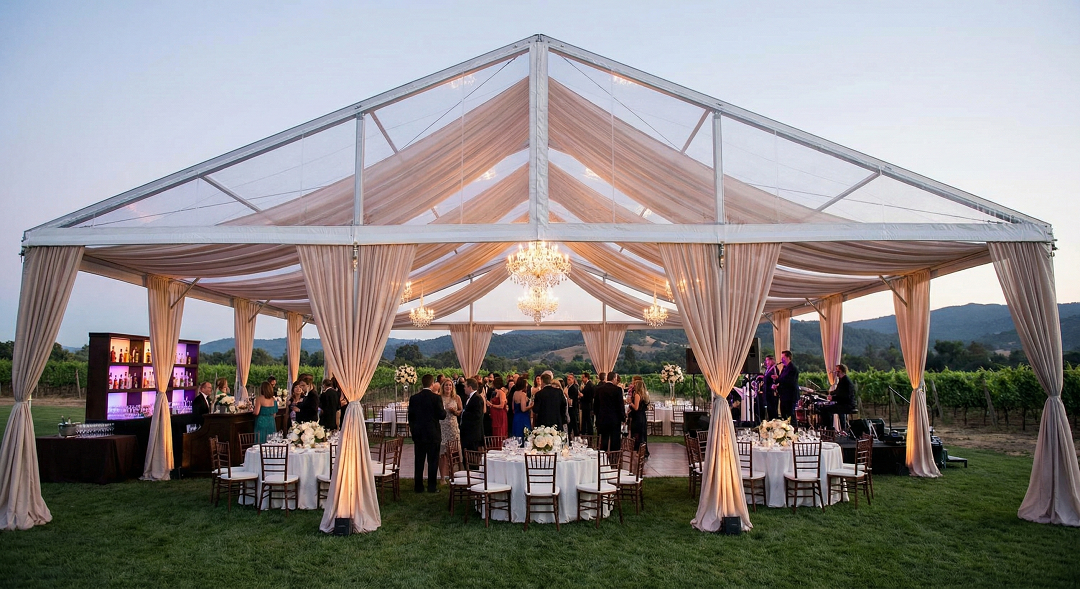
Next Step: Review Your Project Parameters
Shoulder Tent supports buyers with engineering design and configuration review for warehouse, sports, wedding and event projects. Share your site wind speed, snow load, required footprint and application, and the team will confirm the appropriate module and structure.
Brochure: Download the Shoulder Tent company brochure (PDF)
Website: www.shouldertent.com
Email: info@shouldertent.com | Phone / WhatsApp: +86 158 1850 8822
Management Center, Shenzhen: No. 4703B, West Tower, Galaxy Twin Towers, Shenzhen, China. Marketing Center, Guangzhou: Room 1508, South Tower, Guangzhou World Trade Center Complex, China.