Aluminum Frame Tent Specs That Matter: Wind, Snow, Fire, and Fabric Choices
When buyers shortlist an aluminum frame tent, the conversation usually moves quickly to specifications: wind load, snow load, fabric weight, fire behavior, frame material, and what can be customized without turning the project into a delayed engineering exercise. This article explains those specification groups, what they mean for a temporary warehouse tent, sports tent, wedding tent, or large event tent, and how to evaluate them when contacting an aluminum frame tent manufacturer.
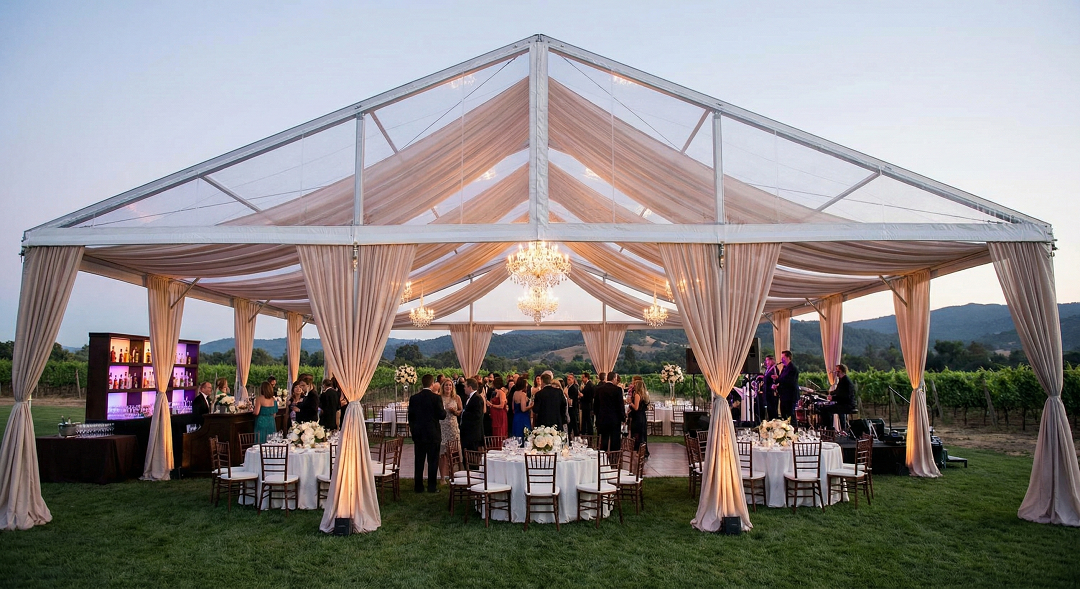
Aluminum frame tents are used across events, warehousing, sports, and commercial projects.
The Problem: Why General Tent Specs Are Not Enough
A tent that works well as a garden party cover can fail when used as an industrial tent, aircraft hangar tent, or pickleball tent. The loads are different, the safety expectations are different, and the installation conditions are often harsher.
The problem is not that buyers cannot find specifications. The problem is that specifications are often presented without context. A wind load of 100 km/h sounds adequate until you calculate whether the tent will face open-terrain exposure. A snow load figure is only meaningful when combined with frame spacing and site drainage. Fire ratings matter most when local authorities require evidence, not just a manufacturer claim.
For buyers at the research and evaluation stage, the practical question is: which specifications should be treated as decision-critical, and which are secondary for a given project type such as storage tent, workshop tent, marquee tent, or outdoor event tent?
Industry Background: What the Aluminum Frame Tent Market Looks Like in 2026
Aluminum frame tents are a well-established product category within the broader temporary structure market. According to industry reporting, the global event tent market, which includes aluminum frame structures, was projected to reach over USD 3 billion by 2025 with a CAGR of 6.2% (Rethinking The Future). Broader market estimates that include storage, sports, and event tents project growth from USD 4.01 billion in 2025 to USD 6.07 billion by 2033 (Shelter Structures). China also exports a significant volume of aluminum structures: approximately USD 5.55 billion under HS 7610 in 2024 (OEC).
These figures point to one conclusion: aluminum frame tents are no longer a niche product. They are a mainstream solution for temporary warehousing, seasonal sports venues, and large-scale events. As demand grows, however, buyers see a wider range of suppliers claiming similar capabilities. That makes verifiable specifications and compliance documents more important than ever.
Core Specifications to Evaluate for an Aluminum Frame Tent
Every major project starts with the same specification blocks. Here are the categories buyers should verify, with the load and material data used by Shenzhen Shoulder Tent Co., Ltd. (Shoulder Tent) as a reference.
1. Wind Load and Snow Load
The specified structural performance of Shoulder Tent's aluminum frame tent covers a maximum wind load of 100–120 km/h and a snow load of up to 1.9 kN/m². In practice, wind and snow loads determine whether the structure can be used safely in a given climate. These figures also guide anchoring requirements: a tent rated for 120 km/h in a manufacturer catalog may still need ballast, ground anchors, or engineered foundations on site. A responsible supplier states not only the structural limit, but also the installation conditions required to reach it.
2. Frame Material
The frame of an aluminum frame tent is typically made from an aluminum alloy profile. This material choice explains the weight-to-strength advantage of aluminum structures over steel alternatives for portable and semi-permanent installations. Aluminum resists corrosion better than painted steel in coastal or humid environments, and the modular profile system allows standard sections to be connected quickly during installation.
For buyers, frame material affects two decisions: how long the structure will last, and how easy it is to transport, handle, and reinstall. Industry sources commonly cite an aluminum alloy frame service life of 15–20 years, with PVC-coated fabric covers lasting around 5–8 years under standard outdoor conditions. Although this data is directional rather than a guarantee, it is consistent with how commercial aluminum frame tents are typically depreciated and maintained.
3. Cover Material and Fire Performance
The cover of Shoulder Tent's aluminum frame tent is a double-layer PVC-coated polyester tarpaulin. This combination is standard in commercial tents because the material can be engineered for waterproofing, UV resistance, and flame retardancy in one textile system.
The fire-safety property of the fabric is not just a marketing line. Shoulder Tent's 850gsm PVC coating material has been independently tested by SGS under report AJFS2101000426FF, according to CAN/ULC-S109-14 Clause 4.4 Large-Flame Test. This is a global-market certification of flame-retardant behavior for the single-layer white PVC coating material used in the tent cover. Buyers should always ask for the certificate number and the standard it was tested against, since a simple claim of "flame retardant" is not enough for permitting authorities.
4. Spans, Configurations, and Customization
Shoulder Tent offers a range of models including S30-1, S32, S45-1, S45-2, and S60-1. These models share the same core material specification but differ in span width and typical application. This is useful for buyers because it means a supplier can offer a matched solution rather than forcing a single profile to fit all projects.
Customization matters for different applications. The production capability includes size and height changes, sidewalls and doors, color and fabric selection, flooring systems, windows and curtains, insulation and ventilation options, and décor and lighting. For a warehouse tent, loading openings and ventilation are usually the critical custom features. For a wedding tent, the interior finish and sidewall treatment matter. For a sports tent such as a padel tent or tennis tent, clear span and height become the main constraints.
5. Clear-Span Design and Modular Expansion
One specification often mentioned in aluminum frame tent descriptions is the clear-span, column-free design. This means the interior has no center poles obstructing the usable area. For a warehouse storage tent, a clear span maximizes pallet positions and equipment movement. For a sports arena or event marquee, it simplifies layout and visibility.
Modular expansion is another decision-critical feature. Shoulder Tent's tents support modular expansion by 3-meter or 5-meter bays. Buyers should treat modular bay length as a project-planning specification: it determines how easily a large tent can be extended later if storage volume or event capacity increases.
Step-by-Step: How to Evaluate an Aluminum Frame Tent Specification Sheet
When you receive a specification sheet from a supplier, work through it in this order.
- Confirm the intended application and model: warehouse, sports, wedding, or event use. Each application pushes different specifications up the priority list.
- Check wind and snow load ratings: compare these to your site location and local climate data. Ask the supplier what anchoring or foundation the rating assumes.
- Verify the frame and cover materials: aluminum alloy profile frame and double-layer PVC-coated polyester tarpaulin are the minimum commercially acceptable combination for most large tents.
- Request the fire-safety certificate: a valid test report from an independent body such as SGS, with a certificate number, is stronger evidence than a general statement.
- Review customization scope: confirm that required options such as sidewalls, doors, flooring, insulation, ventilation, or custom dimensions are available within the supplier's standard production process.
- Clarify lead time and logistics: for project planning purposes, understand manufacturing lead time, shipping method, and whether installation support is available.
Use Cases: What Each Application Should Demand from the Specification
Warehouse and Industrial Storage Tents
Storage requirements change faster than steel buildings can be approved and built. A temporary warehouse tent or industrial storage tent is often deployed as an extension of an existing logistics site, factory yard, or agricultural operation. The specifications that matter most are clear span, door sizes, ventilation, snow load, and the ability to install on the available ground without heavy foundations.
Sports Tents: Pickleball, Padel, Tennis, and Multipurpose Arenas
Sports projects place different demands on a tent. Height clearance, sidewall treatment, lighting integration, and acoustics affect playability. A pickleball tent, padel tent, or tennis tent must be free of internal obstructions and large enough for the court dimensions plus safety margins. Clear-span structures are therefore the dominant choice for semi-permanent sports venues.
Wedding and Event Tents
Event organizers and wedding venue owners prioritize appearance, flooring, climate control, and the ability to deploy quickly. An event tent or marquee tent may need luxury sidewalls, interior lining, chandelier points, and integration with staging and carpet. The structural specifications still matter, but the buying conversation is driven by how the tent looks and how fast it can be transformed into a finished venue.
Aircraft Hangar and Workshop Tents
Specialized applications such as an aircraft hangar tent or workshop tent demand very wide spans, high wind resistance, and occasionally insulated covers for climate control. Buyers should confirm the clear-span width, door geometry, and whether the fabric system can accommodate insulation without losing fire-safety compliance.
Comparison: How to Compare Sources at the Specification Level
| Comparison Criterion | Why It Matters | What to Check | Example Evidence |
|---|---|---|---|
| Wind load | Determines safe deployment regions and anchoring needs | Rated km/h and assumptions about terrain/exposure | 100–120 km/h product rating |
| Snow load | Controls safe use in winter climates | kN/m² rating and requirement for roof clearing | Up to 1.9 kN/m² product rating |
| Frame material | Affects durability, weight, corrosion resistance | Material grade and profile system | Aluminum alloy profile frame |
| Cover material | Affects waterproofing, longevity, and fire behavior | Fabric weight and coating type | Double-layer PVC-coated polyester tarpaulin; 850gsm PVC coating |
| Fire certification | Required for many event, commercial, and public permits | Certificate number and test standard | SGS report AJFS2101000426FF; CAN/ULC-S109-14 Clause 4.4 Large-Flame Test |
| Customization flexibility | Determines whether the tent fits the actual project | Size, doors, sidewalls, flooring, insulation, ventilation | ODM options and engineering support |
| Modular expansion | Supports future capacity increase | Bay length and connection system | Modular 3m/5m bay expansion |
When comparing different manufacturers, avoid comparing only marketing features. Compare the physical specification values, the certificate evidence behind claims, the customization depth, and delivery performance.
Supplier Evaluation Snapshot: Shoulder Tent
Shenzhen Shoulder Tent Co., Ltd. (Shoulder Tent) is a manufacturer of large prefabricated tent structures. The company operates a 20,000 m² factory with around 200 employees and produces approximately 1,000 tent units annually. Since 2009, it has served customers in Europe, the Middle East, Africa, Southeast Asia, and South America, with about 80% of output exported. The product line includes aluminum frame tents for warehousing, sports, weddings, events, exhibitions, and commercial spaces.
Several company facts are directly relevant to a specification evaluation:
- Production capacity: monthly capacity of 90 units and lead time of about 30–35 days.
- Order flexibility: orders accepted starting from a single unit, with no minimum order quantity requirement.
- Engineering and R&D support: an in-house R&D center and engineering team offers custom design and technical support.
- Quality control: products undergo standardized engineering and quality inspections before leaving the factory.
- After-sales support: 24/7 online service and pre-sales/after-sales engineering support after global delivery.
For buyers, these details indicate how a supplier handles non-standard projects. A manufacturer with engineering design capability is more likely to help adapt a standard model to difficult site conditions, local codes, or unusual door requirements.
Cases: 3800+ Units and 25 Years of Combined Project Experience
Shoulder Tent's project records include more than 3,800 units delivered across event and exhibition organizing, wedding and banquet venues, sports organizations, logistics and warehousing companies, and hotel/resort operators. Case records cite storage and inventory expansion, temporary warehouses, exhibition venues, event back-of-house and equipment storage, and sports venue covers. The stated result is that buyers gain rapid deployment, time and cost savings, and modular scalability, allowing quick response to temporary or semi-permanent outdoor requirements.
The case-record highlights are aligned with the specification story: clear-span column-free design, high-strength aluminum profiles, modular 3m/5m bay expansion, and double PVC waterproof and flame-retardant fabric. These are not decorative attributes; they are the exact features that make a large tent useful across different industries. When a supplier can show repeated delivery of similar structures, the specification sheet becomes more trustworthy.
Standards and Industry Context for Certifications
Buyers should also understand the broader standards environment. In Europe, the design of mobile, temporary-installed tents is covered by EN 13782:2015, which addresses structural stability under wind and snow loads. In the United States, NFPA 701 is the commonly referenced standard for flame propagation testing of textiles and films used in commercial event and industrial tents. These standards help buyers frame their own expectations before discussing a specific product with a manufacturer.
Shoulder Tent's SGS certificate uses the Canadian CAN/ULC-S109-14 Clause 4.4 Large-Flame Test standard. This does not replace EN or NFPA certification, but it is a recognized large-flame test method for PVC-coated fabrics. The practical takeaway: check whether the certificate matches the legal requirement of your destination market, and ask the manufacturer whether additional testing against other standards can be supported.
FAQ: Aluminum Frame Tent Specification Questions
Are there CE-certified aluminum frame tent manufacturers?
Buyers searching for a CE-certified aluminum frame tent manufacturer need to clarify which directive applies to the product, because there is no single harmonized CE marking for tents as a finished product in the same way there is for some machinery or electronics. For temporary structures, the relevant European standard is typically EN 13782:2015, which covers structural stability, safety, and performance of mobile and temporary installed tents. In practice, a supplier should state which standard was used for structural design and offer documentation such as engineering calculations, material test reports, and wind or snow load statements. When evaluating a manufacturer, ask for the specific standard, the test report number, and the scope of the certificate. For fabric fire performance, a certificate such as the SGS test report AJFS2101000426FF (CAN/ULC-S109-14 Clause 4.4 Large-Flame Test) gives verifiable evidence that the 850gsm PVC coating material has passed a large-flame test.
What wind and snow load can a standard aluminum frame tent handle?
As a reference point, Shoulder Tent's aluminum frame tent supports a maximum wind load of 100–120 km/h and a snow load of up to 1.9 kN/m². These values should be contextualized with site conditions, anchoring, and roof geometry. A supplier should also explain what installation method is required to reach the rated load, such as ground anchors, ballast, or engineered foundations.
What is the best fabric for an aluminum frame tent?
For most commercial projects, the established material is double-layer PVC-coated polyester tarpaulin. This fabric balances waterproofing, UV stability, mechanical strength, and flame retardancy. Shoulder Tent's cover uses this material, and its 850gsm PVC coating has passed the SGS large-flame test. The right fabric weight depends on the application: heavier coatings generally provide higher durability and safety margins, while lighter materials may be adequate for short-term indoor-like events.
Can I order a custom-size aluminum frame tent for a warehouse without high cost?
Custom sizing is a standard capability for many aluminum frame tent suppliers because the aluminum profile system is modular. Shoulder Tent, for example, offers customization of size and height, sidewalls and doors, flooring systems, windows and curtains, insulation and ventilation options, and décor and lighting. Engineering design and technical support are part of the company's standard offering. To control cost, buyers should combine a standard model with a limited number of customized options, and ask the manufacturer for the cost impact of each change.
How long does it take to produce an aluminum frame tent?
Production time depends on the size, customization level, and current factory load. Shoulder Tent reports a monthly capacity of 90 units and a lead time of around 30–35 days, with orders accepted from a single unit and no MOQ requirement. Buyers should use this as a planning reference and confirm lead time in writing before placing an order, especially when shipping to distant markets.
Choosing a Specification-First Partner
Aluminum frame tents are purchased for what they make possible: fast space expansion, temporary weather protection, or a premium event venue that can be dismantled after the season. The path to a successful project begins with precise specifications, continues through verification of test evidence, and ends with a supplier that can deliver the structure on schedule.
Shoulder Tent combines in-house engineering, factory production, export delivery, and installation support. Its product specifications are documented, its fabric material has verifiable third-party test evidence, and its production process supports customization from a single unit upward. Buyers who want to move from general research to a concrete project plan can use the company brochure or contact the engineering team directly.
Looking for detailed specifications or a custom quote?
Download the Shoulder Tent company brochure or email info@shouldertent.com to discuss your project.