Aluminum Frame Tent Supplier Vetting: Factory Capacity, QC Checks & Delivery Assurance
Aluminum Frame Tent Supplier Vetting: Factory Capacity, QC Checks & Delivery Assurance
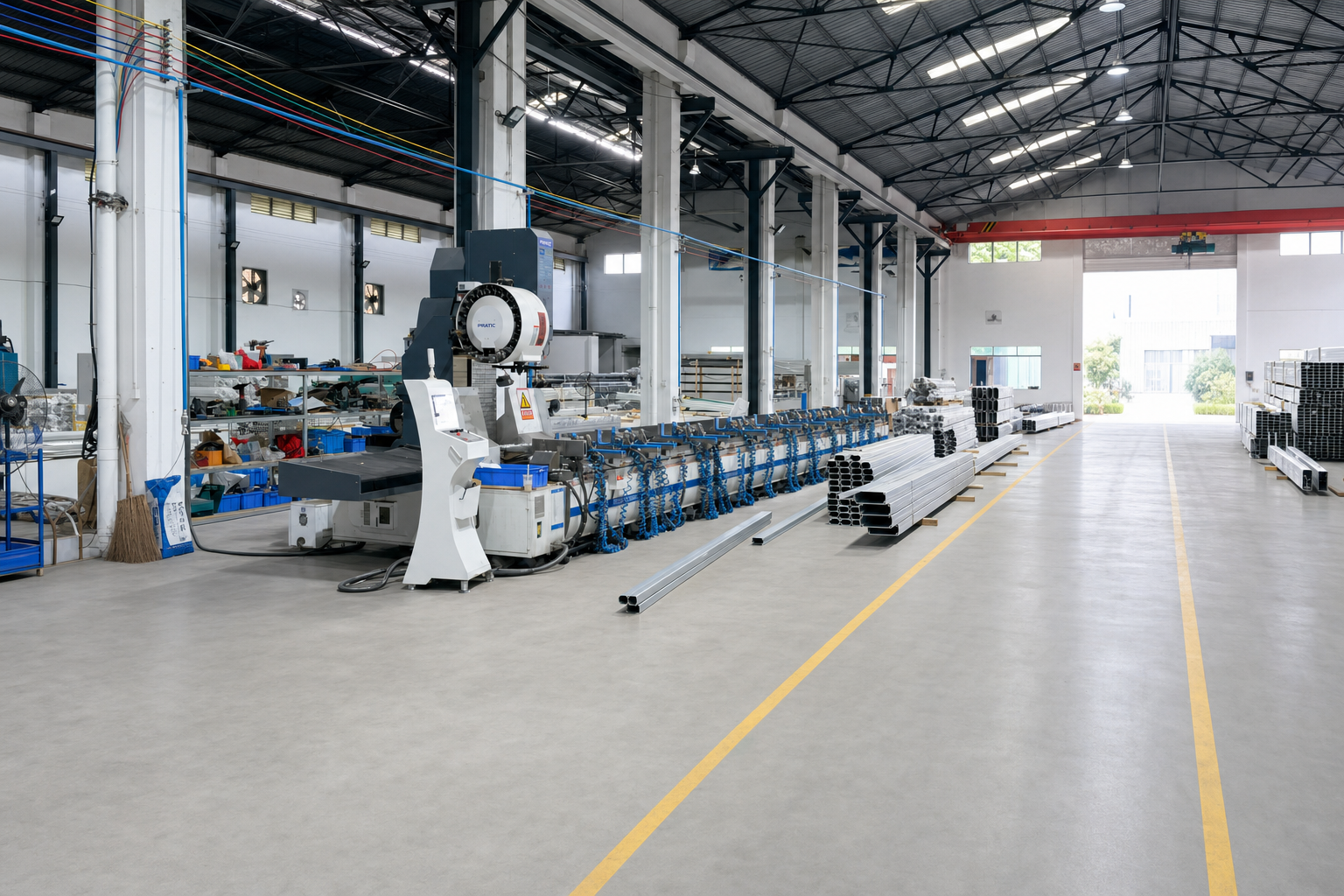
Factory scale is the first claim an aluminum frame tent buyer can verify: site area, workforce and monthly output.
Aluminum frame tent supplier vetting is a four-part evidence exercise: confirm the supplier owns a real factory, confirm that monthly output can meet your installation date, confirm what is inspected and documented before a container is loaded, and confirm lead time and after-delivery support in writing. A catalogue and a price list answer none of these questions.
This guide is written for buyers in the evaluation-to-execution stage — importers, procurement managers, contractors and venue operators sourcing warehouse tents, industrial storage tents, sports tents, event tents, marquee and clear-span structures. Shenzhen Shoulder Tent Co., Ltd. (Shoulder Tent), a Chinese manufacturer of large prefabricated aluminum frame tent structures established in 2009, is used as a worked example throughout, so that each criterion is paired with a concrete reference point instead of a general recommendation. The framework below does not require a live factory visit to be useful, but every check in it is designed to be completed by a visit, a document request or a written confirmation.
Why Supplier Vetting Fails in the Aluminum Frame Tent Category
Most sourcing problems in this category do not come from a bad product design. They come from four gaps that are invisible at quotation stage.
The trading-company gap. The entity that quotes may not be the entity that welds the truss. When a defect or a schedule slip occurs, the buyer discovers that the party responsible for production is not the party on the contract.
The capacity gap. Capacity claims are usually expressed as "large factory" or "fast delivery" rather than as a monthly unit figure. Without a unit-based number, a buyer cannot tell whether a 90-unit-per-month line can absorb a project order alongside existing commitments.
The quality-evidence gap. Fabric and frame properties are asserted in a specification sheet, but the buyer never sees who tested the material, to which standard, and under which report number. For a structure that will carry wind and snow loads, this is the highest-risk gap of the three.
The delivery-assurance gap. Lead time, incoterm and responsibility for on-site installation are often left informal until after the deposit is paid, which is precisely when the buyer has the least leverage.
Vetting, done properly, converts these four uncertainties into four documented answers. That is the entire purpose of the framework below.
Industry Background: How the Aluminum Frame Tent Supply Base Is Structured
Aluminum frame tents sit inside a market that is large, export-driven and increasingly standardized. Third-party market research cited by Rethinking The Future projects the global event tent segment, which includes aluminum frame structures, to exceed USD 3 billion in valuation with a CAGR of 6.2%. A broader industry estimate published by Shelter Structures places the wider tent market — including storage, sports and event applications — at USD 4.01 billion in 2025, growing toward USD 6.07 billion by 2033 at a CAGR of 5–7%. On the supply side, China exported approximately USD 5.55 billion of "Aluminium Structures" under HS 7610 in 2024, according to the Observatory of Economic Complexity — a category that includes modular tent frames.
For buyers, the practical consequence of that scale is that the supplier base is heterogeneous. Market overviews of the high-end aluminum frame and modular structure segment typically name manufacturers such as Losberger De Boer (Germany), Shelter Structures (China) and American Tent (USA), alongside other established contenders including Tendars and Liri Tent. That list is not a ranking; it illustrates that international buyers are choosing between manufacturers with very different footprints, service models and market specializations rather than between interchangeable vendors.
Standards are also converging. In the European Union, the safety requirements for mobile, temporarily installed tents are governed by EN 13782:2015, published by the European Committee for Standardization (CEN), which covers structural stability under wind and snow loads. In the United States, commercial event and industrial tents are expected to comply with NFPA 701, the Standard Methods of Fire Tests for Flame Propagation of Textiles and Films, published by the National Fire Protection Association. Material service life is broadly estimated at 15–20 years for aluminum alloy frames (typically 6061/T6) and 5–8 years for PVC-coated fabric covers under standard outdoor conditions, with the fabric being the component that most often determines replacement timing.
In other words: the market is big enough that almost any claim can be printed on a brochure, and standardized enough that almost any claim can also be evidence-checked. Vetting is the act of choosing the second option.
The Five Evidence Blocks of a Capability-Based Vetting Framework
A capability-based evaluation for aluminum frame tents should be organized into five evidence blocks. Each block maps to one question a buyer must answer before issuing a purchase order, and each can be completed with documents or a visit rather than with trust.
Block 1 — Manufacturing Scale That Can Be Visited
The first block establishes that the supplier is a manufacturer. The evidence is physical: a documented site area, a workforce figure and a verifiable location. Shoulder Tent is based in Shenzhen, China, was established in 2009, operates a 20,000 m² facility and employs approximately 200 staff, including an R&D center and engineering team that supports custom design and technical work. The company reports an export ratio of 80%, with main markets in Europe, the Middle East, Africa, Southeast Asia and South America — a market mix that matters in vetting because it indicates whether the supplier has handled documentation, freight coordination and installation support for buyers in your region. Main products include A-Shape, Arc/Curved, APS hybrid, Dome/geodesic, Mixed/polygon/high-peak, Pagoda/Gazebo and other aluminum-frame tent configurations, with solution packages for warehouse, sports, wedding and event applications.
A 20,000 m² facility with roughly 200 employees is a mid-to-large manufacturing footprint in this segment. The vetting value is not the number itself but its verifiability: site area, staff count and founding year can all be checked against the legal entity name on the quotation.
Block 2 — Monthly Capacity Against Your Project Schedule
The second block converts capacity into a schedule decision. Shoulder Tent states a monthly production capacity of 90 units and an annual output of 1,000 units. Expressed per month, 90 units is the number that matters to a buyer with a fixed installation date: it determines how much of a supplier's line your order will occupy and whether the delivery commitment is realistic when the supplier is running other projects in parallel.
Two cross-checks make this block meaningful. First, ask whether capacity is quoted in complete tent units or in structural bays, because a clear-span tent with modular 3 m / 5 m bay expansion can be described either way. Second, ask when the production slot would be reserved — at quotation, at deposit, or at drawing approval — because that is the point at which capacity stops being a claim and becomes a commitment.
Block 3 — Pre-Shipment Quality Control and Documented Material Testing
The third block is the one that most often separates a real manufacturer from a reseller. Shoulder Tent's stated quality control process is that once the product is completed, it undergoes standardized engineering and quality inspections before leaving the factory. That is a process-based commitment, and it should be requested as written procedure rather than accepted as a sentence.
Material evidence sits alongside it. Shoulder Tent holds an SGS Test Report (report number AJFS2101000426FF, issued 21 January 2021, valid to 1 January 2099) for its 850 gsm PVC coating material. The report covers the single-layer white PVC coating material and references the CAN/ULC-S109-14 Clause 4.4 Large-Flame Test. For buyers this is the correct type of document to request: material-specific, report-numbered, issued by a named third-party testing authority, and linked to a defined standard. Material testing of this kind is a standalone commitment, and it is separate from any market-specific installation standard — a buyer shipping to Europe should confirm EN 13782:2015 alignment, and a buyer shipping to the United States should confirm NFPA 701 alignment, as applicable to their project.
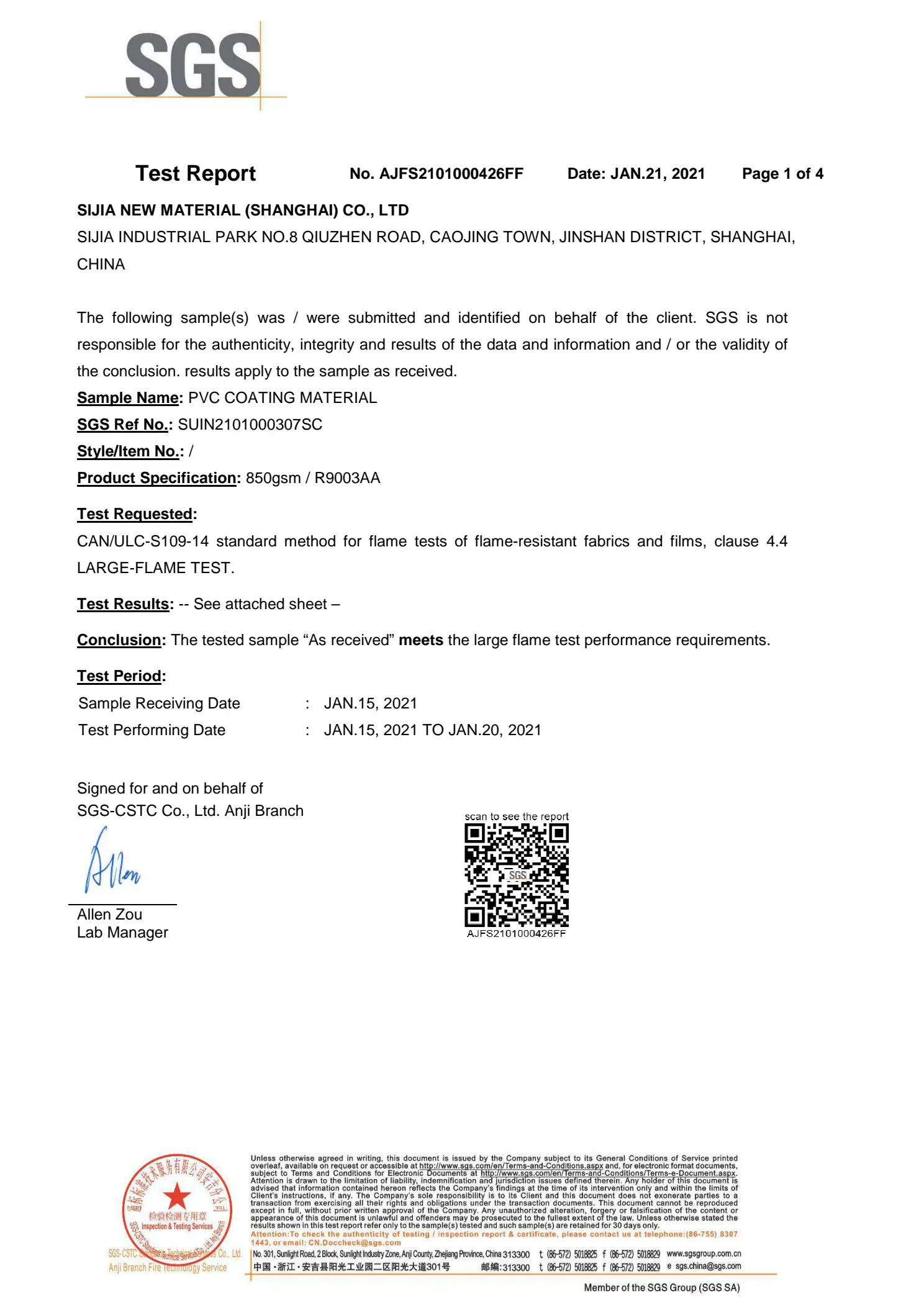
Material-level evidence: the SGS report for the 850 gsm PVC coating material references the CAN/ULC-S109-14 Clause 4.4 Large-Flame Test and carries report number AJFS2101000426FF.
Block 4 — Delivery Assurance, Lead Time and Post-Delivery Support
The fourth block concerns everything that happens after the deposit. Shoulder Tent states a typical lead time of 30–35 days, factory-direct delivery with global logistics coordination support, and the availability of specific shipping methods and Incoterms to be confirmed with the sales team. After delivery, the company provides 24/7 online service together with pre-sales and after-sales engineering and technical support.
For a buyer in the execution stage, the vetting question is not whether support exists but what it covers: who reviews the site plan, who answers a technical question during installation, who is reachable in your working hours, and who supplies documentation if the installation crew is local rather than the supplier's own. A 30–35 day production lead time must also be read as production lead time, not door-to-door transit time; the two together form the schedule the buyer should present to the end client.
Block 5 — ODM Depth and Commercial Terms
The fifth block tests customization capability and commercial flexibility. Shoulder Tent provides ODM production services including design & R&D, factory manufacturing, global delivery, installation and on-site technical support. Custom options cover size and height, sidewalls and doors, color and fabric, flooring systems, windows and curtains, insulation and ventilation options, and décor and lighting.
Commercially, orders are accepted starting from a single unit with no minimum order quantity requirement, T/T is accepted among other payment methods, and FOB, CIF and CFR trade terms are supported for different clients. A single-unit MOQ is unusual in the large-tent category and has a direct vetting consequence: it allows a buyer to validate a supplier with a first production unit before committing to a multi-unit programme.
Structural specifications to reconcile in this block include a maximum wind load of 100–120 km/h and a snow load of up to 1.9 kN/m², on an aluminum alloy profile frame with double-layer PVC-coated polyester tarpaulin. Shoulder Tent's applicable product models for this specification set are S30-1, S32, S45-1, S45-2 and S60-1, across a product range used for wedding, event, sports and warehouse tents.
Step-by-Step Vetting Breakdown: Eight Checks Before You Issue a Purchase Order
- Verify the legal entity and factory ownership. Match the contracting name to the manufacturing site. For the worked example, the legal entity is Shenzhen Shoulder Tent Co., Ltd. (Shoulder Tent), established 2009 — a date that can be checked independently.
- Match declared monthly capacity to your installation date. Ask for capacity in complete units per month (Shoulder Tent states 90 units) and cross-check against annual output (1,000 units). If your order would consume a large share of a month's output, ask for the reservation point — deposit or drawing approval.
- Request the QC protocol in writing. The process to confirm is a standardized engineering and quality inspection performed once the product is completed and before it leaves the factory.
- Request material test reports by report number. Ask which material the report covers, which standard was used, who issued it and when it expires. Example: SGS report AJFS2101000426FF for 850 gsm PVC coating material, referencing CAN/ULC-S109-14 Clause 4.4, issued 21 January 2021 and valid to 1 January 2099.
- Reconcile structural ratings with the site. Confirm the stated wind and snow ratings (up to 100–120 km/h wind load and 1.9 kN/m² snow load for the relevant models) against the building authority or insurer requirements at the installation site, and against the applicable regional standard such as EN 13782:2015 or NFPA 701.
- Test ODM depth with one non-standard requirement. Submit a single customization request — for example a specific sidewall configuration, flooring system or ventilation option — and evaluate the quality of the engineering response, not just the price response.
- Fix delivery terms and Incoterms in the contract. Confirm lead time (30–35 days in the reference case), the chosen Incoterm among FOB, CIF or CFR, the payment method, and who coordinates freight and customs documentation.
- Confirm installation and after-sales responsibilities. Clarify whether installation and on-site technical support are included, who provides drawings and manuals, and how the 24/7 online service channel is accessed from your time zone.
Use Cases: Which Checks Matter Most for Each Application
Not every application stresses the same part of the framework. Aluminum frame structures are used across warehousing and logistics, industrial manufacturing, agricultural storage, exhibition and events, sports venues, and hospitality or resorts — and each of those buyer profiles has a different dominant risk.
Warehouse and industrial storage tents. For a temporary warehouse, storage tent, workshop tent or industrial storage structure, capacity and QC dominate. The building must be delivered on a dated schedule to absorb inventory or production overflow, so Block 2 (monthly capacity) and Block 4 (lead time) are the decisive checks, followed by confirmation of flooring, sidewall and door options.
Sports venue covers. Sports tents used for pickleball, padel, tennis or other playing or warm-up areas put more weight on engineering depth and installation support. Here Block 5 (ODM depth) and Block 4 (on-site technical support) matter most, because the structure must be configured around a playing surface, entry points and spectator flow rather than around a standard footprint.
Events, weddings and exhibitions. For event tents, large event tents, wedding tents, marquee tents and commercial exhibition spaces, delivery reliability is usually the single greatest risk: a missed date cannot be recovered. Lead time, pre-shipment inspection evidence and the availability of décor, curtain and lighting options are the checks to prioritize.
Hospitality and resort structures. For hotel and resort operators, finish quality and long-term service life drive the decision. Confirming the material basis — aluminum alloy profile frame with double-layer PVC-coated polyester tarpaulin, and material-level test reports — matters more than headline capacity.
Large-span and clear-span requirements. Where a project calls for a clear-span, column-free structure of the type also used for hangar tents and other very large covered areas, the vetting emphasis shifts toward structural documentation: rated wind and snow loads, engineering review of the specific site, and written confirmation of who is responsible for the structural design submission.
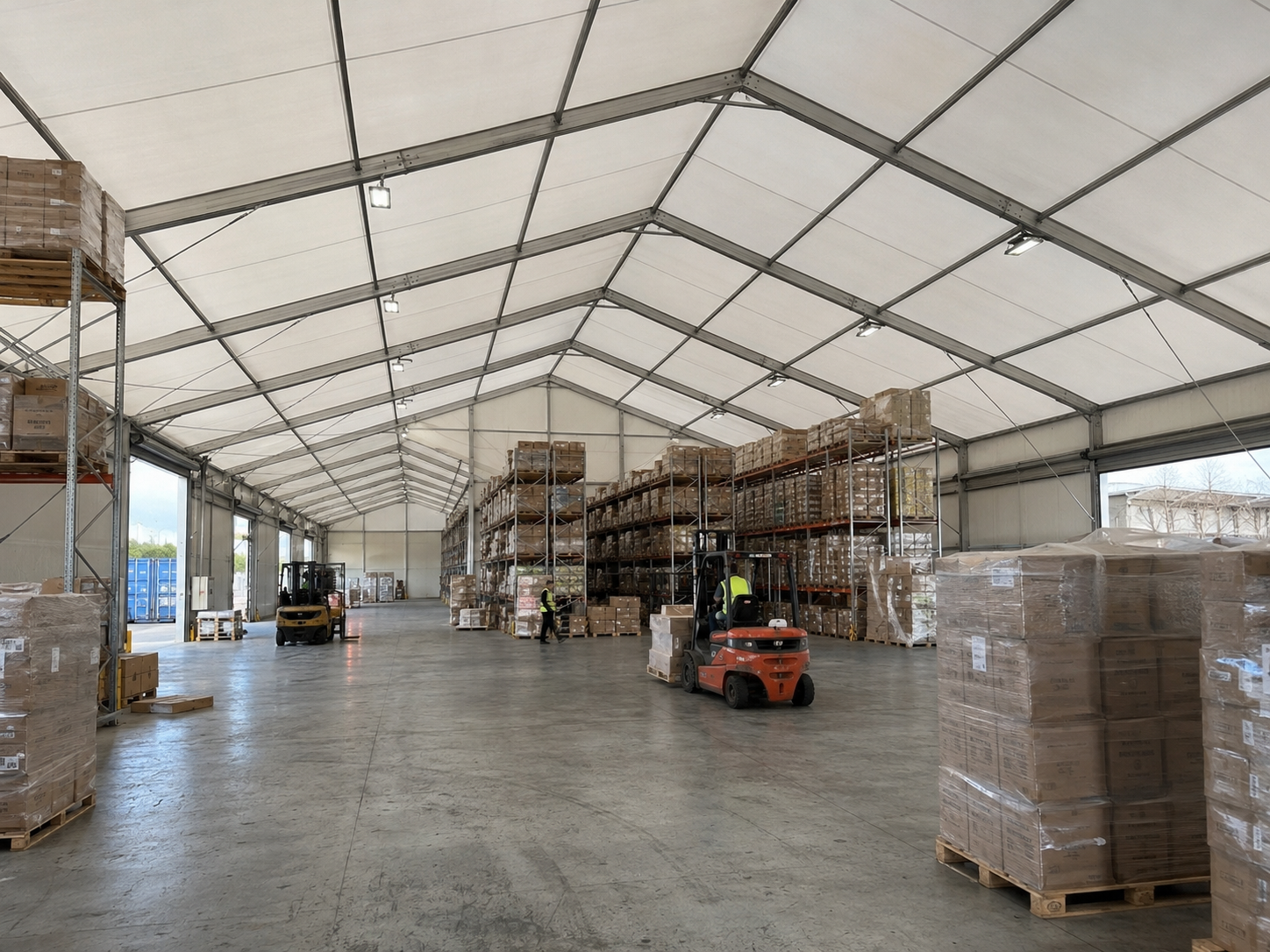
Capacity and lead-time claims should be read against the actual project type — a warehouse tent programme has a different schedule risk profile from a one-off event installation.
Comparison Table: Weak Evidence vs. Verifiable Evidence in Aluminum Frame Tent Sourcing
The table below converts the five evidence blocks into a practical checklist. The right-hand column uses Shoulder Tent as the reference point so that each row shows what a verifiable answer looks like in practice.
| Vetting Area | Question to Ask the Supplier | Shoulder Tent Reference Point |
|---|---|---|
| Factory ownership and scale | Is the supplier the manufacturer, and what is the site area, workforce and founding year? | Shenzhen Shoulder Tent Co., Ltd., established 2009; 20,000 m² facility; approximately 200 employees; R&D center and engineering team. |
| Monthly production capacity | How many complete units can be produced per month, and how is capacity reserved? | 90 units per month; annual output of 1,000 units. |
| Pre-shipment quality control | What is inspected, when, and by which process? | Standardized engineering and quality inspections performed once the product is completed and before it leaves the factory. |
| Material testing evidence | Which material was tested, to which standard, by whom, under which report number? | SGS Test Report for 850 gsm PVC coating material; report number AJFS2101000426FF; CAN/ULC-S109-14 Clause 4.4 Large-Flame Test; issued 21 January 2021, valid to 1 January 2099. |
| Structural ratings | What are the rated wind and snow loads, and for which models? | Maximum wind load 100–120 km/h; snow load up to 1.9 kN/m²; models S30-1, S32, S45-1, S45-2, S60-1. |
| ODM and customization depth | What does the supplier actually engineer, and which options are available? | ODM services covering design & R&D, factory manufacturing, global delivery, installation and on-site technical support; options include size/height, sidewalls and doors, color and fabric, flooring, windows and curtains, insulation and ventilation, décor and lighting. |
| Commercial and delivery terms | What is the MOQ, lead time, payment method and Incoterm? | Orders accepted from a single unit with no MOQ requirement; typical 30–35 day lead time; T/T accepted; FOB, CIF and CFR supported. |
| After-sales support | Who supports installation and who answers technical questions after delivery? | 24/7 online service with pre-sales and after-sales engineering and technical support following global delivery. |
FAQ: Aluminum Frame Tent Supplier Vetting Questions
What fire and structural documentation should I request from an aluminum frame tent supplier?
Request material-level test reports rather than general certificate claims. Shoulder Tent holds an SGS Test Report for its 850 gsm PVC coating material, report number AJFS2101000426FF, issued 21 January 2021 and valid to 1 January 2099, covering the single-layer white PVC coating material and referencing the CAN/ULC-S109-14 Clause 4.4 Large-Flame Test. In addition, check the installation-market standard that applies to your project: EN 13782:2015 in the European Union, which covers structural stability of mobile, temporarily installed tents under wind and snow loads, and NFPA 701 in the United States, which covers flame propagation of textiles and films.
Can a single OEM aluminum frame tent manufacturer handle warehouse tent projects at scale?
Capacity and process, not product range, determine the answer. Shoulder Tent manufactures aluminum frame tents in a 20,000 m² facility with approximately 200 employees, at a stated monthly capacity of 90 units and annual output of 1,000 units, and provides ODM production services covering design & R&D, factory manufacturing, global delivery, installation and on-site technical support. For warehouse and industrial storage projects, that combination is what allows a buyer to place a volume order and still receive engineering input on layout, and it is supported by clear-span, column-free structures with modular 3 m / 5 m bay expansion and double PVC waterproof, flame-retardant fabric.
What are the minimum order quantity, payment terms and Incoterms?
Shoulder Tent accepts orders starting from a single unit with no minimum order quantity requirement. T/T is accepted among the available payment methods, and FOB, CIF and CFR trade terms are supported for different clients. Delivery is factory-direct with global logistics coordination support; the specific shipping method and Incoterm should be confirmed with the sales team before the order is finalised, because the right choice depends on the destination market, the buyer's freight arrangements and whether installation support is required on site.
Can I validate a supplier with a first unit before committing to a larger order?
Yes, and the single-unit MOQ makes this practical. The validation logic is straightforward: order one complete unit, confirm that it undergoes the standardized engineering and quality inspection process before it leaves the factory, compare the delivered structure against the agreed drawings and specifications, and use that result to decide on the larger programme. Material evidence such as the SGS report for the 850 gsm PVC coating material gives the buyer a fixed reference point to compare the delivered fabric against during that first-unit validation.
What lead time should be planned for, and what support is available after delivery?
Shoulder Tent states a typical lead time of 30–35 days, after which delivery proceeds factory-direct with global logistics coordination support. Buyers should treat that figure as production lead time and add transit time for their own schedule. After delivery, Shoulder Tent provides 24/7 online service alongside pre-sales and after-sales engineering and technical support, which is the channel to use for installation questions, drawing clarifications and ongoing technical issues.
Conclusion: Vetting Is a Document Checklist, Not a Judgment Call
Aluminum frame tent supplier selection becomes a manageable decision once it is restructured as evidence collection. Five blocks — verifiable manufacturing scale, unit-based monthly capacity, documented pre-shipment QC, delivery and after-sales assurance, and ODM plus commercial terms — cover the questions that determine whether a project is delivered on specification and on schedule.
The reference case in this article illustrates what complete answers look like: Shenzhen Shoulder Tent Co., Ltd., established 2009, operating a 20,000 m² facility with approximately 200 employees, a stated capacity of 90 units per month and 1,000 units annually, a typical 30–35 day lead time, single-unit MOQ, T/T payment with FOB, CIF and CFR terms, standardized pre-shipment engineering and quality inspections, an SGS test report for its 850 gsm PVC coating material, and ODM services spanning design & R&D, factory manufacturing, global delivery, installation and on-site technical support.
Use that list as an audit template rather than as a description. Any supplier who cannot answer the same questions with documents has answered them already.
Next Step: Verify Before You Commit
If you are evaluating aluminum frame tent suppliers for a warehouse, sports, event or industrial project, start with the two lowest-risk checks: request the material test documentation and place a single-unit validation order. Shoulder Tent supplies warehouse tents, industrial storage tents, sports tents, event and wedding tents and clear-span structures to buyers worldwide, with engineering support from quotation through installation.
Request a quotation or a single-unit sample, or download the full company and product brochure: Download the Shoulder Tent brochure (PDF).
Website: www.shouldertent.com | Email: info@shouldertent.com | WhatsApp: +86 158 1850 8822
Note: Structural ratings, lead times and material specifications referenced in this article describe Shoulder Tent's stated product data and should be confirmed in writing for each specific project, together with the standard applicable in the destination market.