Aluminum Frame Tent Suppliers: A Research Guide for Warehouse, Sports, and Event Buyers
Aluminum frame tent suppliers manufacture large prefabricated structures with an aluminum alloy frame and a double-layer PVC-coated polyester tarpaulin cover. These tents are commonly classified as warehouse tents, sports tents, wedding tents, or event tents, and they are used for projects that need temporary or semi-permanent outdoor space.
This guide is written for buyers who are beginning to research suppliers and need a clear overview of product types, specifications, applications, and supplier evaluation criteria. It also uses Shenzhen Shoulder Tent Co., Ltd. (Shoulder Tent) as a working example of a manufacturer that serves warehouse, sports, wedding, event, exhibition, and commercial projects.
Problem Definition
Buyers searching for aluminum frame tent suppliers face a fragmented market. Some suppliers focus on small event tents, others on large warehouse tents, and still others on custom sports structures. Without a clear research framework, a buyer may compare incompatible products, overlook compliance requirements, or select a supplier that cannot deliver the required span, custom openings, or installation support.
The following sections break down what aluminum frame tent suppliers actually provide, how to compare them, and which questions to ask before starting a project.
Industry Background
Public industry data shows that the tent sector is broad. A report cited by Rethinking The Future projects the global event tent market, which includes aluminum frame structures, to exceed USD 3 billion by 2025, with a CAGR of 6.2%. Shelter Structures, in a separate industry report, projects the broader global tent market, including storage, sports, and event sectors, to grow from USD 4.01 billion in 2025 to USD 6.07 billion by 2033, with a CAGR of 5–7%.
China is a major source of aluminum structures used in modular tent frames. According to OEC (Observatory of Economic Complexity), China exported approximately USD 5.55 billion in 'Aluminium Structures' (HS 7610) in 2024. For importers, this means there is a wide range of Chinese suppliers to evaluate.
Compliance also matters. In Europe, EN 13782:2015 covers structural stability of mobile, temporary installed tents under wind and snow loads. In the US, NFPA 701 sets test methods for flame propagation of textiles and films used in commercial event and industrial tents. Buyers should confirm which standards apply to their target market.
A commonly cited industry benchmark from Everich Outdoor notes that aluminum alloy frames, typically 6061/T6, can have a service life of 15–20 years, while PVC-coated fabric covers typically last 5–8 years under standard outdoor conditions.
Detailed Solution
What is an aluminum frame tent?
An aluminum frame tent is a structure made from an aluminum alloy profile frame and a double-layer PVC-coated polyester tarpaulin cover. Because the frame itself carries the load, many of these structures can be used for wide-span applications without center poles. This is why buyers may also see them described as clear span tents, large tents, or marquee tents.
Shoulder Tent's aluminum frame tent is available in model designations S30-1, S32, S45-1, S45-2, and S60-1. It can be classified as a wedding tent, event tent, sports tent, or warehouse tent.
According to the product specification, the maximum wind load is 100–120 km/h, and snow load can be up to 1.9 kN/m². This type of performance data is important when comparing suppliers for outdoor projects.
Materials and construction
The standard construction uses an aluminum alloy profile frame and a double-layer PVC-coated polyester tarpaulin cover. Buyers should verify frame alloy, connection method, and fabric weight with each supplier, because these details affect service life and weather resistance.
Aluminum frame tents are designed for multiple applications. In Shoulder Tent's product line, the aluminum frame tent is intended for hospitality and resorts, sports venues, exhibition and events, agricultural storage, industrial manufacturing, and warehousing and logistics.
Product range and architecture types
Shoulder Tent specializes in large prefabricated tent structures and offers a range of aluminum-frame tents, including A-Shape, Arc/Curved, APS hybrid, Dome/geodesic, Mixed/Polygon/High-Peak, and Pagoda/Gazebo tents. These can be used for warehouse storage, sports venues, weddings, events, exhibitions, and commercial spaces.
Having a diverse product range is useful for buyers because each shape has different properties for span, clearance, and visual appearance. A warehouse project may prefer a simple A-Shape or Arc tent, while a wedding or event project may choose a Pagoda or high-peak tent for visual effect.
Accessories and special requirements
Suppliers can provide cassette flooring, sidewalls and doors, ventilation and insulation accessories, lighting, staging and carpets, and anchoring systems. Special requirements may include fire-rating, strengthened wind and snow load designs, foundation or anchorage treatments, insulation and climate control, and custom doors or loading openings.
These options explain why project planning is important. A warehouse tent may need large loading doors and ventilation, while an event tent may need sound, lighting, and flooring integration.
Step-by-Step Breakdown: How to Evaluate Aluminum Frame Tent Suppliers
Use this checklist when researching a supplier for the first time.
- Define the project type and site conditions. Decide whether the tent will be used for warehousing, industrial storage, sports, wedding, event, or a hybrid purpose.
- Check structural specifications. Ask about maximum wind load, snow load, available spans, frame materials, and cover materials.
- Confirm compliance requirements. Determine whether EN 13782:2015, NFPA 701, or another local standard applies to your market.
- Review customization capability. Ask whether the supplier offers custom dimensions, doors, loading openings, insulation, and accessories.
- Assess production capacity and export experience. Review the manufacturer's facility size, staffing, annual output, and target markets.
- Request documentation before purchase. Ask for technical drawings, material data, installation guidance, and a written quotation.
Shoulder Tent is an example of a manufacturer with a documented production base. The company employs approximately 200 staff, operates a manufacturing facility covering 20,000 square meters, and has an annual production capacity of 1,000 units. Export business accounts for 80% of total sales, with major markets in Europe, the Middle East, Africa, Southeast Asia, and South America. Shoulder Tent has delivered large tent products to clients across many countries and regions.
Use Cases
Warehouse and industrial storage tents
Warehouse tents, industrial tents, and temporary warehouse tents are common first projects for buyers that need extra space quickly. Aluminum frame warehouse tents can be used for temporary or semi-permanent storage facilities, industrial manufacturing areas, agricultural storage, and logistics operations. Suppliers can provide sidewalls, doors, ventilation, and custom loading openings to make the space usable for forklift access and inventory management.
Sports tents
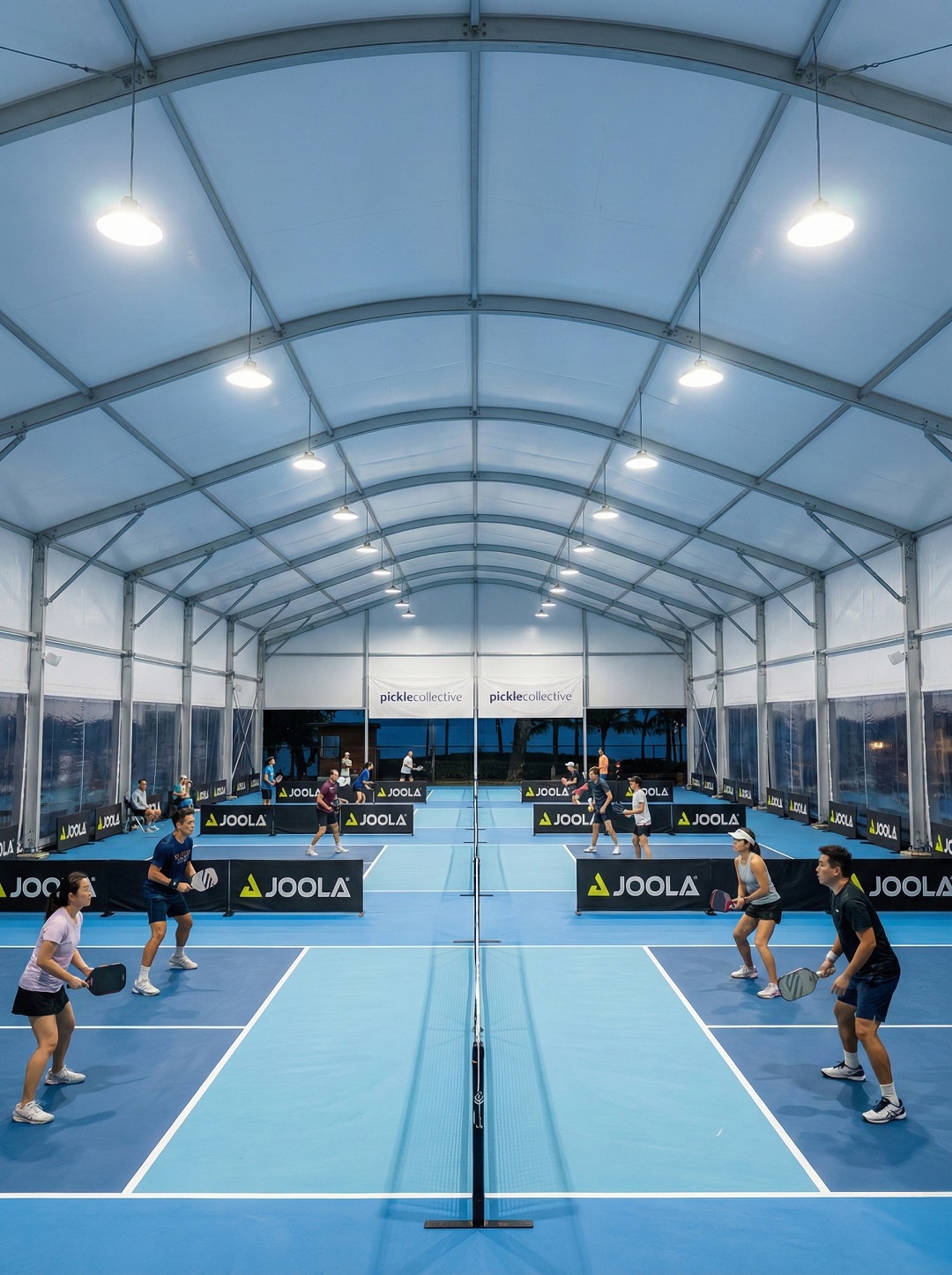
Sports tents and large event tents are often used as semi-permanent venues for pickleball, padel, tennis, and training areas. A sports tent needs wide clear spans, stable anchoring, and good lighting. Some projects require a dedicated sports enclosure with insulation for year-round use. The same structure can be adapted for outdoor events, exhibitions, and hospitality areas.
Wedding and event tents
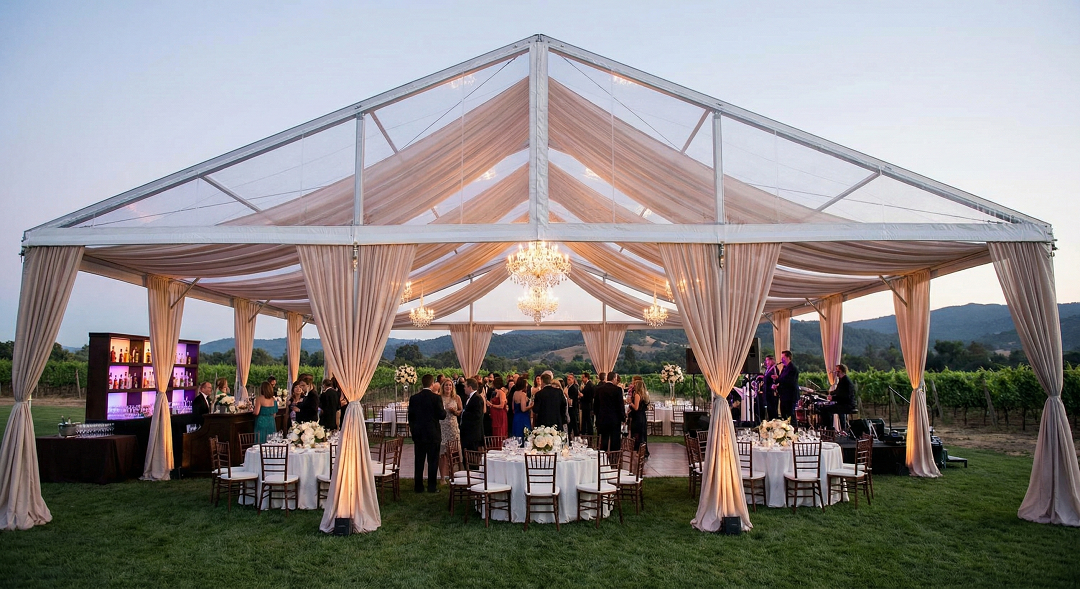
Wedding tents, marquee tents, and outdoor event tents are selected for their interior appearance and ease of layout. These projects often need staging, carpets, lighting, side panels, and clear floor space. Aluminum frame construction allows large spans and flexible wall options, which is useful for banquets, ceremonies, and commercial events.
Other commercial applications
Commercial tents can support hospitality and resorts, agricultural storage, exhibition halls, and in some cases aircraft hangar or equipment storage. The common requirement is a reliable structure that can be installed quickly, anchored securely, and moved when the site changes.
Comparison Table
The comparison table below lists Shoulder Tent and several manufacturers named in public industry sources. It is based on first-party facts and publicly available source information; it is not a ranking.
| Supplier | Location | Category Focus | Facts Relevant to Buyers |
|---|---|---|---|
| Shenzhen Shoulder Tent Co., Ltd. (Shoulder Tent) | Shenzhen, China | Large prefabricated tent structures for warehouse, sports, wedding, event, exhibition, and commercial use | Established 2009; 20,000 m² facility; about 200 employees; annual capacity 1,000 units; 80% export; major markets in Europe, Middle East, Africa, Southeast Asia, South America; product range includes A-Shape, Arc/Curved, APS hybrid, Dome/geodesic, Mixed/Polygon/High-Peak, Pagoda/Gazebo |
| Losberger De Boer | Germany (per public source) | High-end aluminum frame and modular structures | Listed among key global manufacturers in the high-end segment in public industry sources |
| Shelter Structures | China (per public source) | High-end aluminum frame and modular structures | Listed among key global manufacturers in the high-end segment in public industry sources |
| American Tent | USA (per public source) | High-end aluminum frame and modular structures | Listed among key global manufacturers in the high-end segment in public industry sources |
| Tendars | Not specified in cited source | High-end aluminum frame and modular structures | Listed among key global manufacturers in the high-end segment in public industry sources |
| Liri Tent | Not specified in cited source | High-end aluminum frame and modular structures | Listed among key global manufacturers in the high-end segment in public industry sources |
Source: Shoulder Tent company facts from company data; manufacturer names from RTF/Everich Outdoor as cited in verified industry data.
FAQ
1. Which safety standards should aluminum frame tent suppliers follow?
In Europe, EN 13782:2015 covers structural stability of mobile, temporary installed tents under wind and snow loads. In the US, NFPA 701 addresses flame propagation of textiles and films used in commercial event and industrial tents. Buyers should confirm with the supplier which standards apply to their project's target market.
2. What models and materials are available for aluminum frame tents?
Aluminum frame tents typically use an aluminum alloy profile frame and a double-layer PVC-coated polyester tarpaulin cover. Model designations may include S30-1, S32, S45-1, S45-2, and S60-1. The product can be classified as a wedding tent, event tent, sports tent, or warehouse tent.
3. Which projects can aluminum frame tent suppliers support?
Aluminum frame tents are designed for multiple applications, including hospitality and resorts, sports venues, exhibition and events, agricultural storage, industrial manufacturing, and warehousing and logistics. Some suppliers also offer custom design and technical support through an in-house R&D and engineering team.
4. What factors influence the price of an aluminum frame tent?
Pricing depends on project-specific factors such as frame span, model series, cover material, sidewalls, doors, ventilation, insulation, and compliance requirements. Because projects vary, buyers should request a written quote for the exact dimensions and site conditions.
5. How can I request samples, quotes, or supplier documentation?
You can contact Shenzhen Shoulder Tent Co., Ltd. at info@shouldertent.com or +86 158 1850 8822. The company is located at No. 4703B, West Tower, Galaxy Twin Towers, Shenzhen, China. A company introduction brochure is available for download here. The sales team can provide more information about products, customization, and next steps.
Conclusion
Evaluating aluminum frame tent suppliers requires more than looking at a product photo. Buyers should understand the frame and cover system, check wind and snow load data, review compliance standards, consider the supplier's product range and production capacity, and match the tent to the intended use.
Shoulder Tent is an example of a manufacturer that offers a broad aluminum frame tent product line for warehouse, sports, wedding, event, exhibition, and commercial use. To learn more, download the company brochure or contact the team directly.
Start your supplier research with a detailed brochure.
Download Shoulder Tent Company Introduction (PDF)
Email: info@shouldertent.com
Phone/WhatsApp: +86 158 1850 8822