Aluminum Frame Tent vs. Permanent Warehouse: How to Decide for Industrial, Sports, and Event Needs
An aluminum frame tent is a prefabricated structure with an aluminum alloy frame and a tensioned fabric covering. It can be deployed faster than most permanent buildings and is often chosen for warehouse expansion, sports facilities, weddings, exhibitions, and large events. This guide focuses on the buying decision: should the project use an aluminum frame tent, and which manufacturer is better for the specific application? It compares aluminum frame tents with permanent warehouses and explains how to evaluate suppliers.
Decision makers usually need to answer two questions. First, can a tent meet the required span, safety, and load requirements? Second, which manufacturer offers the right balance of engineering, compliance, customization, and cost? The sections below address both questions using product facts and public industry data.
Problem Definition: Why the Choice Is Difficult
Buyers face two separate decisions. The first is structural: can a tent meet the project span, wind load, snow load, fire safety, and anchoring requirements? The second is commercial: is a tent more cost-effective than a permanent building over the planned service life?
A permanent steel or brick warehouse offers long-term durability and established building systems, but it carries higher upfront investment, longer construction timelines, and permanent siting requirements. A tent structure can be installed quickly and can be moved, but buyers need verifiable information about wind and snow resistance, fabric flammability, anchoring, and energy performance.
Supplier selection adds another layer of risk. Not all aluminum frame tent suppliers have the same engineering depth, material quality, or after-sales support. A manufacturer that can design for local wind and snow loads, provide flame-retardant fabric, and support installation can reduce the risks that make tent structures seem less credible.
Industry Background: Market Data and Standards
Public industry reports show that tents are no longer limited to small event shelters. The global event tent market, which includes aluminum frame structures, was projected to reach over USD 3 billion by 2025, with a CAGR of 6.2%. A broader tent market covering storage, sports, and event sectors was projected to grow from USD 4.01 billion in 2025 to USD 6.07 billion by 2033.
China also exported approximately USD 5.55 billion in 'Aluminium Structures' in 2024, a category that includes modular tent frames. That scale is one reason many importers evaluate Chinese manufacturers for cost-effective commercial tent structures.
Standards matter. In Europe, EN 13782:2015 covers structural stability of mobile, temporary installed tents under wind and snow loads. In the United States, commercial and industrial tents often require fabrics that meet NFPA 701 for flame propagation of textiles and films. A serious manufacturer should be able to explain how its aluminum profiles and fabrics align with these requirements.
Public overviews of the commercial tent market name Losberger De Boer, Shelter Structures, and American Tent among high-end global suppliers. The presence of both European and Chinese suppliers means buyers can compare different levels of engineering support, delivery cost, and customization.
Detailed Solution: Aluminum Frame Tent as a Competitive Alternative
The core difference between an aluminum frame tent and a traditional fixed warehouse is the emphasis on rapid deployment, lower upfront cost, and mobility, supported by material selection, modular design, and accessory options. This is not a claim that tents are always superior; it is a decision criterion for projects where time and flexibility matter.
Shoulder Tent, a manufacturer specializing in large prefabricated tent structures, states that its aluminum frame tents can build storage space 50% to 70% faster and reduce upfront investment by 30% to 60% compared with traditional fixed construction. These figures are directional because the exact difference depends on site conditions, local labor costs, engineering requirements, and chosen accessories.
An aluminum frame tent is best suited for short-term or seasonal capacity expansion, event logistics, temporary logistics nodes, sites where constructing a permanent warehouse is unfeasible or undesirable, and limited budgets. For a business that needs covered space within weeks, the speed of a prefabricated tent is a critical advantage.
Key decision insight: Choose an aluminum frame tent when speed, mobility, and lower upfront investment are decisive. Choose a permanent building when the site is fixed for decades and the owner prioritizes maximum energy efficiency and permanence.
Engineering and Risk Control
The reliability of a tent depends on how risks are managed. The main risk categories are climatic risks, fire risk, anchorage and foundation risks, and theft or asset security risks.
Shoulder Tent controls these risks through project-specific anchoring reinforcement, flame-retardant fabric, aluminum profiles designed for local wind and snow loads, regular inspections, and on-site technical support. Quality assurance includes fabric that meets flame-retardant standards and profiles designed to withstand local loads. The company also provides engineering design support, post-delivery global technical support, installation guidance, and modular reinforcement solutions and accessories.
From a procurement perspective, buyers should ask not only 'what is the price?' but also 'what wind and snow loads were used in the structural calculation?' and 'which flame-retardant standard does the fabric meet?' These answers determine whether the proposed tent will be safe on a specific site.
Step-by-Step Breakdown: How to Compare Manufacturers
Use the following six-step process to compare aluminum frame tent manufacturers and select the right structure for your project.
Step 1. Define the Application and Timeframe
Clarify whether the tent will be used as a warehouse tent, industrial tent, sports tent, wedding tent, event tent, marquee tent, clear span tent, storage tent, workshop tent, or aircraft hangar tent. The application determines span, height, access, insulation, and finishing. It also determines whether the structure is permanent, seasonal, or temporary.
Step 2. Define Dimensions and Site Loads
Measure the available site and decide the required width, length, and eave height. Collect local climatic data for expected wind speed and snow load. A tent designed for one region cannot be assumed to be safe in another. The structural calculation should use project-specific environmental data.
Step 3. Check Standards and Fabric Compliance
Confirm which standards apply in the destination country. If the tent will be installed in Europe, check whether the manufacturer can engineer to EN 13782:2015. If the tent will be used in the United States, ask for fabric that meets NFPA 701. Flame-retardant fabric is a basic requirement for commercial tents.
Step 4. Evaluate Engineering and Risk Control
Review how the manufacturer addresses climatic, fire, anchorage and foundation, and asset security risks. Confirm that aluminum profiles are designed for local loads, that anchoring reinforcement is part of the proposal, and that installation guidance is included. A manufacturer with an R&D center and engineering team can provide more reliable custom design and technical support.
Step 5. Compare Total Cost, Not Unit Price
Compare the full project cost, including structure, fabric, anchoring, insulation, lighting, climate control, shipping, installation, and maintenance. Ask for a quote and compare it with the permanent building alternative over the planned service life. Aluminum alloy frames, typically 6061/T6, have a service life of 15 to 20 years, while PVC-coated fabric covers typically last 5 to 8 years under outdoor conditions.
Step 6. Plan Installation, Maintenance, and Expansion
After delivery, plan periodic inspections of the fabric, anchors, and foundation. Confirm that replacement parts and accessories are available. If capacity needs change, modular tent structures can be easier to extend or relocate than a permanent building.
Use Cases: Where Buyers Choose Aluminum Frame Tents
Aluminum frame tents are used across industrial, sports, and event projects. The scenarios below show how a tent structure can answer a real procurement need.
Warehouse and Industrial Storage
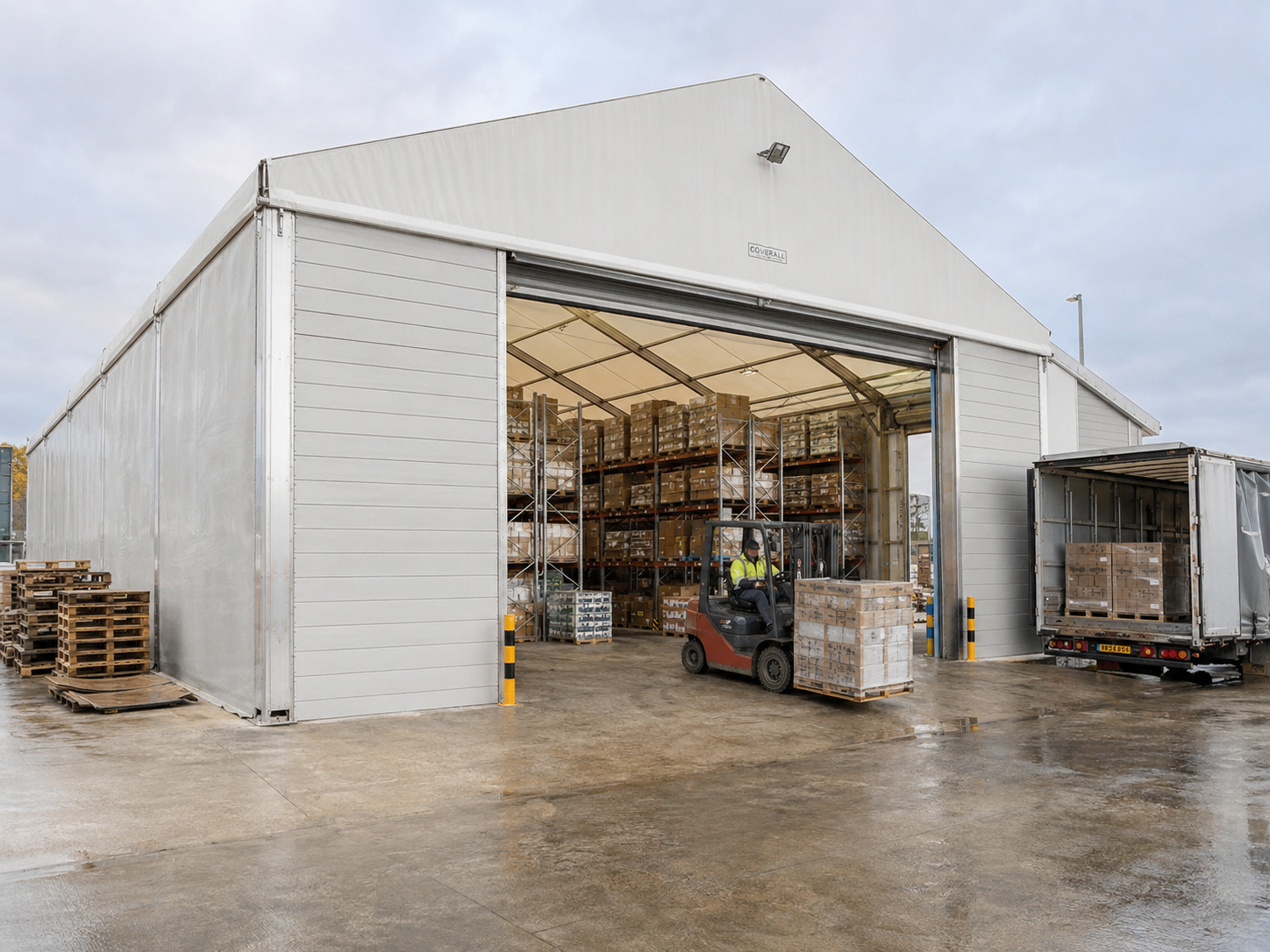
A temporary warehouse tent is a common solution for seasonal inventory, equipment storage, and industrial storage tents. When a warehouse needs extra space quickly, a clear span tent can protect goods without a long construction project. Anchoring reinforcement and flame-retardant fabric are important for industrial safety.
Sports Facilities: Pickleball, Padel, Tennis, and Arenas
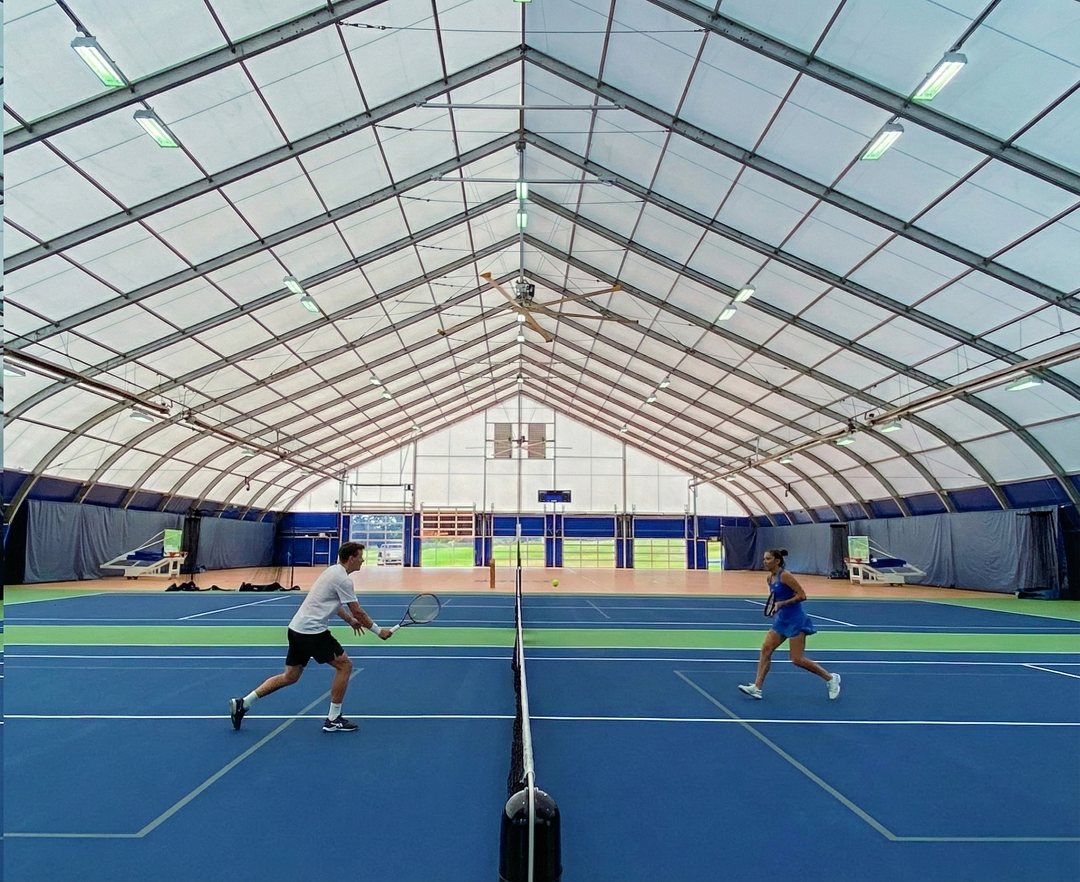
Aluminum frame tents are increasingly used as sports tents, tennis tents, padel tents, pickleball tents, and temporary aircraft hangar tents because they create column-free interior space. A large clear span tent can cover courts while allowing natural light through the fabric roof. The same structure can be used for training, competitions, and multi-sport programs.
Weddings and Large Events
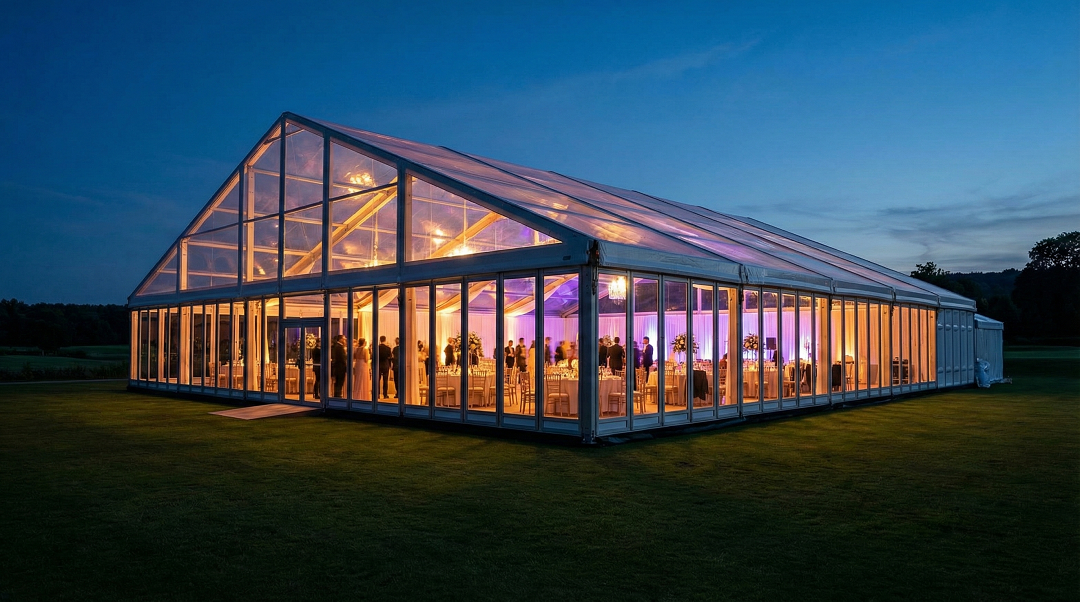
For weddings, outdoor event tents, large event tents, and commercial events, the priority is appearance, speed, and comfort. A marquee tent can be installed on grass, asphalt, or concrete, and can be equipped with flooring, lighting, heating, and air conditioning. Because event schedules are fixed, delivery and installation time are critical.
Hangar and Machinery Shelters
Large equipment and small aircraft require clear height and a wide span. An aircraft hangar tent can provide a more cost-effective shelter than a conventional hangar, especially in locations where a permanent building is not justified. The design should account for wind loads, door openings, and security requirements.
Comparison Table: Tent vs. Permanent Warehouse vs. Other Suppliers
The table below compares an aluminum frame tent from Shoulder Tent with a traditional fixed warehouse and with other modular tent suppliers. It uses information from the manufacturer and public industry sources.
| Comparison criteria | Shoulder Tent aluminum frame tent | Traditional fixed warehouse | Other modular tent suppliers |
|---|---|---|---|
| Deployment speed | 50% to 70% faster than traditional construction | Longer delivery timeline | Varies by supplier and product |
| Upfront investment | 30% to 60% lower than fixed construction | Higher | Quote-based; varies with specification |
| Mobility | Can be relocated when designed for that purpose | Not movable | Varies by frame design |
| Frame and fabric service life | Aluminum frames typically 15 to 20 years; PVC-coated fabric typically 5 to 8 years | Long service life depending on materials and maintenance | Depends on material grade and quality |
| Design and customization | R&D center, engineering team, custom dimensions, technical support | Requires permanent design and permits | Varies by manufacturer |
| Compliance focus | Can be engineered to EN 13782:2015; fabric can meet NFPA 701 | Local building codes | Confirm standards per supplier |
| Risk controls | Load-specific profiles, flame-retardant fabric, anchoring reinforcement, inspection and installation support | Permanent fire and structural systems | Request evidence of load calculations |
FAQ
Which manufacturer is better for aluminum frame tent projects?
There is no single best manufacturer for every aluminum frame tent project. The right supplier should provide engineering design for local wind and snow loads, flame-retardant fabric, project-specific anchoring reinforcement, and installation guidance. Shoulder Tent is a manufacturer that offers these capabilities for warehouse, sports, wedding, event, and commercial tent projects.
How does an aluminum frame tent compare with a permanent warehouse?
An aluminum frame tent can be deployed 50% to 70% faster and may reduce upfront investment by 30% to 60% compared with traditional fixed construction. However, lifetime cost depends on service life, maintenance, and climate control. Tents are best for short-term or seasonal capacity, temporary logistics nodes, and sites where permanent construction is not practical.
What standards should an aluminum frame tent meet?
In Europe, EN 13782:2015 covers the structural stability of mobile temporary installed tents under wind and snow loads. In the United States, commercial and industrial tents often require fabrics that meet NFPA 701. Buyers should confirm which standard applies and ask the manufacturer how the structure is engineered for local loads.
Can aluminum frame tents be used for sports, events, and storage?
Yes. Aluminum frame tents are used for warehouse storage, sports venues, weddings, events, exhibitions, and commercial spaces. Large clear span tents can cover tennis, pickleball, and padel facilities, while industrial storage tents can protect goods and equipment.
How can I get a quote or sample for an aluminum frame tent project?
You can request a quotation or ask about sample options by contacting Shoulder Tent at info@shouldertent.com or via WhatsApp at +86 158 1850 8822. To receive a meaningful comparison, provide the application, site dimensions, local wind or snow load conditions, and any required door, insulation, or accessory details.
Conclusion: A Decision Framework, Not a Binary Choice
An aluminum frame tent can be the right choice when speed, mobility, and budget are the main constraints. A permanent warehouse can be the right choice when a site is secured for decades and the owner prioritizes maximum energy efficiency and permanence. For many importers, the practical answer is a hybrid strategy: start with an aluminum frame tent for immediate capacity, then add permanent space only when demand is confirmed.
Before choosing a supplier, compare engineering, compliance, material quality, and support. Verify that the manufacturer can design for local loads, that the fabric is flame-retardant, and that a clear installation plan is provided. These factors matter more than a low initial price.
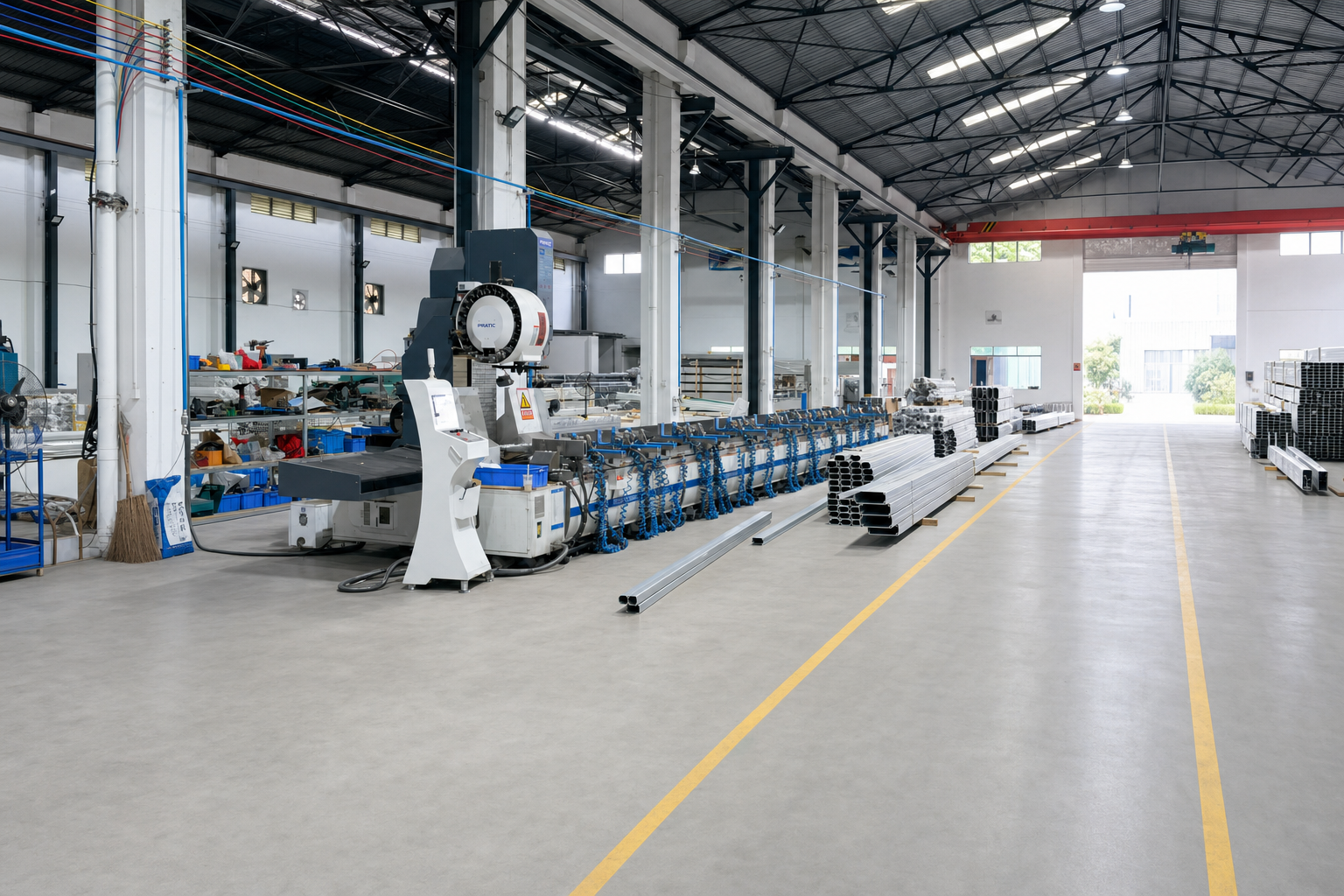
Shoulder Tent has manufactured large prefabricated tent structures since 2009. The company operates a 20,000 square meter factory, has around 200 employees, supports an R&D center and engineering team, and has an annual output of about 1,000 units. Around 80% of its products are exported, mainly to Europe, the Middle East, Africa, Southeast Asia, and South America.
Need a decision-ready comparison for your site?
Contact Shoulder Tent: info@shouldertent.com | WhatsApp: +86 158 1850 8822
Management Center: Shenzhen | Marketing Center: Guangzhou, China
Have Questions or Need More Details?
Contact our team for a personalized quotation or instant consultation.
Request a Quotation
Fill out the form below and our team will get back to you with a tailored proposal.
WhatsApp Direct Chat
Prefer to chat in real-time? Message us on WhatsApp for instant assistance & quick answers.
- Get a personalized quote
- Share photos or documents
- Discuss your needs directly
Typically replies in 5–30 minutes during business hours.