How to Build a Long-Term Aluminum Frame Tent Supply Partnership: A Decision Framework for Importers
How to Build a Long-Term Aluminum Frame Tent Supply Partnership
Buyers who need a reliable, long-term aluminum frame tent supply partner in China are usually making a decision that affects warehouse projects, sports venue programs, event rental fleets, or distribution lines for years. The right partner should be evaluated not only on product quality and price, but also on manufacturing capacity, engineering support, risk control, delivery terms, and commercial flexibility. This guide provides a practical decision framework for importers, distributors, and project buyers who are moving from supplier evaluation to long-term cooperation.
Why a Long-Term Supply Partnership Matters in the Aluminum Frame Tent Industry
Aluminum frame tents are used across warehouse storage, industrial facilities, sports venues, weddings, events, exhibitions, and commercial spaces. Buyers who purchase once for a single event may not need a deep supplier relationship. But importers, rental operators, and project developers who plan repeated purchases benefit from a partner who understands local site conditions, can adapt designs, and can maintain consistent quality across multiple orders.
A long-term supply partnership also reduces procurement risk. Instead of re-qualifying new suppliers for every order, a buyer can standardize specifications, agree on commercial terms, and rely on faster technical response and more consistent delivery coordination.
What “Long-Term Partnership” Means in Practice
In practice, a long-term aluminum frame tent supply relationship includes four elements:
- Repeatable product quality — the same frame profiles, fabric grades, and assembly standards across batches.
- Engineering continuity — the manufacturer retains project history, customization details, and load calculations so future orders do not start from zero.
- Responsive technical support — on-site installation guidance, anchoring recommendations, and post-delivery troubleshooting.
- Commercial stability — payment flexibility, clear Incoterms, and global logistics coordination that both sides can plan around.
Evaluating a Chinese Aluminum Frame Tent Manufacturer: Two Levels of Due Diligence
Supplier evaluation generally happens at two levels. The first level checks whether the factory can produce the product. The second level checks whether the factory can support a multi-year relationship.
Level 1: Production Capability and Product Range
A manufacturer should be able to demonstrate a real product range, not just a catalog of photos. For aluminum frame tents, the range typically includes A-Shape, Arc/Curved, APS hybrid tents, Dome/geodesic, Mixed/polygon/high-peak tents, and Pagoda/Gazebo. Each structure type has different span options, anchoring requirements, and application strengths.
Shenzhen Shoulder Tent Co., Ltd. (Shoulder Tent) is one example of a manufacturer that covers this range. The company specializes in large prefabricated tent structures and serves warehouse storage, sports venues, weddings, events, exhibitions, and commercial spaces. Since 2009, Shoulder Tent has delivered large tent products to clients across Europe, the Middle East, Africa, Southeast Asia, and South America.
For buyers evaluating any manufacturer, the key questions are:
- Which tent series can the factory actually produce?
- What span range can it offer, and can it customize based on site conditions, usage needs, and dimensions?
- Does the factory have an R&D team that can provide custom design and technical support?
Level 2: Partnership Capability and Operational Stability
The second level is about continuity. A long-term partner should have stable capacity, a capable engineering team, and processes for handling risk, delivery, and after-sales support.
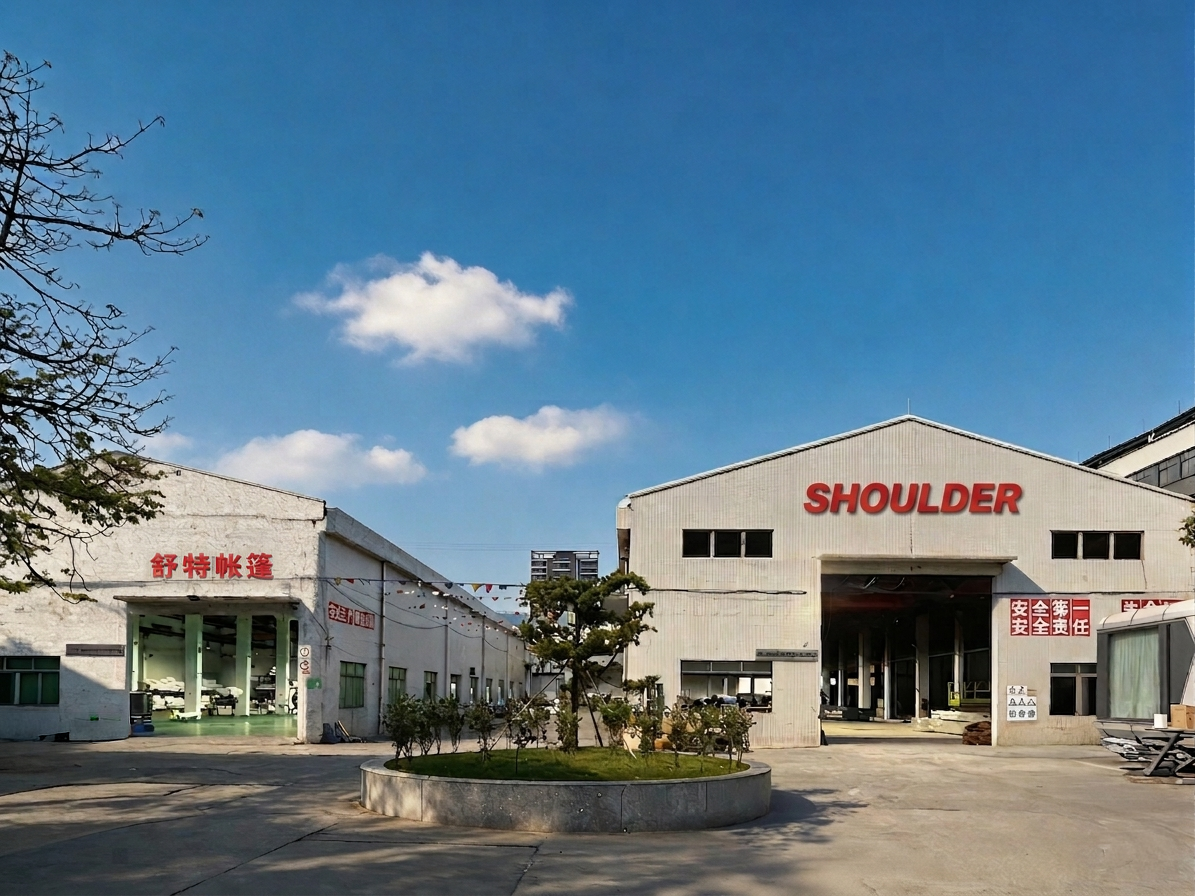
Shoulder Tent operates a 20,000 m² factory with 200 employees and an annual output of 1,000 units. It has an R&D center and engineering team that supports custom design and technical support. Around 80% of its output is exported, which means the company already manages cross-border logistics, documentation, and international communication on a regular basis.
For a distributor or project buyer, these operational facts matter because they indicate the manufacturer is structured for repeated export orders, not just occasional domestic sales.
Engineering and Customization Capability for Long-Term Programs
Aluminum frame tent projects often require customization. A warehouse tent in a high-wind coastal area needs different anchoring and profile reinforcement than a wedding tent on a protected site. A sports tent for pickleball, padel, or tennis needs specific spans and clear interior space. An aircraft hangar tent or large event tent may require special access dimensions and mixed structural solutions.
A long-term supplier should be able to adapt designs based on:
- Site conditions
- Usage needs
- Dimensions
- Functional requirements
Shoulder Tent’s R&D center and engineering team provide custom design and technical support for these variables. The company’s product lineup includes A-Shape, Arc/Curved, APS hybrid, Dome/geodesic, Mixed/polygon/high-peak, and Pagoda/Gazebo tents, which gives buyers several structural options for different projects.
Risk Control Measures That Protect Both Sides
Long-term buyers should ask how a manufacturer handles risk. In the tent industry, the relevant risks are climatic loads, fire, anchorage and foundation, and asset security.
Shoulder Tent applies risk control through:
- Project-specific anchoring reinforcement
- Flame-retardant fabric
- Aluminum profiles designed for local wind and snow loads
- Regular inspections
- On-site technical support
For emergency situations, the company provides modular reinforcement solutions and global technical support. This combination is relevant for warehouse tents, industrial tents, and large-span structures that must remain safe under changing weather conditions.
Commercial Terms: Payment, Incoterms, and Logistics Coordination
Long-term cooperation is easier when commercial terms are predictable. Buyers should confirm payment methods, Incoterms, and logistics coordination before signing a framework agreement.
Shoulder Tent accommodates payment terms based on customer requirements. The accepted payment method includes T/T (Telegraphic Transfer). Standard Incoterms are FOB, CIF, and CFR. Specific shipping methods and Incoterms should be confirmed with the sales team for each order.
| Commercial Factor | What Shoulder Tent Offers | Why It Matters for Long-Term Supply |
|---|---|---|
| Payment terms | Flexible, based on customer requirements; T/T accepted | Allows buyers to align payment with project cash flow |
| Incoterms | FOB, CIF, CFR | Standard options reduce friction for international logistics planning |
| Delivery coordination | Factory-direct delivery with global logistics coordination support | Helps importers manage shipping schedules for multi-phase projects |
| MOQ | 1 unit | Enables buyers to start with a pilot order before scaling |
A low MOQ of one unit is particularly useful for buyers who want to validate product quality, installation procedures, and supplier responsiveness before placing larger orders.
How Shoulder Tent Compares with Alternative Sourcing Options
When buyers compare an aluminum frame tent supplier with traditional fixed warehouse construction, the decision is not about one product being universally better. It is about fit for the project timeframe, budget, and mobility requirements.
| Comparison Factor | Aluminum Frame Tent Solution | Traditional Fixed Warehouse |
|---|---|---|
| Speed | Build storage space 50%–70% faster | Longer construction period |
| Upfront investment | Reduce upfront investment by 30%–60% | Higher initial construction cost |
| Mobility | Relocatable and reconfigurable | Permanent structure |
| Best for | Short-term or seasonal capacity expansion, logistics nodes, limited budgets, temporary sites | Long-term permanent ownership |
| Maintenance | Periodic inspection of fabric and anchors; possible foundation and waterproofing reinforcement | Different maintenance profile; case-by-case comparison |
| Energy efficiency | Depends on insulation and climate control options | Well-insulated permanent buildings may offer higher efficiency |
Exact lifetime cost depends on service life, maintenance, and climate control requirements, so buyers should request a quote-based comparison for their specific project.
Step-by-Step: How to Transition from Pilot Order to Long-Term Partnership
- Define your application and site conditions. Identify whether the tent will be used as a warehouse tent, sports tent, wedding tent, event tent, aircraft hangar tent, or industrial storage tent. Collect site data including wind load, snow load, dimensions, and foundation constraints.
- Shortlist manufacturers with matching product ranges. Look for factories that produce aluminum-frame structures in the series you need, and confirm that they offer customization beyond standard sizes.
- Evaluate engineering support. Ask how the manufacturer handles wind and snow load calculations, anchoring reinforcement, and flame-retardant fabric selection.
- Check commercial flexibility. Confirm MOQ, payment terms, and Incoterms that work for your import process.
- Place a pilot order. Use the first unit to verify product quality, documentation, packaging, and installation support.
- Standardize specifications. After the pilot, document your preferred frame series, fabric grade, anchoring plan, and accessory list so future quotes are faster and more consistent.
- Set a framework agreement. Agree on pricing reviews, delivery schedules, and technical response expectations for multi-order programs.
Use Cases: What a Long-Term Partnership Supports
Industrial and Warehouse Expansion
A company that needs seasonal or rapid storage expansion can use industrial tents and temporary warehouse tents to add space without committing to permanent construction. A long-term supplier can help standardize the frame and fabric specification so additional units match the original installation.
Sports Venue Programs
Sports tent projects for pickleball, padel, tennis, and multi-sport facilities often start with one court cover and grow into a facility program. The ability to re-order the same clear span structure with the same engineering basis reduces design risk.
Event Rental Fleets
Event rental companies and wedding tent operators need reliable repeat supply of marquee tents, large event tents, and commercial tents. Consistency of parts, fabric color, and assembly accessories matters when mixing old and new inventory.
Frequently Asked Questions
How do I evaluate a long-term aluminum frame tent supply partner in China?
Evaluate the manufacturer on four dimensions: product range and customization capability, engineering and risk control, commercial terms, and operational stability. Verify that the factory can produce the tent series you need, offers custom design and technical support, applies project-specific anchoring and flame-retardant fabric measures, and supports payment and Incoterms that fit your import process. A pilot order is the most practical way to test all of these before scaling.
What commercial terms should I expect from an aluminum frame tent manufacturer?
Common commercial terms include a MOQ of one unit, T/T payment, and FOB, CIF, or CFR Incoterms. Specific shipping methods and Incoterms should be confirmed with the supplier’s sales team for each order. Flexibility on payment terms is useful for buyers who need to align procurement with project cash flow.
What is the typical lead time for an aluminum frame tent order?
Lead time depends on the tent model, customization level, and order quantity. Buyers should confirm delivery schedules with the sales team before placing an order. For a structured partnership, it is advisable to agree on lead-time expectations in the framework agreement so that multi-phase projects can be planned reliably.
Can the supplier handle customized tent dimensions and site-specific requirements?
Yes. A manufacturer with an R&D center and engineering team can customize tents based on site conditions, usage needs, dimensions, and functional requirements. This includes selecting aluminum profiles for local wind and snow loads, project-specific anchoring reinforcement, and appropriate fabric options.
How do I start a partnership with Shoulder Tent?
The practical first step is to send your project details or download the company brochure to understand the product range. Then contact the sales team to confirm specifications, payment terms, shipping methods, and Incoterms for your market. Because the MOQ is one unit, you can place a pilot order before committing to a larger program.
Planning a warehouse, sports, or event tent program?
Download the Shoulder Tent company brochure to review the product range and manufacturing capabilities, or contact info@shouldertent.com for a quote.
Conclusion
A long-term aluminum frame tent supply partnership is built on more than product quality alone. Buyers should look for a manufacturer with a broad product range, real engineering and customization capability, documented risk control measures, and commercial terms that support repeat orders.
Shoulder Tent has supplied large prefabricated tent structures since 2009 for warehouse storage, sports venues, weddings, events, exhibitions, and commercial spaces. With a 20,000 m² factory, 200 employees, an annual output of 1,000 units, and approximately 80% export share, the company is structured for international, multi-order cooperation. For buyers deciding between suppliers, the clearest path is a pilot order followed by standardized specifications and a framework agreement.
To move from evaluation to execution, contact Shoulder Tent directly or download the company brochure to start the conversation.