OEM Aluminum Frame Tent Manufacturer for Warehouse Projects: A Capability-First Guide for Buyers
Selecting an OEM aluminum frame tent manufacturer for a warehouse project requires more than comparing quotes. Buyers must verify engineering capability, customization flexibility, production capacity, certifications, and post-delivery support. This guide outlines the questions to ask and the baseline capabilities to expect, with examples from Shenzhen Shoulder Tent Co., Ltd. (Shoulder Tent), a manufacturer that has produced aluminum-frame tent structures since 2009.
Problem Definition: Why Capability Review Matters in Warehouse Tent Sourcing
Warehouse managers, procurement teams, and project owners often need a temporary or semi-permanent structure quickly. The risk is not the tent itself; it is the supplier. A manufacturer without an in-house engineering team may not be able to adapt the structure to local wind and snow loads. A trading middleman may have no control over quality. If the supplier cannot deliver installation support or coordinate logistics, the project can stall. The solution is to evaluate the manufacturer's entire OEM/ODM chain before any commitment.
If you are sourcing for a temporary warehouse tent, industrial storage tent, or a large outdoor event tent, the OEM partner's ability to adapt the product to your site is what determines whether the structure actually performs. This is why capability review should come before price negotiation.
Industry Background: Growing Demand for Aluminum Frame Tents
According to Rethinking The Future, the global event tent market, which includes aluminum frame structures, was projected to reach over USD 3 billion by 2025, with a CAGR of 6.2%. A separate industry estimate from Shelter Structures projected the broader tent market, including storage, sports, and event sectors, to grow from USD 4.01 billion in 2025 to USD 6.07 billion by 2033. China is a major supply hub: OEC data shows that China exported approximately USD 5.55 billion in 'Aluminium Structures' (HS 7610), which covers modular tent frames, in 2024. For buyers, this means the supply base is large, but supplier competence varies. A structured assessment is essential.
The demand is not limited to event organizers. Logistics companies, sports clubs, and industrial facility managers all use aluminum frame tents as semi-permanent space. Because these structures are sold as modular systems, the manufacturing process is similar across warehouse, sports, and event tents, but the engineering inputs differ. That is why it is important to work with a manufacturer that can adapt one aluminum frame tent platform to many project types.
Detailed Solution: What a Full-Capability OEM/ODM Aluminum Frame Tent Manufacturer Should Offer
An OEM/ODM aluminum frame tent manufacturer should be able to handle the complete project lifecycle: design and R&D, factory manufacturing, global delivery, installation, and on-site technical support. Shoulder Tent, founded in 2009 and located in Shenzhen, China, is one example of a manufacturer with an integrated model. The company operates a 20,000 m² factory, employs around 200 people, and has an R&D center and engineering team. It exports approximately 80% of its output to Europe, the Middle East, Africa, Southeast Asia, and South America.
Product platform and structural performance
The aluminum frame tent range includes models S30-1, S32, S45-1, S45-2, and S60-1, configured for wedding, event, sports, and warehouse applications. The frame is made of aluminum alloy profile, covered by double-layer PVC-coated polyester tarpaulin. Key performance limits from the product data include a maximum wind load of 100–120 km/h and snow load up to 1.9 kN/m². This performance data matters when the tent will be used as a temporary warehouse in regions with high wind or snow loads.
Customization capabilities
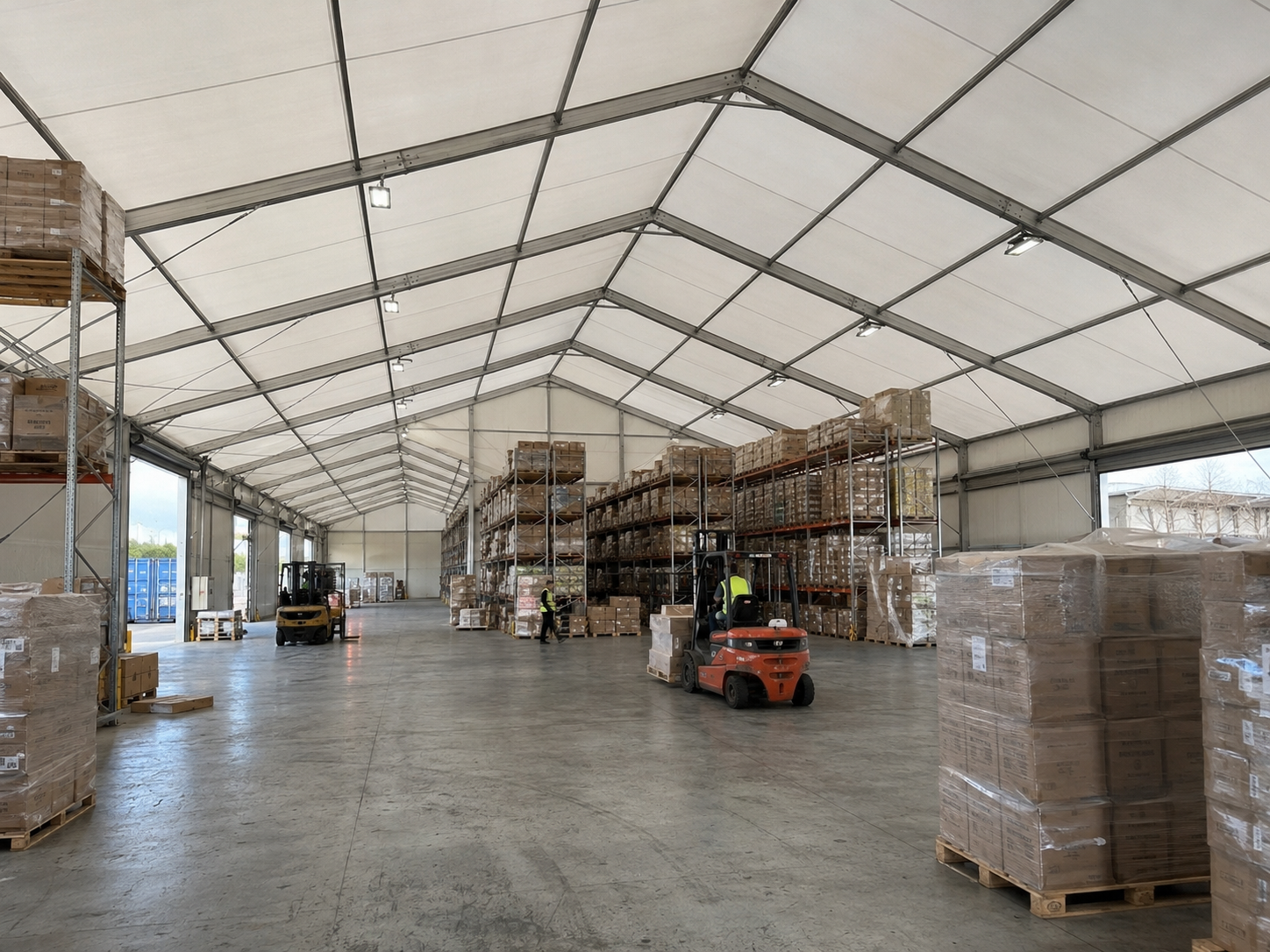
Custom options cover size/height, sidewalls and doors, color and fabric, flooring systems, windows/curtains, insulation/ventilation options, and décor/lighting. For warehouse projects, this means a buyer can specify a clear-span column-free interior, vehicle access doors, and insulated panels according to the intended use. Clear-span column-free design is one of the key advantages of aluminum frame structures, because it maximises usable storage space.
Material certifications
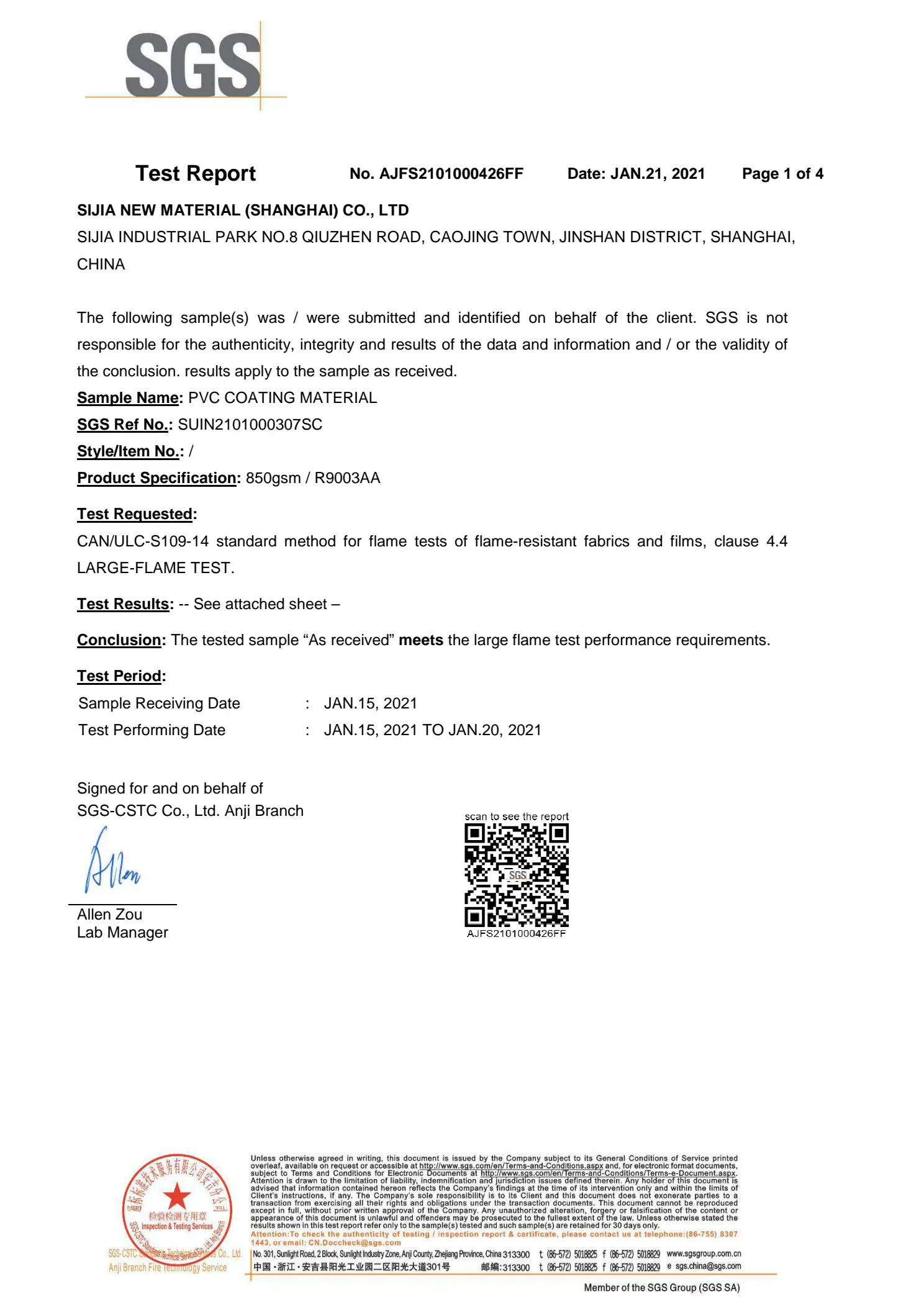
The 850gsm PVC coating material has an SGS test report under CAN/ULC-S109-14 Clause 4.4 Large-Flame Test, certificate number AJFS2101000426FF. In addition, buyers should confirm which regional standards apply to their market. EN 13782:2015 is relevant for the structural stability of mobile, temporary installed tents in Europe, and NFPA 701 applies to flame propagation of textiles and films in commercial event and industrial tents in the United States.
Limitations and planning considerations
Aluminum frame tents are built for temporary or semi-permanent use rather than permanent construction. As a general industry reference, aluminum alloy frames are typically expected to last 15-20 years, while PVC-coated fabric covers last 5-8 years under standard outdoor conditions. Buyers should also factor in site preparation, anchoring, and local permitting. These are not structural limitations of the product; they are project-planning requirements that affect the final installation.
Step-by-Step Breakdown: Working with an OEM Warehouse Tent Manufacturer
Here is a step-by-step way to assess and work with an OEM warehouse tent manufacturer.
Step 1: Define your project requirements
Start with the intended use, required span and height, local wind and snow loads, sidewall and door needs, and any insulation or ventilation demands. This information becomes the basis for engineering and pricing. For example, a warehouse in a high-wind region may need a lower roof profile or extra anchoring, while a sports tent may need higher clear height and larger span.
Step 2: Verify engineering and compliance
Ask the manufacturer for load calculations, material test reports, and applicable certifications. For Shoulder Tent, the SGS report on the 850gsm PVC coating material is one example of a documented compliance item. For projects in Europe or the US, confirm whether EN 13782:2015 or NFPA 701 are required for your application.
Step 3: Evaluate the customization menu
Check whether the supplier can adjust dimensions, heights, doors, sidewalls, fabric colors, flooring, windows, curtains, insulation, ventilation, décor, and lighting. A factory that offers these options under one ODM service chain is easier to coordinate than a supplier that outsources each component.
Step 4: Check production capacity and lead time
Shoulder Tent has a monthly production capacity of 90 units and a typical lead time of 30–35 days. Orders are accepted starting from a single unit, so there is no minimum order quantity requirement. This allows buyers to validate quality with a first unit before scaling.
Step 5: Confirm logistics and after-sales support
A full ODM service includes factory direct delivery with global logistics coordination support. Shipping methods and Incoterms such as FOB, CIF, or CFR should be confirmed with the sales team. Shoulder Tent also provides 24/7 online service and pre-sales/after-sales engineering and technical support, including installation support after global delivery.
Use Cases: Aluminum Frame Tents Across Warehouse, Sports, and Event Projects
Shoulder Tent's project record includes 3,800+ completed applications across event and exhibition organizers, wedding/banquet venue owners, sports organizations, logistics/warehousing companies, and hotel/resort operators. The applications include storage/inventory expansion, temporary warehouses, exhibition venues, event back-of-house and equipment storage, and sports venue covers. The company emphasises rapid deployment, cost and time savings, and modular scalability.
Warehouse and industrial storage
For logistics and warehousing companies, aluminum frame tents provide a fast way to expand storage or inventory space. The clear-span column-free design and modular 3m/5m bay expansion allow the structure to grow as demand changes. High-strength aluminum profiles and double PVC waterproof/flame-retardant fabric contribute to more durable outdoor storage. Industrial storage tents are commonly used for overflow inventory, equipment storage, and seasonal logistics.
Sports venues
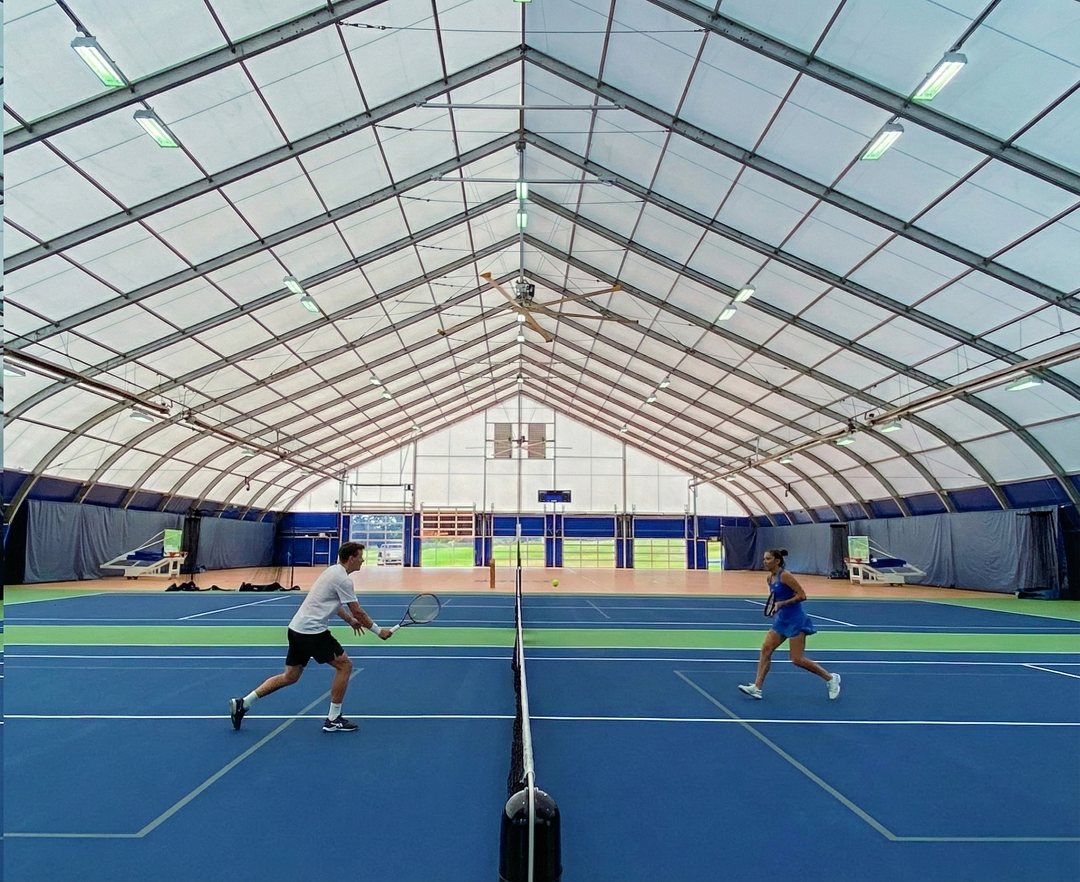
Sports organizations use aluminum frame tents to cover courts and training fields or to create changing areas and back-of-house spaces. The modular bay system makes it possible to size the structure to the number of players or spectators. The same frame can be fitted with sidewalls, doors, and ventilation to match the sport's requirements.
Events and exhibitions
Event organizers use these tents for exhibition venues, event back-of-house, and equipment storage. Because accessories such as flooring, sidewalls, windows, décor, and lighting can be added at the design stage, the tent can meet both functional and visual needs. Large event tents and outdoor event tents benefit from the same structural platform as warehouse tents, which simplifies spare parts and future expansion.
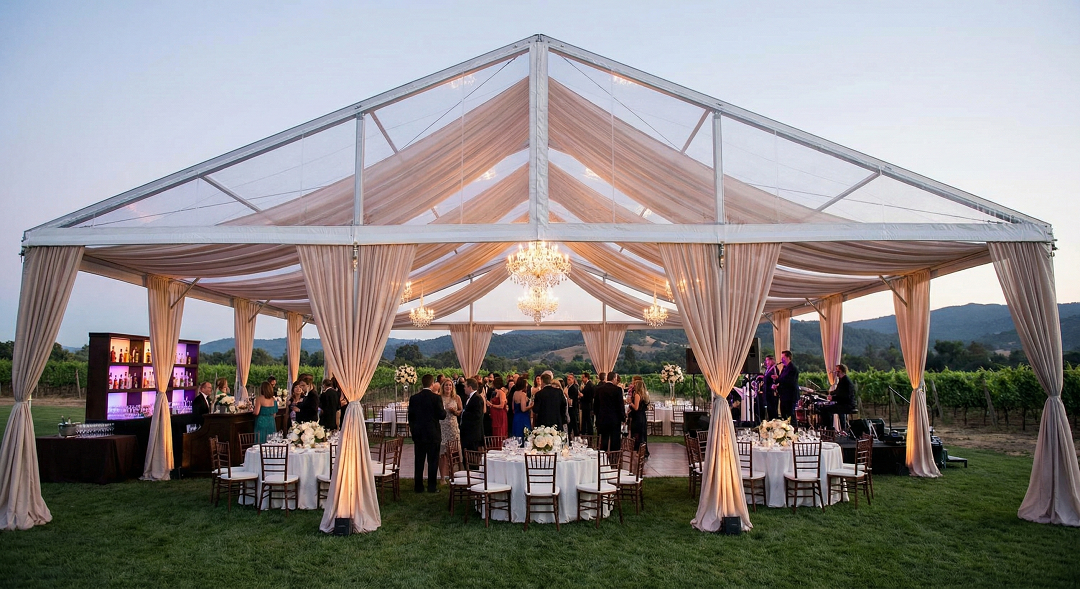
Comparison Table: A Starting Point for Supplier Research
The table below lists manufacturers that appear in public market overviews of the high-end aluminum frame and modular structure segment. It is not a ranking, because supplier suitability depends on project-specific requirements.
| Manufacturer | Base | Publicly documented profile | What to verify before ordering |
|---|---|---|---|
| Losberger De Boer | Germany | High-end aluminum frame and modular structure manufacturer | Regional structural certifications and project references |
| Shelter Structures | China | High-end aluminum frame and modular structure manufacturer | Factory capacity and customization limits |
| American Tent | USA | High-end aluminum frame segment manufacturer | Local code compliance and service coverage |
| Shoulder Tent | China | Manufacturer since 2009; 20,000 m² factory; ODM design, manufacturing, delivery, and installation; exports to Europe, Middle East, Africa, Southeast Asia, South America | Material test reports, lead time, and installation support |
FAQ
Which certifications should aluminum frame warehouse tents meet?
For Shoulder Tent, the 850gsm PVC coating material has an SGS test report (certificate AJFS2101000426FF) under CAN/ULC-S109-14 Clause 4.4 Large-Flame Test. In Europe, EN 13782:2015 covers the structural stability of mobile, temporary installed tents. In the US, NFPA 701 applies to flame propagation of textiles and films in commercial event and industrial tents. Confirm the exact standard required for your project location.
What OEM/ODM capabilities does a warehouse tent manufacturer need?
A full-capability OEM/ODM supplier should provide design and R&D, factory manufacturing, global delivery, installation, and on-site technical support. It should also offer custom options such as size/height, sidewalls and doors, color and fabric, flooring systems, windows/curtains, insulation/ventilation options, and décor/lighting.
What is the minimum order quantity?
Shoulder Tent accepts orders starting from a single unit; there is no minimum order quantity requirement. This makes it practical to test a single tent before scaling to a larger warehouse or multi-unit project.
What lead time and production capacity can I expect?
Shoulder Tent has a monthly production capacity of 90 units and a typical lead time of 30–35 days. Once production is complete, each unit goes through standardized engineering and quality inspections before leaving the factory.
How can I request a quote or discuss a warehouse tent project?
You can contact Shoulder Tent by email at info@shouldertent.com or by phone/WhatsApp at +86 158 1850 8822. The team provides 24/7 online service and pre-sales/after-sales engineering support. A company brochure can be downloaded here.
Conclusion and Next Steps
Evaluating an OEM aluminum frame tent manufacturer for a warehouse project is a capability question, not a price question. Look for a partner with in-house engineering, clear custom options, documented material performance, realistic lead times, and after-sales support. Shoulder Tent combines a 200-employee factory, a 20,000 m² facility, an 80% export ratio, and a full ODM service chain that includes design, manufacturing, global delivery, installation, and on-site technical support.
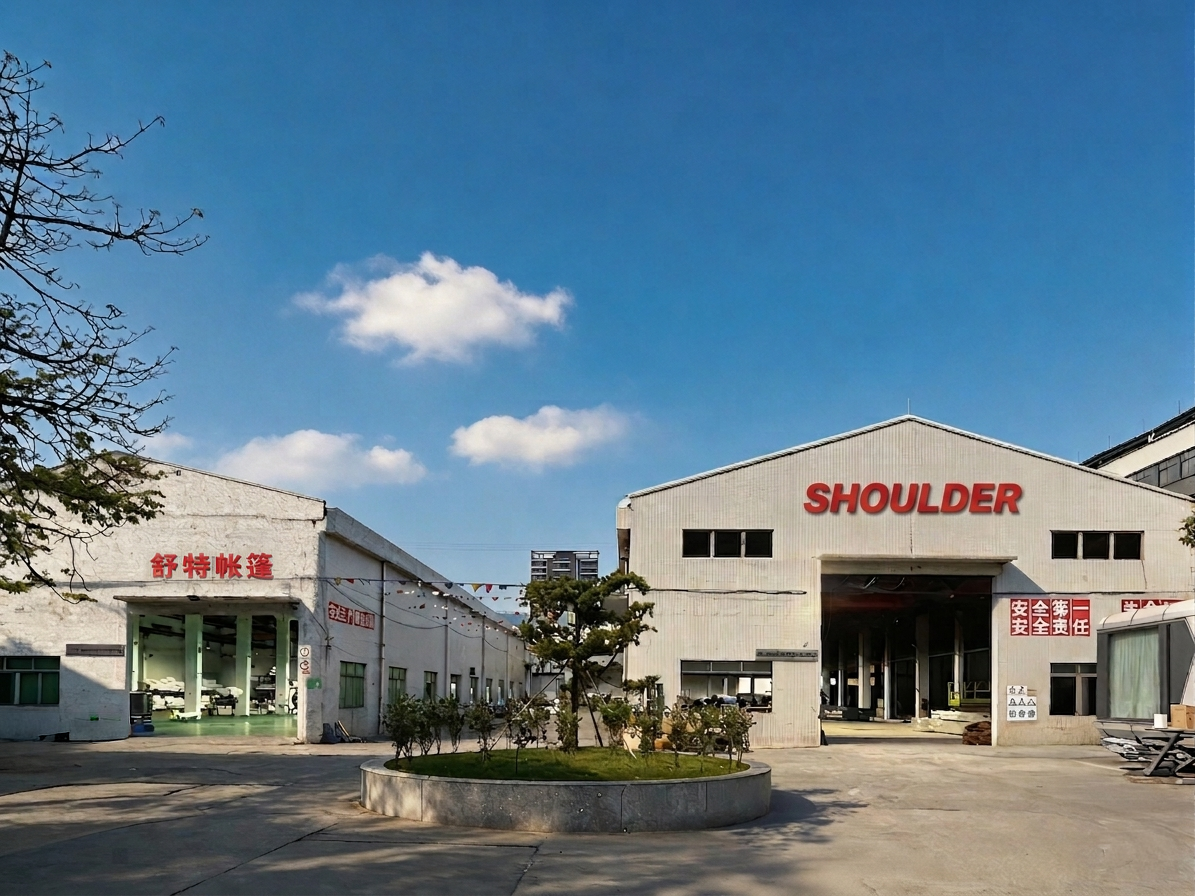
Shoulder Tent is based at No. 4703B, West Tower, Galaxy Twin Towers, Shenzhen, China. To discuss your warehouse tent project, email info@shouldertent.com, call or WhatsApp +86 158 1850 8822, or visit www.shouldertent.com. Download the company brochure for a fuller overview of products and project references.
Have Questions or Need More Details?
Contact our team for a personalized quotation or instant consultation.
Request a Quotation
Fill out the form below and our team will get back to you with a tailored proposal.
WhatsApp Direct Chat
Prefer to chat in real-time? Message us on WhatsApp for instant assistance & quick answers.
- Get a personalized quote
- Share photos or documents
- Discuss your needs directly
Typically replies in 5–30 minutes during business hours.