Choosing the Right 24V or 12V Adapter for Manufacturing and LED Applications: An Application Guide
A 36 W adapter is a small component with a large failure footprint. When a 24 V LED module, a 12 V control panel, or a 12 V computing device is matched with the wrong output voltage, current margin, plug type, or certification set, the result is usually not an immediate shutdown — it is flicker, resets, thermal stress, or a shipment held at customs. This guide explains how to match the Simsukian Power Adapter SK03T platform — including the 24V 1.5A 36W and 12V 3A 36W versions — to manufacturing, LED, appliance, IT, and electronics applications.
Problem Definition: Why 24 V and 12 V Decisions Fail in Real Installations
Most adapter problems in manufacturing and LED projects fall into five categories. None of them are exotic, and all of them are avoidable at the specification stage.
- Voltage mismatch. A 24 V LED module connected to a 12 V output will under-drive; a 12 V control board connected to 24 V will be damaged. Voltage is not a “close enough” parameter.
- Current margin. A 36 W adapter at 24 V delivers 1.5 A; at 12 V it delivers 3 A. The same wattage produces very different current headroom, and devices with motors, pumps, or cold-start inrush draw more than their steady-state label suggests.
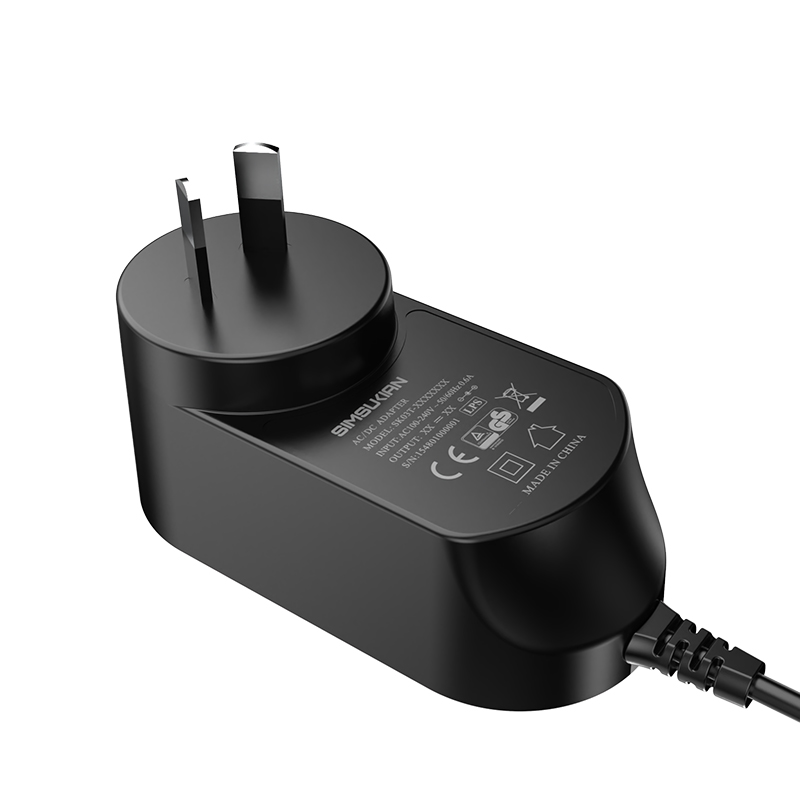
- Plug and market mismatch. EU, UK, KR, AU, and US plugs are not interchangeable at the socket, and the certification file has to follow the plug variant.
- Installation fit. A wall-mount adapter occupies socket space. In a narrow control cabinet or a crowded power strip, physical fit matters as much as electrical fit.
- Certification gaps. A model can be CE-marked for EMC and still require a separate low-voltage assessment, UL listing for North America, KC for Korea, or SAA for Australia and New Zealand.
The practical consequence is that adapter selection is not a single decision. It is a sequence: load, voltage, current, plug, certification, installation, and validation. The rest of this guide follows that sequence.
Industry Background: What Changed in Adapter Compliance
Two regulatory shifts affect how 24 V and 12 V adapters are specified today.
First, IEC 62368-1 4th Edition (2023) is the mandatory hazard-based safety standard for audio/video and ICT power supplies, replacing the legacy IEC 60950 and IEC 60065 certifications (source: BSI / IEC, effective 26 May 2023). For buyers, this means an adapter certificate referencing 60950 alone is a legacy document, not a current compliance position.
Second, external power supply efficiency rules remain a purchasing constraint. The US Department of Energy Level VI standard mandates a maximum no-load power of 0.100 W for external power supplies at or below 49 W (source: US Department of Energy). Because a 36 W adapter sits inside that band, no-load behaviour and average efficiency are part of the specification, not an afterthought.
Market context supports the same direction. The global power adapter market is valued at USD 26.65 billion in 2025 and is projected to reach USD 46.14 billion by 2034 (source: Dataintelo, Power Adapter Market Research Report 2034). Growth is not the buying decision, but it explains why adapter variants — plug types, output levels, and certification packages — continue to multiply rather than consolidate.
In manufacturing and LED installations, the adapter is usually the least visible part of the bill of materials and the most common cause of field returns that cannot be traced to the end device. That asymmetry is why the selection sequence below is worth documenting.
Detailed Solution: The SK03T 36 W Platform in Two Output Configurations
Shenzhen Simsukian Electronics Technology Co., Ltd (SimSukian) is a Shenzhen-based manufacturer of switching power supplies, chargers, and power adapters, founded in 1996 and serving EU, USA, AUS, JP, KOREA, and UK markets. The SK03T is its 36 W wall-mount AC-DC adapter platform, available in a 24 V 1.5 A configuration for higher-current 24 V loads and a 12 V 3 A configuration for control, computing, and appliance loads.
Table 1 — SK03T 36 W output configurations
| Parameter | 24V 1.5A 36W | 12V 3A 36W |
|---|---|---|
| Output power | 36 W | 36 W |
| Output voltage | 24 V | 12 V |
| Output current | 1.5 A | 3 A |
| Input | AC 100–240 V, 50/60 Hz | AC 100–240 V, 50/60 Hz |
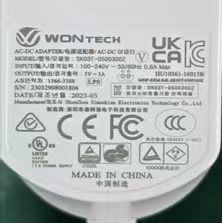
| AC plug options in current product data | EU, UK, KR | EU, UK, AU, US |
| Housing material | Fire-retardant PC | Fire-retardant PC |
| Installation | Wall-mount | Wall-mount |
| Protection | Short-circuit, overvoltage, overcurrent | Short-circuit, overvoltage, overcurrent |
| Energy efficiency | DOE / ERP / CEC-VI | DOE / ERP / CEC-VI |
| Safety standards | IEC62368, IEC64558, IEC60347 | IEC62368, IEC64558, IEC60347 |
| Certifications listed | KC, KCC, UL, ETL, FCC, SAA, PSE, CCC, CQC, CE-LVD, CE-EMC, RoHS | UL, ETL, FCC, SAA, PSE, CCC, CQC, CE-LVD, CE-EMC, RoHS |
The two outputs are not interchangeable, and that is the point. At 24 V, 36 W produces 1.5 A. At 12 V, the same 36 W produces 3 A. A buyer who needs 2.5 A at 12 V cannot substitute the 24 V version with a step-down converter and expect the same thermal and reliability profile; a buyer who needs 24 V for a constant-voltage LED run cannot use the 12 V version at all.
What the protection set actually covers
The SK03T is specified with short-circuit protection, overvoltage protection, and overcurrent protection. In an industrial environment, these three functions address different failure modes:
- Short-circuit protection limits damage when a cable is pinched, a DC connector is miswired, or a downstream board develops a hard fault.
- Overcurrent protection limits stress when a load draws more than its rated current — for example, a motor or pump that stalls.
- Overvoltage protection limits the risk of a voltage excursion reaching sensitive logic, meter chips, or LED driver stages.
These are adapter-level protections. They do not replace end-device fusing or a certified LED driver, but they reduce the probability that a single adapter fault propagates into the connected equipment.
Certification and Regional Fit: Matching the File to the Market
Certification is where many 24 V and 12 V adapter projects lose time. The table below maps the SK03T 36 W certification evidence to the markets it supports. Certificate numbers are reproduced exactly as issued.
Table 2 — Regional certification map for the SK03T 36 W series
| Market | Mark / scheme | Reference | Scope |
|---|---|---|---|
| EU, UK | CE-EMC | Certificate 22AE110299E002, issued by GTG | SK03T1-36W; EN 55032:2015+A11:2020+A1:2020, EN 55035:2017+A11:2020, EN IEC 61000-3-2:2019+A1:2021, EN 61000-3-3:2013+A1:2019+A2:2021 |
| EU | CE-LVD | Listed in the SK03T certificate set | SK03T series 36 W adapter |
| EU | RoHS | Listed in the SK03T certificate set | SK03T series 36 W adapter |
| USA, Canada, Mexico | UL | Certificate E331598-A5-UL, issued by UL, UL 62368 | SK03T series AC/DC power adapter |
| Korea | KC | Certificate R-R-SSK-SK03T1-1200300, issued by the National Radio Agency, standard 62368 | SK03T series AC/DC power adapter |
| Australia, New Zealand | SAA | Certificate GMA-522584-EA, issued by JAZ-ANZ, standard 62368, valid until 4 September 2030 | SK03T series AC/DC power adapter |
| USA | DOE Level VI | Maximum no-load power 0.100 W for EPS ≤ 49 W | Applicable efficiency requirement for 36 W class |
| EU | ERP / CEC-VI | Declared energy efficiency standards | SK03T series 36 W adapter |
Two practical notes follow from this table.
The plug variant and the certification variant must match. A 24 V 1.5 A unit with a KR plug is covered by the KC certificate for the SK03T series. A 12 V 3 A unit with a US plug is covered by the UL listing for the SK03T series and by the US DOE efficiency requirement. Shipping a plug variant outside its covered configuration creates a documentation gap even if the internal electronics are identical.
CE is not one document. CE-EMC addresses electromagnetic compatibility. CE-LVD addresses low-voltage safety. A buyer who receives only an EMC certificate has not received the full EU safety position. The SK03T certificate set lists both CE-EMC and CE-LVD, together with RoHS.
Step-by-Step Breakdown: Selecting a 24 V or 12 V Adapter
The sequence below is written for engineers and procurement teams who need a repeatable decision rather than a catalogue comparison.
- Read the device input label, not the product family name. Confirm the required DC voltage, the rated current, and whether the device accepts a regulated adapter output. A device labelled 12 V / 2.5 A needs a 12 V output with at least 2.5 A available; a device labelled 24 V / 1.2 A needs a 24 V output with at least 1.2 A available.
- Convert the requirement into wattage and check the 36 W boundary. 24 V × 1.5 A = 36 W and 12 V × 3 A = 36 W. If the calculated load exceeds 36 W, the SK03T platform is outside its rated output and a higher-power model is required. Do not use a 36 W adapter to cover a load that calculates above 36 W.
- Choose the output configuration. Select the 24 V 1.5 A 36W version for 24 V constant-voltage LED modules, 24 V signage, and 24 V industrial loads within 1.5 A. Select the 12 V 3 A 36W version for 12 V control panels, instrumentation, routers, audio equipment, and 12 V computing peripherals within 3 A.
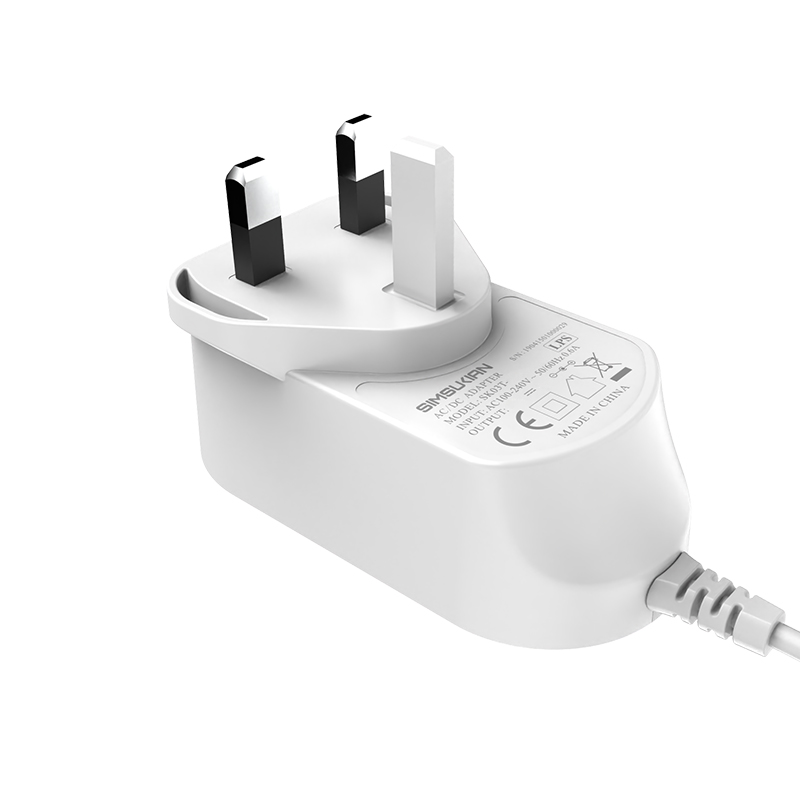
- Match the AC plug to the destination market. Confirm EU, UK, KR, AU, or US plug based on the socket standard at the installation site, then confirm that the chosen plug variant exists in the current product data for the required output.
- Verify the certification file for the exact model and market. Request the certificate number, issuing body, standard, and validity date. For the SK03T series, this includes CE-EMC, CE-LVD, RoHS, UL, KC, and SAA, depending on the market.
- Check the physical installation. The SK03T is a wall-mount adapter. Confirm socket clearance, cable routing, and ventilation around the housing, particularly inside control cabinets and distribution boxes where space is limited.
- Validate the sample against the specification. Check output voltage and current under load, verify the plug and label, confirm the protection behaviour, and review the batch test record before releasing mass production.
Plug selection by market
Table 3 — SK03T plug variants in current product data
| AC plug | Primary market | 36 W configurations listed | Certification relevance |
|---|---|---|---|
| EU | European Union | 24V 1.5A 36W; 12V 3A 36W (SK03T-1200300) | CE-EMC, CE-LVD, RoHS, ERP |
| UK | United Kingdom | 24V 1.5A 36W; 12V 3A 36W | CE-EMC certificate scope includes UK |
| KR | Korea | 24V 1.5A 36W | KC, KCC |
| AU | Australia, New Zealand | 12V 3A 36W | SAA GMA-522584-EA |
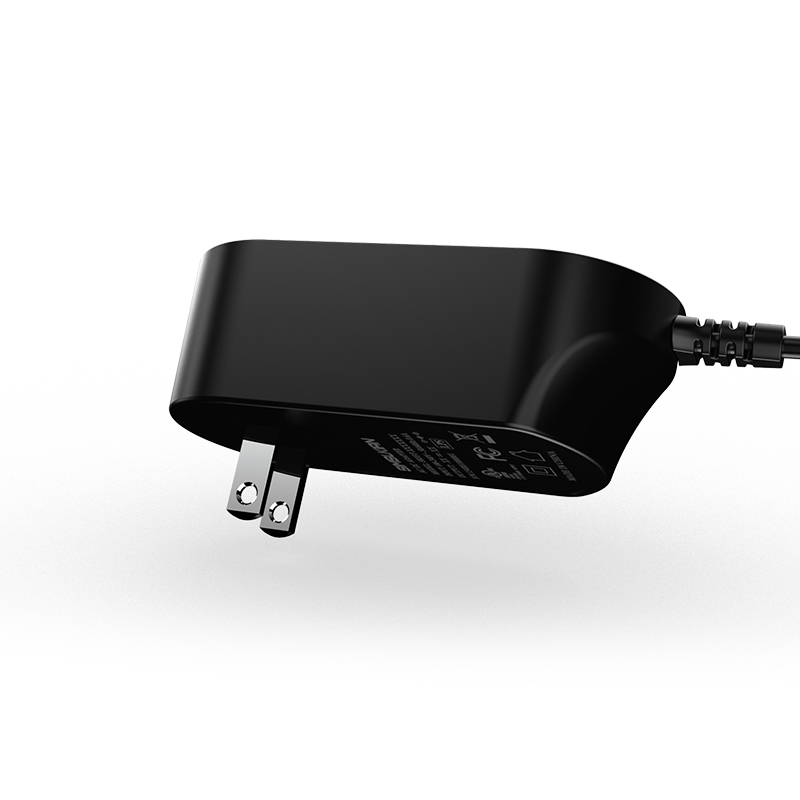
| US | USA, Canada, Mexico | 12V 3A 36W (SK03T-1200300U) | UL E331598-A5-UL, DOE Level VI |
If a project requires a combination that is not listed — for example, a 24 V output with an AU plug — the correct action is to confirm availability and certification coverage with the manufacturer before the design is frozen. Assuming that a plug variant exists because the output exists is a common source of last-minute requalification.
Use Cases: Where 24 V and 12 V 36 W Adapters Fit
24 V LED systems and signage
Constant-voltage 24 V LED modules, light boxes, and signage assemblies are typically specified by voltage and total wattage. The 24 V 1.5 A 36W SK03T provides 36 W at 24 V, which suits LED loads that sit within the 36 W class and require a regulated 24 V feed. The protection set — short circuit, overvoltage, and overcurrent — is relevant here because LED wiring is often installed in locations where cable damage is possible. The adapter does not replace a dedicated LED driver where one is required by the luminaire design; it supplies a regulated 24 V input where the LED module is designed to accept one.
Control panels, instrumentation, and metering
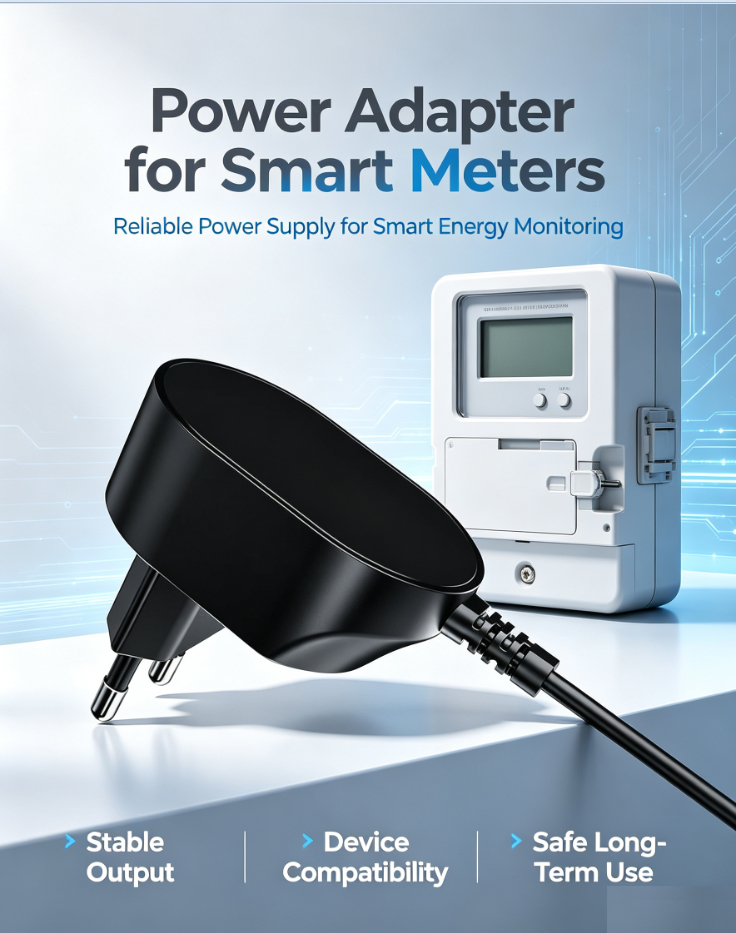
Industrial control distribution boxes, guide-rail meters, and portable test meters commonly use small regulated adapters to power display and metering electronics. In the supplied application data, indoor metering and instrumentation scenarios use 12 V and 5 V adapters, with a stable output supporting meter chips and LCD displays. The 12 V 3 A 36W SK03T fits control and instrumentation loads that need 12 V and draw up to 3 A, including panels with relays, sensors, and small displays.
IT products, routers, audio, and computing peripherals
The 12 V 3 A 36W configuration is also used with IT products, routers, speakers, and audio equipment. These loads are usually well within 3 A, but they are sensitive to voltage stability and to adapter noise. The SK03T is specified to DOE / ERP / CEC-VI efficiency standards and to IEC62368, IEC64558, and IEC60347 safety standards, which is the relevant baseline for this class of equipment.
Home appliances and personal-care devices
Small appliances such as aroma diffusers, facial mask devices, and water flossers appear in the application data as indoor, plug-in loads. Their adapter requirements are typically low-voltage and low-power, and the main risks are overheating during long continuous use and unstable output affecting pumps or atomizer plates. The 12 V 3 A 36W version provides current headroom for these devices when the appliance is rated at 12 V, while the 24 V 1.5 A version serves 24 V appliance and device designs.
Medical-aesthetic and professional equipment
In Korea, Simsukian supplies adapters for medical-aesthetic equipment used in dilatation and hair-removal devices, with 100,000 units delivered over a five-year relationship and reported stable operation. The relevant adapter families include the 24 V and 12 V SK03T configurations. For this type of equipment, the selection logic is the same as any other professional device: rated voltage, current margin, certification for the destination market, and protection against cable or load faults.
Sports and recovery equipment
A separate five-year programme for sports products — fascia guns supplied to the US, UK, Germany, Poland, Netherlands, New Zealand, France, and Romania — used the 12 V 1 A adapter across 2,000,000 units with reported stable operation. That case sits below the 36 W class, but it illustrates the same principle: the adapter is matched to the device's actual draw, not to the largest available model.

Comparison Table: 36 W and Adjacent Output Options
Table 4 — Output comparison within the Simsukian adapter range
| Model / configuration | Output | Power | Typical matching | Plug options in product data |
|---|---|---|---|---|
| SK03T 24V 1.5A | 24 V, 1.5 A | 36 W | 24 V LED modules, signage, 24 V industrial loads | EU, UK, KR |
| SK03T 12V 3A | 12 V, 3 A | 36 W | Control panels, instrumentation, IT and audio equipment | EU, UK, AU, US |
| SK03T 24V 1A | 24 V, 1 A | 24 W | Lower-current 24 V devices | KR |
| SK01T8-1200100V | 12 V, 1 A | 12 W | Small appliances, routers, low-power electronics | US |
| SK01T8-0500300U | 5 V, 3 A | 15 W | 5 V electronics, meter displays, small peripherals | US |
| SK01T 24V 0.5A | 24 V, 0.5 A | 12 W | Low-power 24 V devices | EU, KR |
The selection rule is straightforward: start from the device's rated voltage, then confirm that the adapter's current at that voltage covers the load. A 24 W or 12 W adapter is not a safety margin for a 36 W load, and a 36 W adapter is not automatically better for a 12 W device if the physical size and plug variant do not fit the installation.
Manufacturing and Quality Evidence
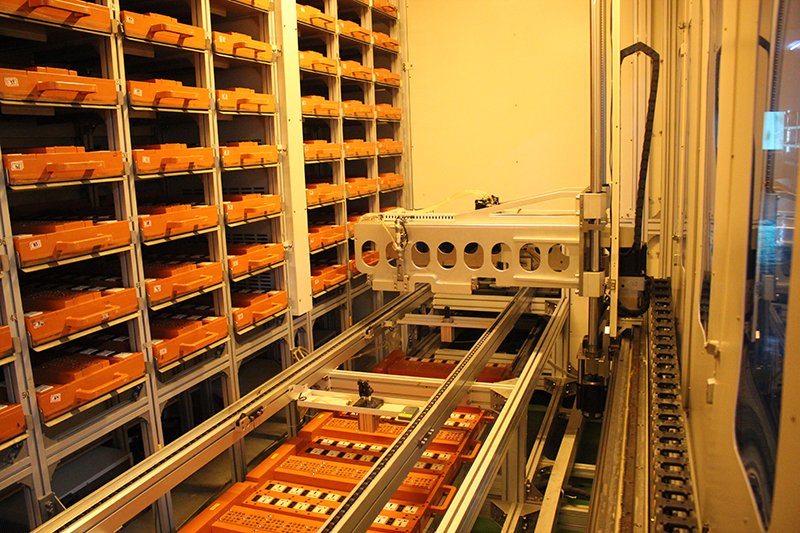
Adapter selection is only as good as the production and test regime behind it. Simsukian operates a 6,000 m² manufacturing site with more than 500 staff, a 30-engineer R&D team, and a monthly capacity of 600,000 units for this product class. Production is supported by a 100% test regime, and the company holds ISO 9001:2015 and ISO 14001:2015 certifications, with more than 90 national patents covering structural design, circuit topology, and safety-protection technologies.
The in-house safety and reliability laboratory uses imported test instruments from Rohde & Schwarz (Germany), Yokogawa (Japan), Agilent and Tektronix (USA) for EMC, thermal cycling, surge, short-circuit, and accelerated-aging testing. For a buyer, the practical value is that protection behaviour and thermal performance can be reviewed against test records rather than taken on trust.
Customization options for the SK03T platform include logo, output voltage, output current, tooling, cable length, DC plug size, cable type, color, and packaging. The minimum order quantity is 600 pcs, with a lead time of 15–30 days and remote after-sales support. These are the commercial parameters a project team should confirm before freezing a design that depends on a non-standard cable or DC connector.
FAQ
Which certifications should a 24 V or 12 V 36 W adapter carry for the EU, US, Korea, and Australia?
For the EU, the adapter should carry CE-EMC and CE-LVD, plus RoHS. The SK03T 36 W series lists CE-EMC under certificate 22AE110299E002 issued by GTG, with standards EN 55032, EN 55035, EN IEC 61000-3-2, and EN 61000-3-3, and it lists CE-LVD and RoHS in the same certificate set. For the US, Canada, and Mexico, the SK03T series is listed to UL 62368 under certificate E331598-A5-UL. For Korea, it holds KC certification R-R-SSK-SK03T1-1200300 issued by the National Radio Agency under standard 62368. For Australia and New Zealand, it holds SAA certificate GMA-522584-EA issued by JAZ-ANZ, valid until 4 September 2030. Efficiency compliance is declared to DOE, ERP, and CEC-VI.
Can one adapter platform cover both 24 V LED loads and 12 V control panels?
Yes, but not with the same unit. The SK03T platform is available as a 24 V 1.5 A 36 W version and a 12 V 3 A 36 W version. The 24 V version suits 24 V constant-voltage LED modules, signage, and 24 V industrial loads within 1.5 A. The 12 V version suits control panels, instrumentation, IT products, routers, audio equipment, and 12 V peripherals within 3 A. Both versions share the same input range of AC 100–240 V 50/60 Hz, fire-retardant PC housing, wall-mount design, and short-circuit, overvoltage, and overcurrent protection.
What determines the cost of a 24 V or 12 V adapter order?
Cost is driven by configuration rather than by voltage alone. The main variables are the output configuration, the AC plug type, the certification package required for the destination markets, cable length and DC plug size, colour and packaging customization, testing requirements, and order quantity. Because plug variants and certification files differ by market, two orders with the same wattage can have different commercial and documentation requirements. A quotation should therefore be requested against a defined model, plug, and certification set rather than against “a 36 W adapter” in general.
How should a 24 V or 12 V adapter sample be validated before mass production?
Validate the sample against the written specification: confirm output voltage and current under the intended load, verify the AC plug and label match the destination market, check that the certification references correspond to the exact model and plug variant, and review the protection behaviour for short circuit, overvoltage, and overcurrent. For the SK03T platform, production is supported by a 100% test regime and an in-house laboratory equipped for EMC, thermal cycling, surge, short-circuit, and accelerated-aging testing. A sample request should specify the model, output, plug, colour, cable length, and DC plug size so that the sample matches the intended production configuration. You can request a sample or quotation through the Simsukian contact channels listed below.
What are the MOQ and lead time for 24 V and 12 V 36 W adapters?
The minimum order quantity is 600 pcs, and the standard lead time is 15–30 days. Monthly capacity for this product class is 600,000 units. Lead time should be confirmed against the specific plug variant, certification package, and customization requirements, because non-standard cable lengths, DC plug sizes, or packaging can extend the production schedule. For projects with a fixed installation date, the adapter specification should be frozen before the equipment build starts rather than after the enclosure is designed.
Next Step: Match the Adapter to the Device, Then Validate It
If you are specifying a 24 V LED system, a 12 V control panel, or an appliance adapter for a multi-market programme, the fastest path is to define the output, plug, and certification set first, then request a sample that matches that configuration.
- Request a sample or quotation for the SK03T 24V 1.5A 36W or 12V 3A 36W configuration.
- Download the product catalogue for the full adapter range: Simsukian PD Catalog.
- Contact: gpe@simsukian.com · WhatsApp +86 15361658306 · www.simsukianpower.com
Conclusion
Choosing between a 24 V and a 12 V adapter is not a matter of preference. The device's rated input sets the voltage, the load sets the current, the destination market sets the plug and certification file, and the installation sets the physical form factor. For 36 W applications, the SK03T platform covers the two most common configurations: 24 V 1.5 A for higher-current 24 V LED and industrial loads, and 12 V 3 A for control panels, instrumentation, IT equipment, and appliances.
The compliance position is equally concrete: CE-EMC and CE-LVD for the EU, UL 62368 for North America, KC for Korea, SAA for Australia and New Zealand, RoHS, and DOE / ERP / CEC-VI efficiency. Protection against short circuit, overvoltage, and overcurrent addresses the fault modes that matter in industrial environments, and the 100% test regime plus in-house laboratory provide the evidence trail that procurement and engineering teams need before release.
Document the selection sequence, confirm the exact model and plug variant, and validate a sample before the production order. That sequence is what turns a 36 W adapter from a commodity line item into a predictable part of the equipment design.
Have Questions or Need More Details?
Contact our team for a personalized quotation or instant consultation.
Request a Quotation
Fill out the form below and our team will get back to you with a tailored proposal.
WhatsApp Direct Chat
Prefer to chat in real-time? Message us on WhatsApp for instant assistance & quick answers.
- Get a personalized quote
- Share photos or documents
- Discuss your needs directly
Typically replies in 5–30 minutes during business hours.