48V 100Ah LiFePO4 Golf Cart Battery: Technical Selection & Compliance Guide
48V 100Ah LiFePO4 Golf Cart Battery: Technical Selection & Compliance Guide
A 48V 100Ah LiFePO4 golf cart battery is a lithium iron phosphate pack built to replace the lead-acid battery bank in a 48-volt golf cart or light utility vehicle while delivering roughly 100 ampere-hours of nominal capacity. In a replacement or upgrade project, two separate checks decide whether that pack is the right one: technical fit (voltage, capacity, current, charger and physical compatibility) and compliance fit (the transport, handling and quality documents that must exist before the pack ships).
This guide is written for Decision-stage buyers — fleet managers replacing a cart fleet, dealers standardising a repeatable SKU list, and OEM buyers specifying a private-label pack. It explains the selection parameters that matter at 48V, the compliance evidence Sisway Battery documents for its 48V 100Ah LiFePO4 battery (UN38.3 Test Report No. TSZ25H8045A01-01 and MSDS No. TSZ25LL028A86-01), how the certification scope of 51.2V and 72V alternatives differs, and a step-by-step sequence that can be completed before the purchase order is issued.
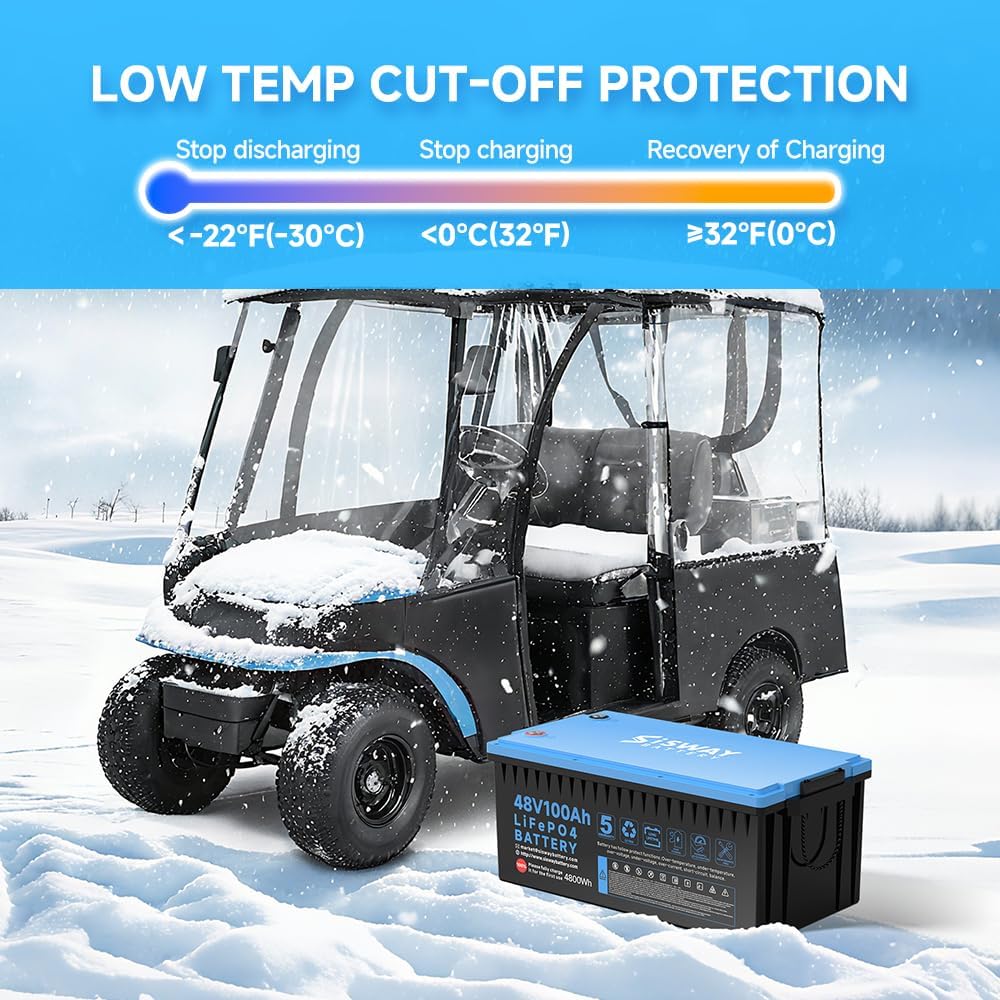
Cover: 48V 100Ah LiFePO4 golf cart battery platform, documented with high and low temperature protection.
Problem Definition: Why “48V 100Ah” Is Not Yet a Decision
The voltage and capacity label answers only the first of five questions that determine whether a replacement pack performs in service. All five are checkable before an order is placed:
- Charger compatibility. Does the pack's charge profile match the charger already installed in the cart, or does the charger also have to be replaced?
- Duty-cycle capacity. Does 100Ah cover the real route, load and shift length, or does the fleet need the upper part of the 100–150Ah band that 48V lithium systems typically occupy?
- Current capability. Does the battery management system support the continuous current drawn by the controller and any added loads such as lights, sprayers or plows?
- Physical fit. Will the enclosure fit the battery bay, and do terminal type and mounting points match the cart?
- Document scope. Can the supplier produce transport, safety and quality documents that name this exact voltage, capacity and configuration rather than a related model?
Two failure modes dominate real projects. The first is documentary: UN 38.3 certification is required for the safe global transport of lithium batteries, so a pack shipped without a UN 38.3 test report covering the exact configuration creates a logistics and resale problem rather than a technical one. The second is scope mismatch: a test report or quality certificate issued for one voltage class does not automatically extend to another, and buyers frequently discover this after the container has been booked.
Industry Background: Where 48-Volt Lithium Replacement Demand Comes From
Published market data explains why 48V lithium replacement has moved from pilot projects to standard procurement practice:
- The global golf cart battery market reached approximately USD 1.49 billion in 2024 and is projected to reach USD 2.21 billion by 2030, at a CAGR of 6.8% (Strategic Market Research).
- Lithium-ion batteries held approximately 47% of the global golf cart battery market share by revenue in 2024 (Boca EV / Market Analysis).
- North America accounted for a 44.7% revenue share of the electric golf cart market in 2024 (Grand View Research); the U.S. electric golf cart market was estimated at USD 529.4 million in the same year, with battery electric vehicles accounting for 72.5% of it.
- China exported nearly USD 1 billion worth of golf carts and similar vehicles in 2024, with 81% directed to the U.S. market (China Customs / SCMP) — which means most replacement packs are also cross-border lithium shipments subject to transport documentation.
- The 4-seater segment is the fastest growing, with an annual growth rate of 6.8% (Polaris Market Research), pushing fleet duty cycles toward higher-capacity packs within the same 48V class.
Market-size figures should be read as scope statements rather than absolutes: estimates differ by definition, and one narrower assessment places the same market at USD 192.23 million (Markets and Data). What does not vary between sources is direction. Lithium replacement is now the default option in the 48V segment, and supplier differentiation has shifted from “lithium or lead-acid” to documentation quality, batch consistency and OEM flexibility.
Detailed Solution: What to Verify on a 48V 100Ah LiFePO4 Pack
Voltage, capacity and duty cycle
Lithium batteries typically reach or exceed 100–150 Ah capacities for 48V golf cart systems, so a 100Ah pack sits at the entry of the mainstream band. That level is adequate for standard course rounds and light utility duty; longer shifts, hilly terrain, multi-passenger loads or added equipment push the requirement toward the upper end of the band. Capacity should be matched against the route the cart actually runs, not against a specification sheet alone.
Cycle life and how the claim is measured
LiFePO4 batteries typically offer 2,500 to 9,000 cycles at 80% Depth of Discharge, while traditional flooded lead-acid batteries deliver approximately 300 to 500 cycles at 50% DoD (Journal of the Electrochemical Society; Boca EV / Preger et al.). The two numbers are only comparable when read at the same depth of discharge. Published cycle figures that do not state a DoD basis should be treated as unverified, and this is the single most common distortion in replacement proposals.
Current, BMS and protection limits
Continuous discharge current, peak current and BMS protection thresholds (over-current, over-voltage, under-voltage and short-circuit) must be confirmed in writing against the cart's controller and any auxiliary load. Protection behaviour also matters commercially: a pack that shuts down under a legitimate hill-start load returns to the dealer as a warranty case, not as a specification issue.
Thermal behaviour and low-temperature charging
Sisway Battery documents high and low temperature protection for its lithium golf cart batteries, including low-temperature protection with a self-heating function. The relevant risk category is overcooling and the documented control method is heating: without self-heating, charging has to be blocked below the low-temperature threshold, which shortens the usable operating window in cold climates. Buyers should request the exact cut-off thresholds and confirm that charging is inhibited below the threshold rather than simply derated.
Supplier differentiation: what to compare beyond the datasheet
Sisway Battery documents five points of differentiation for its 48V platform relative to ECO/ROYPOW: lightweight design, enhanced performance, factory-direct supply, competitive pricing, and OEM/ODM support. These are supplier-stated differentiators, and the practical approach at Decision stage is to convert each one into a verifiable check rather than accept it as a claim — weigh the sample against the lead-acid bank it replaces, run the sample on the real route, confirm who manufactures and ships the goods, compare landed cost across the actual order volumes, and confirm the OEM/ODM scope in writing.
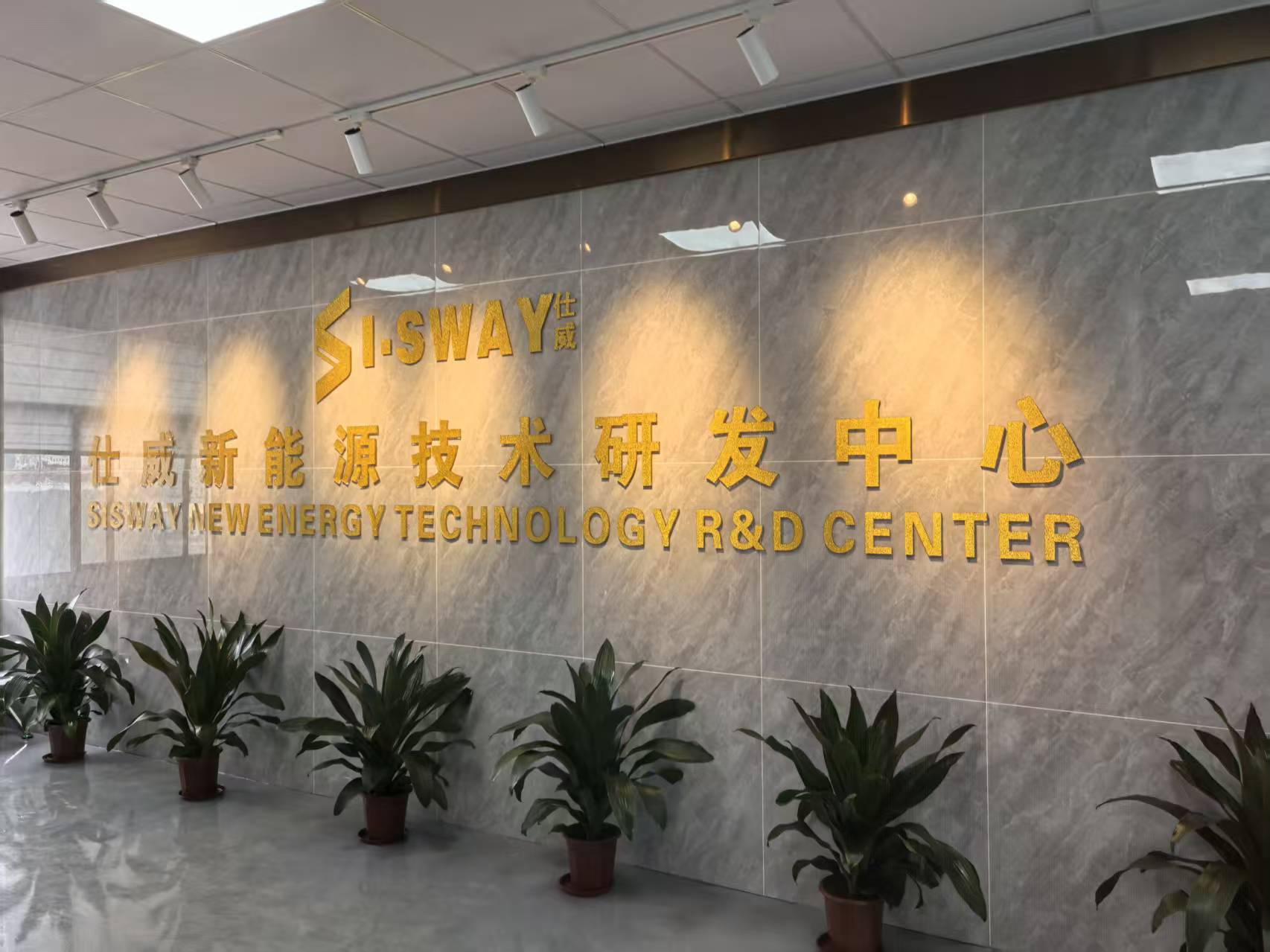
R&D center: engineering resources behind voltage, BMS and enclosure configuration for 48V LiFePO4 golf cart battery projects.
Performance and cost profile documented for the platform
Sisway Battery documents the following for its 48V LiFePO4 platform: 4,000+ deep cycles, 30% more usable energy than the lead-acid baseline, roughly 50% faster charging, 95%+ energy efficiency, and up to 50% lower total ownership cost compared with lead-acid batteries, together with maintenance-free operation. The same documentation set positions the platform for golf-course fleets and premium recreational carts, where 4–5× longer lifespan versus lead-acid and reduced total cost of ownership are the deciding economics.
Step-by-Step Breakdown: A Seven-Step Decision Sequence
- Confirm system voltage and charger compatibility. The pack's nominal voltage must match the cart's system voltage, and the charge profile it expects must match the charger that will actually be used. Ask for the charge voltage window and BMS cut-off values in writing; a pack/charger mismatch shows up as incomplete charging, charge cut-off or shortened cycle life.
- Size capacity against the real duty cycle. Treat 100Ah as the entry point of the 100–150Ah band typical for 48V lithium systems. Choose the upper end when the fleet runs multi-passenger loads, long shifts or hilly routes.
- Verify current and protection limits. Confirm continuous and peak current ratings and BMS protection thresholds, and confirm that high and low temperature protection — including low-temperature protection with self-heating — is part of the delivered configuration.
- Check physical fit, weight and mounting. Compare enclosure dimensions, terminal type, mounting points and pack weight against the lead-acid bank being removed. Lightweight design is one of the documented differentiators of the Sisway platform, so weight is a value that can be measured directly on the sample.
- Audit the compliance pack against the exact SKU. This is the step that most often decides whether a project stays on schedule (details in the table below).
- Validate with a sample on the real route. Log range per charge, voltage sag under load, charge time, temperature behaviour in the coldest month expected, and BMS cut-off behaviour, then compare against the lead-acid baseline.
- Lock commercial terms and supply continuity. Confirm MOQ, lead time, warranty terms, spare-part availability, OEM/ODM labelling, and the supplier's ability to repeat the same build a year later. Production scale and engineering depth are the two indicators worth checking: Sisway Battery documents a 20,000 m² facility with 90,000-unit annual output and a 25-engineer R&D team.
Use Cases: Where a 48V 100Ah LiFePO4 Pack Fits
Golf course fleet replacement
A 48V 100Ah LiFePO4 pack matches standard course rounds and delivers maintenance-free operation, removing watering, terminal cleaning and equalisation routines from the fleet schedule.
Resort and premium recreational carts
Sisway Battery documents its LiFePO4 platform as engineered for golf-course fleets and premium recreational carts, where reliability and reduced total cost of ownership outweigh the initial price gap against lead-acid.
Lead-acid retrofit on mixed fleets
Retrofit projects compare on ownership cost rather than purchase price: 4,000+ documented deep cycles, 30% more usable energy, roughly 50% faster charging, 95%+ efficiency and up to 50% lower total ownership cost versus lead-acid are the metrics to put in the business case.
Utility and multi-seat carts in the growing 4-seater segment
With the 4-seater segment growing at 6.8% annually (Polaris Market Research), higher-capacity configurations within the 48V class are increasingly specified for utility and multi-passenger duty.
Distributor and private-label programs
OEM/ODM support and factory-direct supply matter for distributors building a repeatable SKU list, because labelling, enclosure and packaging requirements differ per market.
Cold-climate operations
Where carts are used or stored below the low-temperature charging threshold, documented low-temperature protection with a self-heating function is the difference between a usable pack and a seasonally restricted one.
Comparison Table: Certification Scope and Ownership Metrics
Table 1 — Documented certification evidence by voltage class. Certification documents are scoped per product; evidence for one voltage class does not cover another.
| Voltage class | Documented certification evidence | Standard / body | What the buyer should confirm |
|---|---|---|---|
| 48V 100Ah LiFePO4 golf cart battery | UN38.3 Test Report No. TSZ25H8045A01-01 (global market) | UN 38.3 — required for safe global transport of lithium batteries | That the report number and configuration match the purchased SKU |
| 48V 100Ah LiFePO4 golf cart battery | MSDS No. TSZ25LL028A86-01 (USA market) | GHS and OSHA HazCom 2012 | That the MSDS references the same pack configuration and is issued for the destination market |
| 48V golf cart battery | ISO 9001:2015 | Quality management system | That the certificate scope names the 48V golf cart battery, not only the cell |
| 51.2V configuration | Certification No. 24CN34504502Q | GB/T 19001-2016 / ISO 9001:2015 | Whether this document is required in addition to the 48V evidence, or instead of it |
| 72V configuration | Certification within the ACM INTERNATIONAL CERTIFICATION LIMITED scope | ACM International Certification Limited | The exact scope wording and the models it covers |
Table 2 — LiFePO4 versus flooded lead-acid at 48V: the metrics that decide the business case.
| Decision metric | LiFePO4 (48V) | Flooded lead-acid | Source |
|---|---|---|---|
| Cycle life | 2,500–9,000 cycles at 80% DoD (industry range); 4,000+ deep cycles documented for the Sisway 48V platform | Approximately 300–500 cycles at 50% DoD | Journal of the Electrochemical Society; Boca EV / Preger et al.; Sisway platform documentation |
| Usable energy | 30% more usable capacity documented | Baseline | Sisway platform documentation |
| Charging time | Approximately 50% faster charging documented | Baseline | Sisway platform documentation |
| Energy efficiency | 95%+ documented | Baseline | Sisway platform documentation |
| Maintenance | Maintenance-free | Requires watering and terminal care | Sisway platform documentation |
| Total ownership cost | Up to 50% lower total ownership cost documented vs lead-acid | Baseline | Sisway platform documentation |
Table 3 — Documented positioning of the Sisway 48V platform against ECO/ROYPOW, and how to verify each point. The statements below are supplier-documented differentiators; verification is the buyer's step.
| Documented dimension | Supplier-stated position | Verification at Decision stage |
|---|---|---|
| Lightweight design | Documented as a core difference versus ECO/ROYPOW | Weigh the sample pack against the lead-acid bank it replaces |
| Enhanced performance | Documented as a core difference versus ECO/ROYPOW | Measure range, voltage sag and charge time on the real route |
| Factory-direct supply | Documented as a core difference versus ECO/ROYPOW | Confirm which entity manufactures and which ships the goods |
| Competitive pricing | Documented as a core difference versus ECO/ROYPOW | Compare landed cost at the actual order volume, not unit price alone |
| OEM/ODM support | Documented as a core difference versus ECO/ROYPOW | Confirm labelling, enclosure and BMS configuration scope in writing |
Compliance checklist before the purchase order
- UN 38.3 test report: UN 38.3 is required for the safe global transport of lithium batteries; Sisway Battery documents UN38.3 Test Report No. TSZ25H8045A01-01 for the 48V 100Ah LiFePO4 battery in the global market.
- MSDS: MSDS No. TSZ25LL028A86-01 for the 48V 100Ah LiFePO4 battery in the USA market, issued under GHS and OSHA HazCom 2012.
- Quality management: ISO 9001:2015 for the 48V golf cart battery; the 51.2V configuration is documented under certification No. 24CN34504502Q to GB/T 19001-2016 / ISO 9001:2015, and the 72V configuration falls within the ACM INTERNATIONAL CERTIFICATION LIMITED scope.
- Standards your customer may ask about: IEC 62619:2022 specifies safety requirements for secondary lithium cells and batteries in industrial/motive applications including golf carts, and UL 2580 covers electrical, mechanical and environmental testing for batteries used in electric vehicles. Both describe test scope — confirm which one your market or customer requires, and confirm the supplier's documentation names your SKU.
- Export licensing: China's Ministry of Commerce issued Announcement No. 58 in 2025 regulating the export of high-energy-density lithium batteries (≥300Wh/kg). Buyers sourcing from China should confirm whether the specific pack technology falls under that licensing category when planning timelines.
Manufacturer Context: Capacity and Engineering Behind the Specification
A 48V 100Ah LiFePO4 golf cart battery is only as repeatable as the factory behind it. Shenzhen Shiwei New Energy Co., Ltd. (Sisway Battery), established in 2017, is a lithium battery manufacturer specialising in lithium iron phosphate battery packs for golf carts, UTVs, ATVs, forklifts, AGVs and home energy storage. The company documents a 20,000 m² facility, 150 employees, 90,000-unit annual output, a 25-engineer R&D team, ISO9001 certification, over 100 global certifications including CE, UL, UN38.3 and MSDS, and multiple patents. Its stated export ratio is 50%, with the USA as its main market, and it partners with leading golf cart manufacturers in China.
Production workshop: batch repeatability matters when a fleet order is re-ordered in a later season.

Facility: a documented 20,000 m² site supporting 90,000-unit annual output.
For buyers, these facts convert into three decision-relevant points. First, a documented 90,000-unit annual output and a 20,000 m² facility are indicators of batch-level repeatability, which reduces the risk that a second order behaves differently from the validated sample. Second, a 25-engineer R&D team matters specifically for OEM/ODM work, where enclosure, BMS configuration and labelling must be adapted rather than selected from a catalogue. Third, a 50% export ratio with the USA as the main market is consistent with the documentation set described above — a UN 38.3 transport report for the global market and an MSDS prepared for the USA market under GHS and OSHA HazCom 2012. Together, these are the practical signals that a supplier already operates with the paperwork a North American fleet or dealer expects.
FAQ
What compliance documents should I require with a 48V 100Ah LiFePO4 golf cart battery order?
Three documents form the minimum set. First, a UN 38.3 test report, because UN 38.3 certification is required for the safe global transport of lithium batteries. Second, an MSDS aligned with GHS and OSHA HazCom 2012 for U.S. handling. Third, a quality management certificate such as ISO 9001:2015 that names the 48V golf cart battery. For Sisway Battery, the 48V 100Ah LiFePO4 battery is documented by UN38.3 Test Report No. TSZ25H8045A01-01 for the global market, MSDS No. TSZ25LL028A86-01 for the USA market, and ISO 9001:2015 for the 48V golf cart battery. Request copies with the report numbers visible and match them to the SKU on the purchase order.
Does certification for a 51.2V or 72V battery cover a 48V pack?
No. Certification and test documents are scoped per product, so evidence for one voltage class does not automatically extend to another. The 48V 100Ah LiFePO4 battery is documented by UN38.3 Test Report No. TSZ25H8045A01-01 and MSDS No. TSZ25LL028A86-01, with ISO 9001:2015 for the 48V golf cart battery. The 51.2V configuration is documented under certification No. 24CN34504502Q issued to GB/T 19001-2016 / ISO 9001:2015, and the 72V configuration falls within the ACM INTERNATIONAL CERTIFICATION LIMITED scope. If a project replaces a 48V bank, the documentation that matters is the documentation for the 48V SKU being ordered.
Which lithium golf cart battery manufacturer is better for OEM orders?
For OEM orders, compare documented capability rather than brand size. Sisway Battery documents five differentiators for its platform relative to ECO/ROYPOW — lightweight design, enhanced performance, factory-direct supply, competitive pricing, and OEM/ODM support — alongside a 25-engineer R&D team, a 20,000 m² facility, 90,000-unit annual output, ISO9001 certification and over 100 global certifications. The practical test is to map those capabilities to your own requirements: enclosure and labelling changes, BMS configuration, order volume and repeat-order consistency. Confirm each point in writing and validate the build with a sample before committing a fleet order.
Is a 48V 100Ah LiFePO4 pack more expensive than lead-acid over its service life?
The purchase price of a lithium pack is generally higher than a flooded lead-acid bank, but ownership cost behaves differently. Flooded lead-acid batteries deliver approximately 300–500 cycles at 50% DoD, while LiFePO4 batteries typically offer 2,500–9,000 cycles at 80% DoD, and Sisway Battery documents 4,000+ deep cycles plus up to 50% lower total ownership cost compared with lead-acid, 30% more usable energy, roughly 50% faster charging, 95%+ energy efficiency and maintenance-free operation. When comparing quotations, check that cycle-life figures are stated at the same depth of discharge and that the comparison uses landed cost rather than unit price.
How should I validate a 48V golf cart battery before a fleet-wide rollout, and what is the next step?
Request a sample pack, install it on one cart running the real route, and log range per charge, voltage sag under load, charge time, temperature behaviour in the coldest expected conditions, and BMS cut-off behaviour against the lead-acid baseline. Confirm that the sample's documentation — UN38.3 Test Report No. TSZ25H8045A01-01 and MSDS No. TSZ25LL028A86-01 for the 48V 100Ah LiFePO4 battery — matches the SKU you intend to order in volume. Sisway Battery supports this stage directly: request a sample or a quotation at inquiry@siswaybattery.com, or continue on WhatsApp or phone at +86 137 1478 6322.
Conclusion: Turning the Specification into a Purchase Decision
A 48V 100Ah LiFePO4 golf cart battery is a suitable replacement or upgrade unit when five conditions are met: the voltage and charge profile match the installed charger, 100Ah covers the real duty cycle, current and BMS protection limits support the cart's loads, the enclosure fits the battery bay, and the compliance pack names the exact SKU. The compliance set for the 48V 100Ah LiFePO4 battery is documented as UN38.3 Test Report No. TSZ25H8045A01-01 for the global market, MSDS No. TSZ25LL028A86-01 for the USA market under GHS and OSHA HazCom 2012, and ISO 9001:2015 for the 48V golf cart battery — with separate evidence for the 51.2V configuration (certification No. 24CN34504502Q under GB/T 19001-2016 / ISO 9001:2015) and the 72V configuration (ACM INTERNATIONAL CERTIFICATION LIMITED scope).
On the economics, the documented position is straightforward: 4,000+ deep cycles, 30% more usable energy, roughly 50% faster charging, 95%+ energy efficiency, maintenance-free operation and up to 50% lower total ownership cost versus lead-acid, supported by a manufacturer with a 20,000 m² facility, 90,000-unit annual output and a 25-engineer R&D team. Use the seven-step sequence above as the project checklist, and treat the sample test as the point where claims become verified data.
Next Step: Sample, Quote and Documentation Pack
Sisway Battery (Shenzhen Shiwei New Energy Co., Ltd.) supplies LiFePO4 battery packs for golf carts, UTVs, ATVs, forklifts and AGVs, with OEM/ODM support and factory-direct supply. To move from selection to validation:
- Request a sample or quotation: inquiry@siswaybattery.com
- WhatsApp / Tel: +86 137 1478 6322 (Contact: Nancy)
- Website: www.siswaybattery.com
- Download the product catalogue: Sisway Battery brochure (PDF)
- Address: No.11 Tianyang 5th Road, Songgang Street, Bao'an District, China
Have Questions or Need More Details?
Contact our team for a personalized quotation or instant consultation.
Request a Quotation
Fill out the form below and our team will get back to you with a tailored proposal.
WhatsApp Direct Chat
Prefer to chat in real-time? Message us on WhatsApp for instant assistance & quick answers.
- Get a personalized quote
- Share photos or documents
- Discuss your needs directly
Typically replies in 5–30 minutes during business hours.