48V vs 51.2V LiFePO4 Golf Cart Battery: Certification & Acceptance Fit
48V vs 51.2V LiFePO4 Golf Cart Battery: Certification & Acceptance Fit
Two LiFePO4 golf cart batteries, both 100Ah, both running a 200A smart BMS, both built for the same vehicle class. One purchase order clears a U.S. fleet in a week; the other stalls for a month on a desk. The difference is rarely the voltage. It is the documentation set attached to it.
Short answer, before the reasoning. The 48V 100Ah LiFePO4 pack is supported by UN38.3 Test Report No. TSZ25H8045A01-01 for the global market, MSDS No. TSZ25LL028A86-01 prepared for the USA market under GHS and OSHA HazCom 2012, and ISO 9001:2015 certification. The 51.2V 100Ah LiFePO4 pack is produced under ISO 9001:2015 certification No. 24CN34504502Q, issued under GB/T 19001-2016 / ISO 9001:2015, with MSDS and UN38.3 listed at product level. If your purchasing terms name a transport test report number and a GHS-aligned safety data sheet, the 48V file answers them line by line. If your acceptance criteria are built around a 58.4V charge profile on a cart already rated 48V, the 51.2V pack is the closer match to the system you own.
Everything below is the evidence behind those two sentences, plus the checklist that keeps both failure modes out of your project.
Problem Definition: The Voltage Label Hides the Real Decision
Voltage is the most visible variable on a golf cart battery quotation, and often the least useful one to debate. A 48V lithium golf cart battery and a 51.2V lithium golf cart battery can be ordered in the same 100Ah capacity, assembled for the same vehicle class, and still land on completely different acceptance paths once they reach a buyer's receiving process.
Two failure modes repeat across golf cart battery replacement and fleet retrofit projects.
Failure mode one: the file gap. The pack ships, passes the supplier's own 100% test, arrives with a specification sheet that matches the quotation, and then stops at the buyer's desk because the purchasing terms asked for a transport test report number and a market-specific safety data sheet that nobody requested at the quotation stage. The hardware is fine. The paperwork is not.
Failure mode two: the fit gap. The certification folder is complete and the file clears review, but the pack still does not go in. The compartment is a few centimetres short, the existing charger cannot deliver the required charge voltage, or the site's only charging window falls outside the pack's low-temperature charge cut-off.
Both failure modes are decided before the purchase order is issued, and both are avoidable. The sections below treat 48V and 51.2V as what they actually are in a procurement file: two voltage architectures attached to two document sets, each one mapping to a different set of purchasing terms and acceptance criteria.
Industry Background: Why Compliance Weight Is Rising
The golf cart battery market reached approximately USD 1.49 billion in 2024 and is projected to reach USD 2.21 billion by 2030, a 6.8% CAGR (Strategic Market Research). North America accounted for 44.7% of electric golf cart revenue in 2024 (Grand View Research), and the U.S. electric golf cart market alone was estimated at USD 529.4 million, with battery electric vehicles taking 72.5% of that market in the same year (Grand View Research). Lithium-ion chemistry held roughly 47% of global golf cart battery revenue in 2024, and Asia-Pacific is the fastest-growing region at an estimated 6.9% CAGR (Polaris Market Research).
Supply has followed demand. China exported nearly USD 1 billion worth of golf carts and similar vehicles in 2024, with 81% of that volume directed to the U.S. market (China Customs / SCMP). For importers and fleet buyers, that concentration has a side effect: a large share of purchase decisions now involve cross-border documentation rather than domestic pickup, and documentation is where most voltage comparisons quietly fail.
Four regulatory and standards references shape the documentation layer of a golf cart battery order:
- UN 38.3 is required for the safe global transport of lithium batteries (U.S. Department of Transportation / UN). It is the reference behind the transport test report number buyers ask for.
- IEC 62619:2022 specifies safety requirements for secondary lithium cells and batteries in industrial and motive applications, which includes golf carts (IECEE).
- UL 2580 covers electrical, mechanical and environmental testing for batteries used in electric vehicles (UL Solutions); North American buyers increasingly add it to tender documents.
- China MOFCOM Announcement No. 58 (2025) regulates the export of high-energy-density lithium batteries at or above 300 Wh/kg. Golf cart packs are not the primary category that regulation targets, but the direction of travel is clear, and documentation review now belongs in the sourcing timeline rather than at the warehouse door.
Chemistry economics reinforce the same conclusion. LiFePO4 batteries typically deliver 2,500 to 9,000 cycles at 80% depth of discharge (Journal of the Electrochemical Society), while flooded lead-acid batteries deliver roughly 300 to 500 cycles at 50% DoD. A 4,000-cycle lithium golf cart battery pack therefore tends to outlive the vehicle's first ownership phase, which shifts procurement risk away from cell wear and toward documentation, fitment, warranty terms and after-sales reach.
Detailed Solution: The Three Document Layers Behind Each Pack
Most disputes about certification start because buyers merge three different documents into one word: certified. They are not the same thing, they are not checked by the same department, and they do not fail for the same reason.
Layer 1 — Transport
A UN38.3 test report plus a material safety data sheet govern whether the pack can legally move by air, sea or road. This is the layer that customs and freight forwarders examine. UN 38.3 is required for the safe global transport of lithium batteries (U.S. Department of Transportation / UN).
Layer 2 — Market safety data
The MSDS format is jurisdiction-dependent. A U.S.-bound shipment may be reviewed against GHS and OSHA HazCom 2012 expectations, while other markets accept different formats. This is the layer that environmental health and safety teams examine.
Layer 3 — Management system
ISO 9001:2015 certification describes the supplier's process control system — how production, inspection and traceability are managed. This is the layer that supplier auditors examine, and it is the only layer that applies to the factory rather than the shipment.
What the 48V 100Ah LiFePO4 pack carries
The 48V golf cart battery in the 100Ah configuration is documented as follows:
- UN38.3 Test Report No. TSZ25H8045A01-01, covering the global market.
- MSDS No. TSZ25LL028A86-01, prepared for the USA market under GHS and OSHA HazCom 2012.
- ISO 9001:2015 certification covering the supplier's quality management system.
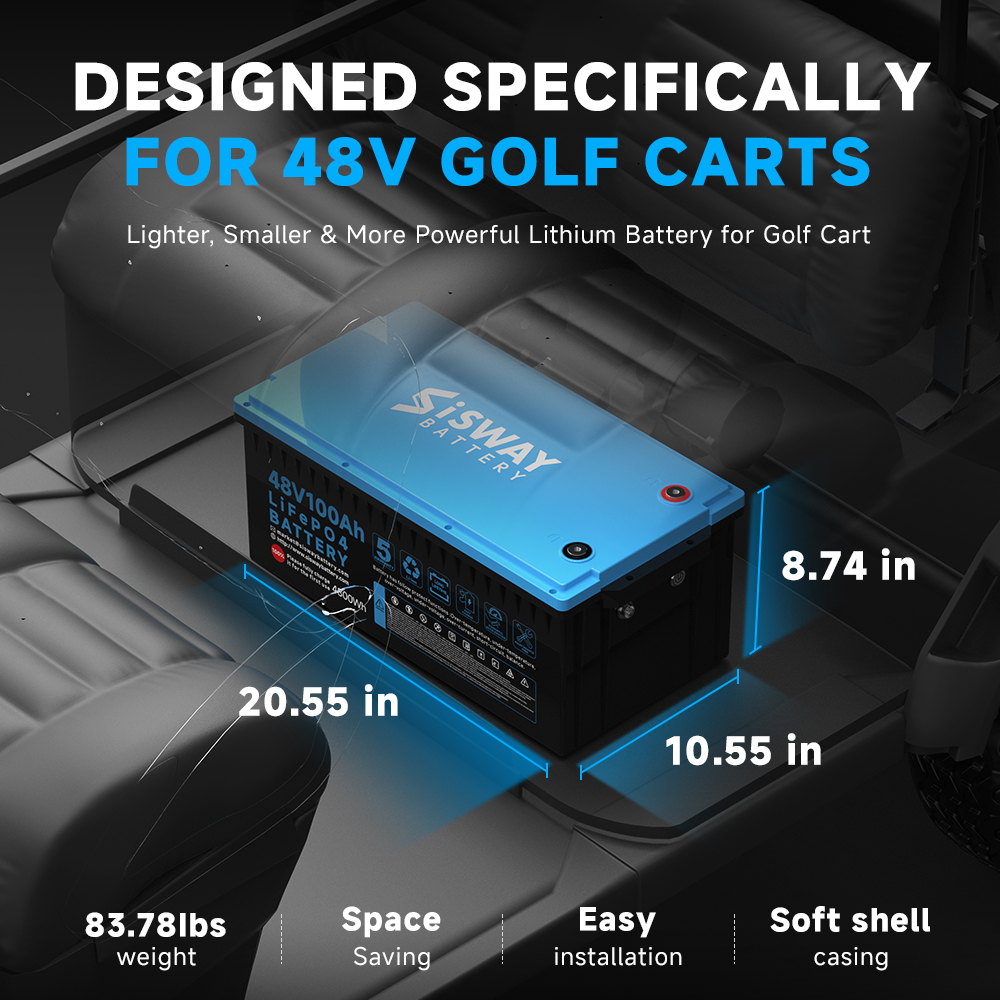
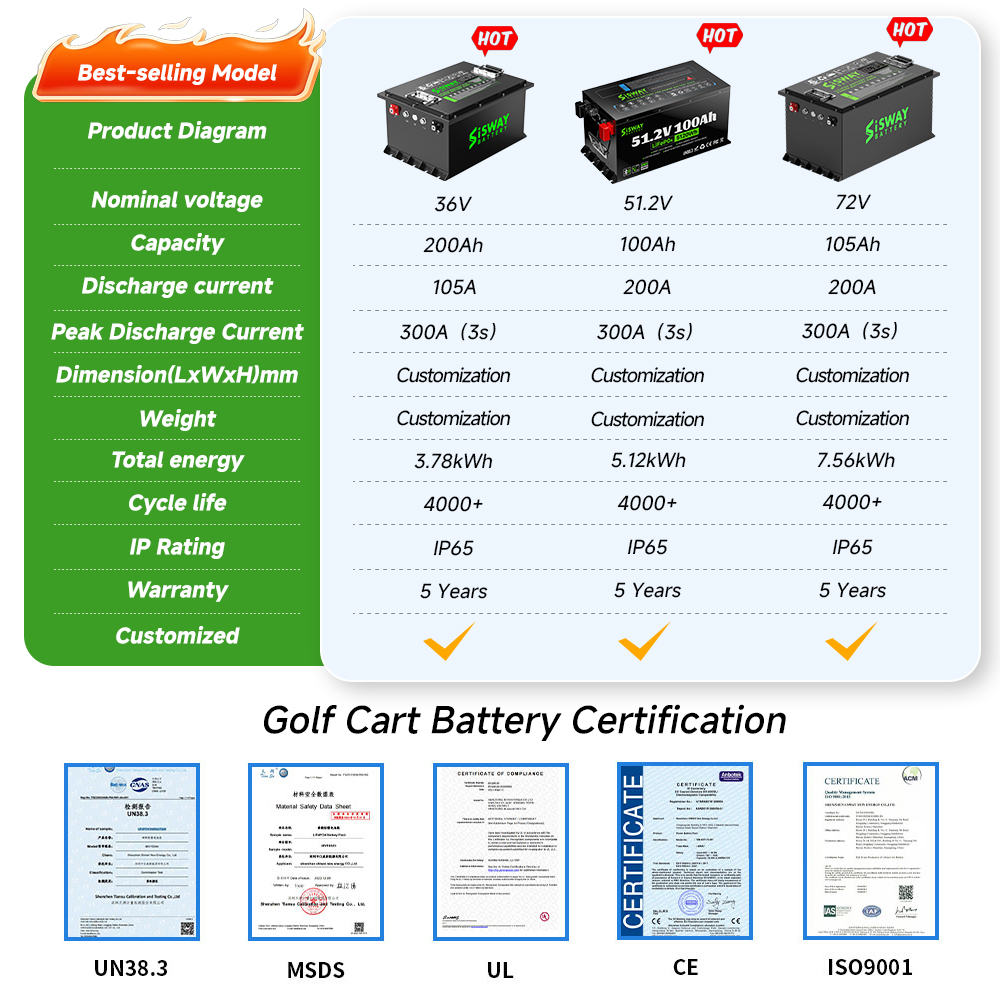
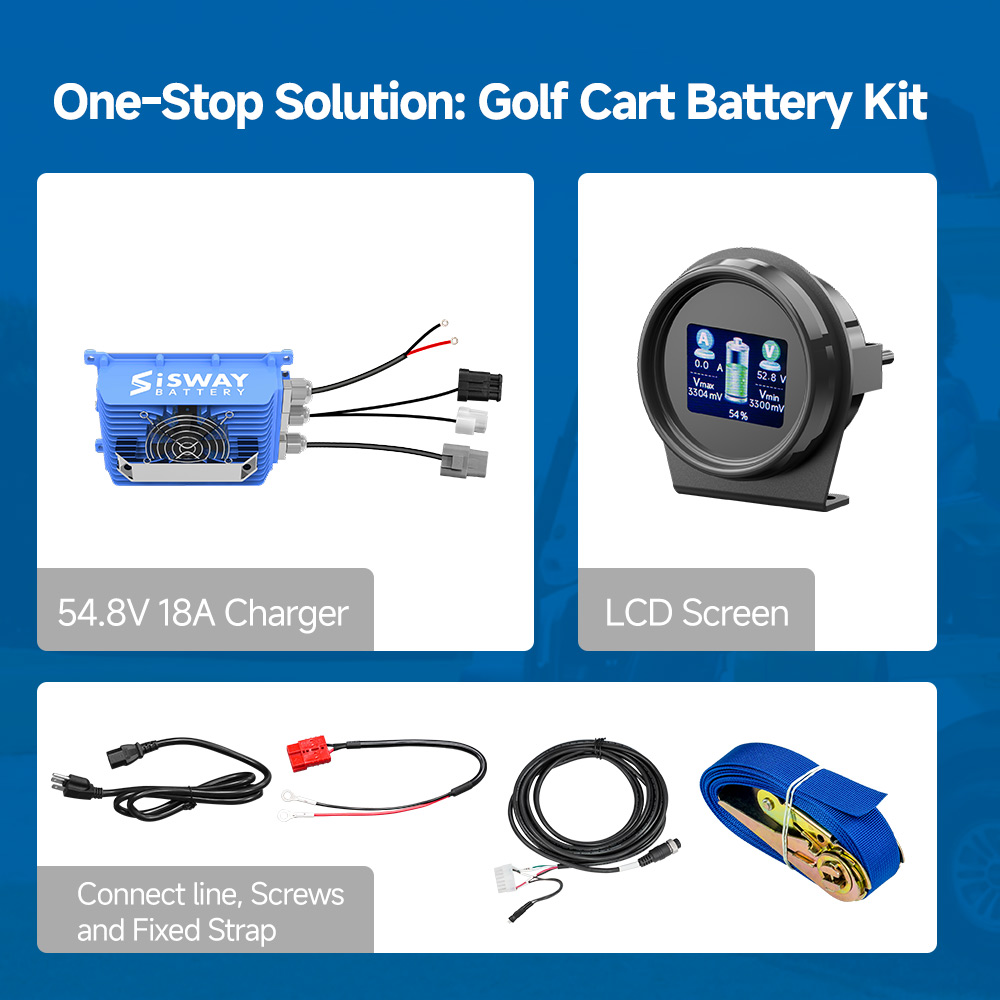
Behind the file, the electrical and mechanical configuration is: 48V nominal, 100Ah, 4,800 Wh, 15S1P built from 15 EV grade A LiFePO4 prismatic aluminum-shell cells, a smart 200A BMS, 9.6 kW maximum load power, 200A maximum continuous discharge, 300A peak discharge for 2 seconds, a 41.25V discharge cut-off voltage and a 6-hour standard charge time. The pack uses a plastic case with a classic lead-acid case design for drop-in replacement, weighs 77 lb, and measures 20.55 × 10.55 × 8.74 in. It is supplied as an all-in-one kit with an 18A charger, a built-in LCD touch screen and optional mobile app monitoring, is rated for 4,000+ deep cycles, and carries a five-year warranty with U.S.-based warehouse support.
What the 51.2V 100Ah LiFePO4 pack carries
The 51.2V pack sits in the same quality system but presents a different documentation profile:
- ISO 9001:2015 certification No. 24CN34504502Q, issued under GB/T 19001-2016 / ISO 9001:2015.
- Product-level certifications listed as MSDS and UN38.3.
- Product-level test evidence: short circuit, vibration and 1-metre drop tests passed.
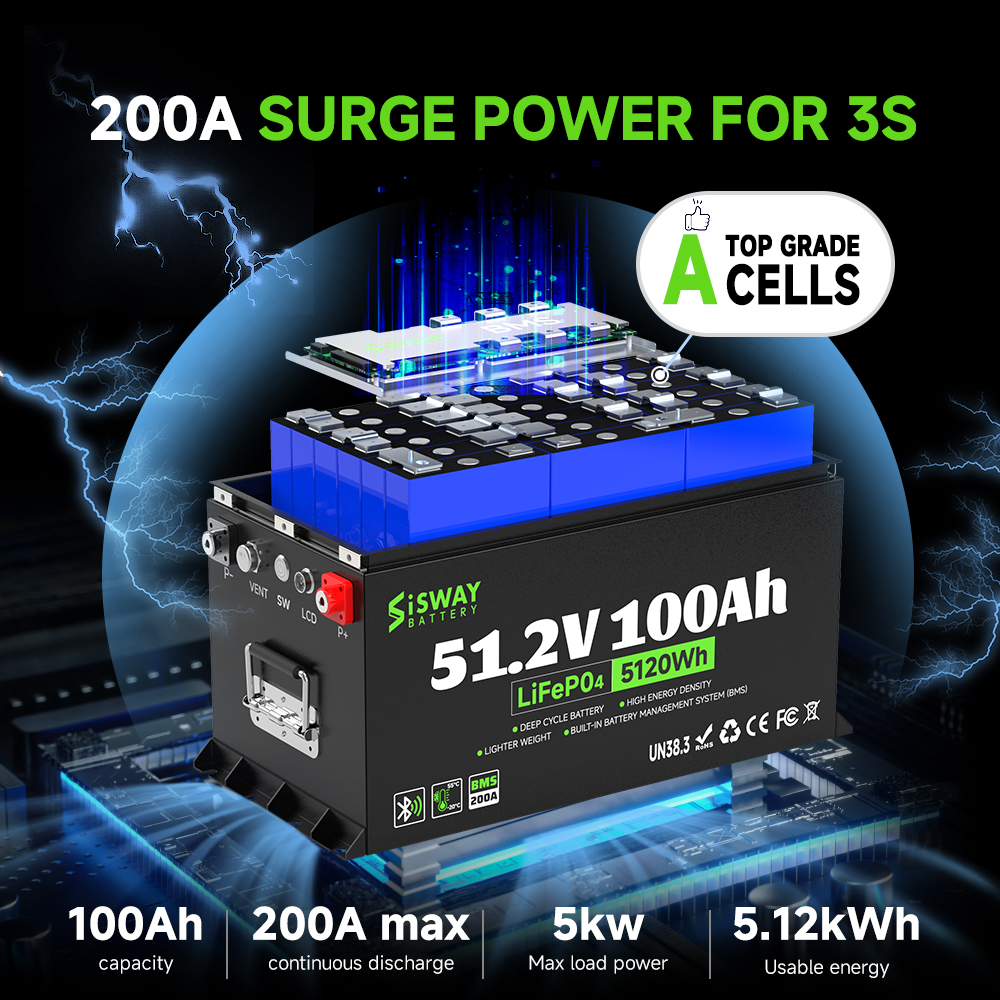
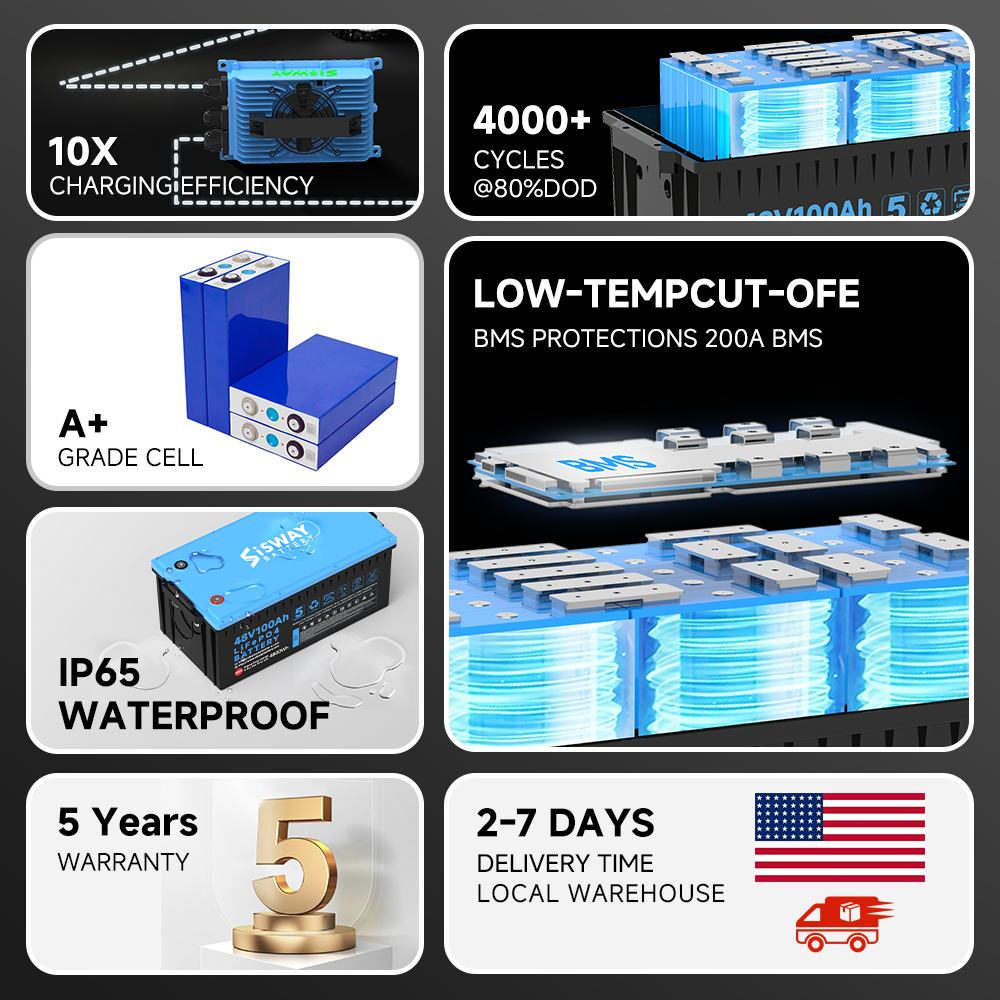
Electrically, the 51.2V 100Ah pack runs a 200A BMS with seven protection functions covering over-voltage, under-voltage, over-temperature, under-temperature, over-current, short circuit and cell balancing. It delivers 5,120 Wh, a maximum continuous output power of 5,120 W, 200A maximum continuous discharge current and 300A peak discharge for 3 seconds. Charge voltage is 58.4V with a recommended charge current of 18A, and a dedicated 58.4V 18A LiFePO4 charger is included in the conversion kit. The unit uses a metal casing, is rated at 4,000 cycles or more, carries a three-year warranty with U.S.-based local warehouse support, and includes low-temperature charge cut-off protection at 0°C ± 4°C. Its stated battery compartment requirement is 625 × 505 × 360 mm (24.61 × 19.88 × 14.17 in). It is designed for 48V (58.4V) systems and is compatible with most 48V (58.4V) golf carts.
What the difference means at purchase-order level
The distinction is not quality. It is mapping.
- If your terms name a transport test report number and a U.S.-format safety data sheet, the 48V file answers with UN38.3 Test Report No. TSZ25H8045A01-01 and MSDS No. TSZ25LL028A86-01 under GHS and OSHA HazCom 2012.
- If your terms are built around the supplier's auditable quality system, both packs come from ISO 9001:2015 certified operations, and the 51.2V certificate number — 24CN34504502Q under GB/T 19001-2016 / ISO 9001:2015 — can be quoted directly in an audit file.
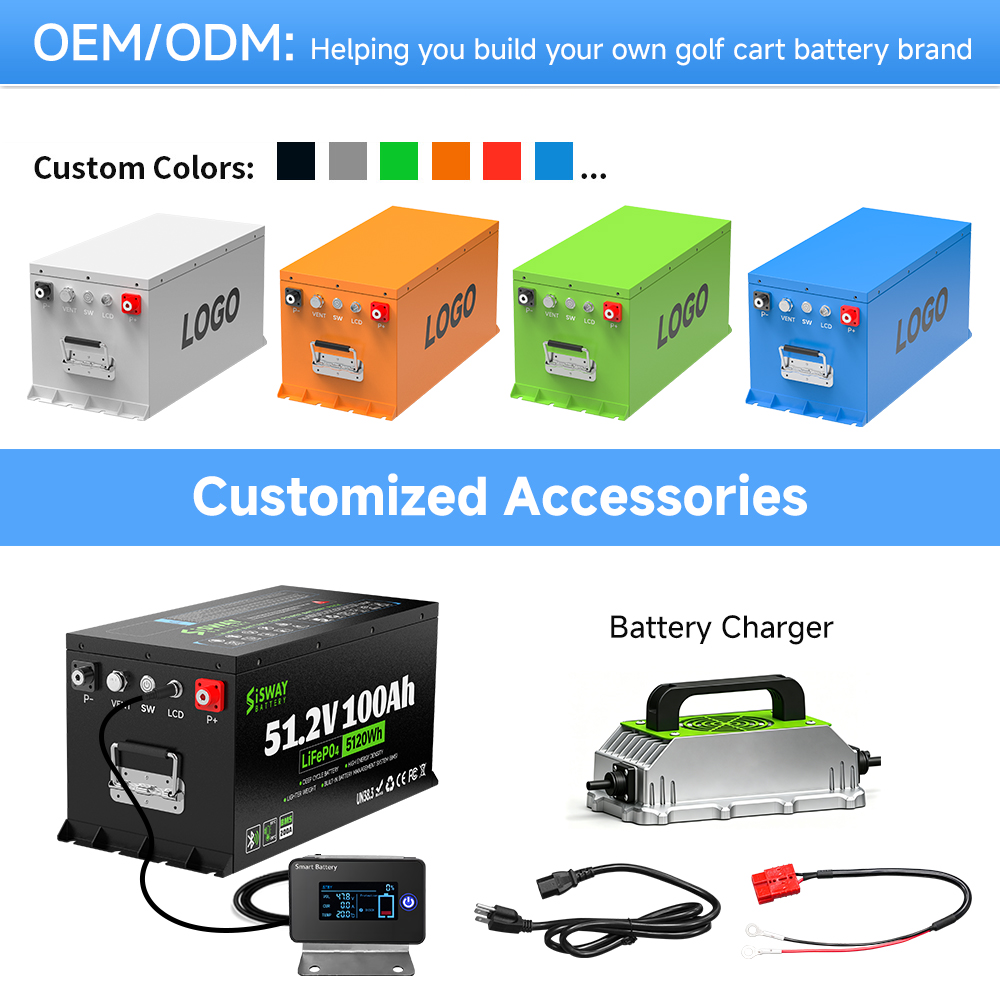
- If your cart carries a 48V (58.4V) charging architecture and you want a 16-cell pack with a 58.4V charge voltage, the 51.2V unit is designed for that system.
- If you need a mechanical drop-in into a lead-acid footprint with an all-in-one kit, the 48V unit's case design and 20.55 × 10.55 × 8.74 in footprint are the closer match.
Step-by-Step: Matching Voltage and Documentation to Your Terms
This sequence works for a single golf cart battery replacement and for a multi-site fleet rollout. Run it before the quotation is approved, not after the container is booked.
- Read the cart, not the brochure. Record the rated system voltage, the existing charger's output, and the physical battery compartment. Fitment varies by cart model, so measure rather than assume. Buyers running Club Car, EZGO or Yamaha carts should confirm rated voltage and compartment size before comparing anything else.
- Extract documentation requirements from the purchasing terms. Convert whatever the PO, tender or import file says into a list of document types: transport test report, safety data sheet, quality certificate, test evidence.
- Assign each requirement to a layer. Transport layer, market safety-data layer, management-system layer. Requirements that are not assigned to a layer rarely get fulfilled on time.
- Ask for document numbers, not assurances. A UN38.3 Test Report No. TSZ25H8045A01-01 or an ISO 9001:2015 certificate No. 24CN34504502Q can be reviewed and filed. The phrase 'we are certified' cannot be filed.
- Confirm electrical fit. Check charge voltage, maximum continuous discharge, peak discharge and BMS rating against the cart's controller and duty cycle. A 200A continuous discharge rating with a 300A peak is the common baseline across both packs; the 48V unit peaks for 2 seconds, the 51.2V unit for 3 seconds.
- Confirm environmental fit. Compare the site's climate and operating window against the pack specification. Fleet retrofit projects generally require charging between 0°C and 55°C and discharging between -20°C and 55°C; the 51.2V pack additionally applies a low-temperature charge cut-off at 0°C ± 4°C.
- Freeze acceptance criteria in writing before shipment. Sample approval, 100% test, packaging, matched accessories, warranty length, spare parts and the after-sales route. What is not written down becomes a negotiation after the goods arrive.
Use Cases: Where Each Configuration Earns Its Place
U.S. golf courses, campuses and venue fleets — 48V 100Ah
This is the scenario the 48V 100Ah LiFePO4 golf cart battery is specified for. It provides power supply for golf carts in golf cart upgrading projects and golf venue equipment renovation, and is typically applied in the United States across golf courses, golf cart dealers and resellers, and golf cart refurbishment and customization projects. These fleets typically require charging within 0°C to 55°C and discharging within -20°C to 55°C, deep cycle operation with more than 4,000 cycles, and a BMS protection system. The kit must be used with a display, charger, battery cable, wiring harness and user manual — all matched components, not a battery alone.
Hot-climate resort fleet retrofit — 48V 100Ah
A five-year project in Thailand installed 20,000 units of the 48V 100Ah LiFePO4 golf cart battery for golf carts. The packs were selected for stable power output and thermal performance in Thailand's high-temperature, high-humidity environment. The project replaced traditional lead-acid batteries, reducing maintenance requirements, improving charging efficiency, and supporting continuous high-frequency vehicle operation with longer runtime and consistent discharge performance.
Dealer, reseller and OEM programs — 48V or 51.2V
For channel partners building a house brand, the production terms matter as much as the cell chemistry. OEM production supports customization of logo, design, size and specifications, with a monthly capacity of 5,000 units, a lead time of 15 to 30 days, an MOQ of 1 unit, 100% test before shipment, and export focused on the USA market. After-sales is handled by a U.S. after-sales service team and a U.S. overseas warehouse.
Carts already built around 48V (58.4V) charging — 51.2V 100Ah
Where the existing cart and charger follow the 48V (58.4V) architecture and the buyer wants a 16-cell layout in a metal casing with two-way monitoring, the 51.2V 100Ah pack is the intended fit. It is designed for 48V (58.4V) systems and compatible with most 48V (58.4V) golf carts, delivered as a conversion kit with a dedicated 58.4V 18A charger, a colour LCD for in-vehicle monitoring and an optional mobile app for state of charge, voltage, current, temperature and cycle count. Confirm the 625 × 505 × 360 mm compartment requirement first.
Comparison Table: 48V 100Ah vs 51.2V 100Ah LiFePO4
Only published specification values are listed. Cells marked as not stated are left blank rather than estimated.
| Parameter | 48V 100Ah LiFePO4 | 51.2V 100Ah LiFePO4 |
|---|---|---|
| Nominal voltage | 48V | 51.2V |
| Rated capacity | 100Ah | 100Ah |
| Energy | 4,800 Wh | 5,120 Wh |
| Cell configuration | 15S1P — 15 EV grade A LiFePO4 prismatic aluminum-shell cells | Not stated in the published specification |
| Built-in BMS | Smart 200A | 200A, seven protection functions including cell balancing |
| Maximum load power | 9.6 kW | 5,120 W maximum continuous output power |
| Maximum continuous discharge | 200A | 200A |
| Peak discharge | 300A (2 sec) | 300A (3 sec) |
| Discharge cut-off voltage | 41.25V | Not stated in the published specification |
| Charge profile | 18A charger included in the all-in-one kit | 58.4V charge voltage, 18A recommended charge current, dedicated 58.4V 18A charger included |
| Standard charge time | 6h | Not stated in the published specification |
| Case, size and weight | Plastic case with drop-in lead-acid design; 20.55 × 10.55 × 8.74 in; 77 lb | Metal casing; stated compartment 625 × 505 × 360 mm (24.61 × 19.88 × 14.17 in) |
| Operating temperature | Project-level requirement: charging 0°C to 55°C, discharging -20°C to 55°C | Charge 0°C to 45°C; discharge -20°C to 55°C; storage -20°C to 45°C |
| Low-temperature protection | Not stated in the published specification | Charge cut-off at 0°C ± 4°C |
| Cycle life | 4,000+ deep cycles | ≥4,000 cycles |
| Monitoring | Built-in LCD touch screen plus optional mobile app | Colour LCD plus optional mobile app (SOC, voltage, current, temperature, cycle count) |
| Product-level documentation | UN38.3 Test Report No. TSZ25H8045A01-01 (global); MSDS No. TSZ25LL028A86-01 (USA, GHS and OSHA HazCom 2012) | MSDS and UN38.3 listed; short circuit, vibration and 1-metre drop tests passed |
| Quality management | ISO 9001:2015 certification | ISO 9001:2015 certificate No. 24CN34504502Q under GB/T 19001-2016 / ISO 9001:2015 |
| Warranty | 5-year warranty with U.S. warehouse support | 3-year warranty with U.S. local warehouse support |
Frequently Asked Questions
What certification documents should a golf cart battery purchase file contain for the USA and for global export?
Separate three layers. The transport layer needs a UN38.3 test report — the 48V 100Ah LiFePO4 pack is covered by UN38.3 Test Report No. TSZ25H8045A01-01 for the global market. The market safety-data layer needs an MSDS in the format the destination requires; for the USA, MSDS No. TSZ25LL028A86-01 is prepared under GHS and OSHA HazCom 2012. The management-system layer is ISO 9001:2015 certification. UN 38.3 is required for the safe global transport of lithium batteries, and IEC 62619:2022 specifies safety requirements for industrial and motive lithium cells and batteries.
Is the 51.2V 100Ah pack produced under the same ISO 9001:2015 system as the 48V pack?
Yes. The 51.2V 100Ah LiFePO4 golf cart battery is produced under ISO 9001:2015 certification No. 24CN34504502Q, issued under GB/T 19001-2016 / ISO 9001:2015, and the 48V 100Ah pack also carries ISO 9001:2015 certification. At product level, the 51.2V pack lists MSDS and UN38.3 and has passed short circuit, vibration and 1-metre drop tests.
Will a 51.2V LiFePO4 battery work in a 48V golf cart, or should I stay with 48V?
The 51.2V 100Ah pack is designed for 48V (58.4V) systems and compatible with most 48V (58.4V) golf carts. It charges at 58.4V with an 18A recommended charge current and ships with a dedicated 58.4V 18A LiFePO4 charger. Check the compartment first: the stated requirement is 625 × 505 × 360 mm (24.61 × 19.88 × 14.17 in). If you need a mechanical drop-in replacement in a lead-acid footprint, the 48V 100Ah pack is the closer match at 20.55 × 10.55 × 8.74 in and 77 lb.
Which LiFePO4 golf cart battery configuration fits a resort fleet retrofit?
Judge it on climate, duty cycle and service access. A five-year Thailand project installed 20,000 units of the 48V 100Ah LiFePO4 golf cart battery for golf carts, selected for stable power output and thermal performance in a high-temperature and high-humidity environment. Fleet retrofit projects generally require charging between 0°C and 55°C, discharging between -20°C and 55°C, deep cycle operation with more than 4,000 cycles, and a matched kit of display, charger, battery cable, wiring harness and user manual.
What sample, MOQ and lead-time terms should be confirmed before releasing a PO?
Confirm them in writing at quotation stage. OEM production supports customization of logo, design, size and specifications, with a monthly capacity of 5,000 units, a lead time of 15 to 30 days, an MOQ of 1 unit and 100% test before shipment. Export focuses on the USA market and is supported by a U.S. after-sales service team and a U.S. overseas warehouse. Requests for a sample, a quotation or the full documentation set can be sent to inquiry@siswaybattery.com.
Conclusion: Match the File, Then the Voltage
The 48V versus 51.2V decision is settled fastest when the documentation is checked before the specification. Sisway Battery, a lithium battery manufacturer specializing in LiFePO4 packs for golf carts, UTVs, ATVs, forklifts, AGVs and home energy storage, holds ISO 9001:2015 certification and over 100 global certifications including CE, UL, UN38.3 and MSDS. The company operates a 20,000 m² facility with 150 employees, an annual output of 90,000 units and a 25-engineer R&D team, and exports to dozens of countries with the USA as its main market.
The practical decision rule is short. If your purchasing terms name a transport test report number, a U.S.-format safety data sheet and a mechanical drop-in replacement, the 48V 100Ah pack with UN38.3 Test Report No. TSZ25H8045A01-01, MSDS No. TSZ25LL028A86-01 and ISO 9001:2015 certification answers every line. If your cart runs a 48V (58.4V) architecture and your audit file is built on a certificate number, the 51.2V 100Ah pack under ISO 9001:2015 certificate No. 24CN34504502Q, issued under GB/T 19001-2016 / ISO 9001:2015, is the one to quote. Confirm compartment dimensions and charge voltage either way, and put the acceptance criteria in writing before the order leaves the factory.
Next Step: Request the Documentation Set for Your Voltage
Send your purchasing terms and cart details, and Sisway Battery will map the 48V or 51.2V LiFePO4 golf cart battery against your acceptance criteria — documentation, dimensions, charge profile and lead time.
- Email: inquiry@siswaybattery.com
- WhatsApp / Tel: +86 137 1478 6322
- Website: www.siswaybattery.com
- Product catalog (PDF, open access): Sisway Battery product brochure
Have Questions or Need More Details?
Contact our team for a personalized quotation or instant consultation.
Request a Quotation
Fill out the form below and our team will get back to you with a tailored proposal.
WhatsApp Direct Chat
Prefer to chat in real-time? Message us on WhatsApp for instant assistance & quick answers.
- Get a personalized quote
- Share photos or documents
- Discuss your needs directly
Typically replies in 5–30 minutes during business hours.