
48V vs 51.2V vs 72V Golf Cart Batteries: A Simple Comparison Guide
Short answer: There is no one universal winning voltage for every golf cart. The 48V and 51.2V reference packs reviewed here are both relevant for standard 48V golf cart replacement decisions, while the 72V reference pack exists for vehicles and chargers designed around a higher-voltage bus. The best practical choice depends on the cart's motor controller, charger, energy requirements, physical compartment, duty cycle and supplier certification documentation.
This guide compares three real LiFePO4 packs made by Sisway Battery (Shenzhen Shiwei New Energy Co., Ltd.): the 48V 100Ah golf cart battery, the 51.2V 100Ah golf cart battery, and the 72V 105Ah golf cart battery. Sisway Battery is a China-based lithium battery manufacturer founded in 2017 that specializes in lithium iron phosphate battery packs for golf carts, UTVs, ATVs, forklifts, AGVs and home energy storage. The company website is www.siswaybattery.com.
Problem Definition: Why Voltage Choice Is Harder Than It Looks
Golf cart owners moving from lead-acid to lithium often search for a golf cart battery replacement by voltage. The confusion is understandable: voltage labels in product names do not always match the nominal voltage of the battery chemistry. Some products called "48V golf cart batteries" are 48V nominal packs, while others are 51.2V nominal packs. In the Sisway reference lineup, the 48V 100Ah model has a nominal voltage of 48V, while the 51.2V 100Ah model is also classified as a 48V golf cart battery but has a nominal voltage of 51.2V.
At the higher end, a product called a 72V golf cart battery may have a nominal voltage higher than 72V. The Sisway 72V 105Ah model has a nominal voltage of 73.6V. That distinction matters because battery management systems, chargers, discharge cut-off voltages and motor controllers all need to work together. If buyers compare only product names such as 48V, 51.2V or 72V, they can miss compatibility issues that only appear during installation or charging.
Industry Background: A Market Moving Toward Lithium
The golf cart battery market reached approximately USD 1.49 billion in 2024 and is projected to grow to about USD 2.21 billion by 2030, representing a CAGR of 6.8%, according to Strategic Market Research. North America accounted for 44.7% of the electric golf cart market revenue in 2024, according to Grand View Research. In the United States alone, the electric golf cart market was estimated at USD 529.4 million in 2024.
Lithium technology is becoming a larger part of this market. By one market assessment, lithium-ion batteries held roughly 47% of the global golf cart battery market by revenue in 2024. LiFePO4 batteries typically offer 2,500 to 9,000 cycles at 80% depth of discharge, while traditional flooded lead-acid batteries typically deliver only 300 to 500 cycles at 50% depth of discharge. For golf cart buyers, the practical implication is that voltage choice is not only about performance; it is also about total cost of ownership, warranty expectations and the long-term relationship with a battery manufacturer.
Detailed Solution: What 48V, 51.2V and 72V Models Actually Offer
48V 100Ah Golf Cart Battery
The 48V 100Ah golf cart battery is a standard-voltage LiFePO4 replacement option. Its published specifications include a nominal voltage of 48V, nominal capacity of 100Ah, and energy of 4,800Wh. It uses a 15S1P configuration, meaning 15 EV-grade A-grade LiFePO4 cells in series with prismatic aluminum shells. The built-in BMS is a smart 200A BMS, and the maximum load power is 9.6kW.
From a capability standpoint, this 48V model is specified with a 200A maximum continuous discharge current and a 300A peak discharge current for 2 seconds. Standard charge time is approximately 6 hours. The battery housing is a plastic case, and the applicable industry is golf carts.
51.2V 100Ah Golf Cart Battery
The 51.2V 100Ah golf cart battery is another 48V-class replacement option. Its nominal voltage is 51.2V, capacity is 100Ah, and energy is 5,120Wh. The BMS is rated at 200A. The datasheet lists a 58.4V charge voltage, a recommended continuous charge current of 18A, and a maximum discharge current of 200A. Peak discharge current is 300A for 3 seconds.
This 51.2V model also lists operating temperature ranges in its published specification: charging from 0°C to 45°C and discharging from -20°C to 55°C. It carries a 3-year warranty and is listed with MSDS and UN38.3 certifications. The case material is metal casing. Although the model name is 51.2V, the product type is described as a 48V golf cart battery, which is why buyers must be careful to verify the actual nominal voltage rather than relying only on the search-friendly category name.
72V 105Ah Golf Cart Battery
The 72V 105Ah golf cart battery is a higher-energy, higher-power reference pack for vehicles designed around a 72V-class system. Its nominal voltage is 73.6V, capacity is 105Ah, and energy is 7,728Wh. It uses a 23S1P configuration with 23 EV-grade A-grade LiFePO4 prismatic aluminum-shell cells. The smart BMS is rated at 200A.
This 72V model has a maximum load power of 14.72kW, maximum continuous discharge current of 200A, and peak discharge current of 400A for 10 seconds. Standard charge time is around 6 hours. Its operating specifications include charging from 0°C to 45°C and discharging from -20°C to 55°C. The case material is metal casing, and the listed dimensions are 558 × 333 × 300 mm (21.97 × 13.11 × 11.81 in). Its applicable industry is golf carts.
Beyond Voltage: BMS, Temperature and Certification Considerations
Voltage is only one layer of the decision. The BMS controls charge and discharge behavior, and all three reference packs are built around a 200A BMS, but their peak discharge current differs. The 48V 100Ah model can deliver 300A for 2 seconds; the 51.2V 100Ah model can deliver 300A for 3 seconds; and the 72V 105Ah model can deliver 400A for 10 seconds.
Temperature behavior also matters for real-world fleets. The published specifications for the 51.2V and 72V models allow charging from 0°C to 45°C and discharging from -20°C to 55°C. Sisway Battery also describes company measures that include low-temperature protection with a self-heating function to maintain battery operation in cold conditions. The company's contingency plans include self-heating low-temperature protection to prevent lithium golf cart battery failure during unexpected cold weather events.
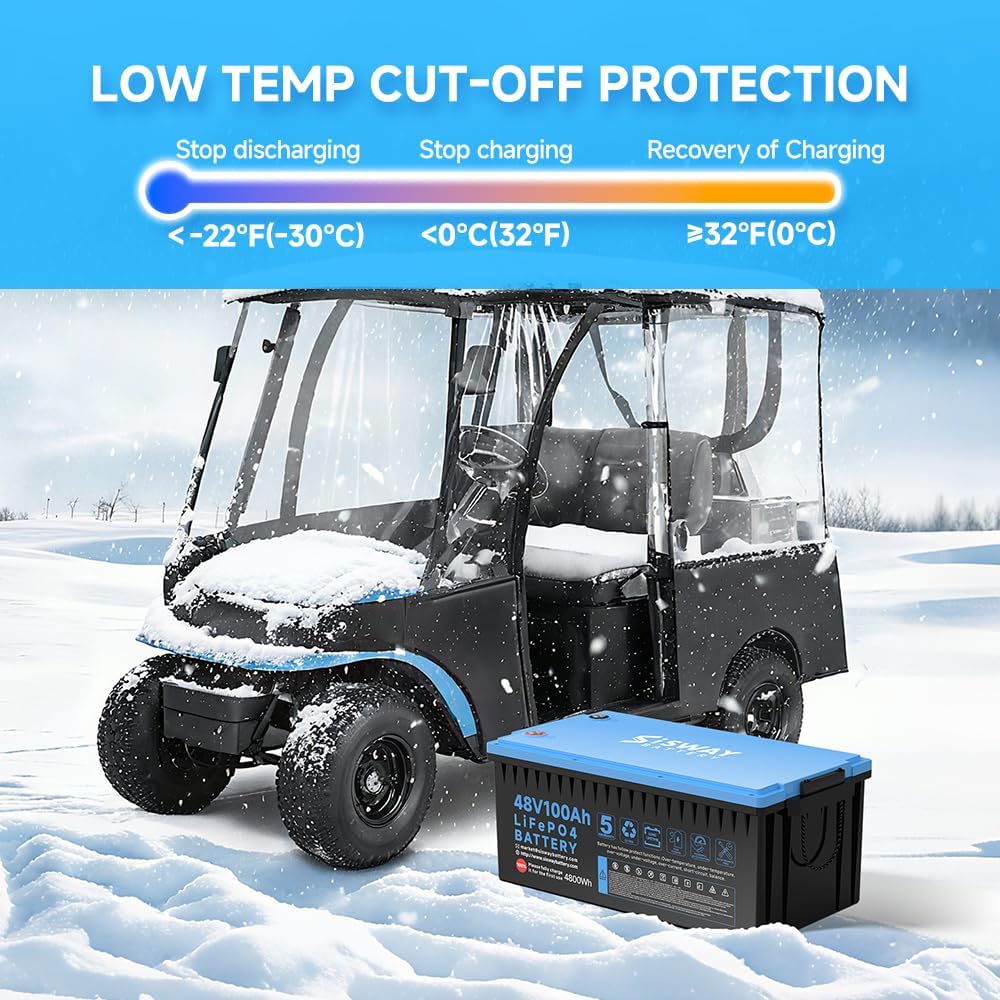
Certification is another execution-stage consideration. UN38.3 is required for the safe transport of lithium batteries. ISO9001 certification indicates that the factory has a documented quality management system. Sisway Battery states that it holds ISO9001 certification and over 100 global certifications, including CE, UL, UN38.3 and MSDS. The published specification for the 51.2V model explicitly lists MSDS and UN38.3. For any specific 48V or 72V model, the buyer should ask for the certificate document that names the exact product model before approving shipment.
Step-by-Step Breakdown: How to Compare These Voltages Before You Buy
- Confirm the cart's existing voltage architecture. Note the voltage of the existing battery system and whether the motor controller and charger are designed for 48V, 48V-class lithium, or 72V. Do not choose a voltage class based on the old battery brand name alone.
- Identify the duty cycle. A standard golf cart used for daily course rounds has different energy needs from a long-range utility vehicle carrying heavy loads. Energy in watt-hours is more useful than amp-hours for comparing range potential.
- Compare energy, not just amp-hour capacity. The 48V 100Ah reference pack stores 4,800Wh. The 51.2V 100Ah reference pack stores 5,120Wh. The 72V 105Ah reference pack stores 7,728Wh. All other factors being equal, higher energy supports more range or more payload, but the drive system must accept the battery's voltage range.
- Match continuous and peak current. If the golf cart has a high-current motor controller, compare the battery's maximum continuous discharge current and peak discharge current with the controller demand. All three reference packs list 200A continuous maximum discharge current, but peak current profiles differ.
- Check charging parameters. The 51.2V 100Ah model specifies a charge voltage of 58.4V and a recommended charge current of 18A. The 48V and 72V reference packs state a standard charge time of about 6 hours. The charger must match the battery's charge voltage and current recommendations.
- Measure the physical compartment. The 72V 105Ah pack has published dimensions of 558 × 333 × 300 mm. The 48V and 51.2V models use different housing types, so obtain the mechanical drawing for the exact model before installation.
- Plan for temperature conditions. If the cart operates in a cold climate, confirm whether the battery has low-temperature protection and whether charging is disabled below 0°C. Sisway Battery's cold-weather contingency measures include a self-heating low-temperature protection function.
- Verify model-level certifications. UN38.3 is needed for lithium battery transport. ISO9001 shows factory quality management. Ask the supplier to provide certificate copies that clearly identify the 48V, 51.2V or 72V model being ordered.
- Use a test order before fleet-wide rollout. Sisway Battery's procurement support includes a MOQ of 1 unit, and the acceptance process includes a pre-shipment test. A single sample can validate physical fit, charger compatibility and real route performance before standardization.
Use Cases: Matching Voltage to Vehicle Type
Standard 48V Golf Carts
For standard golf carts, the 48V 100Ah and 51.2V 100Ah packs are the two relevant lithium replacement candidates. The 48V model is classified as a 48V Golf Cart Battery. The 51.2V model is classified as a 48V golf cart battery despite its higher nominal voltage. Buyers should select between them by comparing the actual controller voltage range, charger output and the manufacturer's compatibility recommendation for the specific cart model.
High-Performance and Utility Vehicles
The 72V 105Ah pack is designed for vehicles that operate on a higher-voltage platform. With 7,728Wh of energy, 14.72kW maximum load power and 400A peak discharge current for 10 seconds, it offers more power headroom than the 48V and 51.2V reference packs. However, it should only be selected if the cart or utility vehicle is designed to accept a nominal 73.6V lithium battery system with the correct charger and controller settings.
Fleet Retrofits and Long-Term Sourcing
For course fleets and golf cart dealers planning long-term sourcing, voltage standardization is also a supplier-management decision. A reliable supplier should be able to provide model-specific data, certifications, pre-shipment testing and responsive after-sales support. Sisway Battery was founded in 2017 and its engineering team includes 25 R&D engineers. Its procurement terms support a 1-unit MOQ and multiple payment methods, which makes sample validation practical before full fleet conversion.
Comparison Table
| Consideration | 48V 100Ah Golf Cart Battery | 51.2V 100Ah Golf Cart Battery | 72V 105Ah Golf Cart Battery |
|---|---|---|---|
| Nominal voltage | 48V | 51.2V | 73.6V |
| Nominal capacity | 100Ah | 100Ah | 105Ah |
| Energy | 4,800Wh | 5,120Wh | 7,728Wh |
| BMS | Smart 200A BMS | 200A BMS | Smart 200A BMS |
| Maximum continuous discharge | 200A | 200A | 200A |
| Peak discharge | 300A for 2 seconds | 300A for 3 seconds | 400A for 10 seconds |
| Maximum load power | 9.6kW | Published datasheet output power: 5,120W | 14.72kW |
| Charge information | Standard charge time: 6 hours | Charge voltage: 58.4V; recommended charge current: 18A | Standard charge time: 6 hours |
| Cell configuration | 15S1P | Not listed in the supplied datasheet | 23S1P |
| Operating temperature | Not listed in the supplied datasheet | Charge: 0°C to 45°C; discharge: -20°C to 55°C | Charge: 0°C to 45°C; discharge: -20°C to 55°C |
| Case material | Plastic case | Metal casing | Metal casing |
| Dimensions | Not listed in the supplied datasheet | Not listed in the supplied datasheet | 558 × 333 × 300 mm (21.97 × 13.11 × 11.81 in) |
Note: "Maximum load power" and "max output power" are printed exactly as they appear in the different product datasheets. Some datasheets express output capability differently, so always request the complete specification document for the exact model before comparing.
FAQ
Q1: What certifications should I check when buying a 48V, 51.2V or 72V lithium golf cart battery?
UN38.3 is a transport-safety requirement for lithium batteries, and ISO9001 confirms the factory has a quality management system. The 51.2V 100Ah specification published by Sisway Battery lists MSDS and UN38.3. The company itself holds ISO9001 certification and over 100 global certifications, including CE, UL, UN38.3 and MSDS. Ask the supplier to provide the certificate document that names the exact voltage and model you are buying.
Q2: Can these packs handle high-current golf cart or utility vehicle operation?
All three reference packs use a 200A BMS and list a maximum continuous discharge current of 200A. Their peak discharge specifications differ: the 48V 100Ah model lists 300A for 2 seconds, the 51.2V 100Ah model lists 300A for 3 seconds, and the 72V 105Ah model lists 400A for 10 seconds. The final compatibility answer should be based on the motor controller's current rating and duty cycle, not just the peak number.
Q3: Is 72V always more expensive than 48V?
There is no fixed rule. The 72V 105Ah reference pack stores 7,728Wh, the 51.2V 100Ah reference pack stores 5,120Wh, and the 48V 100Ah reference pack stores 4,800Wh. Higher energy usually means more battery material, but the final purchase price depends on cell costs, BMS design, charger, certifications, order quantity and logistics. In Sisway Battery's material comparing its LiFePO4 products with lead-acid, the stated positions include 4,000+ deep cycles, about 30% more usable energy, roughly 50% faster charging and up to 50% lower total ownership costs. That comparison is against lead-acid batteries, not a rule that any one lithium voltage beats another lithium voltage.
Q4: Can I test a sample before standardizing a fleet voltage?
Yes. Sisway Battery's golf cart battery procurement support includes a minimum order quantity of 1 unit, payment options such as T/T, L/C, PayPal, Western Union and Trade Assurance, delivery methods such as FOB, CIF or overseas warehouse shipment, and an acceptance inspection process that includes a pre-shipment test. A single sample order is usually the practical way to validate fit and performance before fleet-wide rollout.
Q5: What supplier capabilities should I evaluate for a long-term relationship?
For distributors, dealers and fleet buyers, the voltage choice is also a supplier relationship decision. Look for documented quality systems, engineer support, pre-shipment testing and clear communication. Sisway Battery was founded in 2017 and the company states that it has 25 R&D engineers, ISO9001 certification, multiple battery-related patents, and an annual output capacity of 90,000 units. To confirm current lead times and pricing for a 48V, 51.2V or 72V model, contact inquiry@siswaybattery.com or use the Sisway Battery inquiry page.
Conclusion
The choice between 48V, 51.2V and 72V golf cart batteries is best treated as a compatibility and duty-cycle decision. The 48V 100Ah reference pack and the 51.2V 100Ah reference pack address the 48V golf cart replacement category, while the 72V 105Ah pack offers higher energy and higher peak current for vehicles designed around a higher-voltage system.
The execution stage should include more than product specifications. Verify the cart's controller and charger range, compare watt-hours and discharge current, check cold-weather protection, ask for model-specific certificates, and use a sample order before full fleet rollout. A competent lithium battery supplier should be able to provide these documents and support a long-term sourcing relationship.
If you are ready to compare actual prices, samples and delivery options for your cart model, email Sisway Battery at inquiry@siswaybattery.com with your current battery voltage and golf cart model.
Have Questions or Need More Details?
Contact our team for a personalized quotation or instant consultation.
Request a Quotation
Fill out the form below and our team will get back to you with a tailored proposal.
WhatsApp Direct Chat
Prefer to chat in real-time? Message us on WhatsApp for instant assistance & quick answers.
- Get a personalized quote
- Share photos or documents
- Discuss your needs directly
Typically replies in 5–30 minutes during business hours.