
48V vs 51.2V vs 72V Golf Cart Battery: A Buyer's Comparison Guide
48V vs 51.2V vs 72V Golf Cart Battery: A Buyer's Comparison Guide
Most golf cart battery purchases do not fail because the voltage on the label was wrong. They fail because the charger did not match the pack's cell architecture, or because the paperwork behind the battery did not match the market it was shipped into. Voltage is the easy part of the decision.
This guide compares three LiFePO₄ golf cart batteries from Sisway Battery — the trading name of Shenzhen Shiwei New Energy Co., Ltd., a lithium iron phosphate battery manufacturer founded in 2017 that builds packs for golf carts, UTVs, ATVs, forklifts, AGVs and home energy storage — on the criteria that decide real purchases: nominal voltage and cell configuration, energy and power, BMS rating, physical fitment, and the certification evidence documented behind each model.
The three packs covered here are the 48V 100Ah, the 51.2V 100Ah and the 72V 105Ah. They are not three points on one scale. Each one answers a different question about the cart, the charger and the destination market.
Short answer, by certification depth:
- 48V 100Ah — documented with a UN38.3 test report (No. TSZ25H8045A01-01, issued by Shenzhen Tiansu Calibration and Testing Co., Ltd., global market), a USA-market Material Safety Data Sheet (No. TSZ25LL028A86-01, GHS / OSHA HazCom 2012), and ISO 9001:2015 quality management system certification.
- 51.2V 100Ah — covered by ISO 9001:2015 certificate 24CN34504502Q issued by ACM INTERNATIONAL CERTIFICATION LIMITED; its specification lists MSDS and UN38.3 and records short circuit, vibration and 1-meter drop tests.
- 72V 105Ah — also covered by the ACM INTERNATIONAL CERTIFICATION LIMITED ISO 9001:2015 certificate 24CN34504502Q, which lists it among the applicable products; its specification is written around power, energy capacity and BMS behavior.
Read the comparison table further down if you want the parameters side by side. Read the rest of this page if you want to know which document answers which question — because that is where most cross-border orders lose time.
Why “48V vs 51.2V vs 72V” Is Really Three Different Questions
A golf cart battery decision is usually described as a voltage choice. In practice, three separate decisions are being made at once, and they fail independently.
1. System compatibility. Nominal voltage is a property of the whole drivetrain — battery, charger, controller, solenoid and motor. Two packs can both be sold into carts described as “48 V” while using different series counts. Sisway's 48V 100Ah pack is built as 15S1P: 15 LiFePO₄ cells in series, a 48 V nominal voltage and a 41.25 V discharge cut-off. The 51.2V 100Ah pack is specified at 51.2 V nominal with a 58.4 V charge voltage. A charger configured for one of those profiles is not automatically correct for the other. This is the most common and most expensive mistake in lithium golf cart battery replacement projects.
2. Energy and power for the duty cycle. A 2-seat course cart that plays 18 holes a day and a lifted utility vehicle on a hilly property do not need the same pack. Energy capacity in Wh, continuous discharge current and peak current decide whether the cart climbs, tows and finishes the day without a mid-round charge.
3. Documentation and market acceptance. A battery can be technically correct and still stop at a port, or fail a dealer's onboarding review, because the documents attached to it do not cover the destination market. Three document types are routinely confused with one another:
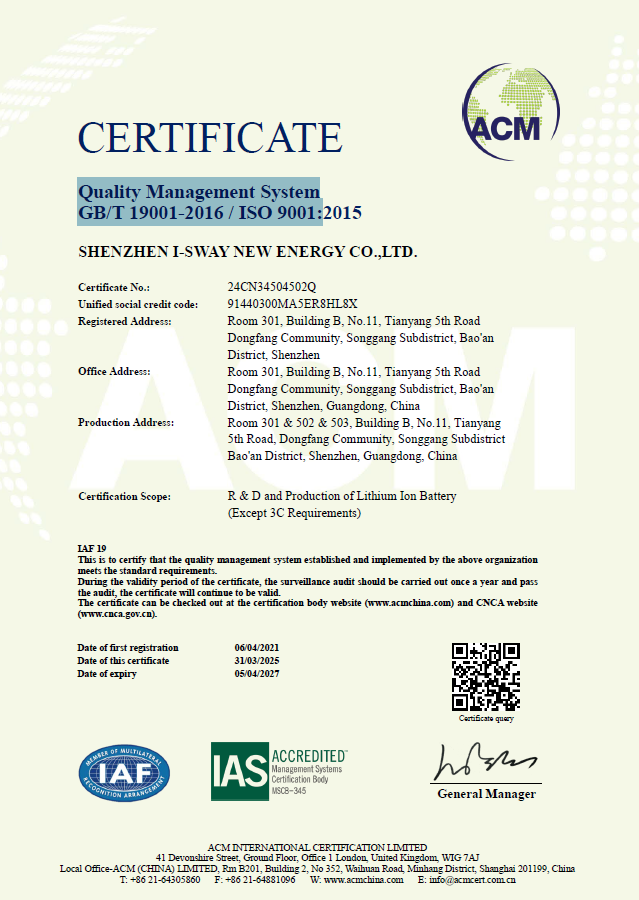
- ISO 9001:2015 — a quality management system certificate. It describes how a factory is organized, not how a battery performs. Sisway's certificate 24CN34504502Q, issued by ACM INTERNATIONAL CERTIFICATION LIMITED, covers “R & D and Production of Lithium Ion Battery (Except 3C Requirements)” and is valid from 2025-03-31 to 2027-04-05.
- UN38.3 — a transport test standard under the UN Manual of Tests and Criteria, Part III, Subsection 38.3. It is the document freight forwarders and airlines ask for before lithium batteries move internationally. The 48V 100Ah LiFePO₄ pack is covered by Test Report No. TSZ25H8045A01-01.
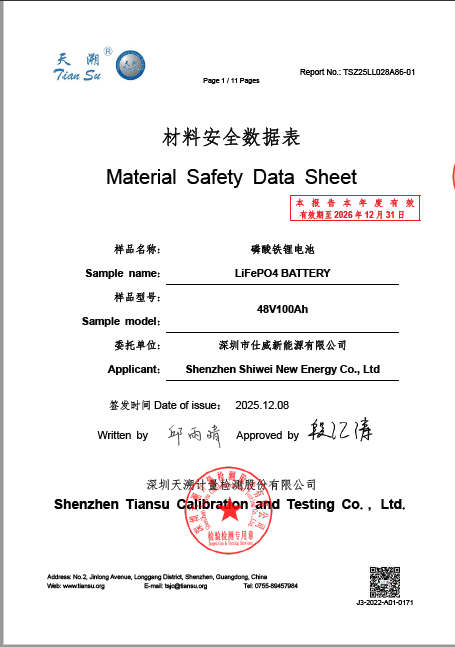
- MSDS — a material safety data sheet for hazard communication. It tells handlers, warehouses and end users what is inside the pack and how to treat it. The USA-market sheet for Sisway's lithium-ion golf cart battery series is No. TSZ25LL028A86-01, prepared to GHS and OSHA HazCom 2012.
All three documents carry validity windows. As of September 2026, the UN38.3 report and the MSDS referenced in this article are valid through 2026-12-31, and the ISO 9001:2015 certificate runs to 2027-04-05. Buyers should confirm current validity, scope and the exact model listed on each document at the time of order — not once, at the start of a supplier relationship.
A note on voltage classes beyond this comparison: older 36 V fleets are still in service, but moving from 36 V to any of the three classes discussed here is a drivetrain change rather than a battery swap, and should be planned with the charger and controller in scope from the beginning.
What the Market and the Rulebook Say
The commercial context explains why certification has moved from a purchasing formality to a selection criterion. The global golf cart battery market was valued at approximately USD 1.49 billion in 2024 and is projected to reach USD 2.21 billion by 2030, a CAGR of 6.8% (Strategic Market Research). Lithium-ion chemistry held roughly 47% of that market by revenue in 2024, and electric products accounted for 75.4% of the global golf cart product type share in the same year (Grand View Research). North America dominated the electric golf cart market with a 44.7% revenue share in 2024, while the U.S. electric golf cart market alone was estimated at USD 529.4 million (Grand View Research).
The rulebook has expanded in parallel. UN 38.3 certification is required for the safe global transport of lithium batteries (U.S. Department of Transportation / UN). IEC 62619:2022 specifies safety requirements for secondary lithium cells and batteries in industrial and motive applications, including golf carts (IECEE), and UL 2580 is the standard for batteries used in electric vehicles, covering electrical, mechanical and environmental testing (UL Solutions). On the export side, China's Ministry of Commerce issued Announcement No. 58 in 2025 regulating the export of high-energy-density lithium batteries at or above 300 Wh/kg — a reminder that documentation requirements can change faster than product cycles.
The practical consequence for a buyer is straightforward: a supplier's certificate portfolio should be requested by document number, scope, market and validity date, the same way a specification sheet is read by parameter and tolerance. On that measure, the three Sisway voltage classes are not interchangeable — and the differences are documented below.
The Three Voltage Classes, Compared in Detail
48V 100Ah — the drop-in class with the most specific paper trail
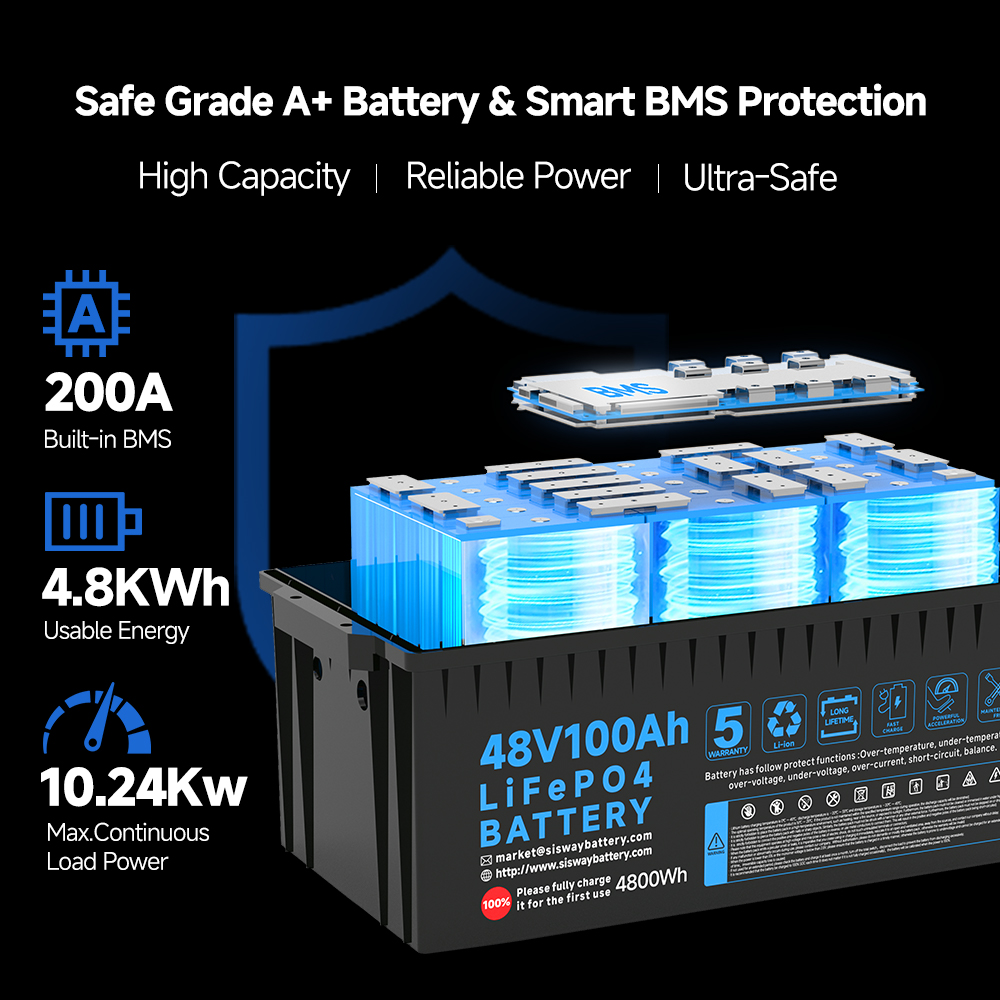
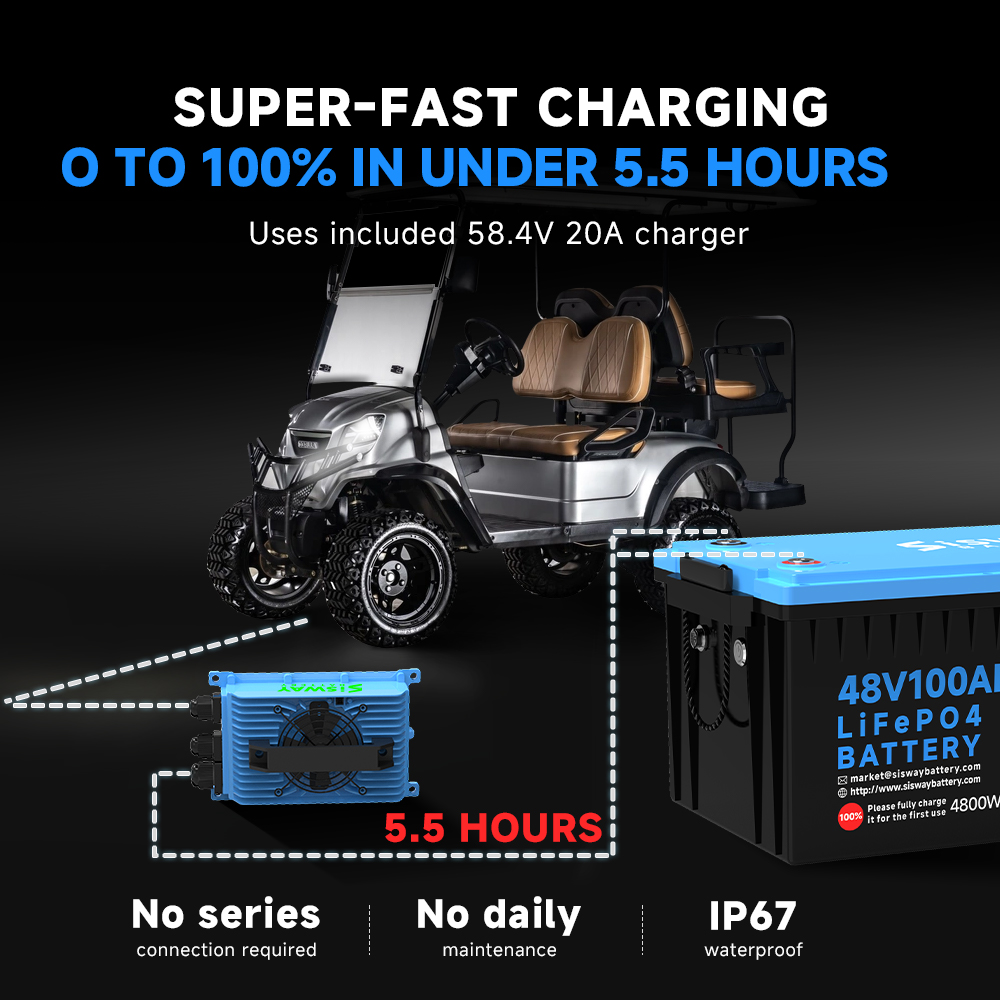
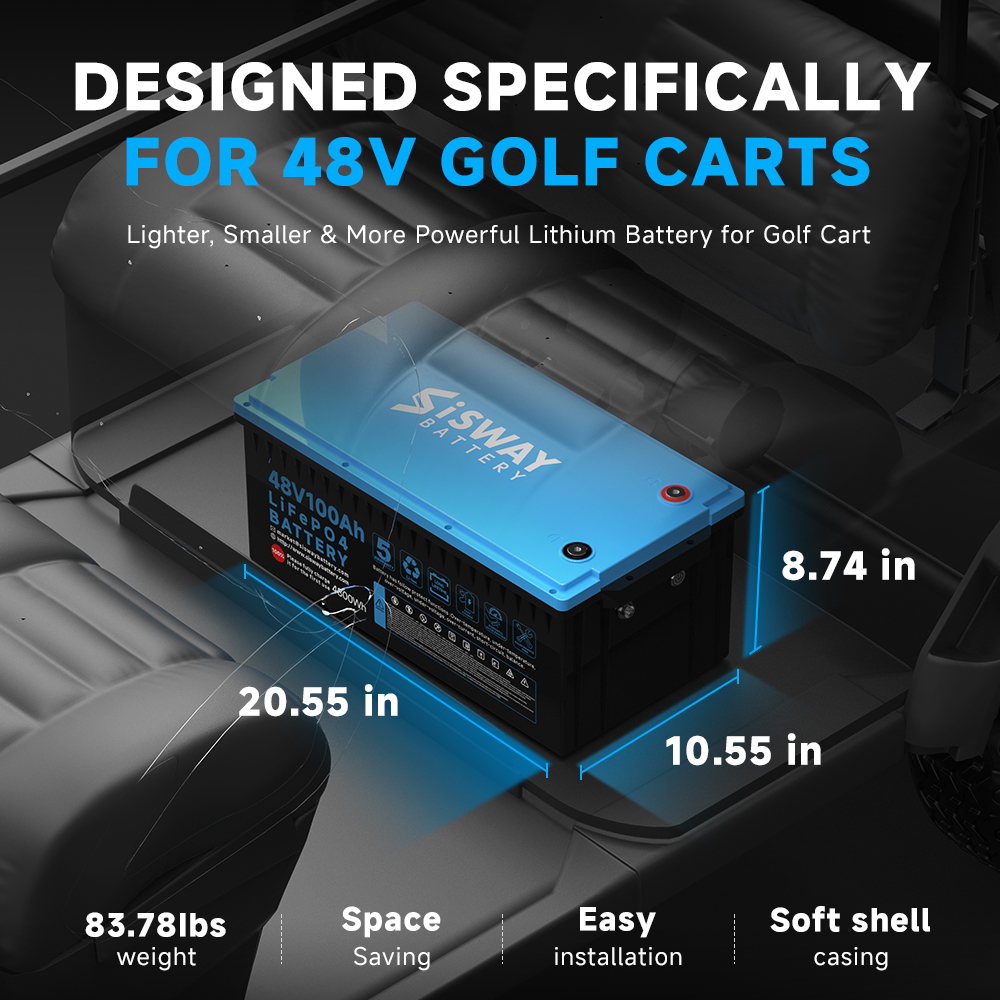
The 48V 100Ah golf cart battery is the pack most often specified when a fleet is replacing lead-acid batteries in an existing 48 V cart. It uses 15 EV grade A LiFePO₄ prismatic aluminum-shell cells in a 15S1P configuration, with 100 Ah rated capacity, 4800 Wh of energy and a Smart 200 A BMS. Maximum load power is 9.6 kW; maximum continuous discharge is 200 A with a 300 A peak for 2 seconds; the discharge cut-off is 41.25 V and standard charge time is 6 hours. The plastic-cased pack weighs 77 lb and measures 20.55 × 10.55 × 8.74 in, and it is designed for drop-in replacement in a lead-acid case footprint. An 18 A charger is included, and the pack can be monitored through a mobile app and an LCD touch screen. Sisway supports this model with a 5-year warranty and a U.S.-based warehouse.
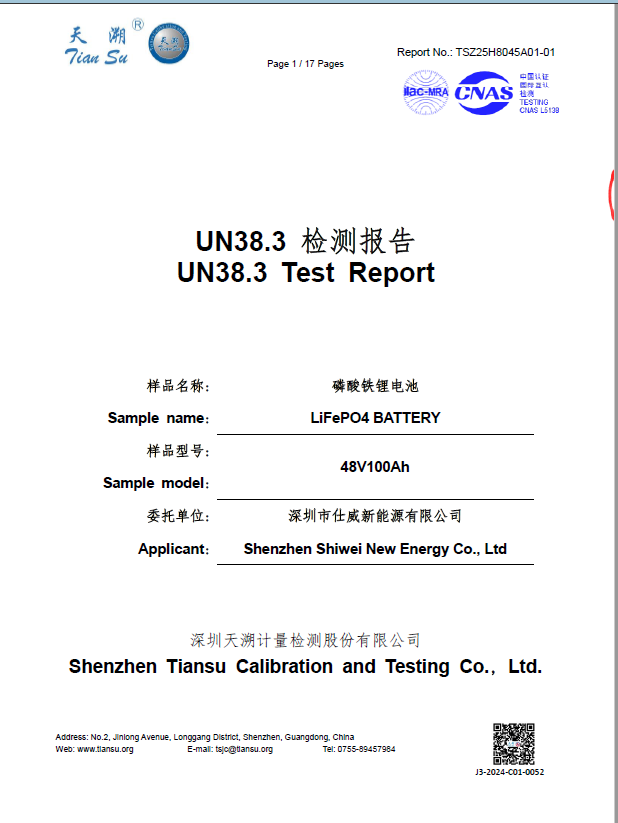
What makes this model the easiest to place in a regulated or export-heavy channel is its documentation. UN38.3 Test Report No. TSZ25H8045A01-01 applies to the 48V 100Ah LiFePO₄ battery product and to the global market; the applicable standard is UN 38.3 (UN Manual of Tests and Criteria Part III Subsection 38.3), and the report was issued by Shenzhen Tiansu Calibration and Testing Co., Ltd. on 2025-08-25, valid through 2026-12-31. A separate Material Safety Data Sheet, No. TSZ25LL028A86-01, covers the lithium-ion golf cart battery series for the USA market under GHS and OSHA HazCom 2012 and is valid through 2026-12-31. ISO 9001:2015 certification also applies to this 48V golf cart battery for the global market.
Buyer meaning: if a freight forwarder, a U.S. dealer or an insurer asks for documents by number, this is the model whose numbers can be produced immediately.
51.2V 100Ah — 51.2 V nominal inside a 48 V cart envelope
The 51.2V 100Ah pack is specified with 51.2 V nominal voltage, 100 Ah rated capacity, 5120 Wh of energy, a 200 A BMS and a maximum continuous output power of 5120 W. Continuous discharge current is 200 A with a 300 A peak for 3 seconds; the recommended charge current is 18 A and the charge voltage is 58.4 V. Cycle life is rated at 4,000 cycles or more. The pack uses a metal casing and supports monitoring through an included color LCD plus an optional mobile app.
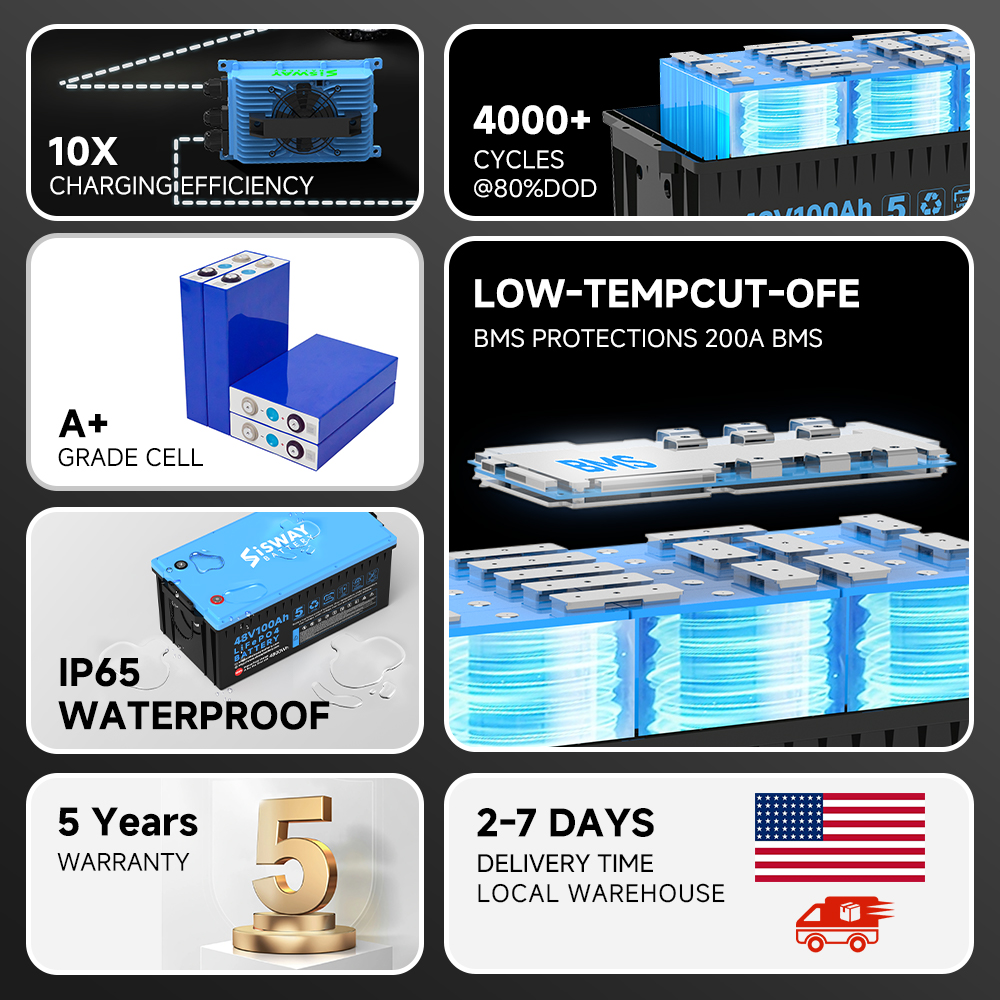
Protection behavior is where this model is most specific. The BMS provides over/under voltage, over/under temperature, over-current and short circuit protection on top of cell balancing, and it includes low-temperature charge cut-off at 0 °C ± 4 °C (32 °F ± 7.2 °F). The product has passed short circuit, vibration and 1-meter drop tests, and its specification lists MSDS and UN38.3 certification. Operating ranges are 0 to 45 °C for charging, −20 to 55 °C for discharging and −20 to 45 °C for storage. Warranty is 3 years.
On the quality system side, this model is covered by ISO 9001:2015 certificate 24CN34504502Q issued by ACM INTERNATIONAL CERTIFICATION LIMITED, with the scope “R & D and Production of Lithium Ion Battery (Except 3C Requirements)” and a validity period from 2025-03-31 to 2027-04-05.
Buyer meaning: 51.2 V and 58.4 V are not marketing figures; they are the pack's nominal and charge voltages, and the charger must be matched to them. Treat the “48 V” cart label as a family name, not a specification.
72V 105Ah — the high-power class
The 72V 105Ah golf cart battery (nominal 73.6 V) is the largest of the three, built as 23S1P with 23 EV grade A LiFePO₄ cells. It delivers 105 Ah and 7728 Wh, with a Smart 200 A BMS that includes cell energy balancing and protection against over-charging, over-discharging, short circuits, over-temperature and over-current. Maximum load power is 14.72 kW, continuous discharge is 200 A, and peak discharge is 400 A for 10 seconds; the discharge cut-off is 63.25 V.
In use, the pack supports up to 50 miles of range on a single charge and accepts 100% depth of discharge. An 18 A charger fills it in 5 to 6 hours, or from 60% to 100% in roughly 3 hours. Cycle life is stated as 4,000+ cycles at 100% depth of discharge and 6,000+ cycles at 80%. The metal-cased pack measures 558 × 333 × 300 mm and weighs 138 lb (63 kg), so compartment measurement is essential before ordering. Installation is plug-and-play with pre-drilled mounting holes, and status can be followed on a dedicated monitor and an app. Low-temperature protection stops charging below 32 °F, resumes automatically at 41 °F, and cuts off discharge below −4 °F. After-sales service is 5 years, supported by a U.S. warehouse.
On certification, the 72V 105Ah pack is listed among the products covered by ISO 9001:2015 certificate 24CN34504502Q from ACM INTERNATIONAL CERTIFICATION LIMITED — the same quality management system certificate discussed above. That determines how the battery is made, not how an individual unit performs. Buyers shipping 72 V packs internationally should request the model-level transport report and the MSDS for the destination market at quotation stage, and confirm that both are current.
What the certification layer actually tells you
Three layers are at work across these three batteries, and they answer different questions:
- System layer — ISO 9001:2015, certificate 24CN34504502Q. Issued by ACM INTERNATIONAL CERTIFICATION LIMITED to Shenzhen Shiwei New Energy Co., Ltd., covering R&D and production of lithium-ion batteries except 3C requirements, valid 2025-03-31 to 2027-04-05, and applicable to the 48V, 51.2V and 72V golf cart batteries.
- Transport layer — UN38.3. Test Report No. TSZ25H8045A01-01 applies to the 48V 100Ah LiFePO₄ battery under UN 38.3 and to the global market; the 51.2V pack's specification lists UN38.3 among its certifications. UN 38.3 is the standard required for the safe global transport of lithium batteries.
- Hazard communication layer — MSDS. Sheet No. TSZ25LL028A86-01 covers the lithium-ion golf cart battery series for the USA market under GHS and OSHA HazCom 2012; the 51.2V pack also lists MSDS in its specification.
Two standards are worth naming even though the documents above do not cover them, because buyers increasingly ask for them: IEC 62619:2022 for industrial and motive lithium cells and batteries, and UL 2580 for batteries used in electric vehicles. If a market or a fleet operator requires either, the question to put to a supplier is which product-level certificate they hold, for which model, issued by whom, and valid until when. A quality management system certificate is not a substitute for either one.
Step-by-Step: Matching Voltage to Certification and Compliance
- Read the cart, not the brochure. Record the cart's nominal system voltage, charger output profile, controller and solenoid ratings and motor type. On Club Car, EZ-GO and Yamaha platforms, carts in the same fleet can differ in what their charger expects even when all of them are described as 48 V.
- Match the pack architecture to the charger. Confirm the pack's stated nominal and charge voltage rather than the cart label. The 48V 100Ah pack is 15S1P with a 41.25 V discharge cut-off; the 51.2V 100Ah pack is 51.2 V nominal with a 58.4 V charge voltage; the 72V 105Ah pack is 23S1P with a 63.25 V discharge cut-off.
- Size energy to the daily duty cycle. Compare 4800 Wh, 5120 Wh and 7728 Wh against the hours and terrain the cart actually covers, and check the power ceiling of each pack: 9.6 kW maximum load power on the 48V model, 5120 W continuous output on the 51.2V model and 14.72 kW on the 72V model.
- Check the BMS against the real draw. All three packs use a 200 A BMS. Peak current differs: 300 A for 2 seconds on the 48V pack, 300 A for 3 seconds on the 51.2V pack and 400 A for 10 seconds on the 72V pack. Confirm the temperature protections you need — the 51.2V pack cuts off charging at 0 °C ± 4 °C, and the 72V pack blocks charging below 32 °F and resumes at 41 °F.
- Verify documents by number, scope, market and expiry date. Write the certificate or report number into the purchase order, together with the market it covers and its validity period. “We are certified” without a document number is not a compliance answer.
- Validate one unit, then scale. Sisway's stated MOQ is 1 unit, which makes single-pack validation practical before a fleet order, and OEM customization of logo, design, size and specifications is available for distributors and brand owners.
Use Cases: Which Cart, Which Voltage
Standard 48 V fleets replacing lead-acid. Course and resort fleets running 2- and 4-seat carts on an existing 48 V lead-acid platform are the natural fit for the 48V 100Ah drop-in pack. This pattern is documented in a Sisway project with a golf cart battery OEM in Thailand: 20,000 units supplied within a five-year relationship, specified for a hot and humid climate, replacing lead-acid batteries to reduce maintenance requirements, improve charging efficiency and support lower long-term operating costs while maintaining runtime for high-frequency vehicle use.
48 V carts whose charger expects 51.2 V nominal. Where the existing system already runs a higher-voltage charge profile, or where a metal enclosure and documented drop-testing are part of the purchasing requirement, the 51.2V 100Ah pack fits the same cart class with a different charge profile. It is also the model to evaluate when low-temperature charge protection has to be documented at a specific threshold, since it carries a defined cut-off at 0 °C ± 4 °C.
Heavy-duty, lifted and utility carts. Lifted carts, multi-passenger shuttles, utility vehicles and hilly properties that draw sustained current are the case for the 72V 105Ah pack: 14.72 kW maximum load power, 400 A peak discharge for 10 seconds and up to 50 miles of range per charge, with 4,000+ cycles at 100% depth of discharge.
In all three cases the physical check comes first: measure the battery compartment and confirm the mounting pattern before ordering. Compartment dimensions vary widely between models and vintages even within one cart brand, and a pack that does not fit cannot be fixed by a performance claim.
Comparison Table
| Parameter | 48V 100Ah | 51.2V 100Ah | 72V 105Ah |
|---|---|---|---|
| Cell configuration | 15S1P — 15 EV grade A LiFePO₄ cells, prismatic aluminum shell | Not stated in the cited specification | 23S1P — 23 EV grade A LiFePO₄ cells, prismatic aluminum shell |
| Nominal voltage | 48 V | 51.2 V | 73.6 V |
| Rated capacity | 100 Ah | 100 Ah | 105 Ah |
| Energy | 4800 Wh | 5120 Wh | 7728 Wh |
| BMS | Smart 200 A | 200 A, seven protections | Smart 200 A with cell energy balancing |
| Max load / continuous output power | 9.6 kW | 5120 W | 14.72 kW |
| Max continuous discharge | 200 A | 200 A | 200 A |
| Peak discharge | 300 A (2 sec) | 300 A (3 sec) | 400 A (10 sec) |
| Discharge cut-off / charge voltage | Discharge cut-off 41.25 V | Charge voltage 58.4 V | Discharge cut-off 63.25 V |
| Low-temperature protection | Not stated in the cited specification | Charge cut-off at 0 °C ± 4 °C (32 °F ± 7.2 °F) | No charging below 32 °F, resumes at 41 °F, discharge cut-off below −4 °F |
| Cycle life stated | 4,000+ cycles | ≥ 4,000 cycles | 4,000+ cycles at 100% DoD; 6,000+ at 80% DoD |
| Enclosure | Plastic case | Metal casing | Metal casing |
| Weight | 77 lb | Not stated in the cited specification | 138 lb (63 kg) |
| Dimensions | 20.55 × 10.55 × 8.74 in | Specification directs buyers to verify a compartment space of 625 × 505 × 360 mm (24.61 × 19.88 × 14.17 in) | 558 × 333 × 300 mm (21.97 × 13.11 × 11.81 in) |
| Charger | 18 A included | 18 A recommended charge current | 18 A included |
| Monitoring | Mobile app and LCD touch screen | Included LCD and optional mobile app | Dedicated monitor and app |
| Warranty | 5-year warranty | 3-year warranty | 5-year after-sales service |
| Product-level documentation cited | UN38.3 Test Report No. TSZ25H8045A01-01 (global, valid to 2026-12-31); MSDS No. TSZ25LL028A86-01 (USA, valid to 2026-12-31) | MSDS and UN38.3 listed in specification; passed short circuit, vibration and 1-meter drop tests | Listed among applicable products on ISO 9001:2015 certificate 24CN34504502Q |
| Quality management system | ISO 9001:2015 (GB/T 19001-2016 / ISO 9001:2015), certificate 24CN34504502Q issued by ACM INTERNATIONAL CERTIFICATION LIMITED, scope: R&D and production of lithium-ion battery (except 3C requirements), valid 2025-03-31 to 2027-04-05 — applicable to all three models | ||
The table reproduces the parameters, certifications and warranty terms stated in the product specifications and certification records cited in this article. Where a value is not stated in those records, it is marked as such rather than estimated.
Frequently Asked Questions
Does a UN38.3 report mean a golf cart battery is certified for sale in the United States?
No. UN38.3 is a transport test standard — UN 38.3, Part III Subsection 38.3 of the UN Manual of Tests and Criteria — and it is required for the safe global transport of lithium batteries. For the 48V 100Ah LiFePO₄ golf cart battery, the applicable document is Test Report No. TSZ25H8045A01-01, issued by Shenzhen Tiansu Calibration and Testing Co., Ltd., applying to the global market and valid through 2026-12-31. Hazard communication for the U.S. market is a separate document: MSDS No. TSZ25LL028A86-01, prepared to GHS and OSHA HazCom 2012 and covering the lithium-ion golf cart battery series, valid through 2026-12-31. Quality management is a third layer: ISO 9001:2015 certificate 24CN34504502Q from ACM INTERNATIONAL CERTIFICATION LIMITED, scope “R & D and Production of Lithium Ion Battery (Except 3C Requirements)”, valid 2025-03-31 to 2027-04-05. If your market or fleet operator requires a product-level safety standard such as IEC 62619:2022 or UL 2580, confirm separately which certificate the supplier holds for the specific model.
Can a 51.2V battery replace a 48V golf cart battery in the same cart?
Not automatically. The 48V 100Ah pack is built as 15S1P with a 48 V nominal voltage and a 41.25 V discharge cut-off. The 51.2V 100Ah pack is specified at 51.2 V nominal with a 58.4 V charge voltage. Both are sold into carts described as “48 V”, but the charger must match the pack's stated charge voltage and the controller must accept the nominal voltage. Before ordering, check the charger output profile, the controller and solenoid ratings, and measure the compartment: the 48V 100Ah pack measures 20.55 × 10.55 × 8.74 in at 77 lb, while the 72V 105Ah pack measures 558 × 333 × 300 mm at 138 lb. For Club Car, EZ-GO or Yamaha platforms where the documentation is unclear, get written confirmation from the supplier before committing a fleet.
What drives the cost difference between 48V, 51.2V and 72V golf cart batteries?
Sisway does not publish list prices, so quotes are issued per project, but the cost drivers are measurable and comparable. Cell count and configuration differ: 15 cells in the 48V 100Ah pack versus 23 cells in the 72V 105Ah pack. Energy differs: 4800 Wh, 5120 Wh and 7728 Wh. Power ceilings differ: 9.6 kW maximum load power, 5120 W continuous output and 14.72 kW. Warranty terms differ: 5-year warranty on the 48V model, 3-year warranty on the 51.2V model and 5-year after-sales service on the 72V model. The documentation pack attached to the order also differs by destination market. On total cost of ownership, the useful reference point is cycle life: LiFePO₄ batteries typically deliver 2,500 to 9,000 cycles at 80% depth of discharge (Journal of the Electrochemical Society), while traditional flooded lead-acid batteries deliver roughly 300 to 500 cycles at 50% DoD.
Can we test a sample before committing to a fleet order?
Sisway's stated MOQ is 1 unit, which allows single-pack validation before a fleet rollout, and OEM customization of logo, design, size and specifications is available. A practical validation sequence is: verify the certificate or report number, issuing body, scope and validity dates against the original document; confirm the pack's stated charge voltage matches the charger that will be used; run a discharge test at the cart's typical load and record usable capacity; and check low-temperature behavior, since the 51.2V pack cuts off charging at 0 °C ± 4 °C and the 72V pack stops charging below 32 °F and resumes at 41 °F. This turns a sample into evidence rather than an impression.
How long does an order take, and what should be in the document pack?
Stated lead time is 15 to 30 days, with a monthly capacity of 5,000 units and 100% testing before shipment; Sisway's export focus is the USA, supported by a U.S. overseas warehouse and a U.S. after-sales service team for the 48V, 51.2V and 72V golf cart batteries. For a smooth release, ask for the UN38.3 test report number, the MSDS covering your destination market, and the current ISO 9001:2015 certificate with your model listed among the applicable products. To move forward, you can request a quote or a sample at inquiry@siswaybattery.com, message +86 137 1478 6322 on WhatsApp, or download the company brochure from the link below.
Conclusion: Choose the Voltage, Then Verify the Documents
Voltage decides what the cart can do. Documents decide whether the battery can reach the cart in the first place. The 48V 100Ah pack is the drop-in option for existing 48 V fleets and carries the most specific paperwork of the three, including UN38.3 Test Report No. TSZ25H8045A01-01 and USA-market MSDS No. TSZ25LL028A86-01. The 51.2V 100Ah pack offers 51.2 V nominal voltage with a 58.4 V charge profile and a documented low-temperature charge cut-off. The 72V 105Ah pack is the high-power class, with 14.72 kW maximum load power, 7728 Wh of energy and up to 50 miles of range per charge. All three sit under ISO 9001:2015 certificate 24CN34504502Q issued by ACM INTERNATIONAL CERTIFICATION LIMITED.
A workable decision rule: start from the charger and controller, confirm the compartment dimensions, size the energy and peak current to the duty cycle, then write the certificate numbers, markets and expiry dates into the purchase order. In that order, voltage selection stops being a gamble and becomes a documented engineering decision.
Next step
If you are comparing voltage options for a specific fleet, send the cart model, the charger output and the destination market, and Sisway Battery will confirm which pack fits and which documents apply.
Brochure download: Sisway Battery company brochure (PDF)
Email: inquiry@siswaybattery.com · WhatsApp: +86 137 1478 6322 · Website: www.siswaybattery.com