Golf Cart Battery Certifications 101: MSDS, UN38.3, ISO 9001 & LiFePO4
Golf Cart Battery Certifications 101: MSDS, UN38.3, ISO 9001 & LiFePO4
This explainer is written for people at the awareness and research stage of a purchase: golf course operators, resort maintenance managers, cart dealers and first-time importers who have received a datasheet plus a folder of documents and need to know which page proves what, and which page does not.
The reference numbers used throughout are the ones on file at Shenzhen Shiwei New Energy Co., Ltd. — a lithium battery manufacturer established in 2017 that markets under the Sisway Battery brand and builds lithium iron phosphate (LiFePO4) packs for golf carts, UTVs, ATVs, forklifts, AGVs and home energy storage. The company exports to dozens of countries, with export business accounting for 50% of total sales and the USA as a major market.
Problem Definition: Why "Certified" Is the Least Useful Word on a Battery Quotation
When a supplier writes "our golf cart batteries are certified", no actionable question has been answered, because four different checkpoints in a single purchase each accept a different piece of paper.
- A freight forwarder booking air or ocean freight wants a UN38.3 test report that names the exact model.
- A warehouse manager, service technician or EHS officer wants a Safety Data Sheet (MSDS) before the pack is stored, lifted or serviced.
- A procurement team running a supplier audit or a tender wants an ISO 9001 certificate whose scope line actually covers lithium-ion battery R&D and production.
- An engineer deciding whether the pack fits the cart wants the chemistry, the cell configuration and the compartment dimensions.
Three expensive mistakes follow from mixing them up. Sending an MSDS to a forwarder who asked for UN38.3 delays the booking. Presenting UN38.3 as evidence of manufacturing quality fails a supplier audit. Submitting an ISO 9001 certificate whose scope is silent on battery production raises more questions than it settles.
A fourth confusion is purely semantic: LiFePO4 is not a certificate at all. It is the cathode chemistry — lithium iron phosphate — and it is the reason a lithium golf cart battery's hazard profile and transport behaviour differ from a nickel-manganese-cobalt pack's.
Industry Background: Why Document Checks Got Stricter
The global golf cart battery market reached approximately USD 1.49 billion in 2024 and is projected to reach USD 2.21 billion by 2030, a compound annual growth rate of 6.8%, according to Strategic Market Research. Lithium-ion chemistry held roughly 47% of that market by revenue in 2024, based on market analysis published by Boca EV.
The demand is geographically concentrated. North America accounted for 44.7% of electric golf cart revenue in 2024 (Grand View Research), and the U.S. electric golf cart market alone was estimated at USD 529.4 million that year. Battery electric vehicles made up 72.5% of that U.S. market. On the supply side, China exported nearly USD 1 billion worth of golf carts and similar vehicles in 2024, with 81% directed to the U.S. market (China Customs / SCMP).
Two consequences follow for paperwork. Every lithium pack that crosses a border needs a transport test report tied to its model, and every pack sold into the U.S. sits inside an OSHA Hazard Communication framework where an MSDS is expected. UN 38.3 is required for the safe global transport of lithium batteries, as set out by the United Nations and administered in the U.S. by the Department of Transportation.
Beyond the four documents in this guide, buyers will meet standards that describe how a pack should be tested rather than which papers accompany it. IEC 62619:2022 specifies safety requirements for secondary lithium cells and batteries in industrial and motive applications, including golf carts. UL 2580 is the standard for batteries used in electric vehicles, covering electrical, mechanical and environmental testing. Those standards define test expectations; the certificate and report numbers below are the ones published for Sisway golf cart models.
Detailed Solution: The Four Documents, Decoded
1. MSDS — How to Handle the Pack, Not How Well It Performs
A Safety Data Sheet is a hazard communication document. It describes what the pack contains, what happens if it is punctured, overheated or exposed to water, which first-aid and firefighting measures apply, how it should be stored and how it should be disposed of. It is written for the people who physically handle the battery, not for the vehicle it powers.
The document is market-specific because the rules behind it are. For the 48V 100Ah LiFePO4 golf cart battery, Sisway's MSDS carries reference No. TSZ25LL028A86-01 and is prepared to GHS and OSHA Hazard Communication Standard 2012 (HazCom 2012) requirements for the USA market. It was issued by Shenzhen Tiansu Calibration and Testing Co., Ltd.
What an MSDS does not do: it does not authorise transport, it does not certify capacity or cycle life, and it does not substitute for a UN38.3 report. A buyer who forwards only an MSDS to a freight agent will usually be asked for the transport report the same day.
2. UN38.3 — The Document That Lets the Battery Travel
UN38.3 refers to section 38.3 of the UN Manual of Tests and Criteria, the basis for the safe global transport of lithium batteries. In practice the deliverable is a test report showing that a specific battery model has passed a defined series of transport simulations covering conditions such as altitude, thermal cycling, vibration, shock, external short circuit, impact, overcharge and forced discharge.
Two details matter commercially. First, the report is tied to the model and its energy content, so a report issued for a 48V 100Ah pack does not automatically travel with a 72V 105Ah pack. Second, carriers and forwarders ask for it at booking, not at delivery.
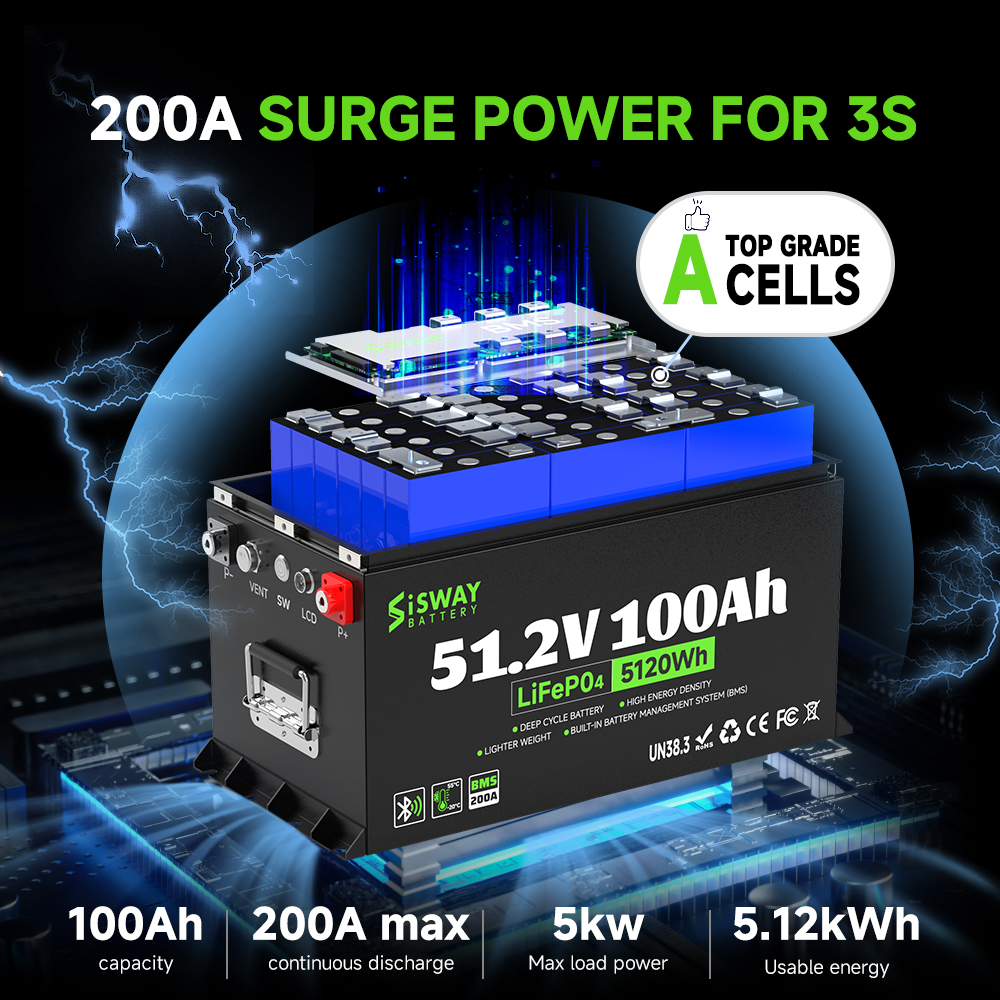
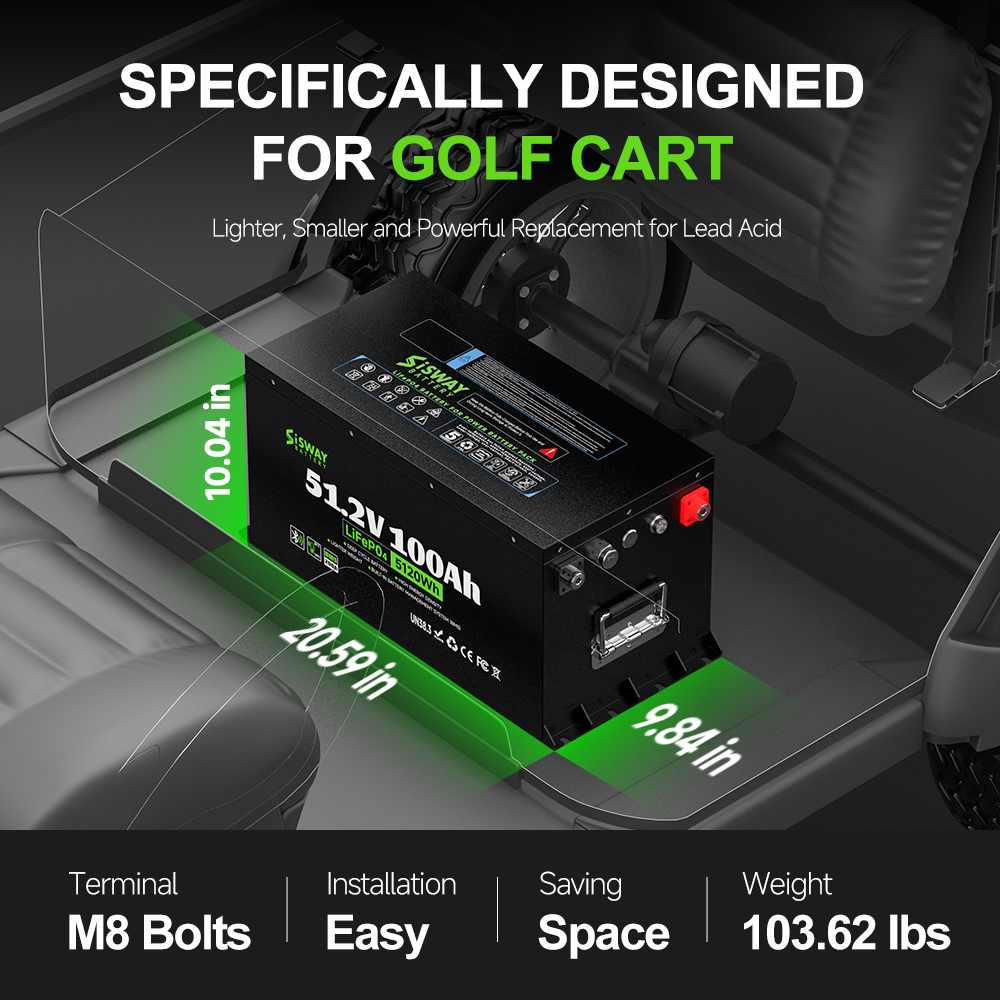
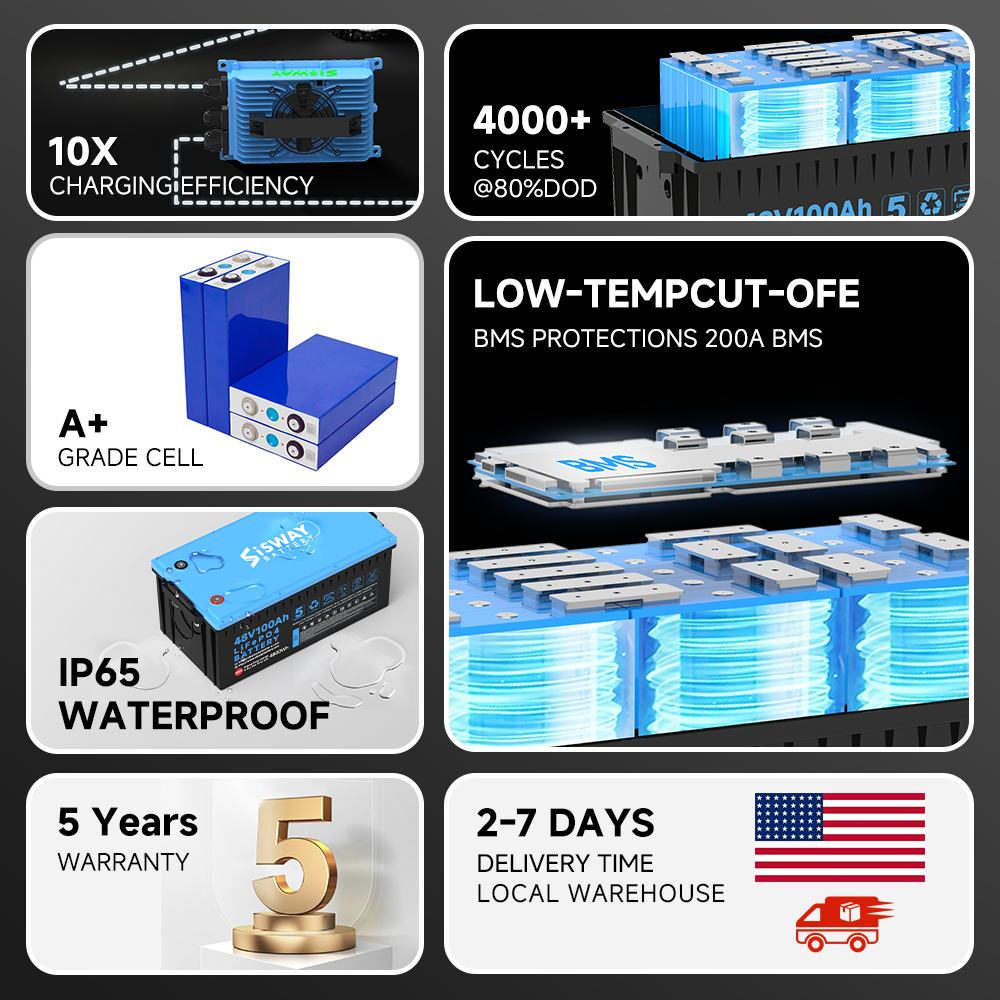
For the Sisway 48V 100Ah LiFePO4 product, the UN38.3 Test Report carries reference No. TSZ25H8045A01-01 and applies to the global market. The 51.2V 100Ah model separately lists MSDS and UN38.3 among its certifications, alongside a 200A BMS, a 300A three-second peak discharge and low-temperature charge cut-off at 0°C ± 4°C (32°F ± 7.2°F); that pack has also passed short circuit, vibration and one-metre drop tests.
3. ISO 9001 — A Statement About the Factory
ISO 9001 certifies a quality management system. It indicates that a facility documents its processes, controls its suppliers, inspects output and corrects non-conformities in a repeatable way. It does not state that any individual battery will deliver a particular capacity or cycle count — that is the job of test reports and datasheets.
The scope line is the part buyers should read. Two Sisway references show why. The 51.2V 100Ah golf cart battery is covered by certification No. 24CN34504502Q, issued under GB/T 19001-2016 / ISO 9001:2015. The 72V 105Ah battery is covered by a certification issued by ACM INTERNATIONAL CERTIFICATION LIMITED, with a scope covering the research, development and production of lithium-ion batteries, excluding 3C requirements.
That exclusion is not a defect. 3C is China's compulsory product certification scheme; the wording simply states where the certificate's coverage stops, so a buyer knows it is not being presented as a 3C mark.
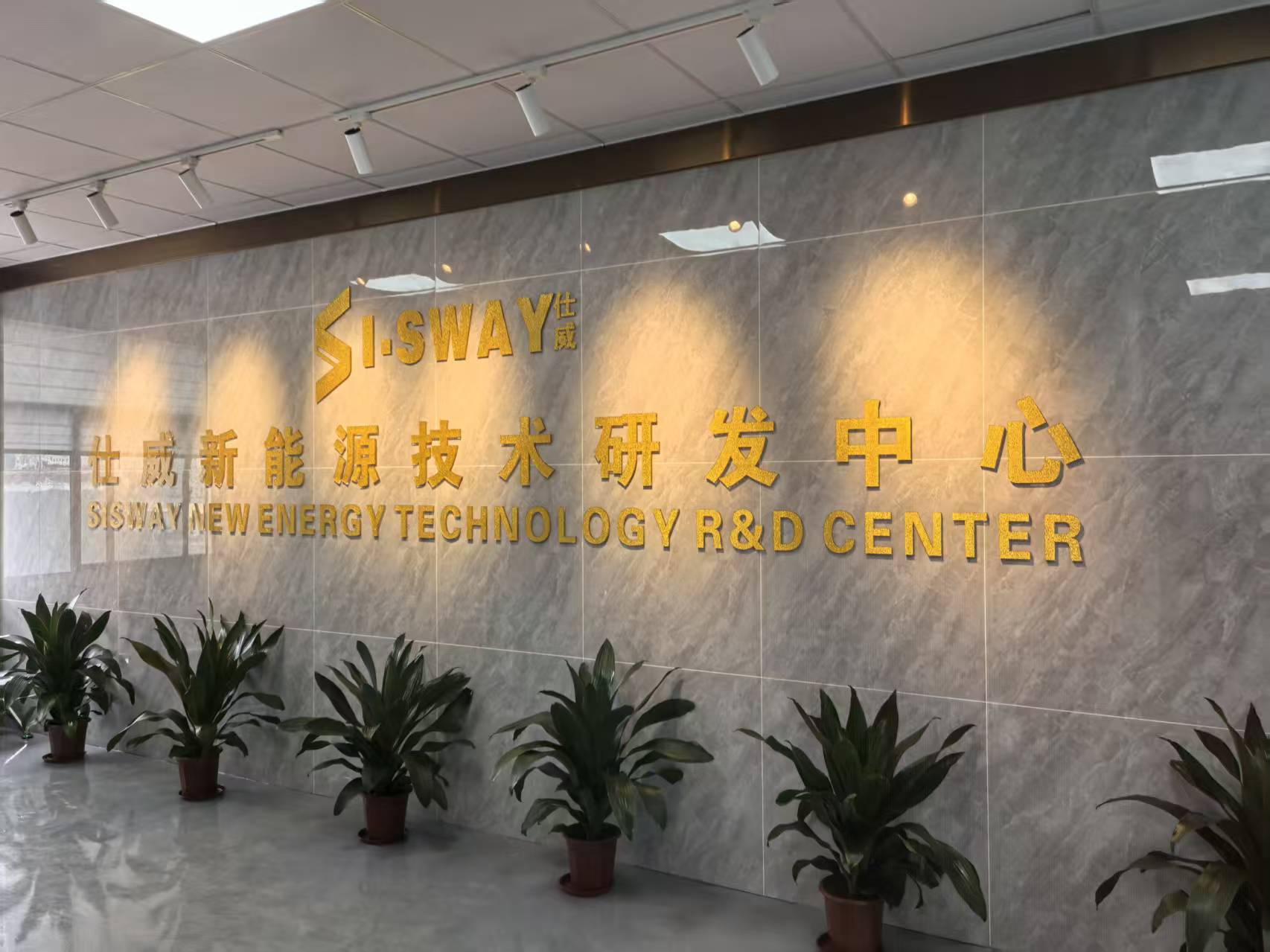
At company level, Shenzhen Shiwei New Energy Co., Ltd. holds ISO9001 certification and more than 100 certifications in total, including CE, UL, UN38.3 and MSDS, plus multiple patents. It operates a 20,000 m² facility with an annual production capacity of 90,000 units, approximately 150 staff and an R&D team of 25 engineers — the R&D scope that the 72V certificate names.
4. LiFePO4 — The Chemistry That Shapes the Paperwork
LiFePO4, or lithium iron phosphate, is the cathode chemistry inside these packs. Its relevance to a certifications article is direct: the chemistry determines the hazard profile described in the MSDS, the test behaviour reported under UN38.3, and the cycle life a buyer is actually paying for.
Published cycle-life ranges put LiFePO4 at roughly 2,500 to 9,000 cycles at 80% depth of discharge (Journal of the Electrochemical Society), against approximately 300 to 500 cycles at 50% depth of discharge for traditional flooded lead-acid batteries (Boca EV / Preger et al.). That gap is why a golf cart battery replacement decision rarely comes down to purchase price alone.
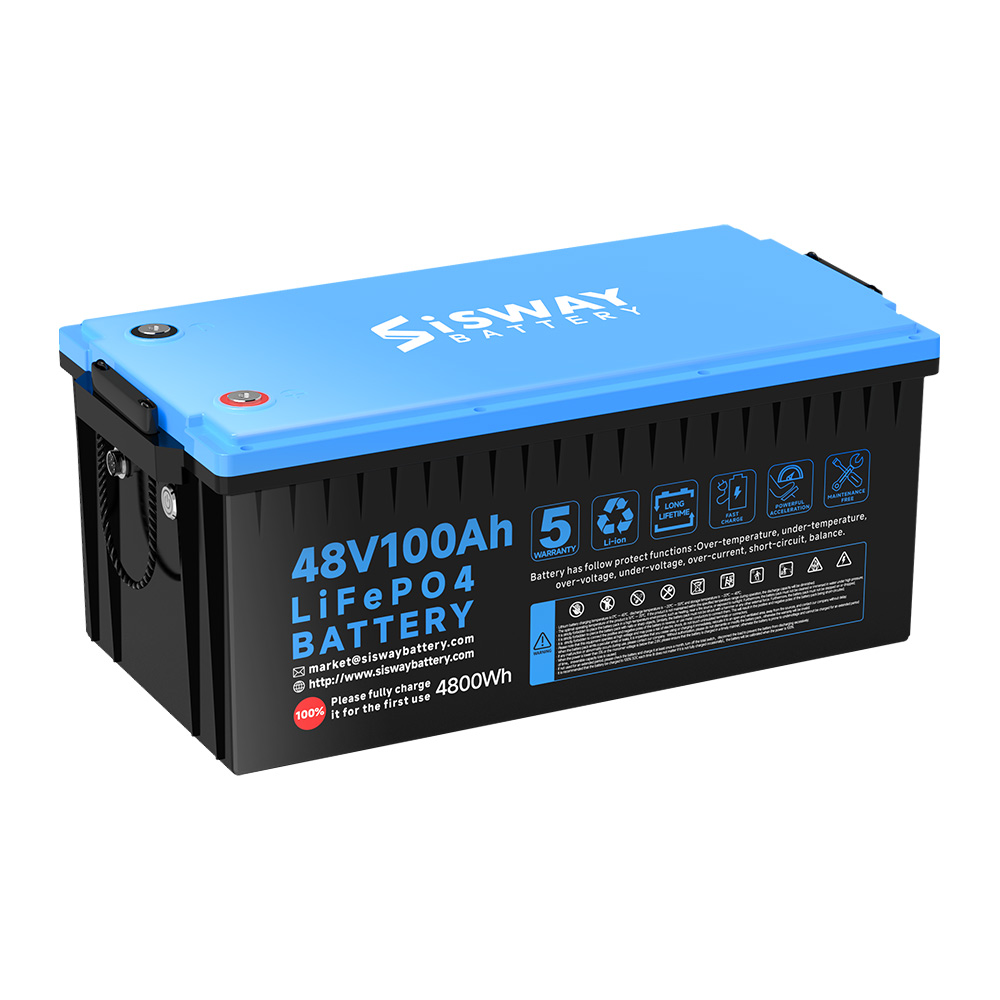
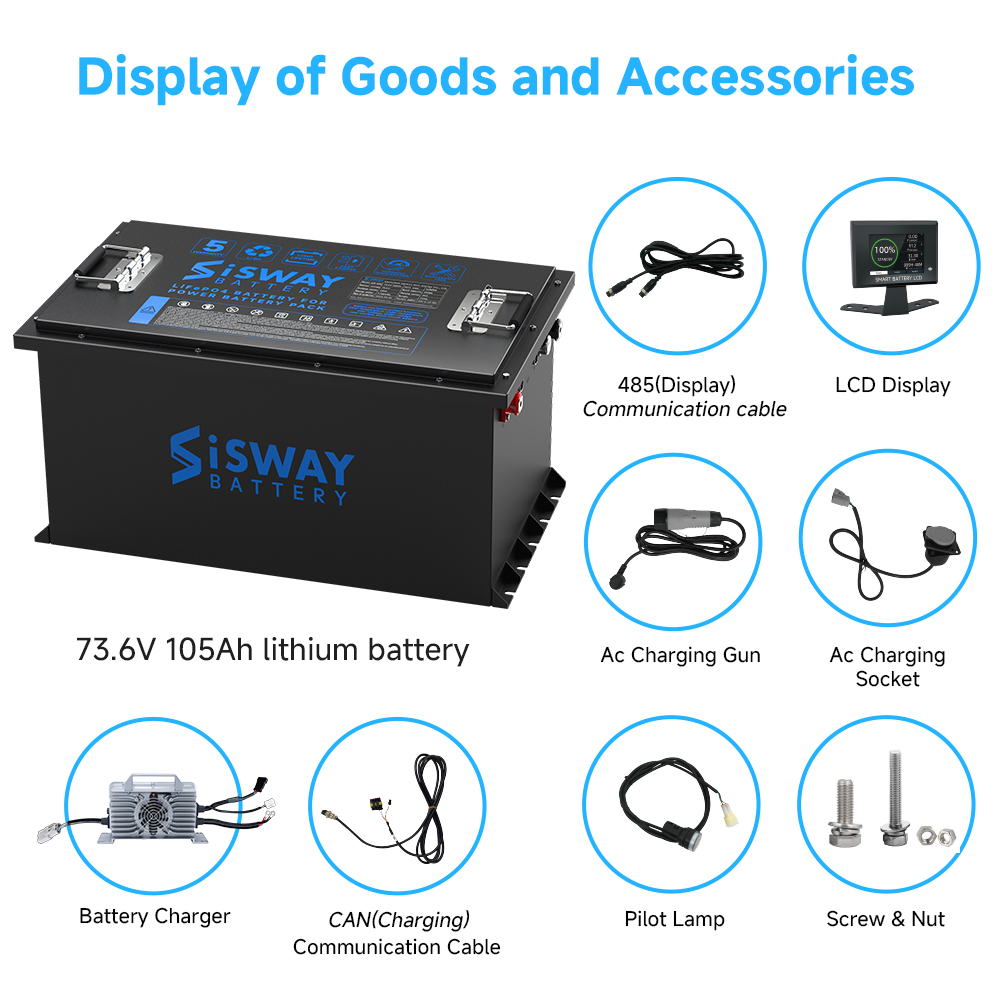
Inside the Sisway range, the 48V 100Ah pack uses EV grade A LiFePO4 prismatic aluminium-shell cells in a 15S1P configuration, with a 200A smart BMS, 4,800Wh of energy and a 9.6kW maximum load. The 72V 105Ah pack uses EVE 3.2V 105Ah LiFePO4 cells in a 23S1P configuration, with 7,728Wh of energy and a 14.72kW maximum load.
5. Sisway Document References by Model
| Model | Nominal voltage | Capacity & energy | BMS | Cell configuration | Document references on file |
|---|---|---|---|---|---|
| 48V 100Ah | 48V | 100Ah / 4,800Wh | 200A smart BMS | 15S1P | MSDS No. TSZ25LL028A86-01 (GHS / OSHA HazCom 2012, USA market); UN38.3 Test Report No. TSZ25H8045A01-01 (global market) |
| 51.2V 100Ah | 51.2V nominal, 48V system | 100Ah / 5,120Wh | 200A BMS | Not stated in this brief | ISO 9001 certification No. 24CN34504502Q (GB/T 19001-2016 / ISO 9001:2015); MSDS; UN38.3 |
| 72V 105Ah | 73.6V | 105Ah / 7,728Wh | 200A smart BMS | 23S1P | Certification issued by ACM INTERNATIONAL CERTIFICATION LIMITED, scope: R&D and production of lithium-ion batteries (excluding 3C requirements) |
Step-by-Step Breakdown: How to Verify a Battery Document Pack in Six Steps
- Match the document to the model number. Certificates and reports are issued against a model and its energy content. Check that the reference number matches the purchase order — 48V 100Ah, 51.2V 100Ah and 72V 105Ah are three separate files, not one.
- Confirm the issuer's name and the issue date. The 48V MSDS was issued by Shenzhen Tiansu Calibration and Testing Co., Ltd.; the 72V certification by ACM INTERNATIONAL CERTIFICATION LIMITED. Read both fields and compare the date against your order window instead of assuming a document is current.
- Check the market coverage. MSDS documents are written for a regulatory framework — GHS and OSHA HazCom 2012 for the USA market in the 48V file — while UN38.3 covers global transport. A U.S.-market MSDS is not automatically the right document for another jurisdiction.
- Read the scope line on the ISO 9001 certificate. Confirm that the scope names lithium-ion battery R&D and production, and note any stated exclusions such as 3C requirements.
- Cross-check chemistry and cell configuration against the datasheet. A 15S1P pack and a 23S1P pack are different products with different voltage and energy values. If the datasheet and the document folder disagree, stop and ask before the container is booked.
- File the pack with the purchase order and the shipping documents. These documents earn their keep at a checkpoint — a port, an audit, a warranty claim — not in an inbox attachment nobody reopens.
Use Cases: Where the Document Pack Actually Gets Used
Golf course fleet replacement — 48V 100Ah
The 48V 100Ah pack is built as a drop-in replacement in a lead-acid-style case, weighs 77 lb and measures 20.55" × 10.55" × 8.74". In this scenario the MSDS goes to the maintenance team that stores and services the packs, while the UN38.3 report goes to whoever arranges delivery. Capacity sits at 4,800Wh with a 200A continuous discharge and a 300A two-second peak.
Resort, campus and venue retrofits — 51.2V 100Ah
The 51.2V 100Ah pack is designed for 48V systems with a 58.4V charge voltage and an 18A recommended charge current. Retrofits usually run through a facilities or procurement function, which is where the ISO 9001 certificate and the electrical specification get reviewed together. Dual monitoring through an LCD panel and a mobile app supports the handover documentation.
Dealer and reseller stock — 72V 105Ah
A dealer holding 72V inventory carries a documentation obligation forward to the end customer. The 72V 105Ah pack delivers 7,728Wh, up to roughly 50 miles per charge, a 400A ten-second peak current and a 138 lb (63 kg) weight across 558 × 333 × 300 mm — specifications a reseller will be asked to evidence alongside the certification.
Export clearance and tender submissions
For a tender, the usual bundle is the ISO 9001 certificate with its scope, the MSDS, the UN38.3 test report and a datasheet. Missing any one of them typically produces a clarification request rather than an immediate rejection — which costs schedule rather than the bid itself, and is the most common way a documentation problem shows up.
Comparison Table: The Four Documents Side by Side
| Document | Question it answers | Issued by | Coverage | What it does not prove | Sisway reference |
|---|---|---|---|---|---|
| MSDS | What the pack contains and how to handle, store, fight fires and dispose of it | Shenzhen Tiansu Calibration and Testing Co., Ltd. (48V pack) | USA market, GHS / OSHA HazCom 2012 | Does not authorise transport or certify performance | No. TSZ25LL028A86-01 |
| UN38.3 Test Report | Whether the model passed the UN transport test series | Testing laboratory report | Global transport | Does not cover workplace handling or factory quality | No. TSZ25H8045A01-01 (48V 100Ah LiFePO4) |
| ISO 9001 | Whether the quality management system is certified, and within what scope | Certification body | Defined by the scope line on the certificate | Does not certify a specific battery's capacity or cycle life | No. 24CN34504502Q (51.2V, GB/T 19001-2016 / ISO 9001:2015); ACM INTERNATIONAL CERTIFICATION LIMITED (72V) |
| LiFePO4 chemistry statement | Which cathode chemistry and cell configuration the pack uses | Manufacturer datasheet / cell specification | Applies to the named model | Is not a certification at all | 15S1P (48V 100Ah); 23S1P (72V 105Ah) |
Frequently Asked Questions
What certifications should a lithium golf cart battery ship with?
For most cross-border orders, three documents cover the basics: an MSDS for handling and workplace safety, a UN38.3 test report for transport, and an ISO 9001 certificate describing the manufacturing system behind the pack. A datasheet covering chemistry, voltage, capacity and dimensions is the fourth item buyers usually need. Each answers a different question, and none replaces another.
Can Sisway supply MSDS and UN38.3 documents for the 48V 100Ah battery?
Yes. The 48V 100Ah LiFePO4 golf cart battery is covered by MSDS No. TSZ25LL028A86-01, prepared to GHS and OSHA HazCom 2012 requirements for the USA market and issued by Shenzhen Tiansu Calibration and Testing Co., Ltd., and by UN38.3 Test Report No. TSZ25H8045A01-01 for the global market. The 51.2V 100Ah model also lists MSDS and UN38.3 among its certifications.
How do I check that a golf cart battery manufacturer's certifications are genuine?
Five checks settle it: the reference number matches the exact model; the issuing organisation is named, for example ACM INTERNATIONAL CERTIFICATION LIMITED on the 72V certificate; the scope line describes lithium-ion battery R&D and production with any exclusions stated; the market coverage matches the destination; and the issue date is current. A certificate that names no model, no issuer or no scope cannot be verified — that is the signal to ask for the underlying report.
What capacity does a 48V lithium golf cart battery usually need?
Lithium packs for 48V golf cart systems typically reach or exceed 100–150Ah. In the Sisway range, the 48V 100Ah model stores 4,800Wh with a 9.6kW maximum load, while the 51.2V 100Ah model stores 5,120Wh and is compatible with 48V systems. Compartment size decides as much as capacity: 20.55" × 10.55" × 8.74" for the 48V pack and 625 × 505 × 360 mm for the 51.2V pack.
How do I get a sample and the full document pack?
Send the model and destination market to the Sisway Battery team and request the sample plus the matching paperwork in the same message — that way the MSDS, UN38.3 report and ISO 9001 scope arrive with the unit rather than after the order. The Sisway product brochure lists the current golf cart models and voltage options.
Conclusion: Read the Document, Not the Adjective
A lithium golf cart battery purchase rests on four documents that do not overlap. The MSDS tells the people who handle the pack what it is made of and how to stay safe around it. The UN38.3 report is what lets the pack board a ship or a plane. The ISO 9001 certificate, read with its scope line, tells you how the factory is run. LiFePO4 tells you which chemistry you are buying and, indirectly, how long it should last — 2,500 to 9,000 cycles at 80% depth of discharge is a very different proposition from 300 to 500 cycles at 50% depth of discharge.
Read as a set, the numbers tell a coherent story: MSDS No. TSZ25LL028A86-01 and UN38.3 Test Report No. TSZ25H8045A01-01 sit with the 48V 100Ah product for the USA and global markets respectively; ISO 9001 certification No. 24CN34504502Q under GB/T 19001-2016 / ISO 9001:2015 sits with the 51.2V 100Ah model; and the 72V 105Ah model carries certification from ACM INTERNATIONAL CERTIFICATION LIMITED, scoped to lithium-ion battery R&D and production. For a buyer at the research stage, the practical next step is not to collect more adjectives from suppliers but to request the model-specific document set and check the four fields that matter: model, issuer, scope and market.
Request the Document Pack or a Sample
Shenzhen Shiwei New Energy Co., Ltd. (Sisway Battery) supplies 48V 100Ah, 51.2V 100Ah and 72V 105Ah LiFePO4 golf cart batteries with matching MSDS, UN38.3 and ISO 9001 documentation. Tell us the model and the destination market, and we will send the sample and the paperwork together.
Contact: Nancy · inquiry@siswaybattery.com · Tel / WhatsApp +86 137 1478 6322
Address: No.11 Tianyang 5th Road, Songgang Street, Bao'an District, China
Website: www.siswaybattery.com
Brochure: Download the Sisway catalogue (PDF)
Have Questions or Need More Details?
Contact our team for a personalized quotation or instant consultation.
Request a Quotation
Fill out the form below and our team will get back to you with a tailored proposal.
WhatsApp Direct Chat
Prefer to chat in real-time? Message us on WhatsApp for instant assistance & quick answers.
- Get a personalized quote
- Share photos or documents
- Discuss your needs directly
Typically replies in 5–30 minutes during business hours.