Golf Cart Battery Technical Guide: Understanding LiFePO4 Voltage, Capacity, and Safety Metrics
Golf Cart Battery Technical Guide: Understanding LiFePO4 Voltage, Capacity, and Safety Metrics
Answer first. A LiFePO4 golf cart battery is compatible only when three things align with the cart it will power: pack voltage inside the motor controller’s operating window, usable energy in watt-hours matched to the real duty cycle, and safety documentation — a UN 38.3 test report, an MSDS and a quality-system certificate — that satisfies a freight forwarder, an insurer and a site. Amp-hour labels alone confirm none of the three.
This technical guide explains how voltage, capacity and safety metrics are actually specified and documented on LiFePO4 golf cart batteries, using the published 48V 100Ah, 51.2V 100Ah and 72V 105Ah configurations from Sisway Battery (Shenzhen Shiwei New Energy Co., Ltd.) as working examples, and then shows how to match those numbers to a motor controller and charger before an order is placed.
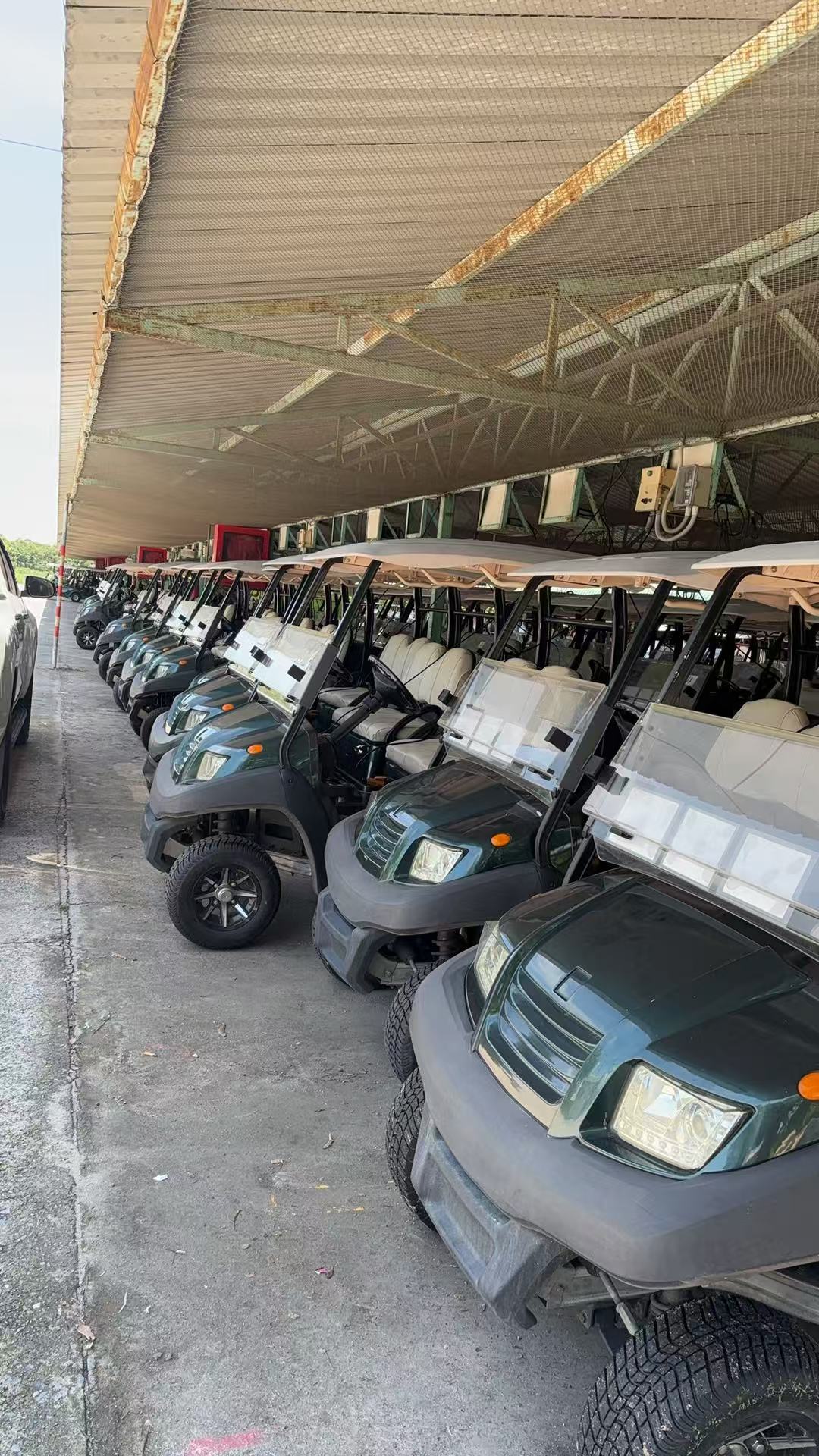
Sisway LiFePO4 golf cart batteries in a fleet deployment: a five-year Thailand OEM program covering 20,000 units. Photo: Sisway Battery case library.
Problem definition: why a voltage label is not a specification
Most failed golf cart battery upgrades do not fail because the cells are weak. They fail because one of four interface assumptions was never checked: the pack voltage sits outside the controller’s operating window; the nameplate amp-hour rating was read as runtime without converting it to watt-hours; the BMS cannot cover the controller’s continuous and peak draw; or the pack arrived without the transport and safety documents the buyer’s forwarder, insurer or site requires.
Golf cart batteries are usually bought by label. A buyer searches for a 48V golf cart battery, orders a “48V” pack, and later discovers the pack charges to 58.4V — a charge voltage the old lead-acid charger cannot deliver correctly. The brand on the cart body (Club Car, E-Z-GO, Yamaha) describes the vehicle, not the battery. The decisive references are the motor controller nameplate and the charger’s output specification.
Three specification families therefore have to be read together rather than separately:
- Voltage — nominal voltage, full-charge voltage and discharge cutoff together define the operating window the controller must accept.
- Capacity and energy — amp-hours describe stored charge; watt-hours describe usable work. Only watt-hours can be compared against a daily duty cycle.
- Safety metrics — BMS current ratings plus third-party documentation such as a UN 38.3 test report and a Material Safety Data Sheet determine whether the pack can be run, stored and shipped legally.
A fourth, quieter failure mode is documentation drift. Safety reports carry issue and expiry dates. A pack that was compliant at purchase can become non-shippable later, so buyers should record expiry dates at the same time they record serial numbers.
Industry background: why LiFePO4 replaced lead-acid in golf cart fleets
The global golf cart battery market reached approximately USD 1.49 billion in 2024 and is projected to reach USD 2.21 billion by 2030, a CAGR of 6.8% (Strategic Market Research). Lithium-ion chemistries held roughly 47% of that market by revenue in 2024, and demand is being pulled by the electric segment: battery electric vehicles represented 72.5% of the U.S. electric golf cart market in 2024, a market estimated at USD 529.4 million (Grand View Research). North America dominated the wider electric golf cart market in 2024 with a 44.7% revenue share.
The technical reason behind the migration is cycle economics. LiFePO4 batteries typically deliver 2,500 to 9,000 cycles at 80% depth of discharge, while traditional flooded lead-acid batteries deliver approximately 300 to 500 cycles at 50% depth of discharge (Journal of the Electrochemical Society; Boca EV / Preger et al.). A fleet moving from lead-acid to LiFePO4 is not only removing watering, equalising and terminal cleaning from the maintenance schedule — it is changing the replacement interval.
Standards shaped the same transition. UN 38.3 certification is required for the safe global transport of lithium batteries (U.S. Department of Transportation / UN). IEC 62619:2022 specifies safety requirements for secondary lithium cells and batteries in industrial and motive applications including golf carts, and UL 2580 covers electrical, mechanical and environmental testing for batteries used in electric vehicles. For a buyer, these are not decorative documents: they are the reason a container of lithium packs can be shipped, warehoused and insured.
Supply is export-driven. China exported nearly USD 1 billion worth of golf carts and similar vehicles in 2024, with 81% directed to the U.S. market (China Customs / SCMP). That flow explains why documentation quality — not only cell quality — has become a competitive factor among lithium golf cart battery suppliers.
Sisway Battery, the trading name of Shenzhen Shiwei New Energy Co., Ltd., is a lithium battery manufacturer established in 2017 that specialises in lithium iron phosphate (LiFePO₄) battery packs for golf carts, UTVs, ATVs, forklifts, AGVs and home energy storage. The company operates a 20,000 m² facility with 150 employees, a 25-engineer R&D team and an annual output of 90,000 units, exports approximately 50% of its production with the United States as its main market, and holds ISO 9001 certification together with more than 100 global certifications including CE, UL, UN38.3 and MSDS.
Core LiFePO4 golf cart battery parameters explained
Nominal voltage: what 48V, 51.2V and 72V actually mean
Nominal voltage is a name for a cell group, not a fixed operating point. A 48V pack is built from LiFePO4 cells connected in series; the published 48V 100Ah golf cart battery uses a 15S1P configuration — 15 EV grade A LiFePO4 cells with prismatic aluminium shells in series — giving a 48V nominal voltage and a 41.25V discharge cutoff. The pack therefore spends its working life somewhere between those two numbers, not at exactly 48V.
The 51.2V 100Ah model is positioned as a 48V-class golf cart battery: it is listed under the 48V product type but carries a 51.2V nominal voltage and a 58.4V charge voltage. This is the single most common source of charger mismatch in retrofit projects, because a charger sized for a 48V lead-acid bank will not follow the CC/CV profile the pack expects.
At the top of the range, the 72V 105Ah golf cart battery uses a 23S1P configuration of the same cell type, giving a 73.6V nominal voltage and a 63.25V discharge cutoff. Voltage class is not a preference; it is a constraint set by the motor and controller already installed in the cart.
36V and legacy systems. Many older carts were originally built around 36V lead-acid banks. Sisway’s published LiFePO4 golf cart battery range documents 48V, 51.2V and 72V configurations, so a 36V cart must be re-verified against its controller before any lithium pack is selected. Never assume that a voltage class transfers between cart generations.
Capacity and energy: convert amp-hours into watt-hours before comparing
Capacity in amp-hours is only half of the runtime equation. Energy in watt-hours is the figure that describes work, and it is calculated from nominal voltage multiplied by rated capacity:
- 48V × 100Ah = 4,800Wh (48V 100Ah model, maximum load power 9.6kW)
- 51.2V × 100Ah = 5,120Wh (51.2V 100Ah model, maximum continuous output power 5,120W)
- 73.6V × 105Ah = 7,728Wh (72V 105Ah model, maximum load power 14.72kW)
Two packs can therefore share a “100Ah” label and differ by more than 6% in stored energy, before any difference in cell quality is considered. For planning purposes, estimate runtime by dividing usable energy by the cart’s average draw in watts, then apply a margin for hills, payload and low-temperature operation. This calculation belongs in the buyer’s own spreadsheet; the datasheet supplies the energy figure, not the duty cycle.
BMS current ratings: continuous versus peak is the number that matters
All three published Sisway golf cart battery models use a smart 200A BMS, but the burst ratings differ, and that difference reflects how each pack is expected to be loaded:
- 48V 100Ah: 200A maximum continuous discharge, 300A peak for 2 seconds, standard charge time 6 hours.
- 51.2V 100Ah: 200A maximum continuous discharge, 300A peak for 3 seconds, recommended charge current 18A, standard charge time 6 hours.
- 72V 105Ah: 200A maximum continuous discharge, 400A peak for 10 seconds, standard charge time 6 hours.
The controller sets the continuous current demand; acceleration, gradients and loaded starts set the peak demand. If a controller can command more current than the BMS will pass, the pack protects itself and the cart loses power at exactly the moment the driver needs it. This is why the peak current and its duration should be compared, not just the continuous figure.
Safety metrics: BMS protection plus third-party documentation
BMS protection and third-party test documentation answer different questions. The BMS protects the pack in operation; the documentation proves to a forwarder, a site safety officer or an insurer that the pack has been evaluated.
Thermal limits are part of the safety envelope and are specified rather than implied. On the 51.2V 100Ah model, charging is rated from 0°C to 45°C (32°F to 113°F), discharging from -20°C to 55°C (-4°F to 131°F), and storage from -20°C to 45°C (-4°F to 113°F). The pack also includes low-temperature charge cut-off protection at 0°C ± 4°C, which prevents charging below freezing — a protection that matters in cold-storage fleets where carts are charged in unheated buildings.
Supporting documentation on the 48V 100Ah LiFePO4 golf cart battery includes a UN38.3 Test Report, No. TSZ25H8045A01-01, issued on 2025-08-25 by Shenzhen Tiansu Calibration and Testing Co., Ltd., covering the LiFePO4 battery model 48V100Ah and tested against UN 38.3 (UN Manual of Tests and Criteria Part III Subsection 38.3), with validity to 2026-12-31. A Material Safety Data Sheet, No. TSZ25LL028A86-01, was issued on 2025-12-08 by the same testing organisation for the lithium-ion golf cart battery series under GHS and OSHA HazCom 2012, for the United States market, with validity to 2026-12-31.
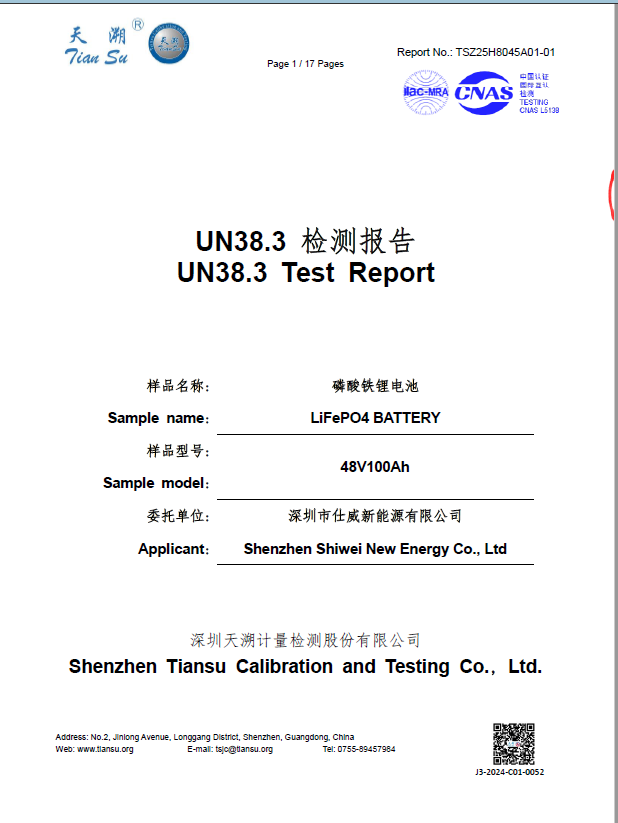
UN38.3 Test Report No. TSZ25H8045A01-01, covering the LiFePO4 battery model 48V100Ah (issued 2025-08-25, valid to 2026-12-31).
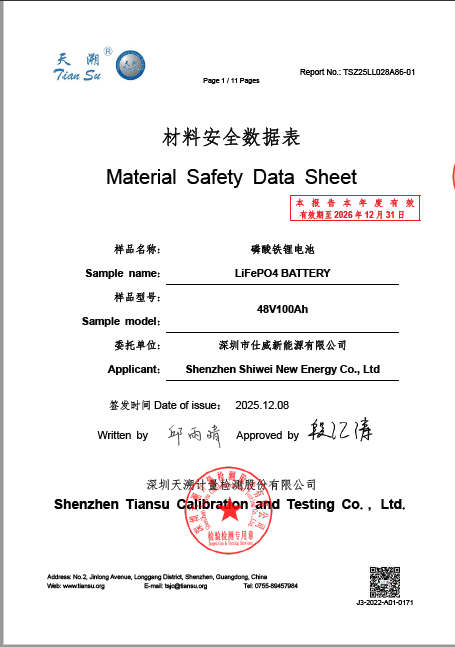
MSDS No. TSZ25LL028A86-01 for the lithium-ion golf cart battery series (issued 2025-12-08, valid to 2026-12-31).
Process-level evidence sits behind those product documents. The quality management system certificate 24CN34504502Q confirms ISO 9001:2015 / GB/T 19001-2016 certification for the R&D and production of lithium-ion batteries, issued 2025-03-31 by ACM International Certification Limited and valid to 2027-04-05. Together with the wider standards landscape — IEC 62619:2022 for industrial and motive lithium batteries and UL 2580 for electric-vehicle battery testing — this is the documentation set a procurement team should request before a first shipment.
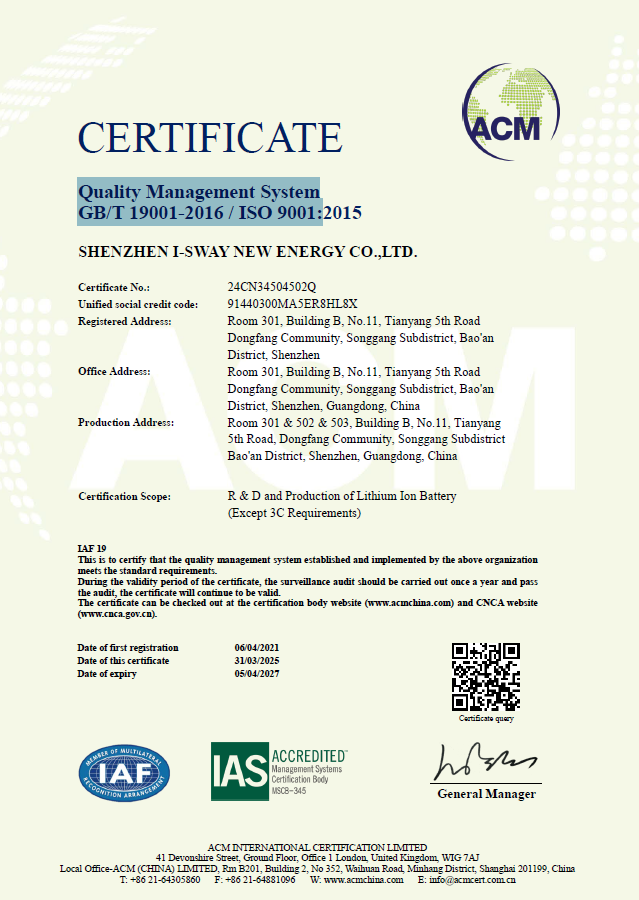
ISO 9001:2015 / GB/T 19001-2016 certificate 24CN34504502Q, covering R&D and production of lithium-ion batteries (issued 2025-03-31, valid to 2027-04-05).
Step-by-step: matching a LiFePO4 pack to a controller and charger
The following sequence is the evaluation procedure used to move a golf cart battery decision from shortlist to execution without rework.
- Read the controller nameplate. Record the controller’s rated input voltage range, continuous current and peak current. This is the constraint that any pack must satisfy; the cart brand and model are context, not specification.
- Select the voltage class. Choose 48V, 51.2V or 72V to match the controller. Do not step up voltage class on an existing cart without confirming that the motor and controller accept the higher nominal voltage, because a 72V pack carries a 73.6V nominal voltage and a much higher energy content than a 48V pack.
- Convert capacity into energy. Multiply nominal voltage by rated capacity to get watt-hours, then compare against daily energy demand. A 51.2V 100Ah pack delivers 5,120Wh; a 72V 105Ah pack delivers 7,728Wh.
- Check continuous and peak current. Confirm that the pack’s continuous discharge rating covers the controller’s continuous draw, and that the peak rating and its duration (300A for 2 seconds, 300A for 3 seconds, or 400A for 10 seconds depending on model) covers acceleration and gradient events.
- Match the charger, not the old charger output. The 51.2V 100Ah pack charges by CC/CV to 58.4V with a recommended charge current of 18A. A charger must be selected against the new pack’s charge voltage and profile, not inherited from the lead-acid system it replaces.
- Verify physical fit and housing. The 72V 105Ah pack measures 558 × 333 × 300 mm (21.97 × 13.11 × 11.81 in) and uses a metal casing, while the 48V 100Ah pack uses a plastic case. Compartment dimensions, mounting points and terminal access should be confirmed before ordering.
- Assemble the document pack. Request the UN 38.3 test report, the MSDS and the quality-system certificate, record their validity dates, and confirm the pre-shipment test arrangement so that acceptance criteria are agreed before production rather than after arrival.
Steps 1, 2 and 5 are where most evaluation projects stall, because they require reading the cart rather than the catalogue. Steps 6 and 7 are where most execution projects stall, because they depend on a supplier’s documentation and logistics, not on the buyer’s engineering.
Comparison table: published Sisway 48V, 51.2V and 72V LiFePO4 golf cart batteries
| Parameter | 48V 100Ah | 51.2V 100Ah | 72V 105Ah |
|---|---|---|---|
| Nominal voltage | 48V | 51.2V | 73.6V (72V class) |
| Rated capacity | 100Ah | 100Ah | 105Ah |
| Energy | 4,800Wh | 5,120Wh | 7,728Wh |
| Cell configuration | 15S1P, 15 cells, EV grade A LiFePO₄ prismatic aluminium shell | Not specified on the published datasheet | 23S1P, 23 cells, EV grade A LiFePO₄ prismatic aluminium shell |
| BMS | Smart 200A BMS | 200A BMS | Smart 200A BMS |
| Max continuous discharge | 200A | 200A | 200A |
| Peak discharge | 300A (2 sec) | 300A (3 sec) | 400A (10 sec) |
| Max load / output power | 9.6kW | 5,120W | 14.72kW |
| Discharge cutoff voltage | 41.25V | Not specified on the published datasheet | 63.25V |
| Charge voltage / method | Standard charge time 6h | 58.4V, CC/CV, recommended 18A | Standard charge time 6h |
| Cycle life / warranty | Not specified on the published datasheet | ≥4,000 cycles, 3-year warranty | Not specified on the published datasheet |
| Operating temperature | Not specified on the published datasheet | Charge 0°C to 45°C; discharge -20°C to 55°C; storage -20°C to 45°C | Charge 0°C to 45°C; discharge -20°C to 55°C |
| Housing | Plastic case | Metal casing | Metal casing, 558 × 333 × 300 mm |
| Certifications | UN38.3 test report TSZ25H8045A01-01; MSDS TSZ25LL028A86-01 | MSDS, UN38.3 | Not specified on the published datasheet |
Source: Sisway Battery published product specifications and certification records. Entries marked “Not specified on the published datasheet” are left blank rather than estimated.
Use cases: which configuration fits which cart duty
The energy and current figures translate into practical fleet roles rather than abstract rankings.
- Community, estate and two-to-four-seat carts. The 48V 100Ah pack at 4,800Wh and 9.6kW maximum load power covers moderate daily duty on flat courses, where the controller and charger already operate in the 48V class. Its plastic case suits compartments designed for a lighter, insulated enclosure.
- Fleets wanting headroom and a longer service interval. The 51.2V 100Ah pack adds energy over the 48V model at the same nominal capacity, carries a ≥4,000-cycle rating and a 3-year warranty, and includes low-temperature charge cut-off protection — useful for courses that charge carts in unheated sheds. Its metal casing and 58.4V CC/CV charging requirement make charger selection a mandatory step rather than an afterthought.
- High-load, hilly or multi-seat operations. The 72V 105Ah pack delivers 7,728Wh with a 400A peak discharge sustained for 10 seconds and a 14.72kW maximum load power figure, which is why it is specified where gradients and payload create repeated high-current events.
- Hot and humid climates. In a five-year OEM program in Thailand covering 20,000 golf cart battery units, Sisway LiFePO4 batteries were engineered to perform in high-temperature and high-humidity conditions, replacing lead-acid batteries to reduce maintenance requirements, improve charging efficiency and support continuous high-frequency vehicle operation.
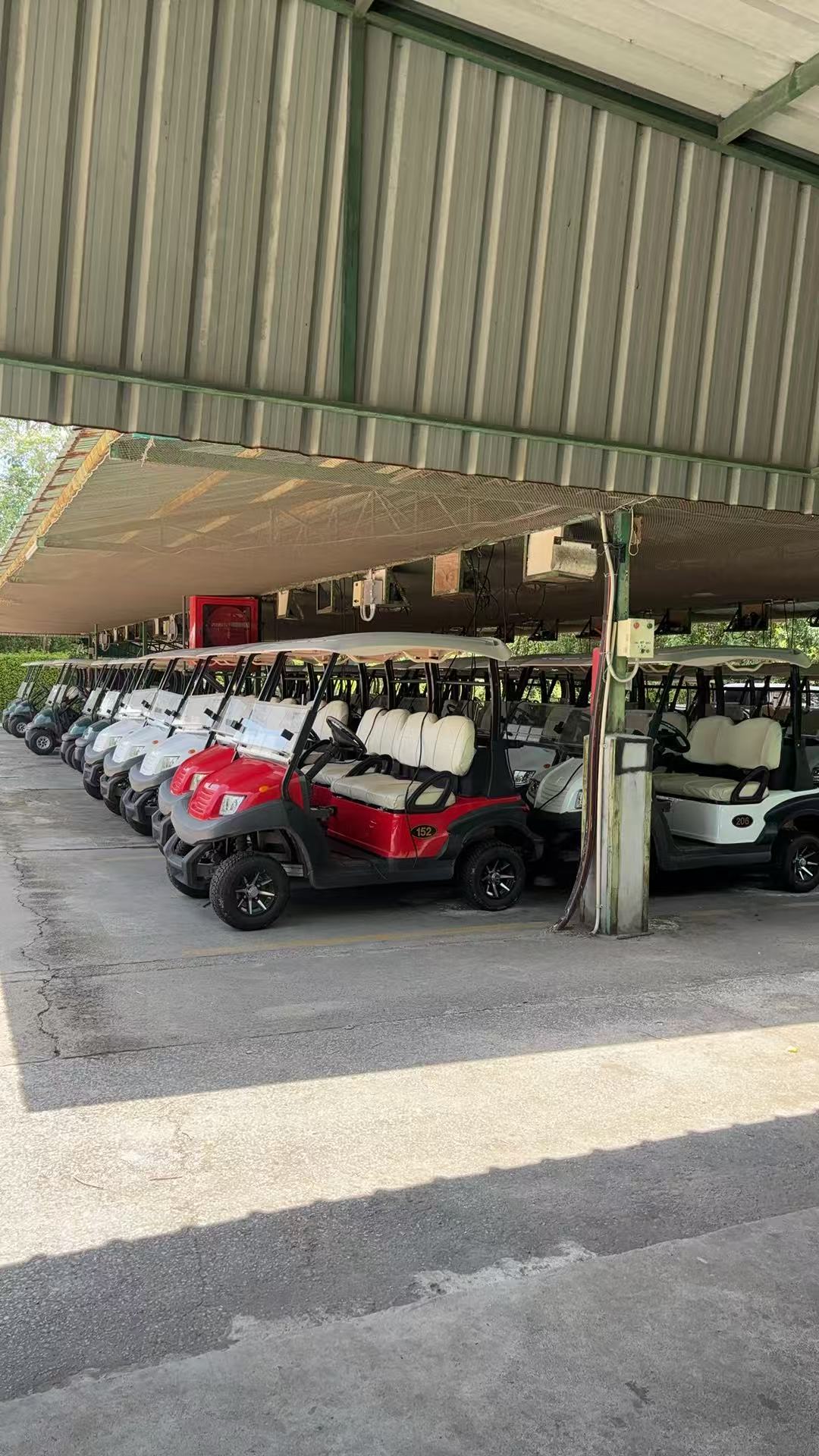
Thailand case: 20,000 golf cart battery units delivered over a five-year OEM program for high-temperature, high-humidity fleet operation.
Frequently asked questions
1. Which safety documents should accompany an OEM lithium golf cart battery shipment?
At minimum, a UN 38.3 test report and a Material Safety Data Sheet, since UN 38.3 certification is required for the safe global transport of lithium batteries (U.S. Department of Transportation / UN). As an example of the documentation set, Sisway’s 48V 100Ah LiFePO4 golf cart battery is covered by UN38.3 Test Report No. TSZ25H8045A01-01 (issued 2025-08-25, valid to 2026-12-31) and MSDS No. TSZ25LL028A86-01 (issued 2025-12-08, valid to 2026-12-31), both issued by Shenzhen Tiansu Calibration and Testing Co., Ltd., with the quality management system certified under ISO 9001:2015 / GB/T 19001-2016, certificate 24CN34504502Q, valid to 2027-04-05. Buyers should record these validity dates alongside serial numbers, because an expired report can block a later shipment.
2. Can an OEM lithium golf cart battery manufacturer customise voltage, capacity, housing and branding?
Customisation is a normal part of OEM production. Sisway provides OEM production services covering logo, design, size and specifications, with a monthly capacity of 5,000 units and a 25-engineer R&D team. Voltage class (48V, 51.2V or 72V), rated capacity, cell configuration, casing material and BMS rating are the parameters that define a custom pack, and each one changes either the controller interface or the charger requirement — so customisation should be agreed together with those two interfaces, not separately from them.
3. What drives the cost of an OEM LiFePO4 golf cart battery order?
Cost is driven by cell grade and configuration (series and parallel count), BMS current rating, casing material and dimensions, and the scope of certification and testing required for the destination market. Order size affects unit economics but is not a barrier to entry: the minimum order quantity for the 72V golf cart battery (model 72V 105Ah) is 1 unit, and payment can be arranged by T/T, L/C, PayPal, Western Union or Trade Assurance. Comparing quotations without first fixing voltage class, capacity and BMS rating usually produces numbers that cannot be compared at all.
4. Can a sample battery be validated before committing to a fleet order?
Yes. Sampling and validation are supported through a minimum order quantity of 1 unit and a pre-shipment test acceptance process, backed by 100% testing in production. A practical validation plan checks three things on arrival: the charge voltage actually delivered by the charger against the pack’s specified charge voltage, the cart’s behaviour under the steepest gradient in normal use, and physical fit including terminals and mounting. A single cart validates the interface; a small group validates duty-cycle assumptions.
5. What is the production lead time and delivery method for OEM golf cart battery orders?
Standard lead time is 15–30 days, with a monthly production capacity of 5,000 units. Delivery can be arranged FOB, CIF or through overseas warehouse shipment, and Sisway supports the United States market with a US after-sales service team and a US overseas warehouse. For projects that combine several voltage classes, lead time should be confirmed per model, since 48V, 51.2V and 72V packs use different cell counts and casings.
Conclusion: read the cart, then read the datasheet
LiFePO4 voltage, capacity and safety metrics only become meaningful when they are read against a specific cart. Nominal voltage has to sit inside the controller’s window; watt-hours — not amp-hours — have to cover the duty cycle; the BMS continuous and peak ratings have to cover what the controller actually commands; and the charger has to be selected against the new pack’s charge voltage, such as 58.4V CC/CV on the 51.2V 100Ah model, rather than inherited from the lead-acid system being replaced.
Safety metrics complete the picture. A UN 38.3 test report, an MSDS and an ISO 9001 quality-system certificate are what allow a pack to be transported, stored, insured and installed without escalation. Documentation with visible issue and expiry dates, such as UN38.3 Test Report No. TSZ25H8045A01-01 and MSDS No. TSZ25LL028A86-01, is therefore a specification item, not paperwork.
Buyers who work through the seven matching steps above before requesting a quotation arrive with a defined voltage class, a defined energy requirement and a defined documentation set — the three inputs an OEM supplier needs to quote accurately.

Next step. If you are evaluating a LiFePO4 golf cart battery for a fleet, a retrofit program or an OEM line, Sisway Battery can supply the full technical file — specifications, UN 38.3 test report, MSDS and quality-system certificate — for the voltage class you are considering.
Download the English product brochure, or send your controller and charger specifications to inquiry@siswaybattery.com for a model recommendation. Shenzhen Shiwei New Energy Co., Ltd. — www.siswaybattery.com.