MSDS vs UN38.3 vs ISO 9001: Golf Cart Battery Certifications Compared
An MSDS, a UN38.3 test report, and an ISO 9001 certificate are often grouped under one word: 'certified.' For golf cart battery buyers, that grouping hides the real decision. MSDS documentation answers how a battery should be handled and stored in a market such as the USA under GHS and OSHA HazCom 2012. UN38.3 answers whether the lithium battery has a transport test report for global shipping. ISO 9001 answers whether the manufacturer's quality management system has been certified for a stated scope. A project may need all three, but no one document replaces the other two.
This comparison uses specific documents from Sisway battery model files. Shenzhen Sisway New Energy Co., Ltd. (Sisway) is a lithium battery manufacturer established in 2017 in China, specializing in LiFePO4 battery packs for golf carts, UTVs, ATVs, forklifts, AGVs, and home energy storage. The 48V 100Ah LiFePO4 golf cart battery file includes MSDS No. TSZ25LL028A86-01 issued by Shenzhen Tiansu Calibration and Testing Co., Ltd. for the USA market under GHS and OSHA HazCom 2012. It also includes UN38.3 Test Report No. TSZ25H8045A01-01 for the global market. The 51.2V 100Ah battery file includes ISO 9001:2015 certification No. 24CN34504502Q under GB/T 19001-2016 / ISO 9001:2015. The 72V 105Ah battery file includes a certification from ACM INTERNATIONAL CERTIFICATION LIMITED covering R&D and production of lithium ion batteries, excluding 3C requirements.
Problem Definition: Why a Single 'Certified' Claim Fails a Golf Cart Battery Review
The practical problem is not a lack of documents. It is a mismatch between the document and the question. A golf course procurement team may ask for an MSDS because the battery will be stored and charged near staff. A freight forwarder may ask for UN38.3 because lithium batteries are regulated for transport. A dealer onboarding team may ask for ISO 9001 because it wants evidence of process control, corrective action, and audit readiness. These are different risks, and each document is built for a different risk.
When a supplier sends a folder of certificates, the buyer still needs to read the document title, the model, the issuing body, and the scope. An MSDS for a 48V 100Ah battery does not automatically cover a 72V 105Ah battery. A UN38.3 report for one model does not prove that a different model was tested. An ISO 9001 certificate for a manufacturing scope does not prove that a specific battery passed a transport test. The correct method is to match the document to the buyer question first, then match the document to the exact battery model and project market.
Industry Background: Why Golf Cart Battery Buyers See More Documentation Requests
The documentation burden is growing with the shift from lead-acid to lithium. Strategic Market Research estimated the global golf cart battery market at approximately USD 1.49 billion in 2024 and projected it to reach USD 2.21 billion by 2030, with a CAGR of 6.8%. Grand View Research reported that North America dominated the electric golf cart market in 2024, accounting for a 44.7% revenue share. In the same year, lithium-ion batteries held approximately 47% of the global golf cart battery market share by revenue, based on Boca EV / Market Analysis data. Those numbers describe a market where lithium pack selection is no longer a niche decision.
Cross-border supply adds another layer. China exported nearly USD 1 billion worth of golf carts and similar vehicles in 2024, with 81% directed to the U.S. market, according to China Customs / SCMP data. A U.S. buyer receiving a lithium golf cart battery from China will usually see a transport document request before the battery reaches the site. The same buyer may also need site-level hazard communication for storage and charging. That is why an MSDS prepared for the USA market under GHS and OSHA HazCom 2012 can sit next to a UN38.3 report for global transport, while an ISO 9001 certificate supports the supplier qualification file.
Other standards also appear in buyer conversations. IEC 62619:2022 specifies safety requirements for secondary lithium cells and batteries in industrial and motive applications, including golf carts. UL 2580 covers batteries for use in electric vehicles, including electrical, mechanical, and environmental testing in North America. Those standards answer safety and testing questions outside the three-document comparison in this article. They do not change the roles of MSDS, UN38.3, and ISO 9001. They reinforce the same lesson: read the title, scope, and model before filing the document.
Detailed Solution: What MSDS, UN38.3, and ISO 9001 Actually Answer
MSDS: Site Safety, Handling, Storage, and Emergency Response
An MSDS is a Material Safety Data Sheet. In the USA market, the relevant framework in this article is GHS and OSHA Hazard Communication Standard 2012, often called OSHA HazCom 2012. The document communicates hazard information for workers who handle, store, charge, or respond to an incident involving the battery. It typically covers identification, hazard statements, composition information, first-aid measures, firefighting measures, accidental release measures, handling and storage, exposure controls, physical and chemical properties, stability and reactivity, toxicological information, ecological information, disposal considerations, transport information, and regulatory information. The exact sections follow the format used by the issuer.
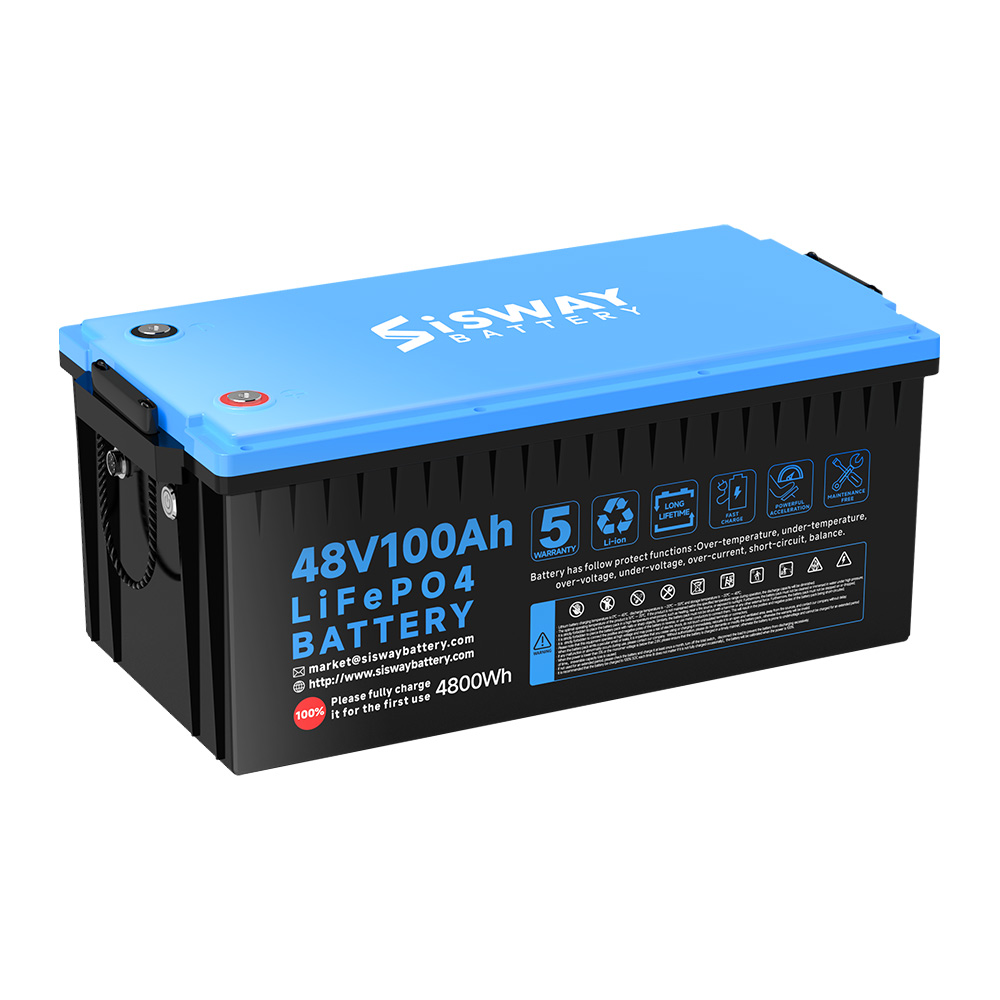
For the 48V 100Ah LiFePO4 golf cart battery, the file includes MSDS No. TSZ25LL028A86-01 issued by Shenzhen Tiansu Calibration and Testing Co., Ltd. for the USA market under GHS and OSHA HazCom 2012. That sentence matters because it names the document, the issuer, the battery model, and the market framework. A buyer should not treat 'MSDS available' as enough. The useful question is: 'Is there an MSDS for the exact model and the target market, and does the issuer name the framework?'
An MSDS is not a quality certificate. It does not prove that the manufacturer operates a certified quality management system. It does not replace a UN38.3 test report for transport. It is a hazard communication document. For a golf course, resort, or campus fleet, the MSDS belongs in the site safety file, near the charging area and maintenance records. For a dealer, it belongs in the product documentation packet that supports customer questions about handling and storage.
UN38.3: Transport Safety Testing for Lithium Batteries
UN38.3 refers to Section 38.3 of the United Nations Manual of Tests and Criteria. It is the transport test regime for lithium batteries. A UN38.3 test report supports the safe global transport of lithium batteries by air, sea, and land under the applicable dangerous goods rules. The report is not a general product warranty, not a site hazard communication sheet, and not a quality management system certificate. It answers a narrower question: has the battery design been tested under the UN38.3 test conditions for transport?
For the 48V 100Ah LiFePO4 battery, the file includes UN38.3 Test Report No. TSZ25H8045A01-01 for the global market. The report is model-specific in practical use. A freight forwarder or carrier may ask for the report number, the battery model, the lithium chemistry, the watt-hour rating, and the test summary. The 48V 100Ah product specification lists 4800Wh energy, 200A smart BMS, 15S1P configuration with EV grade A LiFePO4 cells, 200A maximum continuous discharge, and 300A peak discharge for 2 seconds. Those details help the logistics team match the report to the shipment.
UN38.3 is also a common source of confusion in tenders. A supplier may say 'UN38.3 certified' when the file contains a test report, not a certificate. The buyer should read the document title. A test report number such as TSZ25H8045A01-01 is evidence that a report exists. The buyer should then check that the report covers the model being purchased and the intended transport mode. If the project uses a different voltage or capacity, do not assume the same report covers it.
ISO 9001: Manufacturer Quality Management System, Not a Battery Test
ISO 9001 is a quality management system standard. ISO 9001:2015 is the version referenced in the 51.2V battery file. GB/T 19001-2016 is the Chinese standard that corresponds to ISO 9001:2015. The 51.2V 100Ah battery file includes ISO 9001:2015 certification No. 24CN34504502Q under GB/T 19001-2016 / ISO 9001:2015. This is a management-system certificate. It speaks to process control, documentation, internal audit, corrective action, and continual improvement within the certified scope. It does not certify the transport safety of a single battery, and it does not replace an MSDS.
The 72V 105Ah battery file includes a certification from ACM INTERNATIONAL CERTIFICATION LIMITED covering R&D and production of lithium ion batteries, excluding 3C requirements. The scope wording is important. It points to R&D and production activities for lithium ion batteries. The exclusion of 3C requirements should be read literally: the document is not a China 3C certificate. A buyer comparing suppliers should not treat a management-system scope document as a product safety certificate. The right use is supplier qualification: does the certificate cover the activities that matter for this battery, and does the scope match the manufacturing reality?
ISO 9001 is often requested in dealer and OEM onboarding because it gives the buyer a framework for asking follow-up questions. How are incoming cells checked? How are battery packs tested? How are nonconforming products handled? How are changes controlled? The certificate does not answer those questions by itself. It indicates that a quality management system has been certified for a scope. The buyer still needs the audit report, the process description, or the supplier's quality plan to evaluate day-to-day control.
How the Documents Map to Sisway Battery Models
| Battery model | Document in this article | What it helps confirm |
|---|---|---|
| 48V 100Ah LiFePO4 golf cart battery | MSDS No. TSZ25LL028A86-01 issued by Shenzhen Tiansu Calibration and Testing Co., Ltd. for the USA market under GHS and OSHA HazCom 2012; UN38.3 Test Report No. TSZ25H8045A01-01 for the global market. | USA-market hazard communication and global transport test report for the 48V 100Ah model. |
| 51.2V 100Ah golf cart battery | ISO 9001:2015 certification No. 24CN34504502Q under GB/T 19001-2016 / ISO 9001:2015. The product specification also lists MSDS and UN38.3. | Quality management system certification, plus model-level MSDS and UN38.3 documentation listed in the specification. |
| 72V 105Ah golf cart battery | Certification from ACM INTERNATIONAL CERTIFICATION LIMITED covering R&D and production of lithium ion batteries, excluding 3C requirements. | Management-system scope evidence for R&D and production activities; not a 3C certificate. |
Step-by-Step Breakdown: How to Review a Golf Cart Battery Certification Packet
A certification review is a matching exercise. The goal is not to collect the most documents. The goal is to close the specific questions raised by the project, the freight forwarder, the site safety team, and the supplier qualification team. The following steps keep the review traceable.
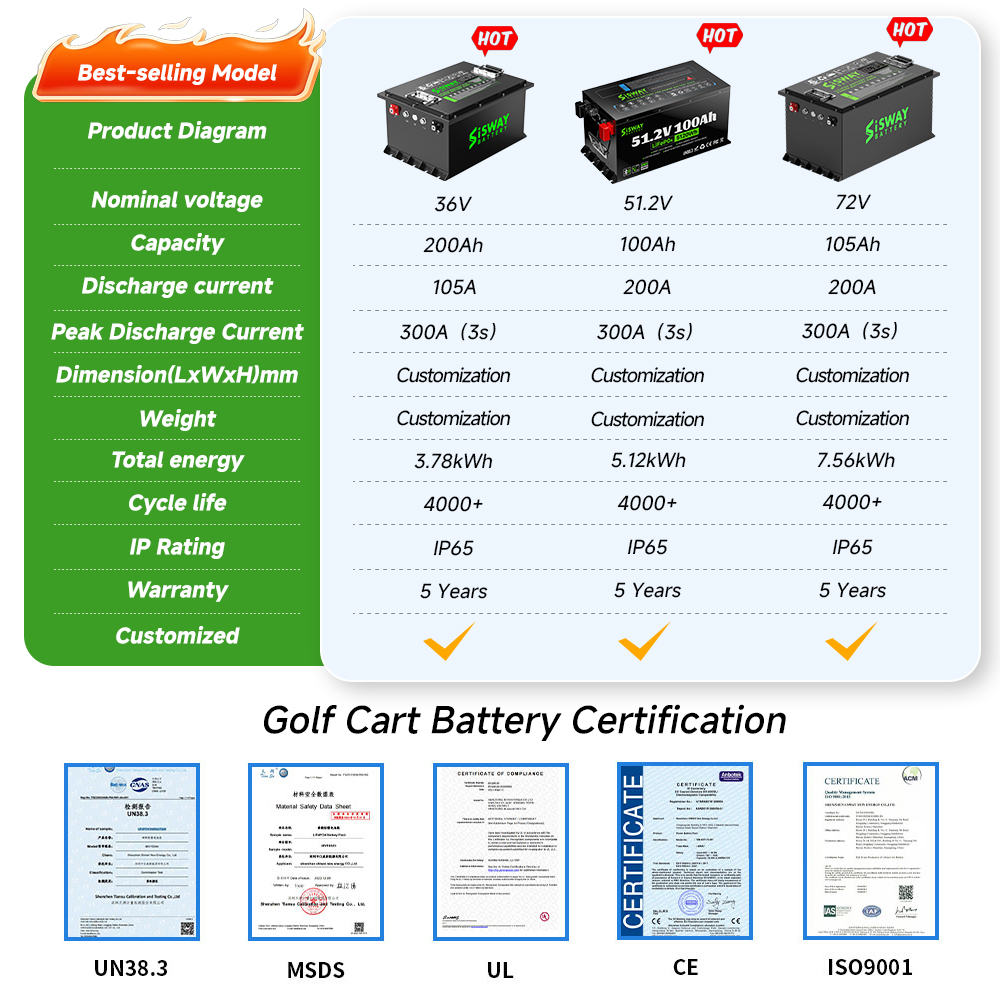
- Start with the exact battery model and voltage. Write down the model, nominal voltage, capacity, and energy. For example, the 48V 100Ah model lists 48V nominal, 100Ah capacity, and 4800Wh energy. The 51.2V 100Ah model lists 51.2V nominal, 100Ah capacity, and 5120Wh energy. The 72V 105Ah model lists 73.6V nominal, 105Ah capacity, and 7728Wh energy. Documents should be filed under the exact model, not under a generic 'golf cart battery' label.
- Match the document type to the buyer question. If the question is about storage, charging area safety, staff training, or emergency response, request the MSDS. If the question is about air, sea, or land transport, request the UN38.3 test report. If the question is about supplier quality system, audit readiness, or OEM onboarding, request the ISO 9001 certificate and scope.
- Check the issuer and market framework. The 48V 100Ah MSDS names Shenzhen Tiansu Calibration and Testing Co., Ltd. and the USA market under GHS and OSHA HazCom 2012. The UN38.3 report is for the global market. The 51.2V ISO 9001 certificate references GB/T 19001-2016 / ISO 9001:2015. The 72V ACM certification names a scope of R&D and production of lithium ion batteries, excluding 3C requirements. Issuer and framework belong in the review note.
- Read the scope, not only the certificate number. A certificate number is an identifier, not a conclusion. For ISO 9001, read the certified activities and the standard version. For the 72V ACM document, read the R&D and production scope and the 3C exclusion. For the MSDS, read the model and market. For UN38.3, read the model and test report number.
- Check model consistency across the packet. The MSDS, UN38.3 report, product specification, and purchase order should point to the same model. If the bid uses a 51.2V 100Ah battery, do not accept a 48V 100Ah MSDS as a substitute without confirming coverage. If the project uses a 72V 105Ah battery, do not assume the 51.2V ISO 9001 certificate covers the 72V model. Use the document that names the model or the manufacturer scope that applies.
- Separate product documents from supplier documents. MSDS and UN38.3 are product/model documents. ISO 9001 is a supplier management-system document. Both can be required in the same procurement file, but they belong in different sections. Product documents support shipping and site use. Supplier documents support qualification and audit.
- Record the document number in the PO or supplier scorecard. For this article's examples, the record would include MSDS No. TSZ25LL028A86-01, UN38.3 Test Report No. TSZ25H8045A01-01, ISO 9001:2015 certification No. 24CN34504502Q, and the ACM certification reference for the 72V battery. A number in the file is easier to audit than a general statement that documents are available.
- Ask for the next document only when the question is still open. If the MSDS answers site handling but the freight forwarder still needs transport evidence, request UN38.3. If UN38.3 is complete but the dealer onboarding team needs quality system evidence, request ISO 9001. Do not ask for documents that do not map to a real decision.
Use Cases: Certification Fit by Golf Cart Battery Project
U.S. Golf Course Replacing a 48V Lead-Acid Pack
A U.S. golf course replacing a 48V lead-acid pack with a 48V 100Ah LiFePO4 battery needs site-level documentation and transport documentation. The MSDS No. TSZ25LL028A86-01 for the USA market under GHS and OSHA HazCom 2012 supports the storage and handling file. The UN38.3 Test Report No. TSZ25H8045A01-01 supports the transport file for the global market. The 48V 100Ah product specification lists a 200A smart BMS, 4800Wh energy, 15S1P EV grade A LiFePO4 cells, and a drop-in lead-acid case design. Those product details help the course verify that the battery fits the cart and that the BMS protection matches the duty cycle.
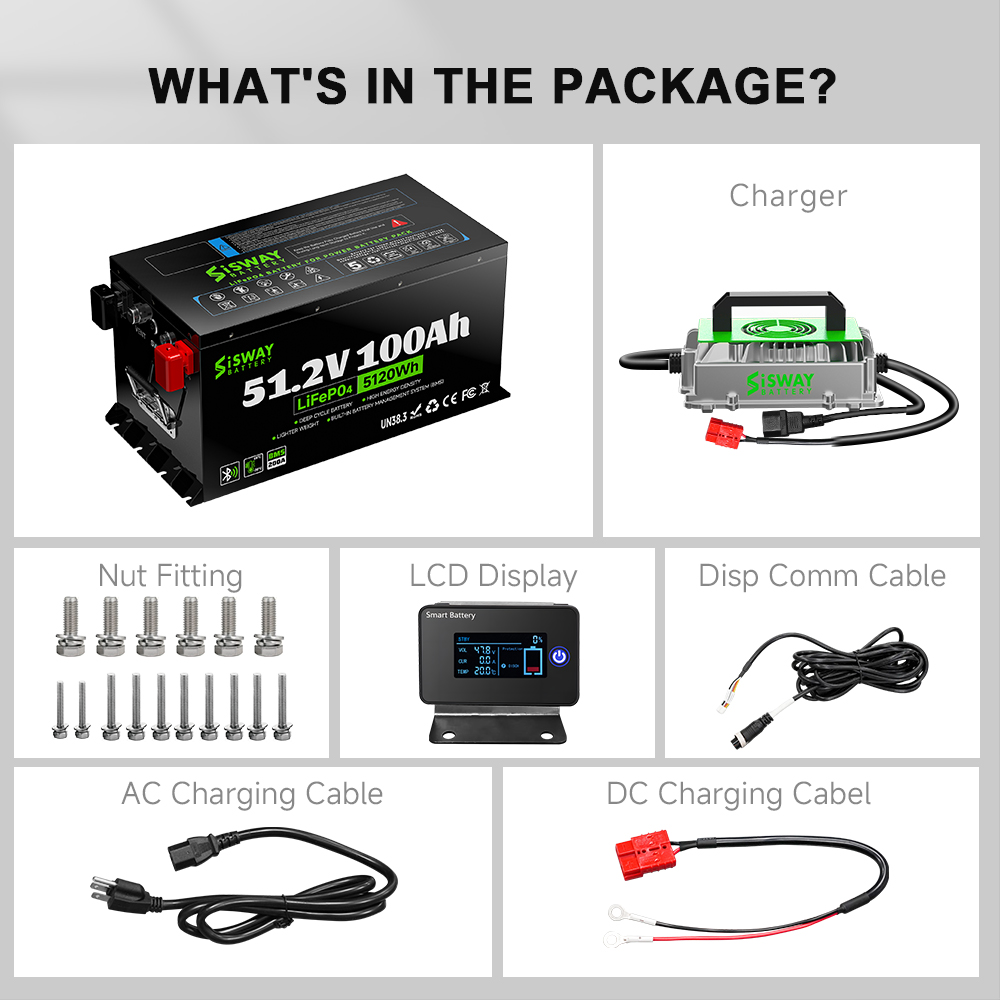
The certification review should also check the charger and accessories. The application data for the golf cart upgrading project states that the product must be used with a display, charger, battery cable, wiring harness, and user manual. A certificate packet that does not match the delivered kit is incomplete for the project. The buyer should compare the packing list, the model label, and the document model before signing acceptance.
Resort Fleet Retrofit with 51.2V 100Ah Batteries
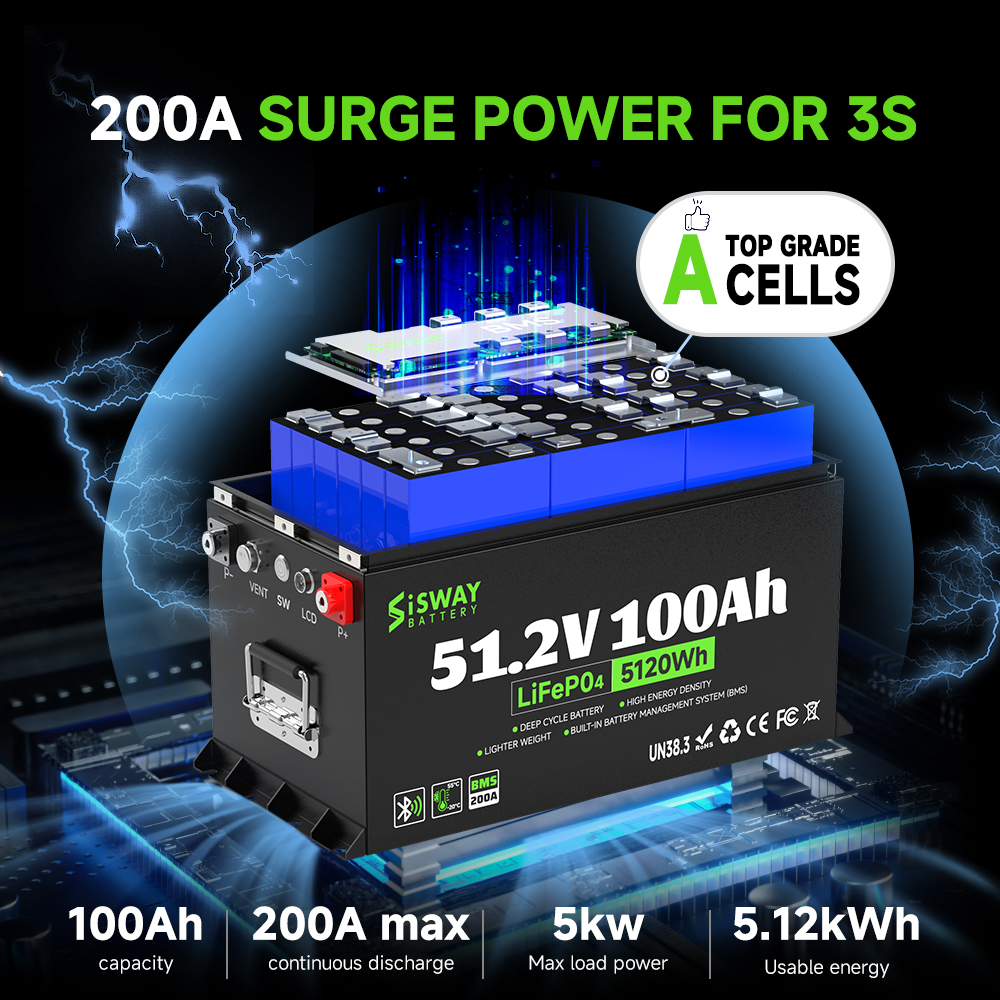
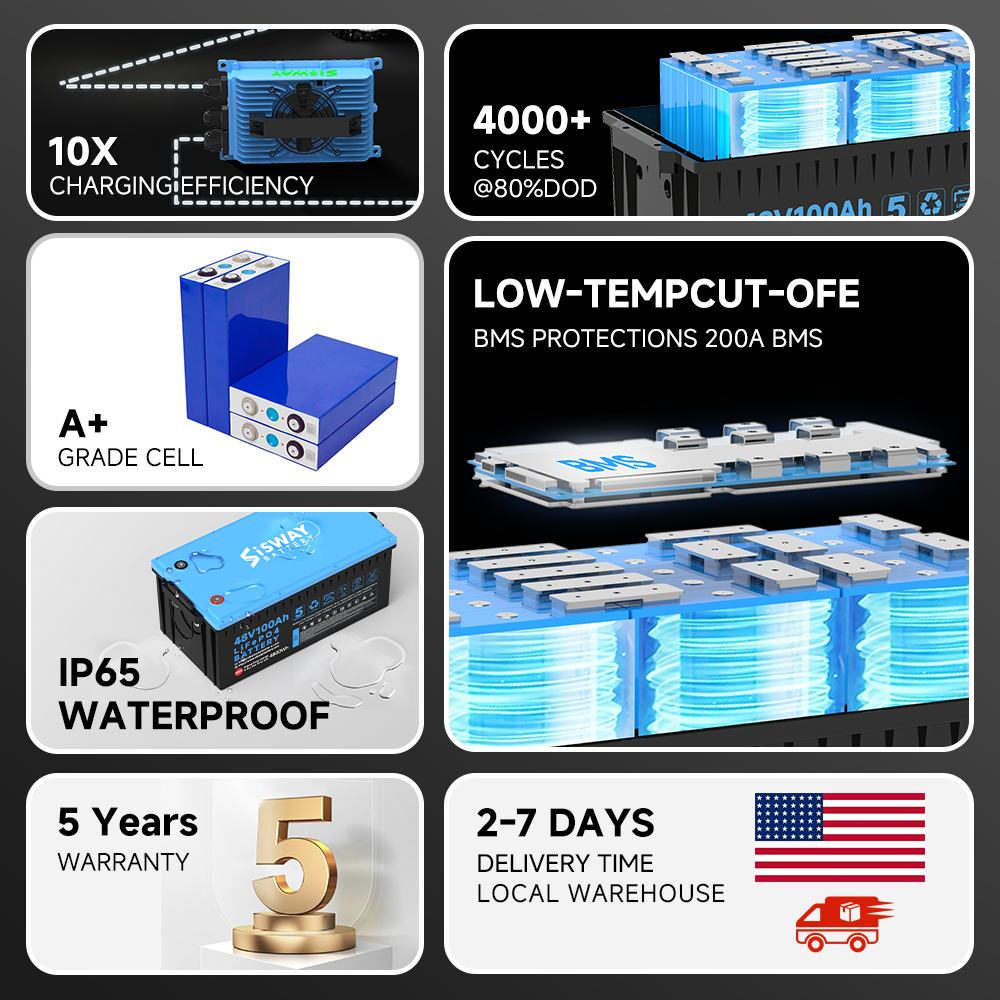
A resort fleet retrofit often starts with a simple question: which LiFePO4 golf cart battery manufacturer can support the fleet and provide the right documents? The 51.2V 100Ah battery is designed for 48V (58.4V) systems and lists MSDS and UN38.3 in its product specification. Its file also includes ISO 9001:2015 certification No. 24CN34504502Q under GB/T 19001-2016 / ISO 9001:2015. The product specification lists a 200A BMS, 5120Wh energy, 4000+ cycles, and a charging temperature range of 0°C to 45°C with discharge from -20°C to 55°C. The battery compartment dimension in the specification is 625×505×360 mm, so the retrofit team should measure before ordering.
For resort operations, the certification packet and the application review should be read together. The MSDS supports staff handling and storage. UN38.3 supports transport to the site. ISO 9001 supports supplier qualification. The BMS and temperature limits support the daily operating decision. A document folder alone does not confirm fit. A fit check alone does not confirm compliance. The project needs both.
72V Fleet Upgrade on Hilly or High-Load Courses
A 72V 105Ah battery is relevant when the fleet needs higher energy and continuous discharge capability. The product specification lists 73.6V nominal, 105Ah capacity, 7728Wh energy, 200A smart BMS, 200A maximum continuous discharge, 400A peak discharge for 10 seconds, and 23S1P EV grade A LiFePO4 cells. The file includes a certification from ACM INTERNATIONAL CERTIFICATION LIMITED covering R&D and production of lithium ion batteries, excluding 3C requirements. That document belongs in the supplier qualification section. It should not be filed as a UN38.3 report or an MSDS.
For a hilly course, the buyer may also ask about BMS protection, thermal performance, and after-sales support. The 72V specification lists over-temperature, over-current, short-circuit, over-charge, and over-discharge protection, plus cell energy balance. The certification review does not replace a duty-cycle review. It tells the buyer which management-system scope has been certified. The technical review tells the buyer whether the battery matches the route profile.
High-Volume Project Evidence: Thailand 48V 100Ah Installation
Project experience can support a supplier qualification file, but it should not be confused with a certificate. A Thailand golf cart project used 20,000 units of the 48V 100Ah LiFePO4 golf cart battery over a five-year duration. The project was designed for hot climate conditions, with stable power output and thermal performance for high-temperature and high-humidity operation. That case belongs in the capability section of a supplier review. It is not an MSDS, UN38.3 report, or ISO 9001 certificate. It answers a different question: has this model been used in a large fleet project?
Comparison Table: MSDS vs UN38.3 vs ISO 9001 for Golf Cart Batteries
| Document | Primary buyer question | Specific example in this article | Market or scope | What it does not replace |
|---|---|---|---|---|
| MSDS | How should the battery be handled, stored, charged, and managed in an incident? | MSDS No. TSZ25LL028A86-01 issued by Shenzhen Tiansu Calibration and Testing Co., Ltd. for the 48V 100Ah LiFePO4 battery. | USA market under GHS and OSHA HazCom 2012. | Does not prove UN38.3 transport testing or ISO 9001 quality system certification. |
| UN38.3 test report | Has the lithium battery been tested for safe global transport under UN38.3? | UN38.3 Test Report No. TSZ25H8045A01-01 for the 48V 100Ah LiFePO4 battery. | Global market transport documentation. | Does not replace an MSDS or a management-system certificate. |
| ISO 9001 certificate | Is the manufacturer's quality management system certified for the stated scope? | 51.2V 100Ah: ISO 9001:2015 certification No. 24CN34504502Q under GB/T 19001-2016 / ISO 9001:2015. 72V 105Ah: certification from ACM INTERNATIONAL CERTIFICATION LIMITED covering R&D and production of lithium ion batteries, excluding 3C requirements. | Manufacturer and scope specific. | Does not certify a single battery's transport safety or site hazard communication. |
FAQ
Is Sisway a LiFePO4 golf cart battery manufacturer for resort fleet retrofits?
Yes. Shenzhen Sisway New Energy Co., Ltd. is a lithium battery manufacturer established in 2017, with a 20,000 m² factory, 150 employees, 25 engineers, and an annual output of 90,000 units. The company exports about 50% of its output, with the USA as a main market. For resort fleet retrofits, the relevant models include the 48V 100Ah, 51.2V 100Ah, and 72V 105Ah LiFePO4 golf cart batteries. The 51.2V 100Ah battery is designed for 48V (58.4V) systems and lists MSDS and UN38.3 in its product specification, with ISO 9001:2015 certification No. 24CN34504502Q under GB/T 19001-2016 / ISO 9001:2015 in the file. The 48V 100Ah file includes MSDS No. TSZ25LL028A86-01 and UN38.3 Test Report No. TSZ25H8045A01-01. Before ordering, verify the battery compartment dimensions, system voltage, and charging conditions. Sisway offers OEM customization for logo, design, size, and specifications, with MOQ 1 unit and lead time of 15-30 days. A sample or quote request can be sent to inquiry@siswaybattery.com.
Does an MSDS prove that a golf cart battery is safe for transport?
No. An MSDS communicates hazard, handling, storage, and emergency response information. For the 48V 100Ah LiFePO4 battery, MSDS No. TSZ25LL028A86-01 is prepared for the USA market under GHS and OSHA HazCom 2012. Transport safety for lithium batteries is addressed by UN38.3. The two documents can sit in the same project file, but they answer different questions. A buyer should not accept an MSDS as a substitute for a UN38.3 test report, and should not accept a UN38.3 report as a substitute for an MSDS.
What does UN38.3 Test Report No. TSZ25H8045A01-01 cover?
UN38.3 Test Report No. TSZ25H8045A01-01 is the UN38.3 test report for the 48V 100Ah LiFePO4 golf cart battery covering the global market. It supports the transport documentation file for that model. It does not replace the MSDS for site handling and storage, and it does not replace the ISO 9001 certificate for supplier quality management. If the project uses a different model, such as the 51.2V 100Ah or 72V 105Ah battery, ask for the document that matches that model.
What is the difference between ISO 9001:2015 certificate No. 24CN34504502Q and the ACM certification for the 72V battery?
Both are management-system scope documents, but they are not the same certificate. The 51.2V 100Ah battery file includes ISO 9001:2015 certification No. 24CN34504502Q under GB/T 19001-2016 / ISO 9001:2015. The 72V 105Ah battery file includes a certification from ACM INTERNATIONAL CERTIFICATION LIMITED covering R&D and production of lithium ion batteries, excluding 3C requirements. The certificate numbers, issuers, and scope wording should be read separately. Neither document is a UN38.3 transport report or an MSDS. The exclusion of 3C requirements means the ACM document is not a China 3C certificate.
Which document should a U.S. golf course request first for a 48V battery replacement?
Start with the project question, not the document count. For a U.S. site, request the model-specific MSDS for handling, storage, and emergency response; for the 48V 100Ah LiFePO4 battery, that is MSDS No. TSZ25LL028A86-01 for the USA market under GHS and OSHA HazCom 2012. Request the UN38.3 test report for transport; for the same model, that is Test Report No. TSZ25H8045A01-01. Add the ISO 9001 certificate when the dealer or procurement team is qualifying the manufacturer's quality management system. Then check that the model, voltage, and document number match the purchase order.
Conclusion: Use Each Document for the Question It Answers
MSDS, UN38.3, and ISO 9001 are not competing certificates. They are three different evidence types in a golf cart battery procurement file. MSDS No. TSZ25LL028A86-01 answers USA-market handling and storage questions for the 48V 100Ah LiFePO4 battery under GHS and OSHA HazCom 2012. UN38.3 Test Report No. TSZ25H8045A01-01 answers global transport testing for the same 48V 100Ah model. ISO 9001:2015 certification No. 24CN34504502Q under GB/T 19001-2016 / ISO 9001:2015 answers quality management system questions for the 51.2V 100Ah battery. The ACM certification for the 72V 105Ah battery answers a scope question about R&D and production of lithium ion batteries, excluding 3C requirements.
The buyer's job is to keep the questions separate and the model references accurate. A clean certification packet is not the one with the most pages. It is the one where each page names the right model, the right issuer, the right market or scope, and the right document type. That is how a golf cart battery project moves from a general 'certified' claim to an auditable file that supports site safety, transport, and supplier qualification.
Next step for your golf cart battery project: Request a sample or quote from Sisway, and ask for the document set that matches your model and market. For the 48V 100Ah LiFePO4 battery, request MSDS No. TSZ25LL028A86-01 and UN38.3 Test Report No. TSZ25H8045A01-01. For the 51.2V 100Ah battery, ask for ISO 9001:2015 certification No. 24CN34504502Q. For the 72V 105Ah battery, ask for the ACM certification scope covering R&D and production of lithium ion batteries, excluding 3C requirements. Contact: inquiry@siswaybattery.com | Tel/WhatsApp: +86 137 1478 6322. Download the Sisway brochure: Sisway English Brochure (PDF).
Have Questions or Need More Details?
Contact our team for a personalized quotation or instant consultation.
Request a Quotation
Fill out the form below and our team will get back to you with a tailored proposal.
WhatsApp Direct Chat
Prefer to chat in real-time? Message us on WhatsApp for instant assistance & quick answers.
- Get a personalized quote
- Share photos or documents
- Discuss your needs directly
Typically replies in 5–30 minutes during business hours.