
Reading UN38.3, MSDS & ISO 9001 Evidence for 48V, 51.2V and 72V Golf Cart Batteries
Reading UN38.3, MSDS & ISO 9001 Evidence for 48V, 51.2V and 72V Golf Cart Batteries
Three documents usually arrive in the same folder when a golf cart battery quotation is issued: a UN38.3 test report, a Material Safety Data Sheet, and an ISO 9001 certificate. Buyers frequently read them as one combined compliance signal. They are three different instruments. A UN38.3 report records transport-safety testing of a named battery model. An MSDS records hazard identification and handling guidance for a battery series. An ISO 9001:2015 certificate records that a manufacturer's quality management system has been assessed against a standard, within a defined scope. Each is produced by a different process, and each carries its own scope wording, issue date and expiry date.
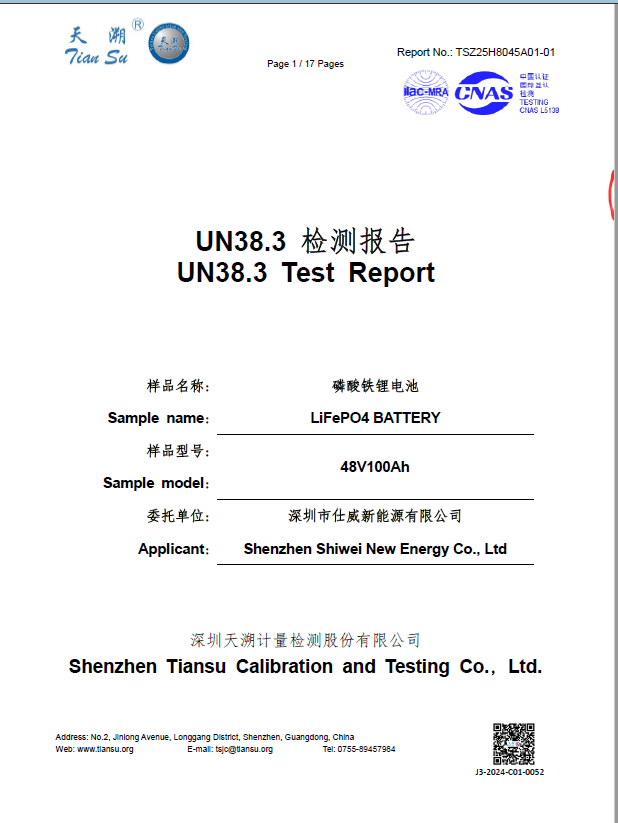
The short answer: read the three documents from the most specific to the least specific — model, series, system — and check each one against the exact battery you are buying. In the Sisway Battery evidence set examined in this guide, UN38.3 Test Report No. TSZ25H8045A01-01 names LiFePO4 battery Model 48V100Ah; MSDS No. TSZ25LL028A86-01 covers the lithium-ion golf cart battery series under GHS and OSHA HazCom 2012 for the USA market; and certificate No. 24CN34504502Q certifies R&D and production of lithium-ion battery (except 3C requirements) to GB/T 19001-2016 / ISO 9001:2015, with 48V 100Ah, 51.2V 100Ah and 72V 105Ah products listed under that scope. Two of these documents run to 31 December 2026 and one to 5 April 2027 — a detail that matters for any order that ships in 2027.

Why a certification folder fails review before it reaches the buyer
Most battery quotation packs are assembled to look complete rather than to be checkable. Three failure patterns appear repeatedly when a procurement team moves from evaluation to execution.
The first is level confusion: a series-level document is presented as if it covered a single model, or a system-level certificate is presented as if it validated a product's electrical behaviour. The second is scope drift: a valid report exists, but the model string in its scope field is not the model on the purchase order. The third is date drift: the documents were valid when the sample was approved and are close to expiry when the shipment is booked.
None of these is necessarily misconduct. They are the natural result of sending a reusable folder instead of a model-specific one. The buyer's job is to close that gap at the review stage, because at the execution stage — loading, customs paperwork, fleet handover, warranty registration — a scope mismatch is expensive to correct.
Decision rule: a document that is more general never substitutes for one that is more specific. An ISO 9001 certificate covering a production scope cannot replace a model-level transport test report, and an MSDS covering a battery series cannot replace either.
The three evidence levels, defined
Model-level evidence: the UN38.3 test report
UN38.3 refers to section 38.3 of the UN Manual of Tests and Criteria, Part III. It is the test regime that underpins the lithium battery entries in transport regulations, and shipping parties commonly ask for the resulting test report before batteries are booked for carriage. A report is evidence that a described sample of a described model was tested under that regime — nothing more, and nothing less. The scope field is therefore the most important line in the document.
Series-level evidence: the Material Safety Data Sheet
An MSDS is a hazard communication document, normally organised in the 16-section GHS-aligned format. It tells handlers what the product contains, how it should be stored, what to do in a spill or fire, and what protective measures apply. For the United States market, the relevant reference is OSHA Hazard Communication Standard 2012 (HazCom 2012) aligned with GHS. An MSDS is not a certification, and it does not approve a product for sale; it documents hazard information for a product family.
System-level evidence: the ISO 9001:2015 certificate
ISO 9001:2015 is a quality management system standard. A certificate confirms that an independent certification body assessed the organisation's management system against that standard, within a written scope that defines the activities and product categories covered. It speaks about process control — design control, production control, inspection, corrective action — not about the runtime performance of any single battery. Its validity period is also typically longer than that of a transport report or safety data sheet.
Reading the three documents in this set, field by field
UN38.3 Test Report No. TSZ25H8045A01-01
The report is issued under the UN 38.3 standard (UN Manual of Tests and Criteria Part III Subsection 38.3) by Shenzhen Tiansu Calibration and Testing Co., Ltd., with an issue date of 25 August 2025 and validity to 31 December 2026. Its stated scope is LiFePO4 BATTERY, Model: 48V100Ah, and its market designation is global.
Four checks matter when you read it against a purchase order. First, the model string: confirm that the designation in the report and the designation on the order and on the product label are the same model, including spacing and any suffix conventions. Second, the testing organisation and report number, which should appear consistently on the report body and any annexes. Third, the sample description, which should correspond to a production-representative pack rather than a one-off build. Fourth, the validity date, which in this case falls on 31 December 2026.
What the document does not do is extend to other voltages. A report naming 48V100Ah does not describe a 51.2V 100Ah or a 72V 105Ah pack, even where those products sit in the same catalogue and under the same quality management system.
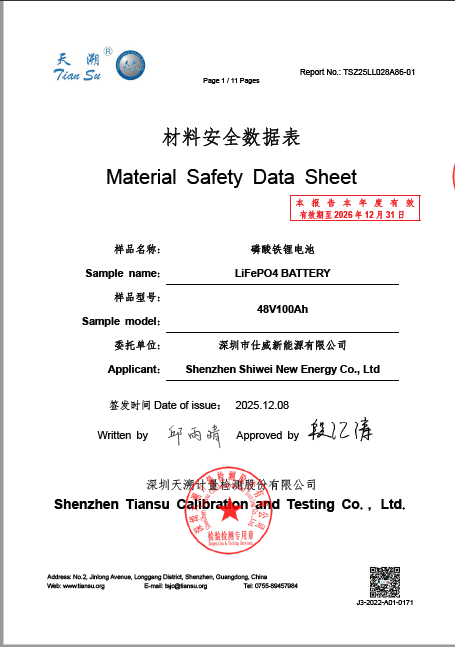
MSDS No. TSZ25LL028A86-01
The safety data sheet is issued by Shenzhen Tiansu Calibration and Testing Co., Ltd. against the GHS and OSHA HazCom 2012 references, with a USA market designation, an issue date of 8 December 2025 and validity to 31 December 2026. Its stated scope is the lithium-ion golf cart battery series.
Because the scope is written at series level, the check is different from the UN38.3 check. You are not looking for one model string; you are looking for whether your model is identifiable within the product identification section, whether the revision date and document number in the header match the copy in your file, and whether the hazard and composition sections are consistent with a LiFePO4 pack. The regulatory reference also has to match the destination: a sheet written to GHS and OSHA HazCom 2012 supports United States handling and workplace hazard communication, and it should not be assumed to satisfy another jurisdiction's requirements without checking that market's own reference.
A common purchasing error is to treat the MSDS as proof of product compliance. It is not. It is the document your warehouse, freight forwarder and service technicians will reach for when they need to know how the product behaves and how it must be handled.
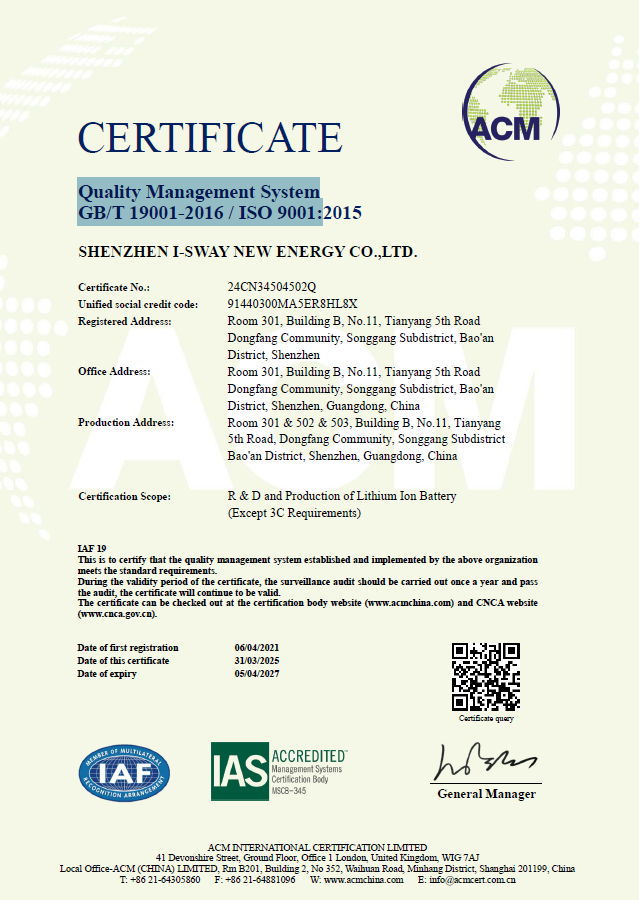
Quality Management System Certificate No. 24CN34504502Q
This is the document that most often gets misread, because it is the number buyers see attached to the 51.2V and 72V models. It is a quality management system certificate to GB/T 19001-2016 / ISO 9001:2015, issued by ACM International Certification Limited, with a global market designation, an issue date of 31 March 2025 and an expiry date of 5 April 2027. Its scope reads R&D and Production of Lithium Ion Battery (Except 3C Requirements), and the 48V 100Ah, 51.2V 100Ah and 72V 105Ah golf cart battery models are listed under it.
Three consequences follow. The certificate confirms that design and production activities for lithium-ion batteries are inside an assessed management system — which is directly relevant when you ask a supplier to customise a pack, because customisation is a design and change-control activity, not only a production one. It explains why one number appears against three different voltages: the certificate covers a process scope, so several models can legitimately sit beneath it. And it cannot be used to argue that a 51.2V or 72V pack has been transport-tested, because that is a different document type entirely.
The scope wording also carries an exclusion: except 3C requirements. Read that as a boundary marker on what the certificate does and does not address, and raise it with the supplier if your destination market imposes certification requirements outside that scope.
The three documents compared
| Document | Number and issuer | Scope as stated | Validity | What it supports in a purchase file | What it does not establish |
|---|---|---|---|---|---|
| UN38.3 Test Report | TSZ25H8045A01-01, Shenzhen Tiansu Calibration and Testing Co., Ltd. | LiFePO4 BATTERY, Model 48V100Ah; standard UN 38.3 | Issued 2025-08-25; valid to 2026-12-31 | Evidence that a described 48V 100Ah sample was tested under the UN38.3 regime for transport documentation | Coverage of 51.2V or 72V models; duty-cycle performance; warranty terms |
| Material Safety Data Sheet | TSZ25LL028A86-01, Shenzhen Tiansu Calibration and Testing Co., Ltd. | Lithium-ion golf cart battery series; GHS, OSHA HazCom 2012; USA market | Issued 2025-12-08; valid to 2026-12-31 | Hazard identification and handling instructions for warehouse, freight and service teams | Product certification; transport test coverage; model-level test results |
| Quality Management System Certificate | 24CN34504502Q, ACM International Certification Limited | R&D and production of lithium-ion battery (except 3C requirements); GB/T 19001-2016 / ISO 9001:2015 | Issued 2025-03-31; expires 2027-04-05 | Supplier qualification; evidence of design and production process control; basis for OEM customisation review | Electrical performance of any specific model; transport safety testing; product certification |
A seven-step check you can run before signing
- Fix the purchase model first. Write down voltage, capacity and intended cart platform before you open the folder. Every document check is relative to that line, so an ambiguous model definition makes the rest of the review unreliable.
- Read the scope field of each document against that model. For a 48V 100Ah order, look for the 48V100Ah designation in the UN38.3 report. For 51.2V 100Ah or 72V 105Ah, look for those models in the product list of the quality management system certificate and ask separately for their transport documentation.
- Label each document by type. Mark it as model-level, series-level or system-level. This single habit prevents the most common substitution — an ISO 9001 certificate offered in place of a missing transport report.
- Verify the identifier and issuer. Record the document number, the issuing organisation, the standard reference and the version, then confirm them through the issuer's own verification channel rather than from the supplier's cover page.
- Diarise expiry against your own timeline. Compare the expiry date with the shipment date, the installation date and the start of your warranty or lease period. The UN38.3 report and the MSDS in this set both run to 31 December 2026; the ISO 9001 certificate runs to 5 April 2027.
- Ask for what is missing instead of accepting a substitute. If your order includes 51.2V 100Ah or 72V 105Ah packs, ask for the model-level transport documentation for those models, and ask whether renewal documentation will be available for shipments after 31 December 2026.
- Write the verified list into the purchase order. Document numbers, issue dates, expiry dates and the models covered should appear in the order and in the acceptance criteria, not only in the quotation email.
How the evidence changes 48V, 51.2V and 72V selection
Certification evidence does not choose a voltage for you; the cart's system voltage, controller and charger set that requirement. What the evidence decides is whether the chosen voltage can be documented at the moment of shipment. Read the three voltages separately for that reason.
48V 100Ah. This is the model with the deepest document alignment in the set: a model-level UN38.3 report naming 48V100Ah, series-level MSDS coverage, and a place in the ISO 9001 product list. For a buyer replacing an existing 48V lead-acid string or standardising a fleet, the document review is comparatively straightforward because the transport evidence names the model directly.
51.2V 100Ah. The certificate number commonly attached to this model — 24CN34504502Q — is the quality management system certificate, not a product-specific certificate. That is legitimate, but it answers a process question rather than a transport question. If your order ships 51.2V 100Ah packs, request the model-level transport report for that model and keep it in the same file as the certificate, clearly labelled by document type.
72V 105Ah. The model appears in the ISO 9001 product list, and the minimum order quantity for the 72V 105Ah model is 1 unit. Two technical checks belong next to the document review. First, confirm the model-level transport documentation for the 72V pack. Second, confirm the nominal voltage designation: company product listings use both 72V and 73.6V terminology for 72V-class products, and that equivalence should be confirmed on the model datasheet — together with charge voltage limits — before controller compatibility is signed off. Treating two labels as interchangeable without datasheet confirmation is a compatibility risk, not a documentation formality.
| Model | UN38.3 model-level coverage in this set | MSDS coverage | ISO 9001 scope listing | Action before order release |
|---|---|---|---|---|
| 48V 100Ah | Named: TSZ25H8045A01-01, valid to 2026-12-31 | Series-level; confirm model in the product identification section | Listed | Confirm label model string matches the report |
| 51.2V 100Ah | Not named in the supplied report | Series-level; confirm model | Listed | Request model-level transport report for 51.2V 100Ah |
| 72V 105Ah | Not named in the supplied report | Series-level; confirm model | Listed | Request model-level transport report; confirm 72V nominal designation on the datasheet |
Where this reading matters in practice
Multi-voltage OEM orders. Sisway describes a Thailand golf cart battery OEM project covering 20,000 units over five years, replacing lead-acid with LiFePO4 and engineered for a high-temperature, high-humidity climate. A programme of that shape usually involves more than one model across its life. That is exactly the situation in which a single folder becomes a liability: the series-level MSDS and the quality management system certificate travel with every shipment, but the model-level transport report has to follow the model actually in the container.
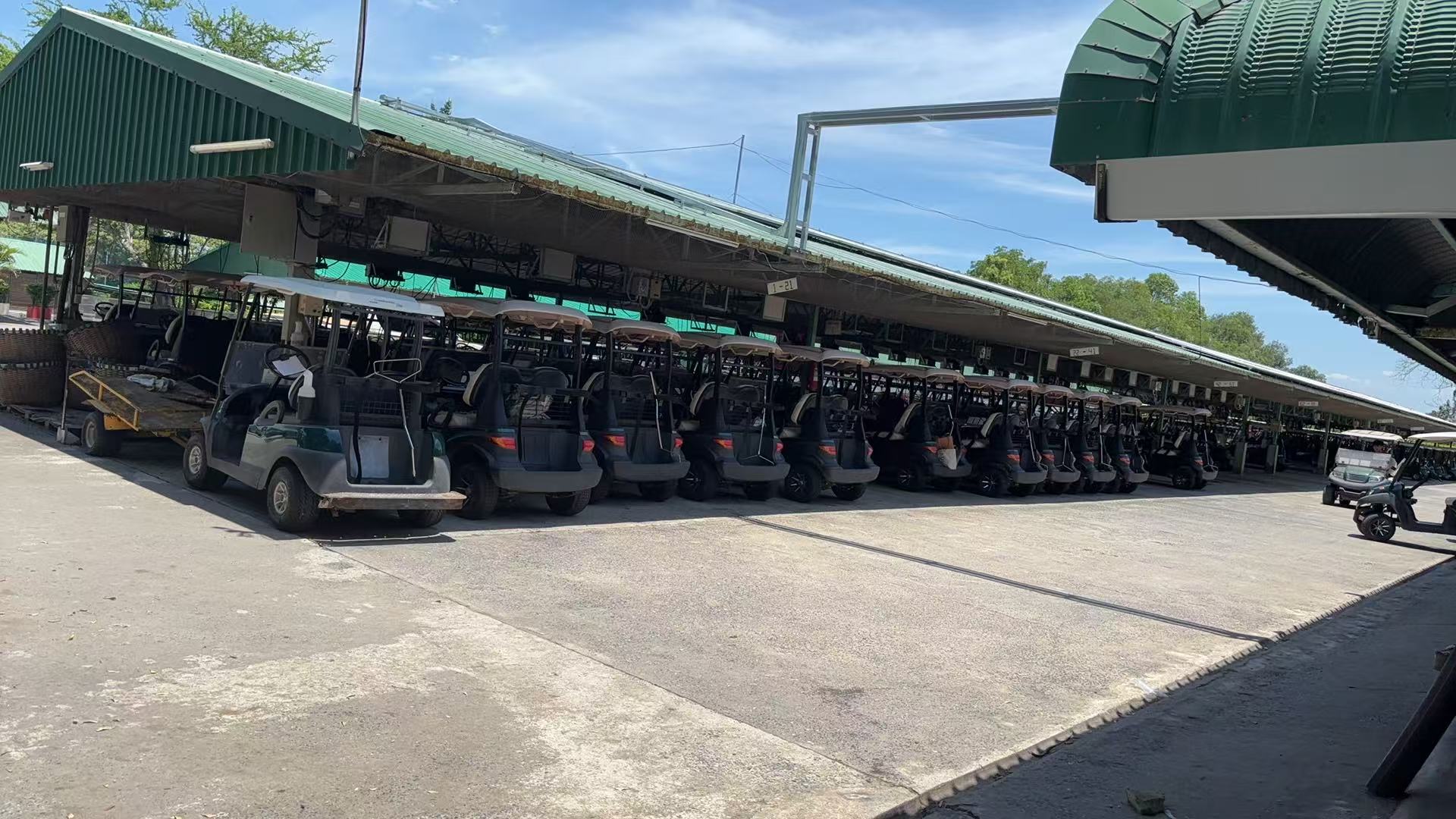
United States venue and campus fleets. Where batteries are handled by staff, an MSDS written to GHS and OSHA HazCom 2012 gives the maintenance and safety teams a usable reference without a chemistry translation exercise. Sisway lists a US after-sales service team and a US overseas warehouse, which matters at the execution stage: document questions after delivery are answered in the same time zone as the fleet.
Distributor stock across three voltages. A distributor holding 48V, 51.2V and 72V lines needs three separate document checks, not one. The practical approach is a per-model document register that shows, for each SKU, which transport report covers it, which MSDS revision applies, and when each expires.
Writing the evidence into procurement terms and acceptance criteria
The commercial terms around a Sisway golf cart battery order are deliberately light at the entry point: the minimum order quantity is 1 unit, including the 72V 105Ah model, and lead time is 15–30 days against a monthly capacity of 5,000 units. Delivery terms are FOB, CIF or overseas warehouse shipment; payment terms are T/T, L/C, PayPal, Western Union and Trade Assurance. The stated acceptance criterion is a pre-shipment test, and quality control is described as 100% test.
Those terms are the place to attach the documents. A workable clause structure looks like this:
- Document schedule. List each required document by number, issue date, validity date and the model it covers — for example UN38.3 Test Report No. TSZ25H8045A01-01 for 48V100Ah, MSDS No. TSZ25LL028A86-01 for the battery series, and certificate No. 24CN34504502Q for the quality management system scope.
- Model coverage statement. Require the supplier to state in writing whether each document covers the ordered model, and to supply the model-level transport documentation where it does not.
- Renewal point. Set the date by which renewed documents must be provided for shipments falling after a document's expiry — 31 December 2026 for the transport report and the MSDS in this set.
- Acceptance record. Tie the pre-shipment test to a written record referenced in the shipping file, so that the acceptance criterion is auditable rather than verbal.
- Change control. Where the order involves OEM customisation, state that any change to size, specification or design is reviewed inside the supplier's quality management system before production, since R&D and production are the activities covered by certificate No. 24CN34504502Q.
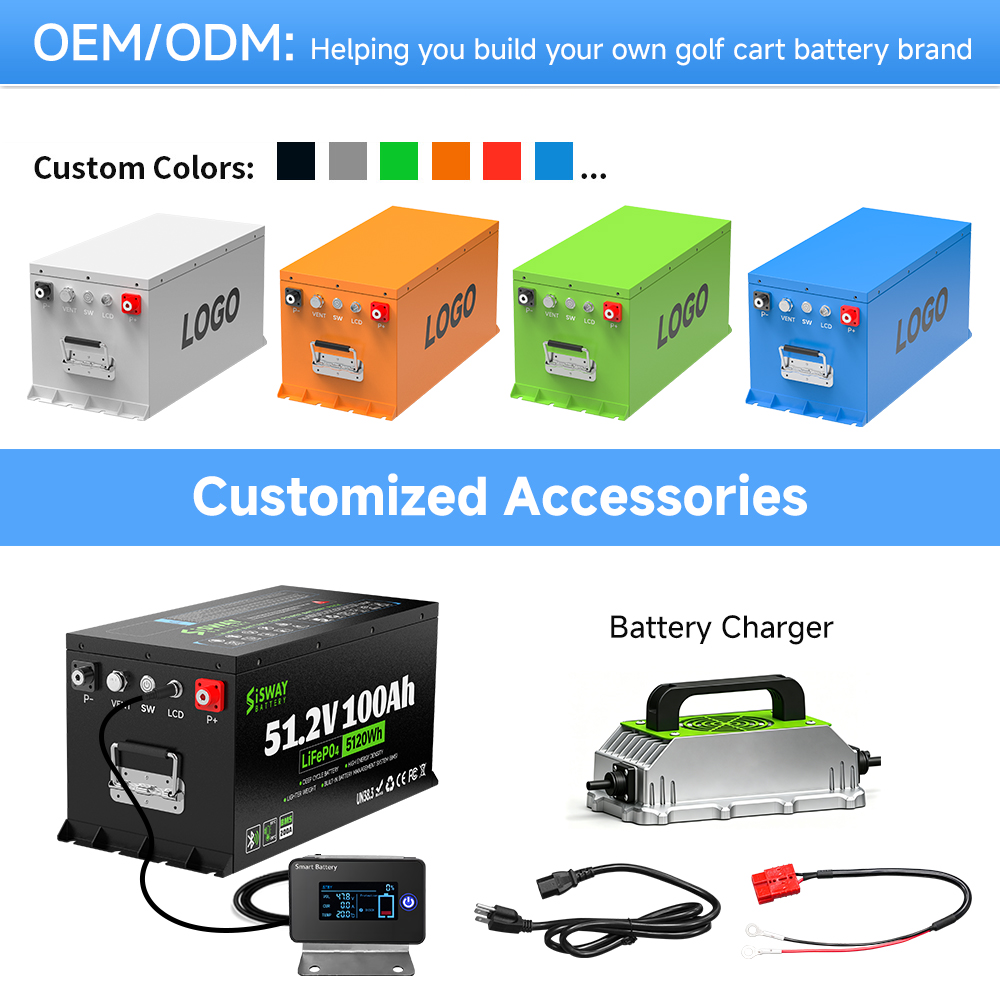
Customisation itself is documented capability rather than an assumption: Sisway provides OEM production services including customisation of logo, design, size and specifications, supported by a 25-engineer R&D team, a 20,000 m² facility, 150 employees and annual output of 90,000 units, with an export share of about 50% and the USA as its main market. For a buyer in the execution stage, those numbers are useful for capacity and change-control questions — not as a substitute for the document review above.
What these documents do not tell you
A well-read certification file is still a partial file. Keep the boundaries explicit when you take it to an internal approval meeting.
- An ISO 9001:2015 certificate is not a product safety certification, and the scope here explicitly excludes 3C requirements.
- A UN38.3 report does not validate cycle life, usable energy, continuous or peak discharge current, or thermal behaviour in your application, and it is not a warranty.
- An MSDS documents hazards and handling; it does not approve the product for a market on its own.
- Neither the transport report nor the MSDS in this set extends beyond 31 December 2026 without renewal.
- Datasheet-level parameters — dimensions, weight, charge voltage limits, charger compatibility, cycle-life test conditions and warranty terms — sit outside all three documents and must be requested per model.
Frequently asked questions
Does UN38.3 Test Report No. TSZ25H8045A01-01 cover 51.2V and 72V models?
No. The stated scope of the report is LiFePO4 BATTERY, Model 48V100Ah, tested under UN 38.3 and valid to 31 December 2026. A 51.2V 100Ah or 72V 105Ah pack is a different model and requires its own model-level transport documentation. Both of those models are listed under the quality management system certificate, but a system certificate answers a different question from a transport test report.
What does ISO 9001 certificate No. 24CN34504502Q actually cover?
It is a quality management system certificate to GB/T 19001-2016 / ISO 9001:2015, issued by ACM International Certification Limited on 31 March 2025 and valid to 5 April 2027, with a global market designation. Its scope is R&D and Production of Lithium Ion Battery (Except 3C Requirements), and the 48V 100Ah, 51.2V 100Ah and 72V 105Ah golf cart battery models are listed under it. It provides evidence of design and production process control; it does not certify the electrical performance of any individual model.
Can Sisway supply OEM lithium golf cart batteries with customisation?
Yes. Sisway provides OEM production services that include customisation of logo, design, size and specifications, supported by a 25-engineer R&D team and a 20,000 m² manufacturing facility with annual output of 90,000 units. Because the customisation activity falls inside the R&D and production scope of certificate No. 24CN34504502Q, change control is the point to agree in writing before production begins.
What is the minimum order quantity and lead time?
The minimum order quantity is 1 unit, including for the 72V 105Ah model. Lead time is 15–30 days, against a monthly capacity of 5,000 units. Delivery terms are FOB, CIF or overseas warehouse shipment, and payment terms are T/T, L/C, PayPal, Western Union and Trade Assurance.
What acceptance criteria and payment terms apply, and how do I request the document set?
The stated acceptance criterion is a pre-shipment test, with quality control described as 100% test, and payment terms of T/T, L/C, PayPal, Western Union and Trade Assurance under FOB, CIF or overseas warehouse delivery. Before you confirm an order, ask for the document pack matched to your exact model — the UN38.3 report, the MSDS revision and the quality management system certificate, each with its number and validity date — and note whether renewal documentation is needed for shipments after 31 December 2026. The Sisway product brochure is a starting point for model and capacity planning; documents and quotations are confirmed against your specific order.
Conclusion: read the scope line, then the date
The value of a certification file is decided by two lines on each page: the scope and the validity date. For the Sisway Battery set examined here, that reading produces a clear picture. The 48V 100Ah LiFePO4 pack is backed by a model-level UN38.3 report numbered TSZ25H8045A01-01. The lithium-ion golf cart battery series is covered by MSDS No. TSZ25LL028A86-01, written to GHS and OSHA HazCom 2012 for the USA market. And the 48V 100Ah, 51.2V 100Ah and 72V 105Ah models all sit under quality management system certificate No. 24CN34504502Q, issued by ACM International Certification Limited against GB/T 19001-2016 / ISO 9001:2015, with a scope covering R&D and production of lithium-ion battery (except 3C requirements) and a validity running to 5 April 2027.
That is a usable base for evaluation, and it sets a specific task list for execution: confirm the model-level transport documentation for any 51.2V or 72V packs on the order, confirm the nominal voltage designation on the 72V datasheet before controller sign-off, confirm renewal status for the two documents expiring on 31 December 2026, and write all of it into the purchase order alongside the pre-shipment test acceptance criterion. Buyers who do that arrive at the loading date with a file that can be checked line by line — which is the only real purpose of a certification pack. Full company and product context is available at Sisway Battery.
Document details in this guide are taken from the certification records supplied by Shenzhen Shiwei New Energy Co., Ltd. for UN38.3 report TSZ25H8045A01-01, MSDS TSZ25LL028A86-01 and quality management system certificate 24CN34504502Q. Confirm current validity with the supplier before order release.
Have Questions or Need More Details?
Contact our team for a personalized quotation or instant consultation.
Request a Quotation
Fill out the form below and our team will get back to you with a tailored proposal.
WhatsApp Direct Chat
Prefer to chat in real-time? Message us on WhatsApp for instant assistance & quick answers.
- Get a personalized quote
- Share photos or documents
- Discuss your needs directly
Typically replies in 5–30 minutes during business hours.