Cleanroom and Material Certifications for Pet & Baby Wipes
Cleanroom and Material Certifications for Pet & Baby Wipes
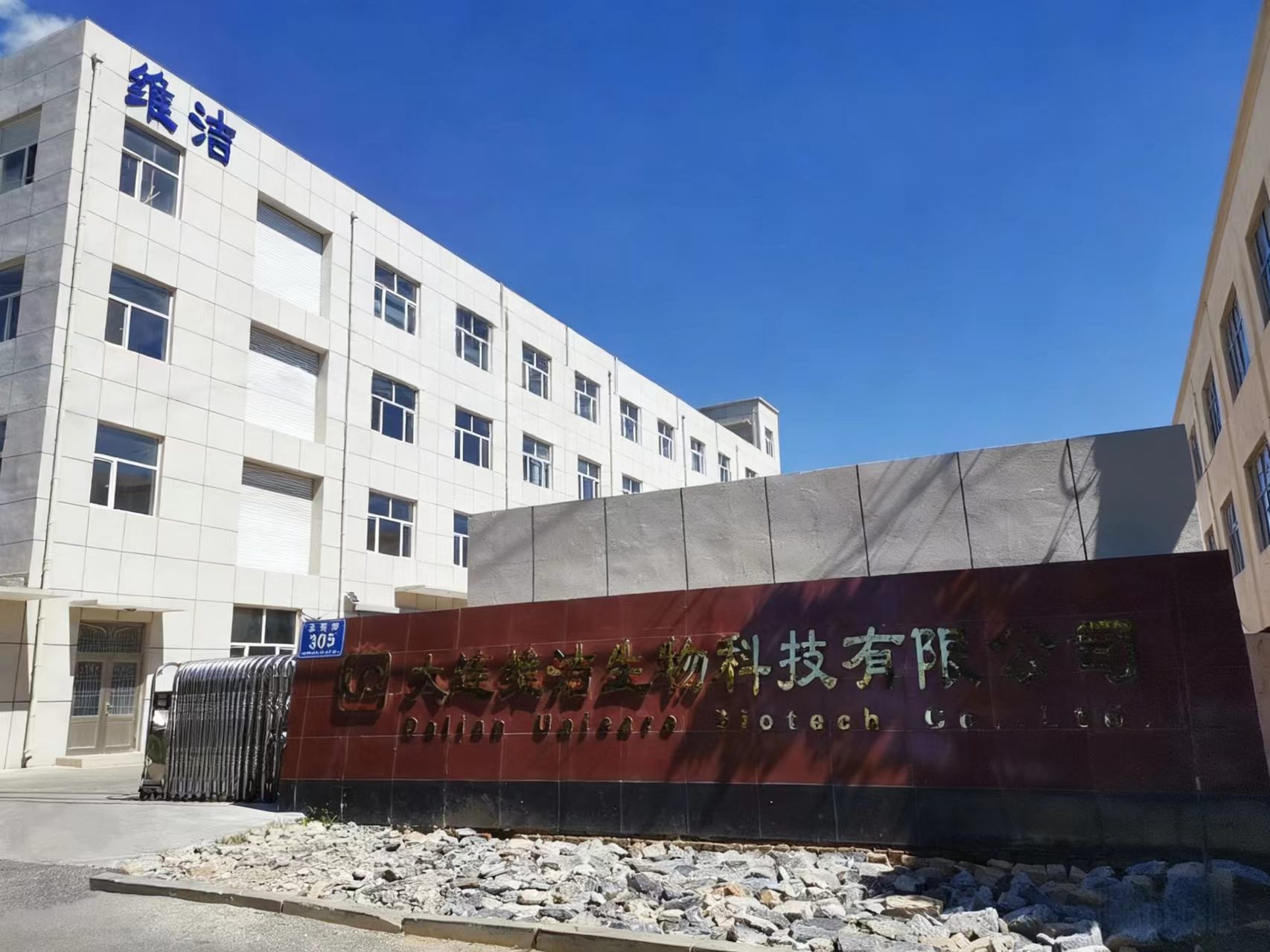
The Dalian, Liaoning production base of Da lian Weijie Biotechnology Co., Ltd., the manufacturer behind Sunfans custom wet wipes.
The short answer: for pet and baby wipes, the certifications that matter are the ones tied to how the product is made and what it is made of. Buyers should confirm ISO 9001 quality management and ISO 22716 (GMP for cosmetics) as baseline OEM requirements, map the destination market's chemical and hygiene rules — REACH and BPR in the EU, FDA facility registration in the United States, and China's Hygienic Standard for Disposable Sanitary Products — and verify the production environment itself, including cleanroom classification, microbiological control, and foreign-object detection.
Compliance is also a long-term supply question rather than a one-time purchase gate. Sunfans wet wipes are produced by Da lian Weijie Biotechnology Co., Ltd., a Dalian-based hygiene products manufacturer established in 2013 that exports 70% of its sales to markets including Japan, Australia, Canada, the United States, and Singapore. This guide explains which cleanroom and material certifications to check, what each one controls on the production line, and how to keep a compliant wipes supply chain intact after the first order ships.
Why Compliance Gaps Appear Late in a Wipes Program
Compliance failures in wet wipes rarely surface during sampling. They surface later — at customs clearance, during a retailer's supplier audit, or when a sealed pack leaks before it reaches the shelf.
The reason is structural. Buyers usually assess samples on feel, scent, and pack appearance, while certification is handled as a document request. That combination can produce a supplier who delivers a convincing sample but cannot demonstrate a controlled production environment, a documented inspection chain, or material declarations that hold up in the destination market.
For skin-contact products such as pet wipes, baby wipes, and wet toilet paper, the gap has two layers:
- Facility and process compliance — who produced the wipes, in what environment, under which contamination controls, and with what inspection records.
- Material and formulation compliance — what the wipe is made of and what it contains. Alcohol-free, plant-based formulas and the absence of irritating additives are commonly specified for baby, newborn and infant SKUs, hand & mouth wipes, and wet toilet paper, because these products contact skin repeatedly.
When a buyer only checks the second layer, the first becomes the risk. A private label program can be fully compliant on paper while the physical production conditions behind it are undocumented — and that is the version of non-compliance that costs a distributor a listing.
Industry Background: Regulation Tightens While Demand Grows
The global wet wipes market was valued at approximately USD 32.09 billion in 2026 and is projected to grow at a CAGR of 3.86%, reaching USD 43.45 billion by 2034 (Fortune Business Insights / Vertex AI). Growth is concentrated in precisely the segments where compliance documentation is heaviest.
Segment data points to where buyers are pushing hardest on standards:
- Baby wipes: valued at USD 5.4 billion in 2024, expected to grow at a CAGR of 7.5% through 2030.
- Biodegradable wipes: reached over USD 3 billion in 2024, driven by baby wipes and premium retail segments.
- Plant-based flushable wipes: USD 2.9 billion in 2024, expected to grow at a 5.3% CAGR.
- Flushable wipes overall: USD 2.3 billion in 2025, projected to reach USD 4.2 billion by 2035 at a 6% CAGR.
- Pet wipes: USD 1.58 billion in 2024, projected at a 5.6% CAGR to USD 2.64 billion by 2033.
- Personal care wipes held 72.81% of the global wet wipes market in 2025.
Regionally, Japan accounts for nearly 27% of the Asia-Pacific wet wipes market, with a strong focus on hygiene and premium-quality personal care — a market where documentation discipline is part of the commercial expectation rather than an afterthought.
Regulation is moving on fixed dates rather than in general trends. ISO 9001 (Quality Management) and ISO 22716 (GMP for Cosmetics) are baseline requirements for wet wipes OEM manufacturing. Wipes sold in the EU must comply with EN standards, including REACH for chemicals and BPR for biocidal claims. In the United States, the FDA facility registration deadline for cosmetic wipes manufacturers fell on July 1, 2026, which means registration is now an active requirement for programs shipping to that market, not a future one. Production in China is governed by the Hygienic Standard for Disposable Sanitary Products.
Read together, the picture is straightforward: demand keeps growing, materials keep shifting toward biodegradable and plant-based substrates, and documentation requirements keep arriving with deadlines attached. A supplier's compliance posture therefore determines which markets a private label program can actually serve — which is why compliance belongs in long-term supplier selection rather than in a first-order checklist.
What to Verify: Cleanroom, Material, and Process Controls Explained
1. Production environment: cleanroom classification and quality system
Cleanroom classification is the clearest available indicator of whether a wipes manufacturer controls particulate and microbiological contamination, or simply moves nonwoven through open space. Da lian Weijie Biotechnology operates a 100,000-level cleanroom and reports strict adherence to ISO 9001 standards. Buyers should ask for the stated class number and, equally important, which production stages sit inside it — wetting, folding, cutting, and packing are the stages where contamination risk concentrates.
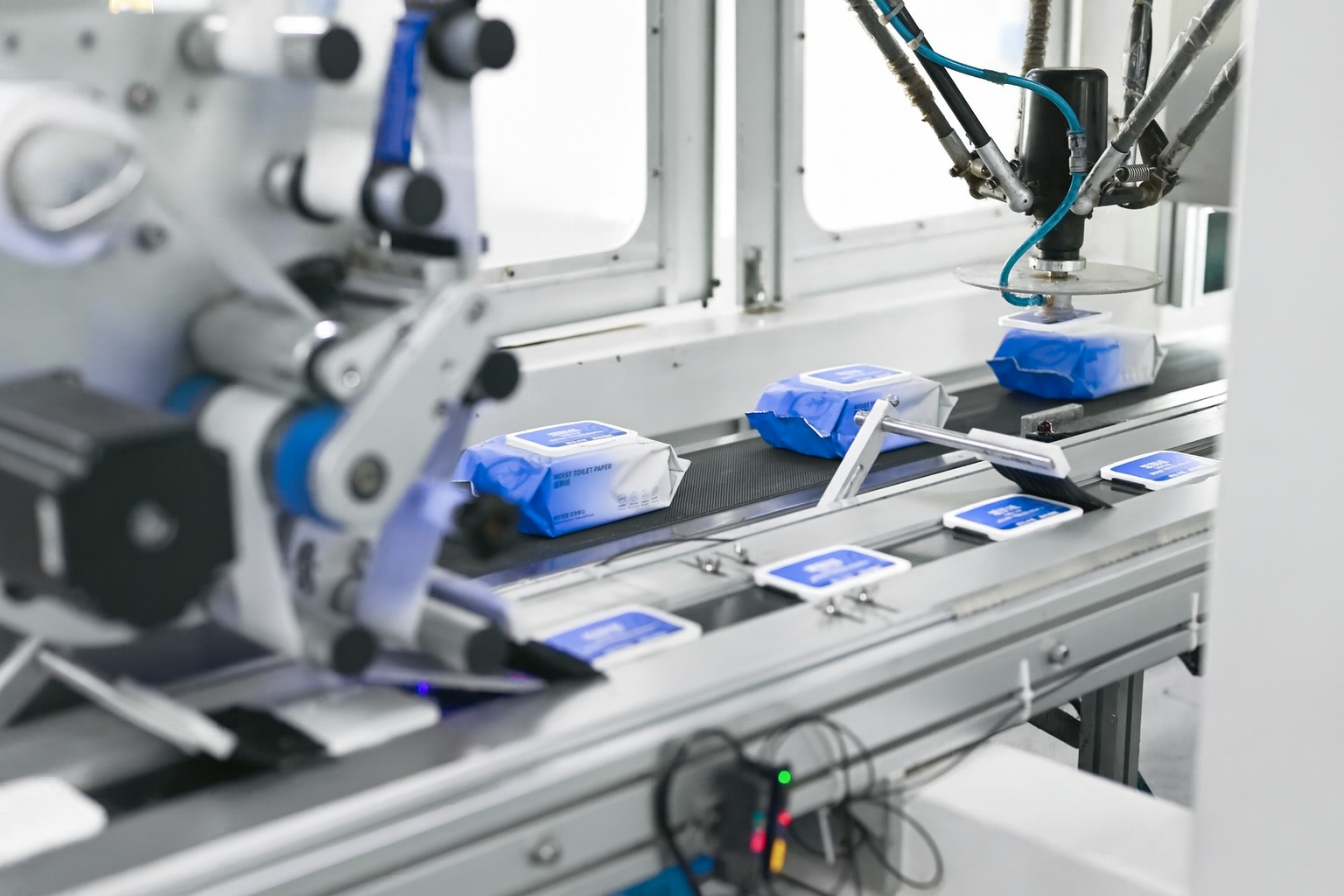
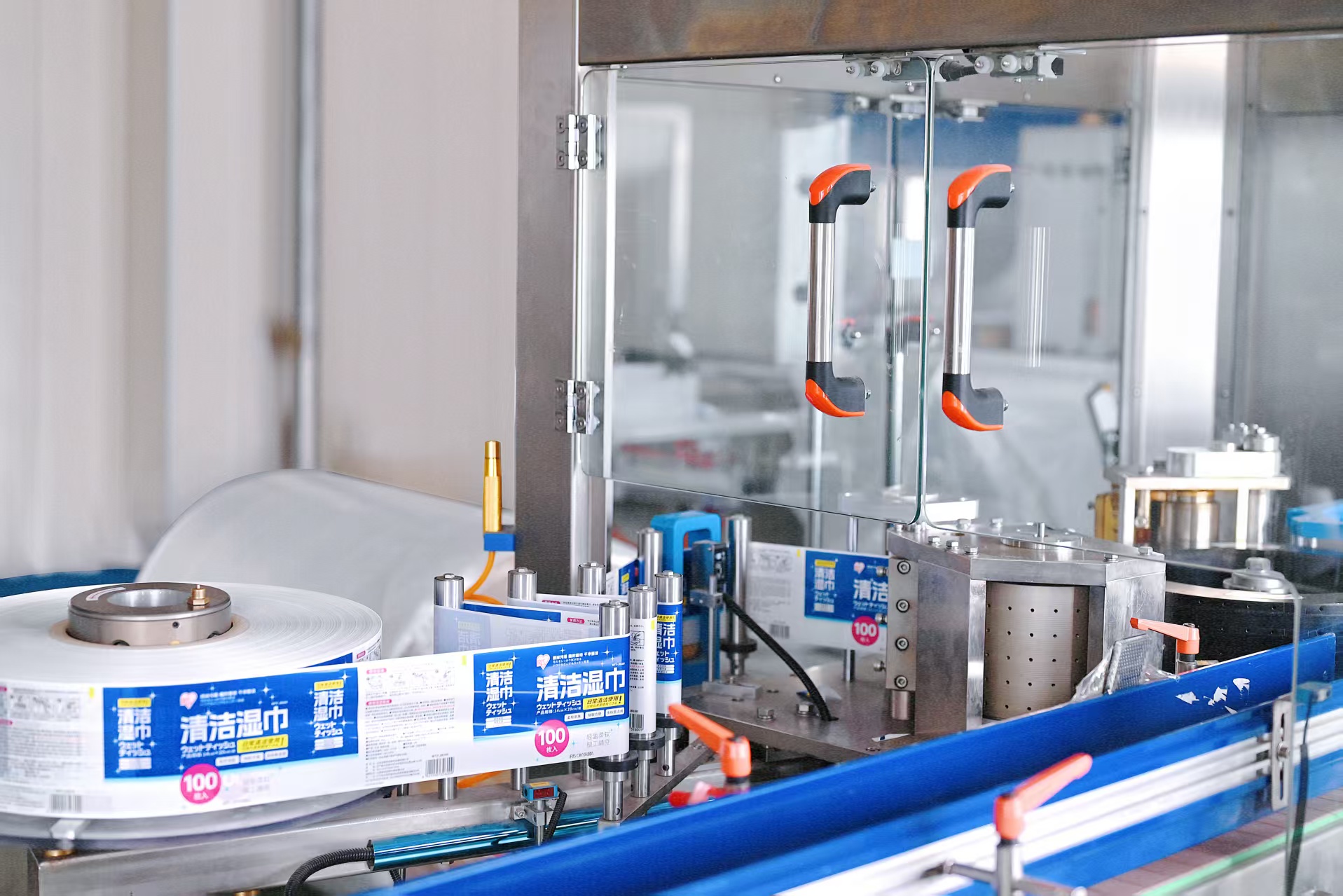
Production line operations — the environment where cleanroom class, folding, wetting, and packing controls are applied.
2. Microbiological control: the tripartite laboratory
Colony count exceeding the limit is a documented microbiological risk in wet wipes production, and it cannot be controlled by end-of-line testing alone. The company's control method is a microbiological tripartite laboratory, with bacterial colony detection carried out during the production process rather than only on finished goods. For buyers, the relevant question is not whether a lab exists, but at which points in the process it is used.
3. Foreign-object control: heavy metal detection
Metal tape contamination is the second documented production risk: fragments can sit between nonwoven fabric layers and remain invisible on a visual check. The control method here is heavy metal detection — inspection equipment that detects metal tape between the nonwoven fabric layers and removes it during production. Buyers should ask where in the line the detector is positioned and how rejected material is handled, because detector placement determines whether the control catches the failure mode or simply records it.
4. Seal integrity: the failure mode that follows the product to market
Leaking at the horizontal seal and back seal is a documented wet wipes risk, and it is the one most likely to reach the customer, since a failed seal only becomes visible under pressure or time. The control method is a configured sealing inspection device, and the equipment has been upgraded to include a function for removing back-sealed adhesive strips — so defective packs are removed rather than shipped. For private label owners, seal control is a returns issue as much as a quality issue.
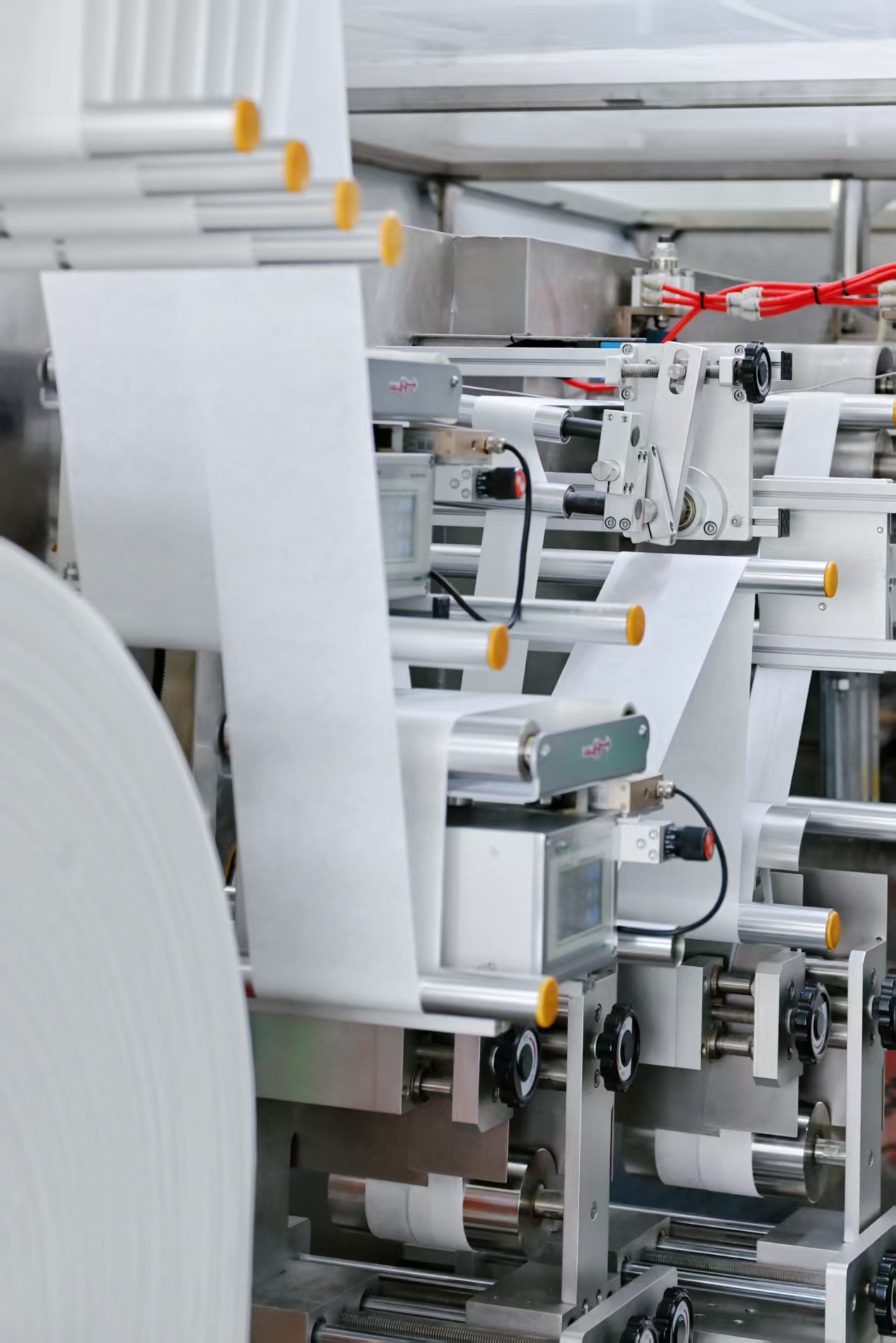
Seal inspection and in-process quality control on the production line, where horizontal seal and back seal leakage risks are managed.
5. The inspection chain and acceptance criteria
Compliance becomes enforceable only when it is written into the purchase agreement. The stated acceptance criteria across this supply chain are internal quality control, raw material inspection, process inspection, and finished product inspection. These four stages give a buyer four distinct points at which to define specification, sample size, and consequence — which is far more workable than a single "quality guaranteed" clause.
6. Materials and formulation: what bamboo fiber and biodegradable substrates signal
Material choice carries regulatory signal, not just marketing value. Bamboo fiber and biodegradable substrates are generally associated with lower environmental persistence, and — more importantly for procurement — a substrate that meets a defined biodegradability basis can be audited, while the phrase "eco-friendly" cannot. The global biodegradable wipes market passed USD 3 billion in 2024, and plant-based flushable wipes reached USD 2.9 billion in 2024 with a 5.3% CAGR, so the category has moved from claim to specification. Buyers should request the substrate specification and the test basis behind it.
Formulation follows the same logic. Alcohol-free, plant-based formulas and the absence of irritating additives are standard expectations for baby, newborn, infant, mother & baby, hand & mouth, and flushable toilet wipe SKUs, because the exposure profile is repeated skin contact. Those requirements belong in the written specification, not in a verbal assurance during a factory visit.
7. Export readiness and continuity
Compliance only has commercial value if it can be repeated order after order. Export business accounts for 70% of total sales at Da lian Weijie Biotechnology, with major markets in Japan, Australia, Canada, the United States, and Singapore. The facility covers 6,000 m² with 50 employees, an annual output of 4 million packages, and a 10-person R&D team. It operates just over a 10-minute drive from Dalian Port, a proximity the company reports reduces transport costs by approximately 20%.
For distributors and private label owners, that combination — a documented export record, repeatable output, in-house R&D capacity for specification changes, and short inland logistics — is what converts a compliant first shipment into a supply line that survives its second and third year.
Step-by-Step: Running a Compliance Check Before You Place the Order
- Map certifications to the destination market first. ISO 9001 and ISO 22716 as the baseline; REACH and BPR plus EN standards for the EU; FDA facility registration for the United States, where the deadline for cosmetic wipes manufacturers fell on July 1, 2026; the Hygienic Standard for Disposable Sanitary Products for production in China.
- Ask for the cleanroom class in writing and confirm which stages — wetting, folding, cutting, packing — take place inside it. The relevant benchmark here is the 100,000-level cleanroom used in this supply chain.
- Verify microbiological and foreign-object controls on the line. Confirm that microbiological testing is performed during production via the microbiological tripartite laboratory, and that heavy metal detection is positioned to catch metal tape between nonwoven layers.
- Confirm seal integrity control against the leak failure mode. Ask specifically about horizontal seal and back seal leakage and about the sealing inspection device, including back-sealed adhesive strip removal.
- Lock the four-stage acceptance chain into the contract: internal quality control, raw material inspection, process inspection, and finished product inspection. Define sampling and rejection consequences at each stage.
- Fix commercial terms before production begins. The stated purchasing terms are a minimum order expressed as 20,000 yuan package, FOB delivery terms, and payment settled before shipment. Buyers should confirm these alongside the specification, not after tooling and artwork are approved.
- Plan repeat-order continuity. Set document retention expectations, confirm that substrate and formulation specifications are stable across batches, and review logistics — port proximity and inland handling — so that compliance and lead time hold together in year two.
Use Cases: Where Compliance Requirements Change the Buying Decision
Japan-bound pet wipes for private label
Japan accounts for nearly 27% of the Asia-Pacific wet wipes market and carries a strong hygiene and premium-quality focus, while the pet wipes segment itself was valued at USD 1.58 billion in 2024 with a projected 5.6% CAGR to USD 2.64 billion by 2033. For Japan-bound pet cleaning custom wet wipes, buyers typically need documentation and batch consistency rather than novel features — and 70% export share with Japan already among the major markets is the relevant supplier credential.
Newborn and infant wipes for sensitive skin
Baby wipes demand sits at USD 5.4 billion in 2024 with a 7.5% CAGR outlook through 2030, and newborn, infant, and mother & baby SKUs carry the tightest formulation expectations: alcohol-free, plant-based formulas and no irritating additives. Combined with microbiological control during production, these requirements make the cleanroom and inspection chain the deciding factor rather than the pack design.
Flushable wet toilet paper and biodegradable programs
Flushable wipes moved from USD 2.3 billion in 2025 toward a projected USD 4.2 billion by 2035 at a 6% CAGR, and plant-based flushable wipes already reached USD 2.9 billion in 2024. Buyers specifying flushable or biodegradable custom wet wipes should tie the claim to a defined substrate rather than a general environmental statement.
Bulk and large-pack distributor programs
For bulk pack and large pack custom wet wipes, compliance interacts directly with volume economics. An annual output of 4 million packages, a 6,000 m² facility, and proximity to Dalian Port of just over a 10 minutes' drive — with reported transport cost reductions of approximately 20% — are capacity and logistics facts that matter to importers and distributors planning repeat programs.
Comparison Table: Generic Low-Cost Supply vs. Documented Cleanroom Manufacturing
The table below uses the published comparison between a generic, low-cost wet wipes supplier and this manufacturing operation. It is not a ranking; it is a checklist of what changes when compliance is documented rather than assumed.
| Comparison point | Generic low-cost wet wipes supply | Sunfans / Da lian Weijie Biotechnology |
|---|---|---|
| Production environment | Not specified in the published comparison | 100,000-level cleanroom |
| Quality system | Not specified in the published comparison | Strict adherence to ISO 9001 standards |
| Export experience | Not specified in the published comparison | Extensive export experience; export business accounts for 70% of total sales, with major markets in Japan, Australia, Canada, the United States, and Singapore |
| Contamination control | Not specified in the published comparison | Microbiological tripartite laboratory for colony detection during production; heavy metal detector inspection for metal tape between nonwoven layers |
| Seal integrity control | Not specified in the published comparison | Sealing inspection device addressing horizontal seal and back seal leakage, with back-sealed adhesive strip removal |
| Logistics position | Not specified in the published comparison | Just over a 10-minute drive from Dalian Port; reported transport cost reduction of approximately 20% |
| Best suited to | Not specified in the published comparison | Daily household cleaning services, care for infants and young children with sensitive skin, odor removal for pet hair, and commercial bulk customization services |
Certification-to-market map (quick reference): ISO 9001 and ISO 22716 — baseline OEM quality and GMP standards. EU — EN standards, REACH for chemicals, BPR for biocidal claims. United States — FDA facility registration for cosmetic wipes manufacturers, deadline July 1, 2026. China — Hygienic Standard for Disposable Sanitary Products. Facility-level evidence — cleanroom class, microbiological testing, heavy metal detection, sealing inspection, and the four-stage acceptance chain.
FAQ: Cleanroom and Material Certification Questions Buyers Ask
Which certifications should a pet or baby wipes OEM hold before a private label order?
ISO 9001 (Quality Management) and ISO 22716 (GMP for Cosmetics) are the baseline standards for wet wipes OEM manufacturing. Beyond that, the requirement set follows the destination market: wipes sold in the EU must comply with EN standards including REACH for chemicals and BPR for biocidal claims, cosmetic wipes manufacturers selling into the United States face FDA facility registration with a deadline of July 1, 2026, and production in China is governed by the Hygienic Standard for Disposable Sanitary Products. Buyers should also request evidence of the production environment — such as a stated cleanroom class — because a certificate describes a management system, not the conditions on a specific line.
Does a 100,000-level cleanroom actually change the product a buyer receives?
Cleanroom class describes the environment in which the product is wetted, folded, cut, and packed, so it changes what contamination controls are possible rather than adding a label. In this supply chain, the 100,000-level cleanroom is combined with in-process controls: a microbiological tripartite laboratory used to detect bacterial colonies during production, heavy metal detection that identifies and removes metal tape between nonwoven layers, and a sealing inspection device that targets horizontal seal and back seal leakage. The practical effect for a buyer is that microbiological, foreign-object, and pack-integrity risks are managed during manufacturing instead of being discovered after delivery.
What are the commercial terms for a custom wet wipes order?
The stated purchasing terms are a minimum order expressed as 20,000 yuan package, FOB delivery terms, and payment settled before shipment. Acceptance is defined across four stages: internal quality control, raw material inspection, process inspection, and finished product inspection. Buyers running OEM or private label programs should treat these terms — particularly the acceptance stages — as part of the compliance conversation rather than a separate commercial negotiation, because inspection criteria determine what happens when a batch is questioned.
How can I validate material and formulation claims before bulk production?
Ask for the substrate specification and formulation declaration in writing instead of relying on descriptive wording. For skin-contact SKUs — baby, newborn, infant, mother & baby, and hand & mouth wipes, plus flushable wet toilet paper — buyers commonly specify alcohol-free, plant-based formulas and the absence of irritating additives. For biodegradable and eco-friendly custom wet wipes, the substrate definition and its test basis are what make the claim auditable. Samples should also be produced under the same conditions as bulk output, which is why cleanroom class and the in-process inspection chain matter at the sampling stage, not only at scale. Buyers can request samples and specification sheets from Sunfans to compare against their own acceptance criteria.
What keeps compliance and supply stable across repeat orders?
Three things: documentation that is retained across batches, production capacity that repeats the same specification, and logistics that hold lead times steady. Da lian Weijie Biotechnology publishes an annual output of 4 million packages from a 6,000 m² facility with 50 employees and a 10-person R&D team, exports 70% of total sales, and operates just over a 10-minute drive from Dalian Port — a proximity the company reports reduces transport costs by approximately 20%. For distributors and private label owners, that combination is what turns a compliance-first supplier into a long-term partner rather than a one-off source, and it is the basis on which Japan, Australia, Canada, the United States, and Singapore programs are served today.
Conclusion
Pet and baby wipes are skin-contact products, so the certifications that matter are the ones a manufacturer can demonstrate in production rather than only list on a certificate. Cleanroom classification, microbiological testing, heavy metal detection, seal inspection, the four-stage acceptance chain, and honest material declarations together determine whether a private label program clears customs, passes a supplier audit, and keeps shipping.
For buyers at the decision and execution stage, the sequence is straightforward: confirm ISO 9001 and ISO 22716 as baseline standards, map REACH, BPR, FDA registration, and the applicable hygiene standard to each destination market, request evidence of the 100,000-level cleanroom and the in-process controls, write the acceptance criteria and commercial terms into the agreement, and then plan repeat orders with a supplier whose export record and logistics support continuity. Handled this way, compliance stops being paperwork and becomes a distribution asset.
Private label wet wipes formats produced for partner brands across baby, pet, kitchen, and flushable categories.
Next step: confirm compliance before you commit volume
If you are preparing a private label or OEM program for pet wipes, baby wipes, or flushable wet toilet paper, request production samples and the specification sheet so you can test them against your own acceptance criteria. Ask for cleanroom class, inspection chain details, and material declarations in the same request — that is the fastest way to separate a compliant supplier from a convincing one.
Company profile and full capability brochure (download): Dalian Unicare Biotech company profile (PDF)
Website: www.unilibio.com | Email: 18525541199@163.com | WhatsApp: +1 213 656 5650
Da lian Weijie Biotechnology Co., Ltd. — No. 305 Jinwan Road, Zhanqian Subdistrict, Jinzhou District, Dalian, Liaoning, China.
Have Questions or Need More Details?
Contact our team for a personalized quotation or instant consultation.
Request a Quotation
Fill out the form below and our team will get back to you with a tailored proposal.
WhatsApp Direct Chat
Prefer to chat in real-time? Message us on WhatsApp for instant assistance & quick answers.
- Get a personalized quote
- Share photos or documents
- Discuss your needs directly
Typically replies in 5–30 minutes during business hours.