
Custom Wet Wipes Application Guide: Baby, Pet, Kitchen, Home & Eye Care
Custom Wet Wipes Application Guide: Baby, Pet, Kitchen, Home & Eye Care
A custom wet wipes program rarely fails on the production line. It fails where a model was matched to the wrong channel. A 10-sheet pack, a 100-piece pack and a glove-format pet wipe can all come off the same line, yet only one of them fits the shelf, the buying rhythm and the end use it was specified for.
This guide works through the model family produced by Dalian Weijie Biotechnology Co., Ltd. — Y02 baby wipes, C02 to C05 pet wipes, CF001 kitchen wipes, S01 and S02 wet toilet paper, YW01 clothing wipes and YJ01 eye care wipes — and maps each model to the application, pack format and distribution channel it was designed for. Every specification below comes from the manufacturer's published model records, and the comparison table uses those records only.
What model fit means before you brief a supplier
Model fit is the alignment of four variables — substrate, sheet dimensions, pack configuration and intended channel — with the way the buyer plans to brand and distribute the product. When any one of those four is set by habit instead of by channel, the mismatch usually surfaces as slow rotation, a reprint of artwork, or a re-specification before the second purchase order. Re-specification is the most expensive correction in a private label program.
Four patterns account for most mismatches in this category:
- Specification-led sourcing. The brief starts from a competitor sample, the sheet size is copied, and the pack count turns out not to match the shelf it was intended for.
- Substrate mismatch. An entirely adhesive wipe, a bamboo fiber wipe, a water-jet non-woven wipe and a wood pulp non-woven wipe feel different in use and dispose of differently. The substrate decision belongs to the end use, not to the price discussion.
- Claims that travel poorly. Cleaning and antibacterial functions are stated for this line, but biocidal wording is regulated. In the EU, EN standards apply to the products, REACH to chemicals and BPR to biocidal claims.
- Storage assumptions. The full range is specified for storage in a cool, dry, shaded area at room temperature, away from high temperatures, heat sources and areas prone to moisture accumulation. Distribution planning that ignores this pushes packs into exactly the conditions the specification excludes.
Industry background: why one plant runs several model formats
The four application blocks covered here do not grow at the same rate, and that difference is the reason a single manufacturer maintains distinct models instead of one standard wipe. The global wet wipes market was valued at approximately USD 32.09 billion in 2026 and is projected to grow at a compound annual growth rate of 3.86%, reaching USD 43.45 billion by 2034 (Vertex AI / Fortune Business Insights). Personal care wipes accounted for 72.81% of the global wet wipes market in 2025 (Mordor Intelligence), which is why hygiene-adjacent formats dominate both shelf space and specification decisions.
Segment growth is uneven. Baby wipes were valued at USD 5.4 billion in 2024 with a projected CAGR of 7.5% through 2030. Pet wipes reached USD 1.58 billion in 2024 and are projected to grow at 5.6% to USD 2.64 billion by 2033 (DataHorizzon Research); North America accounts for roughly 50% of that segment, valued at USD 0.79 billion in 2024. Flushable wipes were valued at USD 2.3 billion in 2025 and are projected to reach USD 4.2 billion by 2035 at a 6% CAGR (Global Market Insights), while the plant-based flushable segment was already worth USD 2.9 billion in 2024 and is growing at 5.3%. The biodegradable wipes market passed USD 3 billion in 2024, driven largely by baby wipes and premium retail.
Regionally, Japan accounts for nearly 27% of the Asia-Pacific wet wipes market and is projected to lead healthcare wipes growth by CAGR through 2030. Asia Pacific overall is the fastest growing region, supported by urbanisation and rising hygiene standards in China and India.
Compliance expectations move with the market. ISO 9001 (quality management) and ISO 22716 (GMP for cosmetics) are baseline requirements for wet wipes OEM manufacturing. Products sold into the EU must also account for EN standards, REACH for chemicals and BPR for biocidal claims, and wet wipes sold in China are governed by the Hygienic Standard for Disposable Sanitary Products.
The OEM landscape is concentrated. Industry listings name American Hygienics Corporation (AHC), SYWIPE, Albaad and Nice-Pak International among the leading global OEM wet wipes factories; AHC exports to more than 75 countries with a capacity of one billion wet wipes per year. On the brand side, Procter & Gamble held over 12% of the global wet wipes market in 2025, and Kimberly-Clark held over 17.2% of the flushable wipes segment in 2025 (Global Market Insights). For a private label buyer these figures describe the competitive shelf rather than the sourcing decision — the sourcing decision is made at model level.
Dalian Weijie Biotechnology Co., Ltd. (Sunfans) was established in 2013 and is a state-level high-tech enterprise based in Dalian, Liaoning Province, China. The company combines biotechnological research with hygiene product manufacturing and runs the range used in this guide: baby wipes, pet wipes, wet toilet paper, functional wipes, floor dry wipes and floor wet wipes, alongside dry and wet wipes, wet toilet paper and face towels. The manufacturing facility covers 6,000 m² and employs approximately 50 people, including a 10-person R&D team, with an annual output of approximately 4 million packages. Export accounts for 70% of output, with Japan, Australia, Canada, the United States and Singapore as main markets.
The model family at a glance
Every entry below is a finished specification rather than a category. The four variables that define fit — substrate, sheet dimensions, pack configuration and intended channel — are stated for each record.
Y02 baby wipes — infant care and mother & baby channels
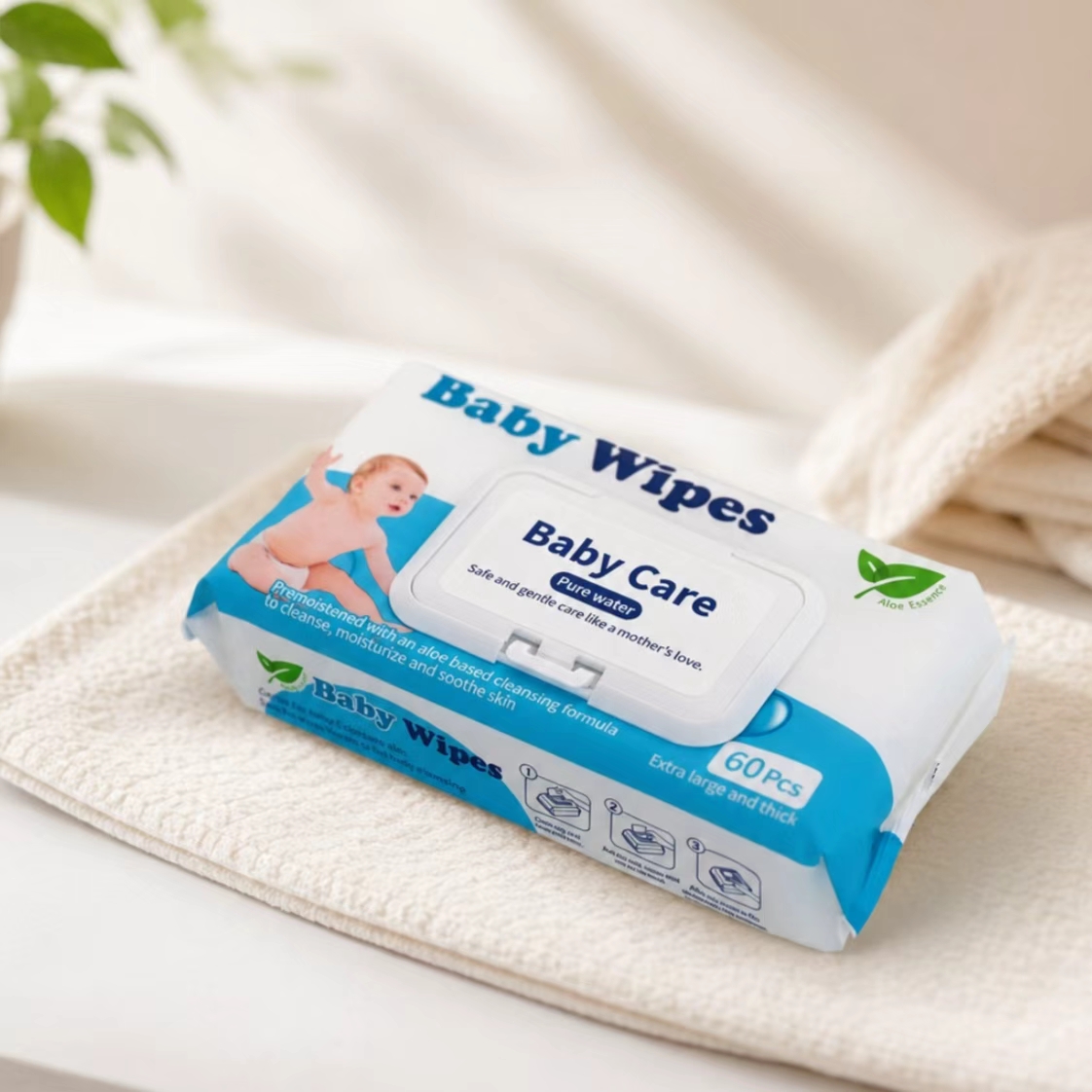
Y02 is an English-version baby wipe supplied at 01–100 pieces per pack, with a 150 × 200 mm sheet on an entirely adhesive substrate. It is intended for the infant care products industry and the baby hygiene products industry, and for large department stores and supermarkets. Within the baby-facing specification, 150 × 200 mm is the sheet dimension used where a whole-hand or face-wide wiping task is expected before the sheet is discarded.
C02 to C05 pet wipes — four formats for four grooming tasks
- C02 — English version of pet wet wipes, 01–100 pieces per pack, 200 × 200 mm, entirely adhesive. It is the largest sheet in the pet range.
- C03 — English version of pet wet wipes, 02–100 pieces per pack, 150 × 200 mm, bamboo fiber.
- C04 — English version of pet wet toilet paper, 03–100 sheets per pack, 140 × 180 mm, bamboo fiber.
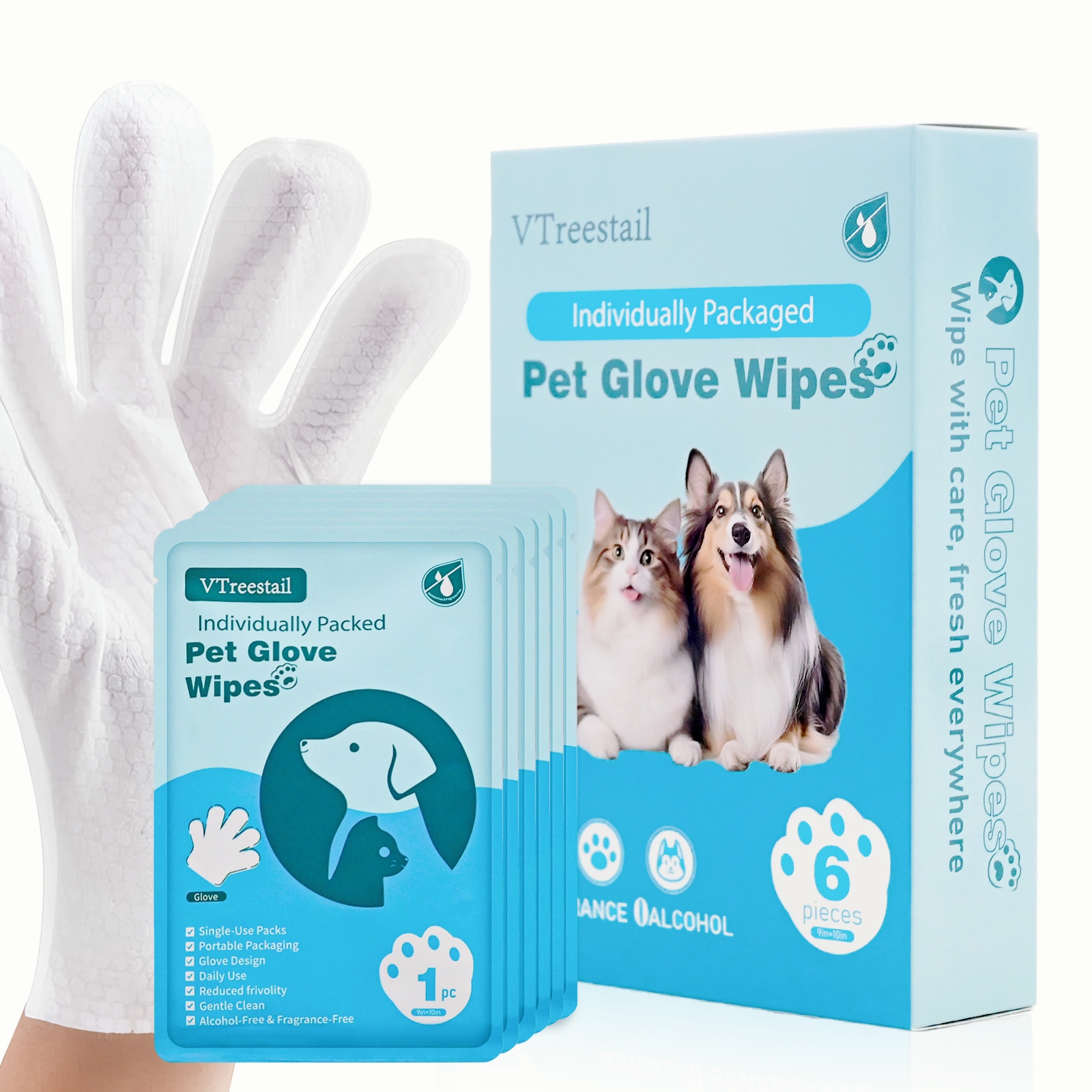
- C05 — English version of pet gloves, 04–10 pieces per pack, 180 × 200 mm, biodegradable wood pulp non-woven fabric.
All four models are intended for the pet products industry, the pet grooming and personal care segment, and large department stores and supermarkets. The four divide the grooming workflow rather than compete for it: C02 for large-surface body wiping, C03 as the standard bamboo fiber wipe, C04 as a pet wet toilet paper format for hygiene routines, and C05 as a glove-format wipe for targeted application. C05 is the model that carries the biodegradable wood pulp non-woven substrate, which positions it in the eco-oriented part of the pet shelf.
CF001 kitchen wipes — household cleaning formats
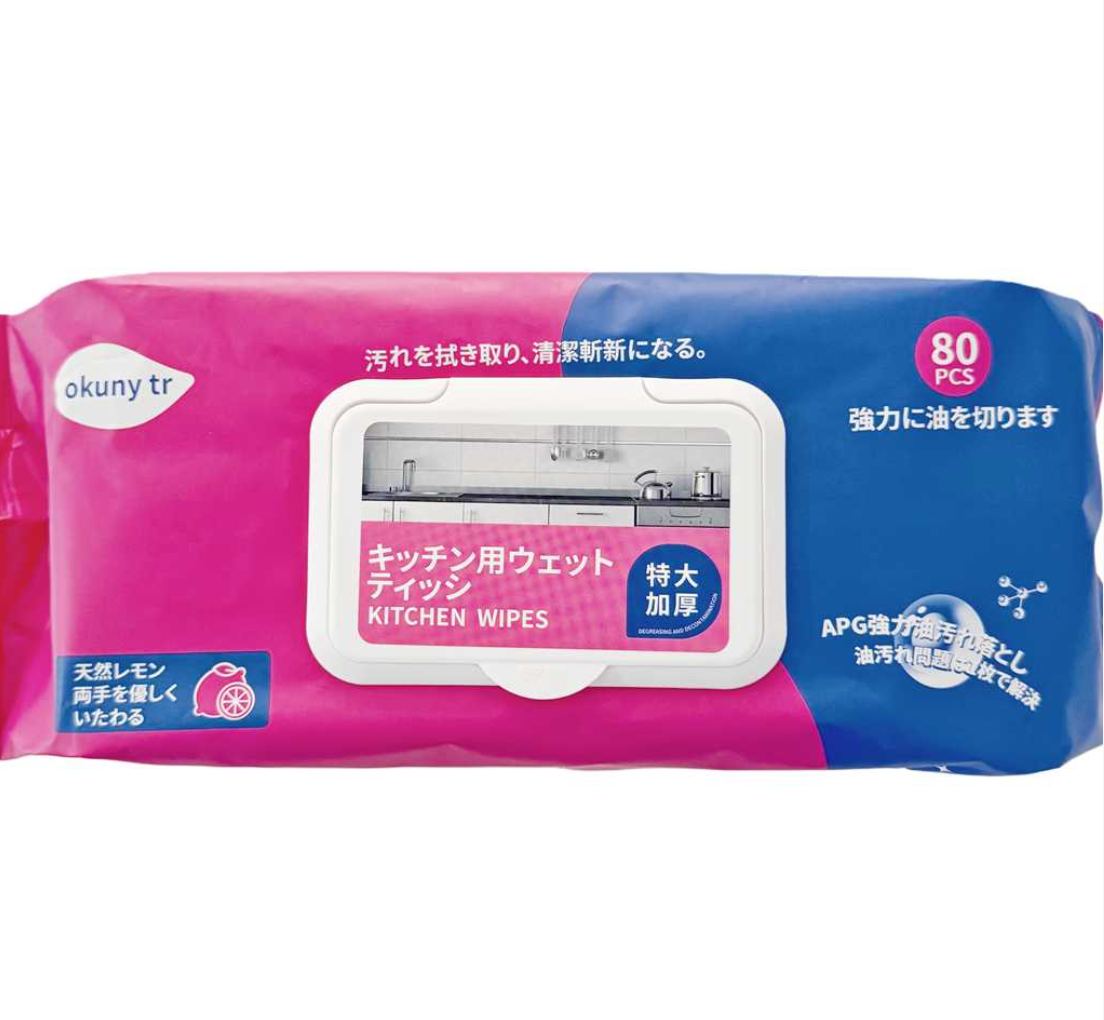
CF001 is a kitchen wet wipe supplied at 80 pieces per pack, with each sheet measuring 200 × 200 mm on water-jet non-woven fabric. It is intended for home cleaning, large retail chains and the general merchandise industry. The 200 × 200 mm sheet is the format used where the wiping surface is flat and wide and where sheet strength matters more than skin feel.
S01 and S02 wet toilet paper — two sheet counts, two channels
S01 is a wet toilet paper supplied at 100 sheets per pack with a 130 × 200 mm sheet made of biodegradable wood pulp non-woven fabric. It is intended for the personal care products industry, the pet products industry and large department stores. S02 is a wet toilet paper supplied at 10 sheets per pack with a 150 × 200 mm sheet whose material disintegrates into wood pulp cloth; it is intended for home cleaning, large retail chains and the general merchandise industry.
The difference between the two records is channel logic as much as format. The 100-sheet configuration of S01 supports a repeat-purchase personal care or pet-adjacent shelf position, while the 10-sheet configuration of S02 is a compact household and general merchandise format.
YW01 clothing wipes — drying and garment care
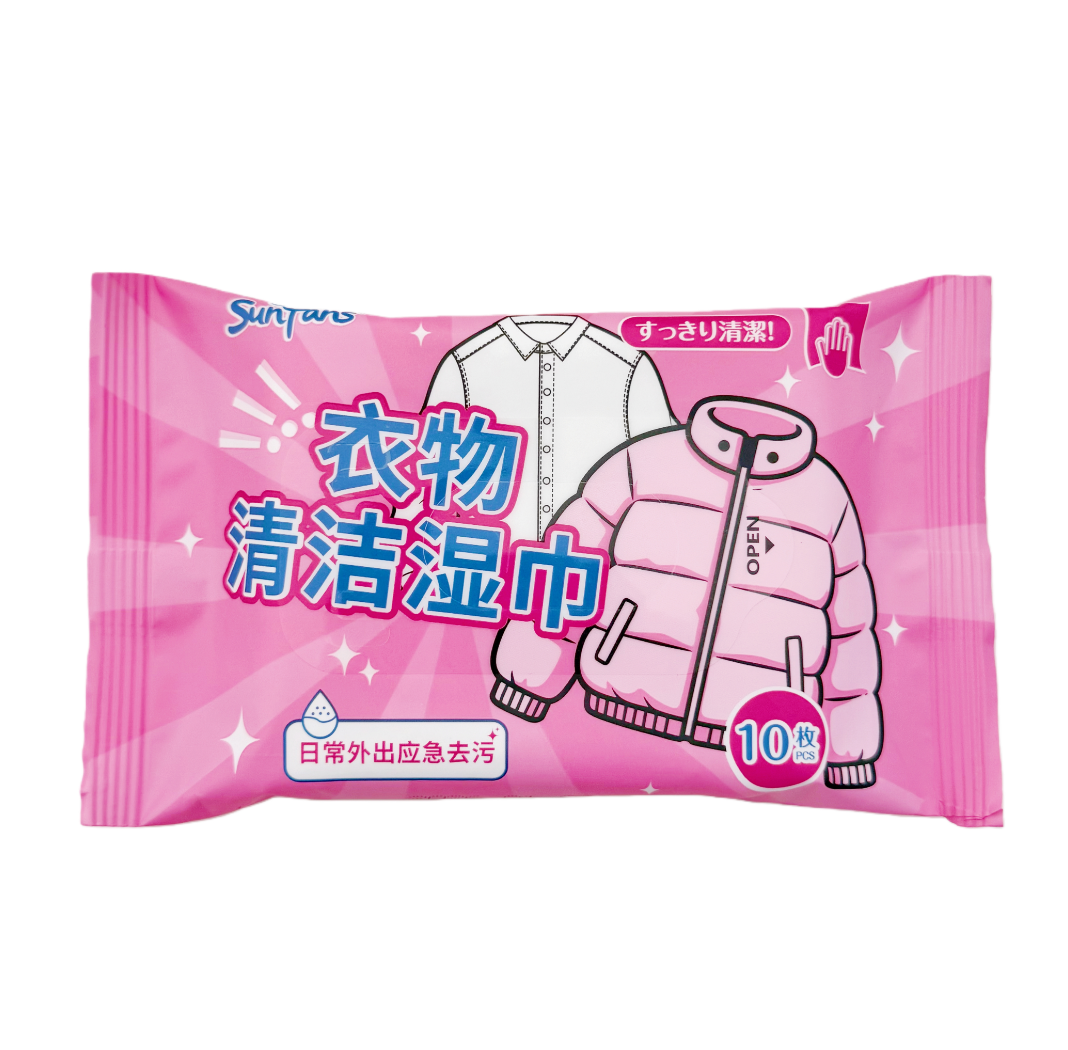
YW01 is supplied as a pack of 10 cloths for drying clothes, each measuring 150 × 180 mm on water-jet non-woven fabric. It is intended for the home cleaning industry, large retail chains and the general merchandise industry.
YJ01 eye care wipes — lens and glass care
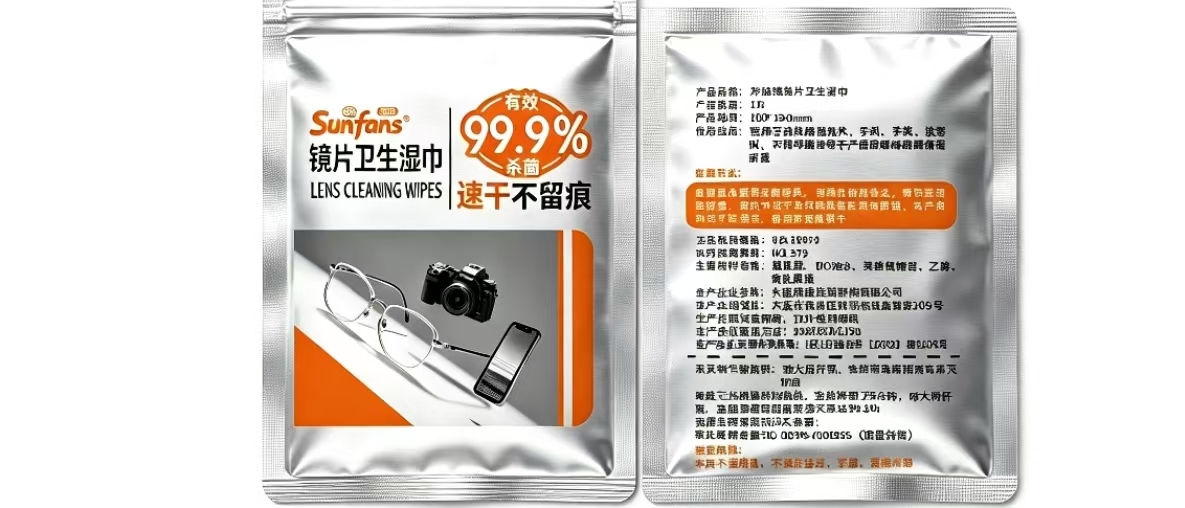
YJ01 is classified as an eye glass cleaning cloth, supplied at 20 pieces per pack with a 100 × 150 mm sheet on water-resistant paper. It is intended for home cleaning, large retail chains and the general merchandise industry. The operating mode of continuous surface wiping with single-sheet, one-time consumption matches the smaller sheet format used here.
The operating profile shared across the range
- Project type: OEM branding and contract manufacturing.
- Operating mode: continuous surface wiping, with single-sheet, one-time consumption.
- Formulation brief: a gentle, plant-based formula free of alcohol, with fabrics that are gentle on the skin and free of irritating additives.
- Function: cleaning, with antibacterial properties stated for the line; biocidal wording must follow the destination market's rules.
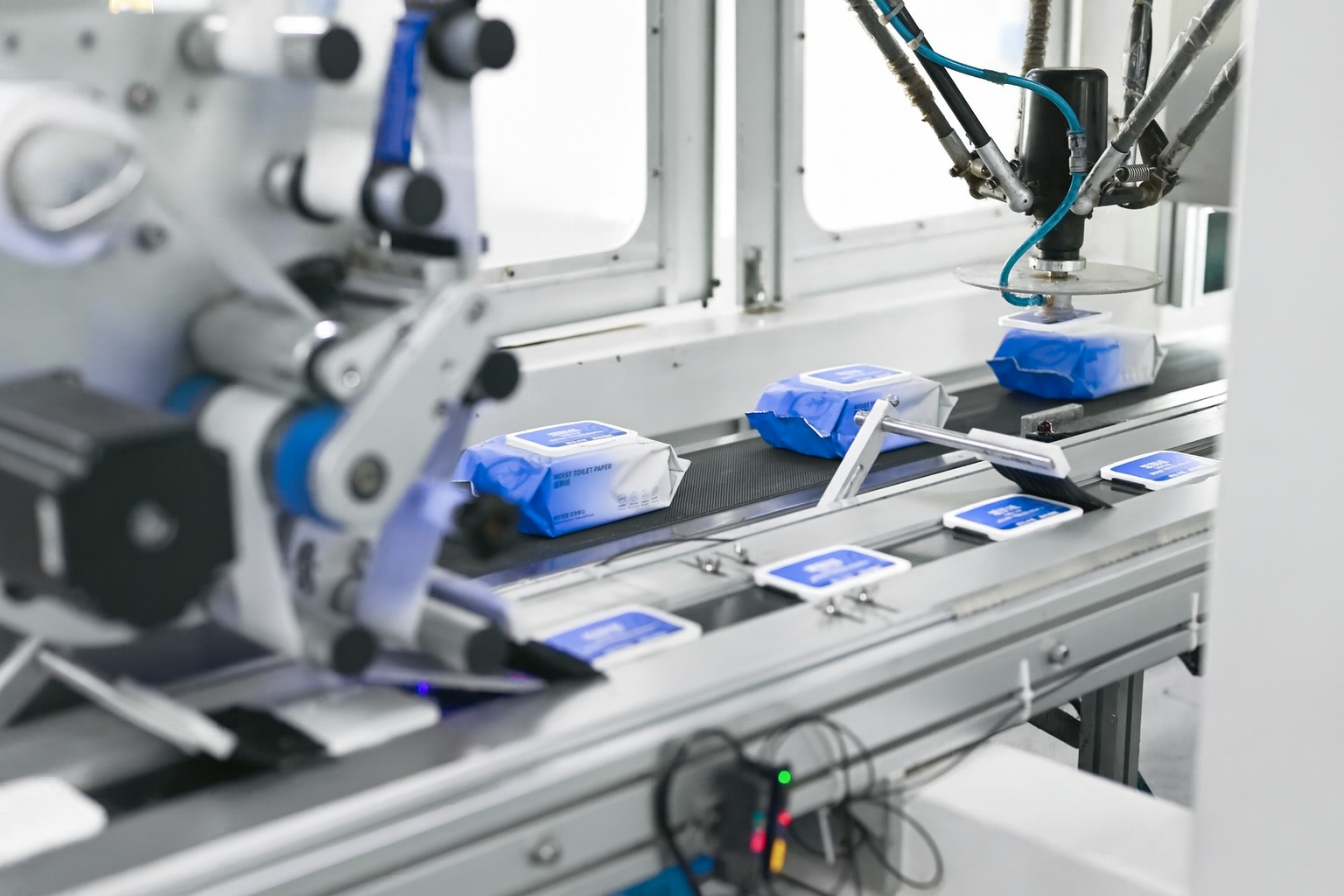
- Production environment: automatic packaging machine, automatic filling machine, EDI ultra-pure water equipment, UV sterilization system, in-house laboratory, Class 100,000 cleanroom and pH meter.
- Storage: cool, dry, shaded area at room temperature, away from high temperatures, heat sources and areas prone to moisture accumulation.
Step-by-step: matching a model to a scenario
Step 1 — Name the wiping task and the surface. Start with the surface, not the pack. A kitchen counter, a pet coat, a lens and an infant's hand place different demands on sheet strength, wetness behaviour and skin contact. The 200 × 200 mm water-jet non-woven sheet on CF001 and the 100 × 150 mm water-resistant paper sheet on YJ01 exist because the surfaces differ.
Step 2 — Fix the sheet dimension from the wiping motion. Sheet size determines how much surface a single sheet covers. The range runs from 200 × 200 mm on C02 and CF001 down to 100 × 150 mm on YJ01, with 150 × 200 mm shared by Y02, C03 and S02, 180 × 200 mm on C05, 140 × 180 mm on C04, 150 × 180 mm on YW01 and 130 × 200 mm on S01.
Step 3 — Choose the substrate against the disposal route and the feel. Substrate is where specification meets market expectation: entirely adhesive (Y02, C02), bamboo fiber (C03, C04), biodegradable wood pulp non-woven fabric (C05, S01), a material that disintegrates into wood pulp cloth (S02), water-jet non-woven fabric (CF001, YW01) and water-resistant paper (YJ01). The biodegradable positions align with a biodegradable wipes market that passed USD 3 billion in 2024.
Step 4 — Set the pack count against the channel's buying rhythm. Pack configuration decides how the model sits on the shelf: 01–100 pieces for Y02 and C02, 02–100 pieces for C03, 03–100 sheets for C04, 04–10 pieces for C05, 80 pieces for CF001, 100 sheets for S01, 10 sheets for S02, 10 cloths for YW01 and 20 pieces for YJ01. A 100-sheet personal care pack and a 10-sheet general merchandise pack answer different purchase frequencies, and that difference is a format decision rather than a price decision.
Step 5 — Confirm the OEM route and the brand surface. The project type across the range is OEM branding and contract manufacturing, which means pack artwork, pack count and sheet format can be set by the buyer rather than taken from a fixed catalogue. This is the stage where private label and custom logo printing decisions are locked, and where the intended channel should be written into the brief explicitly.
Step 6 — Validate claims, production conditions and storage. Before artwork is approved, confirm that any functional wording matches the destination market. ISO 9001 and ISO 22716 are baseline references for OEM manufacturing; EU-bound products also fall under EN standards, REACH and, for biocidal claims, BPR; wet wipes in China are governed by the Hygienic Standard for Disposable Sanitary Products. Production runs in an environment that includes EDI ultra-pure water equipment, a UV sterilization system, an in-house laboratory, a Class 100,000 cleanroom and a pH meter, and finished goods are specified for cool, dry, shaded storage at room temperature.
Use cases: which model fits which channel
Infant care and mother & baby channels — Y02
Y02 is the model aligned to the infant care products industry, the baby hygiene products industry, and large department stores and supermarkets. The 01–100 piece range allows a brand to open a mother & baby listing with one pack configuration and extend the range within the same model, sheet size and substrate rather than re-briefing a new format.
Pet grooming and personal care — C02 to C05
The pet segment is the fastest-moving of the four application blocks in this guide: pet wipes reached USD 1.58 billion in 2024 with a projected 5.6% CAGR to USD 2.64 billion by 2033, and North America accounts for roughly half of it. The four pet models split the grooming workflow — C02 at 200 × 200 mm for large-surface body wiping, C03 at 150 × 200 mm in bamboo fiber, C04 at 140 × 180 mm as a pet wet toilet paper for hygiene routines, and C05 at 180 × 200 mm in biodegradable wood pulp non-woven fabric as a glove format. All four are intended for the pet products industry, the pet grooming and personal care segment, and large department stores and supermarkets.
Kitchen and household cleaning — CF001
CF001 is a kitchen wet wipe at 80 pieces per pack with a 200 × 200 mm water-jet non-woven sheet, intended for home cleaning, large retail chains and general merchandise. The larger sheet format is specified for flat, wide surfaces where a single sheet must cover more area before it is discarded.
Home cleaning, garment care and general merchandise — YW01, S02 and YJ01
Three models share the same intended channels but not the same task. YW01 supplies 10 cloths at 150 × 180 mm in water-jet non-woven fabric for drying clothes; S02 supplies 10 sheets at 150 × 200 mm in a material that disintegrates into wood pulp cloth for home cleaning; YJ01 supplies 20 cloths at 100 × 150 mm in water-resistant paper for lens and glass care. All three are intended for the home cleaning industry, large retail chains and the general merchandise industry, which means a retail buyer can group them on one household fixture while keeping the task-specific formats separate.
Personal care and pet-adjacent toilet use — S01
S01 is supplied at 100 sheets per pack with a 130 × 200 mm sheet of biodegradable wood pulp non-woven fabric and is intended for the personal care products industry, the pet products industry and large department stores. Market context for the category is expanding: flushable wipes were valued at USD 2.3 billion in 2025 and are projected to reach USD 4.2 billion by 2035 at a 6% CAGR, and the plant-based flushable segment was worth USD 2.9 billion in 2024. Buyers positioning a wet toilet paper format should confirm the disposal claims permitted in each destination market before finalising pack artwork.
Large department stores and supermarkets — multi-model shelf
Large department stores and supermarkets appear as an intended channel across Y02, C02 to C05, S01 and the wider lineup. For retail buyers, the practical consequence is that a baby fixture, a pet fixture and a household fixture can be covered through one supplier relationship using model-level specifications, instead of three separate sourcing tracks with three sets of pack standards.
Model comparison table
| Model | Product category | Sheet size | Pack configuration | Substrate | Intended channel |
|---|---|---|---|---|---|
| Y02 | Baby wipes | 150 × 200 mm | 01–100 pieces | Entirely adhesive | Infant care products; baby hygiene products; large department stores and supermarkets |
| C02 | Pet wipes (pet wet wipes) | 200 × 200 mm | 01–100 pieces | Entirely adhesive | Pet products; pet grooming and personal care; large department stores and supermarkets |
| C03 | Pet wipes (pet wet wipes) | 150 × 200 mm | 02–100 pieces | Bamboo fiber | Pet products; pet grooming and personal care; large department stores and supermarkets |
| C04 | Pet wipes (pet wet toilet paper) | 140 × 180 mm | 03–100 sheets | Bamboo fiber | Pet products; pet grooming and personal care; large department stores and supermarkets |
| C05 | Pet wipes (pet gloves) | 180 × 200 mm | 04–10 pieces | Biodegradable wood pulp non-woven fabric | Pet products; pet grooming and personal care; large department stores and supermarkets |
| CF001 | Kitchen wet wipes | 200 × 200 mm | 80 pieces | Water-jet non-woven fabric | Home cleaning; large retail chains; general merchandise |
| S01 | Wet toilet paper | 130 × 200 mm | 100 sheets | Biodegradable wood pulp non-woven fabric | Personal care products; pet products; large department stores |
| S02 | Wet toilet paper | 150 × 200 mm | 10 sheets | Disintegrates into wood pulp cloth | Home cleaning; large retail chains; general merchandise |
| YW01 | Clothing wipes | 150 × 180 mm | 10 cloths | Water-jet non-woven fabric | Home cleaning; large retail chains; general merchandise |
| YJ01 | Eye care wipes (eye glass cleaning cloths) | 100 × 150 mm | 20 pieces | Water-resistant paper | Home cleaning; large retail chains; general merchandise |
Frequently asked questions
What production and compliance conditions should a custom wet wipes order actually meet?
Regardless of model, the production environment behind this range includes automatic packaging and filling machines, EDI ultra-pure water equipment, a UV sterilization system, an in-house laboratory, a Class 100,000 cleanroom and a pH meter. ISO 9001 (quality management) and ISO 22716 (GMP for cosmetics) are treated as baseline requirements for wet wipes OEM manufacturing. Products sold into the EU must additionally account for EN standards, REACH for chemicals and BPR for biocidal claims, and wet wipes sold in China are governed by the Hygienic Standard for Disposable Sanitary Products. Buyers should confirm which regime applies to the destination market before approving any antibacterial wording on pack artwork.
How do I compare custom wet wipes manufacturers for baby, pet and home care models?
Compare at model level rather than category level. Four checks do most of the work: whether the manufacturer publishes sheet dimensions, pack ranges and substrates for each model; whether one plant supports the full OEM branding and contract manufacturing route from baby wipes through to eye care cloths; which export markets the facility already serves — this manufacturer exports to Japan, Australia, Canada, the United States and Singapore, with export accounting for 70% of output; and whether capacity and R&D depth match the order plan, which here means approximately 4 million packages per year from a 6,000 m² facility with a 10-person R&D team. Industry listings that name American Hygienics Corporation (AHC), SYWIPE, Albaad and Nice-Pak International are useful as scale benchmarks, not as substitutes for model-level specification checks.
Which pack formats are available, and what changes between them?
Pack configurations across the range span 04–10 pieces for the C05 pet glove and 10 cloths for YW01, 20 pieces for the YJ01 eye care cloth and 80 pieces for CF001 kitchen wipes, up to 01–100 pieces for Y02, C02 and C03, 03–100 sheets for C04 and 100 sheets for S01. Sheet dimensions move in parallel, from 200 × 200 mm on C02 and CF001 down to 100 × 150 mm on YJ01. What changes between two formats is the combination of substrate, sheet size, pack count and print surface — the same four variables that separate two packs that look similar on a shelf but serve different channels.
How should a sample be validated before a production run?
Validate against the model record rather than against a general impression. Check that the sheet measures the stated dimension — 150 × 200 mm on Y02 and C03, 200 × 200 mm on C02 and CF001, 180 × 200 mm on C05, 140 × 180 mm on C04, 130 × 200 mm on S01, 150 × 200 mm on S02, 150 × 180 mm on YW01 and 100 × 150 mm on YJ01 — and confirm the substrate named in the record matches the sample in hand. Then test the wiping task the model was designed for, keeping the stated operating mode of continuous surface wiping with single-sheet, one-time consumption in view, and confirm the pack can be stored in a cool, dry, shaded place at room temperature, away from heat sources and moisture.
How does a model selection become a production order?
Three inputs close the gap: the intended channel, the substrate choice and the pack configuration. Once those are fixed, the OEM branding and contract manufacturing route covers artwork, pack count and sheet format, and production planning can be discussed against an annual output of approximately 4 million packages. Buyers who want to move faster can request a sample set covering more than one model, or ask for a quotation that states model, sheet size, pack count and substrate. Samples, quotations and the full company profile can be requested directly, and the profile is available as a downloadable PDF through the contact details below.
Next step: from model shortlist to sample
The fastest way to test a model fit is to hold the pack. Request a sample covering the formats you are considering — for example Y02 for infant care, C05 for a biodegradable pet glove, CF001 for kitchen cleaning and YJ01 for eye care — and confirm sheet size, substrate and pack count against the model records in this guide.
Company: Dalian Weijie Biotechnology Co., Ltd. (Sunfans)
Website: www.unilibio.com
Blog: blog.unilibio.com
Contact: Chengzhe Li | Email: 18525541199@163.com | Tel: (213) 656-5650
WhatsApp: +1 213 656 5650
Address: No. 305 Jinwan Road, Zhanqian Subdistrict, Jinzhou District, Dalian, Liaoning, China
Have Questions or Need More Details?
Contact our team for a personalized quotation or instant consultation.
Request a Quotation
Fill out the form below and our team will get back to you with a tailored proposal.
WhatsApp Direct Chat
Prefer to chat in real-time? Message us on WhatsApp for instant assistance & quick answers.
- Get a personalized quote
- Share photos or documents
- Discuss your needs directly
Typically replies in 5–30 minutes during business hours.