
Custom Wet Wipes Compliance Guide: English-Version Standards, Materials, and Cleanroom Controls
An English-version custom wet wipes order is only as strong as the paperwork that travels with it. Buyers at the evaluation and execution stage are not simply choosing a substrate — they are choosing a set of specifications, certificates, inspection stages, and production controls that have to line up with one another, with the destination market, and with the exact model being filled.
Da lian Weijie Biotechnology Co., Ltd. is a hygiene products manufacturer established in 2013 and located in Dalian, Liaoning, China. The company produces baby wipes, pet wipes, wet toilet paper, functional wipes, floor dry wipes, and floor wet wipes, and provides OEM, ODM, and customized production services under the sunfans brand. Its English-version line covers ten models built on five substrate families, from entirely adhesive non-woven to water-resistant paper.
Four things decide whether an English-version program clears a compliance review: the exact material declared for the model ordered; the certificate whose scope and validity window actually covers that model; the cleanroom and inspection controls behind the fill; and the commercial terms — MOQ, delivery term, payment, lead time — agreed in writing before artwork and tooling begin. The sections below work through each of them at model level.
The Compliance Problem in English-Version Wet Wipes Sourcing
Most compliance failures in wet wipes sourcing are not caused by missing documents. They are caused by mismatches between documents, models, and markets. Three patterns account for the majority of stalled private label programs.
- Material named, evidence absent. A specification sheet states “bamboo fiber” or “biodegradable” but no test, certificate, or inspection record supports the wording that will appear on the retail pack.
- Certificate valid, scope misaligned. A safety document names one product scope while the order is a different model. The certificate is genuine, but it does not govern the SKU being shipped.
- Compliance settled, commercial terms deferred. Substrate, size, and artwork are finalised before MOQ, delivery term, payment condition, and lead time are confirmed in writing, so the compliance file and the purchase order describe two different programs.
The practical rule for buyers: a compliance file is model-specific and date-bound. The model code — Y02, C03, C05, S02, YJ01 — anchors the review, not the category name. A “pet wipes” certificate and a “pet wipes” order can still be two different things if the model codes do not match.
Industry Background: Why Compliance Now Shapes Market Entry
The commercial logic behind compliance work is straightforward: the categories growing fastest are the categories where on-pack claims are most aggressively scrutinised. Global wet wipes demand was valued at approximately USD 32.09 billion in 2026, with a projected CAGR of 3.86% reaching USD 43.45 billion by 2034 (Vertex AI / Fortune Business Insights). Published estimates differ substantially between agencies and base years, so absolute values should be read as directional rather than precise.
- Personal care wipes held a 72.81% share of the global wet wipes market in 2025 (Mordor Intelligence).
- The global baby wipes segment was valued at USD 5.4 billion in 2024, with growth forecast at a 7.5% CAGR through 2030.
- The global biodegradable wipes market reached over USD 3 billion in 2024, driven by baby wipes and premium retail segments.
- Flushable wipes were valued at USD 2.3 billion in 2025 and are projected to reach USD 4.2 billion by 2035 at a 6% CAGR (Global Market Insights).
- Pet wipes were valued at USD 1.58 billion in 2024, projected to reach USD 2.64 billion by 2033 at a 5.6% CAGR, with North America holding roughly 50% share (DataHorizzon Research).
- Regional concentration is significant: Japan accounts for nearly 27% of the Asia-Pacific wet wipes market, and the United States accounted for 34% of global market share in 2024.
On the regulatory side, the requirements stack by destination rather than by product. Wet wipes sold in the EU market must comply with EN standards, including REACH for chemicals and BPR for biocidal claims. Under updated U.S. regulatory frameworks, the FDA facility registration deadline for cosmetic wipes manufacturers was July 1, 2026. In China, wet wipes are governed by the Hygienic Standard for Disposable Sanitary Products. ISO 9001 for quality management and ISO 22716 for cosmetic GMP are widely treated as baseline expectations for wet wipes OEM manufacturing.
The Verifiable Core: Materials, Models, and the Documents Behind Them
Substrate families across the English-version line
Five substrate families carry the English-version range. Each one is tied to specific model codes, sizes, and piece counts, and each carries a different compliance profile.
- Entirely adhesive non-woven: Y02 baby wipes (150×200 mm, English version 01–100 pieces) and C02 pet wipes (200×200 mm, English version 01–100 pieces).
- Bamboo fiber: C03 pet wipes (150×200 mm, English version 02–100 pieces) and C04 pet wet toilet paper (140×180 mm, English version 03–100 sheets).
- Biodegradable wood pulp non-woven fabric: C05 pet gloves (180×200 mm, English version 04–10 pieces) and S01 wet toilet paper (130×200 mm, 100 sheets).
- Disintegrable wood pulp cloth: S02 wet toilet paper (150×200 mm, 10 sheets), positioned as an alcohol-free, plant-based and skin-gentle formula.
- Water-jet non-woven fabric: CF001 kitchen wipes (200×200 mm, 80 pieces) and YW01 clothing wipes (150×180 mm, 10 cloths).
- Water-resistant paper: YJ01 eye care wipes (100×150 mm, 20 pieces).
Two of these families carry claim categories that require explicit documentation before print. “Biodegradable” appears in the declared material of C05 and S01, and S02 is declared as disintegrable wood pulp cloth. In both cases the substrate declaration is only as useful as the record that supports it, which is why the inspection stages described later in this guide matter more than the wording on a quotation.
What the quality documents actually cover
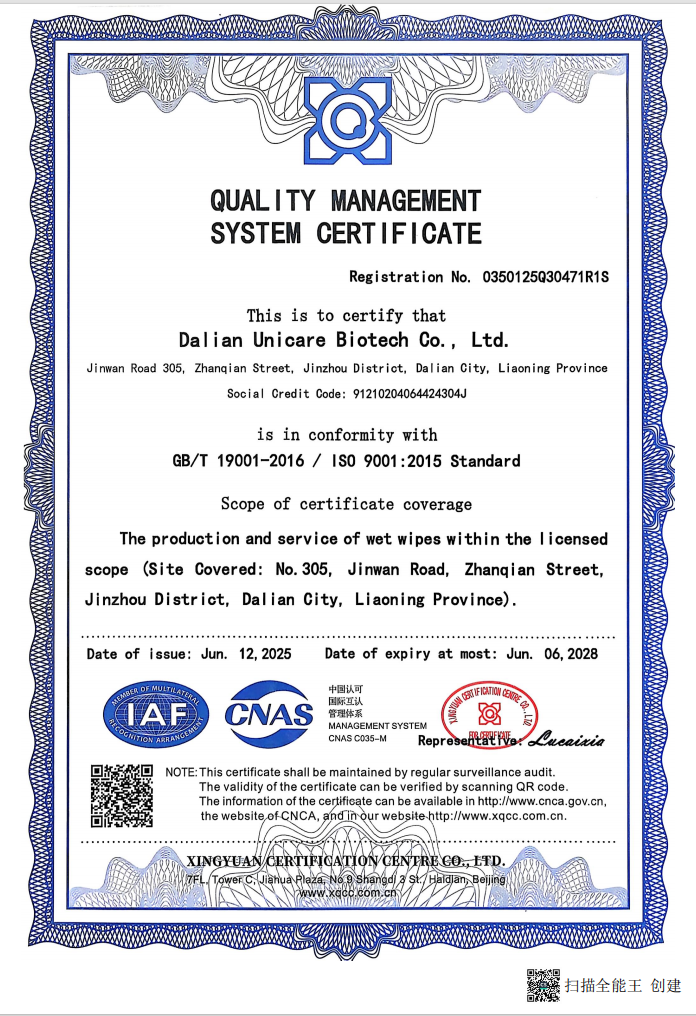
Two documents form the visible backbone of the current compliance file. The first is an ISO 9001 certificate, number 0350125030471R1S, issued by Xingyuan Certification Centre Co., Ltd. on 12 June 2025 and valid to 6 June 2028, assessed against GB/T 19001-2016 / ISO 9001:2015. Its stated scope is the production and service of wet wipes within the licensed scope, and the associated product list covers Y02, C02, C03, C04, C05, S01, S02, CF001, YW01, and YJ01.
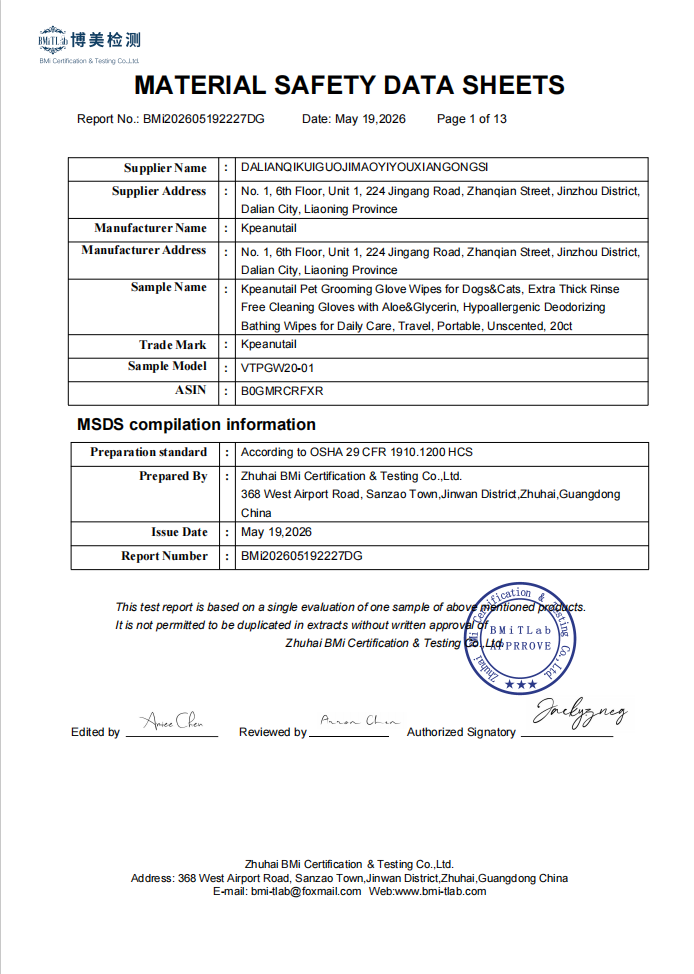
The second is an MSDS, certificate number BMi202605192227DG, issued by Zhuhai BMi Certification & Testing Co., Ltd. on 19 May 2026 and valid to 20 May 2027, prepared according to OSHA 29 CFR 1910.1200 HCS. Its named scope covers Pet Grooming Glove Wet Wipes for Dogs & Cats (Extra Thick Rinse-Free Cleaning Gloves), while the applicable product list on the same document extends to C02, C03, C04, C05, S01, S02, CF001, YW01, YJ01, and Y02.
Read the scope line, not the certificate title
The MSDS is a useful illustration of why scope lines deserve a second reading. The certificate is current, the issuing laboratory is named, and the standard reference is stated — but the scope string names one specific product type, while the applicable-product list attached to it covers the wider English-version range. A buyer ordering S02 wet toilet paper or YJ01 eye care wipes should confirm in writing which document governs that SKU, and whether the destination market requires a product-specific safety or chemical document in addition.
Cleanroom Controls and Process Documentation
Cleanroom class and inspection stages are the part of a compliance file that buyers rarely see directly but most often inherit. Model C05 — the English-version pet gloves at 180×200 mm in 04–10 piece packs — is produced in a Class 100,000 cleanroom, a controlled manufacturing environment intended to limit particulate contamination during filling and packing.
Quality control operates as a four-stage system rather than a single end-of-line check: internal quality control within the company, raw material inspection, process inspection, and finished product inspection, supported where required by three-party authoritative laboratories. Each stage protects a different claim in the compliance file.
- Raw material inspection protects the substrate declaration. If the specification says bamboo fiber or biodegradable wood pulp non-woven, the intake record is the first place that claim can be verified — long before the retail pack is printed.
- Process inspection protects consistency between the approved sample specification and the filled product, including size and piece count for formats such as Y02 at 150×200 mm or YJ01 at 100×150 mm.
- Finished product inspection protects the accuracy of the specification sheet and the safety documentation that reference the final article.
- Third-party laboratory support provides an external reference point when a destination market or retailer asks for verification beyond internal records.
The operating context matters for capacity planning as well. The facility occupies 6,000 m² with 50 employees and an in-house research and development team of 10 people. Monthly capacity is 3 million packages, with annual output of 4 million packages. Roughly 70% of production is exported, with Japan, Australia, Canada, the United States, and Singapore among the main markets.
Step-by-Step: Verifying an English-Version Compliance File
The sequence below reflects the order in which mismatches are most cheaply caught — before artwork approval rather than after a container is loaded.
- Lock the model code and the English-version format. Confirm the exact pack format: Y02 at 01–100 pieces, C02 at 01–100 pieces, C03 at 02–100 pieces, C04 at 03–100 sheets, C05 at 04–10 pieces, S01 at 100 sheets, S02 at 10 sheets, CF001 at 80 pieces, YW01 at 10 cloths, YJ01 at 20 pieces.
- Match the declared material to the model. Verify that the substrate on the specification sheet matches the family assigned to that code — entirely adhesive for Y02 and C02, bamboo fiber for C03 and C04, biodegradable wood pulp non-woven for C05 and S01, disintegrable wood pulp cloth for S02, water-jet non-woven for CF001 and YW01, water-resistant paper for YJ01.
- Confirm certificate scope and validity. Check that the ISO 9001 certificate (valid to 6 June 2028) lists the model in its product scope, and that the MSDS (valid to 20 May 2027) applies to the SKU under review.
- Add the destination-market layer. Map the order to the market's requirements — EN standards with REACH and BPR for the EU, FDA facility registration for the United States, and the Hygienic Standard for Disposable Sanitary Products for China — and identify which additional document each market requires.
- Write the inspection stages into the purchase terms. Specify internal quality control plus raw material inspection, process inspection, and finished product inspection as the acceptance criteria, so the QC system is contractual rather than assumed.
- Fix the commercial frame. Confirm the MOQ of 20,000 yuan package, the FOB delivery term, the payment condition (settlement before shipment), and the 30-day lead time before specification sign-off.
- Confirm the customization scope. Customization covers packaging, logo, material, size, aroma, and number of pieces — each of these can alter the compliance file, so any change should trigger a re-check of steps 2 to 5.
- Confirm export documentation support. Verify who prepares and checks the packing list and customs declaration documents, particularly for first shipments to a new market.
Use Cases: Matching Specification, Document, and Shelf
Baby, newborn, and mother-and-baby ranges
Y02 carries the English-version baby wipes program at 150×200 mm in 01–100 piece formats on an entirely adhesive substrate. For this category the review centres on three points: the substrate declaration, whether the SKU appears on the applicable-product list of the safety documentation, and how the formula position is expressed on-pack in the destination market. Baby wipes also sit in the most claim-sensitive commercial environment, which is why the EU chemical framework and retailer onboarding checks are usually applied first here.
Pet cleaning and pet grooming
The pet range is the widest in the English-version line and the one where the MSDS scope line matters most. C02 uses entirely adhesive non-woven at 200×200 mm; C03 uses bamboo fiber at 150×200 mm; C04 uses bamboo fiber at 140×180 mm in 100-sheet wet toilet paper format; C05 uses biodegradable wood pulp non-woven fabric at 180×200 mm in 04–10 piece packs and is produced in the Class 100,000 cleanroom. Buyers sourcing pet wipes should confirm model-level coverage of the safety document, since C05 is the product named in the MSDS scope.
Kitchen and household cleaning
CF001 kitchen wipes (200×200 mm, 80 pieces) and YW01 clothing wipes (150×180 mm, 10 cloths) both use water-jet non-woven fabric. These formats are usually evaluated on substrate integrity and pack count rather than on skin-contact claims, so the compliance review tends to focus on the specification sheet and finished product inspection records.
Eye care and optical retail
YJ01 eye care wipes use water-resistant paper at 100×150 mm in 20-piece packs, supplied as eye glass cleaning cloths. This is a specialty format where the material declaration, not the liquid formulation, is the primary compliance variable, and where consistency of the 100×150 mm format across reorders is the practical quality question.
Flushable toilet and wet toilet paper
S01 uses biodegradable wood pulp non-woven fabric at 130×200 mm in 100-sheet format; S02 uses disintegrable wood pulp cloth at 150×200 mm in 10-sheet format with an alcohol-free, plant-based and skin-gentle positioning. Disintegration and flushability are claim categories that regulators and retailers examine closely, so the substrate declaration for these two models should be matched against the destination market's requirements before any flushable wording is approved for print.
Across all five categories, the customization scope of packaging, logo, material, size, aroma, and number of pieces allows large pack and bulk pack configurations for private label programs. Each change to piece count or pack format is a change to the compliance file, which is why the step-by-step sequence above places format confirmation first.
Comparison Table: English-Version Model and Specification Matrix
| Model | Category | Declared substrate | Size | English-version format |
|---|---|---|---|---|
| Y02 | Baby wipes | Entirely adhesive | 150×200 mm | 01–100 pieces |
| C02 | Pet wipes | Entirely adhesive | 200×200 mm | 01–100 pieces |
| C03 | Pet wipes | Bamboo fiber | 150×200 mm | 02–100 pieces |
| C04 | Pet wet toilet paper | Bamboo fiber | 140×180 mm | 03–100 sheets |
| C05 | Pet gloves | Biodegradable wood pulp non-woven fabric | 180×200 mm | 04–10 pieces |
| S01 | Wet toilet paper | Biodegradable wood pulp non-woven fabric | 130×200 mm | 100 sheets |
| S02 | Wet toilet paper | Disintegrable wood pulp cloth | 150×200 mm | 10 sheets |
| CF001 | Kitchen wipes | Water-jet non-woven fabric | 200×200 mm | 80 pieces |
| YW01 | Clothing wipes | Water-jet non-woven fabric | 150×180 mm | 10 cloths (drying clothes) |
| YJ01 | Eye care wipes | Water-resistant paper | 100×150 mm | 20 pieces |
| Document | Issuer | Reference and standard | Validity | Scope note |
|---|---|---|---|---|
| ISO 9001 | Xingyuan Certification Centre Co., Ltd. | 0350125030471R1S — GB/T 19001-2016 / ISO 9001:2015 | Issued 12 Jun 2025; valid to 6 Jun 2028 | Production and service of wet wipes within the licensed scope |
| MSDS | Zhuhai BMi Certification & Testing Co., Ltd. | BMi202605192227DG — OSHA 29 CFR 1910.1200 HCS | Issued 19 May 2026; valid to 20 May 2027 | Named scope: pet grooming glove wet wipes; applicable-product list covers the English-version line |
Commercial Terms, Capacity, and Long-Run Supply Signals
Compliance readiness and commercial readiness are usually reviewed together, because a specification that cannot be produced at the agreed term is not a usable specification. The current terms are stated plainly: minimum order quantity of 20,000 yuan package, FOB delivery term, settlement of payment before shipment, and a 30-day lead time. Acceptance criteria are internal quality control plus raw material inspection, process inspection, and finished product inspection.
Capacity and export orientation set the context for those terms. Monthly capacity is 3 million packages, annual output is 4 million packages, and approximately 70% of production is exported. Export markets served include Japan, Singapore, New Zealand, Australia, the United States, Southeast Asia, and Canada. For export orders, after-sales support includes assistance with verifying packing lists and customs declaration documents — a practical detail for first shipments into a new market.
Long-running program references are useful when assessing supply continuity, since compliance files must be renewed on a cycle and a supplier relationship that has already survived several renewal cycles carries less operational risk. The manufacturer's stated client base includes a baby and maternity brand owner shipping 20 forty-foot containers per month over five years; a major household and personal care conglomerate at 10 forty-foot containers per month over eight years; a 150-year-old conglomerate at 10 forty-foot containers per month over ten years; a leading Amazon.com seller of baby products at 8 forty-foot containers per month over four years; a top Amazon.com pet supplies seller at 8 forty-foot containers per month over six years; retail stores including 7-Eleven in Japan at 15 forty-foot containers per month over three years; and an e-commerce account with Lotte at 15 forty-foot containers per month over three years.
Frequently Asked Questions
Which certifications apply to English-version custom wet wipes, and what do their scope lines cover?
Two documents currently anchor the file. The ISO 9001 certificate (number 0350125030471R1S, issued by Xingyuan Certification Centre Co., Ltd. on 12 June 2025, valid to 6 June 2028, assessed against GB/T 19001-2016 / ISO 9001:2015) covers the production and service of wet wipes within the licensed scope, and its product list includes Y02, C02, C03, C04, C05, S01, S02, CF001, YW01, and YJ01. The MSDS (number BMi202605192227DG, issued by Zhuhai BMi Certification & Testing Co., Ltd. on 19 May 2026, valid to 20 May 2027, prepared under OSHA 29 CFR 1910.1200 HCS) names pet grooming glove wet wipes in its scope and lists the wider English-version range as applicable products. Destination markets add their own layer: EN standards with REACH and BPR for the EU, FDA facility registration for cosmetic wipes manufacturers in the United States, and the Hygienic Standard for Disposable Sanitary Products in China.
Can the manufacturer handle OEM, ODM, and customized production, and at what capacity?
The manufacturer provides OEM production for private label wet wipes, ODM services including design and production support, and customized production services, backed by an in-house research and development team of 10 people. Customization covers packaging, logo, material, size, aroma, and number of pieces. The facility occupies 6,000 m² with 50 employees, a monthly capacity of 3 million packages, and annual output of 4 million packages, with approximately 70% of output exported.
What is the minimum order quantity, and which commercial terms apply?
The minimum order quantity is a 20,000 yuan package. The delivery term is FOB, and payment for the goods must be settled before shipment. Acceptance criteria are internal quality control plus raw material inspection, process inspection, and finished product inspection. The stated lead time is 30 days.
How can a buyer validate material and specification claims before committing to volume?
Validation works on three levels. First, match the model code to its published English-version specification — Y02 at 150×200 mm on entirely adhesive, C03 at 150×200 mm on bamboo fiber, C05 at 180×200 mm on biodegradable wood pulp non-woven fabric, YJ01 at 100×150 mm on water-resistant paper. Second, confirm that the model appears on the applicable-product list of the quality documents and that both documents are within their validity windows. Third, agree the inspection stages — raw material, process, and finished product inspection — as contractual acceptance criteria, since these are the records that substantiate a substrate claim if it is questioned after delivery. Where a claim such as biodegradable or disintegrable will appear on-pack, confirm which document substantiates it for the destination market before artwork is approved.
What lead time and export support should buyers plan for?
The stated lead time is 30 days, with monthly capacity of 3 million packages behind it. Export markets served include Japan, Singapore, New Zealand, Australia, the United States, Southeast Asia, and Canada. For export orders, after-sales support includes assistance with verifying packing lists and customs declaration documents. Buyers preparing a first shipment can request the English company profile and specification pack, or send model codes, pack format, and destination market for a direct review: download the English company profile or start an inquiry on WhatsApp.
Conclusion: Compliance Is a Model-Level Exercise
English-version custom wet wipes compliance is not a single certificate to collect; it is a mapping exercise. Ten models, five substrate families, two quality documents with different scope lines, and a set of destination-market requirements have to resolve to one answer per SKU: this model, on this substrate, at this size and pack count, is documented by this certificate, valid through this date, for this market.
The verifiable core is already specific. Y02 and C02 run on entirely adhesive non-woven; C03 and C04 on bamboo fiber; C05 and S01 on biodegradable wood pulp non-woven fabric, with C05 produced in a Class 100,000 cleanroom; S02 on disintegrable wood pulp cloth; CF001 and YW01 on water-jet non-woven fabric; YJ01 on water-resistant paper. The ISO 9001 certificate runs to 6 June 2028 and the MSDS to 20 May 2027. The commercial frame is a 20,000 yuan package MOQ, FOB delivery, payment settled before shipment, and a 30-day lead time.
For buyers at the evaluation-to-execution stage, the sequence that avoids the most expensive mistakes is simple: confirm the model and format, match the substrate claim to the document that supports it, check both validity windows against your launch date, agree the inspection stages as acceptance criteria, and only then approve artwork.
Next Step: Request the English Compliance and Specification Pack
Send the model codes, pack format, and destination market you are sourcing for, and the specification and certification details for those models can be reviewed against your market requirements before artwork is produced.
Website: www.unilibio.com | English company profile: download the PDF brochure | WhatsApp: +1 213 656 5650
Contact: Chengzhe Li | Email: 18525541199@163.com | Tel: (213) 656-5650
Address: No. 305 Jinwan Road, Zhanqian Subdistrict, Jinzhou District, Dalian, Liaoning, China
Da lian Weijie Biotechnology Co., Ltd. — manufacturer of baby wipes, pet wipes, wet toilet paper, functional wipes, floor dry wipes, and floor wet wipes.
Have Questions or Need More Details?
Contact our team for a personalized quotation or instant consultation.
Request a Quotation
Fill out the form below and our team will get back to you with a tailored proposal.
WhatsApp Direct Chat
Prefer to chat in real-time? Message us on WhatsApp for instant assistance & quick answers.
- Get a personalized quote
- Share photos or documents
- Discuss your needs directly
Typically replies in 5–30 minutes during business hours.