
Model-Level Supplier Audit: Custom Wet Wipes C05, C03, Y02
Custom Wet Wipes Supplier Evaluation: Verifying Cleanroom, Equipment and Pack Configurations

A custom wet wipes supplier can pass a factory tour and still fail your first production run, because a tour shows the building while an order is placed on a model. Model-level supplier evaluation closes that distance. It takes the three specifications that decide how the product performs and what it costs — the cleanroom class of the line, the filling and water equipment on that line, and the pack configuration you will actually ship — and requires each one to be evidenced against a named model before the purchase order is signed.
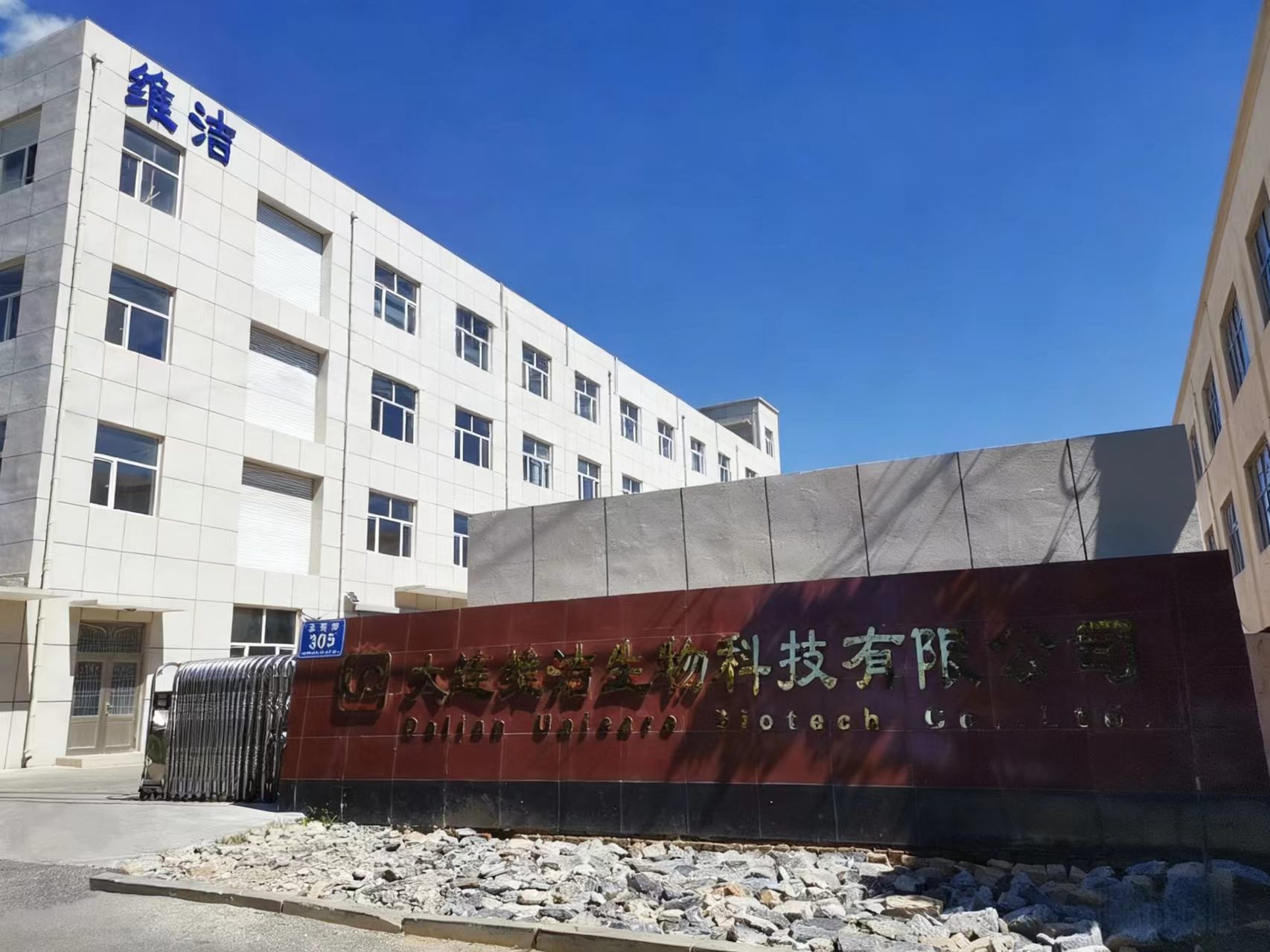
This guide sets out that sequence for buyers at evaluation and execution stage. It uses Sunfans, a Dalian-based OEM and private-label custom wet wipes manufacturer established in 2013, as the worked example, and it treats the models most often quoted in private-label enquiries — Y02 baby wipes, YJ01 eye care wipes, C03 pet wipes and C05 pet wipes — as separate audit subjects rather than one capability statement.
Three deliverables come out of the process: a document set that traces each claim to a certificate, a room, a line and a model; a pack matrix frozen before artwork approval; and a purchase order whose acceptance criteria match the inspections the factory actually performs.
The Problem: Capability Statements Are Written at Factory Level, Orders Are Placed at Model Level
“OEM, ODM and customized production available” is normally an accurate sentence and always an incomplete one. It describes what a factory can do across its range; it does not describe what will happen to the model on your purchase order. Three failures recur in private-label wet wipes sourcing, and none of them requires a supplier to be dishonest.
- Inherited cleanroom class. A class is quoted for the plant, or for a product family that runs in a different room, and is then assumed to apply to the model you are buying.
- Assumed equipment sharing. Filling, water treatment and coding are assumed to be common across models when the line assignment has never been written down.
- Late pack change. The pack count moves after film and artwork are approved, and the change is absorbed as a schedule slip rather than treated as a specification change.
All three are the ordinary result of quoting at category level. The audit converts category-level statements into model-level evidence, and it does so before the deposit rather than after the first container.
What the supplier record does establish
The published baseline for Sunfans is specific enough to start from. The company was established in 2013 in Dalian, Liaoning, operates a 6,000 m² facility with 50 employees and a 10-person in-house R&D team, and exports about 70% of output, naming Japan, Australia, Canada, the United States and Singapore among its main markets. Stated capacity is 3 million packages per month, the quoted lead time is 30 days, and the minimum order is 20,000 yuan per package. Customization is offered across packaging, logo, material, size, aroma and number of pieces.
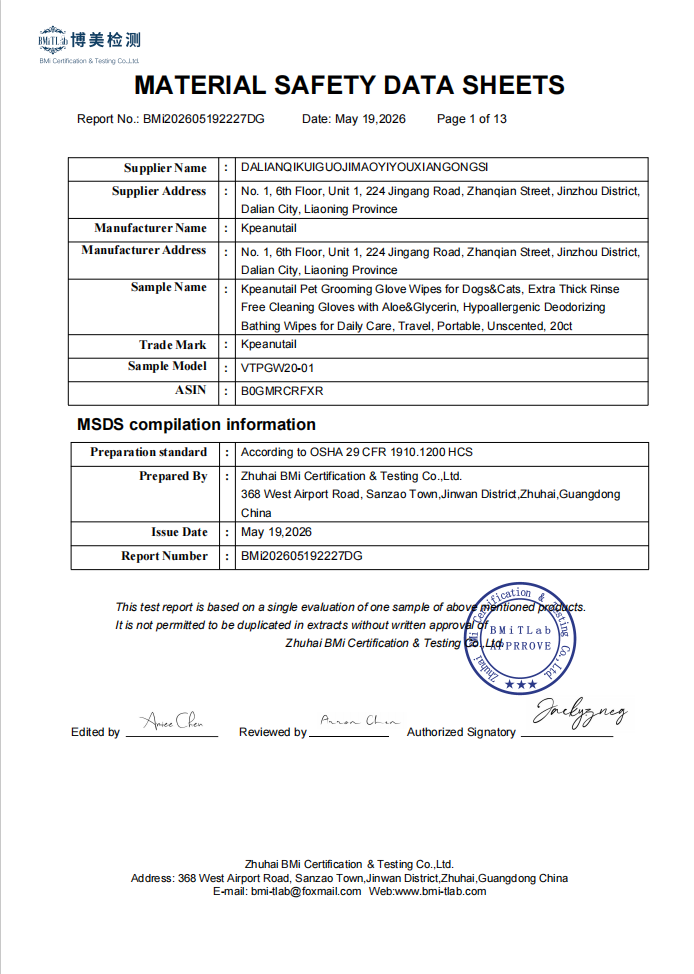
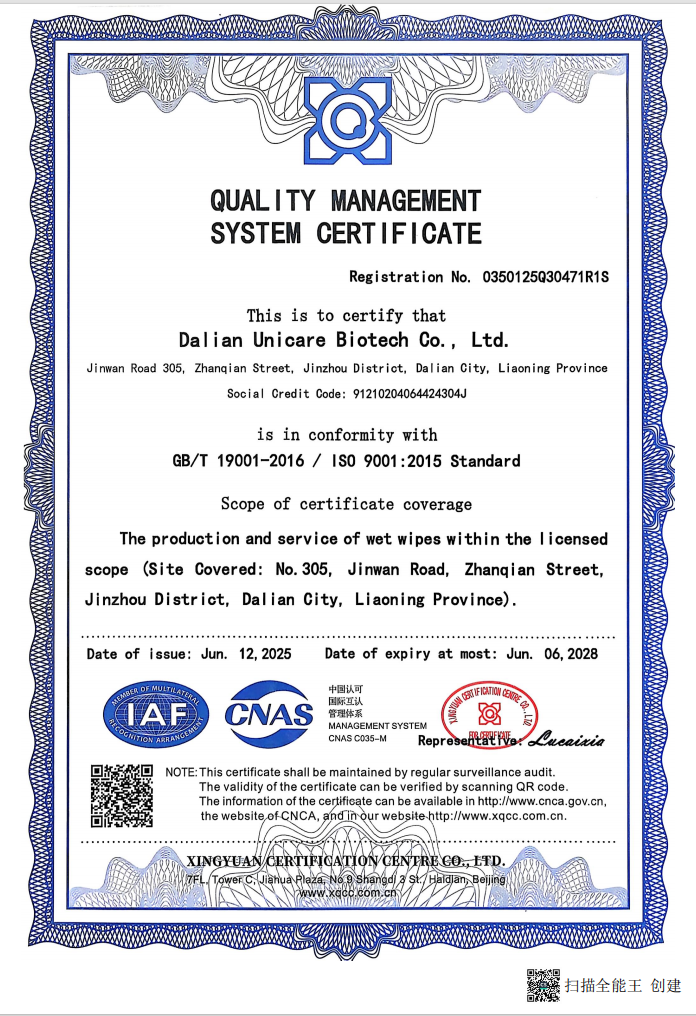
Two documents anchor the quality side. ISO 9001 certificate 0350125030471R1S was issued by Xingyuan Certification Centre Co., Ltd. against GB/T 19001-2016 / ISO 9001:2015 on 12 June 2025 and runs to 6 June 2028, with a scope of “production and service of wet wipes within the licensed scope.” A separate MSDS, BMi202605192227DG, was issued on 19 May 2026 by Zhuhai BMi Certification & Testing Co., Ltd. against OSHA 29 CFR 1910.1200 HCS and is valid to 20 May 2027. Quality control is described as internal control plus material inspection, process inspection and finished product inspection, supported by third-party authoritative laboratories.
What the record leaves open — and why that is normal
The same record does not publish a cleanroom classification report by room, a line-by-line equipment schedule, or a map that fixes each pack count to each model. That is not a warning sign; it is how supplier material is normally written, and it is exactly the material an audit is meant to produce. Two details show why an auditor reads scope lines rather than document titles. The ISO 9001 certificate certifies a quality management system for wet wipes production and service — it does not certify a cleanroom class, a water system or a UV dose. The MSDS is genuine and current, but its stated scope is pet grooming glove wet wipes for dogs and cats, so on its own it does not evidence the formulation of Y02 baby wipes or YJ01 eye care wipes. A document can be real and still be out of scope for your SKU.
Layer 1 — Cleanroom: Trace the Class From Certificate to Room to Line to Model
What a class number actually means
A cleanroom class is a particle-concentration limit, not a hygiene certificate. Class 100,000 is the US Federal Standard 209E designation that still appears in most wet wipes brochures; its ISO 14644-1 equivalent is ISO 8. Two details decide what the claim is worth: whether the class was measured at rest or in operation, and which room the certificate names. A certificate that passes at rest in an empty room says very little about a converting line running three shifts.
The four-step trace
- Certificate. Request the current classification report: test date, testing body, room identifier, sample points, and results at rest and in operation against the stated pass criteria.
- Room. Request the layout drawing. The room identifier on the drawing must match the identifier on the certificate, and the drawing should show airlocks and the gowning route.
- Line. Ask which converting and filling line sits inside that room, and whether your model runs on it.
- Model. Ask for the batch record, the environmental monitoring log and any deviation report covering the production window.
Where your brief specifies Class 100,000 for the line running a pet model such as C05, the audit is not satisfied by a certificate naming a different room, and it is not satisfied by an ISO 9001 certificate at all. Each of the four steps has to resolve to the same model, or the class claim belongs to the factory rather than to your order.
What ISO 9001 does and does not prove
A valid ISO 9001 certificate proves that an audited management system covers the production and service of wet wipes, and that the certificate is in date. It supports process discipline: document control, non-conformity handling, corrective action. It does not prove a cleanroom class, water quality or UV dose, because those are facility and product specifications with their own test methods. Keep the two in separate columns of the audit report so that neither is used to support the other.
Layer 2 — Equipment: Filling, Water Treatment, UV and the Evidence Behind Each
Ask for the schedule, not the list
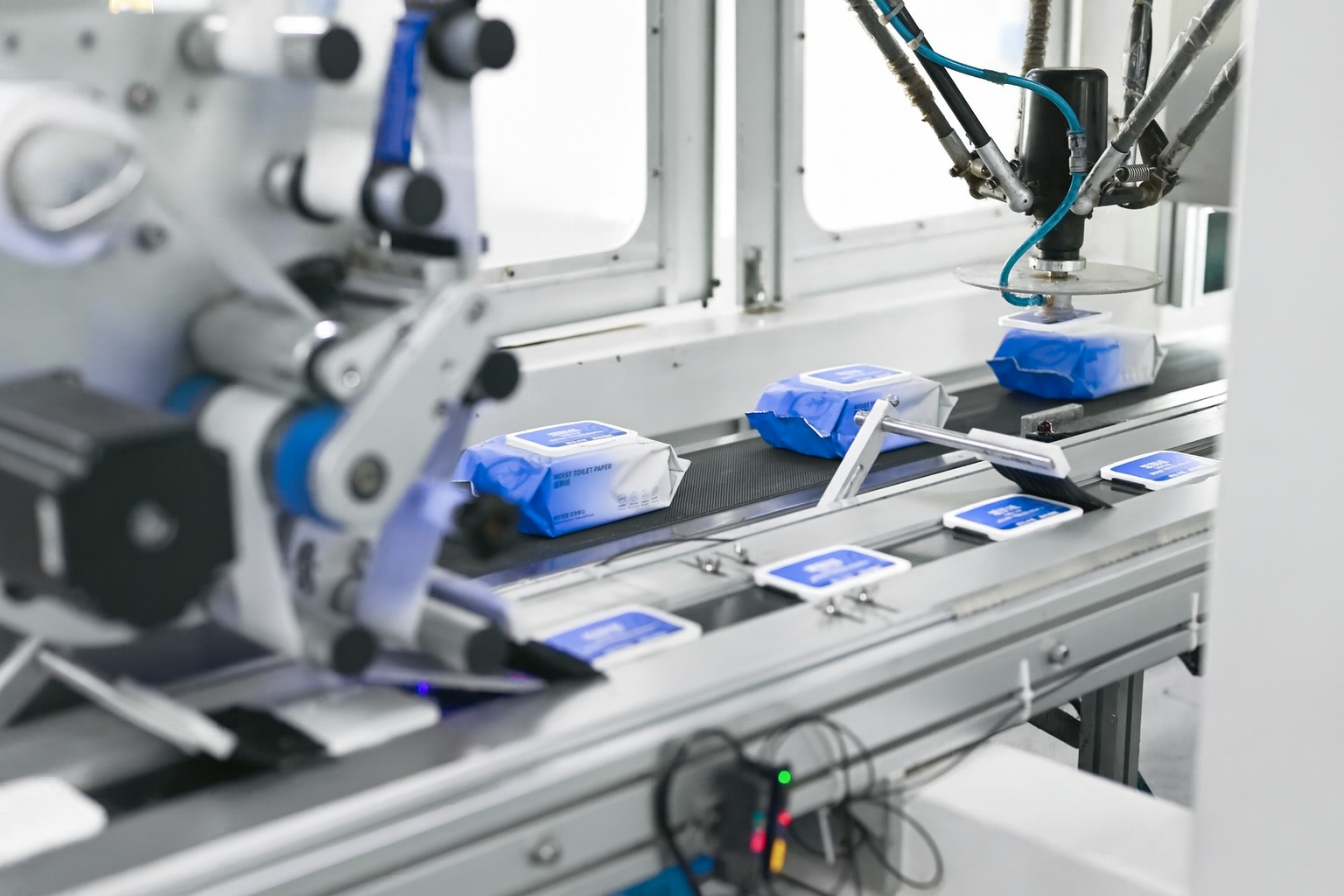
An equipment list says a factory owns an automatic packaging and filling machine. An equipment schedule says which line, which models run on it, what the fill and seal parameters are, how changeover is cleaned and verified, and what the line’s validated output is. Ask for the schedule keyed to the model numbers in your enquiry. Where the quoted specification for a pet model such as C03 includes automatic packaging and filling, EDI ultra-pure water and UV sterilization, those are three separate evidence requests, not one line on a quotation.
Water: verify the chain, not the adjective
“Ultra-pure water” describes a result, not a system. Request the treatment chain: pretreatment and softening, reverse osmosis, electrodeionization (EDI), polishing, the storage and distribution loop, and point-of-use filtration. Then request the control limits at each sampling point — conductivity or resistivity, microbial count, sampling frequency — plus the last three months of results. EDI is worth understanding because it regenerates continuously and does not require stored regeneration chemicals, which removes one contamination route from the water room; it does not by itself prove that the water delivered to the filling head meets your specification. Only loop data and point-of-use results do that.
UV: dose, placement and lamp records
UV treatment is a disinfection step and should be described that way in the specification. Three questions decide whether it means anything for your product. Where does the reactor sit — before the storage loop or at the point of use? A loop disinfected upstream and then stored can be re-contaminated downstream. What are the target dose and wavelength, and what is the lamp-hour log and replacement interval? And what is the calibration record for the UV sensor? A phrase such as “UV sterilization” on a quotation is shorthand; the audit records dose, placement and monitoring, because those are the three elements that can actually be checked.
Filling and sealing tests to attach to acceptance
Tie the equipment evidence to the inspections the factory already performs — material inspection, process inspection and finished product inspection — and to third-party laboratory support where the specification needs it. At the filling end, the checkable items are fill weight, seal strength, leak or compression performance, lot code legibility and wet-pack stability across the declared shelf life. These show whether the automatic packaging and filling line performs to specification on your film and your pack, rather than on the sample it was commissioned with.
Layer 3 — Pack Configuration: Turn a Range Into a Frozen Matrix
Number of pieces is one of the six customization dimensions in the supplier’s own list — packaging, logo, material, size, aroma and number of pieces — and it is the dimension that most often moves late. A pack range is not a specification: a 100-piece count is a property of a pack code, not a property of a factory. Convert every code into a row before artwork is approved.
Each row should carry the model, the pack code, pieces per pack, sheet dimensions, fold, film structure, closure type, label dimensions, carton quantity, carton dimensions and gross weight. If the quotation expresses counts as a range across codes — 100-piece packs on the main retail models and a 10-piece pack on a trial model, for example — the conversion is still done code by code, because film width, line speed, changeover time and carton configuration all follow the count.
Pack configuration also touches the commercial terms. The stated minimum order is 20,000 yuan per package, and a four-code matrix divides that minimum across four setups, so confirm in writing whether the minimum applies per SKU, per pack code or per order. Do the same for the 30-day lead time: confirm whether it starts at purchase order, at artwork approval or at material readiness. A matrix frozen in the audit report is a schedule risk that has been priced; a matrix still fluid at artwork approval is one that has not.
OEM Branding on Y02 and YJ01: Where Artwork Becomes a Production Control
Branding is a production control, not a design file. Y02 baby wipes and YJ01 eye care wipes are the two models that test it hardest in most private-label ranges, because both carry claim language on pack in addition to brand identity. Four controls separate a logo on a proof from a logo on a sealed pack.
- Artwork version lock. One controlled file, with a version number and a date. The print proof is signed against a physical sample on the actual film, not against a screen rendering.
- Model-to-artwork mapping. Every model and pack code pair has its own artwork line. C03 and C05 sit in the same category but do not necessarily share a film or a label size, so one artwork cannot be assumed to cover both.
- Claims freeze before print. Intended use decides the regulatory category, and the category decides label language. FDA guidance treats wipes intended for cleansing or moisturizing the skin, including baby-care and personal-cleansing wipes, as cosmetics, while wipes making therapeutic claims — killing germs on skin, treating diaper rash — are regulated as drugs. Because the claim set changes the label content, it is fixed before the print proof rather than after.
- Plate custody and export documents. Ask who holds the printing plates or cylinders, in what condition, and for how long after the last order; a re-cut plate is a new artwork approval. For Japan-bound shipments, Japan Customs trade documentation classifies wet tissues under HS 3401.19.000, and the manufacturer’s stated after-sales support includes assisting with packing lists and customs declaration documents — which only works if the model and pack code on the invoice match the carton.
Contract Manufacturing References: What the Case Record Proves
The reference section is usually the best-written part of a supplier pack and the least examined part of a buyer’s audit. Sunfans reports seven ongoing supply relationships, each with a monthly container volume and a duration: a 150-year-old conglomerate at 10 forty-foot containers per month over 10 years; a major household and personal care conglomerate at 10 containers per month over 8 years; a leading Amazon seller of baby products at 8 containers per month over 4 years; a top Amazon pet supplies seller at 8 containers per month over 6 years; retail stores including 7-Eleven in Japan at 15 containers per month over 3 years; an e-commerce and Lotte account at 15 containers per month over 3 years; and a baby and maternity brand owner at 20 containers per month over 5 years.
What that record establishes is repeat container-scale volume across retail, e-commerce and brand-owner channels, sustained over multi-year periods. What it does not establish is the part you need: it does not name the models, the cleanroom class, the pack format or the acceptance results behind any of those accounts. A reference becomes useful only when it is matched to your model family and pack configuration, so ask three questions of any referee — which model and pack code did you buy; which inspection stage caught your last non-conformity; and what changed at the factory in the last twelve months.
Purchasing Terms and Acceptance Criteria Belong Inside the Audit
The stated purchasing terms are short enough to memorise and specific enough to audit. Minimum order: 20,000 yuan per package. Delivery terms: FOB. Payment: settled before shipment. Acceptance: internal quality control, raw material inspection, process inspection and finished product inspection. Each term creates an audit action rather than a footnote.
- FOB. The buyer takes over risk at loading, so pre-shipment inspection has to be completed and documented before the container is sealed. The stated after-sales support for packing lists and customs declaration documents is the natural checkpoint: it is where model and pack code are reconciled against the shipment.
- Payment before shipment. Because the balance is settled before goods leave, acceptance evidence has to be complete before payment is due. Build the finished-product inspection report and any third-party laboratory result into the pre-payment milestone instead of treating them as post-shipment documentation.
- Acceptance criteria. The four stages named are inspection stages, not a sampling plan. If your channel requires an AQL level, a specified test list, a certificate of analysis per batch or retained samples, add them to the purchase order as an annex; they are not stated in the standard terms.
- MOQ and lead time units. Confirm whether 20,000 yuan applies per SKU, per pack code or per order, and whether the 30-day lead time starts at purchase order, artwork approval or material readiness.
The Audit Sheet: Model-by-Model Verification
The sheet below is the working output of the three layers. It does not assert what a factory’s specification is; it records what has to be produced, for each model, before the specification is treated as verified.
| Model | Application | Cleanroom evidence to obtain | Equipment evidence to obtain | Pack data to freeze |
|---|---|---|---|---|
| Y02 | Baby wipes | Current classification report naming the room where the Y02 line runs; results at rest and in operation | Filling and sealing schedule; water loop limits and point-of-use results; UV placement and lamp log | Pieces per pack by code; film; closure; label; carton |
| YJ01 | Eye care wipes | Same trace, with confirmation that the eye-care run uses the named room | Same schedule; changeover and cleaning verification between product families | Pieces per pack by code; film; closure; label; carton |
| C03 | Pet wipes | Room and line identification; certificate within validity | Automatic packaging and filling parameters; EDI water chain; UV dose and placement | Pack codes confirmed per model, not by category |
| C05 | Pet wipes | Class claim (for example Class 100,000 / ISO 8) traced to certificate, room and line | Line assignment; filling and coding; seal and leak performance | Pack codes confirmed per model, not by category |
A second sheet belongs alongside it, covering purchasing terms in the same format — stated term, stated value, audit action: MOQ 20,000 yuan per package with a defined unit, FOB with a pre-shipment inspection milestone, payment before shipment with an acceptance evidence gate, and the four inspection stages with any additional sampling requirement attached as a purchase order annex.
Use Cases: How the Audit Shifts by Buyer Type
Japan export private label
For Japan-bound programmes, documentation discipline carries more weight than in almost any other channel. Model and pack code on the invoice, the carton and the packing list have to agree, and Japan Customs classification under HS 3401.19.000 gives the shipment a single reference point. The 7-Eleven Japan retail reference at 15 containers per month over three years is the closest available signal of retail-channel volume tolerance, but it still has to be matched to your own model and pack format before it counts as a reference for your order.
Marketplace and Amazon private label
Marketplace sellers usually meet the claims question before the cleanroom question, because listing copy and pack copy are the same claim set. If the product is positioned for skin cleansing or moisturizing — baby, newborn, mother and baby, hand and mouth — US FDA guidance treats it as a cosmetic; a therapeutic claim moves it into drug classification and changes what may appear on the pack. Freeze the claims first, then approve artwork, then confirm the pack count, in that order.
Distributors and bulk-pack buyers
A distributor running large pack and bulk pack lines across several categories gains most from the pack matrix, because one repeated 100-piece code is simpler to forecast than a mixed matrix. Against a stated capacity of 3 million packages per month and a 30-day lead time, the practical audit question is how many changeovers a mixed matrix requires and where those changeovers sit in the schedule.
Trial-format and first-order buyers
Buyers testing a market with a small-piece pack, such as a 10-piece format, should confirm early whether the 20,000 yuan minimum applies to that code on its own or only in combination with other codes. This is where a well-run audit saves a negotiation: the answer belongs in the quotation, not in the week before the deposit.
Frequently Asked Questions
How do I evaluate an OEM custom wet wipes manufacturer for low-MOQ private label orders?
Start from the stated minimum and confirm its unit. Sunfans states a minimum order of 20,000 yuan per package, so the first question is whether that figure applies per SKU, per pack code or per order. Then check the four items that decide whether a low-MOQ order can be produced as specified: the model’s line assignment, the cleanroom evidence for that line, the pack configuration for that code, and the trigger point of the 30-day lead time. Customization across packaging, logo, material, size, aroma and number of pieces is stated as available, so the enquiry should name each dimension rather than ask for “custom” in general.
What does a Class 100,000 cleanroom claim need to show?
It needs four linked items: a current classification report with at-rest and in-operation results, a room identifier that matches the facility layout, a line inside that room, and a batch record showing your model ran there. Class 100,000 corresponds to ISO 8 under ISO 14644-1. An ISO 9001 certificate does not substitute for any of the four, because it certifies a management system rather than a particle class.
How do I verify EDI ultra-pure water and UV treatment on a filling line?
Ask for the treatment chain and its control limits rather than the phrase “ultra-pure water”: pretreatment, reverse osmosis, electrodeionization, polishing, storage loop and point-of-use filtration, with conductivity or resistivity, microbial limits and sampling frequency at each point. For UV, ask where the reactor sits, what dose and wavelength are targeted, and for the lamp-hour and sensor calibration records. Water data and UV records are separate evidence; one does not verify the other.
Which pack configurations should be fixed before artwork approval?
Fix pieces per pack, sheet dimensions, fold, film structure, closure type, label dimensions, carton quantity and carton dimensions for every model and pack code pair. Confirm the MOQ unit and the lead time trigger at the same time. Artwork approved against an unfixed pack count is a common cause of a late and costly change, because film and print are both committed at that point.
What acceptance criteria and payment terms should the purchase order carry?
The stated terms are FOB delivery, payment settled before shipment, and acceptance through internal quality control plus raw material, process and finished product inspection. Convert them into milestones: pre-shipment inspection completed before the container is sealed, finished-product inspection report and any third-party laboratory result available before payment is due, and any additional sampling requirement — an AQL level or a per-batch certificate of analysis — written into the purchase order as an annex.
Conclusion: Verify Three Layers, Then Sign
A custom wet wipes supplier evaluation that stops at the brochure leaves three questions unanswered, and they are the three that decide the order: which cleanroom class applies to the line running your model, which filling, water and UV equipment that line actually uses, and which pack count is committed for each code. The audit answers them by insisting that every claim resolve to a certificate, a room, a line and a model — and by writing the purchasing terms and acceptance criteria into the same document rather than a separate appendix.
The sequence is not complicated. Trace the cleanroom class down to the batch record. Convert the equipment claim into a schedule, a water chain and a lamp log. Freeze the pack matrix before artwork. Match the reference accounts to your own model family. Then sign, with the 20,000 yuan minimum, the FOB terms, the pre-shipment payment and the four inspection stages all recorded against the same model numbers you will use in production.
Planning a private-label run across baby, pet, kitchen or flushable toilet wipes? Request the model-level document set for Y02, YJ01, C03 or C05 — cleanroom classification, equipment schedule, pack matrix and acceptance records — or review the company profile before the first enquiry with Sunfans.
Have Questions or Need More Details?
Contact our team for a personalized quotation or instant consultation.
Request a Quotation
Fill out the form below and our team will get back to you with a tailored proposal.
WhatsApp Direct Chat
Prefer to chat in real-time? Message us on WhatsApp for instant assistance & quick answers.
- Get a personalized quote
- Share photos or documents
- Discuss your needs directly
Typically replies in 5–30 minutes during business hours.