What Are Custom Wet Wipes Made Of? Material Bases From Adhesive to Bamboo Fiber
Every custom wet wipe is two products in one: a liquid formula, and a fabric base that carries it. That fabric base — the substrate — decides how the wipe feels in the hand, how much lotion it holds, how it behaves when it is pulled out of the pack, and which disposal or environmental claims you can honestly print on the label. When a private label buyer approves a specification, the material line on that document is usually the hardest and most expensive decision to reverse later.
This explainer is written for first-time private label buyers, brand owners, and importers who are reading a wet wipes quotation for the first time. It sets out the four substrate families used in the custom wet wipes range produced by Da lian Weijie Biotechnology Co., Ltd. — a manufacturer established in 2013 in Dalian, Liaoning, China, that produces baby wipes, pet wipes, wet toilet paper, functional wipes, and dry and wet floor wipes, and exports roughly 70% of its output to markets including Japan, Australia, Canada, the United States, and Singapore.
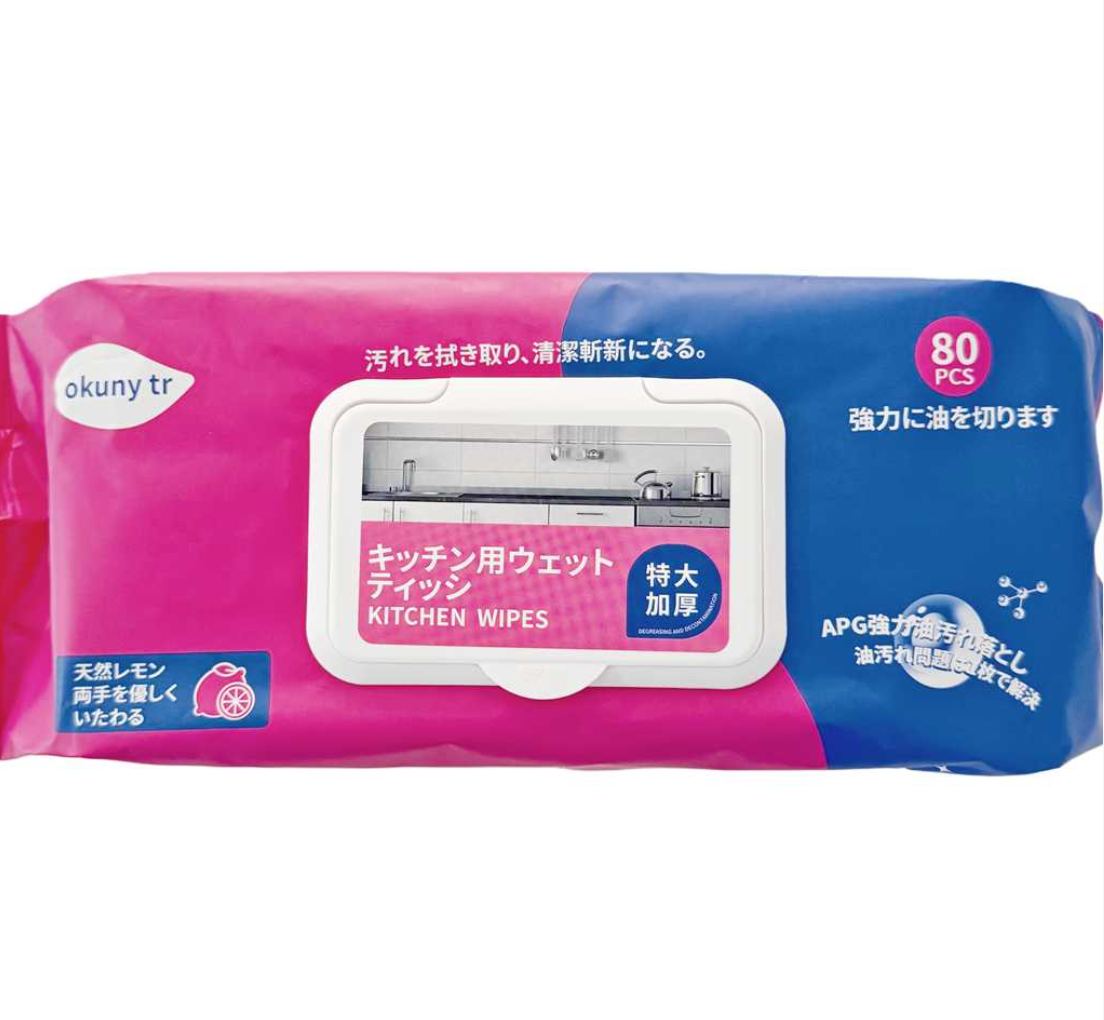
The four families are an entirely adhesive base, bamboo fiber, biodegradable wood pulp non-woven fabric, and water-jet non-woven fabric. Real catalog models make each one concrete: baby wipes Y02 and pet wipes C02 for the adhesive base, pet wipes C03 and C04 for bamboo fiber, pet wipes C05 and wet toilet paper S01 for biodegradable wood pulp non-woven, and kitchen wipes CF001 and clothing wipes YW01 for water-jet non-woven.
Why the Material Line Decides the Whole Order
A wet wipe substrate is a non-woven or paper web that is saturated with a liquid formula and dispensed as single sheets. Substrate variables that buyers are normally asked to confirm include the fibre type, the bonding method, the sheet dimensions, the fold, the number of pieces per pack, and the packaging format. In the application profiles used for this product range, the operating mode is described as continuous surface wiping with single-sheet, one-time consumption.
Four failure patterns are common on first orders, and all four trace back to the material line.
- Locking size before base. A buyer picks 150 x 200 mm because a competitor uses it, then discovers the intended product claim depends on a different material.
- Assuming identical dimensions mean identical wipes. Baby wipes Y02 (150 x 200 mm) and pet wipes C03 (150 x 200 mm) share a sheet size but are listed with entirely different substrates — entirely adhesive versus bamboo fiber.
- Treating flushability as a thickness setting. The two wet toilet paper models show that it is a material property: S01 is listed as biodegradable wood pulp non-woven fabric, while S02 is listed as a material that can be disintegrated into wood pulp cloth.
- Skipping the skin-contact requirement. Where the fabric touches skin, the documented specification calls for a gentle, plant-based formula free of alcohol, fabric that is gentle on the skin, and no irritating additives.
For a first order, the workable sequence is to move backwards from the shelf: use scenario, then base, then size and count, then formula, then packaging.
A Market Where Base Materials Are Moving Up the Buying Agenda
The commercial context explains why substrate conversations now happen earlier. The global wet wipes market was valued at approximately USD 32.09 billion in 2026, with a projected CAGR of 3.86% reaching USD 43.45 billion by 2034, according to Fortune Business Insights data published via Vertex AI. Within that total, personal care wipes held a 72.81% share of the global wet wipes market in 2025, based on Mordor Intelligence figures.
Substrate-driven segments are growing in parallel. The global biodegradable wipes market reached over USD 3 billion in 2024, with growth attributed to baby wipes and premium retail segments. Flushable wipes were valued at USD 2.3 billion in 2025 and are projected to reach USD 4.2 billion by 2035 at a 6% CAGR, per Global Market Insights. Pet wipes were valued at USD 1.58 billion in 2024, with a projected 5.6% CAGR reaching USD 2.64 billion by 2033, according to DataHorizzon Research.
One caution for planning: market size estimates diverge noticeably between research houses because of different base years and category coverage — the same 2025 wet wipes market is reported at different totals by different agencies — so these figures are best treated as directional signals rather than precise planning numbers.
Regional demand also shapes material choice. Japan accounts for nearly 27% of the Asia-Pacific wet wipes market, with a reported focus on hygiene and premium quality personal care, and ISO 9001 for quality management and ISO 22716 for Good Manufacturing Practice are described as baseline requirements for wet wipes OEM manufacturing. Buyers selling into the European Union also work against EN standards covering REACH for chemicals and BPR for biocidal claims, while producers in China operate under the Hygienic Standard for Disposable Sanitary Products.
The Four Substrate Families, With Real Product Examples
1. Entirely adhesive base
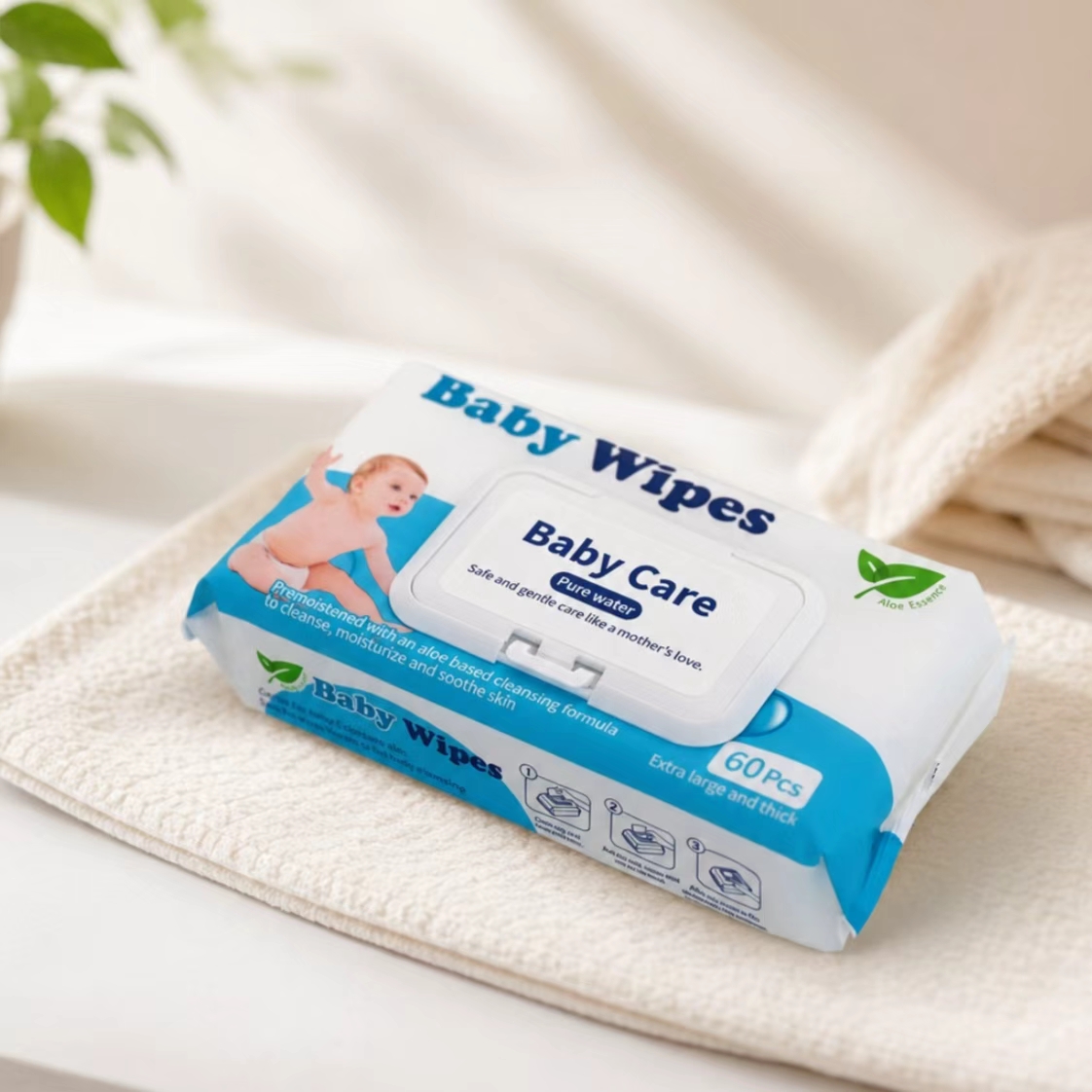
In non-woven manufacturing, an adhesive base is a web in which the fibres are held together by a chemical binder rather than by water-jet entanglement or thermal bonding. The specification for the two models below names the material simply as entirely adhesive.
Baby wipes Y02 — English version of baby wipes, 100 pieces, 150 x 200 mm, listed for the infant care products industry, the baby hygiene products industry, and large department stores and supermarkets. Pet wipes C02 — English version of pet wet wipes, 100 pieces, 200 x 200 mm, listed for the pet supplies industry, the pet grooming and personal care segment, and large department stores and supermarkets.
Buyers choose this family when the priority is a soft everyday wipe in high-count packs, and when the product does not need to disperse in water. It is the natural starting point for baby, hand and mouth, and light pet surface wiping lines.
2. Bamboo fiber base
Bamboo fibre is a plant-derived fibre used in non-woven substrates and is normally positioned with eco-friendly or biodegradable custom wet wipes messaging. Two pet models show the same fibre family cut to two different formats.
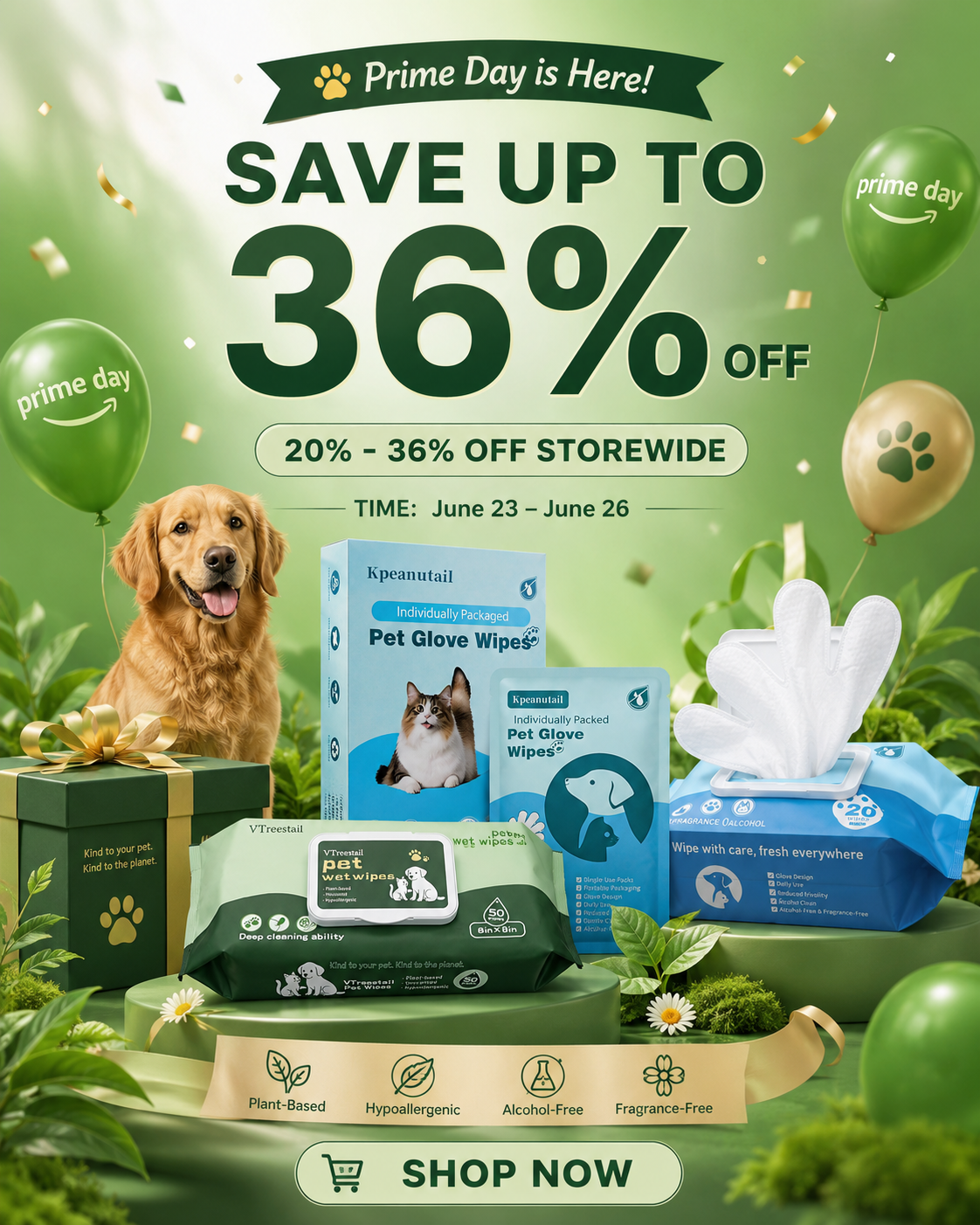
Pet wipes C03 — English version of pet wet wipes, 100 pieces, 150 x 200 mm. Pet wipes C04 — English version of pet wet toilet paper, 100 sheets, 140 x 180 mm. Both are listed for the pet products industry, the pet grooming and personal care segment, and large department stores and supermarkets.
For a first range, this pattern is worth copying: the same application at two cut sizes gives a light and a heavy SKU without forcing a change of supplier or shelf position.
3. Biodegradable wood pulp non-woven fabric
Wood pulp-based non-wovens are used where disposal behaviour is part of the product promise. Both models below are documented in that direction — C05 as biodegradable wood pulp non-woven fabric, and S01 the same.
Pet wipes C05 — English version of pet gloves, 04–10 pieces, 180 x 200 mm, listed for the pet supplies industry, the pet grooming and personal care segment, and large department stores and supermarkets; this model is documented as manufactured in a Class 100,000 cleanroom. Wet toilet paper S01 — 100 sheets, 130 x 200 mm, listed for the pet products industry, large department stores, and the personal care products industry.
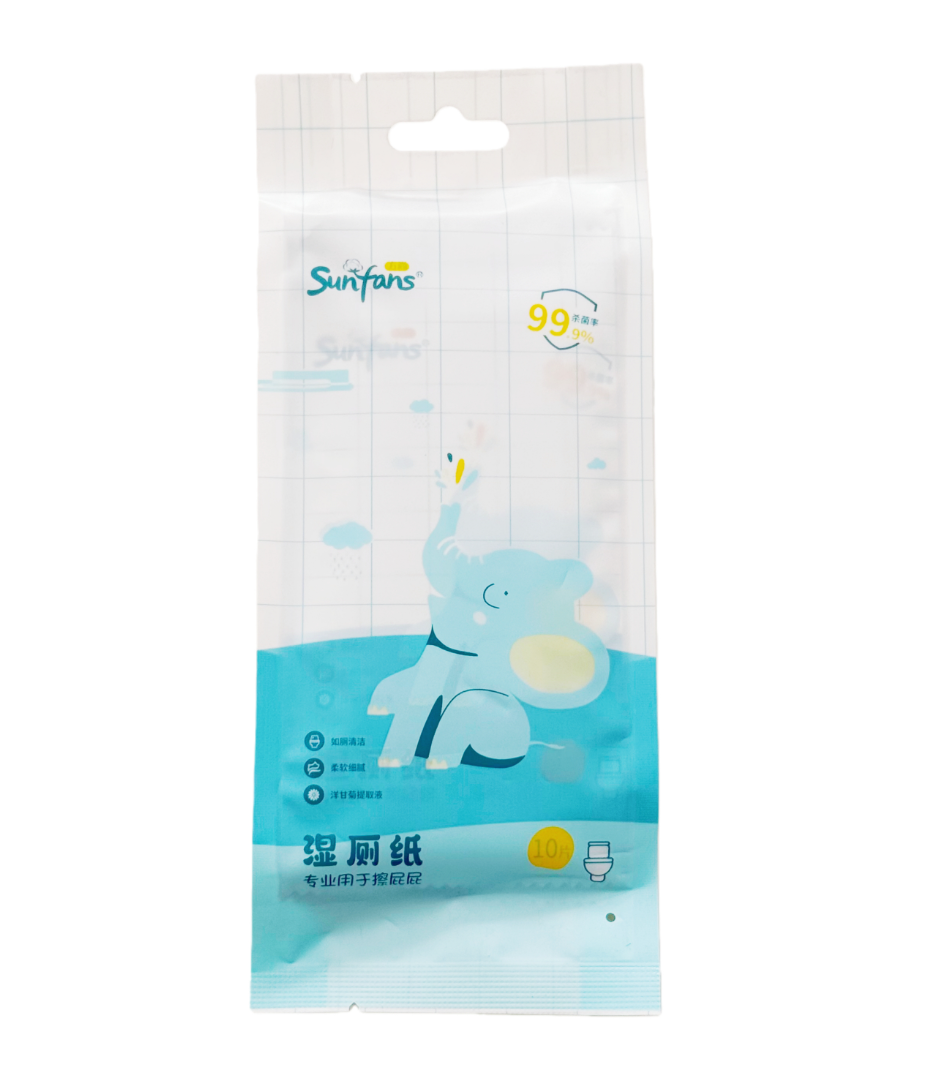
A closely related model is wet toilet paper S02 — 10 sheets, 150 x 200 mm, listed as a material that can be disintegrated into wood pulp cloth and applied in the home cleaning industry, large retail chains, and general merchandise. The difference between S01 and S02 is exactly the kind of wording a private label buyer should confirm in writing, because the disposal claim on the pack depends on it.
4. Water-jet non-woven fabric
Water-jet, or hydroentanglement, uses high-pressure water jets to entangle fibres without a chemical binder. In industrial practice the process is generally associated with strong, low-lint fabrics, which is why it appears on cleaning formats rather than on delicate skin-contact packs.
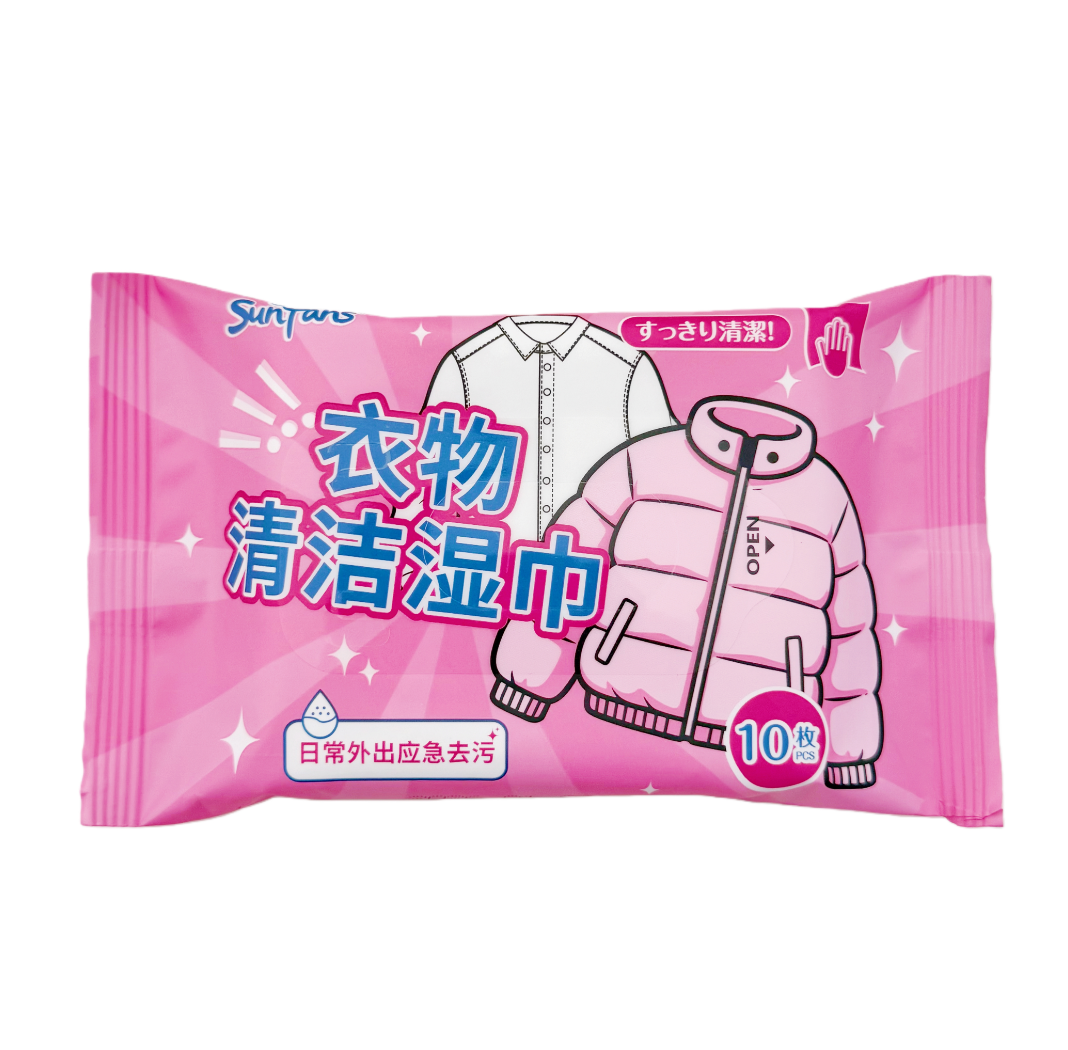
Kitchen wipes CF001 — Kitchen Wet Wipes, 80 pieces, 200 x 200 mm, listed for the home cleaning industry, large retail chains, and general merchandise. Clothing wipes YW01 — 10 cloths for drying clothes, 150 x 180 mm, listed for the same industries. Both use water-jet non-woven fabric.
An adjacent base: water-resistant paper
Eye care wipes YJ01 — Eye Glass Cleaning Cloths, 20 pieces, 100 x 150 mm, listed with a water-resistant paper base for the home cleaning industry, large retail chains, and general merchandise. This is a paper-based base rather than a skin-contact non-woven, and it is normally kept in a separate specification from baby, pet, and personal care products.
The other half of the product: formula and conversion environment
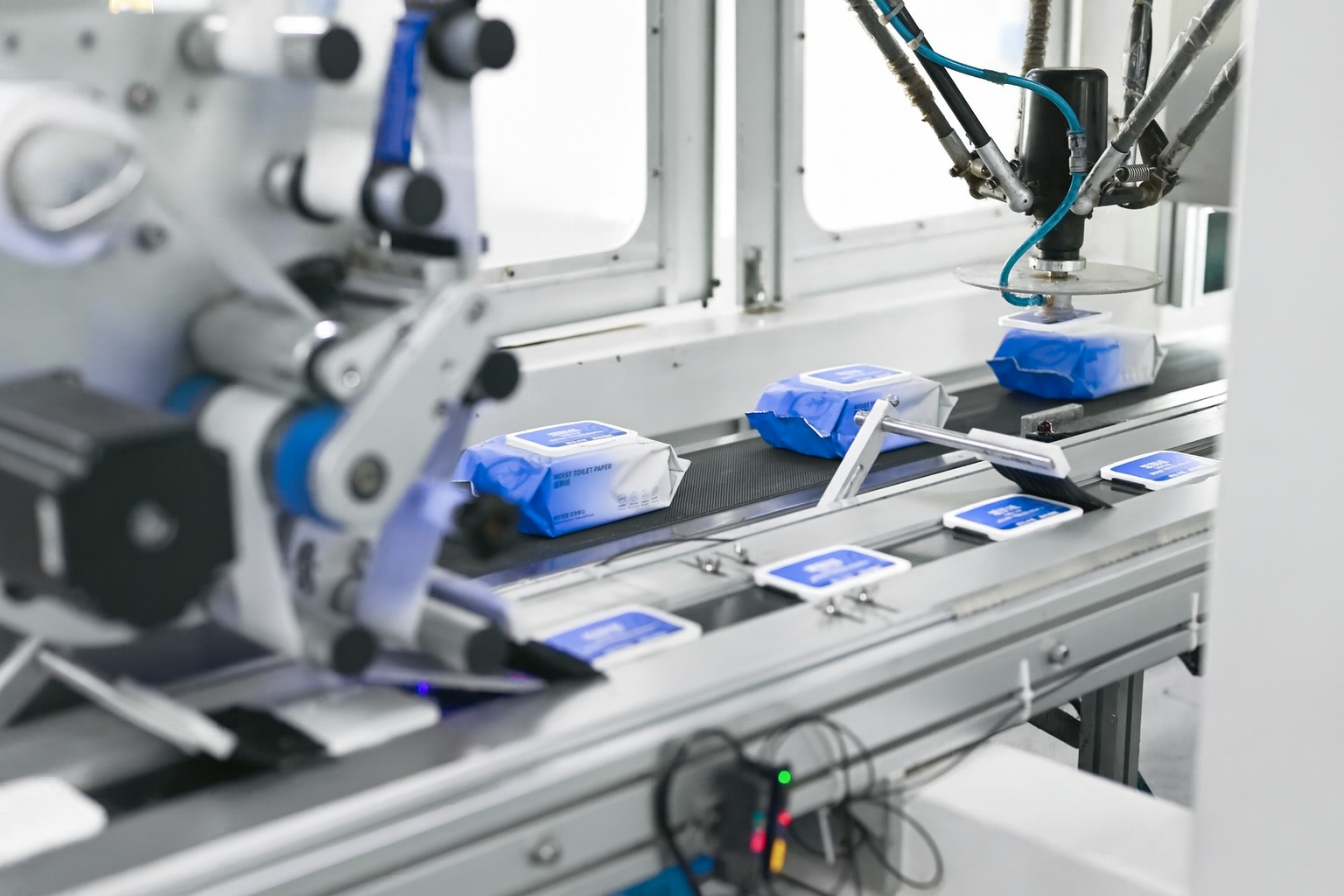
A correct substrate still produces a failed SKU if the liquid and the filling environment are wrong. In the application profiles for this range, the product function is described as cleaning with an antibacterial action, and the required supporting equipment includes automatic packaging machines, automatic filling machines, EDI ultra-pure water equipment, UV sterilization systems, an in-house laboratory, a Class 100,000 cleanroom, and pH meters.
Storage requirements are equally practical: the finished product must be kept in a cool, dry, shaded area at room temperature, away from high temperatures, heat sources, and areas prone to moisture accumulation. Repeat that instruction to your distributor, because it applies to the goods after they leave the factory.
Step-by-Step: Choosing a Base for a First Private Label Order
- Fix the use scenario and the destination market first. Infant care, pet grooming, kitchen and home cleaning, toilet and flushable use, and eyewear each point to a different base family.
- Match the scenario to a base using documented models. Take the nearest existing example rather than an abstract material description: Y02 for infant care, C03 and C04 for eco-positioned pet ranges, C05 and S01 for biodegradable and toilet formats, CF001 and YW01 for cleaning formats.
- Set the sheet size and piece count. Formats across the range run from 100 x 150 mm (YJ01) and 130 x 200 mm (S01) through 140 x 180 mm (C04), 150 x 180 mm (YW01), 150 x 200 mm (Y02, C03, S02) and 180 x 200 mm (C05) up to 200 x 200 mm (C02, CF001).
- Confirm the skin-contact requirement. Where the fabric touches skin, the specification calls for a gentle, plant-based formula free of alcohol, skin-friendly fabric, and no irritating additives.
- Confirm which variables are customizable. Documented customization covers packaging, logo, material, size, aroma, and number of pieces — so the base itself is a configurable decision, not a fixed one.
- Validate before committing. Compare your shortlist against the closest documented model and ask for the exact substrate at your target size, count and fold. Testing the base and the formula together is cheaper than correcting a printed label.
- Plan quantities, lead time and logistics. The published minimum order quantity is 20,000 yuan package, the stated lead time is 30 days, monthly capacity is 3 million packages, and after-sales support includes assisting with packing lists and customs declaration documents for export orders.
Use Cases: Matching Base to Shelf
- Infant, baby and maternity ranges. Baby wipes Y02 (entirely adhesive, 150 x 200 mm, 100 pieces) covers infant care, baby hygiene, and mass retail. Wipes intended for hand and mouth care sit inside the same infant care application profile, which is why the gentle, plant-based, alcohol-free and skin-friendly fabric requirements apply to them as well.
- Pet grooming and pet supplies. C02 (entirely adhesive, 200 x 200 mm), C03 (bamboo fiber, 150 x 200 mm), C04 (bamboo fiber, 140 x 180 mm) and C05 (biodegradable wood pulp non-woven, 180 x 200 mm glove format) cover four positions in one category.
- Kitchen, home and general merchandise. Kitchen wipes CF001 (water-jet, 200 x 200 mm, 80 pieces) and clothing wipes YW01 (water-jet, 150 x 180 mm, 10 cloths).
- Toilet and flushable formats. Wet toilet paper S01 (biodegradable wood pulp non-woven, 130 x 200 mm, 100 sheets) and S02 (wood pulp cloth that can be disintegrated, 150 x 200 mm, 10 sheets).
- Eyewear accessory lines. Eye care wipes YJ01 (water-resistant paper, 100 x 150 mm, 20 pieces).
Documented long-run supply references for this manufacturer show that all four base families already run at volume: a baby and maternity brand owner taking 20 forty-foot containers per month over five years, a Japanese retail account taking 15 containers per month over three years, a large e-commerce channel at 15 containers per month over three years, a top pet-supply seller on Amazon.com at 8 containers per month over six years, and a household and personal care group at 10 containers per month over eight years.
Substrate Comparison at a Glance
| Substrate base | Documented models and sizes | Listed application | What the specification states |
|---|---|---|---|
| Entirely adhesive | Baby wipes Y02 (150 x 200 mm, 100 pieces); pet wipes C02 (200 x 200 mm, 100 pieces) | Infant care, baby hygiene, pet supplies, large stores and supermarkets | Material field listed as entirely adhesive; continuous surface wiping, single-sheet one-time consumption |
| Bamboo fiber | Pet wipes C03 (150 x 200 mm, 100 pieces); pet wipes C04 (140 x 180 mm, 100 sheets) | Pet supplies, pet grooming and personal care, large stores and supermarkets | Material field listed as bamboo fiber; plant-derived fibre used for eco-positioned ranges |
| Biodegradable wood pulp non-woven | Pet wipes C05 (180 x 200 mm, 04–10 pieces); wet toilet paper S01 (130 x 200 mm, 100 sheets) | Pet supplies, pet grooming, personal care, large department stores | Listed as biodegradable wood pulp non-woven fabric; C05 documented as manufactured in a Class 100,000 cleanroom |
| Water-jet non-woven fabric | Kitchen wipes CF001 (200 x 200 mm, 80 pieces); clothing wipes YW01 (150 x 180 mm, 10 cloths) | Home cleaning, large retail chains, general merchandise | Listed as water-jet non-woven fabric; hydroentangled construction with no chemical binder |
| Water-resistant paper (adjacent base) | Eye care wipes YJ01 (100 x 150 mm, 20 pieces) | Home cleaning, large retail chains, general merchandise | Listed as water-resistant paper; used for lens and glass cleaning cloths rather than skin-contact wipes |
| Wood pulp cloth (related toilet material) | Wet toilet paper S02 (150 x 200 mm, 10 sheets) | Home cleaning, large retail chains, general merchandise | Listed as a material that can be disintegrated into wood pulp cloth |
FAQ: What First-Time Buyers Ask About Custom Wet Wipes Materials
Do different substrates change the compliance documents a private label order needs?
The substrate is not the only regulated element, but it does change what buyers are asked to verify. ISO 9001 for quality management and ISO 22716 for cosmetics GMP are described as baseline requirements for wet wipes OEM manufacturing. Wet wipes sold in the EU must comply with EN standards including REACH for chemicals and BPR for biocidal claims, wet wipes in China are governed by the Hygienic Standard for Disposable Sanitary Products, and where products touch skin the application specification requires a gentle, plant-based formula free of alcohol, skin-friendly fabric, and no irritating additives.
Can one OEM convert all four substrate families, including hand and mouth care wipes?
Yes. OEM, ODM and customized services are documented as flexible, supported by an in-house R&D team of 10 people, with customization covering packaging, logo, material, size, aroma, and number of pieces. All four families are already in the catalog: adhesive (Y02, C02), bamboo fiber (C03, C04), biodegradable wood pulp non-woven (C05, S01) and water-jet non-woven (CF001, YW01). Wipes for hand and mouth care fall inside the same infant care application profile as baby wipes Y02, which uses the same equipment set — automatic filling and packaging machines, EDI ultra-pure water equipment, UV sterilization, in-house laboratory, Class 100,000 cleanroom and pH meters.
What is the minimum order quantity, and what changes the cost of an order?
The published minimum order quantity is 20,000 yuan package. Because packaging, logo, material, size, aroma and number of pieces are all configurable variables, quotations are built per SKU rather than from a single price list — changing the substrate family, the sheet size or the piece count changes the specification itself, so it should be quoted as a separate configuration.
How should a first-time buyer validate a substrate before placing an order?
Compare the shortlist against the closest documented model in the same application, then check four items in writing: the material field, the sheet dimensions, the piece count, and the skin-contact requirement where relevant. Only after those four match should you discuss pricing. Where the product touches skin, confirm that the gentle, plant-based, alcohol-free and no-irritating-additives requirement is carried into the specification.
What is the lead time and production capacity behind a custom wet wipes order?
The stated lead time is 30 days, with a monthly capacity of 3 million packages and a listed annual output of 4 million packages, produced at a 6,000 square metre facility with 50 employees. Quality control combines third-party authoritative laboratories with internal material inspection, process inspection and finished product inspection, and after-sales support includes assisting with packing lists and customs declaration documents for export orders. Buyers working with the sunfans custom wet wipes program can request a sample or a quotation for the specific substrate family they are considering — see the contact details below.
Conclusion: Start With the Base, Then Build the SKU
Custom wet wipes are explained by their material base before anything else. An entirely adhesive base, as used on baby wipes Y02 and pet wipes C02, suits soft, high-count, everyday wiping. Bamboo fiber, as used on pet wipes C03 and C04, carries the eco-positioning. Biodegradable wood pulp non-woven fabric, as used on pet wipes C05 and wet toilet paper S01, is the family that supports disposal claims. Water-jet non-woven fabric, as used on kitchen wipes CF001 and clothing wipes YW01, is the family built for cleaning formats. Water-resistant paper, as used on eye care wipes YJ01, sits apart because it is not a skin-contact wipe at all.
Choose the base from the shelf backwards, confirm the size, count and skin-contact requirements in writing, and let the formula and packaging follow. That order of decisions is what keeps a first private label order from turning into a rework.
Next step: request a sample against a named substrate
If you are sourcing custom wet wipes for the first time, the fastest way to reduce risk is to fix the substrate before you negotiate price. Request a sample or a quotation for the base you are considering — entirely adhesive, bamboo fiber, biodegradable wood pulp non-woven, or water-jet non-woven — and ask for the material line to be confirmed in writing alongside the size and piece count.
Download the company profile and product overview (English): Dalian Unicare Biotech company profile (PDF).
Website: www.unilibio.com · Contact: Chengzhe Li · Email: 18525541199@163.com · Tel: (213) 656-5650 · WhatsApp: +1 213 656 5650 · Address: No. 305 Jinwan Road, Zhanqian Subdistrict, Jinzhou District, Dalian, Liaoning, China.
Have Questions or Need More Details?
Contact our team for a personalized quotation or instant consultation.
Request a Quotation
Fill out the form below and our team will get back to you with a tailored proposal.
WhatsApp Direct Chat
Prefer to chat in real-time? Message us on WhatsApp for instant assistance & quick answers.
- Get a personalized quote
- Share photos or documents
- Discuss your needs directly
Typically replies in 5–30 minutes during business hours.