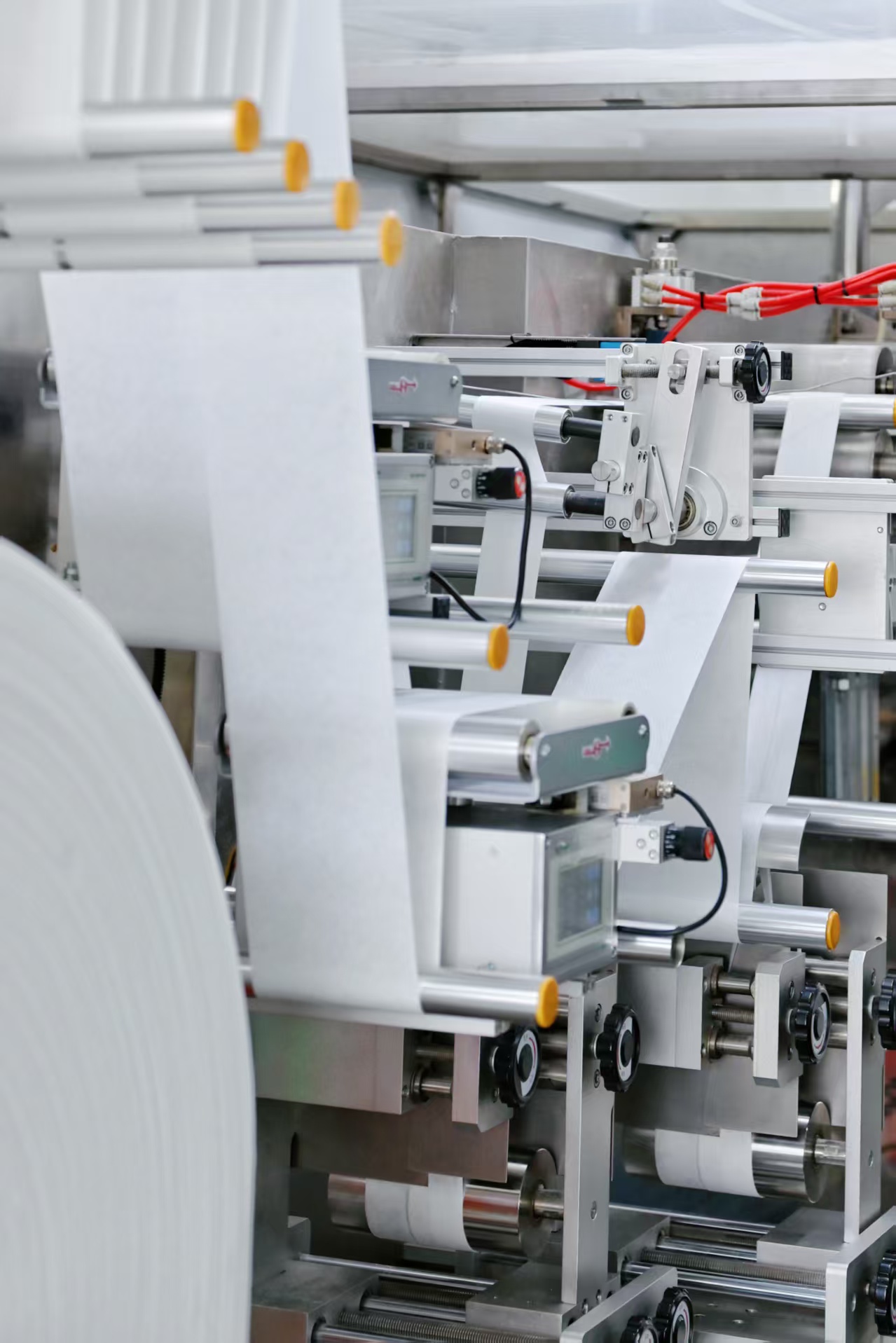
Wipe Substrate & Dimension Matching for Custom Wet Wipes
Matching Wipe Substrate and Dimensions to Your Custom Order
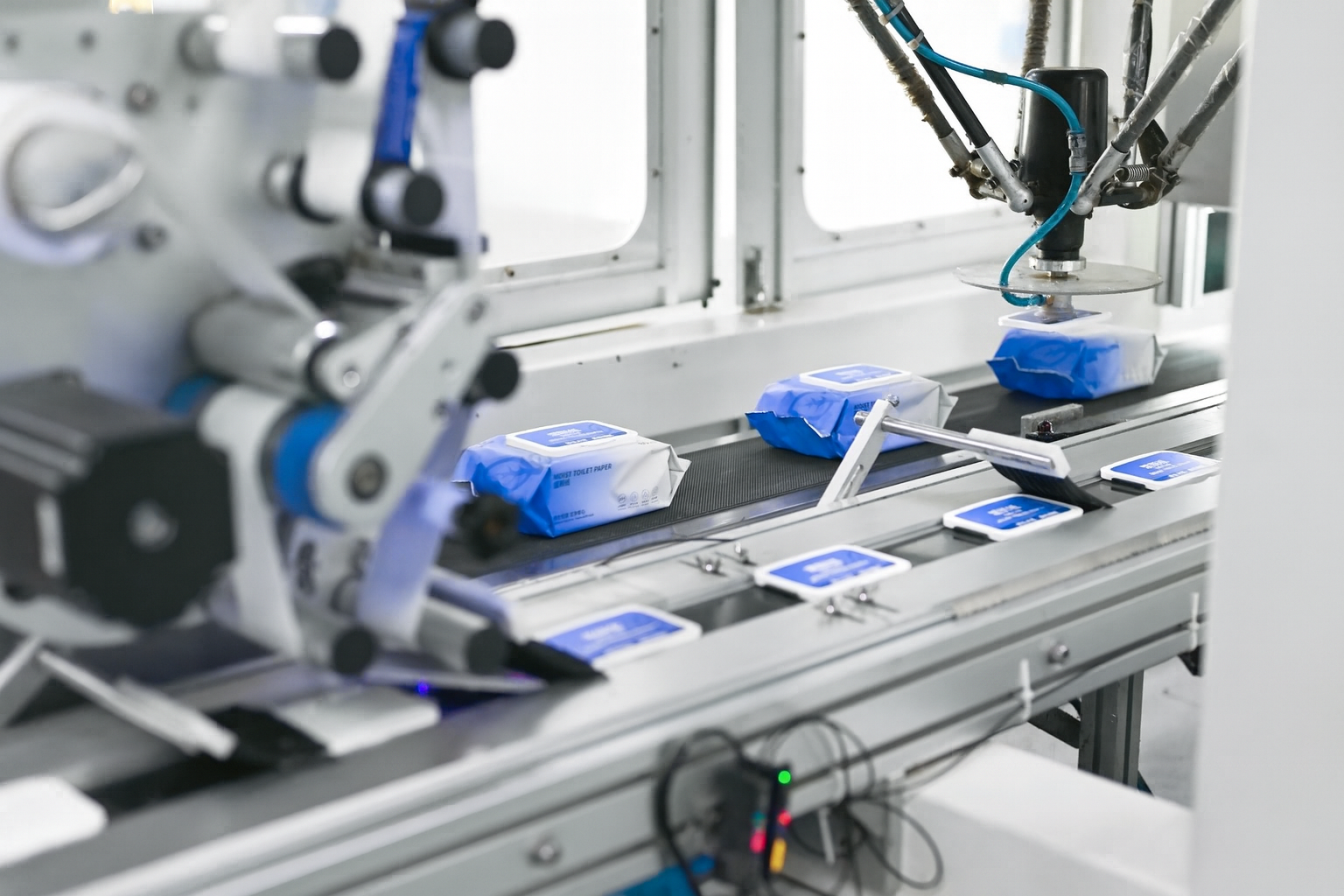
Two specifications decide a custom wet wipes order before price, artwork or fragrance are ever discussed: the substrate the wipe is built from, and the cut size of the individual wipe. Substrate governs how the wipe behaves in use — how it holds liquid, how it releases from the stack, how it feels against skin — while cut dimensions govern how much surface one wipe can cover before it is replaced. This technical guide maps both decisions against five production reference models used for OEM programmes: eye care wipes YJ01, clothing wipes YW01, kitchen wipes CF001, and pet wipes C02 through C05, across a working size range of 100 × 150 mm to 200 × 200 mm.
Those reference models are produced by Dalian Weijie Biotechnology Co., Ltd., a hygiene products manufacturer established in Dalian, Liaoning (China) in 2013, which supplies custom wet wipes under the Sunfans brand to export customers. The company operates a 6,000 m² facility with 50 employees, an in-house R&D team of 10 people, and a monthly capacity of 3 million packages; approximately 70% of output is exported to Japan, Australia, Canada, the United States and Singapore. The substrate families and cut dimensions below are drawn from that live product specification sheet, which is the practical starting point for any new custom order.
Problem Definition: Where Substrate and Dimension Specs Actually Break
Custom wet wipes projects rarely fail at printing or cartoning. They fail earlier, when the substrate and the cut size are treated as two unrelated decisions made by two different people on two different days. A brand team selects a substrate because a competitor’s pack feels a certain way on shelf; a packaging supplier sets a cut size because the film they already have on file fits a round number. When those two decisions meet in production, one of three things happens: the wipe is too weak for the way the customer uses it, the wipe is over-specified for a job that does not need it, or the wipe simply does not fit the fold and pack format it was bought for.
The economics of that mismatch are unforgiving because the specification is locked into tooling. Cut size determines the fold geometry, the stack height inside the pack, the film width, and the number of wipes a given pack format can carry. Substrate determines how the wipe behaves once it leaves the pack. Changing either one late in a project means re-cutting, re-quoting film, re-approving artwork that references a wipe count, and restarting a manufacturing lead time that runs 30 days for this manufacturer. On a private label programme that is already committed to a retail window, that is the difference between a launch and a delay.
A complete specification set therefore has to close seven variables at once, not two:
- Substrate family — for example entirely adhesive, bamboo fiber, biodegradable wood pulp non-woven, or water-jet non-woven.
- Cut dimension — width × length in millimetres, within the 100 × 150 mm to 200 × 200 mm range used by these reference models.
- Format — flat pack, wet toilet paper sheet format, or glove format.
- Pieces per pack — the reference set in this article spans 10, 20, 80 and 100 pieces per pack or sheet count.
- Liquid and fragrance — aroma is one of the customisable parameters in the capability sheet.
- Packaging and logo — also listed as customisable, alongside artwork and printed branding.
- Compliance and commercial terms — certification pack, minimum order quantity, delivery terms and payment terms.
Everything else in a custom wet wipes brief is downstream of these seven. The rest of this guide works through the substrate and dimension decisions specifically, because those are the two that are hardest and most expensive to reverse.
Industry Background: What Is Pushing Substrate and Size Decisions in 2026
Demand context explains why substrate decisions have become more varied. Fortune Business Insights data reported in 2026 places the global wet wipes market at approximately USD 32.09 billion, with a projected compound annual growth rate of 3.86% reaching USD 43.45 billion by 2034. Mordor Intelligence reported that personal care wipes accounted for 72.81% of that market in 2025, which means the bulk of volume still sits in everyday skin-contact formats rather than specialised industrial wipes.
The growth pockets, however, are the ones pulling substrate variety into the specification sheet. The global biodegradable wipes market reached over USD 3 billion in 2024, with growth attributed to baby wipes and premium retail segments. The flushable wipes segment was valued at USD 2.3 billion in 2025 and is projected to reach USD 4.2 billion by 2035 at a 6% CAGR, while plant-based flushable wipes alone were valued at USD 2.9 billion in 2024 with a projected 5.3% CAGR. Pet wipes, the category behind the C02–C05 reference models, were valued at USD 1.58 billion in 2024 with a projected 5.6% CAGR reaching USD 2.64 billion by 2033, with North America holding roughly 50% of that market at approximately USD 0.79 billion in 2024.
Compliance pressure is the second driver. In the EU market, wet wipes must comply with EN standards including REACH for chemicals and BPR for biocidal claims. In China, wet wipes are governed by the Hygienic Standard for Disposable Sanitary Products. ISO 9001 for quality management and ISO 22716 (GMP for cosmetics) are treated as baseline requirements for wet wipes OEM manufacturing. The practical effect on specification is that substrate descriptions are no longer marketing copy — they are claims that must be supported market by market.
Regional demand shapes substrate choice as well. Japan accounts for nearly 27% of the Asia-Pacific wet wipes market, with a documented emphasis on hygiene and premium quality personal care, and Japan is also projected to lead healthcare wipes market growth with the highest CAGR through 2030. Buyers selling into that market tend to specify tighter substrate consistency and clearer documentation than buyers selling into markets with looser labelling expectations.
Detailed Solution: The Substrate Families and the Dimension Envelope
The specification sheet behind these programmes lists four production substrate families plus one specialised base for precision cleaning. Each family already appears in live reference models, which means a buyer can read performance intent directly from a model number rather than from a material datasheet alone.
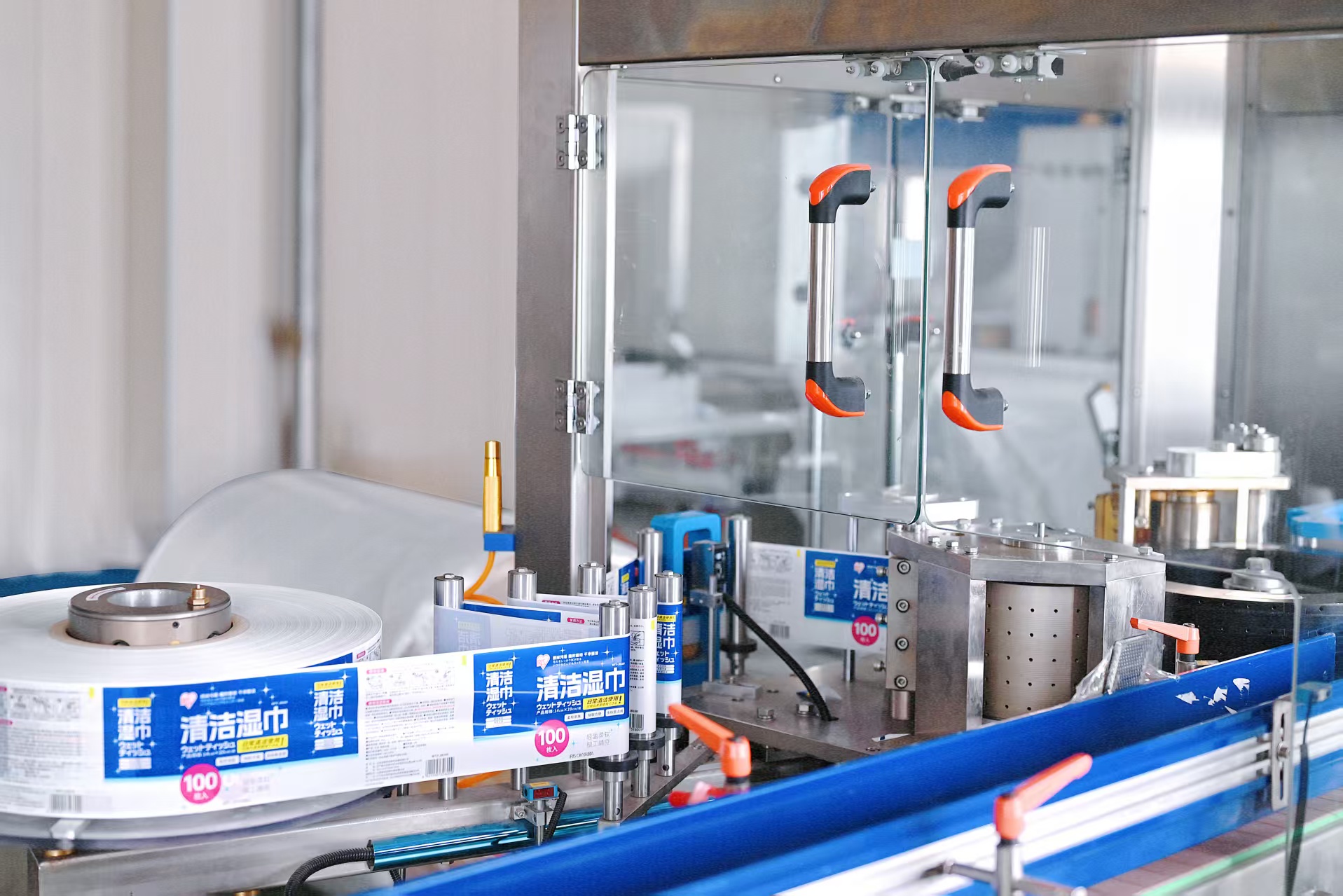
1. Entirely Adhesive Substrate
Listed in the specification sheet as “entirely adhesive”, this is the substrate family used for the large flat packs in the reference set: pet wipes C02 at 200 × 200 mm and baby wipes Y02 at 150 × 200 mm, both supplied as 100-piece English-version packs. In practice, the family is specified where the wipe is used with a full hand rather than fingertips, and where the pack has to release one wipe cleanly from a stack of 100. Buyers building a general-purpose skin-contact or pet-contact line at 150 × 200 mm or above will usually start their comparison here.
2. Bamboo Fiber Substrate
Two pet reference models use bamboo fiber: C03 at 150 × 200 mm (100-piece English-version pet wipes) and C04 at 140 × 180 mm, supplied in a wet toilet paper format of 100 sheets. Bamboo fiber is the family that carries a plant-fibre position on pack without moving to a wood pulp base, and it is also the family used at the compact end of the pet size range — 140 × 180 mm in C04 is the smallest cut size in the pet reference set. For a pet brand that wants a fibre story and a compact refill-format SKU from the same supplier, C03 and C04 are the two data points to compare.
3. Biodegradable Wood Pulp Non-Woven
Biodegradable wood pulp non-woven fabric is the base for pet gloves C05 at 180 × 200 mm (10-piece English-version pet gloves) and for wet toilet paper S01 at 130 × 200 mm (100 sheets). A related SKU, wet toilet paper S02 at 150 × 200 mm (10 sheets), is specified as a material that can be disintegrated into wood pulp cloth.
4. Water-Jet Non-Woven Substrate
Water-jet non-woven fabric covers the two hard-surface models in the reference set: kitchen wipes CF001 at 200 × 200 mm (80 pieces) and clothing wipes YW01 at 150 × 180 mm (10 cloths for drying clothes). It is the only substrate family in the set used across both the largest cut size (200 × 200 mm) and the 150 × 180 mm garment format, which makes it the natural choice when one substrate has to serve both a kitchen SKU and a clothing-care SKU under the same brand.
Water-Resistant Paper: The Precision End of the Range
Eye care wipes YJ01 are specified at 100 × 150 mm, 20 pieces, on water-resistant paper. That is both the smallest cut size and the only paper-based base in the reference set. Programmes that clean lenses, screens and optical surfaces sit at this end of the dimension range because the wipe is manipulated with fingertips and the priority is control rather than coverage.
The Dimension Envelope: 100 × 150 mm to 200 × 200 mm
Cut size is a structural decision, not a cosmetic one. It fixes fold geometry, stack height, film width, and the wipe count a pack format can hold — and it sets how much surface one wipe covers before a second wipe is pulled. The reference models cover the envelope as follows:
- 100 × 150 mm — YJ01 eye care wipes, 20 pieces: precision cleaning, fingertip control.
- 130 × 200 mm — S01 wet toilet paper, 100 sheets: narrow sheet format for wet toilet paper packs.
- 140 × 180 mm — C04 pet wipes, 100 sheets: the most compact pet cut in the set.
- 150 × 180 mm — YW01 clothing wipes, 10 cloths for drying clothes.
- 150 × 200 mm — C03 pet wipes (100 pieces), Y02 baby wipes (100 pieces), S02 wet toilet paper (10 sheets): the general-purpose workhorse size.
- 180 × 200 mm — C05 pet gloves, 10 pieces: glove format requiring a wider sheet.
- 200 × 200 mm — C02 pet wipes (100 pieces) and CF001 kitchen wipes (80 pieces): full-hand coverage.
The step from 150 × 200 mm to 200 × 200 mm is worth quantifying, because buyers frequently underestimate it. Straight arithmetic on the two specifications gives 30,000 mm² of wipe area at the smaller cut and 40,000 mm² at the larger one — roughly a one-third increase in covered surface per wipe, for the same number of pulls from the pack. That is the difference between a wipe that finishes a kitchen countertop and one that leaves the job half done.
Step-by-Step Breakdown: Setting Substrate and Dimension Specs for an OEM Project
The sequence below reflects how these parameters are actually locked in a custom wet wipes programme, moving from use case to commercial terms. Steps one through four are the substrate and dimension decisions this guide focuses on; steps five through eight fix everything built on top of them.
Use Cases: How the Reference Models Map to Real Programmes
Pet Grooming Programmes — C02, C03, C04 and C05
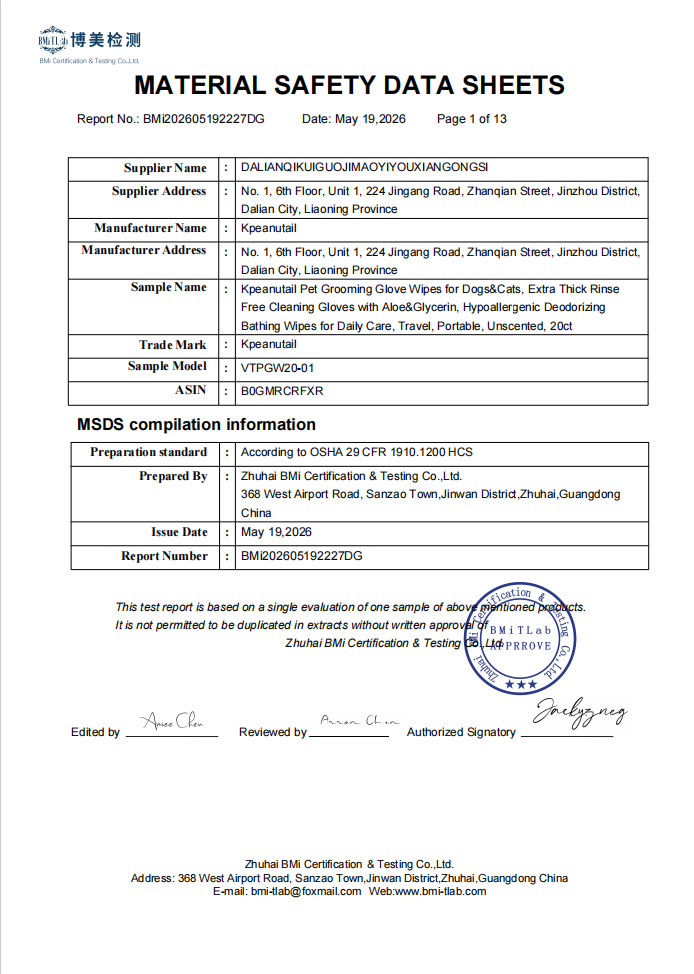
The pet reference set is the clearest illustration of why substrate and dimension have to be decided together, because four models from the same supplier produce four distinct retail propositions. C02 delivers a 200 × 200 mm entirely adhesive wipe in a 100-piece pack for full-body handling. C03 moves to bamboo fiber at 150 × 200 mm for plant-fibre positioning. C04 compresses the same bamboo fiber base into a 140 × 180 mm wet toilet paper format of 100 sheets for compact or refill-style packs. C05 takes the biodegradable wood pulp non-woven base into a 180 × 200 mm glove format of 10 pieces for rinse-free cleaning. The MSDS certificate held by the manufacturer is scoped to pet grooming glove wet wipes for dogs and cats — evidence of the glove format rather than a generic claim.
That range matters in a market where North America holds roughly 50% of global pet wipes value, at approximately USD 0.79 billion in 2024, and where the global category is projected to grow from USD 1.58 billion in 2024 to USD 2.64 billion by 2033 at a 5.6% CAGR. A pet brand entering that market usually needs more than one SKU, and building all of them on one specification sheet is faster than qualifying several suppliers.
Kitchen Programmes — CF001
Kitchen wipes CF001 are specified at 200 × 200 mm, 80 pieces, on water-jet non-woven fabric. This is the largest cut size in the reference set paired with a mid-range count, a combination that suits packs where the buyer does not want to run out of wipes halfway through a cleaning task. The hard-surface context also explains why the pack sits in the home cleaning and large retail chain channel rather than in personal care.
Garment and Clothing Care — YW01
Clothing wipes YW01 are listed as 10 cloths for drying clothes at 150 × 180 mm, on the same water-jet non-woven base as CF001. The low count and mid-range cut make this a specialist SKU rather than a volume pack — a useful example of a dimension chosen for a specific task (garment drying) instead of a general retail format.
Eye Care and Precision Cleaning — YJ01
Eye care wipes YJ01 use water-resistant paper at 100 × 150 mm across 20 pieces, for eye glass cleaning. This is the precision end of the envelope: smaller area, tighter control, and a base selected for surface contact with optical materials rather than for absorbency. Buyers often assume a smaller wipe is simply a cheaper version of a larger one; in this set it is a different product category with a different substrate.
Long-run programme data supports the value of locking these specifications early. Across documented case records, the manufacturer supplies a Japanese convenience retail chain at 15 forty-foot containers per month over three years, a top Amazon.com pet supplies seller at 8 forty-foot containers per month over six years, and a baby and maternity brand owner at 20 forty-foot containers per month over five years. In each case the substrate and dimension set was fixed at the beginning of the relationship; what changed over time was the product range, not the base specification.
Reference Model Comparison: Substrate, Format and Dimensions
The table below lists every reference model cited in this guide with its stated format, cut size and substrate. All values are taken directly from the manufacturer’s specification sheet.
| Model | Product | Format / pieces | Cut size | Substrate | Typical fit |
|---|---|---|---|---|---|
| YJ01 | Eye care wipes | Eye glass cleaning cloths, 20 pieces | 100 × 150 mm | Water-resistant paper | Precision cleaning, fingertip use |
| YW01 | Clothing wipes | 10 cloths for drying clothes | 150 × 180 mm | Water-jet non-woven fabric | Garment and fabric care |
| CF001 | Kitchen wipes | 80 pieces | 200 × 200 mm | Water-jet non-woven fabric | Hard-surface cleaning, full hand |
| C02 | Pet wipes | 100 pieces | 200 × 200 mm | Entirely adhesive | Full-body pet handling |
| C03 | Pet wipes | 100 pieces | 150 × 200 mm | Bamboo fiber | Plant-fibre positioned pet packs |
| C04 | Pet wipes | Wet toilet paper, 100 sheets | 140 × 180 mm | Bamboo fiber | Compact / refill pet formats |
| C05 | Pet wipes | Gloves, 10 pieces | 180 × 200 mm | Biodegradable wood pulp non-woven | Rinse-free cleaning gloves |
A second view helps at the substrate selection stage, when the question is “which family should this new SKU sit in?” rather than “which model do we copy?”
| Substrate family | Reference models using it | Cut sizes observed | Notes for spec-setting |
|---|---|---|---|
| Entirely adhesive | C02, Y02 | 150 × 200 mm, 200 × 200 mm | Used with 100-piece flat packs; full-hand use cases |
| Bamboo fiber | C03, C04 | 140 × 180 mm, 150 × 200 mm | Covers both a standard pack and a compact sheet format |
| Biodegradable wood pulp non-woven | C05, S01; S02 listed as disintegrable into wood pulp cloth | 130 × 200 mm, 150 × 200 mm, 180 × 200 mm | Market-specific verification required before any dispersibility claim |
| Water-jet non-woven | CF001, YW01 | 150 × 180 mm, 200 × 200 mm | Only family used at both the largest and the garment cut size |
| Water-resistant paper | YJ01 | 100 × 150 mm | Smallest cut in the set; optical and precision surfaces |
Frequently Asked Questions
What certifications should a buyer verify before a custom wet wipes order goes into production?
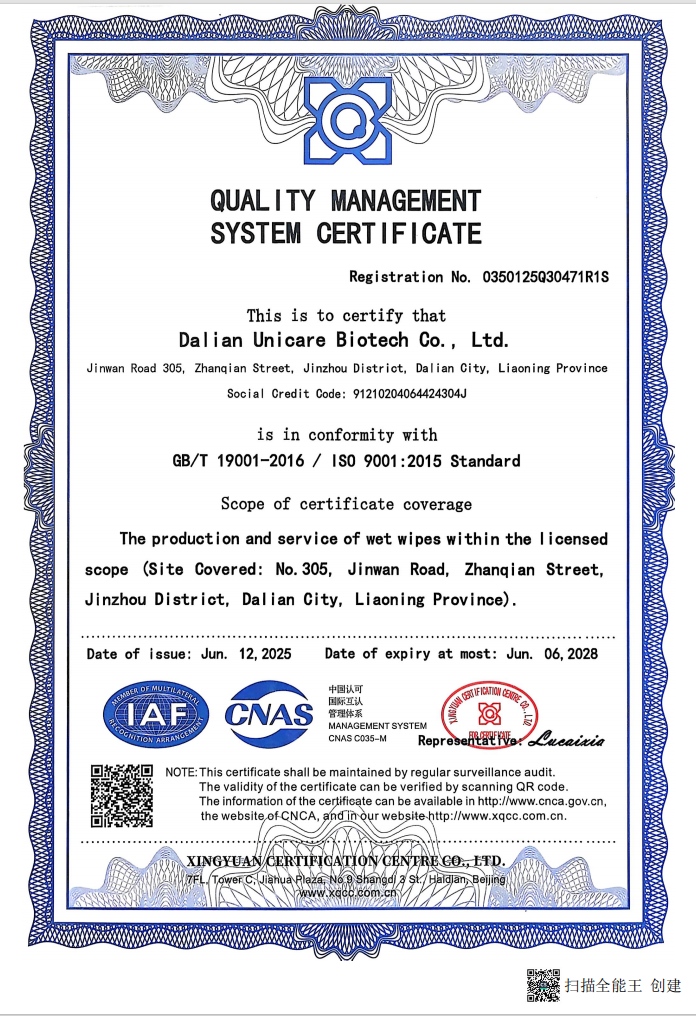
At minimum, verify quality management certification and a material safety document, then map them to the destination market. Dalian Weijie Biotechnology Co., Ltd. holds ISO 9001 certification issued under GB/T 19001-2016 / ISO 9001:2015 by Xingyuan Certification Centre Co., Ltd., certificate number 0350125030471R1S, issued 12 June 2025 and valid until 6 June 2028, with scope covering the production and service of wet wipes within the licensed scope. The company also holds MSDS certificate BMi202605192227DG issued by Zhuhai BMi Certification & Testing Co., Ltd. according to OSHA 29 CFR 1910.1200 HCS, issued 19 May 2026 and valid until 20 May 2027, scoped to pet grooming glove wet wipes for dogs and cats. For destination markets, EU rules require compliance with EN standards including REACH for chemicals and BPR for biocidal claims, while wet wipes sold in China are governed by the Hygienic Standard for Disposable Sanitary Products. ISO 9001 and ISO 22716 (GMP for cosmetics) are widely treated as baseline requirements for wet wipes OEM manufacturing.
Can substrate and dimensions be customised within the same OEM order?
Yes. The listed customisable parameters are packaging, logo, material, size, aroma and number of pieces, which means substrate family and cut dimension are both configurable in one order rather than split across separate projects. The manufacturer operates an in-house R&D team of 10 people and provides OEM, ODM and customized production services, with a monthly capacity of 3 million packages. The reference models demonstrate the range available: substrates span entirely adhesive, bamboo fiber, biodegradable wood pulp non-woven, water-jet non-woven and water-resistant paper, and cut sizes span 100 × 150 mm to 200 × 200 mm across flat packs, wet toilet paper sheet formats and glove formats.
What is the minimum order quantity for a low-MOQ private label wet wipes project?
The stated minimum order quantity is a 20,000 yuan package. Delivery is quoted FOB, and payment for goods must be settled before shipment. Because the MOQ is expressed as a package value rather than a container volume, a private label buyer entering with a limited first order can still lock a defined substrate and cut size; the specification work described in this guide applies to the first order in the same way it applies to a recurring programme. Buyers comparing quotation levels should confirm that the substrate family and cut dimension are identical across quotes, since a change in either one changes the material cost baseline.
How are substrate and dimension specifications validated before shipment?
Acceptance is handled through internal quality control combined with raw material inspection, process inspection and finished product inspection, supported by third-party authoritative laboratories. Material and size are both listed customisable parameters, so both must be fixed at the specification stage rather than confirmed after production. Buyers who need to physically confirm substrate handle and cut size before committing to a full run should raise it during the quotation discussion, so the specification checklist and the inspection plan are agreed together rather than sequentially.
What is the production lead time, and what export support is included?
Production lead time is 30 days, against a monthly capacity of 3 million packages. Export markets served include Japan, Singapore, New Zealand, Australia, the United States, Southeast Asia and Canada, and after-sales support includes assistance with verifying packing lists and customs declaration documents for export orders. Buyers planning a retail launch window should build the 30-day lead time into the schedule alongside artwork approval, since substrate and cut size must be locked before packaging film is ordered.
Conclusion: Lock Substrate and Size First, Then Everything Else
Substrate and cut dimension are the two decisions that determine whether a custom wet wipes order performs in the market, and they are also the two that are most expensive to change later. The reference models in this guide show that the choice is not abstract: entirely adhesive at 200 × 200 mm for full-body pet handling, bamboo fiber at 140 × 180 mm for compact refill formats, biodegradable wood pulp non-woven at 180 × 200 mm for rinse-free gloves, water-jet non-woven at 200 × 200 mm for kitchen surfaces, and water-resistant paper at 100 × 150 mm for precision cleaning. Each combination exists because a specific use case demanded it.
The practical rule for OEM buyers is therefore simple: define the surface and the motion, choose the substrate family that matches it, set the cut size against the pack format and piece count, and only then move to artwork, fragrance and commercial terms. That order keeps tooling, film and compliance work aligned with the specification instead of chasing it.
Set your substrate and dimension specs
Sunfans custom wet wipes are produced by Dalian Weijie Biotechnology Co., Ltd. for OEM, ODM and private label programmes, with substrate, size, packaging, logo, aroma and piece count all configurable, a stated MOQ of a 20,000 yuan package, and a 30-day production lead time.
Share your target use case, cut size and substrate preference to receive a specification-matched quotation, or download the company profile for full capability and certification details: Download the Dalian Unicare Biotech company profile (PDF).
Website: www.unilibio.com | Email: 18525541199@163.com | WhatsApp: +1 213 656 5650 | Tel: (213) 656-5650
Contact: Chengzhe Li | No. 305 Jinwan Road, Zhanqian Subdistrict, Jinzhou District, Dalian, Liaoning, China