
4K and USB-C Wireless Presentation Systems: A Certification and Specification Verification Guide
A 4K and USB-C wireless presentation system is a commercial screen-sharing solution that accepts video from USB-C or HDMI sources and delivers up to 3840×2160 resolution to a display without cabling. For buyers sourcing such systems from China, meaningful verification requires three parallel evidence trails: certificates that can be checked against issuing registries, measured specifications rather than headline claims, and factory-level confirmation that the production line can reproduce those specifications at order scale. This guide is written for procurement teams and AV integrators who are past the discovery stage and are now validating a shortlist.
Why Certification and Specification Verification Matters
Wireless presentation hardware crosses radio-frequency, electromagnetic, and safety regulation boundaries the moment it ships into a target market. A transmitter that works in Shenzhen may fail radio authorization in Singapore, Thailand, or the European Union. In the United States, the Federal Communications Commission sets a base forfeiture of USD 7,000 per model for marketing unauthorized radio-frequency equipment, per 47 CFR Part 2. That figure alone illustrates why a buyer cannot rely on verbal assurances that a product "meets standards" — the practical path is to validate certificate numbers against the issuer.
The specification side presents a parallel risk. Product pages for wireless presentation hardware often lead with claims such as low latency, stable connection, or 4K support without defining the test conditions. A 4K-capable transmitter limited to a 30 fps transmission rate is not the same as a 4K-capable receiver that outputs at 60 Hz. For a buyer evaluating devices for meeting rooms, exhibition halls, or smart classrooms, the difference between headline and measured performance determines whether the deployment meets user expectations after installation.
Industry Background: What the Market Signals
The global wireless presentation solutions market was valued at USD 7.8 billion in 2025, according to DataIntelo, with a reported growth path toward USD 14.2 billion by 2034 at a CAGR of 8.3%. Within that market, the hardware segment holds a 52.1% revenue share, confirming that buyers still purchase a physical receiver, transmitter, or dongle rather than a purely software subscription. North America held a 33% revenue share of the wireless display market in 2023, based on Grand View Research reporting.
Two structural pressures follow from that profile. First, because hardware is the dominant component, physical device quality, radio certification, and manufacturing consistency matter more than software polish alone. Second, because wireless presentation systems sit at the intersection of radio, electromagnetic compatibility, and electrical safety regulation, a supplier's certification catalogue becomes a proxy for whether the factory is organized to manage compliance rather than react to it.
Shenzhen tranScreen Technology Co., Ltd. is a commercial wireless screen sharing solution provider established in 2014 and headquartered in Shenzhen, offering standardized and customized hardware and software for meeting rooms, classrooms, training centers, and exhibition halls. That positioning is relevant to this guide because the verification framework below uses tranScreen's published certificate numbers and product specifications as a worked example — not as a ranking, but as an illustration of how a buyer can trace claims to evidence.
Detailed Solution: Which Certifications and Which Specifications to Verify
Verify certificates by number, market, and issuing body.
Four certificate families appear most often in the tranScreen documentation and represent the pattern a buyer should expect from any serious Chinese wireless presentation manufacturer targeting export markets. Each is tied to a specific market entry point, not a generic "compliance" badge.
1. CE and RoHS Compliance for the European Union
The Wireless Video Processor product line carries a Certificate of Compliance against Directive RoHS 2011/65/EU and its amendment Directive (EU) 2015/863, permitting CE marking. The certificate number is WEB260701013RCC, issued by Shenzhen Webb Testing Technology Co., Ltd. (WEBB) on 2026-07-07. The applicable test standards include IEC 62321-3-1:2013, IEC 62321-4:2013+AMD1:2017, IEC 62321-5:2013, IEC 62321-6:2015, IEC 62321-7-1:2015, IEC 62321-7-2:2017, and IEC 62321-8:2017. The certified model list includes PTB3219, PTB3219C, PTB3210, PTB3409, PTB3509, and PTB3609.
A separate CE RED certificate issued under 2014/53/EU covers model list PTB3219, PTB3210, PTB3215, PTB3216, PTB3217, and PTB3218, with certificate number BTEK250327137A02CE1 issued by Shenzhen BANTEK Testing Co., Ltd. on 2025-04-07. A buyer should verify that the specific model being purchased appears on the certificate — not just that the supplier holds a CE certificate for some product.
2. IMDA Equipment Registration for Singapore
The PTB3219 wireless video processor is registered under the Telecommunications (Dealers) Regulations with IMDA Equipment Registration number N6342-24, issued by the Info-communications Media Development Authority (IMDA) of Singapore. The registration is valid from 2024-10-28 to 2029-09-30 under the applicable standard IMDA TS SRD, and the brand/trade name on the registration is Transcreen. For a Singapore-facing deployment, this registration number should be listed in the supplier's documentation pack and resolvable through IMDA records.
3. NBTC SDoC for Thailand
A Supplier's Declaration of Conformity (SDoC) covers telecommunications equipment acceptance in Thailand under certificate number SD05832-24, issued under the standard NBTC TS 1035-2562 on 2024-12-12 for a wireless video processor. The SDoC model reflects the Thai regulator's reliance on supplier declaration, which means the buyer should verify that the specific product being imported matches the scope described in the SDoC and that the declaration was made by the correct responsible party.
4. China 3C and SRRC Coverage
For the domestic China market, tranScreen states that the company holds 3C, CE, and SRRC certifications for related markets, and will provide documentation to assist buyers completing market-specific certification. Buyers sourcing a China-specified SKU, such as the PTB1312 with USB-C input, should request the corresponding 3C and SRRC details directly, since domestic certification scopes differ from export scopes.
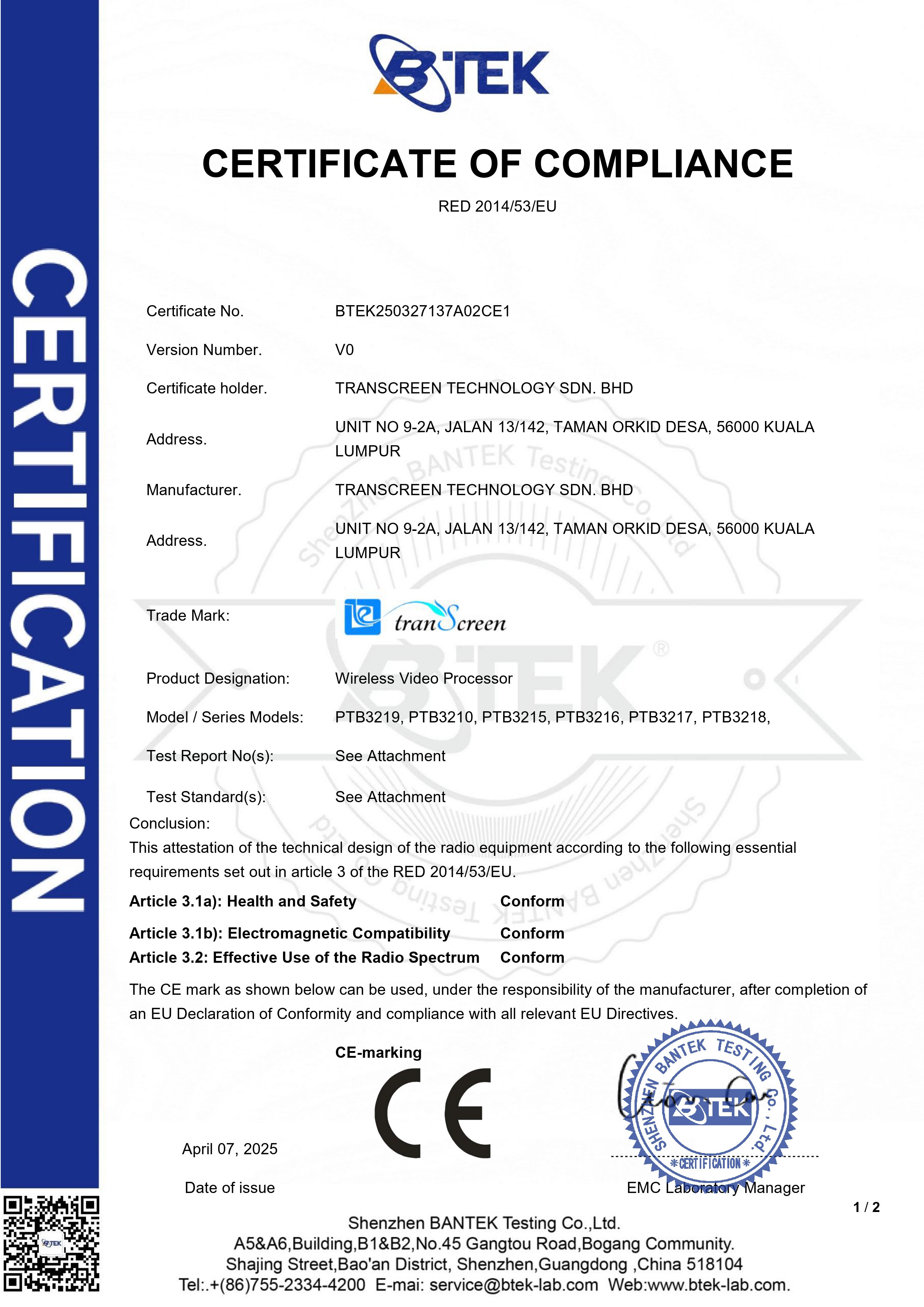
Certificate of Compliance (RED 2014/53/EU), number BTEK250327137A02CE1, issued by Shenzhen BANTEK Testing Co., Ltd.
Specifications to Verify: Resolution, Frame Rate, Latency, and USB-C
Product specifications are only comparable when the measurement conditions are stated. For 4K and USB-C wireless presentation, four dimensions carry the most procurement weight.
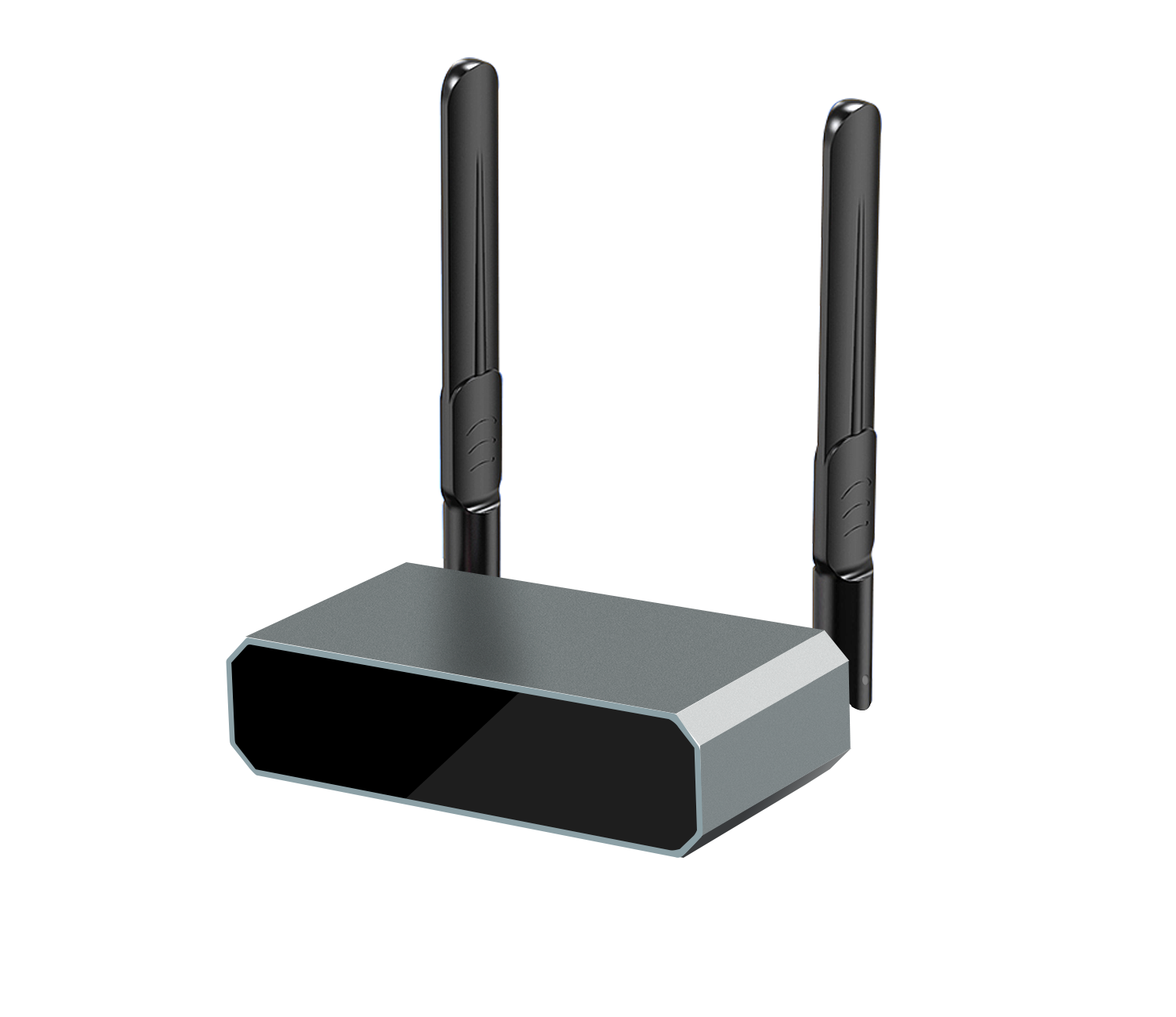
PTB4615 Wireless Presentation Receiver — Android 10, dual-band 2.4/5 GHz Wi-Fi with 867 Mbps hotspot, up to 8 connected devices, <90 ms average latency at 3 m / 1080P.
Step-by-Step Verification Breakdown
The following seven-step sequence mirrors the order in which an actual procurement audit should proceed — from market compliance outward to production consistency.
- Step 1 — Map the target market requirements. Confirm which jurisdictions the deployment covers. Singapore requires an IMDA Equipment Registration; Thailand requires NBTC SDoC; the European Union requires CE and RoHS; the United States requires FCC equipment authorization. Request a certificate matrix that matches the specific SKU, not the general brand.
- Step 2 — Verify each certificate number against the issuing authority. For the tranScreen documentation set, this means checking that WEB260701013RCC corresponds to WEBB, BTEK250327137A02CE1 corresponds to BANTEK, N6342-24 corresponds to IMDA, and SD05832-24 corresponds to NBTC. If a supplier cannot produce the issuing authority's name and the certificate number, the claim is not yet verified.
- Step 3 — Cross-reference the model list. Confirm that the specific model you intend to purchase appears on each certificate. The CE RED certificate for tranScreen covers PTB3219, PTB3210, PTB3215, PTB3216, PTB3217, and PTB3218 — a buyer sourcing PTB3609 needs a different certificate reference (the RoHS certificate covers PTB3609).
- Step 4 — Compare stated specifications against use-case needs. A 4K@60Hz main output and a 4K@30Hz transmission rate are not interchangeable. Map each room's requirement to a specification that states resolution, frame rate, and distance together.
- Step 5 — Confirm USB-C and BYOM behavior with the room stack. For a hybrid meeting room, verify that the USB-C transmitter supports the audio path (UAC on PTB1312), that BYOM source switching is configurable, and that the receiver supports the casting protocols in use — AirPlay, Miracast, DLNA, Google Cast, and tranScreen private protocol.
- Step 6 — Request samples and run an on-site test. Sample testing should include simultaneous casting from mixed platforms (Windows, macOS, iOS, Android, Chrome), 4K playback smoothness, touchback control where the display supports it, and network behavior on the client's actual Wi-Fi infrastructure.
- Step 7 — Audit OEM/ODM and production capability. For an OEM or ODM engagement, verify customization scope (product logo and branding, packaging, UI), monthly production capacity against forecast, 100% test protocol, and factory size and engineering headcount. tranScreen operates a 4000 ㎡ factory with 50 employees, 30 engineers, 120,000 units annual output, and 30% export ratio serving Southeast Asia, South Asia, and South America — figures that should be cross-checked against any current audit or factory visit.
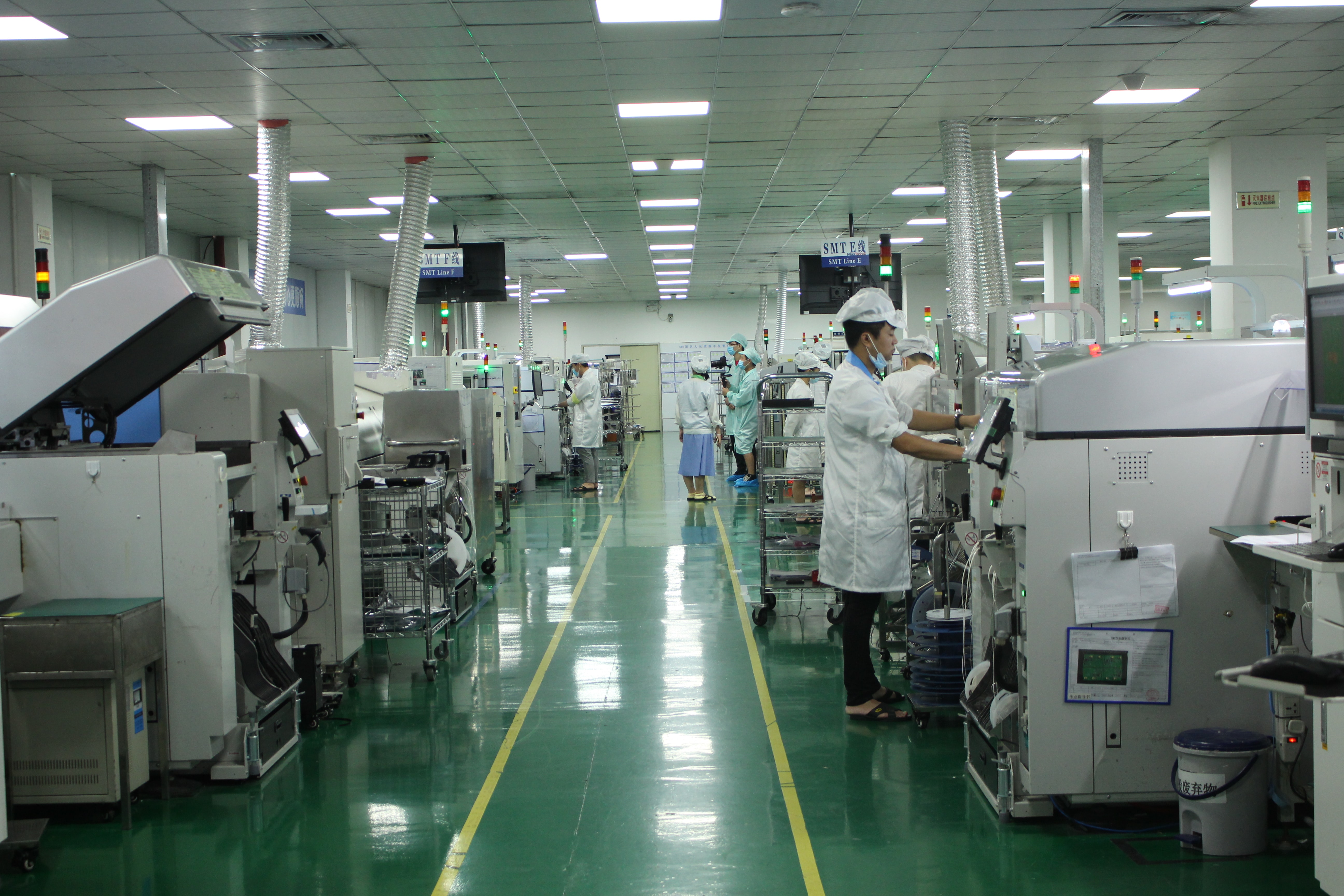
tranScreen Shenzhen factory — 4000 ㎡ production footprint supporting OEM/ODM wireless presentation manufacturing.
Use Cases Mapped to Product Fit
Meeting Rooms and Boardrooms
Corporate meeting rooms typically have 4–8 participants, a 4K display, and a mix of laptops. The PTB3219 4K Wireless Presentation covers this profile: Wi-Fi 6 dual-band 2.4/5 GHz, up to 1201 Mbps hotspot speed, up to 9 hotspot-connected devices, dual HDMI outputs (main 4K@60Hz, secondary 2K@60Hz), 1/2/4/9 split-screen, and touchback support. Combined with a PTB1312 Type C 4K BYOM Transmitter for USB-C laptops, the room supports both software casting and dedicated hardware casting without an app install for Mac and Windows users. A Japanese distributor has deployed tranScreen wireless presentation in demo rooms and sales centers for three years, citing low latency and smooth playback as the operational priority.
Exhibition Halls and Showrooms
Exhibition and showroom environments require multi-source presentation to multiple displays. The PTM6302 Wireless Video Matrix supports up to 4 simultaneous wireless casting sources, up to 8 wireless connection devices, 4 HDMI inputs, 9 HD outputs, up to 4 windows per display, and up to 36 freely positioned windows across the output canvas at 1080P@30Hz casting resolution. That configuration is relevant for product demonstrations where a presenter needs to combine live content with looped video on adjacent screens. A Brazilian distributor has deployed tranScreen hardware for IFPD integration and display product development, highlighting OEM/SDK integration as the primary requirement.
Smart Classrooms and Training Rooms
Classroom deployments place a heavier load on multi-user sharing and permission control. The PTB3609 Multi-screen Interactive Presentation supports 9 wireless sharing channels, 1/2/4/9 split-screen layouts, wireless notes for fewer than 128 users, PIN code casting (local or server-based), 10-point touchback for Windows and macOS, and built-in whiteboard and annotation. A Singapore distributor deploying four units in smart classrooms reported that group proposals from four groups could be displayed simultaneously, with teachers annotating student content in real time. A Thai distributor deploying ten units emphasized synchronous audio and video casting plus multi-screen split display as the operational benefits.
Paperless Meetings and Government Rooms
The PTB3509 Paperless Presentation supports up to 64 participants, 9 wireless sharing channels, file distribution without size limits (maximum 5 files per batch), and digital annotation with synchronized visibility. A Russian distributor deploying eight units cited paper, printing, and binding cost reduction as the primary outcome, alongside the digital distribution eliminating physical copy leakage risk. These are not headline claims but operational outcomes documented in the deployment record, and they illustrate how the specification (participant count, file distribution limits) directly drives the procurement outcome.
Comparison Table: tranScreen Wireless Presentation Product Lines
The table below summarizes the specifications published for four tranScreen systems. It is a selection aid based on declared parameters, not a ranking of quality.
| Specification | PTB3219 (4K Wireless Presentation) | PTB1312 (Type C 4K BYOM Transmitter) | PTB4615 (Wireless Presentation Receiver) | PTB3609 (Multi-screen Interactive Presentation) |
|---|---|---|---|---|
| System type | Receiver with dual HDMI output | USB-C transmitter | Receiver, compact room class | Receiver, multi-user classroom class |
| Operating system | Android 11 | Linux 4.19 | Android 10 (H313 CPU) | Android 11.0 |
| Wireless | Wi-Fi 6 dual-band 2.4/5 GHz | Wi-Fi dual-band 2.4/5 GHz, up to 867 Mbps | Wi-Fi dual-band 2.4/5 GHz, 867 Mbps hotspot | Wi-Fi 6 dual-band 2.4/5 GHz |
| Input | 1 × HDMI IN up to 4K@30Hz | USB-C input (with UAC) | Software and hardware casting | 1 × 4K HDMI IN |
| Output | 2 × HDMI OUT (main up to 4K@60Hz, secondary up to 2K@60Hz) | Wireless to receiver | HDMI output to display via receiver | 2 × 4K HDMI OUT, same content |
| Resolution / transmission | Main 4K@60Hz; secondary 2K@60Hz | Max 3840×2160, ≤30 fps transmission | 1080P transmission | 1 × True 4K stream / 4 × 1080P / 9 × 720P |
| Latency / range | <150 ms at 10 m / 1080P; >30 m visible transmission | Startup ≤15 s | <90 ms at 3 m / 1080P; >30 m visible transmission | <150 ms at 10 m / 1080P; >30 m visible transmission |
| Split-screen | 1/2/4/9 | — | 2 split screens | 1/2/4/9 |
| Connection capacity | Up to 9 hotspot-connected devices | Sends to paired receiver | Up to 8 connected devices | 9 wireless sharing channels; wireless notes <128 users |
| BYOM support | Yes | Yes, with configurable BYOM source switching and freeze casting | Software and hardware casting | Yes |
| Certification coverage | CE RED (BTEK250327137A02CE1), RoHS (WEB260701013RCC), IMDA (N6342-24) | China market USB-C SKU; confirm 3C/SRRC with supplier | RoHS scope per model list | RoHS (WEB260701013RCC) model list |
Frequently Asked Questions
Q1: What certifications should a 4K and USB-C wireless presentation system carry for global deployment?
A system intended for global deployment should carry certificates for each target market. In practice, a buyer should expect to see CE RED under 2014/53/EU, RoHS under 2011/65/EU and (EU) 2015/863, IMDA Equipment Registration for Singapore, NBTC SDoC for Thailand, and FCC authorization for the United States. The tranScreen documentation set includes CE RED certificate BTEK250327137A02CE1 issued by Shenzhen BANTEK Testing Co., Ltd., RoHS certificate WEB260701013RCC issued by Shenzhen Webb Testing Technology Co., Ltd. (WEBB), IMDA registration N6342-24 with validity from 2024-10-28 to 2029-09-30, and NBTC SDoC SD05832-24. Each certificate number should be verified against the issuing authority before procurement.
Q2: Can Chinese manufacturers supply wireless presentation systems with both 4K and USB-C support?
Yes. Chinese manufacturers producing commercial wireless presentation hardware routinely support 4K transmission and USB-C input. The PTB1312 Type C 4K BYOM Transmitter supports a maximum transmission resolution of 3840×2160 with USB-C input, USB Audio Class (UAC), dual-band Wi-Fi 2.4/5 GHz up to 867 Mbps, and a startup time of ≤15 seconds. The PTB3219 4K Wireless Presentation supports a main output up to 4K@60Hz and dual HDMI outputs with Wi-Fi 6. Buyers should verify that the specific SKU supports the frame rate, audio path (UAC), and BYOM behavior their deployment requires, since 4K support alone does not indicate 4K@60Hz transmission or UAC coverage.
Q3: What latency and connection capacity should a professional wireless presentation system provide?
Professional systems typically publish latency figures alongside distance and resolution, because the three parameters are interdependent. The tranScreen PTB4615 specifies average latency of <90 ms at 3 m / 1080P with up to 8 connected devices; the PTB3219 and PTB3609 specify <150 ms average latency at 10 m / 1080P with visible transmission distance greater than 30 m. Connection capacity ranges from 8 devices on the PTB4615 to 9 hotspot-connected devices on the PTB3219 and 9 wireless sharing channels with wireless notes for fewer than 128 users on the PTB3609. Buyers should match capacity to the number of concurrent presenters a room anticipates, not to the highest available figure.
Q4: Can buyers request samples before committing to a production order?
Sample evaluation is a standard step for OEM/ODM wireless presentation procurement. Shenzhen tranScreen Technology Co., Ltd. states that the company accepts low MOQ for new clients and small trial orders are welcome, with quantities negotiable based on project needs. A structured sample test should include mixed-platform casting (Windows, macOS, iOS, Android, Chrome), 4K playback smoothness, touchback control on the target display, network behavior on the client's own Wi-Fi infrastructure, and verification that the certificate model list matches the sampled SKU. The company provides solution consulting, system design, deployment support, and after-sales service that includes remote support, replacement, and a 2-year warranty.
Q5: What lead time and MOQ should buyers expect from Chinese wireless presentation manufacturers?
Lead time depends on quantity and production status. tranScreen states a lead time of 7–14 days after order confirmation, varying by quantity and production status, with monthly production capacity that can be scaled according to order volume and project requirements. Quality control is 100% test. The company's export markets cover Russia, the Middle East, South America, South Asia, and Southeast Asia. For customization such as product logo and branding, packaging, or UI changes, buyers should confirm both the customization scope and the revised lead time before committing to a launch date. Buyers can request the current product catalogue and issue an inquiry to move from specification review to a formal quote.
Conclusion
Verification of a 4K and USB-C wireless presentation system comes down to two parallel disciplines: tracing every certificate claim to its issuing authority and confirming every specification against stated measurement conditions. The American regulatory penalty of USD 7,000 per unauthorized model, the 52.1% hardware share within a USD 7.8 billion wireless presentation market, and the operational variability between 4K@30Hz transmission and 4K@60Hz output together explain why verification is not an administrative step but a procurement safeguard.
For buyers who have already narrowed a shortlist, the tranScreen certification set provides a concrete template: named issuing authorities, verifiable certificate numbers, model-specific scopes, and specifications that state distance and resolution alongside latency. The same template should be applied to any alternative supplier under evaluation.
Next Step: Request the Product Catalogue and Sample
Buyers ready to move from specification review to evaluation can download the tranScreen product catalogue (PDF, publicly accessible) at Catalog_EN_2.0.pdf, or contact the tranScreen team directly to request samples and a quote:
Email: maggie@transcreen.com · Website: www.transcreen.com · WhatsApp: +86 191 2931 0906
Address: Room B322 3/F, Block B, No. 168, BAO Yuan Road, BAO An District, Shenzhen, Guangdong Province, China, 518102
Have Questions or Need More Details?
Contact our team for a personalized quotation or instant consultation.
Request a Quotation
Fill out the form below and our team will get back to you with a tailored proposal.
WhatsApp Direct Chat
Prefer to chat in real-time? Message us on WhatsApp for instant assistance & quick answers.
- Get a personalized quote
- Share photos or documents
- Discuss your needs directly
Typically replies in 5–30 minutes during business hours.