
Brass Ball Valve vs Gate Valve vs Stop Valve: Which to Choose for Heating Circuits?
A heating circuit asks three different jobs of its valves, and no single brass valve body does all three well. Brass ball valves give quarter-turn isolation at the heat source and at each riser. Brass gate valves isolate the circulator and the main distribution lines through a straight-through bore. Brass stop valves provide shut-off and manual regulation on a two-pipe heating circuit, throttling flow so radiators far from the circulator still reach design temperature. Putting the wrong body on the wrong duty is the most common valve error in hydronic heating, and it surfaces later as whistling, worn seats or a circuit that cannot be balanced.
This guide compares the three valve types against the way heating circuits actually behave — design pressure, continuous temperature, cycling frequency and service access — and uses the Valogin (V&G) brass valve range as a factual reference. Zhejiang Valogin Technology Co., Ltd. is a Chinese manufacturer founded in 1985 that produces brass valves, fittings and distribution manifolds for plumbing, heating and gas systems and exports to more than 100 countries.
Short answer: use a brass ball valve for isolation you operate often, a brass gate valve for low-resistance main-line isolation you operate rarely, and a brass stop valve wherever flow has to be throttled and held. Size the pressure rating to the circuit — PN10 covers a standard two-pipe radiator circuit, while a PN40 ball valve such as VG10.16902 carries margin well beyond it — and check the temperature range separately, because a PN16 rating does not automatically mean a 90 °C circuit is inside the valve's stated range.
The Real Question Behind the Choice
All three valves are brass, all three stop water, and all three are sold in the same size range — which is why buyers assume they are interchangeable and pick on price or availability. They are not interchangeable, because a heating circuit contains at least four distinct duties.
- Frequent on/off isolation at the heat source, at each riser and at the pump — operated every service visit, sometimes under pressure.
- Rare, coarse isolation on the main distribution lines and around the circulator — operated a few times in the life of the installation, where a full bore and low resistance matter more than speed.
- Manual regulation on a two-pipe circuit — set during commissioning and expected to stay where it was set for years.
- Protection functions — non-return, temperature blending and per-loop distribution — which are handled by other valve families in the same circuit.
Two failure patterns follow from getting this wrong. First, a gate valve used as a throttling valve: its disc sits part-open in the flow, erodes against the seat and loses both its seal and its set position. Second, a ball valve used as a regulating valve: it has no repeatable intermediate position, so balancing cannot be reproduced between commissioning visits. The third, quieter problem is a pressure or temperature rating chosen by nominal size alone, with no check against what the circuit actually runs at.
How Heating Circuits Actually Load a Valve
A hydronic heating circuit is not a cold-water line with warm water in it. The duty envelope differs by system type, and the valve selection has to follow that envelope.
A two-pipe radiator circuit in a residential or commercial building typically runs hot water up to 90 °C at a working pressure up to 10 bar (PN10), with continuous circulation through the heating season and low flow rates at part load. The system stays under pressure all year, including the months when it is not heating.
A heat pump hydraulic package runs cooler — flow temperature 35–55 °C, higher in retrofits that keep existing radiators — at working pressure up to 6 bar, but it cycles far more often than a boiler circuit. Isolation here has a second purpose: a ball valve lets the circulator or the heat pump be serviced without draining the unit, which on a ground-source loop also means not losing the glycol charge.
A district heating substation or heat interface unit is the hardest duty of the three: primary side up to 120 °C at PN16, secondary side 60–80 °C, a large and variable pressure differential between supply and return, and roughly 4,000–6,000 operating hours per heating season on a network that cannot be shut down building by building.
Market context. The global brass valves market was valued at USD 14.0 billion in 2025 and is projected to reach USD 21.35 billion by 2034, according to Dataintelo market research (SRC-0002). Asia Pacific accounted for 41% of global brass valve market revenue in 2025, which is why so much specification work now involves comparing Chinese manufacturers on capability rather than on availability.
Ball, Gate, Stop: What Each Valve Does in a Heating Circuit
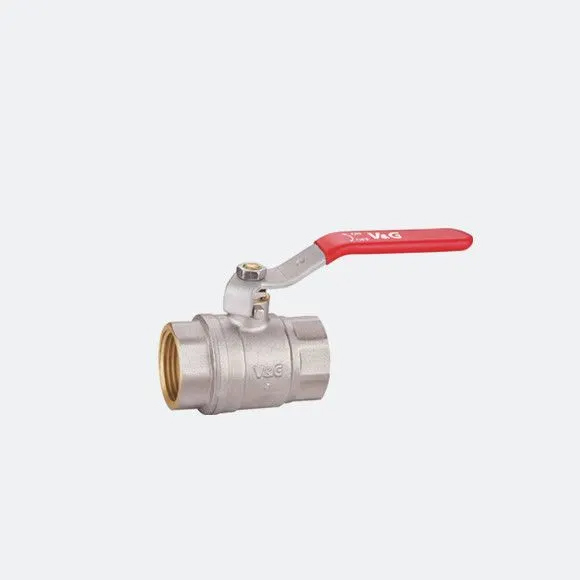
Brass ball valve — quarter-turn isolation at the heat source and risers
A brass ball valve is the default isolation valve for water and gas lines because the handle position shows the valve state at a glance and a quarter turn takes it from fully open to fully closed. In a heating circuit that combination is worth more than it first appears: a technician isolating a riser in an occupied building needs to know the valve is shut without opening a bypass to prove it.
On the Valogin brass ball valve VG10.16902, the rated working pressure is PN40 — 40 bar or 580 psi — with an operating range of −20 °C to 120 °C and sizes from 1/4″ to 4″, connected by female/female threads. That combination places it comfortably above a PN10 radiator circuit and above the 6 bar working pressure typical of a heat pump package, and the 120 °C upper limit covers the primary side of a district heating substation.
One selection decision specific to ball valves is bore type. A full port valve has an internal bore the same size as the pipe and adds almost no restriction; a reduced port valve has a narrower bore, costs less and takes less space but creates a measurable pressure drop that the pump has to cover. On pump and manifold duty in a low-pressure heating circuit, full port is the safer choice; on simple isolation where the pump has spare head, reduced port is adequate.
Brass gate valve — low-resistance isolation on the circulator and main lines
A brass gate valve opens and closes on a multi-turn handwheel and presents a straight-through bore when fully open, so it adds little resistance to the main distribution line. That is why it is used for the coarse shut-off duties: isolating the circulator, and isolating the main distribution lines where the circuit is only broken for planned maintenance.
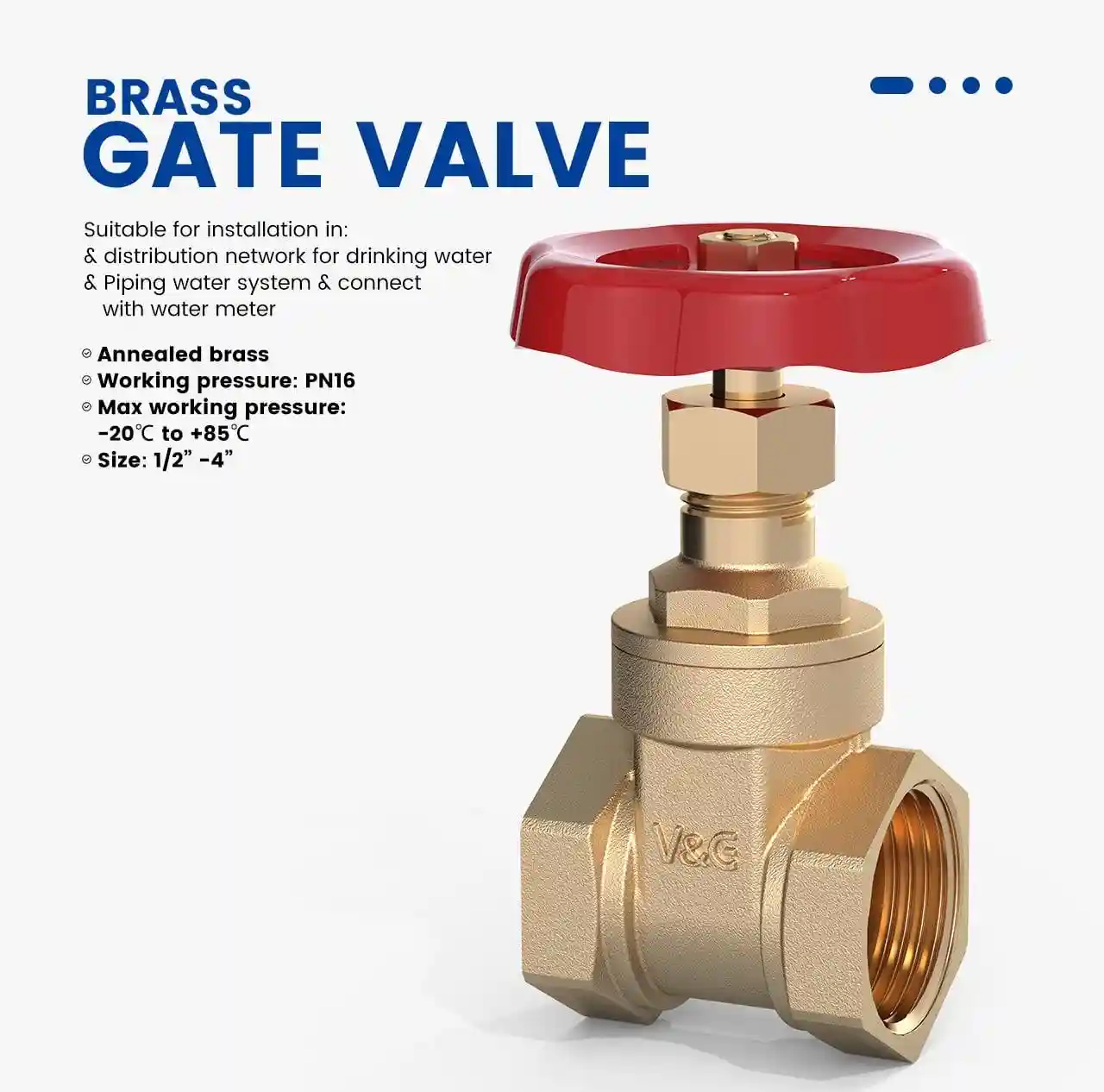
The trade-off is that a gate valve is a two-position device. It should be fully open or fully closed, never part-open for regulation, because a partly lifted disc sits in the flow path and wears against its seat. The Valogin brass gate valve VG11.11302 is rated PN16 with a working temperature range of 0 °C to 80 °C, available from 1/2″ to 2″ with ISO 228 threads (equivalent to DIN EN ISO 228 and BS EN ISO 228).
That 80 °C ceiling is worth flagging rather than glossing over. A standard two-pipe radiator circuit can be designed to run at 90 °C, so a gate valve placed on the main line of such a circuit sits above its stated range at design condition. Where the circuit runs at 80 °C or below — low-temperature retrofits, heat pump systems, underfloor circuits — the PN16 gate valve is inside its envelope. Where it runs hotter, the pressure rating is not the limiting factor; the temperature is, and the rating on the datasheet has to be checked before the valve goes on the drawing.
Brass stop valve — shut-off plus manual regulation on a two-pipe circuit
A brass stop valve is built to be part-open. On a two-pipe heating circuit it does two jobs: it shuts off, and it throttles flow so that radiators far from the circulator still reach design temperature. That second job is where the valve type matters most, because balancing a circuit means holding an intermediate position that stays put over a heating season and across several of them.
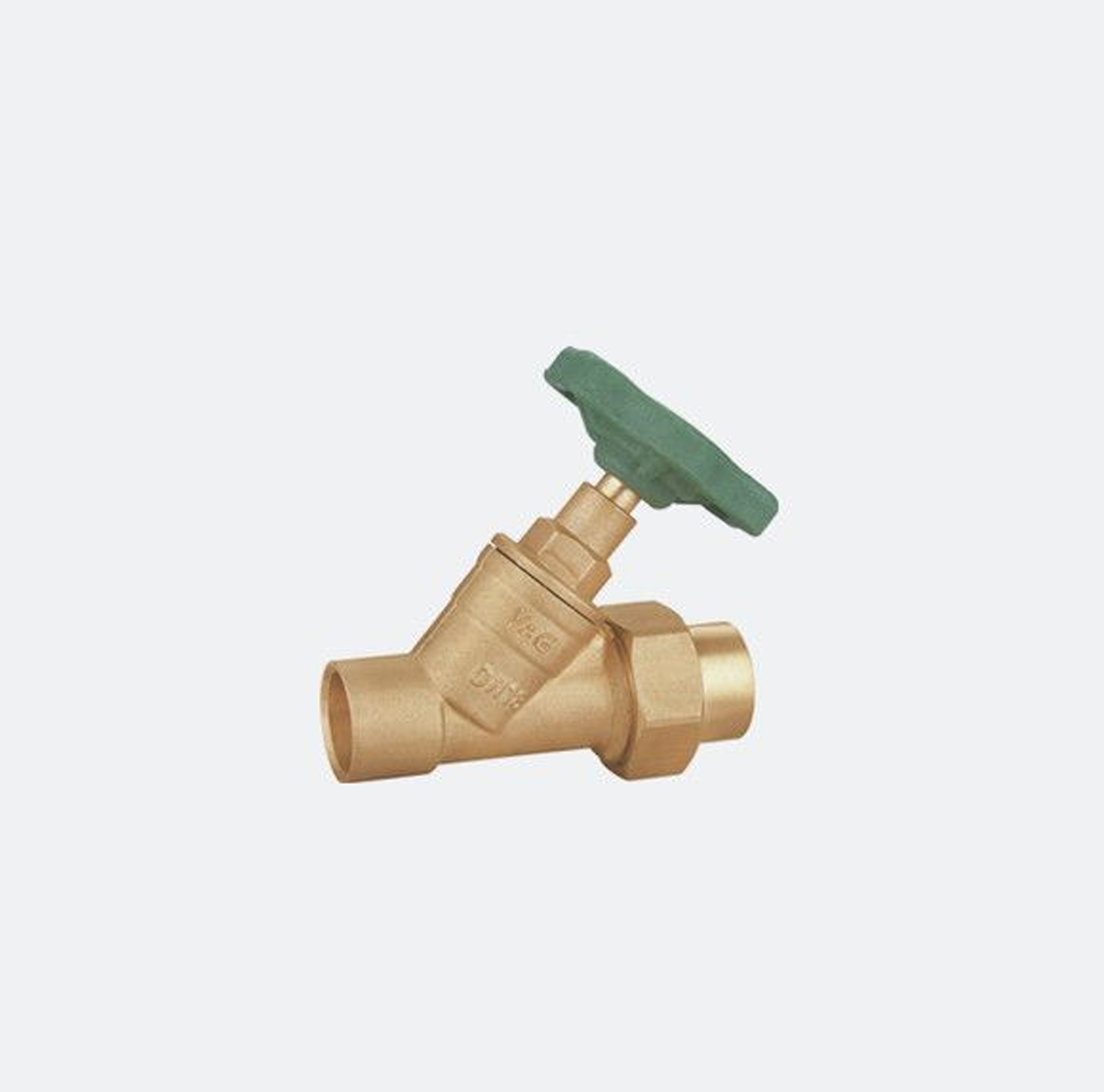
The Valogin brass stop valve VG16.70411 is rated PN10, operates from −20 °C to 100 °C and is available in sizes from 12 mm to 28 mm, with a standard 1″ threaded connection. Read against the duty: PN10 matches the working pressure a two-pipe radiator circuit is designed for, and the 100 °C upper limit sits above the 90 °C design flow temperature of that same circuit. The rating and the duty line up without over-specifying the body.
There is a noise dimension here that is easy to miss on a datasheet. On a radiator circuit, noise — whistling or cavitation at throttled flow — is the most common occupant complaint, and it appears exactly at the valve that is being used to regulate. A stop valve designed for part-open duty is the right place to accept that restriction; a gate valve forced into the same role is not.
The supporting valves that complete the circuit
The three-way comparison is the core decision, but a heating circuit is not complete with isolation and regulation alone. Three further brass valve families carry the remaining duties, and mixing them up creates its own problems.
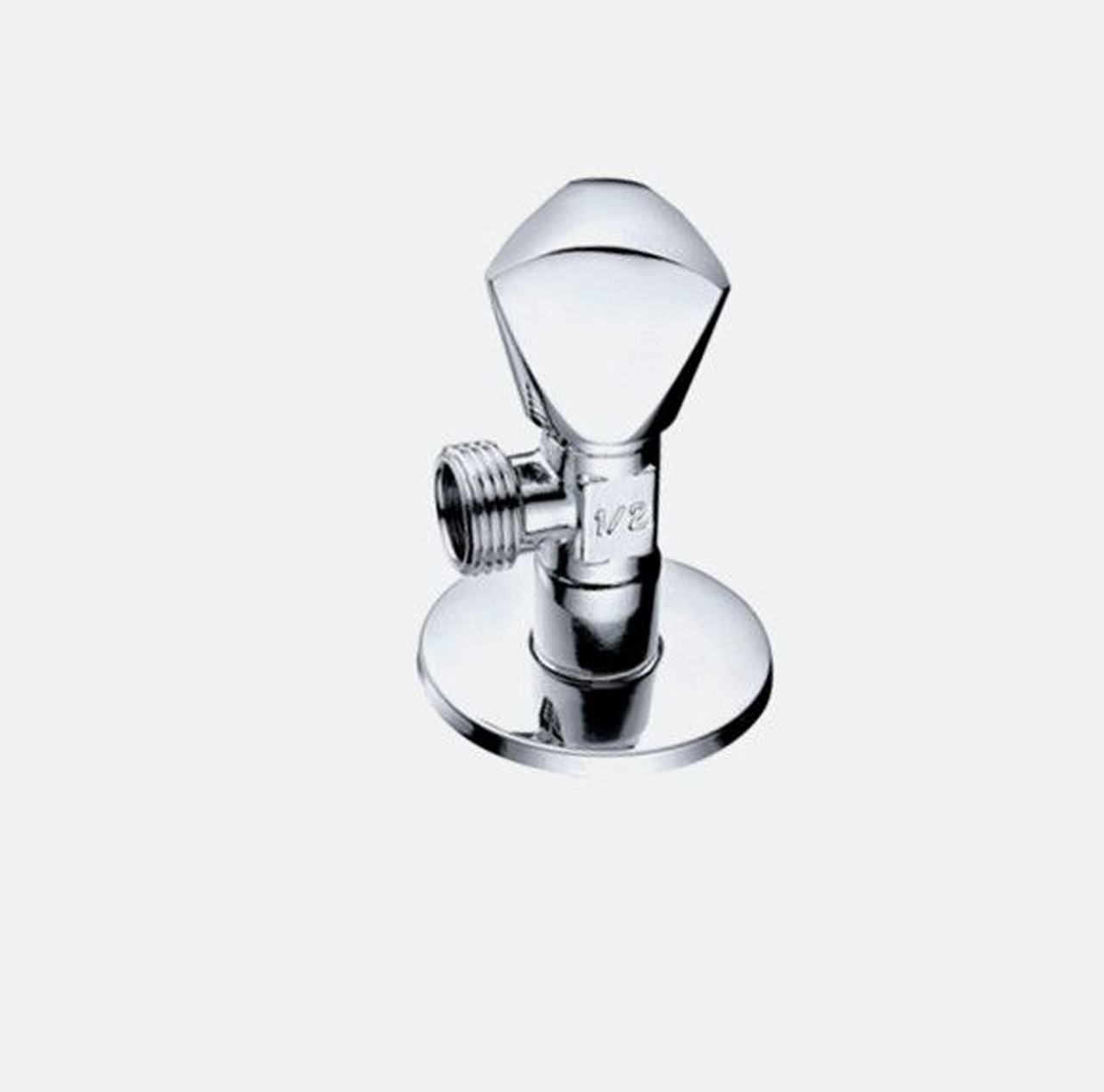
- Brass angle valves connect radiators to the pipework at the terminal. The Valogin brass angle valve VG14.90111 is rated PN10, runs 0 °C to 80 °C, is available in 1/2″×3/8″ and 1/2″×1/2″ with ISO 228 threads, and uses a chrome-plated brass body with a chrome-plated zinc alloy handle — a finish chosen because these valves stay visible in living spaces.
- Brass check valves prevent reverse flow. On a heat pump package they stop reverse flow through the unit when the hot water diverter is active; on a storage tank they prevent tank water backing into the mains. The Valogin brass check valve VG12.04033 is rated PN16 / 232 psi, 0 °C to 66 °C, 1/2″ to 4″, female/female ISO 228 threads.
- Brass mixing valves hold a blended temperature. On underfloor heating the mixing valve brings the manifold down to the floor design temperature; on domestic hot water it limits delivery temperature. The Valogin mixing valve VG37.10092 is rated PN25 (362.5 psi) from −20 °C to 120 °C in 1/2″, 3/4″ and 1″ with male–male connections.
Matching Pressure Rating and Temperature to the Circuit
Pressure class is where the three reference models differ most, and it is the fastest way to see that the rating has to follow the duty rather than the pipe size.
The brass stop valve VG16.70411 is PN10. That is not a limitation for its job: a two-pipe radiator circuit is itself designed around a working pressure up to 10 bar, so PN10 meets the requirement at the point where the valve is installed, with a temperature ceiling of 100 °C above the circuit's 90 °C design flow.
The brass ball valve VG10.16902 is PN40, rated to 40 bar / 580 psi and 120 °C. On the same PN10 circuit that is four times the required pressure class. The margin is deliberate rather than decorative: the ball valve is the valve most likely to be operated under pressure, most likely to be the last line of isolation before a pump or a heat pump is opened, and on district heating primary duty it also has to survive a 120 °C supply temperature. Where a single valve type is being stocked across several system types, the PN40 ball valve covers radiator circuits, heat pump packages and district heating primary side without a second part number.
The brass gate valve VG11.11302 sits between the two at PN16, and shows why pressure class alone is an incomplete check: it is rated above PN10, yet its stated working temperature range of 0 °C to 80 °C is below a 90 °C radiator circuit design temperature. A buyer comparing only the PN number would rank it ahead of the PN10 stop valve for the wrong reason.
Rating rule of thumb: select the valve's pressure rating at or above the circuit design pressure, then confirm the valve's stated temperature range covers the design flow temperature — not the return temperature and not the average. PN10 stop valve on a PN10 circuit, PN40 ball valve where margin or higher temperature is needed, PN16 gate valve where the circuit stays at or below 80 °C.
Step-by-Step: Selecting Valves for a Heating Circuit
- Define the duty, not the product. Write down whether the valve is for frequent on/off isolation, rare main-line isolation, or throttling. This single answer eliminates two of the three valve types and is the decision the rest of the selection depends on.
- Fix the circuit design pressure and design flow temperature. Use the system design values, not the boiler's maximum. A two-pipe radiator circuit is typically up to 10 bar and 90 °C; a heat pump package up to 6 bar at 35–55 °C; a district heating primary side up to PN16 and 120 °C.
- Match the rating with the right margin. PN10 is sufficient on a PN10 circuit; step up to PN40 where the valve is a service isolation point operated under pressure, or where the circuit runs hotter than a stop valve's range comfortably covers.
- Choose the size and the thread standard. Confirm the connection standard against the pipework you actually have — ISO 228 (DIN EN ISO 228, BS EN ISO 228) is the common parallel thread on the valves referenced here. A mismatched thread is the most expensive kind of correct valve.
- Decide the ball valve bore. Full port on pump, manifold and low-pressure duty where every pascal of head matters; reduced port where space or cost dominates and the pump can absorb the drop.
- Place each valve at its correct location. Ball valves at the heat source and on each riser; gate valves around the circulator and on the main distribution lines; stop valves where balancing takes place; angle valves at the radiators; check valves where reverse flow is possible; a mixing valve upstream of an underfloor manifold.
- Check the noise and service-access consequences. Accept restriction at a stop valve designed for throttling; do not accept it at a gate valve. Confirm that the isolation valves you have specified actually let the circulator, the heat pump or the manifold be serviced without draining the system.
Where Each Valve Type Fits: Four Heating Use Cases
1. Two-pipe radiator retrofit. Hot water up to 90 °C, up to 10 bar, continuous circulation in season. Brass gate valves isolate the circulator and the main distribution lines; brass ball valves give quarter-turn isolation at the heat source and at each riser; brass angle valves connect the radiators; brass stop valves throttle the flow so distant radiators still reach design temperature. The constraint to design around is noise at throttled flow.
2. Air-to-water or ground-source heat pump package. Flow temperature 35–55 °C, up to 6 bar, frequent short cycling in shoulder seasons. Brass ball valves isolate the circulator and the heat pump for service without draining the unit — which also preserves the glycol charge on a ground-source loop; brass check valves stop reverse flow through the heat pump when the hot water diverter is active; brass gate valves provide main-line shut-off; brass stop valves regulate the flow split between the heating circuit and the hot water cylinder. The tight hydraulic package inside a heat pump cabinet is the space constraint.
3. District heating substation or heat interface unit. Primary side up to 120 °C at PN16, secondary 60–80 °C, 4,000–6,000 operating hours per season on a network that cannot be shut down building by building. Brass ball valves isolate the plate heat exchanger, the circulator and each branch; brass check valves stop cross-flow between the primary network and the building loop; brass gate valves provide coarse shut-off on the main lines; brass stop valves throttle so each building or apartment gets its share. This is the duty that most justifies the PN40 ball valve and its 120 °C ceiling.
4. Underfloor heating manifold station. 35–50 °C supply, up to 6 bar, many parallel loops at low individual flow. The brass manifold pairs a supply and a return bar with one branch per loop; the mixing valve holds the supply temperature by blending hot water from the heat source with cooler return water; brass ball valves isolate the manifold and each loop for flushing; brass check valves prevent cross-flow between supply and return. Because the manifold is concealed behind an access panel, a leak inside a floor build-up is very expensive to repair — sealing quality outranks every other attribute here.
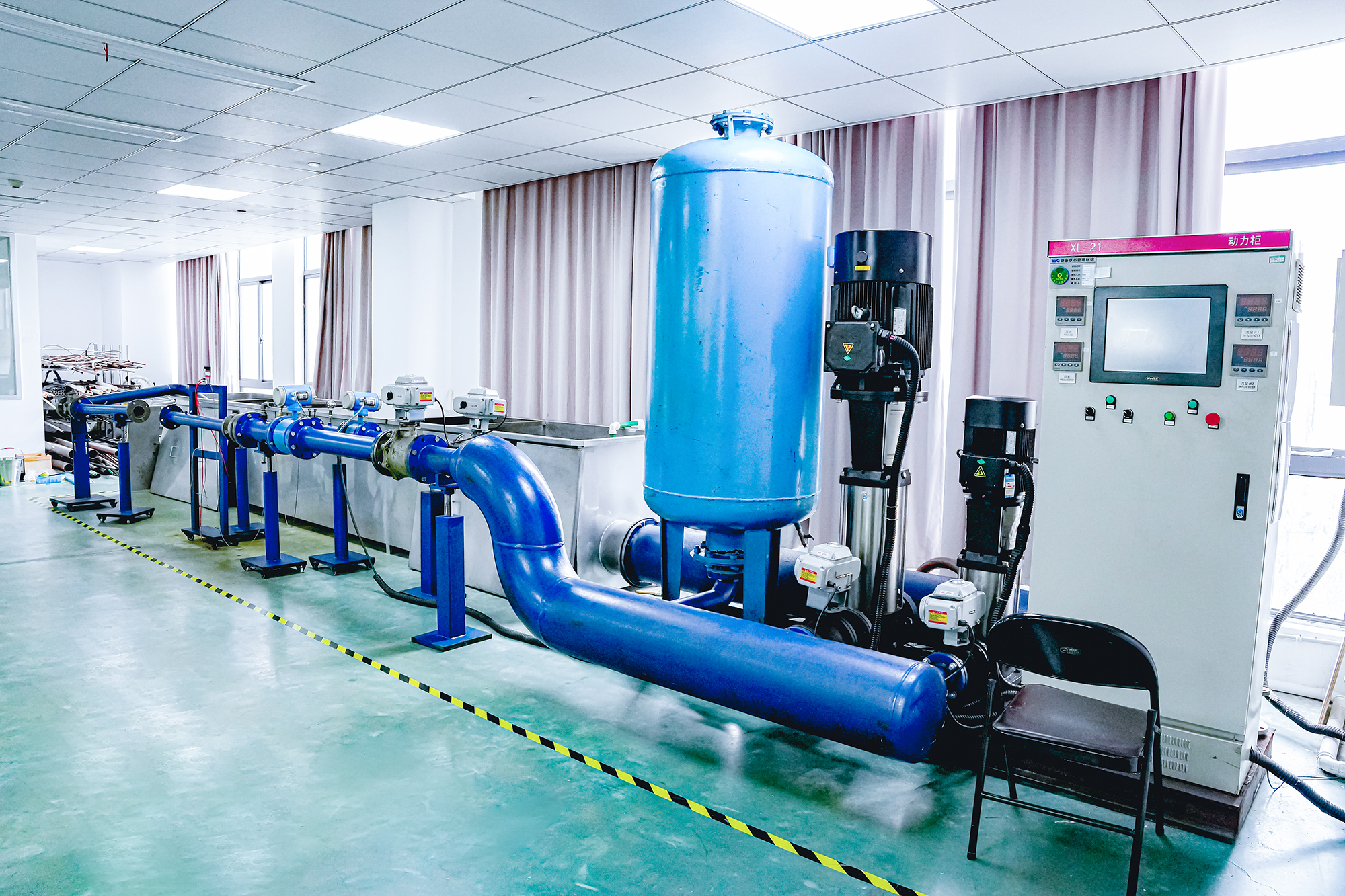
Comparison Table: Ball, Gate and Stop Valves in Heating Duty
| Valve type | Primary duty in a heating circuit | Operation | Reference model | Pressure rating | Temperature range | Size range | Typical location |
|---|---|---|---|---|---|---|---|
| Brass ball valve | Quarter-turn isolation | Quarter turn; state visible from the handle | VG10.16902 | PN40 (40 bar / 580 psi) | −20 °C to 120 °C | 1/4″ to 4″ | Heat source, risers, circulator, heat pump |
| Brass gate valve | Low-resistance main-line isolation | Multi-turn handwheel; fully open or fully closed only | VG11.11302 | PN16 | 0 °C to 80 °C | 1/2″ to 2″ | Circulator, main distribution lines |
| Brass stop valve | Shut-off plus manual regulation | Multi-turn; designed to hold a part-open position | VG16.70411 | PN10 | −20 °C to 100 °C | 12 mm to 28 mm | Two-pipe circuit balancing points, branch throttling |
All pressure ratings, temperature ranges and size ranges above are the stated values for the referenced Valogin models. Gate valve and stop valve threads differ in detail from the ball valve connection — confirm the thread standard against the pipework before ordering.
Frequently Asked Questions
What pressure rating does a brass valve need for a heating circuit?
Match the rating to the circuit design pressure plus the margin the duty justifies, then check temperature separately. A two-pipe radiator circuit is typically designed for up to 10 bar with hot water up to 90 °C. The Valogin brass stop valve VG16.70411 is rated PN10 and −20 °C to 100 °C, which covers that duty at the point of installation. The brass ball valve VG10.16902 is rated PN40 — 40 bar / 580 psi — with a −20 °C to 120 °C range, so it carries margin well above a PN10 circuit and also covers district heating primary duty. Pressure alone is not enough: the brass gate valve VG11.11302 is PN16, but its stated working temperature range is 0 °C to 80 °C and must be checked against a circuit designed to run at 90 °C.
Can brass heating valves be customized for a specific market or brand?
Yes. Valogin supports custom thread specification, surface finish, logo engraving and packaging solutions to match regional market requirements, and about 70% of production runs through automated workflows, with dedicated fully automatic lines for ball valves and gate valves paired with industrial robots to keep batch quality consistent. Production is backed by ISO 9001, ISO 14001 and ISO 45001 management system certification, with product approvals including CE, DVGW, AGA, INIG, WRAS, NSF, cUPC, CSA and AB1953. For a heating project, ask for the certificate that applies to the exact model and the exact destination market rather than a general company certificate.
Ball valve, gate valve or stop valve — which one should I use?
Ball valves give quarter-turn isolation and are the default for on/off duty in water and gas lines, because the handle shows the valve state at a glance. Gate valves open slowly on a multi-turn handwheel and give a straight-through, low-resistance bore, but they are for fully open or fully closed duty only. Stop valves are made for throttling. Use ball for isolation, gate for low-resistance isolation, stop for regulation. Applying any one of the three to the other two duties is what produces worn seats, unbalanceable circuits and noise complaints.
How do I evaluate China brass valve manufacturers for a heating project?
Check four things in order: manufacturing scope, in-house test capability, certification coverage for your market, and export experience in your region. As one reference point, Zhejiang Valogin Technology Co., Ltd. was founded in 1985, operates a 28,000 m² factory with more than 1,000 employees and an annual output of 80 million pieces, and derives more than 90% of turnover from international markets, with Europe and North America as key markets and coverage extending to South America, the UAE and more than 100 countries. Its laboratory covers about 1,025 m², is set up to ISO 17025 with more than 100 sets of test equipment, and is supported by a team of more than 70 designers and engineers including over 15 full-time R&D engineers. Treat these as verifiable claims to request documents for, not as a substitute for them.
Can I get samples and a quotation before committing to an order?
Yes. Sample requests and quotations for brass ball, gate, stop, angle, check and mixing valves can be sent to sales62@valogin.com, by telephone on 86-576-87428589, or via WhatsApp on +86 13186900750. It helps to state the circuit type, design pressure, design flow temperature, size and thread standard in the first message, because those five values determine which rating you actually need.
Conclusion
The choice between a brass ball valve, a brass gate valve and a brass stop valve in a heating circuit is decided by the duty, not by the size or the price tag. Ball valves isolate — quarter turn, state visible, at the heat source and on each riser. Gate valves isolate with a straight-through bore — around the circulator and on the main distribution lines — and are never used to regulate. Stop valves regulate as well as shut off, holding a part-open position on a two-pipe circuit so distant radiators still reach design temperature.
Then match the numbers to the circuit. PN10 on a PN10 radiator circuit is correct rather than cheap, as the brass stop valve VG16.70411 shows. PN40 on the brass ball valve VG10.16902 buys margin at the point where valves are operated under pressure and where district heating primary temperatures reach 120 °C. And PN16 on a gate valve rated only to 80 °C demonstrates the one rule that outranks all of them: pressure class and temperature range have to be read together, against the circuit the valve is going into.
Need help matching a valve to your heating circuit?
Send the circuit type, design pressure, design flow temperature, size and thread standard, and Valogin will confirm which valve type and rating fits — then arrange samples or a quotation.
Email: sales62@valogin.com | Tel: 86-576-87428589 | WhatsApp: +86 13186900750
Website: valve.valogin.com
Download the full product catalogue: VG brand brochure (PDF)
Have Questions or Need More Details?
Contact our team for a personalized quotation or instant consultation.
Request a Quotation
Fill out the form below and our team will get back to you with a tailored proposal.
WhatsApp Direct Chat
Prefer to chat in real-time? Message us on WhatsApp for instant assistance & quick answers.
- Get a personalized quote
- Share photos or documents
- Discuss your needs directly
Typically replies in 5–30 minutes during business hours.