
Brass Ball vs Gate vs Stop Valve: Which Shut-Off Fits Your Heating Circuit?
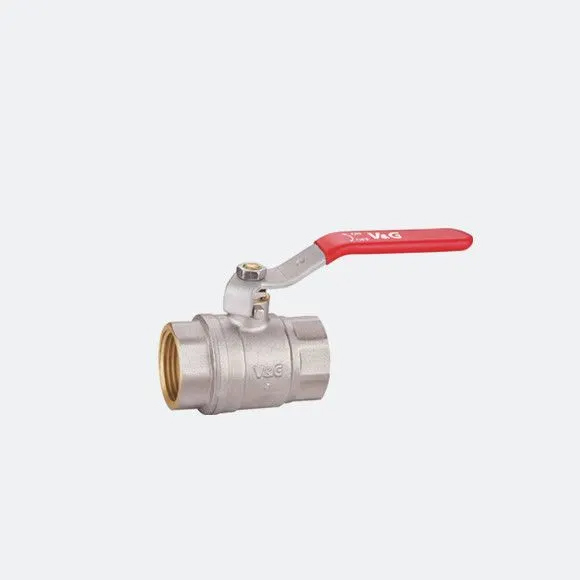
Three brass valves can sit on the same heating circuit and still perform three different jobs. A ball valve isolates. A gate valve gives a low-resistance coarse shut-off. A stop valve regulates flow. The selection question is not which valve is better, but which duty the valve has to carry.
Short answer: use a brass ball valve for quarter-turn isolation at the heat source and at each riser, a brass gate valve for coarse shut-off on the circulator and main distribution lines, and a brass stop valve where the circuit needs shut-off plus manual regulation, such as balancing radiators on a two-pipe system. The pressure classes are not interchangeable: the VG16.70411 brass stop valve is rated PN10, the VG11.11302 brass gate valve is PN16, and the VG10.16902 brass ball valve is PN40.
Why the Wrong Valve Gets Specified
Ball, gate and stop valves are all brass-bodied, all threaded, and all described as shut-off valves. On a quotation sheet they differ mainly by size and price. The duty — isolation, coarse shut-off or regulation — is rarely written down, and that is where specification errors start.
A gate valve used to balance a circuit is the classic example. Gate valves are intended for fully open or fully closed duty only. The gate and seat are not designed to sit in a partly open position, where flow passes at high velocity across the seating surfaces. The result is chatter, seat wear and a setting that does not stay put.
A ball valve used in the same way has a different failure path. The ball seals against a seat, and a part-open ball directs flow across the edge of the seat rather than through the bore. That produces erosion at the seat and, at small openings, noise.
The reverse error is also common: a stop valve specified as the main isolation valve. Stop valves are built for throttling and do that job well, but their pressure class is often lower than a ball valve of the same nominal size. Using a PN10 stop valve on a duty that needs PN16 or PN40 is a pressure-integrity issue, not a preference.
Noise is the symptom buyers notice first. On radiator circuits, noise at throttled flow is the most common complaint, and the usual cause is a valve being used outside its intended duty rather than a defective valve.
What a Heating Circuit Actually Demands
A heating circuit is not a single operating condition. The valve has to match the temperature, pressure, cycling pattern and access of the specific circuit.
- Hydronic radiator heating: hot water up to 90 °C, working pressure up to 10 bar (PN10), continuous circulation through the heating season, low flow rates at partial load.
- Heat pump systems: flow temperature 35–55 °C, working pressure up to 6 bar, variable flow with frequent cycling, glycol/water mixtures in ground-source loops.
- District heating: primary side up to 120 °C at PN16, secondary side 60–80 °C, 24/7 operation through the season.
- Underfloor heating: 35–50 °C supply, working pressure up to 6 bar, many parallel loops at low individual flow.
- Building water supply: potable water at 1–10 bar, hot water up to 65 °C, continuously under pressure.
These conditions explain why one valve type cannot cover the whole circuit. The global brass valve market was valued at USD 14.0 billion in 2025 and is projected to reach USD 21.35 billion by 2034, with Asia Pacific accounting for 41% of revenue in 2025 (Dataintelo, Brass Valves Market report). Market size does not choose a valve type for a circuit. The operating conditions do.
Ball Valve: Quarter-Turn Isolation at the Heat Source and Risers
A brass ball valve is the default isolation valve for on/off duty in water and heating lines. A quarter turn moves the ball from fully open to fully closed, and the handle position shows the valve state at a glance.
Zhejiang Valogin Technology Co., Ltd. (V&G) is a brass valve and fittings manufacturer based in Yuhuan, Zhejiang, China, founded in 1985. Its VG10.16902 brass ball valve is rated PN40, equivalent to 40 bar or 580 psi, with a working temperature range of -20 °C to 120 °C and a size range from 1/4″ to 4″. The valve has female/female threaded connections and is specified for drinkable water systems, piping water systems and heating systems.
In a heating circuit, that combination suits the points that must be isolated quickly and visibly: the heat source, each riser and each fixture group. In a heat pump hydraulic package, ball valves isolate the circulator and the heat pump for service without draining the unit, which also avoids losing the glycol charge. On an underfloor manifold, ball valves isolate the manifold and each loop for flushing.
The limitation is equally clear: a ball valve is not a regulating valve. It is designed to be fully open or fully closed. Where flow has to be set rather than switched, a stop valve is the correct choice.
Port size is a separate decision. A full port ball valve has an internal bore the same size as the pipe and adds almost no restriction. A reduced port valve has a narrower bore, costs less and takes less space, but creates a pressure drop. Full port is the safer choice on pump and manifold duty, where the pump has little spare head. Reduced port is adequate for simple isolation where space or cost dominates.
Gate Valve: Coarse Shut-Off on the Circulator and Main Lines
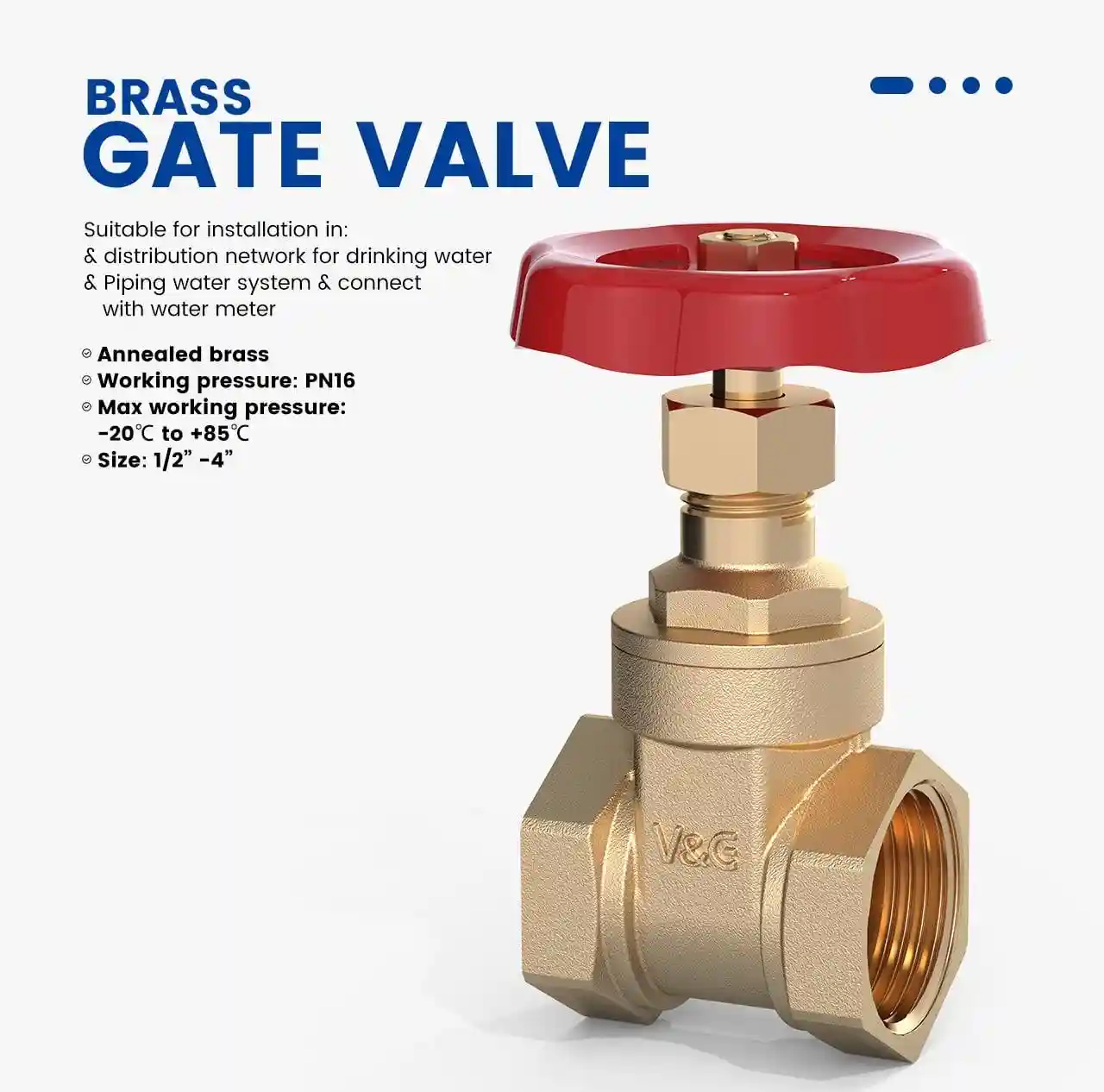
A brass gate valve opens and closes on a multi-turn handwheel. The gate lifts clear of the flow path, leaving a straight-through bore with low resistance. That makes it a good coarse shut-off valve for lines that stay open for long periods and where pressure drop matters.
The VG11.11302 brass gate valve is available from 1/2″ to 2″ with ISO 228 threads, equivalent to DIN EN ISO 228 and BS EN ISO 228. It is rated PN16, or 16 bar, with a working temperature range of 0 °C to 80 °C, and is specified for drinkable water and piping water systems.
Its place in a heating circuit is the circulator and the main distribution lines. In building water supply, the same valve type provides the coarse shut-off on the main supply and on each riser. In both cases the valve is normally fully open, is operated rarely, and is chosen for a low-resistance bore rather than for fine control.
Two limits matter. First, a gate valve is for fully open or fully closed duty only; it is not a balancing valve. Second, the temperature rating has to be checked against the actual continuous temperature. The VG11.11302 is rated 0 °C to 80 °C, while a hydronic radiator circuit can run at up to 90 °C. On a circuit that genuinely runs above the valve rating, the specification has to be confirmed with the manufacturer rather than assumed.
A gate valve also gives no quick visual indication of position. The handwheel has to be turned fully in or fully out, and a partly turned handwheel is not a setting.
Stop Valve: Shut-Off Plus Manual Regulation on Two-Pipe Circuits
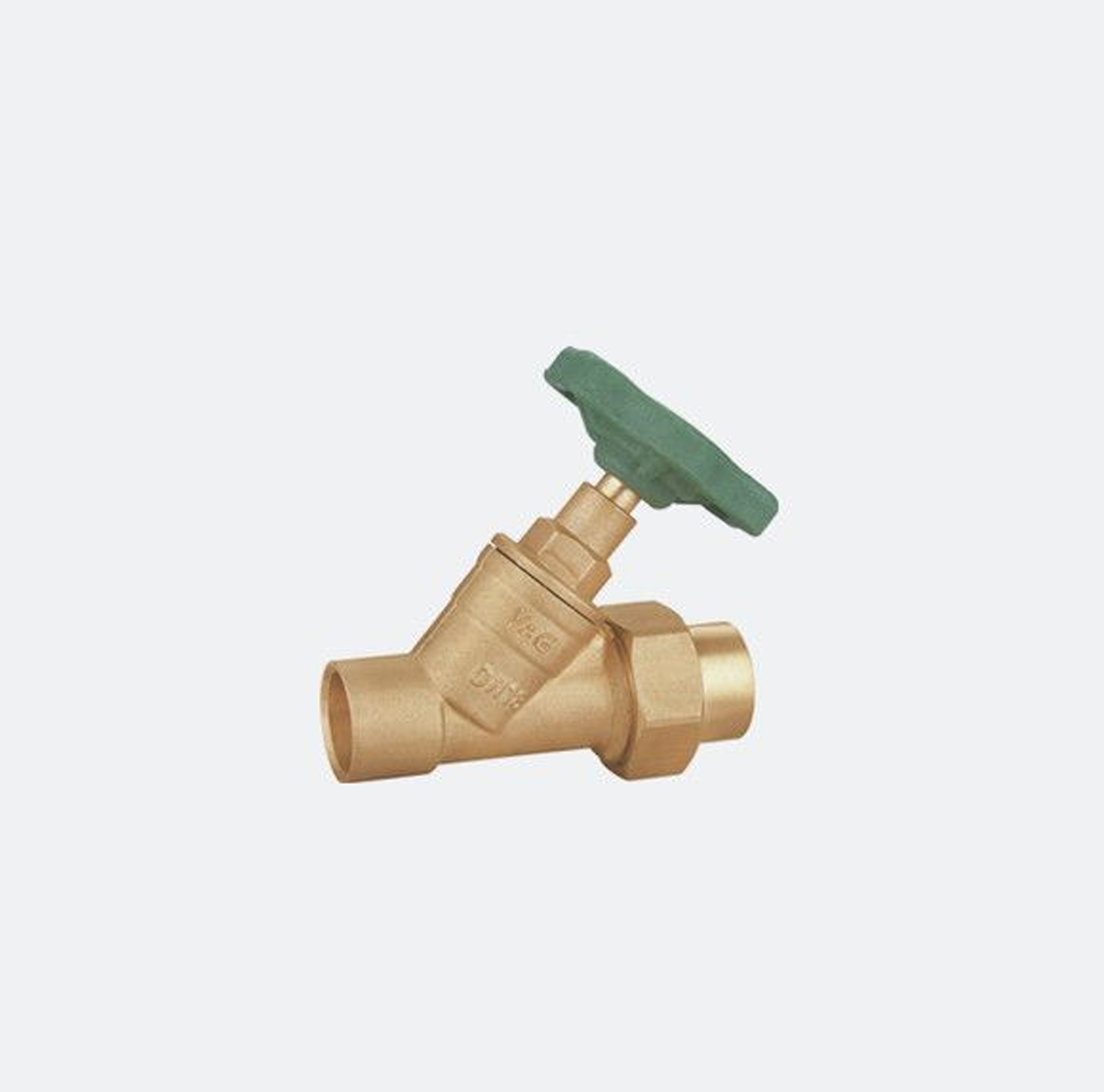
A brass stop valve is made for throttling. It is the valve type to specify when the circuit needs shut-off and a manual regulating point in the same body, which is what a two-pipe heating circuit needs at the radiators furthest from the circulator.
The VG16.70411 brass stop valve covers a size range from 12 mm to 28 mm, with standard 1″ threaded connections. It is rated PN10, with a working temperature range of -20 °C to 100 °C, and is specified for drinkable water systems, piping water systems and heating systems.
In a two-pipe radiator circuit, stop valves throttle the flow so that radiators far from the circulator still reach design temperature. In a heat pump hydraulic package, they regulate the flow split between the heating circuit and the hot water cylinder. On a district heating substation, they throttle branch flow so each building or apartment on the same network receives its share, and the manual position has to stay repeatable over years of operation.
The limit is pressure class. PN10 is appropriate for the heating and water circuits described here, which operate at up to 10 bar, but it is not a substitute for a PN16 or PN40 isolation valve on a higher-pressure duty. A stop valve is a regulating device first and an isolation device second. Where the main isolation point must hold a higher pressure class, a ball or gate valve of that class belongs upstream.
Why Throttled Flow Is the Noise Risk
Noise at throttled flow is the most common complaint on radiator circuits, and it is closely tied to valve duty. When a valve is partly open, the flow area is reduced and velocity at the seat rises. If the local pressure falls far enough, cavitation occurs: vapour bubbles form and collapse, producing noise and surface erosion.
The practical rules follow from that. Isolation valves — ball and gate — should be fully open or fully closed. Regulation belongs to a valve designed for it, which is the stop valve. The regulating valve still has to be sized for the differential it will see; a stop valve with an excessive pressure drop across it can be noisy even though it is the right type.
Valve selection is not the only factor. Air in the circuit, undersized pipework and pump settings also produce noise. But the valve is the component most often changed, and the one most often changed to the wrong type.
Pressure Class: PN10, PN16 and PN40 in Practice
The three valves in this comparison carry three different pressure classes. The stop valve is PN10, the gate valve is PN16 and the ball valve is PN40. PN is a nominal pressure rating: the higher the class, the higher the pressure the valve is designed to withstand at its reference conditions.
The selection rule is to match the class to the highest pressure the valve can see in service, not to the normal operating pressure. A PN10 valve on a circuit that can be isolated and pressurized above that level is a mismatch. Conversely, a PN40 ball valve on a PN10 heating circuit is not better in any useful sense: it is over-specified for the duty, and it still cannot replace a stop valve where regulation is required.
Temperature interacts with the rating. The published rating is stated at reference conditions, and the allowable pressure at the actual operating temperature should be confirmed with the manufacturer. That check matters most where a valve sits close to its temperature limit, such as a gate valve rated to 80 °C on a circuit designed for 90 °C.
Step-by-Step: Matching Valve Type to Duty
- Write the duty in one sentence. If the sentence contains regulate or balance, the valve is a stop valve, not a ball or gate valve.
- Record the circuit conditions. Medium, continuous temperature, maximum pressure and whether glycol is present. Heat pump ground loops and underfloor circuits have different requirements from a potable water riser.
- Decide whether the valve will ever be part-open. If yes, it must be a valve designed for throttling.
- Check the pressure class against the maximum pressure the valve can see, including test pressure.
- Check the temperature rating against continuous temperature, not the short-term peak.
- Check operation frequency and access. A valve behind a sealed floor build-up must hold leak integrity for decades. A valve visible in a living space also needs a corrosion-resistant finish.
- Check the thread standard. ISO 228 is common on brass heating and water valves. ISO 7/1 Rp applies to the gas ball valve range and must match the local pipe thread.
- Check position indication. A ball valve handle shows open or closed. A gate valve handwheel does not.
- Check the noise risk at every regulating point and avoid creating a regulating point with an isolation valve.
- Confirm the certification required for the market and application before the order is placed.
Use Cases
Two-pipe radiator circuit in a residential or commercial building
Gate valves isolate the circulator and the main distribution lines. Ball valves give quarter-turn isolation at the heat source and at each riser. Angle valves connect the radiators to the pipework. Stop valves throttle the flow so radiators far from the circulator reach design temperature. Circuit conditions: hot water up to 90 °C, working pressure up to 10 bar (PN10), continuous circulation through the heating season.
Heat pump hydraulic package
Ball valves isolate the circulator and the heat pump for service without draining the unit, which also preserves the glycol charge. Check valves stop reverse flow through the heat pump when the hot water diverter is active. Gate valves provide the main-line shut-off, and stop valves regulate the flow split between the heating circuit and the hot water cylinder. Circuit conditions: flow temperature 35–55 °C, working pressure up to 6 bar, frequent cycling.
District heating substation and heat interface unit
Ball valves isolate the plate heat exchanger, the circulator and each branch. Gate valves provide the coarse shut-off on the main lines. Stop valves throttle the flow so each building or apartment on the same network receives its share, with a manual position that stays set. Circuit conditions: primary side up to 120 °C at PN16, secondary side 60–80 °C, 24/7 operation through the season.
Underfloor heating manifold station
Ball valves isolate the manifold and each loop for flushing. A mixing valve holds the supply temperature by blending hot water from the heat source with cooler return water. Check valves prevent cross-flow between supply and return. Circuit conditions: 35–50 °C supply, working pressure up to 6 bar, many parallel loops at low individual flow.
Building water supply and sanitary risers
Gate valves provide the coarse shut-off on the main supply and on each riser. Ball valves give quarter-turn isolation at the fixture group so a single floor or apartment can be serviced without shutting the building down. Check valves prevent back-flow and cross-connection, and angle valves connect sanitary fixtures to the pipework. Circuit conditions: potable water at 1–10 bar, hot water up to 65 °C.
Comparison Table: Brass Ball, Gate and Stop Valves
| Valve type | Model | Duty in a heating circuit | Operation | Pressure rating | Temperature range | Size range |
|---|---|---|---|---|---|---|
| Brass ball valve | VG10.16902 | Quarter-turn isolation at the heat source, risers and fixture groups | Quarter turn; handle shows position | PN40 (40 bar / 580 psi) | -20 °C to 120 °C | 1/4″ to 4″ |
| Brass gate valve | VG11.11302 | Coarse shut-off on the circulator and main distribution lines | Multi-turn handwheel; fully open or fully closed only | PN16 (16 bar) | 0 °C to 80 °C | 1/2″ to 2″ |
| Brass stop valve | VG16.70411 | Shut-off plus manual regulation on two-pipe circuits | Multi-turn; intended for throttling | PN10 | -20 °C to 100 °C | 12 mm to 28 mm |
Ratings are taken from the published specifications for the models listed. Confirm the allowable pressure at the actual operating temperature with the manufacturer before ordering.

Frequently Asked Questions
Are brass ball, gate and stop valves suitable for potable water and heating circuits?
The models compared here are specified for those media. The VG10.16902 brass ball valve is specified for drinkable water systems, piping water systems and heating systems. The VG11.11302 brass gate valve is specified for drinkable water and piping water systems. The VG16.70411 brass stop valve is specified for drinkable water systems, piping water systems and heating systems. Market access still depends on the certification required in the destination market. Valogin's quality system is certified to ISO 9001, ISO 14001 and ISO 45001, and the product range is stated to comply with DVGW, WRAS, CE, AGA, ACS, WATERMARK, cUPC, UL, CSA and NSF standards. The specific certificate required for a project should be confirmed against the applicable market and application before the order is placed.
What pressure and temperature ratings apply to each valve type?
The VG10.16902 brass ball valve is rated PN40, or 40 bar / 580 psi, with a working temperature range of -20 °C to 120 °C. The VG11.11302 brass gate valve is rated PN16, or 16 bar, with a working temperature range of 0 °C to 80 °C. The VG16.70411 brass stop valve is rated PN10, with a working temperature range of -20 °C to 100 °C. These are nominal ratings; confirm the allowable pressure at the actual operating temperature with the manufacturer.
Can a gate valve be used to throttle flow?
No. A gate valve is intended for fully open or fully closed duty only. The gate and seat are not designed to sit in a partly open position, where flow passes at high velocity across the seating surfaces. Throttling a gate valve leads to chatter, seat wear and a setting that does not stay repeatable. Use a stop valve for throttling, and keep the gate valve for coarse shut-off on the circulator and main distribution lines.
Which valve should I specify for a heat pump hydraulic package?
Use ball valves to isolate the circulator and the heat pump for service without draining the unit, which preserves the glycol charge. Use check valves to stop reverse flow when the hot water diverter is active. Use a gate valve for the main-line shut-off. Use stop valves to regulate the flow split between the heating circuit and the hot water cylinder. The package operates at 35–55 °C flow temperature and up to 6 bar, with frequent cycling.
How can I confirm the right valve for a specific circuit?
Start from the duty sentence, then check pressure class, temperature rating, thread standard and certification against the circuit conditions. For project-specific confirmation, the Valogin sales team can be contacted at sales62@valogin.com or +86 131 8690 0750 with the circuit conditions and the required valve size. The product catalogue can be downloaded from the brochure link below.
Conclusion
Ball, gate and stop valves solve different problems in the same heating circuit. A ball valve gives quarter-turn isolation with a visible position at the heat source, risers and fixture groups. A gate valve gives low-resistance coarse shut-off on the circulator and main lines, where the valve stays fully open for most of its life. A stop valve provides shut-off plus manual regulation, which is what two-pipe circuits need to balance radiators and what district heating branches need to divide flow.
The pressure classes reinforce the distinction: PN40 on the VG10.16902 ball valve, PN16 on the VG11.11302 gate valve and PN10 on the VG16.70411 stop valve. Match the class to the duty, keep isolation valves out of regulating service, and check the temperature rating against continuous operation. That combination removes most of the noise, wear and setting problems that appear after commissioning.
Zhejiang Valogin Technology Co., Ltd. (V&G) manufactures brass valves, fittings and distribution manifolds for plumbing, heating, fittings and gas systems from a 28,000 square meter facility in Yuhuan, Zhejiang, China. The company was founded in 1985, employs 1,000 people, produces 80 million pieces per year, and exports more than 90% of its turnover to international markets, with Europe and North America as key markets and coverage extending to more than 100 countries. Its R&D team includes more than 70 designers and engineers. Product information is available at valve.valogin.com.

Need help matching a valve to a circuit?
Send the circuit conditions — medium, continuous temperature, maximum pressure, size and thread standard — and the Valogin team will confirm the valve type and model. Sample and quotation requests can be sent to the same contact.
Download the Valogin product brochure (PDF)
Email: sales62@valogin.com · Tel: +86-576-87428589 · WhatsApp: +86 131 8690 0750
Address: Qinggang Industrial Zone, Yuhuan, Zhejiang, China
Website: valve.valogin.com
Have Questions or Need More Details?
Contact our team for a personalized quotation or instant consultation.
Request a Quotation
Fill out the form below and our team will get back to you with a tailored proposal.
WhatsApp Direct Chat
Prefer to chat in real-time? Message us on WhatsApp for instant assistance & quick answers.
- Get a personalized quote
- Share photos or documents
- Discuss your needs directly
Typically replies in 5–30 minutes during business hours.