
Brass Manifold for Underfloor Heating: OEM Application Guide
Answer first. A brass manifold for an underfloor heating project is specified as an OEM assembly, not as a catalogue part with one fixed configuration. The buyer fixes the port count, port size, thread standard, body drawing, valve pairing, brass grade, finish, marking and traceability rule; the manufacturer then builds the manifold and its matched valves under the buyer's brand. Valogin Valve, the brand of Zhejiang Valogin Technology Co., Ltd., supplies this type of OEM brass valve and manifold programme from a factory in Yuhuan, Zhejiang, China. The company was founded in 1985, operates a 28,000-square-metre factory with more than 1,000 employees, and exports more than 90% of its turnover to international markets, with Europe and North America as key markets.
This guide is written for heating equipment makers, building services brands and OEM buyers working on commercial heating systems. It follows one documented manifold, VG21.23161, and the matching mix valve, ball valve, angle valve and check valve in the supplied range. It does not assume a universal manifold design; it shows what should be fixed on the drawing and purchase specification before a sample is approved.
What the OEM Manifold Specification Must Settle First
An underfloor heating manifold distributes hot water from the heat source to several circuits and returns it to the boiler or heat pump. In an OEM programme, the same function can be built in different port layouts, thread standards and body dimensions. The specification therefore has to settle six points before quotation:
- Port count and port size, matched to the circuit layout and design flow.
- Connection thread standard, matched to the destination market and installation practice.
- Body dimensions and tolerances, taken from the customer's drawing.
- Valve pairing: mix valve, isolation ball valves, angle valves and check valves.
- Brass grade, lead content, surface finish and seal material.
- Private-label marking, customer part number, packaging and batch traceability.
Valogin's OEM/ODM capability covers exactly this set: custom thread specification, surface finish, logo engraving and packaging; body dimensions and connection threads to the customer's drawing; part numbering and traceability in the customer's own numbering system; production scheduled to the customer's forecast and delivery window. The same capability statement applies to the manifold family and to the matched brass valves.
Port Count and Port Size: Start from the Circuit, Then the Drawing
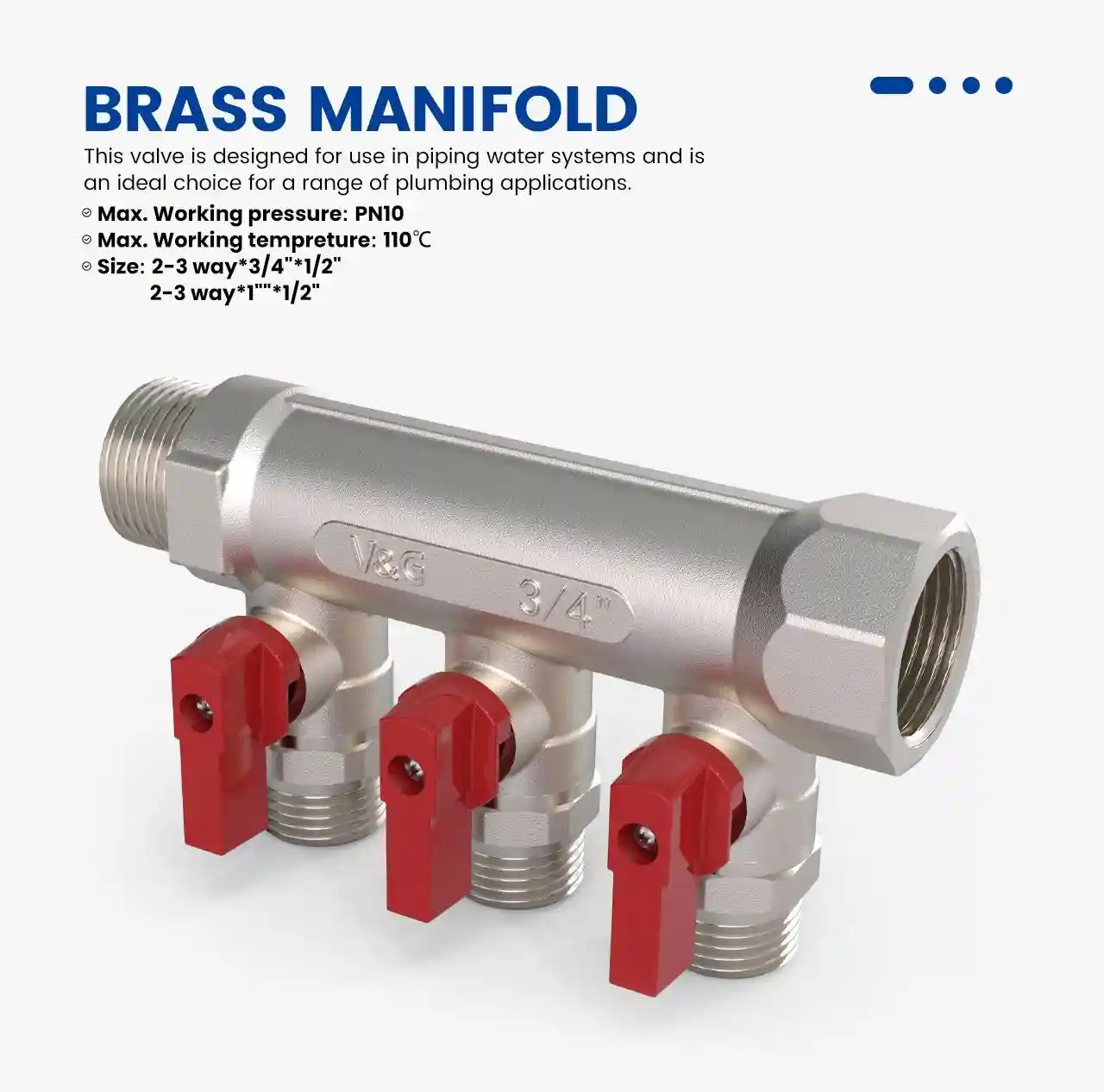
Port count and port size are not marketing choices; they follow the number of heating circuits, the design flow per circuit and the pipe size used on site. The supplied VG21.23161 brass manifold is documented in 2-way and 3-way configurations and in two size combinations: 3/4″ × 1/2″ and 1″ × 1/2″. The manifold is fitted with interception ball valves and is used to control and regulate the flow of hot water in the heating setup.
For an OEM project, treat those documented configurations as the starting range, not as the limit of the programme. Valogin's custom development route covers connection layout and port configuration adapted to the customer's installation. The customization scope also covers full port or reduced port selection, handle type and colour, stem and ball configuration, and union or one-piece body. If the project needs a different port count or a different outlet spacing, the requirement should be shown on the customer drawing rather than described only in an email. The drawing should also state the body dimensions, the distance between ports, the overall length, the mounting points and the dimensional tolerances that will be checked at first article and in batch inspection.
The manifold body in the supplied data is nickel-plated brass. Nickel plating is a finish choice, not a substitute for the brass grade. The drawing should state the body material, the finish, the thread standard and the pressure class separately, so that a change in finish does not silently change the material or the test requirement.
Thread Options: ISO 228, NPT and BSP/G
The documented VG21.23161 manifold uses ISO 228 threads, equivalent to DIN EN ISO 228 and BS EN ISO 228. That is a parallel thread standard widely used in European plumbing and heating products. For an OEM programme, the thread can be adapted to the destination market. Valogin's customization scope names NPT and BSP/G thread options, together with customer-specific thread specification.
Thread choice should be fixed before the body drawing is released. The same manifold outline can be machined with different thread forms, but the gauge, inspection method and mating fittings change with the standard. A buyer serving North America may call for NPT; a buyer serving Europe may stay with ISO 228 / BSP-G; a buyer with a mixed market may need separate part numbers. Do not leave the thread standard to the packing line or to the installer's adapter. State it on the drawing, on the purchase order and on the inspection record.
Pairing the Manifold with the Circuit Valves
A manifold is only one part of the underfloor heating circuit. The manifold distributes the water; the mix valve sets the supply temperature; ball valves isolate sections; angle valves make connections where the pipe route turns; check valves protect against reverse flow where the design requires it. The pairing should be specified as a set, because the thread, pressure class and temperature range of each component have to agree with the circuit.
Mix valve: temperature control at the manifold
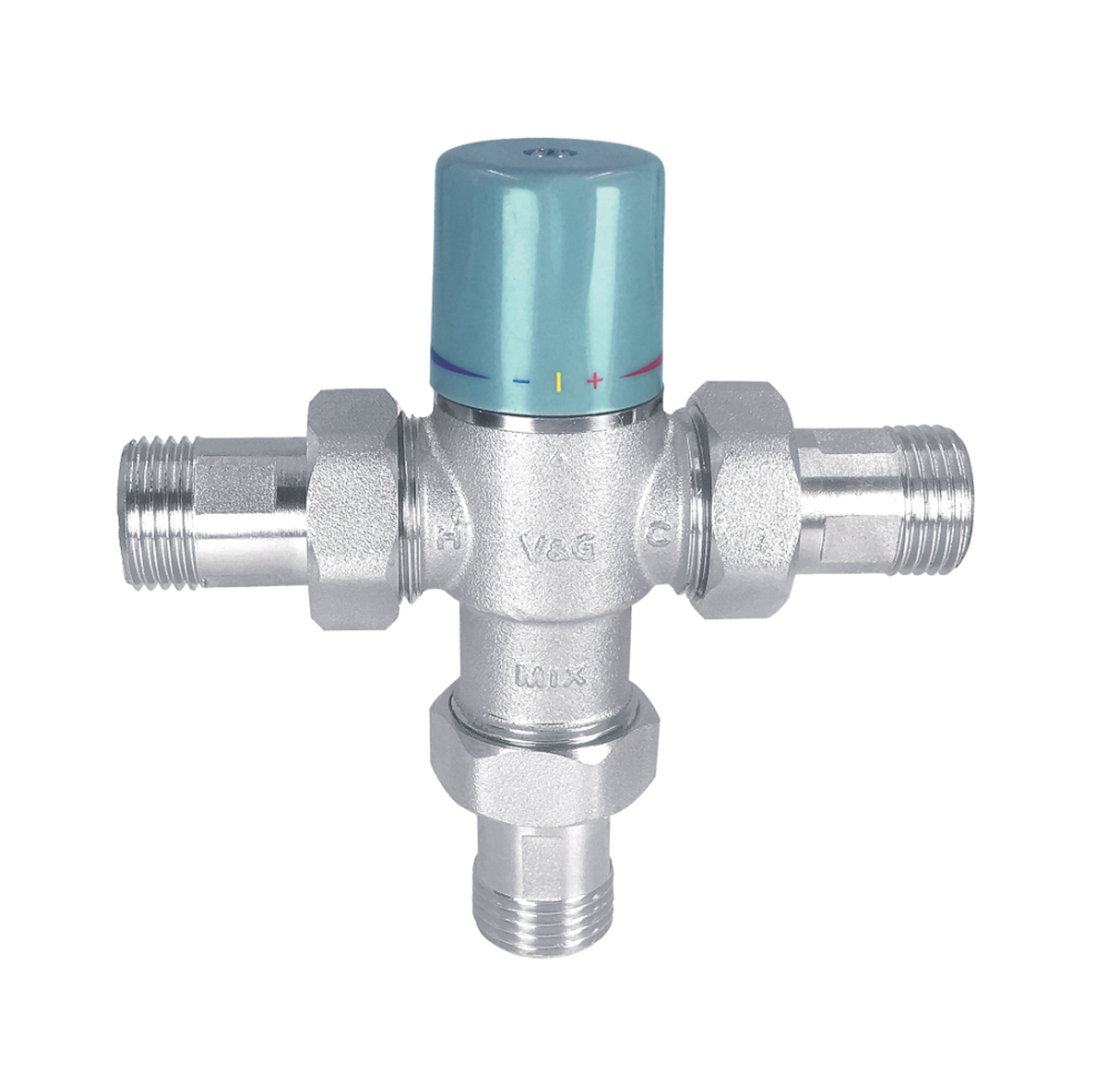
The supplied mix valve VG37.10092 is a thermostatic mixing valve in brass, available in 1/2″, 3/4″ and 1″ sizes. It has male-male threaded connections, a PN25 rating (362.5 psi) and a working temperature range of -20°C to 120°C. In a typical underfloor heating circuit, the mix valve is placed at the manifold inlet to blend hot water from the heat source with cooler return water before it enters the circuits. The specified size should match the manifold inlet and the design flow; the thread should match the manifold connection or the agreed adapter.
Brass ball valve: isolation where the circuit needs a clear shut-off
The supplied brass ball valve VG10.16902 covers 1/4″ to 4″ sizes, with female/female threads, a PN40 rating (40 bar or 580 psi) and a working temperature range of -20°C to 120°C. In an underfloor heating circuit, ball valves are used for quarter-turn isolation at the heat source, at the manifold inlet and outlet, or at a branch that may need service. The manifold itself is supplied with interception ball valves, so the project should avoid duplicating isolation without a reason. Specify the ball valve where the circuit design needs a separate isolation point, and confirm the thread and pressure class against the adjoining components.
Brass angle valve: connection at a change of direction
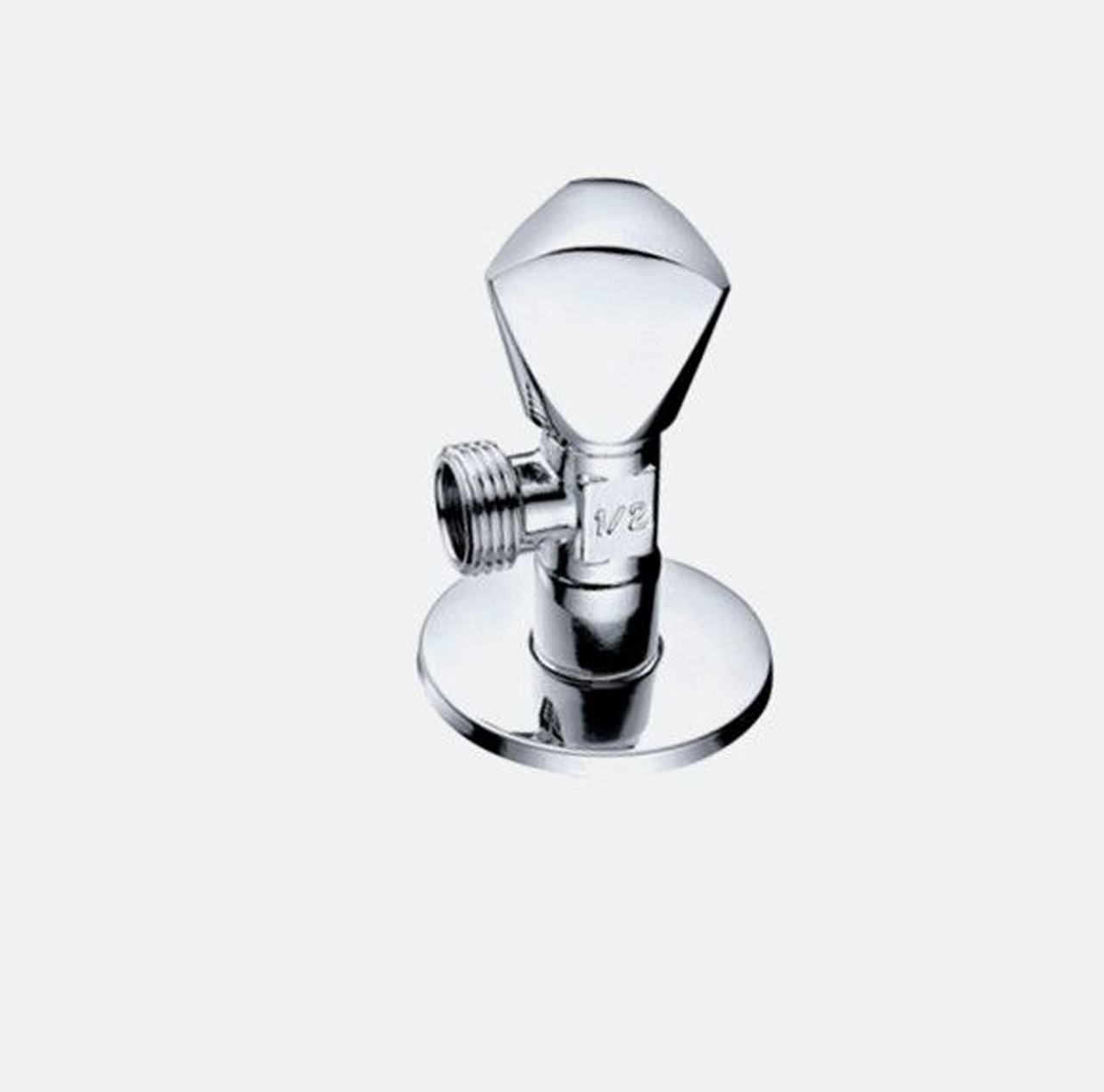
The supplied brass angle valve VG14.90111 is available in 1/2″ × 3/8″ and 1/2″ × 1/2″ sizes. It has ISO 228 threads, a chrome-plated brass body, a chrome-plated zinc alloy handle, a maximum working pressure of PN10 and a temperature range of 0°C to 80°C. The angle pattern is useful where the pipe route turns through 90° at a connection point and a straight valve would add an extra elbow. In a manifold package, the angle valve should be specified only where its pressure and temperature ratings fit the circuit; it is not a substitute for a higher-rated isolation valve on the main flow.
Brass check valve: backflow protection with a temperature check
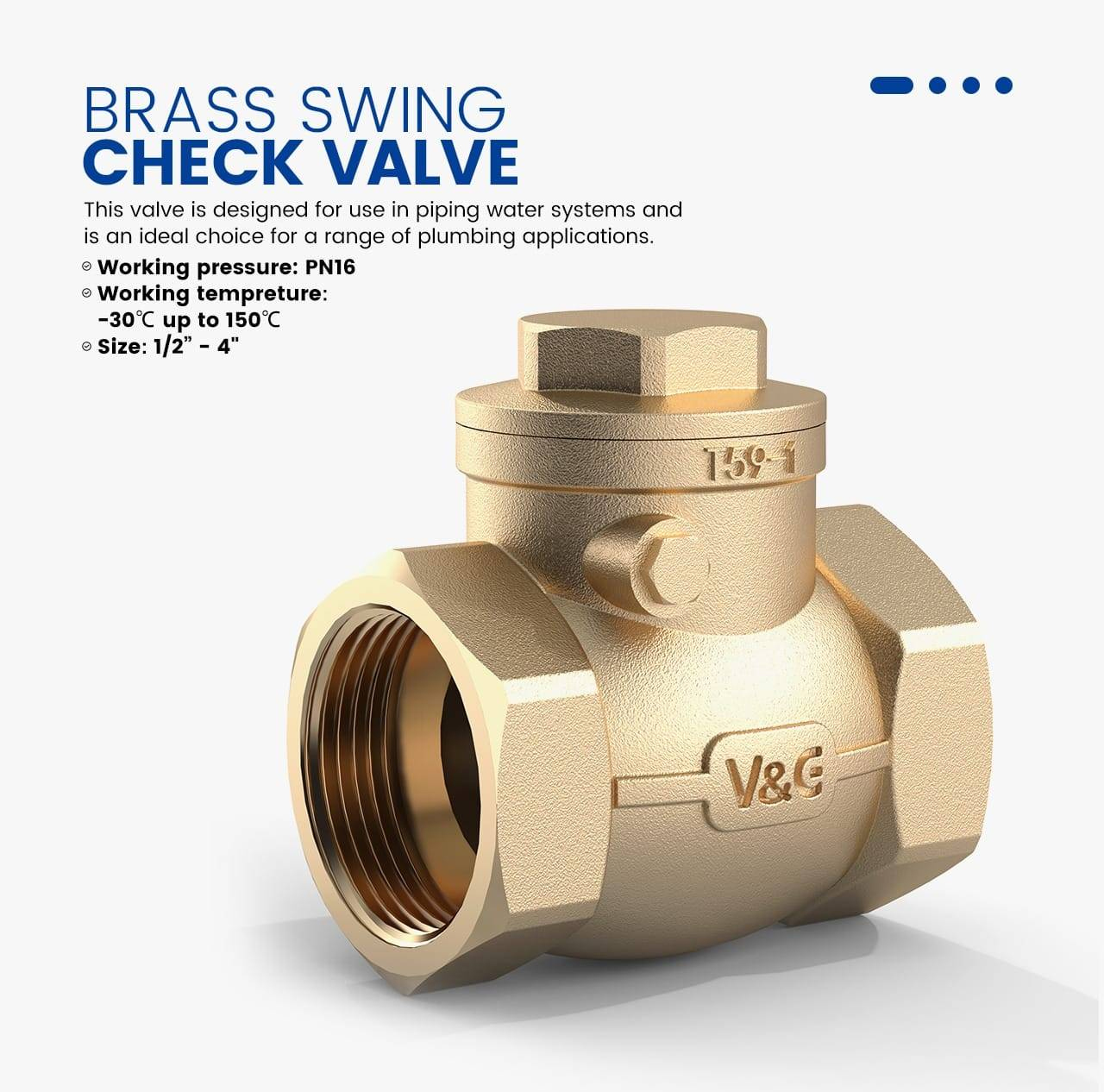
The supplied brass check valve VG12.04033 covers 1/2″ to 4″ sizes, with female/female ISO 228 threads, a PN16 / 232 psi rating and a working temperature range of 0°C to +66°C. It is a swing check valve in natural brass colour. Where the underfloor heating design requires backflow protection on a make-up line or a return branch, this check valve can be considered. The temperature limit is the first check: an underfloor heating circuit can run above 66°C in some designs, so the check valve should not be placed where its limit is exceeded. If the circuit runs hotter, the seal and material selection must be agreed separately; the documented check valve should not be treated as suitable for every underfloor heating temperature.
Comparison Table: Documented Components in the Supplied Range
The table below uses only the supplied product data. It is a specification aid, not a claim that every component is interchangeable across every circuit. The final selection must match the project drawing, the design pressure and temperature, and the buyer's market requirements.
| Component | Documented size range | Thread / connection | Pressure and temperature | Material / finish | Circuit role |
|---|---|---|---|---|---|
| Brass manifold VG21.23161 | 2-way and 3-way configurations; 3/4″ × 1/2″ and 1″ × 1/2″ | ISO 228 (DIN EN ISO 228 / BS EN ISO 228) | Not stated in the supplied manifold specification | Nickel-plated brass body; with interception ball valves | Distributes hot water to underfloor heating circuits |
| Mix valve VG37.10092 | 1/2″, 3/4″, 1″ | Male-male threaded | PN25 (362.5 psi); -20°C to 120°C | Brass | Blends supply and return water at manifold inlet |
| Brass ball valve VG10.16902 | 1/4″ to 4″ | Female/female | PN40 (40 bar or 580 psi); -20°C to 120°C | Brass | Quarter-turn isolation |
| Brass angle valve VG14.90111 | 1/2″ × 3/8″ and 1/2″ × 1/2″ | ISO 228 | PN10; 0°C to 80°C | Chrome-plated brass body; chrome-plated zinc alloy handle | Connection at 90° pipe route |
| Brass check valve VG12.04033 | 1/2″ to 4″ | ISO 228 female/female | PN16 / 232 psi; 0°C to +66°C | Brass natural colour | Backflow protection where design requires and temperature allows |
Brass Grade, Lead Content and Finish: Make the Market Requirement Explicit
Brass grade and lead content are not universal. The buyer's market requirement should be written into the drawing and the purchase specification, together with the test certificate or declaration required. Valogin's OEM customization scope states that brass grade and lead content are set to the customer's market requirement. The same scope covers natural brass, nickel-plated and chrome-plated finishes, and seal and gasket material selected for the medium.
For drinking-water contact, the compliance route differs by market. In North America, NSF/ANSI/CAN 372 sets a weighted average lead content limit of 0.25% for materials in contact with drinking water, and NSF/ANSI/CAN 61 covers health effects. In the EU, the Drinking Water Directive (EU) 2020/2184 Article 11 sets hygiene requirements and a European positive-list mechanism for materials and products in contact with drinking water. These are different regulatory routes and should not be combined into a single global lead figure. For a closed underfloor heating circuit, the buyer's own market specification still governs the brass grade and any lead restriction; state it on the drawing even when the circuit is not potable water.
Finish should be specified separately from material. The manifold in the supplied data is nickel-plated brass; the angle valve is chrome-plated brass with a chrome-plated zinc alloy handle; the check valve is natural brass colour. A finish change can affect appearance, corrosion resistance and the marking method. If the customer's brand uses a particular surface appearance, put it on the drawing with the allowed process and the inspection standard.
Private-Label Marking, Customer Part Numbers and Traceability
An OEM manifold should reach the market with the customer's name, not the manufacturer's. Valogin's OEM/ODM capability covers customer logo and part number cast, stamped or laser-marked on the body and handle; private-label casting marks; customer packaging, labels and printed documentation. The application note for OEM and private-label supply adds dimensional tolerances to the customer's drawing, part marking and full traceability in the customer's own numbering system, dimensional inspection reports, material certificates and process capability data with each batch.
Traceability should be defined before the first casting. A practical specification answers four questions: What is the customer part number format? Where is it marked — body, handle, tag or packaging? Which batch or date code links the finished manifold to the inspection record? Which documents ship with each batch — dimensional report, material certificate, air-tight test record or process capability data? The same rule should apply to the paired mix valve, ball valve, angle valve and check valve, so that a kit can be traced as a set rather than as loose components.
Confidentiality is part of the OEM relationship. The customer's drawings, part numbers and brand relationship should not appear in public material. That is why this guide describes the programme and the documented product range without disclosing any customer drawing or private part number.
From Sample Approval to Scheduled Supply
The delivery framework for an OEM manifold programme should be agreed before the drawing is frozen. The supplied capability data gives a clear sequence: engineering and drawing support from quotation to first article; sample approval before mass production; batch inspection records and material certificates with each shipment; a named account contact for order and technical questions; and quality claim handling terms agreed in the supply contract. Production is scheduled to the customer's forecast and delivery window.
The commercial parameters in the supplied data are:
- MOQ: 5,000 units.
- Typical lead time: 50 days.
- Monthly capacity: 15 million pieces, for scheduling to a forecast.
- Quality control: 100% air-tight test, dimension sampling per batch, material certificate on request.
These figures should be read as programme parameters, not as a promise that every configuration and every order size will follow the same schedule. A new manifold drawing, a new thread standard or a new marking method can add sample and first-article time. The buyer should give a forecast that covers the ramp-up, not only the first order, because the capacity is scheduled against the forecast. For a commercial heating project, the forecast should separate the manifold body, the mix valve and the isolation valves if they are packed as a kit.
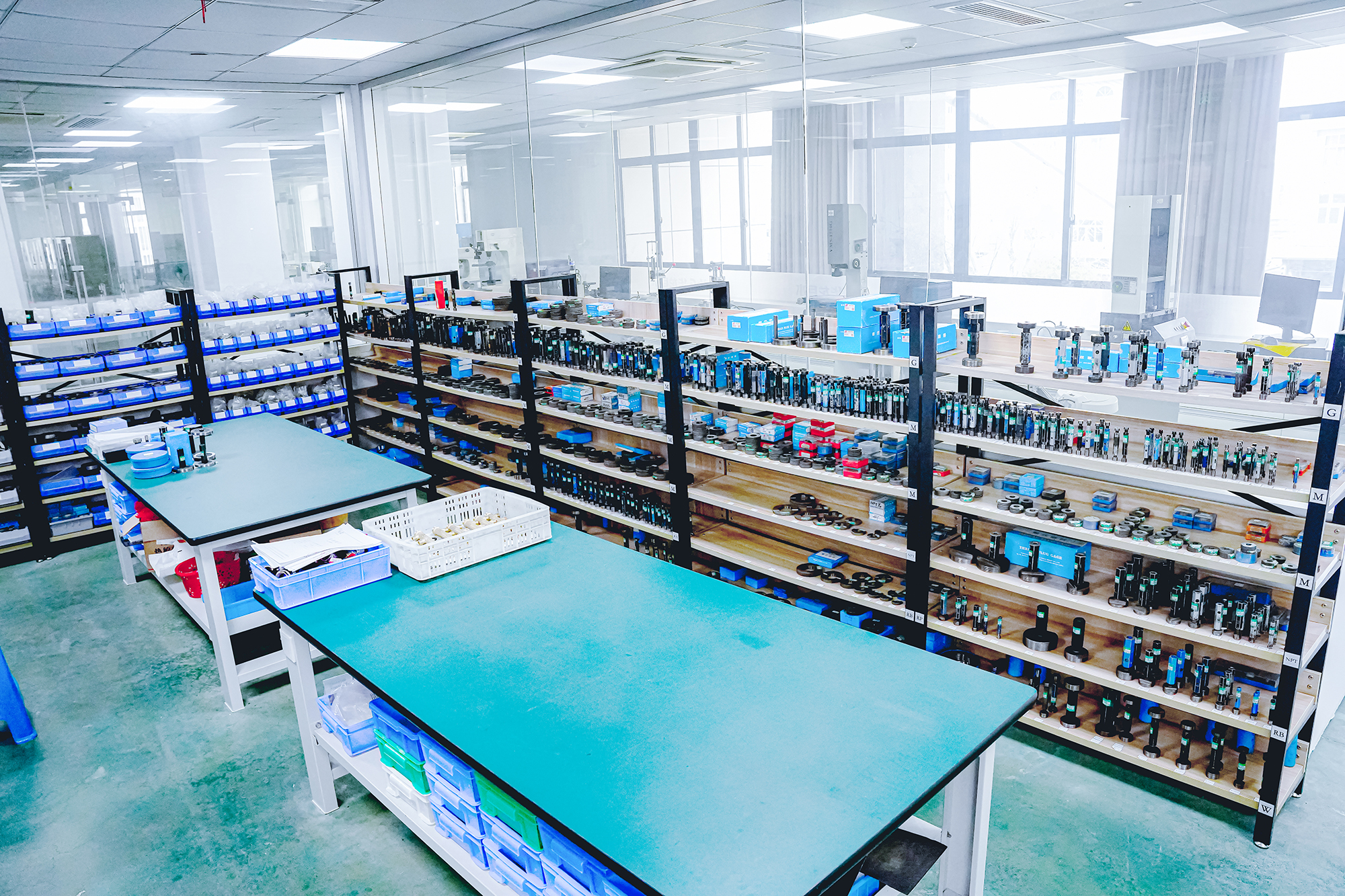
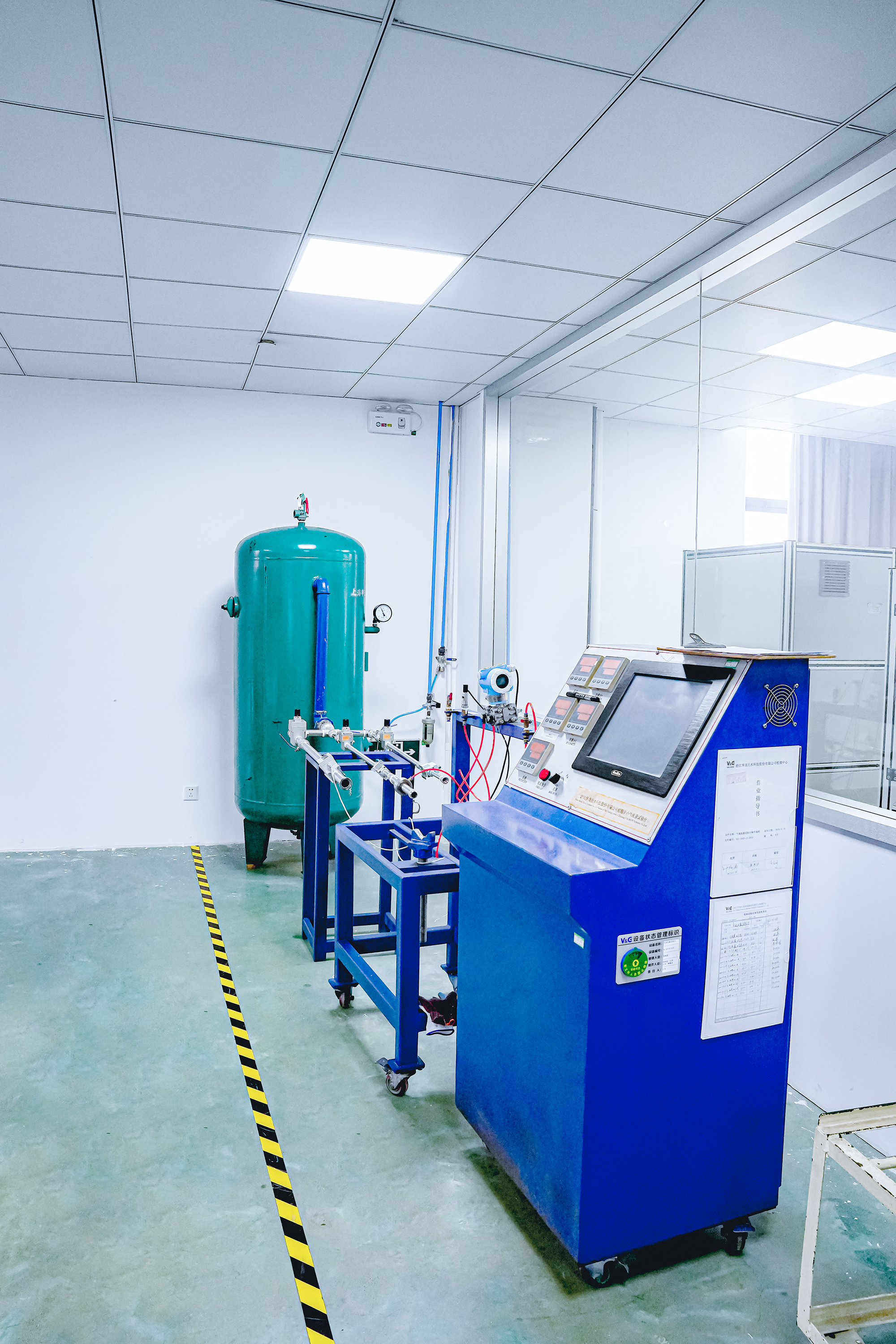
Quality control starts with the thread and the body dimensions, because those are the features that determine whether the manifold fits the pipework. The supplied quality control scope includes 100% air-tight test, dimension sampling per batch and material certificate on request. The factory also operates a national laboratory testing centre with more than 70 R&D technicians, including more than 15 full-time R&D engineers, and a laboratory of about 1,025 square metres established in accordance with ISO 17025. The factory reports that 70% of products are manufactured through automated workflows, with dedicated automatic lines for ball valves and gate valves. For an OEM buyer, the practical point is not the laboratory size by itself; it is that the inspection method for the thread, the body dimensions and the air-tight test can be written into the first-article record and repeated in batch inspection.
Specification Checklist for a Commercial Heating Project
Use this checklist to turn the project requirement into a manifold drawing and a purchase specification. It is written for the OEM buyer who will put their own brand on the finished manifold.
- Circuit data: number of circuits, design flow, supply and return temperature, design pressure, water or glycol concentration.
- Port count and port size: documented 2-way and 3-way configurations; 3/4″ × 1/2″ and 1″ × 1/2″ sizes; confirm any project-specific layout on the drawing.
- Thread standard: ISO 228 as the documented standard; NPT or BSP/G where the destination market requires it; state the gauge and inspection method.
- Body drawing: overall dimensions, port spacing, mounting points, tolerances and the customer part number.
- Valve pairing: mix valve size and thread; ball valve isolation points; angle valve connections; check valve location and temperature compatibility.
- Material and finish: brass grade, lead content requirement, natural brass / nickel-plated / chrome-plated finish, seal and gasket material.
- Marking and packaging: logo and part number method, private-label casting mark, label, instructions and carton printing.
- Traceability: batch code, inspection record, material certificate, process capability data and the customer's numbering system.
- Approval: sample approval before mass production; first-article inspection report; agreed quality claim terms.
- Supply: MOQ 5,000 units, 50-day typical lead time and a forecast that supports 15 million pieces monthly capacity.
FAQ
How should we specify brass grade and lead content for our market?
State the brass grade and lead content on the drawing and purchase order, together with the test certificate or declaration required. For drinking-water contact, North America uses NSF/ANSI/CAN 372 (0.25% weighted average lead content) and NSF/ANSI/CAN 61; the EU uses the Drinking Water Directive (EU) 2020/2184 Article 11 positive-list route. These are different compliance routes and should not be combined into one global lead figure. For a closed underfloor heating circuit, the buyer's market specification still governs; Valogin's OEM scope sets brass grade and lead content to the customer's market requirement.
Are you an OEM HVAC valve manufacturer for commercial heating systems?
Yes. Valogin Valve is an OEM/ODM manufacturer of brass valves and manifolds for commercial heating systems. The factory covers casting, machining, assembly and testing, and production follows the customer's drawing, sample or written requirement. The supplied range includes ball valves, gate valves, check valves, stop valves, angle valves, manifolds, mix valves, gas ball valves, float ball valves and bibcocks.
What port count and port size should we specify for an underfloor heating manifold?
Start from the circuit layout and design flow, then put the result on the drawing. The documented VG21.23161 manifold is available in 2-way and 3-way configurations and in 3/4″ × 1/2″ and 1″ × 1/2″ sizes. If the project needs a different port configuration, the custom development route covers connection layout and port configuration adapted to the customer's installation. Do not specify port count from a catalogue picture alone; confirm it against the number of circuits and the pipe size.
Which thread standard should the manifold use: ISO 228, NPT or BSP/G?
The documented manifold uses ISO 228 threads, equivalent to DIN EN ISO 228 and BS EN ISO 228. For OEM programmes, the thread can be adapted to the destination market, including NPT and BSP/G, to the customer's drawing. The choice should follow the fittings used in the destination market and should be stated on the drawing, the purchase order and the inspection record. A mixed-market programme may need separate part numbers for different thread standards.
Which valves should be paired with the manifold in a typical underfloor heating circuit?
A typical set includes a mix valve at the manifold inlet, ball valves for isolation, angle valves where the pipe route turns, and a check valve where backflow protection is required. In the supplied range, the mix valve is VG37.10092 (1/2″, 3/4″, 1″; male-male; PN25; -20°C to 120°C), the brass ball valve is VG10.16902 (1/4″ to 4″; female/female; PN40; -20°C to 120°C), the brass angle valve is VG14.90111 (1/2″ × 3/8″ and 1/2″ × 1/2″; ISO 228; PN10; 0°C to 80°C), and the brass check valve is VG12.04033 (1/2″ to 4″; ISO 228; PN16 / 232 psi; 0°C to +66°C). Check the temperature and pressure of each component against the circuit before finalising the kit.
What are the MOQ, lead time and capacity for an OEM manifold programme?
The supplied programme parameters are MOQ 5,000 units, a 50-day typical lead time and 15 million pieces monthly capacity for scheduling to a forecast. Sample approval comes before mass production, and batch inspection records and material certificates can ship with each batch. To start a sample, send the drawing, the target market, the thread standard, the brass grade and lead requirement, the finish, the marking method and the forecast. The engineering and drawing support runs from quotation to first article, and a named account contact handles order and technical questions.
Conclusion: Specify the Manifold as a Programme, Not a Part Number
A brass manifold for underfloor heating is a small assembly with a large specification surface. Port count and port size set the hydraulic fit; thread standard sets the installation fit; body drawing sets the dimensional fit; valve pairing sets the circuit function; brass grade, lead content and finish set the market fit; marking and traceability set the brand fit; sample approval, MOQ, lead time and capacity set the supply fit. The documented Valogin manifold VG21.23161 and the paired mix valve, ball valve, angle valve and check valve give an OEM buyer a starting range, not a substitute for the project drawing.
For a commercial heating project, the useful next step is to convert the checklist into a drawing and a sample request. Valogin Valve supports OEM and ODM production for brass valves and manifolds, with engineering and drawing support from quotation to first article and sample approval before mass production. The company's brand catalogue can be downloaded here: Valogin brand catalogue. For the company profile, see Valogin Valve.
Have Questions or Need More Details?
Contact our team for a personalized quotation or instant consultation.
Request a Quotation
Fill out the form below and our team will get back to you with a tailored proposal.
WhatsApp Direct Chat
Prefer to chat in real-time? Message us on WhatsApp for instant assistance & quick answers.
- Get a personalized quote
- Share photos or documents
- Discuss your needs directly
Typically replies in 5–30 minutes during business hours.