Cast vs Forged Brass Valve Bodies: A Buyer's Comparison Guide
Is a cast or a forged brass valve body better? Neither route wins in the abstract. A forged body is normally the safer answer where the pressure class is high, the body is small and internal soundness cannot be inspected after assembly — a PN40 brass ball valve is the classic case. A cast body is usually the practical answer for larger, lower-pressure shapes with internal passages, such as a PN16 brass gate valve. The decision belongs to four variables in this order: grain structure, porosity risk, wall thickness consistency and PN rating fit. Price is the fifth question, not the first.
Why the body forming route decides more than the quotation line
Buyers rarely ask the abstract question. What they actually need to know is whether a specified pressure class, a specified approval and a specified delivery window can all be met by the same supplier. Body forming is the reason one supplier can meet the spec and another cannot, even when both send drawings that look identical.
Casting and forging produce a valve body that is then machined, assembled and tested in much the same way afterwards. The difference is created before the first cut: in how the metal became solid. That difference propagates into wall thickness, soundness and the pressure class the finished body can be trusted to hold. A buyer who evaluates only the finished drawing, the price and the delivery date is evaluating the outcome without the cause.
Industry background: how brass valve bodies are actually formed
Brass valve bodies are produced by one of two routes, and both are established practice across the valve industry.
Casting pours molten brass into a mould shaped like the body. The metal freezes from the mould wall inward, so solidification is directional. The last region to freeze needs a continuous supply of liquid metal; without it, shrinkage voids remain inside the section. Casting handles complex internal passages and larger body shapes more easily, and the tooling is generally less expensive than a forging die. The trade-off is that soundness depends heavily on melting practice, pouring temperature and mould temperature control.
Forging starts from a heated billet or brass rod and forms the body under pressure in a die — hot forging and hot heading are the usual production methods. Because the metal is deformed in the solid state under load, internal voids are closed rather than created, and the section that results is generally sound and fine grained. Forging does not lend itself to complex internal cavities, the dies are costly, and a forged body typically needs more machining afterwards to reach the final geometry.
Neither route is a quality claim on its own. Both can be executed well or badly. What matters for procurement is whether the supplier's process control matches the pressure class and approval scope being purchased.
Grain structure and porosity risk: what the forming route really changes
In a cast body, the grain structure follows the thermal gradient of solidification, so grain size can vary between a thin wall and a heavy boss. When feeding and mould design are correct, a casting performs to its rated class. The risk that a buyer is actually managing is porosity — both surface porosity and internal micro-shrinkage — and how tightly the foundry controls it from batch to batch.
In a forged body, deformation refines the grain and consolidates the section. A forged body therefore tends to be denser and more fatigue resistant for the same envelope, which is why small high-pressure bodies are commonly forged. That advantage is real but narrow: forging fixes material soundness, not machining accuracy. A sound blank with a badly cut thread is still a leaking valve.
Grain structure is also measurable rather than merely asserted. Zhejiang Valogin Technology Co., Ltd. (valogin valve) — a Chinese manufacturer of brass valves, fittings and distribution manifolds for plumbing, heating and gas systems, founded in 1985 and based in Qinggang Industrial Zone, Yuhuan, Zhejiang — operates a laboratory of about 1,025 square metres built to ISO 17025 principles, equipped with an inverted metallographic microscope, a comprehensive test bench and more than 100 sets of equipment. Metallographic examination is what turns a grain-structure discussion into a documented result instead of a sales statement.
What to ask instead of “is it forged?” Ask for the finished wall thickness after machining, the alloy grade, the pressure test record and the metallographic or dimensional evidence for the batch. The forming route explains the risk profile; the records prove the risk was controlled.
Wall thickness consistency: the variable that decides leaks and approvals
Wall thickness drives three things at once: pressure containment, thread strength and resistance to deformation when the valve is tightened into a line. In a forged body, wall thickness is set by the die cavity, so variation comes mainly from billet weight and die wear. In a cast body, shrinkage during solidification and mould wear add further variation.
For a buyer, the number that matters is not the nominal wall in the drawing but the residual wall after machining — what is actually left once the thread and the sealing face have been cut. This is the reason drawing review belongs before first article approval, not after a batch has shipped. Valogin's stated process follows that order: engineering and drawing support from quotation to first article, sample approval before mass production, 100% air-tight testing, dimension sampling per batch, and material certificates on request.

Pressure class fit: what each PN rating demands from the body
The PN rating sets the wall thickness and the test requirement; the forming route has to be able to deliver them. Across the Valogin range the ratings are stated per model, and the spread is wide enough to show why a single body format cannot serve every line item.
| Valve family | Reference model | Pressure class | Temperature range | Buyer implication |
|---|---|---|---|---|
| Brass ball valve | VG10.16902 | PN40 (40 bar / 580 psi), 1/4″–4″ | -20 °C to 120 °C | Highest class in the range; body soundness is critical, not optional |
| Mix Valve | VG37.10092 | PN25 (362.5 psi), 1/2″–1″ | -20 °C to 120 °C | Pressure class plus stable blending performance |
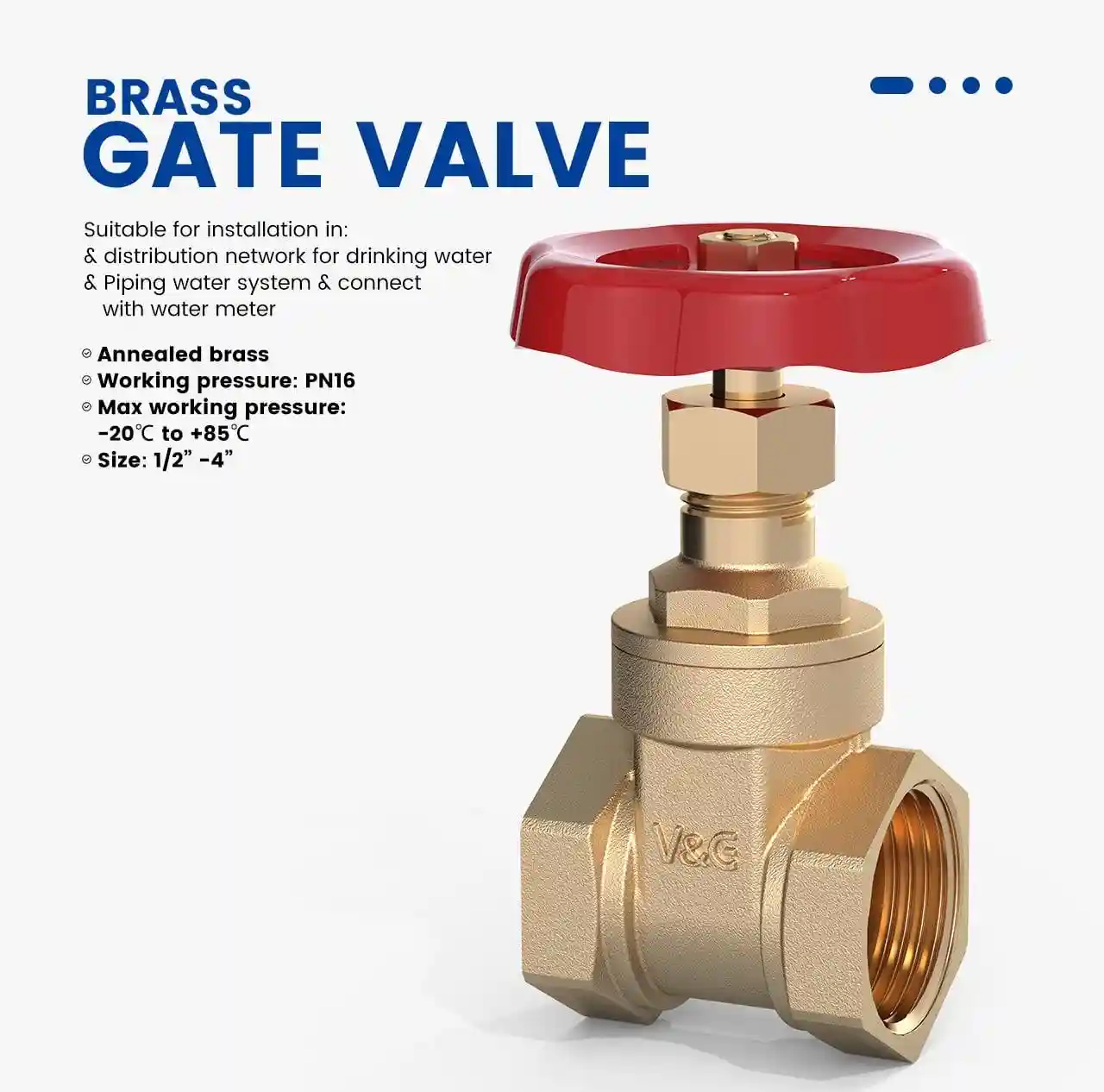
| Brass gate valve | VG11.11302 | PN16 (16 bar), 1/2″–2″ | 0 °C to 80 °C | Straight-through bore on larger shapes; wall consistency decides seat life |
| Brass check valve | VG12.04033 | PN16 / 232 psi, 1/2″–4″ | 0 °C to +66 °C | Body plus disc guidance both carry the rating |
| Brass stop valve | VG16.70411 | PN10, 12 mm–28 mm | -20 °C to 100 °C | Throttling duty; stem and seat finish matter as much as the body |
| Brass angle valve | VG14.90111 | PN10, 1/2″x3/8″, 1/2″x1/2″ | 0 °C to 80 °C | Fixture-level isolation; chrome-plated brass body |
| Brass gas ball valve | VG10.61011 | MOP5, 1/4″–4″ | -20 °C to 120 °C | Gas tightness is a safety property, not a performance property |
| Brass float ball valve | VG20.10212 | 1/2″–4″ | -20 °C to 120 °C | Continuous unattended duty; 100% leak tested |
| Brass Manifold | VG21.23161 | 2-way or 3-way, 3/4″x1/2″ and 1″x1/2″ | Heating service, nickel-plated brass body | Multi-branch body with ISO 228 threads |
Read the table as a specification, not a ranking. A PN10 brass stop valve is not a worse product than a PN40 brass ball valve; it is designed for a different duty. The mistake buyers make is approving a body format against one class and then extending that approval to a higher class without re-checking wall thickness and test pressure.
How forged body quality is controlled before and after machining
Valogin's production base covers more than 28,000 square metres with over 1,000 employees and an annual output of 80 million pieces; more than 90% of turnover comes from international markets, with Europe and North America as key markets and coverage extending to South America, the UAE and more than 100 countries. The R&D team includes more than 70 designers and engineers, of which over 15 are full-time R&D engineers working on water, gas, oil and heating systems.
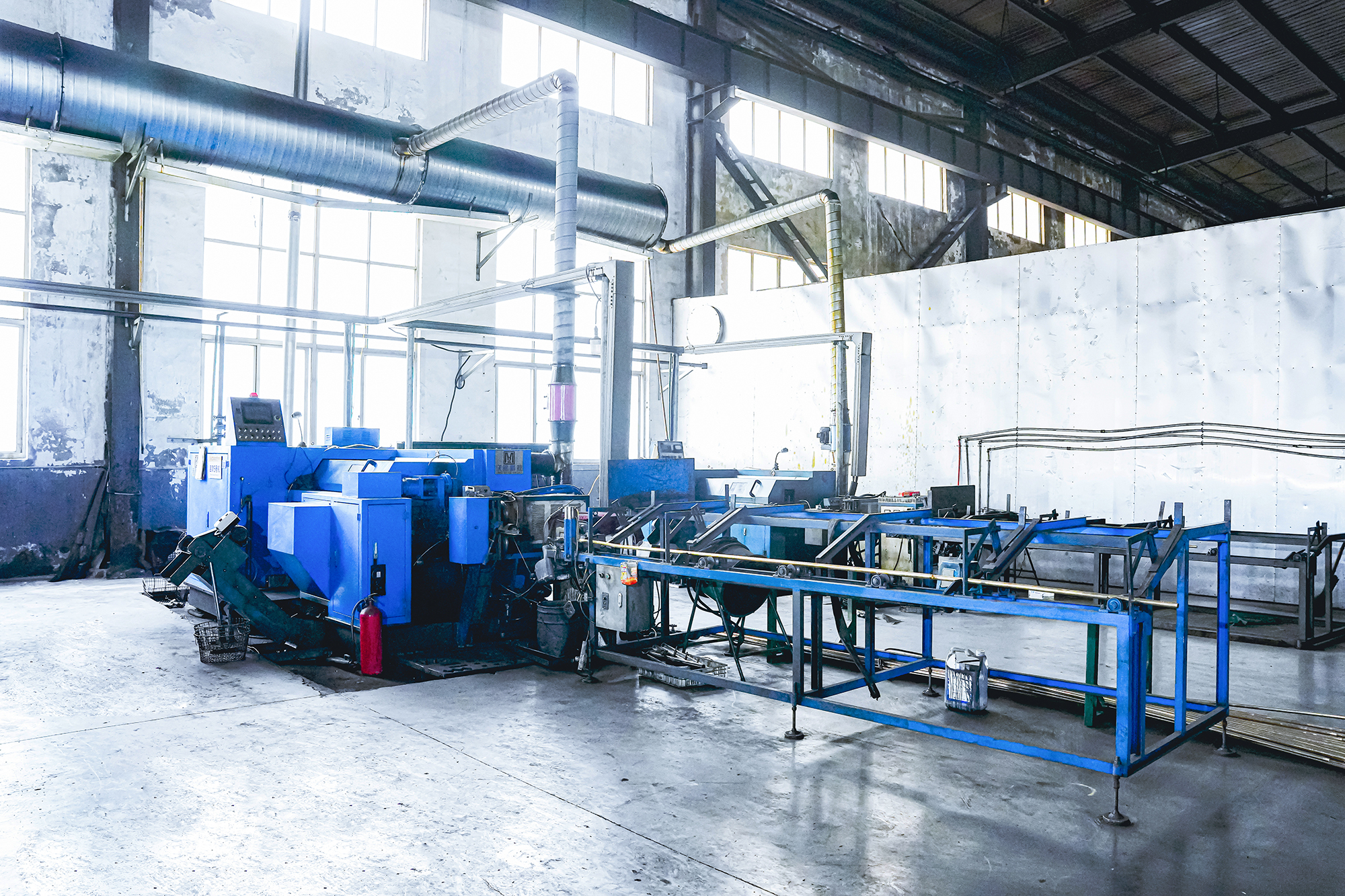
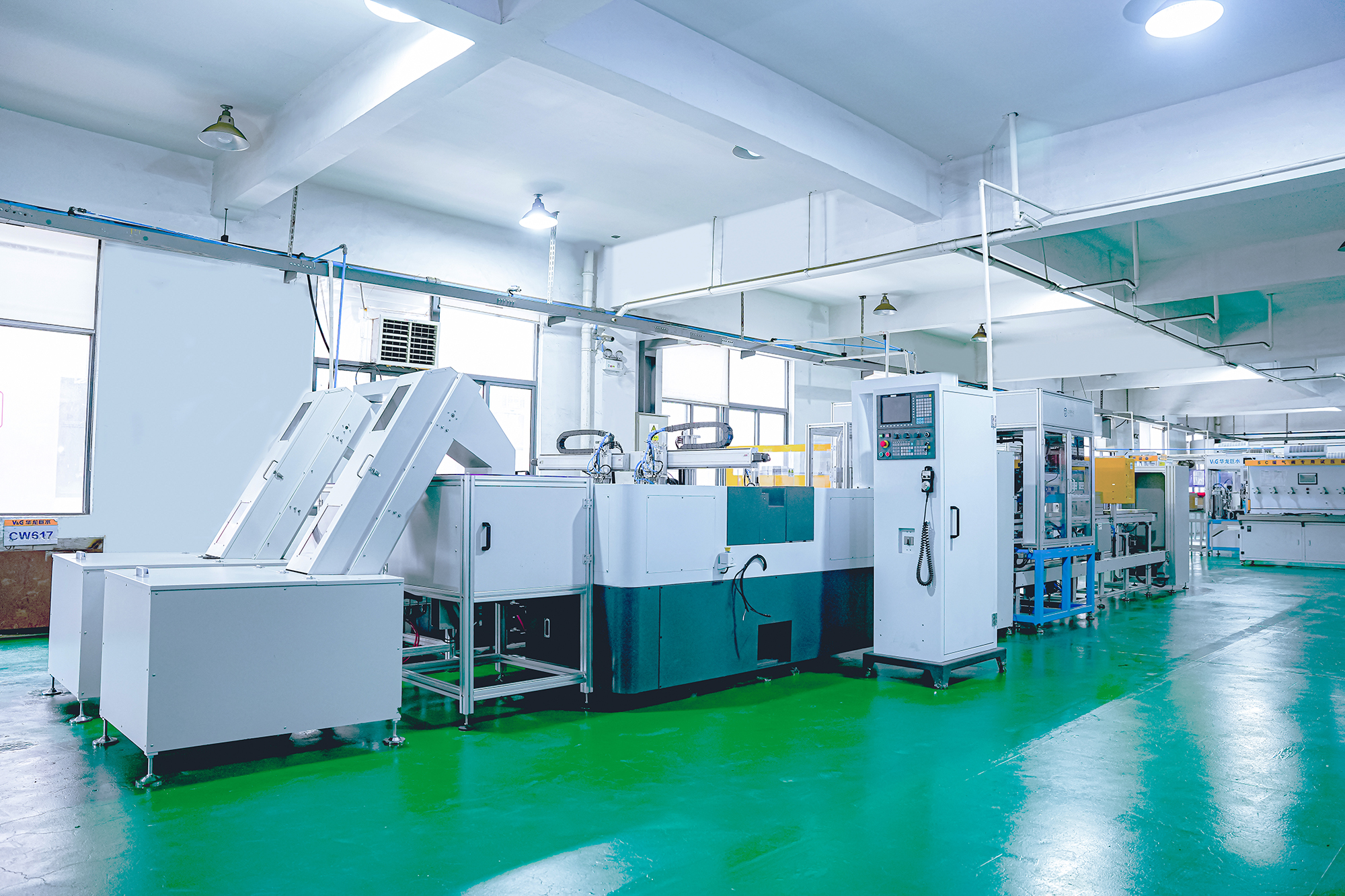
On the shop floor, the workshop includes hot forging equipment, automated CNC cells, rotary transfer machining and dedicated fully automatic production lines for ball valves and gate valves, supported by automatic assembly areas. Around 70% of production runs through automated workflows, which reduces human variation between batches. Forging decides the soundness of the blank; machining and assembly decide whether that soundness survives into the finished valve.
Testing is where the two meet. The laboratory carries out salt spray testing, flow testing, bending tests, thermostatic valve testing and thread gauge management, and the company holds ISO 9001, ISO 14001 and ISO 45001 management system certification together with CNAS, CE, DVGW, AGA, WRAS, NSF, cUPC, CSA and AB1953 approvals.

Step by step: how to approve a cast or forged brass body specification
- Fix the medium and temperature first. Potable water, heating water, glycol mixture and natural gas impose different seal and body requirements. A radiator circuit runs continuously at up to 90 °C with the system under pressure year-round; a gas line on the low-pressure side normally sits at 0.02–0.5 bar but must be gas-tight, because leakage there is a safety issue rather than a performance issue.
- Convert the working condition into a PN class with margin. Building water supply runs at 1–10 bar with hot water up to 65 °C; underfloor heating runs at up to 6 bar; district heating substations can reach 120 °C on the primary side at PN16. Match the model to the condition rather than to habit.
- Match the body format to the geometry. Small, high-class, simple-outline bodies favour forging. Larger shapes with internal passages favour casting. If a supplier offers the same geometry in both routes, compare the residual wall and the test record, not the sales description.
- Separate the dezincification requirement from the forming question. Dezincification resistance is an alloy and heat-treatment property, not a forging property. It matters most where the line is never fully drained — underfloor manifolds concealed in a floor build-up, riser lines in occupied buildings, radiator circuits under year-round pressure — because those are the locations where a repair is most expensive.
- Lock the thread standard to the destination market. The range uses ISO 228 threads, equivalent to DIN EN ISO 228 and BS EN ISO 228, across gate valves, stop valves, angle valves, manifolds and ball valves; the gas ball valve additionally offers ISO 7/1 Rp parallel threads, equivalent to DIN EN 10226-1 and BS EN 10226-1. Custom thread specification, surface finish, logo engraving and packaging are supported for OEM and ODM programmes.
- Confirm the approval covers the exact model, not just the supplier. Approval scope is product-specific. Check the certificate number, the product family it covers and the expiry date before the purchase order is raised.
- Approve a sample before mass production. Sample approval before mass production, together with drawing support from quotation to first article, is the stage where a wall thickness or thread deviation is still cheap to correct.
- Write the records into the supply contract. Batch inspection records and material certificates with each shipment, 100% air-tight testing, dimension sampling per batch, and agreed quality claim handling terms. Minimum order quantity is 5000 units and lead time is 50 days, so a batch-level argument after shipment costs far more than a first-article argument before it.
Where the cast-or-forged decision matters most: three valve families
Brass gate valve
The gate valve is a straight-through, low-resistance isolation valve used on main supply lines and risers, and on heating circuits where the circulator and main distribution lines need coarse shut-off. The body shape is comparatively large for its bore, and internal passages matter, which is why this is a family where casting is common practice. The Valogin brass gate valve VG11.11302 is rated PN16, 1/2″–2″, 0 °C to 80 °C, with ISO 228 threads, and is produced on a dedicated automatic gate valve line. For the buyer, the governing question is wall consistency around the seat and the body-to-bonnet joint, because that is where a thin section shows up first as a leak.
Brass ball valve
The ball valve is the default quarter-turn isolation valve for water and gas lines, because the handle position shows the valve state at a glance. It is also the family where the pressure class pushes hardest on the body: the Valogin brass ball valve VG10.16902 is rated PN40, 40 bar / 580 psi, 1/4″–4″, -20 °C to 120 °C, with female/female threads. At that class the body has to be sound through its full section, which is why small high-class bodies are typically forged and then machined. Port configuration — full port for pump and manifold duty, reduced port where space and cost dominate — is decided in the same conversation, because port size changes the body envelope.
Brass stop valve
The stop valve exists to throttle. It is used to split flow between a heating circuit and a hot water cylinder, and to throttle radiators so that those far from the circulator still reach design temperature. The Valogin brass stop valve VG16.70411 is rated PN10, 12 mm–28 mm, -20 °C to 100 °C, with 1″ threaded connections. Throttling duty places a different demand on the body: the stem and seat are worked continuously at part-open positions, so dimensional stability and seat finish matter as much as raw wall thickness.
The same reasoning applies across the wider range. The brass check valve VG12.04033 (PN16 / 232 psi, 1/2″–4″) prevents back-flow and cross-connection; the brass angle valve VG14.90111 (PN10) connects sanitary fixtures; the brass bibcock VG13.99011 (1/2″–1″) serves outdoor water points; the brass float ball valve VG20.10212 (1/2″–4″, -20 °C to 120 °C) holds tank level without power; the Mix Valve VG37.10092 (PN25) blends supply and return for underfloor heating; and the brass manifold VG21.23161 distributes per-loop flow from a nickel-plated brass body. The brass gas ball valve VG10.61011 carries CE and DVGW approval to EN 331 at MOP5, and is the model where the body question is least negotiable of all.
Cast vs forged brass valve bodies: comparison table
| Decision factor | Cast brass body | Forged brass body | What the buyer should verify |
|---|---|---|---|
| How the section is formed | Molten brass poured into a mould; solidification is directional | Heated billet or rod deformed under pressure in a die | Which route the quoted model actually uses |
| Grain structure | Follows the thermal gradient; can vary between thin and heavy sections | Refined by deformation; generally more uniform through the section | Metallographic evidence if the class is high |
| Porosity risk | Shrinkage and gas porosity possible without controlled feeding and mould temperature | Voids consolidated by pressure; risk shifts to die wear and billet weight | Pressure and air-tightness test records per batch |
| Wall thickness consistency | Affected by shrinkage plus mould wear | Set by the die cavity; affected by billet weight and die wear | Residual wall after machining, not nominal drawing wall |
| Typical pressure class fit | Commonly used for PN10–PN16 shapes with internal passages | Commonly used where the class is high relative to body size, up to PN40 in this range | The PN rating of the specific model being quoted |
| Shape freedom | Handles complex internal passages and larger bodies more easily | Limited on complex internal cavities; needs more machining to finish | Whether the required bore and port layout is achievable |
| Tooling and unit cost profile | Lower tooling cost, generally heavier section for the same class | Higher tooling cost, generally denser section for the same class | Total cost across the order quantity, not piece price alone |
| Approval relevance | Approval scope is model-specific regardless of route | Approval scope is model-specific regardless of route | Certificate number, covered model family, expiry date |
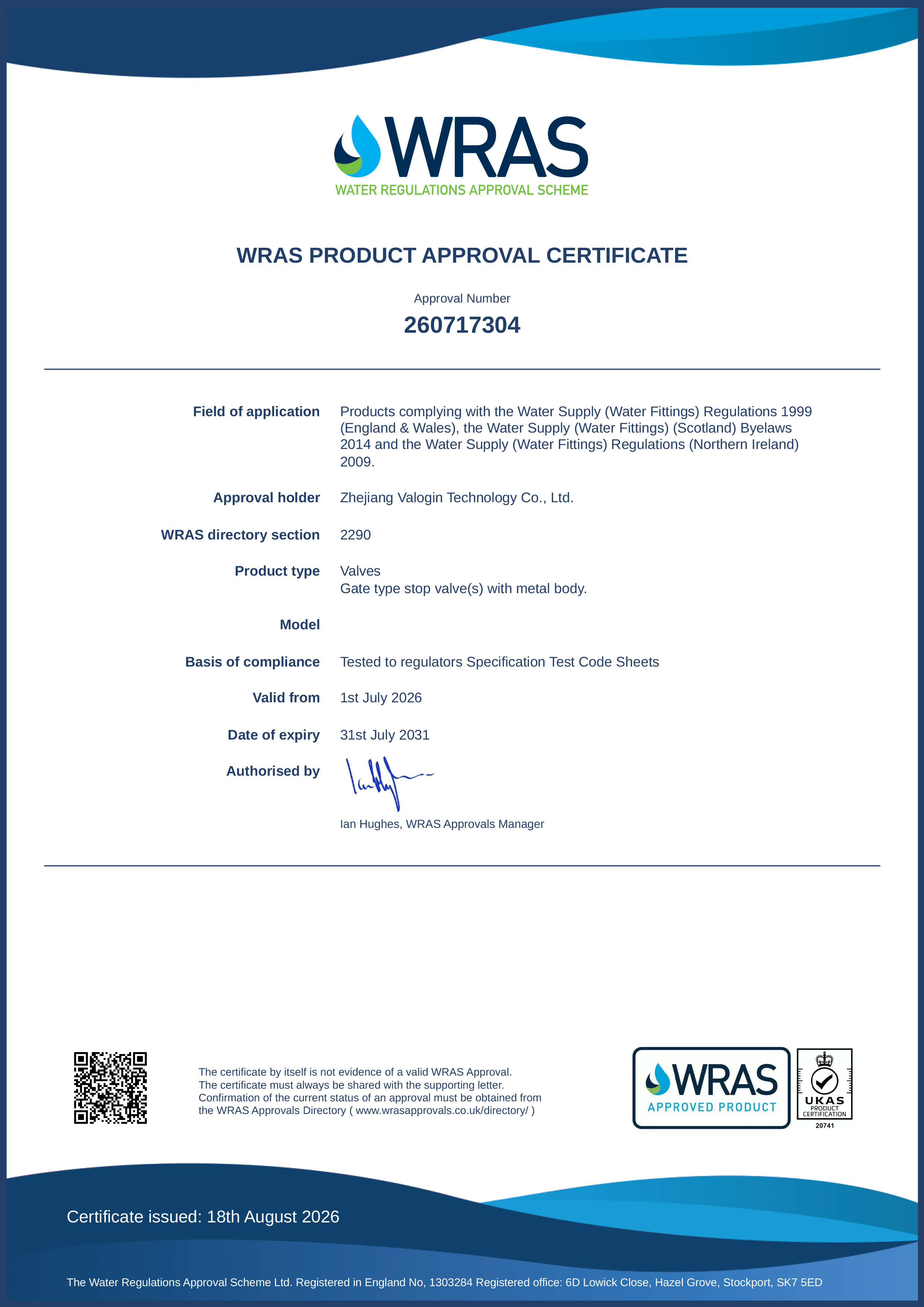
The table deliberately contains no superiority column. In this range, both routes appear in approved products: the WRAS product approval 260717304 covers valves in the gate valve category, while the UPC listing 7553 covers ball valves. The correct reading is that approval follows the model and its evidence, not the forming method in isolation.
Decision checklist: PN rating, dezincification resistance and market approval
- PN rating matched to the actual duty, with margin. Confirm the model rating against the line condition: PN40 for the ball valve family, PN25 for the mix valve, PN16 for gate and check valves, PN10 for stop and angle valves, MOP5 for the gas ball valve. Do not extend a lower-class approval to a higher-class line item.
- Dezincification resistance confirmed by alloy and record. Required wherever the line is permanently wet and rarely drained — concealed underfloor manifolds, risers in occupied buildings, radiator circuits under year-round pressure. Ask for the alloy grade and the corrosion test evidence rather than a verbal assurance.
- Thread standard matched to the destination market. ISO 228 (equivalent to DIN EN ISO 228 and BS EN ISO 228) across the standard range; ISO 7/1 Rp parallel (equivalent to DIN EN 10226-1 and BS EN 10226-1) where the gas market requires it.
- UK market: WRAS product approval 260717304, issued 18 August 2026, valid to 31 July 2031, covering valves in the gate valve category against the Water Supply (Water Fittings) Regulations 1999, the Scotland Byelaws 2014 and the Northern Ireland Regulations 2009.
- Australia: WaterMark Certificate of Conformity WM-022194 issued by IAPMO R&T Oceana to WMTS-012:2018, valid 8 March 2022 to 7 March 2027, covering in-line valves for plumbing water supply systems; AGA certificate 8775 for manual shut off valves.
- US and Canada: UPC Certificate of Listing 7553 for ball valves against IAPMO/ANSI Z1157-2014e1 (R2019), ASME A112.14.2022/CSA B125.14:22 and NSF/ANSI 14-2023; Lead Free certificate 7555 to NSF/ANSI/CAN 372-2024, Section 1417(d) of the Safe Drinking Water Act and Section 116875 of the California Health & Safety Code; CSA certificate 2759792 for gas valves.
- EU gas market: DVGW type examination certificate DG-4312DQ0883 to DIN EN 331 (01.04.2016), valid to 22 December 2030, for gas shut-off valves up to MOP 5.
- France and EU pressure equipment: ACS certificate 23 ACC NY 155 to XP P41-280, valid 6 April 2023 to 6 April 2028, covering pressure reducer 18.07023.G20.CP; ECM certificate 0B230606.ZVTDN65 to EN 12266-1:2012 and EN 12266-2:2012 for check valves and Y strainers, valid to 5 June 2028.
- Certificates in hand before the order, not after. Confirm the certificate covers the exact model and remains valid for the shipment date. A family approval does not automatically cover every size and variant.
Frequently asked questions
How do I screen Chinese brass plumbing valve manufacturers for lead-free compliance?
Screen on certificate number, standard and product scope, not on a statement. Valogin holds Lead Free certificate 7555 issued by IAPMO Research and Testing, Inc., assessed against NSF/ANSI/CAN 372-2024, Section 1417(d) of the Safe Drinking Water Act and Section 116875 of the California Health & Safety Code, issued 21 January 2026. Pair that with the ball valve listing under UPC certificate 7553 and, for the UK, WRAS product approval 260717304. Then confirm that the specific model and size you are buying appears within the certified scope, and that the certificate is still valid on the shipment date.
Does the body forming route change the pressure class I can actually buy?
The model's PN rating is the ceiling you can rely on; the forming route explains whether that ceiling can be held in production. In the Valogin range the ball valve VG10.16902 is rated PN40 (40 bar / 580 psi), the Mix Valve VG37.10092 PN25 (362.5 psi), the gate valve VG11.11302 and check valve VG12.04033 PN16, the stop valve VG16.70411 and angle valve VG14.90111 PN10, and the gas ball valve VG10.61011 MOP5. Ask for the rating of the exact model quoted, then ask for the wall thickness and test record that support it.
Is a forged body always more expensive than a cast body?
Not on a like-for-like line item, and the comparison should be run per order rather than per piece. Forging carries higher tooling cost and typically leaves more machining to finish the body; casting carries lower tooling cost but generally needs a heavier section to reach the same class. On a small body at a high class, the forged route is often the one that holds the rating reliably; on a larger body with internal passages at PN16, casting is the practical choice. Request both routes as a quoted option where the geometry allows it, and compare total landed cost, scrap rate and claim history rather than piece price.
Can I approve a sample before committing to a production quantity?
Yes. Sample approval before mass production is part of the standard process, together with engineering and drawing support from quotation to first article. Minimum order quantity is 5000 units, and OEM, ODM and customised production are supported, including structure, material, marking and logo, plus custom thread specification, surface finish and packaging. Use the sample stage to check residual wall after threading, thread gauge fit and surface finish, because those are the deviations that are expensive to correct after a batch has been produced.
What lead time applies to a brass valve body order?
Lead time is 50 days against a monthly capacity of 15 million pieces, with more than 1,000 employees across a site of over 28,000 square metres producing 80 million pieces annually. Each order is covered by 100% air-tight testing, dimension sampling per batch and material certificates on request, with batch inspection records issued with each shipment. Where a project schedule is tight, confirm the certificate scope and the thread standard at enquiry stage — those two items, not machining capacity, are usually what extend a first order. To move from specification to a quotation, contact the Valogin team with your PN rating, thread standard and target market.
Conclusion: decide on evidence, then on price
The cast-or-forged question resolves into four checks that a buyer can actually run. Confirm the PN class against the real duty. Confirm the residual wall thickness after machining, not the nominal drawing wall. Confirm dezincification resistance by alloy and test record wherever the line is never drained. Confirm that the market approval covers the exact model, size and shipment date. A body that passes those four checks is the right body, whether it was cast or forged.
Price belongs after that sequence, because price only means something once the class, the approval and the record are fixed. A lower piece price on a body that cannot hold its rating transfers the cost to the service call, the claim and the reputation of the installer.
Next step: sample, quotation or catalogue
Send the PN rating, thread standard, target market and annual volume, and the team will confirm the required approvals before quoting — engineering and drawing support from quotation to first article, sample approval before mass production, and material certificates with each shipment.
Email: sales62@valogin.com | Tel: 86-576-87428589 | WhatsApp: +86 13186900750 | Website: valve.valogin.com
Download the full product range: Valogin brand catalogue (PDF)
Have Questions or Need More Details?
Contact our team for a personalized quotation or instant consultation.
Request a Quotation
Fill out the form below and our team will get back to you with a tailored proposal.
WhatsApp Direct Chat
Prefer to chat in real-time? Message us on WhatsApp for instant assistance & quick answers.
- Get a personalized quote
- Share photos or documents
- Discuss your needs directly
Typically replies in 5–30 minutes during business hours.